Best Places to Visit in Odisha: The Ultimate Heritage, Temple & Nature Guide
Odisha, situated along the sun-drenched coast of the Bay of Bengal, is one of India’s most spiritually evocative and historically profound states. Known anciently as Kalinga and Utkala, this sacred land is defined by its soaring sandstone temples, vibrant living traditions, pristine coastal lagoons, and deep tribal heritage. Whether you are a pilgrim seeking the divine blessings of Lord Jagannath, an art lover fascinated by Kalinga architecture, or a nature enthusiast yearning for the tranquil backwaters of Chilika Lake, Odisha offers an authentic, unhurried journey through India’s spiritual soul.
This comprehensive guide brings together the best places to visit in Odisha, organized into logical regional travel circuits with verified darshan guidelines, transport logistics, and practical tips to help you build an unforgettable itinerary.
Odisha Travel at a Glance: Regional Hubs & Highlights
Before exploring individual destinations, use this regional overview to understand how Odisha’s premier attractions are geographically clustered.
| Region / Circuit | Primary Hub City | Famous Attractions | Ideal For | Recommended Duration |
| The Golden Triangle | Bhubaneswar & Puri | Jagannath Temple, Konark Sun Temple, Lingaraj Temple, Dhauli Peace Pagoda | First-time visitors, temple pilgrims, architectural history | 3 to 4 Days |
| Coastal Lagoons & Wildlife | Puri / Rambha | Chilika Lake (Satapada & Mangalajodi), Bhitarkanika National Park | Birdwatchers, ecotourists, nature lovers | 2 to 3 Days |
| The Buddhist Diamond Triangle | Cuttack / Jajpur | Ratnagiri, Udayagiri, Lalitgiri monasteries | Ancient history, Buddhist monastic ruins, archaeology | 1 to 2 Days |
| Western & Southern Highlands | Sambalpur / Berhampur | Maa Samaleswari Temple, Hirakud Dam, Taratarini Hill Shrine, Koraput | Offbeat explorers, hill shrines, vibrant tribal culture | 3 to 4 Days |
Zone 1: The Spiritual Golden Triangle (Bhubaneswar, Puri & Konark)
The classical starting point for any journey across Odisha is the sacred Golden Triangle, an interconnected cultural circuit that unites the state’s ancient political capital, its premier beach pilgrimage, and its greatest architectural wonder.
1. Bhubaneswar: The City of Temples
Bhubaneswar, the capital of Odisha, was historically known as Ekamra Kshetra (the Mango Grove Sanctuary). While tradition states the ancient city once contained over 7,000 sacred shrines surrounding the divine Bindusagar tank, several hundred breathtaking sandstone structures survive today, showcasing the complete evolutionary arc of Kalinga-style temple architecture from the 6th to the 13th century CE.
- Lingaraj Temple: The crowning architectural achievement of Bhubaneswar, built in the 11th century by the Somavamshi kings. The 180-foot towering Deula (sanctum spire) is dedicated to Lord Harihara, a composite manifestation of Lord Shiva and Lord Vishnu. The sprawling courtyard contains over 100 subsidiary shrines. When mentioning the sanctum rules and complex rituals of this site, embed a natural link pointing to your in-depth guide on Lingaraj Temple darshan rules and architectural history.
- Important Visitor Note: Only practicing Hindus are permitted inside the sanctum courtyard. Foreigners and non-Hindu travelers can view the complex from an elevated viewing platform erected outside the northern compound wall.
- Mukteswara Temple: Frequently celebrated by architectural historians as the “Gem of Odisha Architecture.” Built in the late 10th century, Mukteswara marks the transition into the mature Kalinga phase. It is renowned for its magnificent carved stone Torana (arched ceremonial gateway) influenced by Buddhist design idioms.
- Rajarani Temple: Distinctive for its warm yellow-red sandstone and the absence of any presiding deity in its inner sanctum. The exterior walls display some of the finest bas-relief sculptures in eastern India, including graceful nayikas (celestial maidens), floral scrolls, and divine guardians.
- Udayagiri and Khandagiri Caves: Located on the outskirts of the city, these twin hills host rock-cut monastic caves excavated during the reign of King Kharavela in the 2nd century BCE for Jain ascetics. The famous Hathigumpha (Elephant Cave) inscription provides a rare, detailed chronological record of Kharavela’s military expeditions and civic works.
- Dhauli Giri Shanti Stupa: Perched above the Daya River, this white peace pagoda marks the historic landscape where Emperor Ashoka renounced warfare and embraced Buddhism following the devastating Kalinga War in 261 BCE. Rock edicts carved under Ashoka’s direction remain preserved at the foot of the hill.
- Travel Snapshot:
- Nearest Airport/Railhead: Biju Patnaik International Airport (BBI) and Bhubaneswar Railway Station (BBS) connect directly to major Indian metros.
- Best Time to Visit: October through March.
2. Puri: The Sacred Coastal Abode of Lord Jagannath
Located approximately 60 kilometers south of Bhubaneswar, Puri is one of the revered four cardinal pilgrimage sites (Char Dham) of Hinduism. Everything in this ancient coastal city revolves around Lord Jagannath (a cosmic form of Lord Vishnu/Krishna), alongside his siblings Balabhadra and Subhadra.
- Sri Jagannath Temple: Erected during the 12th century by King Anantavarman Chodaganga Deva of the Eastern Ganga dynasty, this majestic 214-foot shrine is a powerhouse of living faith and ancient spiritual mysteries. The daily rituals, the fluttering Patitapabana flag that defies standard wind logic, and the sacred kitchen feeding tens of thousands are legendary. Connect your readers here to the dedicated post for the comprehensive Jagannath Temple Puri pilgrimage guide, highlighting the mystery of the deities, Darshan booking realities, and Anandabazar etiquette.
- Sacred Mahaprasad (Chappan Bhog): Cooked exclusively in earthen pots stacked atop one another over pure wood fires in the world’s largest traditional temple kitchen, the consecrated food (Abhada) is available daily to pilgrims in the Anandabazar courtyard.
- Rath Yatra (The Chariot Festival): Celebrated annually in June/July (Ashadha Shukla Dwitiya), when the deities step out of their sanctum to mount monumental wooden chariots (Nandighosa, Taladhwaja, and Darpadalana) and journey to the Gundicha Temple. It is the only occasion when non-Hindus and international visitors can see the holy deities up close.
- Strict Visitor Protocols: Non-Hindus and foreigners are strictly prohibited from entering the inner compound. Mobile phones, leather accessories (belts, wallets), and cameras must be deposited in security lockers outside the Singhadwara (Lion’s Gate). A conservative dress code covering shoulders and knees is mandatory.
- Puri Golden Beach: Beyond its sacred aura, Puri features a wide, golden-sand shoreline. The stretch near the Mayfair lagoon has been awarded the prestigious international Blue Flag Certification, guaranteeing clean bathing waters, lifeguard patrols, eco-friendly wooden seating, and modern sanitation amenities.
- Swargadwar Beach: The bustling, traditional heart of Puri’s seaside, lined with handicraft stalls, fried seafood shacks, and evening sweet vendors offering piping hot Khaja (the flaky, layered sweet offered to Lord Jagannath).
3. Konark: The Colossal Sun Temple
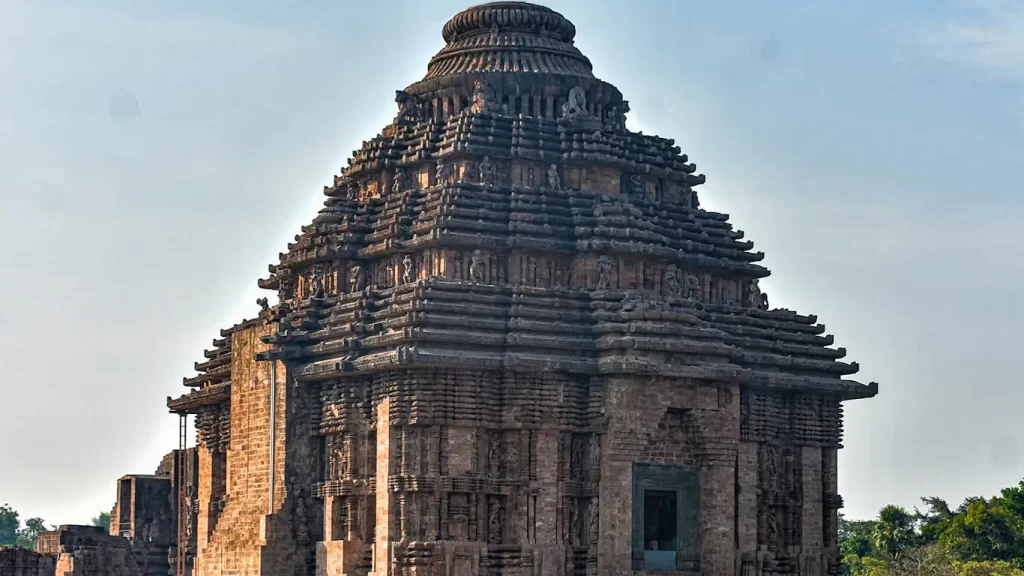
Perched along the scenic marine coastline 35 kilometers northeast of Puri stands the legendary Sun Temple of Konark, a UNESCO World Heritage Site conceived as a cosmic chariot for Surya, the Sun God.
- Architectural Grandeur: Commissioned in the 13th century by King Narasimhadeva I of the Eastern Ganga dynasty, the entire complex was designed as an enormous stone chariot pulled by seven spirited horses representing the days of the week. Its 24 intricately carved stone wheels act as sophisticated sundials capable of calculating time down to the minute based on shadow alignments. Insert a contextual link here pointing to the comprehensive analysis of Konark Sun Temple architecture and legends, where you explain the magnet legends, sundial calculation formulas, and temple restoration histories.
- The Jagamohana Preservation: The original soaring sanctum tower (Vimana) collapsed centuries ago under contested circumstances (debated between structural instability, foundational settling, and external invasions). To preserve the remaining assembly hall (Jagamohana), British engineers in 1903 filled the interior with sand and masonry. The Archaeological Survey of India (ASI) monitors this landmark and has begun controlled excavations to assess the stability of the inner core.
- Chandrabhaga Beach: Situated 3 kilometers east of the Sun Temple, this tranquil beach carries deep spiritual significance. Pilgrims assemble here during the annual Magha Saptami festival to take a pre-dawn cleansing bath in the sea to honor the rising Sun God. The beach is pristine, quiet, and ideal for photography.
- Konark Dance Festival: If visiting during the first week of December, attend this classical dance festival held against the floodlit backdrop of the Sun Temple’s open-air Natamandira (Dancing Hall).
4. Raghurajpur: The Living Heritage Craft Village
Located 14 kilometers inland from Puri on the banks of the Bhargavi River, Raghurajpur is an internationally celebrated crafts village where every household preserves ancestral artistic traditions.
- Pattachitra Paintings: The primary art form here is Pattachitra—traditional narrative paintings executed on specially prepared cloth scrolls using handmade natural mineral and plant pigments. The themes depict episodes from the Gita Govinda, the life of Krishna, and the lore of Lord Jagannath.
- Gotipua Dance: Raghurajpur is the ancestral home of Gotipua, the traditional precursor to classical Odissi dance, where young boys dress in female attire and perform intricate acrobatic temple dances.
- Artisanal Immersion: Visitors can walk directly into artisans’ open verandas to witness the creation of palm-leaf engravings (Talapatra Chitra), wooden toys, and papier-mâché masks without middleman markups.
Zone 2: Coastal Lagoons, Wetlands & Marine Wildlife
Odisha’s coastline stretches across 485 kilometers, hosting rare eco-reserves and brackish wetland ecosystems of international significance.
5. Chilika Lake: Asia’s Largest Brackish Water Lagoon
Spanning over 1,100 square kilometers across the Puri, Khordha, and Ganjam districts, Chilika is a Ramsar Wetland of International Importance. Its unique mix of marine and freshwater environments provides refuge to endangered species and hosts over a million winter migratory birds arriving from Siberia, Central Asia, and the Caspian Sea.
- Satapada (The Dolphin Zone): Located at the southern tip of the Puri district where the lake opens into the Bay of Bengal. Satapada is world-renowned for sightings of the rare, shy Irrawaddy Dolphin (Orcaella brevirostris). Authorized boat journeys take visitors to the Sea Mouth—where the lake meets the ocean—and the scenic Rajhans Island.
- Mangalajodi (The Birdwatcher’s Paradise): Situated in the northern freshwater reach of Chilika, Mangalajodi is an internationally acclaimed community-led conservation triumph. Former poachers have transitioned into expert naturalists and birding guides. Between November and February, you can glide through the narrow marsh channels on silent wooden punting boats to observe northern pintails, black-tailed godwits, purple swamphens, and bronze-winged jacanas within touching distance.
- Kalijai Island: Resting in the heart of the lagoon, this island features the sacred shrine of Goddess Kalijai, the divine guardian spirit of the lake revered by all local fishermen. The island comes alive with thousands of pilgrims during the annual Makar Sankranti festival in January.
6. Bhitarkanika National Park: The Mangrove Labyrinth
Located in the Kendrapara district, Bhitarkanika is India’s second-largest mangrove ecosystem after the Sundarbans. It is a Ramsar site crisscrossed by tidal rivers, creeks, and mudflats.
- Giant Estuarine Saltwater Crocodiles: Bhitarkanika holds the Guinness World Record for the largest recorded white and estuarine crocodiles (Crocodylus porosus), with specimens measuring beyond 20 feet. Motorized boat safaris through the Khola and Dangmal creeks offer close sightings of these apex predators sunbathing along muddy banks.
- Gahirmatha Marine Sanctuary: Neighboring the park is Gahirmatha Beach, the world’s largest known nesting rookery for endangered Olive Ridley Sea Turtles (Lepidochelys olivacea). Hundreds of thousands of female turtles swim ashore synchronously under the cover of dark winter nights for the mass-nesting phenomenon known as Arribada.
- Birding Towers: The heronry at Bagagahana serves as a nesting hub for over 80,000 resident wetland birds during the monsoon and post-monsoon breeding months.
- Visitor Logistics: Entry permits must be obtained online or at the forest checkpoints at Khola or Gupti. Night stays inside the reserve require advance booking at the government-managed ecotourism cottages at Dangmal.
Zone 3: The Buddhist Diamond Triangle & Historic Environs
Centuries before the great Vaishnava revival in eastern India, Odisha was an epicentre of Mahayana and Vajrayana (Tantric) Buddhism. The monastic triangle in Jajpur and Cuttack preserves this chapter of Indian history.
7. Ratnagiri: The Hill of Jewels
- Vajrayana Center: Flourishing between the 5th and 12th centuries CE, Ratnagiri was a preeminent center of Buddhist philosophy that rivaled Nalanda. It played an instrumental role in the development and dissemination of the Kalachakra Tantra tradition.
- The Sculpted Green Doorway: The entrance to Monastery No. 1 is arguably the most photographed Buddhist doorway in India—an intricately carved chlorite portal showing celestial attendants and geometric bands preserved in pristine relief.
- Colossal Buddha Heads: The open-air monastic courtyard holds monumental stone carvings of Lord Buddha in the Bhumisparsha mudra, surrounded by votive stupas and finely carved figures of Avalokiteshvara, Tara, and Heruka.
8. Udayagiri & Lalitgiri: Ancient Monastic Academies
- Udayagiri: The largest monastic complex in the Diamond Triangle, featuring an impressive brick stupa, extensive residential cells, and an ancient stepped well carved directly into the hillside.
- Lalitgiri: The oldest Buddhist settlement in the region, dating back to the Mauryan period (3rd century BCE). Archaeological excavations here yielded an invaluable find: a stone relic casket containing bone fragments believed by historians and devotees to be sacred relics of Gautama Buddha or his chief disciples. The excavated treasures are displayed in an on-site museum run by the Archaeological Survey of India (ASI).
9. Cuttack: The Millennium Silver City
Situated at the apex of the Mahanadi and Kathajodi river deltas, Cuttack served as Odisha’s historical capital for over a millennium before administrative authority shifted to Bhubaneswar in 1948.
- Barabati Fort: The stone ruins of this 14th-century fortress, built under the Ganga dynasty, stand on the banks of the Mahanadi. While much of the inner citadel was dismantled historically, the monumental 9-story arched gate and the wide defensive moat remain standing.
- Tarakasi (Silver Filigree): Cuttack is internationally famed for its heritage craft of Tarakasi, where master craftsmen draw fine strands of purified silver wire into jewelry, ornamental boxes, and intricate temple miniatures.
- Cuttack Chandi Temple: Dedicated to the city’s patron deity, Maa Chandi, this active temple hub draws thousands of devotees during the annual Durga Puja and Kali Puja festivities.
- Culinary Pilgrimage: Cuttack is the undisputed birthplace of Dahibara Alookdum—soft lentil vadas soaked in spiced yogurt, smothered with thick spicy potato curry (Alookdum) and yellow peas (Ghuguni), topped with fresh coriander and grated coconut.
Zone 4: Western & Southern Spiritual Sanctuaries & Hill Country
Traveling away from the coastal plains leads into the highland landscapes of western and southern Odisha, home to powerful Tantric devi shrines, engineering marvels, and biodiverse forests.
10. Sambalpur & The Hirakud Dam
Sambalpur is the cultural capital of western Odisha, recognized for its Sambalpuri textiles and folk music traditions.
- Maa Samaleswari Temple: Built in the 16th century along the banks of the Mahanadi River, this temple is dedicated to Goddess Samaleswari, the fierce mother deity presiding over the Sambalpuri region. The newly constructed Samalei Heritage Corridor provides wide, polished stone walkways and organized darshan facilities for visiting pilgrims.
- Hirakud Dam: Stretches across the Mahanadi River just 15 kilometers north of Sambalpur. Measuring over 25 kilometers (including its earthen dykes), it is one of the world’s longest composite masonry and earthen dams. The view from the Gandhi Minar watchtower encompasses a vast, shimmering inland freshwater sea.
- Huma’s Leaning Temple: Located 23 kilometers downstream from Sambalpur stands the 17th-century shrine of Lord Bimaleswar (Shiva). The entire structure leans visibly at an angle of roughly 13 degrees, while its inner sanctum floor remains completely horizontal. The adjacent river ghat is home to the sacred Kudo fish, which swim to the water’s edge to be hand-fed grain by visiting devotees.
11. Maa Taratarini Temple (Purushottampur, Ganjam)
Perched on the summit of the holy Taratarini Hill (Purnagiri) alongside the Rushikulya River, this sacred shrine is worshipped as the Stana Peetha (Breast Shrine) of Adi Shakti, placing it among India’s most important Tantric pilgrimage centers.
- The Twin Goddesses: The sanctum features two ancient stone idols representing the divine sisters Tara and Tarini, decorated with silver masks and traditional red silk robes.
- Ascent Options: Devotees can ascend to the hill shrine using a well-maintained modern ropeway (cable car) system, via a motorable ghat road, or by climbing 999 stone steps up the forested hillside.
- Chaitra Jatra: The temple serves as the epicenter of southern Odisha’s spiritual gatherings during the Tuesdays of the Hindu month of Chaitra (March/April), when hundreds of thousands of families gather for ritual tonsuring (head-shaving offerings) and child blessing ceremonies.
12. Simlipal National Park & Tiger Reserve
Located in the northern Mayurbhanj district, Simlipal is a designated UNESCO Biosphere Reserve covering over 2,750 square kilometers of dense Sal forests, plateaus, and meadows.
- Flora & Fauna: Simlipal is home to royal Bengal tigers, wild Asian elephants, Indian bisons (gaur), and rare melanistic (black) tigers found naturally in this region.
- Monumental Waterfalls: The park hosts two of eastern India’s most scenic waterfalls: Barehipani Falls (a two-tiered cascade dropping from a height of 399 meters) and Joranda Falls (a straight 150-meter plunge).
- Seasonal Access: The reserve remains strictly closed to tourists during the summer monsoon months (typically from mid-June to late October) due to washed-out river crossings. It reopens for controlled eco-tours in November.
13. Daringbadi: The “Kashmir of Odisha”
Nestled at an elevation of 3,000 feet in the tribal Kandhamal district, Daringbadi is Odisha’s sole hill station.
- Climate & Landscape: Surrounded by pine forests, coffee plantations, black pepper gardens, and cascading mountain streams, Daringbadi enjoys cool daytime weather throughout the year. On winter nights (December to January), temperatures can dip near freezing, occasionally producing thin morning ground frost.
- Key Stops: The Hill View Park, the Pine Forest Valley, Midubanda Waterfall, and the Belghar Nature Reserve (home to the indigenous Kutia Kondh tribal community).
Curated Odisha Itineraries for Every Traveler
To help you design a realistic travel plan, here are two field-tested itineraries adapted to different schedules:
Essential Practical Advice for Odisha Visitors
- Temple Dress Codes & Footwear Rules: Conservative dress is strictly mandated across all operational shrines in Odisha. Men should wear traditional dhotis, cotton trousers, or kurtas; women should wear sarees or salwar kameez. Avoid shorts, sleeveless tops, and western clubwear. Leather items (belts, wallets, camera cases) are strictly forbidden in most sanctums; deposit them in the designated footwear counters (Juta Stand) outside.
- Photography Bans: Photography and mobile phones are strictly prohibited within the courtyards of major working temples, including Puri Jagannath and Lingaraj. Secure lockers are available at the entrance gates. Non-compliance can result in heavy police fines.
- Panda (Temple Priest) Etiquette: Around popular pilgrimage centers like Puri and Lingaraj, freelance temple guides and pandas may approach visitors offering expedited darshan or personal rituals for donations. Always clarify service charges beforehand, or book guided services directly through the official temple counter or the OTDC tourism office.
- Best Seasonal Window: The best travel window spans from October through March, when daytime temperatures range between 20°C and 28°C and humidity is minimal. The summer months (April through June) can be intensely hot and humid, with temperatures exceeding 42°C.
- Traditional Cuisine to Sample: Do not depart Odisha without sampling authentic local dishes:
- Temple Mahaprasad: Steamed aromatic rice, sweet kanika, dalma (lentils cooked with raw papaya, pumpkin, and roasted cumin), and pot-baked kheer.
- Chhena Poda: Odisha’s signature baked dessert made by slowly caramelizing fresh cottage cheese, sugar, cardamom, and ghee wrapped in sal leaves overnight.
- Pahala Rasagola: Unlike the spongy white Bengali variant, the authentic Rasagola of Pahala (along the Bhubaneswar-Cuttack highway) is light brown, soft, and melts immediately in warm, cardamom-infused syrup.
Frequently Asked Questions
Which month is best to visit Odisha?
The ideal time to visit Odisha is between October and March. During these months, the weather is pleasant, daytime humidity along the coast drops, migratory birds congregate at Chilika Lake, and festivals like the Konark Dance Festival (December) take place.
How many days are needed to explore Odisha?
A 4-day trip is sufficient to cover the core Golden Triangle (Bhubaneswar, Puri, and Konark). If you wish to add Chilika Lake, the Buddhist Diamond Triangle, and a wildlife reserve like Bhitarkanika or Simlipal, a 7 to 9-day itinerary is recommended.
Are non-Hindus allowed inside the Jagannath Temple in Puri?
No. In accordance with age-old temple customs, only traditional Hindus are permitted inside the inner compound of the Sri Jagannath Temple. International travelers and non-Hindu visitors can view the temple complex, its spire, and ceremonies from the rooftop of the nearby Raghunandan Library or see the deities during the annual outdoor Rath Yatra.
What is the most famous handicraft to buy in Odisha?
The most renowned handicrafts are Pattachitra cloth scroll paintings and palm-leaf engravings from Raghurajpur, Tarakasi (silver filigree) jewelry from Cuttack, Pipili appliqué lanterns, and handwoven Sambalpuri and Kotpad silk and cotton sarees.
Is Chilika Lake worth visiting for a day trip?
Yes. Chilika Lake can easily be visited as a half-day or full-day excursion from Puri or Bhubaneswar. If you wish to observe the rare Irrawaddy dolphins, visit the Satapada sector. For world-class winter birdwatching in shallow freshwater marshes, plan an early-morning boat tour at Mangalajodi.