Karni Mata Temple Udaipur
The Karni Mata Temple Udaipur is tastefully located on top of the Machla Magra Hills close to the peaceful Doodh Talai Lake in Udaipur, Rajasthan, India. It’s a site where history, piety, and a stunning panoramic view of Udaipur blend harmoniously. The temple is a sacred shrine devoted to Karni Mata, a powerful Hindu warrior sage, believed by many as an avatar of the great Goddess Durga.
Contents
- 1 Introduction to the Divine Karni Mata Temple Udaipur
- 2 History of the Karni Mata Temple Udaipur
- 3 Cultural, Spiritual, and Mythological Significance
- 4 Special Poojas and Daily Rituals
- 5 Distinct Architectural Styles and Ornaments
- 6 Myths and Beliefs at Karni Mata Temple Udaipur
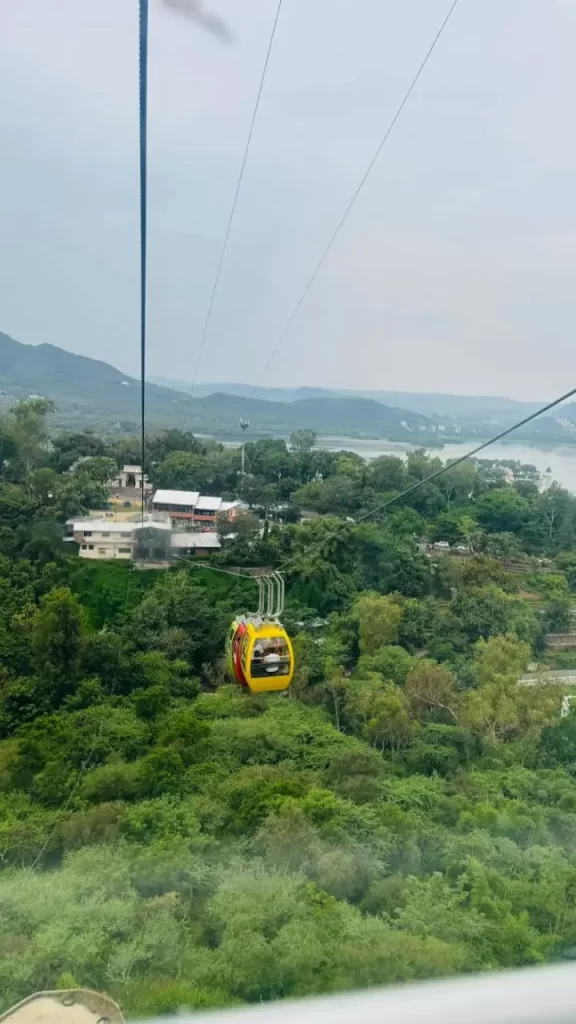
- 7 Temple Timing, Ropeway, and Accommodation
- 8 Sites to See Around the Temple
- 8.0.1 Shri Jogadya Shaktipeeth, Kshirgram, West Bengal
- 8.0.2 Vibhash Shakti Peeth | Kapalini (Bhimarupa) Shaktipeeth
- 8.0.3 Ujani Shaktipeeth Shri Mangal Chandi Temple
- 8.0.4 Nandikeshwari Temple | Nandipur Shakti Peeth, Sainthia
- 8.0.5 Shree Trishrota Maa Bhramoree Debir Shaktipeeth Temple
- 8.0.6 Anandamayee Shakti Peeth Temple
- 9 Popular Questions regarding Karni Mata Temple Udaipur
- 10 How to Get to the Temple (The Journey is the Destination!)
Introduction to the Divine Karni Mata Temple Udaipur
The instant you say the words Karni Mata Temple Udaipur, most people instinctively remind themselves of the renowned “Rat Temple” of Deshnoke, Bikaner. It helps to note that both temples share a common deity, but the temple at Udaipur, which goes by the name the Shri Manshapurna Karni Mata Temple, provides a very different, yet no less fascinating, experience.
The most notable thing here isn’t the sheer amount of kabbas (the holy rats, although they are there and worshipped in a cage), but the unbelievable, wish-granting ambiance and the stunning view it has to offer. Manshapurna directly means “wish-granting,” proof of the strong belief that the Goddess here fulfills the genuine wish of her followers.
As a working guide, I always request that tourists consider the trekking to the temple as a part of their pilgrimage experience. Whether you take the beautiful ropeway ride or the religious walk up the stairs, the climb is meant to awaken your mind and heart for the divine blessings that await you at the top. The peace here, detached from the city’s chaos, makes it a real spiritual retreat.
History of the Karni Mata Temple Udaipur
To truly appreciate this temple, we must travel back in time to the 17th century.
The Construction by Maharana Karan Singh
The history of the Karni Mata Temple Udaipur also relates to the Mewar royal dynasty. The original small temple was built by Maharana Karan Singh I, a dominant ruler of the Sisodia Rajput clan. He ruled the state between 1620 and 1628 CE.
The temple was initiated around the time when he was building the residential complex of Machla Magra. The strategic position on the hill was not a coincidence. It was constructed to invoke the divine protection of Karni Mata, who was and still is the kuldevi (family god) of several Rajput clans, such as the Rathores of Bikaner and Jodhpur. The Maharana wished a divine shield for the new city expansion. It’s an exemplary case of Rajput kings anchoring their domains with the grace of a strong deity.
Renovation and Modern Accessibility
Throughout the centuries, the original building was modified many times. Nevertheless, an important page in its history is its renovation and restoration by the temple committee during the late 1990s. The activity brought the shrine back to life.
Recently, the addition of Manshapurna Karni Mata Ropeway has made it even easier for everyone to access the temple regardless of age or physical capability. The new convenience has increased exponentially the people going to the Karni Mata Temple Udaipur for pilgrimage and for tourism, making it possible for all people to see the spiritual energy and the breathtaking view.
Legend of the Temple and the Goddess
The Goddess Karni Mata is a legendary figure. She was born Riddhi Bai in the 14th century in Suwap village of the Jodhpur district and is commonly worshiped as an avatar of Goddess Durga or Hinglaj Mata. Her existence was characterized by getting miracles done (Karni actually means ‘miraculous’).
Read More>> Tulja Bhavani Temple Tuljapur
The Rat Legend: Kabaas
This is the most well-known tale linked with her, although it is mainly related to the Deshnoke temple, it is the basis of the religion and is highly revered in Udaipur as well.
It is said that Lakshman, the son of her sister and brother-in-law, drowned in the Kapil Sarovar at Kolayat. Desperate, Karni Mata, who had divine powers, dared Yama, the God of Death. Yama at first refused to bring the boy back to life on the grounds that the cycle of birth must continue.
But Karni Mata, being an embodiment of a mighty Goddess, would not accept this. She ordained that her male Charans (her descendants and followers) would never again meet judgment by Yama. Rather, their souls, at death, would reside for a while in the form of a kabba (rat) and stay in her divine presence in the temple. With the rat’s death, they would be reborn as members of the Charan clan again.
It is a vow of everlasting spiritual protection close to the divine, a special notion that makes this religion so remarkable. In the Karni Mata Temple Udaipur, although the kabbas are safeguarded in a cage and worshiped, the central theme is the Manshapurna (wish-fulfilling) nature of the Goddess. The sighting of a white rat, who is said to be the Goddess herself or one of her sons, is believed to be an omen of huge good fortune here as well.
Karni Mata as a Guardian and State Goddess
Karni Mata was a historical figure who lived an ascetic existence for more than 150 years. She was not only a sage but also a political and religious counselor who swayed the founding and safety of prominent Rajput states. She founded foundation stones of Mehrangarh Fort in Jodhpur and Junagarh Fort in Bikaner. Her position as a guardian of the people and state is why the Maharana of Udaipur constructed this temple in order to protect his city.
Cultural, Spiritual, and Mythological Significance
Karni Mata Temple Udaipur occupies a place of extreme significance in the religious culture of Rajasthan.
Spiritual Significance: The Wish-Fulfilling Goddess
The temple is commonly referred to as Shri Manshapurna Karni Mata Temple—a befitting signature of its spiritual appeal. Followers go with pure intentions and are convinced that Karni Mata, being the personification of Shakti (feminine divine power), bestows their pure desires, if they are of general welfare. It is a spiritual obligation for many of the locals to go there early in the morning, being convinced that their desires come quicker.
Cultural Significance: Rajput Heritage
To the Charan and Rajput people, Karni Mata is not only a goddess but the originator of their identity, an icon of triumph, strength, and non-violence. The temple at Udaipur is a powerful cultural connection with their rich past and spiritual wisdom that formed their kingdoms. The structure, the age-old aarti, and the rituals observed are an indication of the rich Rajasthani heritage.
Mythological Association: Incarnation of Durga
In mythological terms, Karni Mata is revered as an incarnation of Goddess Durga (or Awad Mata, an older Sagat of Hinglaj). This association brings her to the broader Hindu mythology, particularly the aspect of Shakti, the original cosmic energy. Her significance is amplified countless times during the festival of Navratri.
Special Days and Festivals
If you wish to feel the real devotional vibe of the Karni Mata Temple Udaipur, you will have to schedule your visit during the main festivals.
Read More>> Yamai Devi Temple Aundh: Mystery of the Black Stone Goddess
The two seasonal Navratri festivities—Shardiya Navratri (in September/October) and Chaitra Navratri (in March/April)—are the busiest and holiest days. Karni Mata, being an avatar of Durga, is revered with utmost passion for nine days.
Crowded Days: The principal days of Navratri, especially the Ashtami (eight) and Navami (ninth) days, experience a huge volume of pilgrims.
Rituals: Aartis are specially conducted several times a day, with local folk songs and devotional music. Chunaris (holy red cloth) and prasad (offering sweets) are given by devotees. Fasting is prevalent, and the atmosphere brims with spiritual force.
Other Important Days
Purnima (Full Moon Day): The days are usually auspicious for a visit and experience a larger footfall than ordinary days.
Fridays: Since the day devoted to Goddesses in the Hindu calendar, Fridays also receive more local devotees.
Read More>> Sree Suvarna Temple Powai
Special Poojas and Daily Rituals
Though the Udaipur temple emphasizes the Manshapurna aspect, the daily rituals are undertaken with utmost devotion.
Mangla Aarti: Conducted in the early morning (about 4:30 AM), this is a lovely ceremony to see as day breaks.
Rajbhog Aarti: The midday offering.
Sandhya Aarti (Evening Aarti): Usually conducted at sunset, this is the favorite timing for tourists, as it couples the worship with a stunning view of the sun setting behind Udaipur’s lakes.
Providing Kabaas: The believers come bearing offerings in the form of milk, grains, and sweets, which are then left for the divine rats (kabbas) at the specific place. This is a method of asking for the blessings of Charan souls who have left their mortal coils.
Distinct Architectural Styles and Ornaments
The Karni Mata Temple Udaipur architecture is a less elaborate, yet peaceful, version of the magnificent temple in Deshnoke, combining Rajasthani and Rajput traditional styles.
The Temple Structure
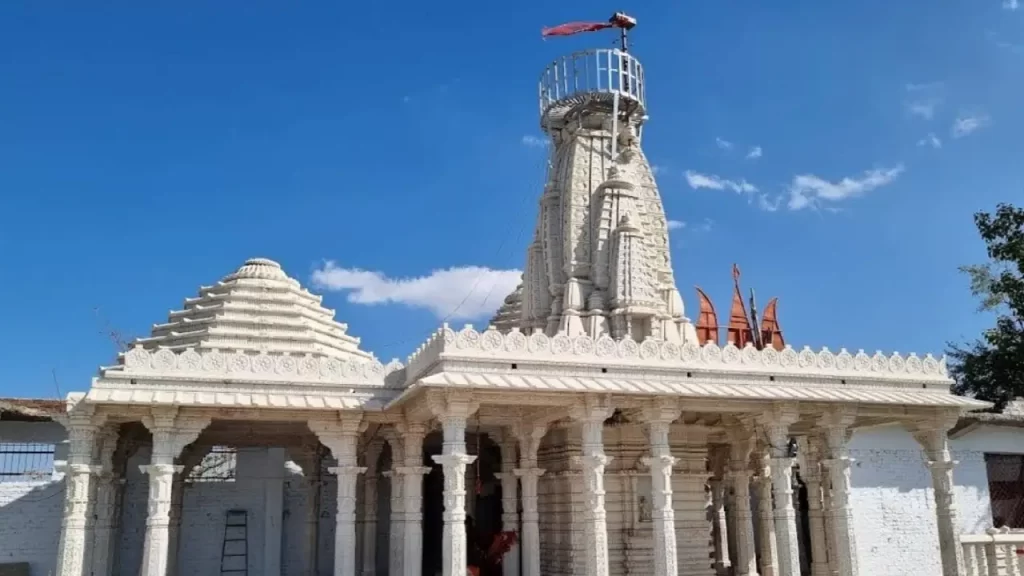
The temple is constructed mostly of white marble, which makes it look serene and pure, standing beautifully against the blue lakes and green hills around it.
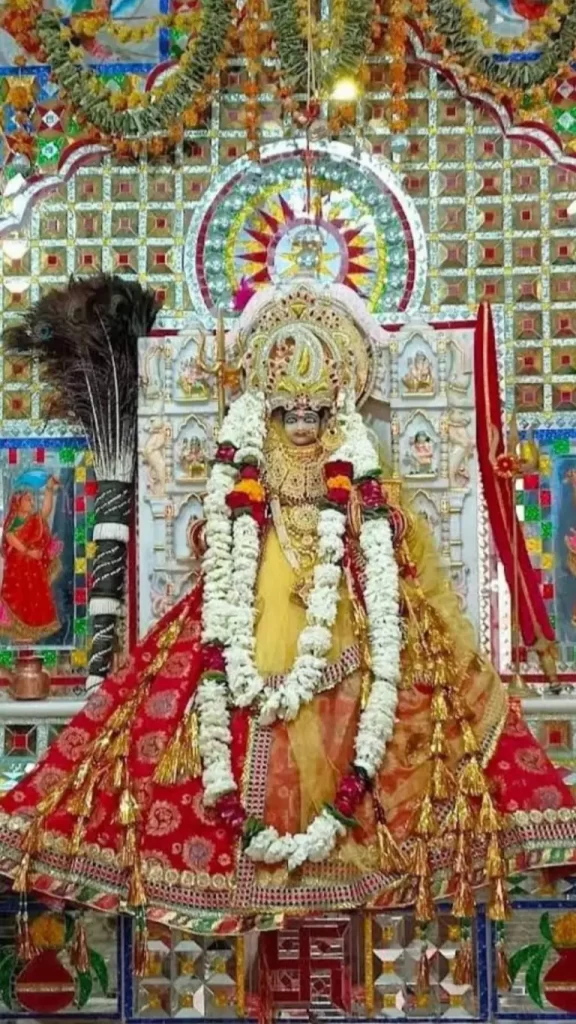
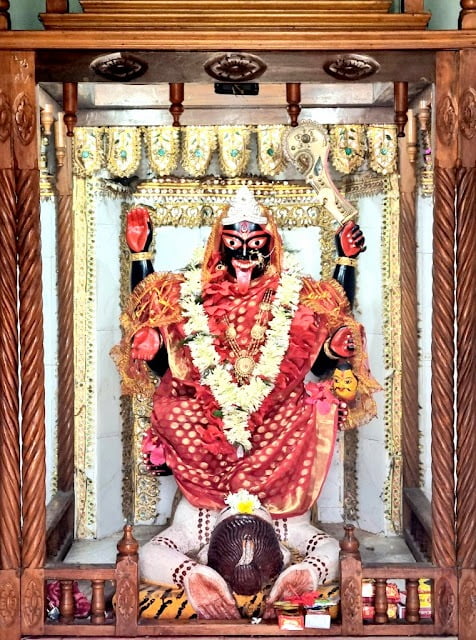
Main Sanctum (Garbhagriha): This contains the main idol of Karni Mata. The idol is white stone sculpture of the goddess, usually splendidly dressed in rich attire, jewellery, and mor pankh (peacock feathers), which hold special significance in the local culture.
Delicate Carvings: While not as highly ornate as some of the other temples, there are finely carved white pillars within the temple, reflecting the Rajput craftsmanship of the period. Examine the door frames and niches carefully for intricate details.
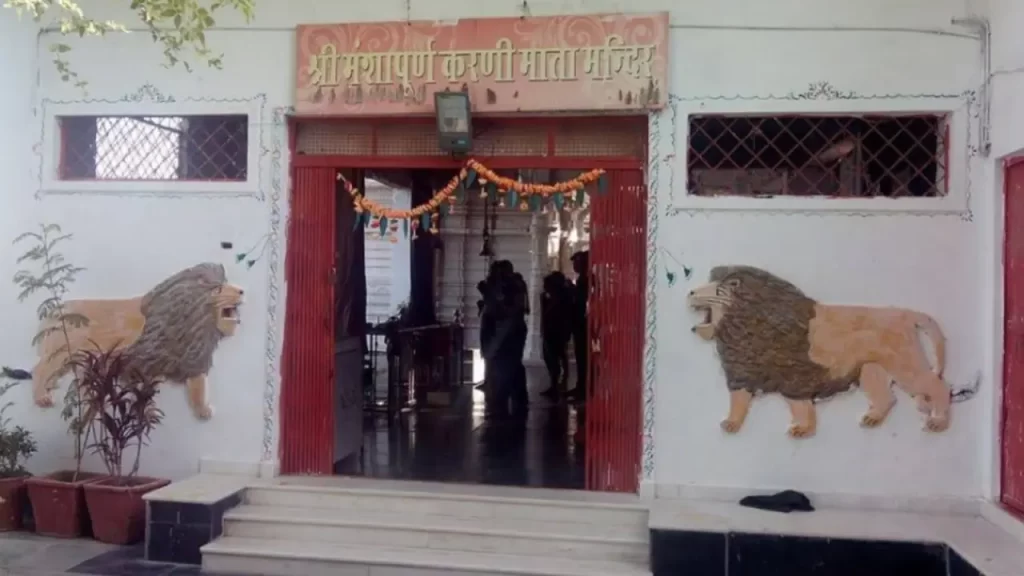
The Shiva Linga: A few steps outside the main door is the sacred Shiva Linga, guarded by paintings or carvings of lions representing the divine masculine (Shiva) protected by the divine feminine (Shakti/Karni Mata).
Rooftop: The rooftop of the temple provides a distinct view. It is here that one realizes the strategic location of the temple, which is meant to guard the whole city of Udaipur, providing arguably the finest panoramic view in the area.
Read More>> Hidden Power of Haridwar Mansa Devi Temple: #1 Wish Granted!
Myths and Beliefs at Karni Mata Temple Udaipur
The beliefs about Karni Mata are strong and personal and serve to create the special ambiance of the temple.
The Power of Darshan
Most of the locals believe that going to the Karni Mata Temple Udaipur twice daily will make the Goddess grant your wishes soon and bless you with good fortune and good health. Such strong belief contributes to the temple being a bustling place every day.
The Sacred Kabbas
Whereas the Deshnoke temple is well known for its thousand of rats, any appearance of the kabbas within Udaipur, even in a limited space, is a vivid reminder of the central myth.
Good Fortune: When a rat crosses your feet, it’s a very auspicious omen, a direct touch by an blessed soul.
The White Rat: Sighting the white rat is the ultimate blessing and is thought to be Karni Mata or her sons in manifestation. This makes the visit even more thrilling, spiritual questing.
Tying the Chunari: As you climb up the path or along the temple railing, you’ll notice innumerable chunaris (red or colored sacred cloths) knotted by pilgrims. Each knot signifies a sincere wish or a prayer for a family member’s happiness. This colorful visual spectacle is an aggregate affirmation of the “Manshapurna” power of the Goddess.
Temple Timing, Ropeway, and Accommodation
To make your visit to the Karni Mata Temple Udaipur seamless, here are the essential details:
Karni Mata Temple Timings:
The temple is typically open all year round, but do remember that timings can sometimes vary slightly, especially during major festivals like Navratri.
Activity Typical Timings
Morning Darshan 4:00 AM – 10:00 AM
Evening Darshan 5:00 PM – 9:00 PM
Aarti Early Morning (approx. 5:30 AM) and Evening (approx. 7:00 PM)
Best time to go there is definitely during sunset. The spot where the temple stands provides a fairy-tale feel as the setting sun goes below the Aravalli hills while the lights of the City Palace start twinkling.
Read More>> Chelamattom Sreekrishna Swami Temple: Powerful Temple for Ancestors
Accommodation Facilities around Karni Mata Temple Udaipur
As the temple is located in the heart of the city, the whole city of Udaipur becomes your accommodation hub. You can get every budget option:
Luxury/Heritage: The hotels along Lake Pichola (such as those with a view of the lake) are within a short auto-rickshaw journey.
Mid-Range/Boutique: There are many cozy guesthouses and hotels in the regions surrounding Doodh Talai, City Palace, and Jagdish Temple.
Budget: Several hostels and low-cost accommodations are located in Hanuman Ghat and Lal Ghat.
The fact that the temple is located in the middle of the city makes it easily accessible for all traveler types.
Read More>> Basara Gnana Saraswati Temple
Sites to See Around the Temple
Your trip to the Karni Mata Temple Udaipur places you in the middle of Udaipur’s most significant spiritual and travel destinations.
Jagdish Temple: This is a short distance away from Doodh Talai, the largest and most renowned temple of Udaipur, constructed in the Indo-Aryan style, and dedicated to Lord Vishnu. A must-see because of its beautiful carvings.
City Palace, Udaipur: The grand palace complex, overlooking Lake Pichola, is a world-renowned architectural and historical wonder.
Lake Pichola and Jag Mandir: Following blessings from the Goddess, take a boat ride on Lake Pichola to experience the legendary views of the Lake Palace and the island palace Jag Mandir.
Doodh Talai Lake: Set at the foot of the Machla Magra Hill itself, this smaller, picturesqie lake and garden area makes for a lovely place to take an evening walk.

Popular Questions regarding Karni Mata Temple Udaipur
As a guide, I hear familiar questions from tourists often. Here are the most popular ones:
Is Karni Mata Temple in Udaipur the “Rat Temple”?
No, not really. The renowned Rat Temple is the original Karni Mata Temple at Deshnoke near Bikaner. The Karni Mata Temple Udaipur is more commonly referred to as the Shri Manshapurna Karni Mata Temple (Wish-Fulfilling Temple) due to its stunning vistas and its placement in the middle of the city. Though the kabbas (holy rats) do exist and are worshiped, their numbers are not in the thousands as they are in Deshnoke.
Is there a reference to Karni Mata in Hindu Scriptures or Puranas?
Although Karni Mata herself, being a figure of the 14th-16th centuries, does not find direct mention in the ancient Vedas or Puranas (which were written thousands of years prior to her), she is worshiped as an avatar or incarnation of a larger goddess, i.e., Hinglaj Mata or Goddess Durga, who are famous figures in the Puranas and several Hindu scriptures. The faith views her as a Sagat—an embodied form of the divine feminine Shakti—a concept that is absolutely central to Hindu mythology. Her divine status is therefore through her manifestation as an aspect of the primordial Mother Goddess.
What is the best time to visit the temple?
Evening is the most sought after time. Not only do you get to see the stunning sunset over City Palace and Lake Pichola, but you also get to enjoy the stunning Sandhya Aarti (Evening Prayer). The climate is also popular in October to March.
Which is the busiest day?
The busiest period is the nine days of Navratri (both September/October and March/April). Besides festival periods, weekends (particularly Sunday night) and Purnima days have more visitors.
Why is this place extremely significant?
The Karni Mata Temple Udaipur is significant for three reasons:
Spiritual Significance: It is considered Manshapurna—the wish-fulfilling temple, attracting millions of followers who come seeking blessings.
Historical Significance: It links Udaipur directly to the royal heritage of the Rajputs, constructed for the protection of the city by Maharana Karan Singh.
Scenic Beauty: It presents the most breathtaking and panoramic view of Udaipur, the City of Lakes.
How to Get to the Temple (The Journey is the Destination!)
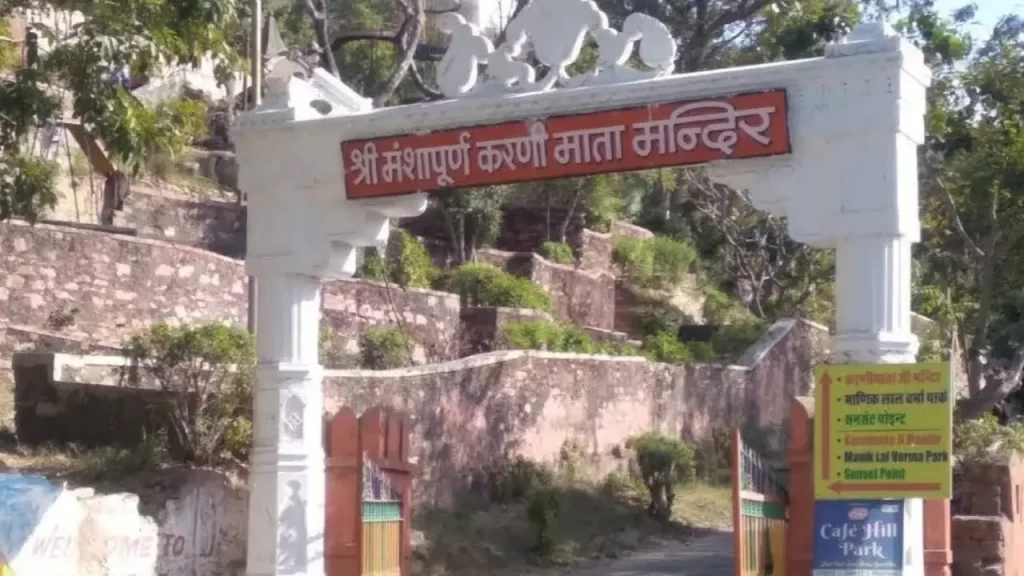
The temple sits atop the Machla Magra Hills close to Doodh Talai.
By Ropeway: The most scenic and favorite choice. The Mansapurna Karni Mata Ropeway is between Deendayal Upadhyay Park (near Doodh Talai) and the hilltop of the temple.
Ropeway Timings: Typically 9:00 AM to 9:00 PM.
The trip is a stunning, brief ride with panoramic views of Lake Pichola, City Palace, and Sajjangarh Fort.
By Foot: For the more adventurous pilgrim or the fitness buff, there are flight of stairs well maintained leading to the temple from the Doodh Talai grounds. It’s a satisfying 15-20 minute walk.