Arulmigu Subramanya Swamy Temple, Tiruttani: Complete Pilgrim Guide
Arulmigu Subramanya Swamy Temple in Tiruttani is one of the most revered hill shrines in South India, celebrated as the Fifth Arupadai Veedu (the six sacred battle-camp abodes of Lord Murugan). Perched on the peaceful hill of Thanigaimalai in Tamil Nadu’s Tiruvallur district, this ancient Tiruttani Murugan temple marks the sacred spot where Lord Murugan retreated to cool his righteous anger after defeating the demon king Surapadman, and where he later wedded the forest maiden Goddess Valli.
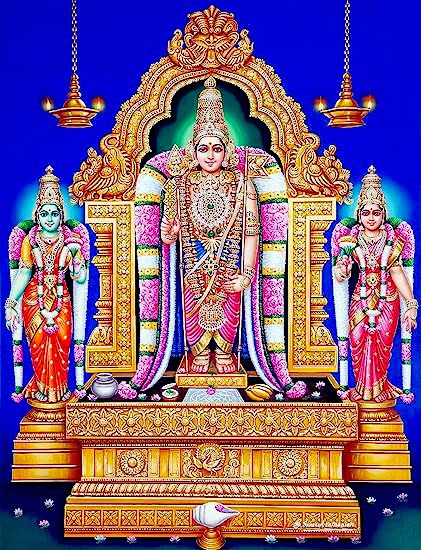
Devotees climb 365 stone steps—each representing a day of the solar year—or take a motorable winding ghat road to reach the summit. Whether you are planning your first trip from Chennai, embarking on a complete tour of the Arupadai Veedu, or accompanying elderly relatives, this practical guide provides everything you need: daily darshan schedules, step climbs versus ghat road access, sacred rituals, historical context, and transit routes.
Quick Information: Tiruttani Subramanya Swamy Temple
| Feature | Details |
| Temple Name | Arulmigu Subramanya Swamy Temple (Thiruthani Murugan Temple) |
| Main Deity | Lord Murugan (worshipped as Tanikesan / Subramanya Swamy) |
| Consorts Present | Goddess Valli and Goddess Deivanai (enshrined in separate sanctums) |
| Location | Tiruttani town, Tiruvallur District, Tamil Nadu, India |
| Hill Name | Thanigaimalai (also called Shanthamalai or Santhana Parvatham) |
| Temple Type | Hill Temple (Kundu Kovil) / Fifth Arupadai Veedu |
| Steps to Climb | 365 steps (symbolizing 365 days of the year) |
| Alternative Access | Motorable Ghat Road directly to hill summit; lift/elevator available |
| General Darshan Timings | 5:45 AM to 9:00 PM (open continuously on most days; afternoon breaks may occur during select festivals) |
| Prominent Festivals | Aadi Krithigai (July/August), Padi Utsavam (December 31 / January 1), Panguni Uthiram |
| Nearest Railway Station | Tiruttani Railway Station (AJJ-RU suburban line) – 2.5 km from the base |
| Nearest Major Airport | Chennai International Airport (MAA) – approx. 85 km |
| Administrative Authority | HR&CE Department, Government of Tamil Nadu |

Spiritual Significance: The Fifth Arupadai Veedu
In the sacred geography of Tamil Shaivism and Kaumaram traditions, the Six Abodes of Lord Murugan (Arupadai Veedu) represent milestones in the deity’s cosmic actions. Unlike Thiruchendur, where Lord Murugan wages intense war against evil forces, Tiruttani represents divine tranquility, peace, and spiritual grace.
The name Thiruthani comes from Thiru-Thaniyai, meaning “sacred place of cooling down” or “resting place.” Classical texts like the Thirumurugatrupadai (written by the Sangam poet Nakkirar) and the Kanda Puranam describe this hill as the haven where the Lord calmed his fiery battle energy after destroying Surapadman at Tiruchendur. In this sanctum, Lord Murugan bestows Shantha Swaroopam—a gentle, peaceful countenance that dispels inner anxiety and worldly turmoil.
Tiruttani is also the sacred setting of Valli Kalyanam. According to tradition, Lord Murugan came to the surrounding Valli Malai hills, tested the devotion of the tribal princess Valli through playful pastimes, won her heart with the assistance of his brother Lord Ganesha (worshipped here as Gajamukha Vinayagar), and united with her in holy matrimony. Consequently, the temple blesses unmarried individuals seeking life partners and couples praying for familial harmony.
Continue Reading >> Six Abodes of Lord Murugan (Arupadai Veedu)

Architectural Layout and Sanctum Highlights
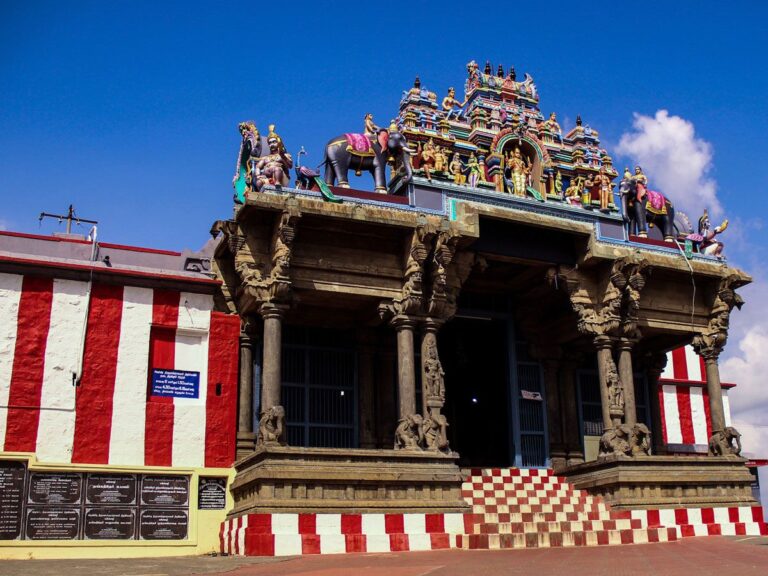
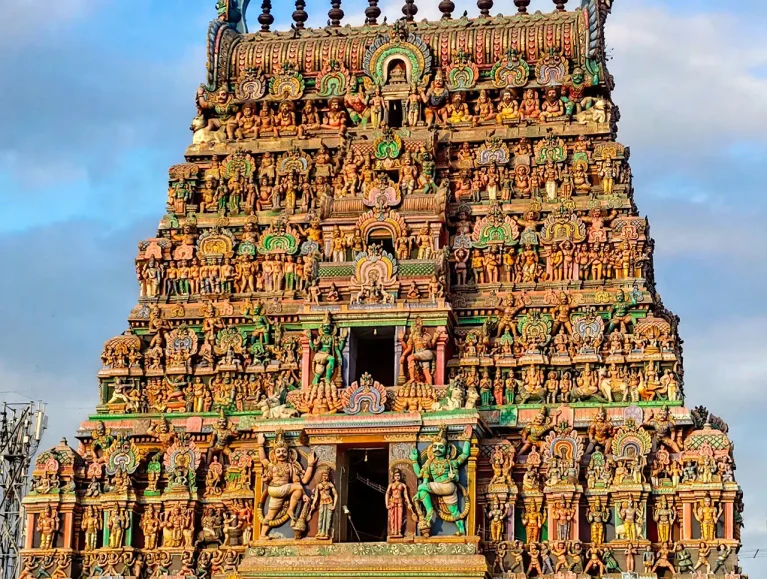
The temple rests upon a gentle hill rising approximately 700 feet above sea level. It features traditional Dravidian temple architecture characterized by towering Rajagopurams, pillared mandapams, and stone-carved friezes depicting scenes from the Kanda Puranam.
The Moolavar (Presiding Sanctum)
Inside the Garbhagriha (innermost sanctum), Lord Subramanya stands in an imposing, benevolent posture. A unique iconographical feature distinguishes this idol: the Lord does not hold his customary spear (Vel) in his hand. Instead, his right hand holds a divine weapon called the Vajra Hastam, while his left rests upon his hip (Kati Hastham).
On the chest of the moolavar, one can observe a faint, hollow depression. Temple priests explain that this marks the impact site where the demon king Tarakasuran threw his weapon during the cosmic war, demonstrating how the Lord bore the strike to protect his devotees.
Separate Shrines for Valli and Deivanai
Unlike many temples where consorts stand side-by-side on the same pedestal as the moolavar, at Tiruttani, Goddess Valli and Goddess Deivanai have individual sanctums:
- Goddess Deivanai: Represents Kriya Shakthi (the energy of action), seated in an adjoining shrine following her formal celestial marriage.
- Goddess Valli: Represents Iccha Shakthi (the energy of pure, loving devotion), resting in her own dedicated shrine.
The Elephant Vahana Facing East
Turn your attention toward the stone flagstaff (Dhwajasthambam) and the vahana pedestal. In front of the primary shrine, Lord Murugan’s mount is not his customary peacock, but an elephant known as Airavatam. Uniquely, the elephant faces toward the East, looking away from the main sanctum rather than facing inward.
According to temple tradition, Lord Indra gifted his divine white elephant Airavatam to Murugan as a wedding present upon his marriage to Deivanai. Indra requested that the elephant face eastward toward his celestial realm (Amaravati) so that divine prosperity would flow uninterrupted into the heavens.

The 365 Steps vs. The Ghat Road: Planning Your Ascent
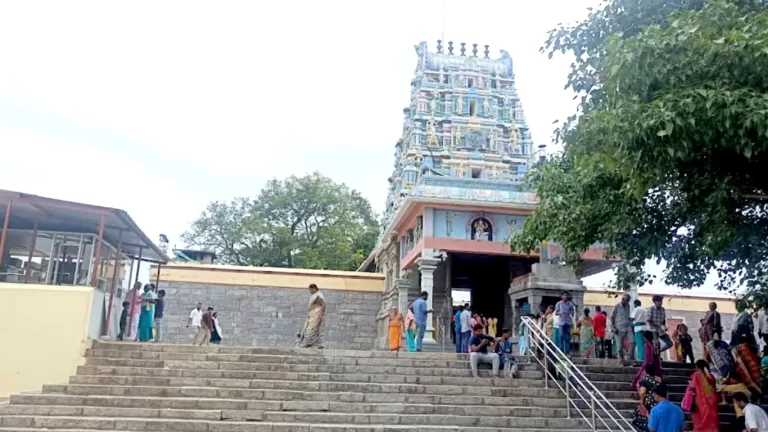
Pilgrims have two distinct routes to reach the hilltop sanctum: the historic footstep path or the motorable ghat road.
Climbing the 365 Sacred Steps (Padi Pathai)
For physically able pilgrims and vow-keepers, walking the stairs is a deeply spiritual experience. The stairway features exactly 365 stone steps, with each step symbolizing one day of the year. Devotees offer prayers step-by-step, traditionally lighting a pinch of camphor on each slab to surrender every single day of the year to the Lord’s grace.
- Climbing Duration: Between 20 to 45 minutes, depending on your physical stamina.
- Shelter & Gradients: The path is paved with granite slabs and partially covered by overhead roofs to protect walkers from the midday sun. Handrails are available along steeper stretches.
- Spiritual Exercise: Devotees carrying Kavadi or brass milk pots (Paal Kudam) invariably choose this sacred footstep route.
Driving Up via the Ghat Road
If you are travelling with senior citizens, young children, or individuals with mobility restrictions, you do not need to climb the steps.
- A well-maintained, two-lane motorable ghat road winds up the hill directly to the summit.
- Vehicle Toll & Parking: Private cars, taxis, and auto-rickshaws can drive up to the designated parking lot near the northern gopuram entrance after paying a nominal municipal/temple toll at the base check-post.
- Elevator / Lift Facility: The temple administration runs an elevator system connecting the lower vehicle drop-off zone with the inner courtyard, eliminating the need to navigate uneven temple terrain.
Thiruthani Murugan Temple Timings and Pooja Schedules
The temple opens early in the morning and operates throughout the day. While general darshan remains open continuously, minor pauses occur during the formal changing of vastrams and deepa aartis.
Devotees wishing to book special entry tokens or check official holiday announcements can review the Tamil Nadu HR&CE official portal.
Regular Daily Timings
- Temple Gates Open: 5:45 AM
- Morning Abhishekam (Kala Sandhi): 6:00 AM – 7:30 AM
- Uchikala Pooja (Midday Ritual): 12:00 PM – 12:30 PM
- Sayaratchai (Evening Aarti): 5:30 PM – 6:30 PM
- Arthajama Pooja (Night Closure Ritual): 8:30 PM – 9:00 PM
- Temple Gates Close: 9:00 PM
(Note: During major festival days such as Aadi Krithigai or Sashti, the temple opens as early as 3:30 AM and remains accessible late into the night.)
Darshan Queues and Entry Options
- Dharma Darshan (Free Queue): The general queue line is open to all visitors. Waiting times range from 45 minutes on ordinary weekdays to over 3 to 4 hours on weekends and Krithigai star days.
- Special / Quick Darshan: Paid queue tickets (typically priced at nominal tiers like ₹50 or ₹100 at temple counters) provide a faster path through covered waiting enclosures.
- Sahasranama Archana: Pilgrims who purchase an archana ticket can sit inside the inner pillared mandapam while the temple priests chant the 1,008 sacred names of Lord Murugan.

Major Festivals Celebrated at Tiruttani
The hill temple comes alive throughout the year with colourful, high-energy festivals steeped in Tamil folk and classical devotion.
1. Padi Utsavam (The Step Festival)
Celebrated on December 31st and January 1st, the Padi Thiruvizha is Tiruttani’s signature annual festival. Started in the early 20th century, thousands of devotees gather at the base of the hill on New Year’s Eve. Singing the sacred verses of the Thiruppugazh, groups ascend the 365 steps one by one, smearing each step with turmeric, kumkum, and lighting camphor lamps to usher in the new year with spiritual peace.
2. Aadi Krithigai (July – August)
Aadi Krithigai is the most crowded festival celebrated at this hill shrine. Falling in the auspicious Tamil month of Aadi, over two to three lakh pilgrims converge on Tiruttani. Devotees carry elaborate floral and wooden structures called Mayil Kavadi and Pal Kavadi on their shoulders, often walking barefoot for miles as an act of gratitude and penance.
3. Skanda Sashti (October – November)
Observed over six days during the Tamil month of Aippasi, Skanda Sashti commemorates the divine victory over Surapadman. Uniquely, because Tiruttani is a shrine of peace, the dramatic Surasamharam battle reenactment is conducted with serene ceremonial grace, concluding with the joyous divine wedding (Thirukalyanam) of Lord Murugan and Goddess Deivanai.
4. Float Festival (Theppam)
Celebrated during the month of Chithirai (April – May), the utsava murtis (processional bronze idols) are taken to the sacred temple tank, the Saravana Poigai, located at the foot of the hill, and taken around the water on a brightly illuminated, flower-decked floating raft.
Musical and Literary Heritage: Arunagirinathar and Dikshitar
Beyond its architectural beauty, the Thanigaimalai hill holds a central place in the history of Indian devotional literature and Carnatic music.
The Thiruppugazh of Saint Arunagirinathar
The 15th-century mystic poet Saint Arunagirinathar visited Tiruttani after receiving spiritual initiation from Lord Murugan. Enraptured by the serene atmosphere of this hill, he composed 63 hymns in his celebrated work, the Thiruppugazh. He praised this hill as an unmatched refuge where worldly attachments dissolve effortlessly.
Birthplace of Muthuswami Dikshitar’s Musical Legacy
For lovers of Carnatic classical music, Tiruttani is sacred ground. In the late 18th century, the legendary composer Muthuswami Dikshitar (one of the revered Music Trinity) visited this temple.
Tradition recounts that while he was deep in prayer on the slopes of Thanigaimalai, an elderly ascetic approached him, placed a lump of sugar candy on his tongue, and vanished into the sanctum. The experience opened Dikshitar’s inner voice, inspiring him to compose his very first musical kriti: “Sri Nathadi Guruguho Jayathi Jayathi” in Raga Maya Malavagaula. He adopted the signature mudra Guruguha (meaning “Murugan who dwells in the cave of the heart”) for all his subsequent compositions.
Practical Pilgrimage Logistics: Dress Code, Food, and Stay
Strict Dress Code Regulations
In accordance with Tamil Nadu HR&CE directives, visitors must wear modest, traditional attire:
- Men: Traditional dhotis, pyjamas, or plain trousers paired with shirts or kurtas. Traditional dhotis without shirts are customary in the innermost praharam. Shorts, bermudas, and sleeveless athletic shirts are strictly prohibited.
- Women: Sarees, half-sarees, or salwar kameez with dupattas. Western tops, mini-skirts, and skin-tight clothing are not permitted inside the sanctum corridors.
Tonsure (Mundan) and Ear-Piercing Facilities
Devotees fulfilling vows by shaving their heads can access the organized tonsure halls (Mottai Mandapam) located near the foot of the hill, as well as on top near the main parking area. Licensed temple barbers operate for a standardized token fee. Clean shower blocks are available nearby for bathing before proceeding to darshan.
Where to Stay
- Temple Cottages: The HR&CE temple administration maintains guesthouses, rest houses, and AC/non-AC donor cottages on both the summit and base. Bookings can be made directly at the temple administrative office counters.
- Private Hotels: Tiruttani town offers several budget and mid-range lodges located around the railway station and along the main Chennai-Tirupati bypass road. For luxury accommodations, many pilgrims choose to base themselves in nearby Arakkonam (15 km), Kanchipuram (42 km), or Tirupati (65 km).
Annadhanam (Free Meals)
The temple participates in the state government’s Annadhanam scheme. Wholesome, hygienic vegetarian meals (sambar rice, kootu, rasam, and buttermilk) are served daily to hundreds of devotees inside the dedicated Annadhana Hall located near the outer gopuram during afternoon hours.
How to Reach Tiruttani
Tiruttani is strategically positioned on the highway connecting Chennai with Chittoor and Tirupati, making it accessible by train, road, and air.
1. By Train (The Most Convenient Mode from Chennai)
Tiruttani railway station is linked to the Chennai Suburban Railway Network.
- Direct EMU suburban local trains depart frequently from the Chennai Central Suburban Terminal (MMC) toward Tiruttani via Tiruvallur and Arakkonam. The train ride takes approximately 2 hours.
- Tiruttani also falls on the main railway line linking Arakkonam Junction to Renigunta/Tirupati. Numerous express passenger trains make scheduled halts here.
- From the Tiruttani railway station, auto-rickshaws and town buses run round-the-clock to the base of the hill (2.5 km away).
2. By Road
- From Chennai (Approx. 85 km): Drive along the Chennai-Tiruvallur High Road (NH 716) via Poonamallee, Tiruvallur, and Thiruvalangadu. Travel time by private car is around 2 to 2.5 hours. Regular Tamil Nadu State Transport Corporation (TNSTC) buses depart from CMBT (Koyambedu) directly to the Tiruttani Bus Stand.
- From Tirupati (Approx. 65 km): Follow the direct route via Puttur and Nagari along NH 716. Direct inter-state buses operate every 15 minutes between Tirupati and Tiruttani.
- From Kanchipuram (Approx. 42 km): Regular direct buses run via Arakkonam, taking roughly 1 to 1.5 hours.
3. By Air
The closest airport is Chennai International Airport (MAA), situated about 85 km away. Taxis can be hired directly from the airport terminal to Tiruttani. Alternatively, pilgrims can take the suburban train from Chennai Tirusulam station (opposite the airport) to Chennai Central and switch to an outbound Tiruttani local train.
Nearby Temples to Combine with Your Pilgrimage
A trip to Tiruttani can be combined with other historic shrines located in the northern Tamil Nadu and Andhra Pradesh border belt:
- Thiruvalangadu Sri Vadaranyeswarar Temple (18 km away): One of the five sacred dance halls of Lord Shiva (Rathina Sabha), famous for the cosmic dance competition between Lord Nataraja and Goddess Kali.
- Kanchipuram Temple City (42 km away): Home to world-renowned sacred sites including the Ekambareswarar Temple, Kailasanathar Temple, and Varadharaja Perumal Temple.
- Surutapalli Pallikondeswara Temple (45 km away): A rare and famous Shiva temple where Lord Shiva is depicted in a reclining posture on the lap of Goddess Parvati after consuming the cosmic poison.
- Tirumala Tirupati Sri Venkateswara Swamy Temple (65 km away): Many devotees follow the age-old tradition of visiting the Tiruttani Murugan Temple before ascending the Seven Hills to receive the blessings of Lord Balaji.
Frequently Asked Questions About Tiruttani Murugan Temple
How many steps are there in Tiruttani Murugan Temple?
There are exactly 365 steps leading from the base of the hill to the temple entrance. Each step represents one day of the solar calendar year. Climbing the steps takes between 20 to 45 minutes for an average walker.
Can we drive our car directly to the top of Tiruttani Temple?
Yes. There is a well-paved, two-lane motorable ghat road that leads directly to the top parking area. A small vehicle toll is collected at the base. From the upper parking lot, an elevator (lift) connects directly to the inner sanctum courtyard for disabled and elderly visitors.
What is the best time of year to visit Tiruttani?
The winter season between October and February is the best time to visit, featuring pleasant temperatures ranging from 20°C to 28°C. If you wish to witness the vibrant spiritual culture, plan your visit during the Padi Utsavam (December 31 – January 1) or during Aadi Krithigai (July/August).
Is photography allowed inside the temple?
Photography and videography are strictly prohibited inside the inner sanctum, mandapams, and main praharams. You can take photographs of the outer gopurams and the scenic landscape from the designated terrace areas of the hill.
How much time is needed for darshan at Tiruttani?
On normal weekdays, you can complete darshan within 1 to 2 hours using the general line. On weekends, Krithigai days, and festival periods, waiting times can range from 3 to 5 hours. Planning your arrival around early morning (before 7:00 AM) or late evening guarantees the fastest entry.