Ramaswamy Temple Kumbakonam: Complete Pilgrimage, Architecture, and History Guide
The Ramaswamy Temple in Kumbakonam, Tamil Nadu, is a celebrated 16th-century Hindu temple dedicated to Lord Rama. Built during the reign of the Thanjavur Nayaka rulers, it is often called the “Ayodhya of Southern India.” The temple is renowned for its unique sanctum where Lord Rama is depicted in his coronation (Pattabhishekam) posture alongside Goddess Sita, flanked by all three of his brothers—Lakshmana, Bharata, and Shatrughna—and Lord Hanuman holding a veena and palm-leaf manuscript.

Unlike most Rama shrines where only Lakshmana and Sita accompany him, Ramaswamy Temple offers devotees the rare sight of the entire divine family reunited on a single pedestal. Beyond its immense spiritual significance, the temple is an architectural masterpiece of the Nayaka period, famous for its 64 intricately carved monolithic pillars and a rare gallery of 110 wall paintings narrating the entire Valmiki Ramayana.
Quick Information: Ramaswamy Temple Kumbakonam
| Feature | Details |
| Temple Name | Sri Ramaswamy Temple (ஸ்ரீ ராமசுவாமி கோவில்) |
| Primary Deity | Lord Rama (in Pattabhishekam / Coronation posture) |
| Consort | Goddess Sita Devi |
| Accompanying Deities | Lakshmana, Bharata, Shatrughna, and Hanuman |
| Location | Kumbakonam, Thanjavur District, Tamil Nadu, India |
| Architecture Style | Dravidian / Thanjavur Nayaka Style |
| Era / Century | 16th Century CE (c. 1540–1600 CE) |
| Built By | King Achyutappa Nayak and Minister Govinda Dikshitar |
| Daily Darshan Timings | 6:00 AM – 12:00 PM & 4:00 PM – 9:00 PM |
| Major Festivals | Rama Navami (Panguni/Chithirai), Vaikunta Ekadashi, Hanumath Jayanthi |
| Dress Code | Traditional attire (Dhoti/Kurta for men; Sarees/Salwar for women) |
| Nearest Railway Station | Kumbakonam Railway Station (approx. 2 km) |
| Nearest Airport | Tiruchirappalli International Airport (TRZ) (approx. 95 km) |
Continue Reading >> Ram Mandir Ayodhya | Shri Ram Janmabhoomi

The Sacred Legend (Sthala Purana) of Ramaswamy Temple
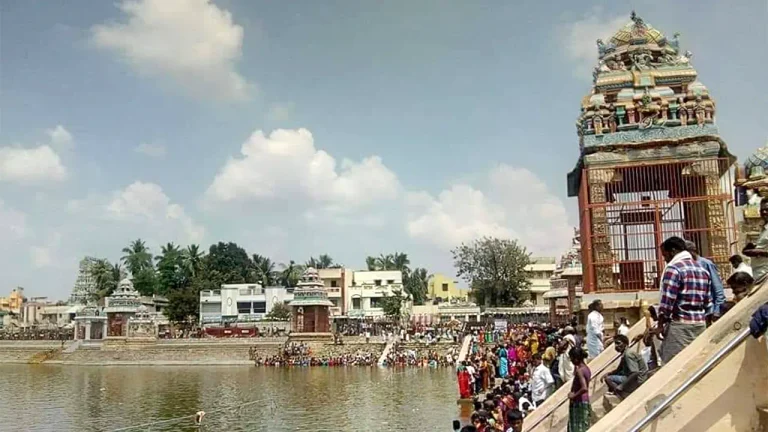
The origin of the Ramaswamy Temple is closely intertwined with the historic Mahamaham Tank of Kumbakonam and the deep devotion of the Thanjavur Nayaka dynasty.
During the 16th century, King Achyutappa Nayak ruled Thanjavur under the aegis of the Vijayanagara Empire. His prime minister, the illustrious scholar and statesman Govinda Dikshitar, was overseeing excavation and renovation work at the holy Potramarai tank and Mahamaham tank in Kumbakonam.
According to temple records, while workers were desilting and deepening the holy tank bed, they unearthed exquisite stone idols of Lord Rama and Goddess Sita. Overjoyed by this divine discovery, Govinda Dikshitar felt it was an auspicious sign to consecrate a dedicated temple for Lord Rama in the heart of the temple town.
King Achyutappa Nayak commissioned the construction, dedicating vast resources to ensure the temple matched the grandeur of the classical Nayaka sculptural style. The consecration took place in the late 16th century, creating a lasting spiritual center that seamlessly bridged Vijayanagara craftsmanship with local Tamil Vaishnavite devotion.
Continue Reading >> 2500 Years Dwarkadhish Temple: Where Miracles Still Happen

Unique Sanctum Iconography: The Reunited Divine Family
The sanctum sanctorum (Garbhagriha) of Ramaswamy Temple presents an iconographic layout that is practically unique across South India.
In standard Hindu iconography:
- Lord Rama is typically shown in the Kodandarama form (standing with his bow, accompanied only by Sita and Lakshmana).
- Alternatively, during coronation scenes, Bharata and Shatrughna are rarely sculpted alongside the primary stone moolavar idols in the main sanctum.
At the Ramaswamy Temple, however, the moolavar pedestal features:
- Lord Rama and Goddess Sita: Seated together in the regal Pattabhishekam (coronation) posture, radiating grace and sovereignty.
- Lakshmana: Standing respectfully to one side, holding his bow, ever vigilant in service.
- Bharata: Standing reverently, holding the royal royal umbrella (chatra) over his elder brother.
- Shatrughna: Standing beside Bharata, holding the sacred fly-whisk (chamara).
- Lord Hanuman: Uniquely seated in front, not in his usual humble posture with hands over his mouth, but holding a musical veena in one hand and a sacred palm-leaf manuscript (Ramayana sloka text) in the other, immersed in reciting the divine name.
This darshan represents the ideal harmony of brotherhood, duty (Dharma), and devotion, making it a sacred destination for families seeking unity, peace, and spiritual strength.
Continue Reading >> Arunachaleswara Temple: A Spiritual Experience of a Lifetime

Architectural Marvels: The 64 Pillars and Ramayana Murals
Though modest in perimeter compared to sprawling temples like Srirangam or Madurai Meenakshi, the Ramaswamy Temple stands as one of the finest gems of Nayaka stone craftsmanship.
1. The Maha Mandapam (Pillared Hall of Monoliths)
The front hall features 64 monolithic stone pillars, each sculpted from single granite blocks. The Nayaka artisans pushed the boundaries of high-relief stone carving here:
- Dashavatara Sculptures: Exquisite depictions of Lord Vishnu’s ten incarnations, with extraordinary detailing on Vamana taking the giant stride as Trivikrama and Narasimha slaying Hiranyakashipu.
- The Epic Confrontations: Dynamic, life-like sculptures capturing the duel between Vali and Sugriva, Rama piercing the seven sal trees with a single arrow, and scenes of Hanuman leaping across the ocean.
- Rati and Manmatha: Intricate secular and divine motifs, showcasing the costumes, jewellery, and facial expressions typical of 16th-century Vijayanagara-Nayaka aesthetics.
2. The Pictorial Ramayana (Inner Prakaram Murals)
The covered ambulatory pathway (pradakshina corridor) surrounding the main sanctum houses a breathtaking set of historical wall paintings:
- 110 Detailed Panels: Painted across three tiers, these murals present the complete narrative arc of the Valmiki Ramayana, beginning from King Dasharatha’s Putrakameshti Yajna in the Bala Kanda to the grand Pattabhishekam in the Yuddha Kanda.
- Natural Pigments: Originally executed using herbal dyes and natural mineral pigments, the panels demonstrate historical South Indian fresco techniques.
- Sequential Walking Meditation: Pilgrims circumambulating the sanctum three times absorb the entire epic visually, making the pradakshina both an act of worship and a journey through sacred scripture.
Continue Reading >> Brihadeeswarar Temple: Timeless Marvel of Chola Architecture

Ramaswamy Temple Timings and Rituals
The temple follows classical Vaikhanasa Agama traditions. Regular darshan is organized smoothly throughout the morning and evening sessions.
General Visiting Hours:
- Morning Session: 6:00 AM to 12:00 PM
- Evening Session: 4:00 PM to 9:00 PM
(Note: During special festival occasions like Rama Navami and Vaikunta Ekadashi, the temple doors open earlier, often by 4:30 AM, and remain open longer into the afternoon).
Regular Daily Poojas (Kaala Pooja Schedule):
- Ushathkalam (Dawn Pooja): ~6:30 AM
- Kalasanthi Pooja: ~8:00 AM
- Uchikalam (Noon Pooja): ~11:30 AM (Sanctum closes at 12:00 PM)
- Sayaratchai (Evening Pooja): ~5:30 PM
- Irandam Kalam: ~7:30 PM
- Ardha Jamam (Night Pooja): ~8:30 PM (Sanctum closes at 9:00 PM)
Important Festivals Celebrated
- Sri Rama Navami (March – April): The grandest festival of the year, celebrated for 10 days during the Tamil month of Panguni or Chithirai. The festival culminates in the divine chariot procession (Ther Thiruvizha) and the re-enactment of the royal coronation.
- Vaikunta Ekadashi (December – January): Observed with immense piety during the Tamil month of Margazhi. Devotees gather in the early dawn hours to witness the ceremonial opening of the Paramapada Vaasal (the Gate of Heaven).
- Hanumath Jayanthi: Special butter-covering (Vennai Kaapu) alankaram and special garland offerings made of betel leaves and vadai are offered to Lord Hanuman in celebration of his divine service.

Visitor Rules, Dress Code, and Practical Travel Advice
To ensure a smooth and respectful pilgrimage, keep the following travel tips in mind:
- Dress Code: Traditional dress is strictly appreciated. Men should ideally wear dhotis with upper cloth or formal shirts and trousers; women should wear sarees, half-sarees, or churidars with dupattas. Sleeveless tops, shorts, and western beachwear are prohibited.
- Photography: Photography of the main stone moolavar deities inside the sanctum sanctorum is strictly forbidden. Photography of the pillar carvings in the Maha Mandapam may be allowed or subject to a small nominal fee administered by the HR&CE counter; always look for signage or ask temple staff.
- Footwear: Footwear must be deposited at the designated footwear stand outside the east gopuram entrance before stepping onto the temple premises.
- Best Time to Visit: The winter months from October to March offer the most pleasant weather for exploring Kumbakonam’s heritage sites.
How to Reach Ramaswamy Temple Kumbakonam
The temple is centrally situated within Kumbakonam town, making it exceptionally accessible:
- By Train: Kumbakonam Railway Station is just 2 km away. Regular express trains link Kumbakonam directly with Chennai, Tiruchirappalli, Thanjavur, and Madurai.
- By Air: The nearest airport is Tiruchirappalli International Airport (TRZ), located approximately 95 km away. Taxis and direct state transport buses connect the airport to Kumbakonam via Thanjavur.
- By Road: Kumbakonam has a well-organized central bus stand with round-the-clock buses running from Chennai, Bangalore, Coimbatore, and all major towns in Tamil Nadu. Local auto-rickshaws are readily available throughout the town to reach the temple entrance.
Exploring the Nearby Temples of Kumbakonam
Kumbakonam is renowned as a sacred temple town. A visit to the Ramaswamy Temple can easily be paired with several world-famous Shaivite and Vaishnavite shrines within a 2 km radius:
- Sarangapani Temple: One of the prominent Divya Desams, featuring a towering 11-tier gopuram and a sanctum shaped like a stone chariot.
- Chakrapani Temple: A rare Vaishnavite temple dedicated to Lord Sudarshana (the divine discus of Vishnu).
- Adi Kumbeswarar Temple: The central Shaivite temple of Kumbakonam, historically associated with the cosmic pot of nectar (Amrita Kalasha) from which the town derives its name.
Frequently Asked Questions (FAQs)
Why is Ramaswamy Temple called the “Ayodhya of the South”?
It is called the Ayodhya of the South because it is one of the rare temples where Lord Rama is worshipped in his complete coronation glory (Pattabhishekam), surrounded by all three brothers (Lakshmana, Bharata, Shatrughna), Mother Sita, and Lord Hanuman holding a veena.
Who built the Ramaswamy Temple in Kumbakonam?
The temple was built during the late 16th century CE by King Achyutappa Nayak, the ruler of Thanjavur, under the guidance of his revered chief minister, Govinda Dikshitar.
How much time is needed to visit Ramaswamy Temple?
A general darshan takes approximately 30 to 45 minutes. However, if you wish to observe the 64 carved pillars and the 110 panels of the Ramayana wall paintings in detail, plan to spend around 1 to 1.5 hours.
Is there an entry fee for Ramaswamy Temple?
General entrance is free for all devotees. During peak festival days, special quick-darshan queues may be arranged by the HR&CE department for a nominal ticket fee (typically ₹10 or ₹20).
Plan Your Pilgrimage
A visit to the Ramaswamy Temple in Kumbakonam offers an inspiring synthesis of intense devotion, Nayaka-era stone artistry, and scriptural heritage. Whether you are walking through the monolithic pillars of the Maha Mandapam or admiring the vibrant, centuries-old mural panels of the Valmiki Ramayana, this sacred shrine stands as a timeless monument to the life and virtues of Lord Rama.