Rajarani Temple, Bhubaneswar: History, Architecture, Timings, and Visitor Guide
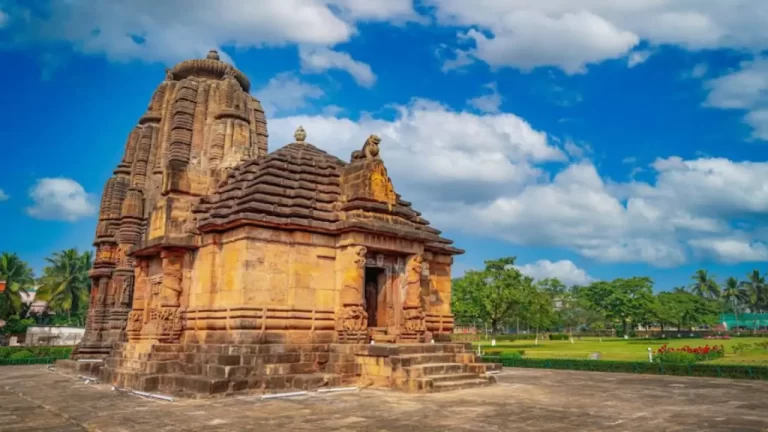
The Rajarani Temple in Bhubaneswar is an 11th-century masterpiece of Kalinga architecture located in the Old Town (Ekamra Kshetra) area of Odisha’s capital city. Built during the rule of the Somavamsi dynasty, the temple is famous for its warm yellow-and-red sandstone (locally called Rajarani stone), its clustered spire of miniature towers, and its exquisite carvings of directional guardians and graceful figures. Unlike active worship shrines in the city, Rajarani Temple has no presiding deity inside its sanctum and is maintained as a protected heritage monument by the Archaeological Survey of India (ASI).

Set inside a quiet, manicured garden along Tankapani Road, this temple feels very different from the bustling pilgrimage complexes nearby. Visitors come here not for ritual darshan or aarti, but to admire some of the finest stone craftsmanship in Indian history and to experience the annual Rajarani Music Festival held under the winter sky.
Quick Information: Rajarani Temple, Bhubaneswar
| Feature | Verified Details |
| Temple Name | Rajarani Temple (Historically linked by scholars to Indreswara Temple) |
| Presiding Deity | None inside the sanctum (Garbhagriha); exterior carvings are dedicated to Lord Shiva |
| Location | Tankapani Road, Old Town (Ekamra Kshetra), Bhubaneswar, Khordha District, Odisha |
| Built In / Period | Early to mid-11th Century CE (Somavamsi Dynasty era) |
| Architectural Style | Kalinga Architecture (Pancharatha Rekha Deul with clustered Urushringa spires and Pidha Jagamohana) |
| Primary Material | Dull red and yellow sandstone locally known as Rajarani stone |
| Managed By | Archaeological Survey of India (ASI), Bhubaneswar Circle |
| Daily Timings | Morning to Evening (Typically 6:30 AM – 6:00 PM / Sunrise to Sunset; closed after dark except during the January music festival) |
| Daily Puja / Aarti | No daily rituals or puja (Non-living heritage monument) |
| Entry Fee | Small ASI monument ticket fee applies for Indian and foreign visitors (verify current ASI rates at the gate or online ticket counter) |
| Best Time to Visit | October to March (Pleasant weather; the Rajarani Music Festival takes place in January) |
| Nearest Railway Station | Bhubaneswar Railway Station (Approx. 4 to 5 km) |
| Nearest Airport | Biju Patnaik International Airport, Bhubaneswar (Approx. 5 to 6 km) |
| Time Needed for Visit | 45 minutes to 1 hour |

Why Is Rajarani Temple So Famous?
Bhubaneswar is home to hundreds of ancient stone shrines, yet the Rajarani Temple stands out immediately to both casual visitors and historians. Four distinct features make this monument one of the most celebrated sites in Odisha:
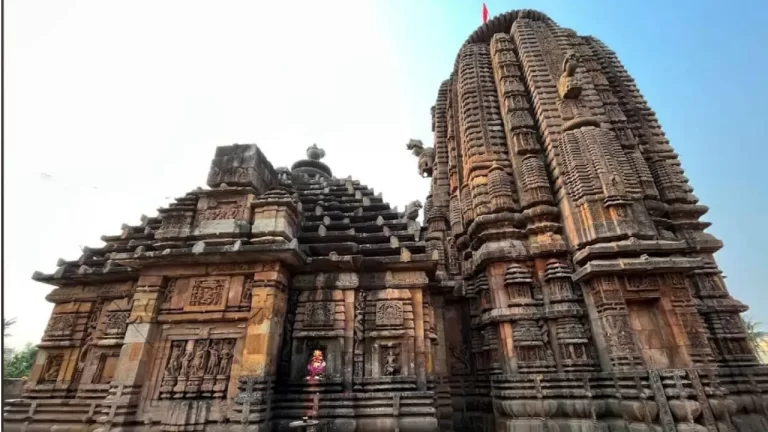
- A Spire Unlike Any Other in Odisha: Most temples in Bhubaneswar—such as the grand Lingaraj Temple in Bhubaneswar —have a single, smoothly curving tower rising above the sanctum. The Rajarani Temple instead surrounds its main tower with smaller replica towers (urushringas) that hug the central spire, looking remarkably similar to the Khajuraho Temples in Madhya Pradesh.
- The Glowing “Rajarani” Sandstone: The entire temple is built from a fine-grained, buff-colored sandstone with warm shades of amber, yellow, and soft red. Locals call this stone Rajarani, and its soft texture allowed 11th-century sculptors to carve delicate facial expressions, jewelry, and flowing garments that still look lifelike nearly a thousand years later.
- A Temple With No Deity Inside: When you step into the inner sanctum, the chamber is completely empty. Because there is no consecrated idol inside, no priests perform daily rituals here, allowing visitors of all backgrounds to walk right up to the doorway and study the stonework in peace.
- World-Class High-Relief Sculptures: The outer walls of the main tower feature some of the best-preserved carvings of the Ashta-Dikpalas (the eight guardians of the directions) and Alasakanyas (graceful female figures in everyday poses) anywhere in India.
History of Rajarani Temple and the Mystery of Its Name
Historians and archaeologists place the construction of the Rajarani Temple in the early to mid-11th century CE, during the rule of the Somavamsi dynasty (also known as the Keshari dynasty in local tradition). The Somavamsi kings moved from the upper Mahanadi valley to coastal Odisha and ushered in a golden age of temple building in Bhubaneswar, constructing landmarks like the Mukteshwar, Brahmeshwar, and Lingaraj temples.
How Did It Get the Name “Rajarani”?
Over the centuries, two main explanations have emerged for the temple’s unusual name:
- The Architectural Material Theory (Most Accepted by Scholars): According to the Archaeological Survey of India (ASI) and leading historians of Odisha, the temple takes its popular name from the specific type of dull red and yellow sandstone used to build it, which local stoneworkers called Rajarani stone.
- Local Folklore: Popular local stories sometimes call it a pleasure resort of an ancient king (Raja) and queen (Rani), or suggest it was built so a royal couple could admire its romantic carvings. However, historical records show it was built as a sacred Hindu temple, not a secular palace.
Was It Originally Called the Indreswara Temple?
Yes, most historians—including renowned Odisha archaeologist K.C. Panigrahi—identify the Rajarani Temple as the ancient Indreswara Temple mentioned in the Ekamra Purana (a traditional Sanskrit text describing the sacred geography of Bhubaneswar).
According to the Ekamra Purana, the Indreswara Temple stood to the east of the Siddheshwar and Mukteshwar temples—the exact geographical spot where the Rajarani Temple stands today. Historians believe it was commissioned by the Somavamsi king Indraratha (who ruled in the early 11th century) and was named Indreswara after its royal patron, honoring Lord Shiva.
Read More>> Kapila Theertham Temple Tirupati

Why Is There No Deity Inside the Rajarani Temple?
One of the first questions visitors ask at the entrance gate is: “Why is the sanctum empty, and which god was worshipped here?”
While the inner sanctum (garbhagriha) has no idol today, the carvings on the outside of the temple leave no doubt that it was built as a Shaivite temple dedicated to Lord Shiva. Look closely at the exterior and doorway, and you will spot clear Shaivite markers:
- Nataraja (The Cosmic Dancer): A richly carved panel on the base of the temple shows Lord Shiva dancing the cosmic Tandava above a lotus pedestal, accompanied by musicians.
- Parvati at the Entrance: The central projection on the door lintel (lalatabimba) features an image associated with Goddess Parvati, and panels nearby depict the divine marriage (Kalyanasundara Murti) of Shiva and Parvati.
- Lakulisa (Founder of the Pashupata Shaiva Sect): Near the entrance portal sits a carved figure of Lakulisa, an important Shaivite teacher who appears prominently on almost all early Shiva temples in Bhubaneswar.
- Shaivite Door Guardians (Dvarapalas): The entrance is flanked by the Shaiva guardians Chanda and Prachanda, accompanied by a skeletal ascetic (Bhringi) and attendants holding tridents.
Why Was Worship Stopped?
Historians offer two grounded explanations for why there is no Shiva Linga inside today:
- The Temple Was Left Partially Unfinished: Notice the stark contrast between the main tower (Vimana) and the front porch (Jagamohana). While the main tower is covered in elaborate carvings, the front porch is almost completely bare, with rough stone blocks that were marked for carving but never chiseled. If political upheaval—such as invasions during the reign of King Indraratha—halted the final decorative work, the formal consecration (Prana Pratishtha) of the main deity may never have been completed, or the idol may have been removed in later centuries.
- Later Structural Repairs: By the late 19th and early 20th centuries, the temple had fallen into serious disrepair. In 1903, colonial conservation teams carried out major structural restorations to prevent the stones from collapsing, preserving it strictly as an archaeological monument.
Read More>> 5th CE Yaganti Temple with Mysteries

Architecture of the Rajarani Temple: A Detailed Walkthrough
To appreciate the Rajarani Temple when you visit, it helps to understand how an Odia temple is put together. In traditional Kalinga temple architecture, a temple is designed like a human body and consists of two main connected buildings built along an east-west axis:
- The Vimana (or Bada Deul): The tall tower that rises directly over the inner sanctum.
- The Jagamohana (or Mukhasala): The front assembly hall or porch where devotees stand before entering the sanctum.
At Rajarani Temple, the entire structure rests on a raised stone platform (pitha) with three molded layers at the bottom, elevating the shrine roughly 55 feet (about 18 meters) into the sky.
1. The Clustered Spire (Vimana and Urushringas)
The main tower of Rajarani Temple is a Pancharatha Rekha Deul—meaning its floor plan has five distinct vertical projections (rathas) on each side, creating deep vertical recesses that catch sunlight and cast dramatic shadows throughout the day.
What makes this tower unique in Odisha is its spire (gandi). Instead of rising as a single smooth tower, the central spire is clustered with two tiers of miniature replica spires called urushringas (or angashikharas). These smaller towers lean inward against the main spire like petals wrapping around a flower bud.
Architectural historians believe this design reflects cultural exchange with Central India, specifically the Chandela temples of Khajuraho and the temples of Dahala-Mandala. Rajarani was a bold architectural experiment in Bhubaneswar. Although local builders admired its beauty, later Odia architects returned to the classic single-tower Kalinga style when they built the massive Jagannath Temple in Puri.
At the very top of the tower sits the Mastaka (the crown), consisting of a recessed neck (beki), a large ribbed stone disc shaped like an Indian gooseberry (amalaka), a bell-shaped cap (khapuri), and an auspicious water pot finial (kalasha).
2. The Plain Assembly Hall (Jagamohana)
Attached to the front of the richly carved tower is the Jagamohana (front hall). Built on a square plan, it has a pyramidal roof made of horizontal stone tiers (pidhas), classifying it as a Pidha Deul.
Walking from the ornate main tower to the front hall feels like stepping between two different worlds. Unlike the main shrine, the outer walls of the Jagamohana are completely plain. This contrast actually helps visitors see how ancient Indian temples were built: stone blocks were first stacked and fitted together without mortar (connected using iron clamps), and the master sculptors carved the walls from the top down after the structure was standing. For reasons lost to history, the sculptors finished the main tower and the front doorway, leaving the walls of the porch smooth.
3. The Naga-Nagi Entrance and Navagraha Architrave
Before stepping into the front hall, pause at the main eastern doorway:
- Naga-Nagi Pillars: Flanking the entrance are two round pilasters entwined by giant mythical serpent kings (Nagas) and serpent queens (Nagis) with human upper bodies and braided snake tails. Unlike older temples where the serpents look fierce, the figures here have gentle, welcoming expressions.
- The Navagraha Lintel: Above the doorway rests a heavy stone beam carved with the Navagrahas—the nine planetary deities of Hindu astrology (Surya, Chandra, Mangala, Budha, Brihaspati, Shukra, Shani, Rahu, and Ketu). Carving all nine planets above the entrance was meant to protect the temple and anyone crossing its threshold from astrological harm.
- Gajalakshmi: Below the planetary beam sits a carving of Goddess Lakshmi seated on a lotus while elephants pour sacred water over her from upturned pots.
Read More>> Komuravelli Mallanna Temple

Famous Sculptures on the Walls of Rajarani Temple
The greatest treasure of Rajarani Temple lies on the vertical outer walls (bada) of the main sanctum tower. Walk slowly clockwise around the temple (the traditional path of pradakshina), and look for two world-famous groups of sculptures: the Ashta-Dikpalas and the Alasakanyas.
1. The Ashta-Dikpalas (The Eight Guardians of the Directions)
Carved near the base of the corner walls are the Ashta-Dikpalas—the eight Hindu deities who guard the cardinal and corner directions of the universe. The versions at Rajarani Temple are considered the finest standing Dikpala statues in all of Odisha because they stand in high relief (almost three-dimensional) and wear delicate, see-through carved drapery.
Each guardian stands above his traditional animal mount (vahana):
- Indra (Guardian of the East): Holds a thunderbolt (vajra) and elephant goad, standing with his royal elephant, Airavata, crouched below.
- Agni (Guardian of the Southeast): The god of fire, portrayed with a bearded face, flames rising behind his shoulders, a rosary in hand, and his mount, the ram, at his feet.
- Yama (Guardian of the South): The god of death and justice, holding a staff (danda) and noose (pasha), accompanied by his mount, the buffalo.
- Nirriti (Guardian of the Southwest): Protector of the southwest corner, holding a sword and shield while standing over a prostrate human figure (naravahana).
- Varuna (Guardian of the West): The lord of the cosmic waters, carved with remarkable grace holding a noose and lotus, with his mythical sea-creature mount, the Makara, below him. The statue of Varuna on Rajarani Temple is widely praised by art historians as one of the finest pieces of medieval Indian sculpture.
- Vayu (Guardian of the Northwest): The god of wind, holding fluttering banners, with his swift deer (or stag) mount at the base.
- Kubera (Guardian of the North): The lord of wealth, portrayed with a rounded belly and flanked by jars of treasure (nidhis).
- Ishana (Guardian of the Northeast): An aspect of Lord Shiva guarding the auspicious northeast corner, holding a trident and accompanied by Nandi the bull.
2. The Alasakanyas (Graceful Maidens in Everyday Moments)
Higher up on the walls and nestled inside the deep vertical niches are dozens of life-like female figures known in Odia architectural texts as Alasakanyas (literally “languid or graceful maidens”) and Surasundaris (celestial beauties).
Rather than standing stiffly, these figures twist gently at the waist (tribhanga pose) and capture quiet, relatable moments of daily life:
- Padmagandha: A woman smelling the fragrance of a freshly bloomed lotus flower.
- Darpana: A maiden looking into a handheld mirror while adjusting her hair or applying sindoor (vermilion) to her forehead.
- Ketakibharana: A woman decorating her hair with a fragrant ketaki flower petal.
- Matrimurti: A tender carving of a mother holding her young child on her hip.
- Shukasari: A woman playfully talking to a pet parrot perched on her hand or shoulder, while a monkey tugs gently at her garment below.
- Nupurapadika: A dancer bending down gracefully to fasten bells (ghungroo) around her ankles before a performance.
- Dalana: A slender figure reaching up to hold the branch of a flowering tree (Salabhanjika), symbolizing fertility and nature’s abundance.
Alongside these figures, the recessed bands of the walls feature mythical Vyalas (half-lion, half-elephant or horned creatures rearing up on their hind legs) symbolizing untamed natural power being mastered by human consciousness.
Read More>> Shri Vishnupad Temple Gaya
The Rajarani Music Festival (Every January)
Although no daily religious ceremonies take place inside the sanctum, the temple complex comes alive once a year during the Rajarani Music Festival.
Organized every year from January 18 to January 20 by the Department of Tourism, Government of Odisha in collaboration with the Odisha Sangeet Natak Akademi, this three-day festival celebrates Indian classical music.
During the festival:
- The 11th-century sandstone tower is illuminated with warm golden spotlights against the night sky, serving as the stage backdrop.
- Visitors sit on the open lawns surrounding the temple.
- Renowned maestros of Hindustani, Carnatic, and Odissi classical vocal and instrumental music (such as flute, sitar, santoor, violin, and mardala percussion) perform live in the evening breeze.
If you plan to visit Bhubaneswar in mid-January, attending an evening concert on the Rajarani Temple lawns is one of the most memorable cultural experiences in Odisha.

Practical Visitor Information: Timings, Tickets, and Rules
Because Rajarani Temple is an archaeological monument rather than an active shrine managed by temple priests, visiting it is straightforward and relaxed.
Visiting Hours
- Daily Timings: Open every day from morning until evening (generally 6:30 AM to 6:00 PM, or sunrise to sunset).
- Best Time of Day to Visit:
- Early Morning (7:00 AM – 9:30 AM): The morning sun shines directly onto the eastern entrance, illuminating the Naga-Nagi columns and the Navagraha doorway. The gardens are cool and quiet.
- Late Afternoon (3:30 PM – 5:30 PM): During the golden hour before sunset, the warm Rajarani sandstone glows deep amber and orange, bringing out the fine details of the Dikpala and Alasakanya carvings on the western and southern walls.
Entry Fee and Tickets
- As a ticketed monument under the Archaeological Survey of India (ASI), a small entry fee is charged at the gate (or via the official ASI digital QR ticket system at the entrance).
- Children under 15 years of age typically enter free of charge.
- Keep digital payment (UPI/card) or small cash notes handy at the ticket counter.
Photography, Dress Code, and Visitor Rules
- Photography: Unlike the Lingaraj Temple or Puri Jagannath Temple—where cameras and mobile phones are strictly prohibited inside—photography is permitted inside the Rajarani Temple complex. You can freely photograph the gardens, the exterior carvings, and the architecture. (Note: Use of commercial tripods, drones, or professional filming equipment requires prior written permission from the ASI Bhubaneswar Circle).
- Religion & Entry Restrictions: Because there is no consecrated deity inside the sanctum, visitors of all nationalities and faiths are welcome inside the complex and up to the viewing areas.
- Footwear: You can walk along the paved garden pathways in your shoes, but if you step up onto the main stone plinth (pitha) or into the Jagamohana porch, remove your footwear as a mark of respect for the ancient temple structure.
- Dress Code: There is no strict religious dress code enforced at the gate, though modest, comfortable cotton clothing and sun protection (a hat or umbrella during midday) are recommended.
- Facilities on Site: The complex features well-maintained lawns, shaded garden benches, drinking water, and basic restroom facilities near the entrance.
Read More>>Badrinath Temple | Badrinarayan Temple
How to Reach Rajarani Temple in Bhubaneswar
The Rajarani Temple is located along Tankapani Road in the historic Old Town area of Bhubaneswar, making it very easy to reach from anywhere in the city.
- By Air: The nearest airport is Biju Patnaik International Airport (BBI) in Bhubaneswar, located roughly 5.5 km (a 15-to-20-minute drive) from the temple. Pre-paid taxis and app-based cabs (Ola, Uber) are readily available outside the terminal.
- By Train: Bhubaneswar Railway Station (BBS) on the East Coast Railway line is about 4.5 km away. From the station, you can take an auto-rickshaw, cab, or city bus toward Old Town / Ravi Talkies / Tankapani Road.
- By Road and Local Bus: Bhubaneswar’s Baramunda ISBT (Inter-State Bus Terminal) is about 9 km away. Within the city, public Mo Bus routes connect Master Canteen (the railway station hub) and Kalpana Square to the Old Town and Tankapani Road corridor.
- By Auto-Rickshaw or Cab: If you are visiting multiple temples in Old Town, hiring a local auto-rickshaw or taxi for a half-day (3 to 4 hours) is the easiest way to hop between monuments without waiting in the sun.
Nearby Temples to Combine With Your Visit (Old Town Heritage Trail)
Rajarani Temple sits right inside Ekamra Kshetra, the historic heart of Bhubaneswar. Because a visit to Rajarani takes about 45 to 60 minutes, you can easily combine it into a rewarding half-day temple walk:
- Mukteshwar Temple and Siddheshwar Temple (Approx. 500 meters away): Located just a 5-minute walk west down the road, Mukteshwar Temple is famous for its 10th-century arched gateway (Torana) and ceiling lotus carvings. It sits inside the same compound as the Siddheshwar and Parashurameshwar temples.
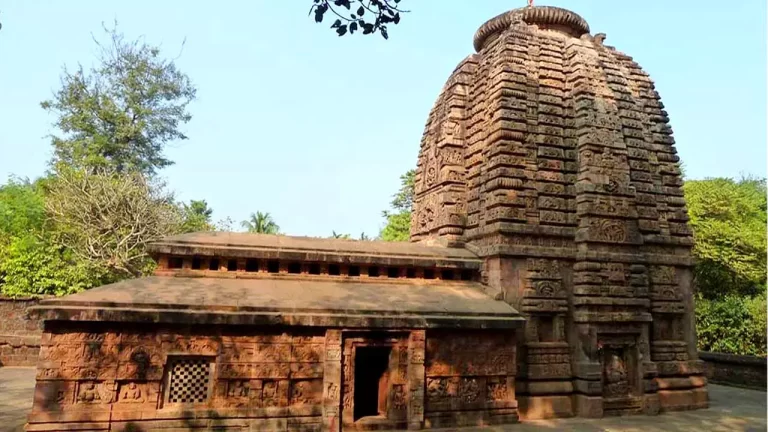
- Parashurameshwar Temple (Approx. 600 meters away): Dating back to the 7th century CE (Shailodbhava period), this is one of the oldest intact temples in Bhubaneswar and shows what early Kalinga temples looked like four centuries before Rajarani was built.
- Kedargouri Temple and Sacred Tank (Approx. 650 meters away): Situated right across from Mukteshwar Temple, known for its natural spring water tank (Marichi Kunda and Gouri Kunda).
- Brahmeshwar Temple (Approx. 1 km east): Another 11th-century Somavamsi temple built by Queen Kolavati Devi, featuring four corner shrines (Panchayatana layout) and active Shiva worship.
- Lingaraj Temple and Bindu Sagar Lake (Approx. 1.5 to 2 km southwest): The largest and most sacred active Shiva temple in Bhubaneswar, towering 180 feet high.
- Odisha Golden Triangle Extension: Many travellers visiting Rajarani Temple also pair Bhubaneswar with day trips to the Konark Sun Temple (about 60 km away) and Puri (about 60 km away).
Frequently Asked Questions (FAQs) About Rajarani Temple
1. Why is there no idol or deity inside the Rajarani Temple?
The inner sanctum (garbhagriha) of the Rajarani Temple is empty today because either its final consecration was interrupted in the 11th century before the front hall (Jagamohana) could be fully carved, or the original Shiva Linga was lost during later centuries of abandonment before the Archaeological Survey of India restored the monument.
2. Which god was the Rajarani Temple originally dedicated to?
Although there is no idol inside the sanctum today, the exterior sculptures clearly show it was dedicated to Lord Shiva. The temple features prominent carvings of Nataraja (dancing Shiva), Goddess Parvati, the Shaivite teacher Lakulisa, and Shaiva door guardians. Historians identify it as the Indreswara Shiva temple mentioned in the ancient Ekamra Purana.
3. Are non-Hindus and foreign tourists allowed inside Rajarani Temple?
Yes. Because Rajarani Temple is a protected archaeological monument managed by the ASI and has no active religious rituals or consecrated deity inside, visitors of all faiths and nationalities are welcome to enter the complex and view the monument up close.
4. Can I take photos inside the Rajarani Temple complex?
Yes, photography with mobile phones and handheld cameras is allowed inside the gardens and around the temple exterior. This makes Rajarani Temple one of the best places in Bhubaneswar to photograph classic Kalinga stone carvings up close.
5. What is Rajarani sandstone?
Rajarani is the local Odia name for a fine-grained, buff-to-reddish-yellow sandstone quarried near Bhubaneswar. Its warm golden hue and workable texture allowed 11th-century sculptors to carve extraordinarily fine details on the temple walls, and the temple itself took its popular name from this stone.
6. How is the spire of Rajarani Temple different from Lingaraj Temple?
While the Lingaraj Temple has a single, unbroken curvilinear tower (Rekha Deul), the Rajarani Temple surrounds its main tower with clusters of smaller replica spires called urushringas. This clustered design resembles the Kandariya Mahadeva Temple at Khajuraho in Madhya Pradesh.
7. When is the Rajarani Music Festival held?
The Rajarani Music Festival is held every year from January 18 to January 20 on the lawns of the temple complex. It is organized by Odisha Tourism and features evening concerts by leading Hindustani, Carnatic, and Odissi classical musicians.
8. How much time do I need to explore Rajarani Temple?
Most visitors spend 45 minutes to 1 hour walking around the temple, admiring the Ashta-Dikpala and Alasakanya sculptures on the main tower, and relaxing in the surrounding gardens. You can easily combine it with nearby Mukteshwar and Parashurameshwar temples in a single morning or afternoon.