Maa Biraja Temple, Jajpur: Complete Guide to Odisha’s Sacred Nabhi Gaya Shakti Peetha
Maa Biraja Temple in Jajpur, Odisha, is one of the oldest and most revered Hindu pilgrimage centres in Eastern India. Revered as the sacred Nabhi Peetha among the 51 Shakti Peethas, this ancient shrine is where Goddess Sati’s navel is believed to have fallen. The temple stands in Jajpur Town on the banks of the sacred Baitarani River, drawing pilgrims from all across the country to seek the blessings of the two-armed Mahishasuramardini and perform ancestral Pinda Daana rituals at the holy Nabhi Gaya well.

Unlike many modern temple complexes, the Biraja Temple preserves an unbroken spiritual tradition dating back well over a thousand years. From its distinctive chariot festival during Durga Puja to its deep scriptural mention in the Mahabharata, this holy site—traditionally known as Viraja Kshetra—is a cornerstone of Sanatana Dharma’s Shakti and Pitru traditions.
Quick Information: Biraja Temple, Jajpur
| Detail | Information |
| Temple Name | Maa Biraja Temple (Biraja Devi Temple) |
| Sacred Identity | Nabhi Gaya Shakti Peetha / Viraja Kshetra |
| Main Deity | Goddess Biraja (Two-Armed Mahishasuramardini Durga) |
| Location | Jajpur Town, Jajpur District, Odisha, India |
| Geographical Note | Located in Jajpur, Odisha (often confused with Jaipur, Rajasthan due to similar spelling) |
| Temple Timings | 5:00 AM to 1:00 PM; 3:00 PM to 9:00 PM (open daily; hours expand during Navaratri) |
| Primary Rituals | Maa Biraja Darshan, Chandi Patha, Nabhi Gaya Pinda Daana, Baitarani Snana |
| Major Festivals | Sharadiya Durga Puja (Simhadhwaja Rath Yatra), Chaitra Navaratri, Triveni Amavasya |
| Nearest Major City | Cuttack (~80 km south) and Bhubaneswar (~125 km south) |
| Nearest Railway Station | Jajpur Keonjhar Road (Station Code: JJKR), roughly 30 km from the temple |
| Nearest Airport | Biju Patnaik International Airport (BBI), Bhubaneswar (~125 km) |
| Dress Code | Modest traditional attire recommended (Dhoti/Kurta for men; Saree/Salwar for women) |
| Official Administrative Body | Shree Biraja Temple Trust Board, under the Odisha Hindu Religious Endowments Act |
Read More>> Hinglaj Mata Temple Balochistan

Spiritual Significance: Why Biraja Kshetra is Revered
In Hindu theology, sacred geographic spaces are sanctified through divine events. Among them, Viraja Kshetra holds a unique dual status: it is simultaneously an exalted Shakti Peetha and one of the three principal Gaya Tirthas for ancestral liberation.
The Sacred Nabhi Shakti Peetha
According to the Puranic tradition documented in texts such as the Devi Bhagavata Purana and the Tantra Chudamani, Lord Shiva wandered in cosmic grief while carrying the charred body of Goddess Sati. To restore cosmic harmony, Lord Vishnu used his Sudarshana Chakra to sever the sacred form into multiple parts.
Devout tradition holds that the navel (Nabhi) of Sati fell at this sacred spot in Jajpur. Because the navel represents the source of life, creation, and vitality in the human form, the Nabhi Peetha is revered as an extraordinary centre of maternal grace and transformative spiritual energy.
Editorial Context: Devotees exploring the sacred pan-Indian pilgrimage circuit can explore our comprehensive study on the 51 Shakti Peethas of India to understand how each holy spot maps to the sacred geography of Sanatana Dharma.
Read More>> Manibandh Shakti Peeth Pushkar.
The Holy Trio of Gaya Tirthas: Shiro, Nabhi, and Pada Gaya
Many pilgrims visit Jajpur specifically to fulfill their duties to departed ancestors (Pitrus). Hindu tradition describes the demon Gayasura, whose enormous body became sanctified by Lord Vishnu’s boon:
- Shiro Gaya (Head): Located at Gaya, Bihar, where the sacred footstep (Vishnupada) of Lord Vishnu rests.
- Nabhi Gaya (Navel): Located inside the inner compound of the Maa Biraja Temple in Jajpur, Odisha.
- Pada Gaya (Feet): Located at Pithapuram in Andhra Pradesh, near the Kukkuteswara Swamy shrine.
Performing Shraddha and offering Pinda (rice balls) at Nabhi Gaya is believed to liberate seven generations of ancestors from karmic bonds, elevating them to higher spiritual realms.

The Ancient Iconography of Maa Biraja Devi
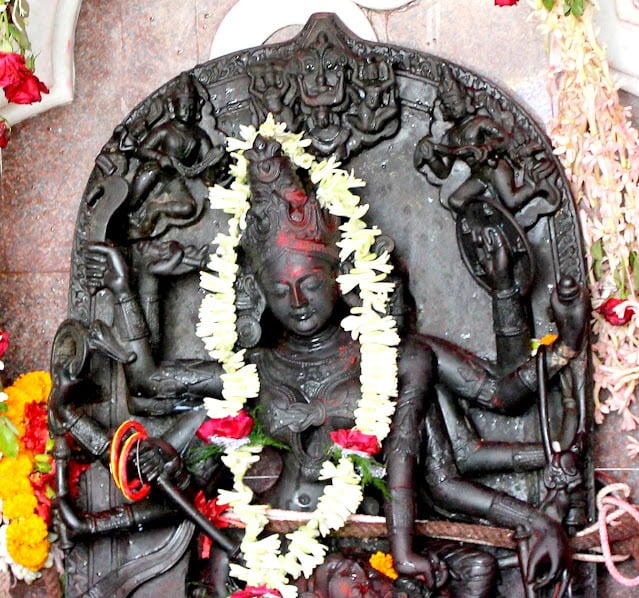
One of the most remarkable features of the Biraja Temple is the physical iconography of the presiding deity. While modern depictions of Goddess Durga feature 8, 10, or 18 arms brandishing weapons, the deity inside the sanctum sanctorum of Jajpur is an extremely rare Dwi-Bhuja (two-armed) Mahishasuramardini.
Archaeologists and art historians note that two-armed representations of the Goddess slaying the buffalo demon represent an early stage of Indian sculptural tradition, characteristic of the Gupta and post-Gupta eras (4th to 6th century CE).
- The Right Hand: Maa Biraja holds a sharp trident (Trishula), piercing the body of the demon Mahishasura.
- The Left Hand: She holds the tail of the buffalo demon, pulling him upward.
- The Stance: One of her feet firmly pins the neck or back of the buffalo beast, illustrating the victory of supreme cosmic consciousness over ego and ignorance.
- The Vahana: Beside her, her mount, the lion, stands watchful and fierce.
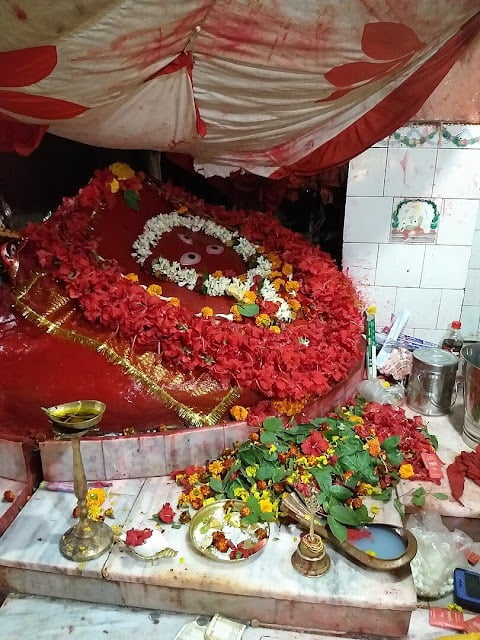
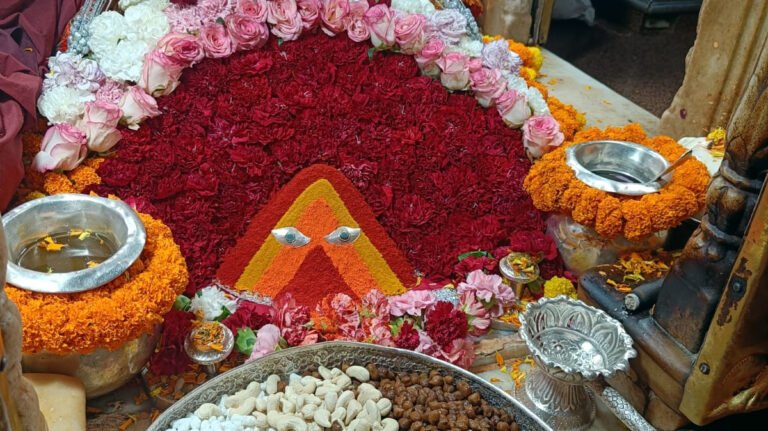
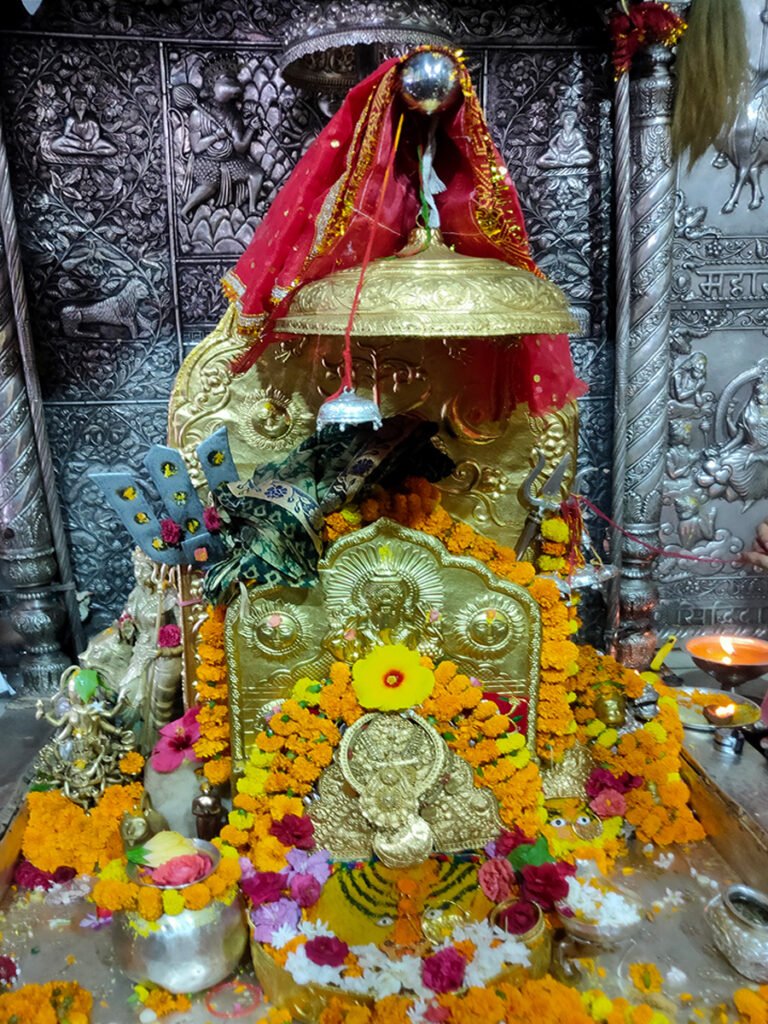
The vigraha is decorated daily with sacred sandalwood paste, rich silk sarees, and fresh floral garlands, radiating maternal warmth and divine authority.
Read More>> Gayatri Shaktipeeth Chitrakoot Temple.
History and Architecture of the Temple
The town of Jajpur, anciently known as Yajnapura or Virajanagara, was a capital city under various early dynasties of Odisha.
The Architectural Marvel: Kalinga Style
The present structural complex showcases the refined traditions of Kalinga Architecture:
- The Vimana (Sanctum): Built in the Rekha Deula style, soaring upward with curvilinear miniature spires (rathas) that mirror the architectural grandeur of classical shrines like the Lingaraj Temple in Bhubaneswar.
- The Jagamohana (Assembly Hall): Designed in the stepped pyramidal Pidha Deula style, where devotees gather to pray, chant hymns, and offer respects.
- The Outer Prakaram (Walls): High laterite and stone boundary walls protect the vast temple compound, preserving numerous subsidiary shrines, ancient rock-cut carvings, and sacred stone pillars.
Around the complex, visitors can observe ancient stone sculptures of the Ashta Matrikas (the Eight Mother Goddesses), Ganesha, Kartikeya, and Lord Shiva, reflecting the seamless synthesis of Shaivism and Shaktism in Odishan heritage.

The Sacred Nabhi Gaya Well & Ancestral Rituals
Located within the inner courtyard of the temple complex is Nabhi Gaya Kunda, a sacred well of profound religious importance.
Guidance for Devotees Performing Pinda Daana
- Best Times for the Ritual: While performed throughout the year, doing Pinda Daana during Pitru Paksha (the fortnight of the ancestors in Bhadrapada/Ashwin), on Amavasya (new moon days), or during solar and lunar eclipses carries exceptional spiritual merit.
- Priests and Dakshina: Temple priests (Sevakas) assist devotees with the ritual materials, Sanskrit mantras, and Sankalpa. Agree upon the dakshina (priest offering) before beginning the ceremony to ensure complete peace of mind during your prayers.
- Mindset: Approach the ritual with reverence and gratitude toward parents and departed elders.
Unique Festivals of Maa Biraja
While Navaratri is celebrated in every Shakti shrine across India, Maa Biraja Temple features a sacred observance found nowhere else.
The Simhadhwaja Rath Yatra: The Goddess on a Chariot
In almost all Hindu temple traditions, chariot festivals (Rath Yatras) are reserved for male deities—such as the world-famous festival at the Jagannath Temple in Puri.
Biraja Temple is an extraordinary exception: it is the only temple in India where the presiding Goddess rides a chariot during Durga Puja.
- The Chariot (Simhadhwaja): A majestic nine-wheeled chariot adorned with the flag of a lion (Simhadhwaja) is assembled afresh each year before the festival.
- The Duration: During the nine days of Sharadiya Navaratri (Ashwina month), the ceremonial bronze representation (Chalanti Pratima) of Maa Biraja boards the chariot.
- The Parikrama: The chariot circumambulates the temple compound daily amidst blowing conch shells, the rhythmic beating of traditional drums (Mardala), and devotional chants, attracting hundreds of thousands of pilgrims.
- Aparajita Puja: The chariot festival culminates on Vijaya Dashami, marking the triumph of righteousness over dark cosmic forces.
Other Important Observances
- Triveni Amavasya (Magha Month): Celebrated as the birthday of Maa Biraja (Biraja Janmotsava), featuring special midnight rituals and sacred abhishekam.
- Chaitra Navaratri & Basanti Puja: The springtime festival celebrated with continuous Vedic chanting, Chandi Homa, and floral decorations.
- Raja Parba: A festival celebrating divine femininity, where special bhoga and alankara are offered to the mother deity.

Daily Darshan Timings and Temple Schedule
The daily rituals at Biraja Temple follow traditional temple manuals maintained by the servitors. While timing can adjust slightly during eclipses and major festival seasons, the standard schedule is as follows:
| Period | Typical Timings | Ritual / Observance |
| Morning Opening | 5:00 AM | Nirmalya Darshan, Mangala Aarti, and cleaning of the sanctum |
| Morning Abhishekam | 6:00 AM – 7:30 AM | Sacred bath of the deity, Chandi Patha chanting |
| General Darshan | 7:30 AM – 1:00 PM | Public darshan, personal archanas, and special offerings |
| Madhyahna Bhoga | 1:00 PM – 2:00 PM | Midday food offering to the Goddess; sanctum temporarily closed |
| Afternoon Reopening | 3:00 PM | Temple reopens for public darshan and circumambulation |
| Sandhya Aarti | 6:30 PM – 7:15 PM | Evening lamp offering (Deeparadhana) accompanied by traditional music |
| Night Pahada | 8:30 PM – 9:00 PM | Final night offering (Badasinghara Bhoga) and closure of the sanctum |
Devotee Tip: To experience peaceful prayer without large crowds, plan your darshan during the early morning hours between 7:30 AM and 9:30 AM on weekdays.
Important Shrines Within and Around the Complex
Visiting the Biraja Temple is an expansive spiritual journey. Devotees should set aside time to explore the many sacred shrines within the outer complex and across Jajpur town:
- Brahma Kunda: A sacred stepped water tank located near the temple, traditionally believed to have been created when Lord Brahma performed a great yajna at this site.
- The Ashta Chandis: Eight protective manifestations of Goddess Chandi placed around the borders of Jajpur to protect the sacred town.
- The Holy Baitarani River Ghats: Located just 2 km from the temple. Taking a holy bath in the Baitarani River and offering Dasha-Dāna (charity) is considered essential before entering the temple for Pitru rituals.
- Varahanatha Temple: Situated directly across the Baitarani River, this ancient shrine dedicated to Lord Varaha (the Boar incarnation of Lord Vishnu) forms an essential component of the Jajpur pilgrimage circuit.
- Jagannath Temple, Jajpur: An ancient shrine showcasing the deep spiritual unity between Shaktism and Vaishnavism in Odisha’s sacred landscape.
Practical Pilgrimage Planning: How to Reach & Visitor Guidelines
Planning a trip to Jajpur requires understanding the distinction between the railway hub and the temple town.
1. By Train
The nearest railway station is Jajpur Keonjhar Road (Station Code: JJKR), situated on the main Howrah–Chennai mainline.
- Crucial Transit Note: Jajpur Keonjhar Road railway station is approximately 30 to 32 kilometres away from Jajpur Town, where the temple is located.
- Regular auto-rickshaws, shared taxis, and local government/private buses run frequently between the railway station and Jajpur Town bus stand.
2. By Air
The closest airport is Biju Patnaik International Airport (BBI) in Bhubaneswar, located roughly 125 km south. From the airport:
- You can hire a direct private taxi to Jajpur Town (approx. 2.5 to 3 hours via NH 16).
- Alternatively, board a fast express train from Bhubaneswar railway station to Jajpur Keonjhar Road.
3. By Road
Jajpur Town is well-connected by smooth four-lane and six-lane expressways via National Highway 16 (NH 16).
- From Cuttack: ~80 km (approx. 1.5 to 2 hours drive).
- From Bhubaneswar: ~125 km (approx. 2.5 hours drive).
- From Kolkata: ~330 km via Kharagpur and Balasore (approx. 6 to 7 hours drive).
Accommodation and Facilities
- Temple Trust Guest Houses: The Shree Biraja Temple administration operates basic guesthouses for pilgrims. Inquiries can be made at the temple office upon arrival.
- Hotels in Jajpur Town: Several comfortable budget hotels and modern lodges are situated within a 2 to 4 km radius of the temple.
- Hotels at Jajpur Keonjhar Road: For travellers who prefer staying close to the railway mainline, Jajpur Keonjhar Road offers numerous well-equipped business and family hotels.
Frequently Asked Questions About Maa Biraja Temple
1. Is Maa Biraja Temple located in Jaipur, Rajasthan, or Jajpur, Odisha?
The temple is located in Jajpur Town, Jajpur District, Odisha. The similarity in spelling between “Jaipur” and “Jajpur” often causes confusion online, but the sacred Nabhi Gaya Shakti Peetha is exclusively located in Odisha on the banks of the sacred Baitarani River.
2. What is special about the murti of Maa Biraja?
Maa Biraja is depicted as a two-armed (Dwi-Bhuja) Mahishasuramardini, which is an ancient and extremely rare iconographical form dating back to the early post-Gupta period. Modern Durga murtis almost universally feature 8, 10, or more arms.
3. Can anyone perform Pinda Daana at Nabhi Gaya?
Yes. Devotees of all backgrounds who wish to offer prayers for their ancestors can perform the Pinda Daana ritual. Local priests are available near the Nabhi Gaya well inside the temple courtyard to guide pilgrims through the necessary Sanskrit mantras and offerings.
4. What is the Simhadhwaja Rath Yatra?
The Simhadhwaja Rath Yatra is the nine-day chariot festival celebrated at Biraja Temple during the Sharadiya Durga Puja (Navaratri). It is widely regarded as the only temple festival in India where the presiding Goddess rides a chariot, a tradition usually reserved for male deities.
5. What is the dress code for visiting the temple?
While there is no strict computerized dress screening, devotees are requested to wear traditional and modest Indian clothing. Men generally wear dhotis or pyjamas with kurtas, while women wear sarees or salwar kameez. Short dresses, beachwear, and sleeveless clothing are discouraged.
6. Are cameras and mobile phones allowed inside the sanctum?
Photography and videography are strictly prohibited inside the main sanctum sanctorum (Garbhagriha) to preserve the sanctity of the deity. You may carry mobile phones, but they must remain switched off or kept on silent mode inside the temple compound.
Plan Your Pilgrimage to Viraja Kshetra
A visit to Maa Biraja Temple in Jajpur is more than a standard temple visit; it is a profound journey into the spiritual heart of Odisha’s cultural heritage. Whether you are arriving to offer respectful prayers to your ancestors at the sacred Nabhi Gaya well, witnessing the majestic sight of the mother deity on her historic chariot, or simply admiring the thousand-year-old stone architecture of the Kalinga kings, this sacred Shakti Peetha offers deep peace and spiritual elevation.
Plan your travel during the pleasant winter months (October through March), keep a few hours open to bathe in the holy Baitarani River, and immerse yourself in the divine grace of Maa Biraja Devi.