Adinath Temple, Khajuraho: History, Architecture, Timings, and Complete Visitor Guide
The Adinath Temple in Khajuraho is a late 11th-century Jain temple located in the Eastern Group of Monuments in Chhatarpur district, Madhya Pradesh. Built during the rule of the Chandela dynasty, it is dedicated to Lord Adinath (Rishabhanatha), the first Jain Tirthankara. Today, it is part of the UNESCO World Heritage Khajuraho Group of Monuments and is famous for its gracefully carved sandstone tower (shikhara), delicate sculptures of celestial dancers, and peaceful walled courtyard.
Unlike the crowded Western Group of temples, the Adinath Temple sits inside a quiet, active Jain enclosure in the old village area of Khajuraho (Sevagram). It stands right next to the larger Parsvanath Temple and the Shantinath Temple, making it an essential stop for both heritage travelers and Jain pilgrims.
Quick Information: Adinath Temple, Khajuraho
| Feature | Verified Details |
| Temple Name | Adinath Temple (Adinatha Jain Temple, Khajuraho) |
| Main Deity | Lord Adinath (Rishabhanatha), the 1st Jain Tirthankara |
| Monument Group | Eastern Group of Temples (Jain Temple Enclosure) |
| Location | Sevagram, Khajuraho, Chhatarpur District, Madhya Pradesh – 471606 |
| Built By / Era | Chandela Dynasty (Late 11th Century CE) |
| Architectural Style | Nagara Style (Central Indian Nirandhara Temple Plan) |
| Heritage Status | UNESCO World Heritage Site (Inscribed in 1986); Protected by the Archaeological Survey of India (ASI) |
| Daily Timings | Sunrise to Sunset (Generally 6:00 AM to 6:00 PM; local enclosure gate hours may vary slightly by season) |
| Entry Fee | Free (No separate ASI entry ticket is required for the Eastern Group Jain complex, unlike the Western Group) |
| Time Required | 30 to 45 minutes (1 to 1.5 hours for the entire Eastern Jain enclosure) |
| Best Time to Visit | October to March (cool, pleasant weather for walking and examining outdoor stone carvings) |
| Major Festivals | Adinath Jayanti, Mahavir Jayanti, Paryushana Parva, and Khajuraho Dance Festival (February) |
| Distance from Western Group | Approximately 1.5 to 2 km southeast of the Western Group main ticket gate |
| Nearest Railway Station | Khajuraho Railway Station (KURJ) — approx. 7 to 8 km away |
| Nearest Airport | Khajuraho Airport (HJR) — approx. 4 to 5 km away |
| Visitor Dress Code & Rules | Modest clothing covering shoulders and knees; remove footwear outside the temple complex; leather items are discouraged inside active Jain shrines |
Who Is Worshipped at the Adinath Temple?
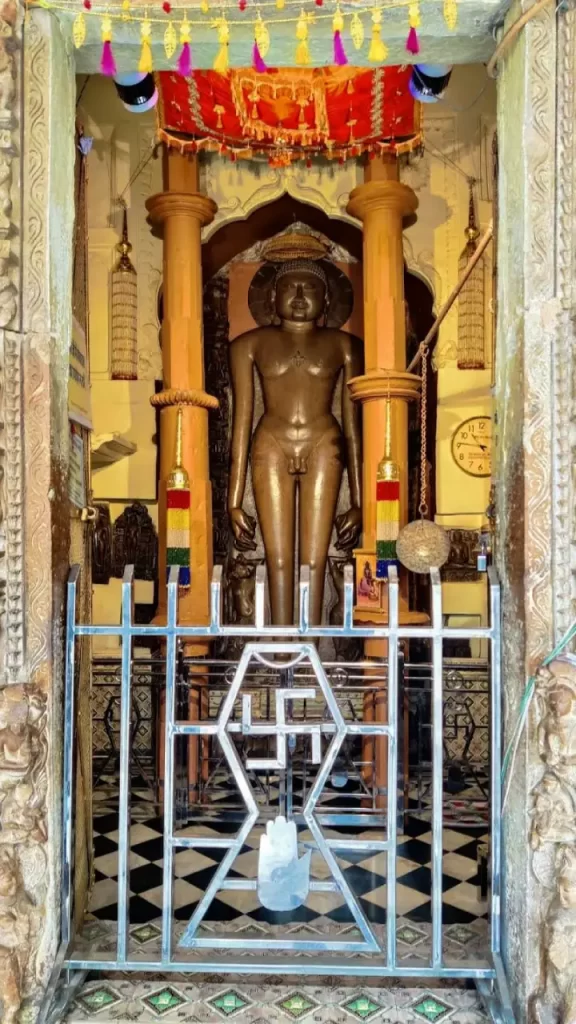
The temple is dedicated to Lord Adinath, also known as Rishabhanatha or Rishabhadeva, the very first of the 24 Tirthankaras (spiritual teachers who show the path across the cycle of rebirth) in Jainism. In Jain tradition, Adinath is revered as the founder of human civilization who taught people agriculture, arts, writing, and peaceful living before renouncing his kingdom to attain spiritual liberation (moksha).
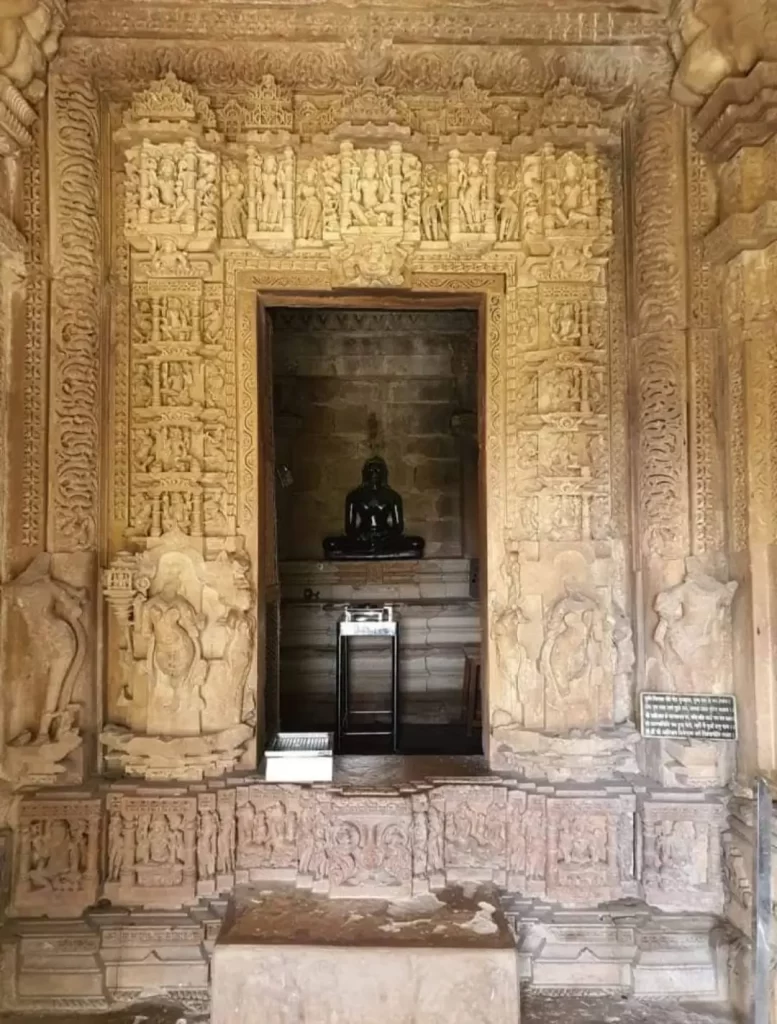
When you step into the garbhagriha (inner sanctum) today, you will see a polished black stone idol of Lord Adinath standing in a calm meditative posture.
Archaeological records show an important detail that many casual visitors miss:
- The temple structure is medieval (late 11th century CE), built during the Chandela period.
- The current black stone idol is a later installation, placed atop an ancient carved stone pedestal after the original medieval idol was lost in earlier centuries.
- Even though the main statue is newer, the doorway lintels and outer walls preserve original 11th-century Jain iconography, confirming that the shrine was built for Jain worship from the very beginning.
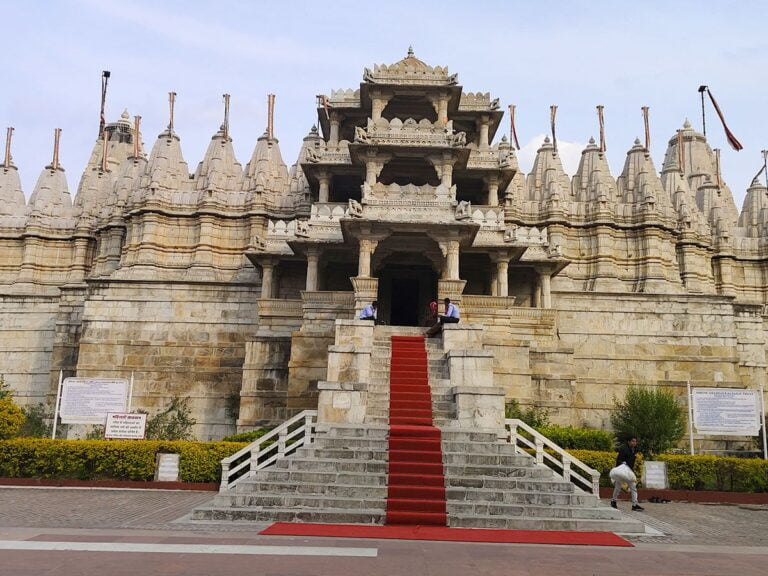
Much like the famous Ranakpur Jain Temple in Rajasthan, the Adinath Temple in Khajuraho honors the first Tirthankara through intricate stone artistry.
History of Adinath Temple and the Chandela Patronage
To understand why a Jain masterpiece stands alongside famous Hindu temples in Khajuraho, it helps to look at the religious harmony of the Chandela dynasty, which ruled the Bundelkhand region (then known as Jejakabhukti) between the 9th and 13th centuries CE.
Religious Tolerance Under the Chandela Kings
Although the Chandela kings were primarily devotees of Lord Shiva and Lord Vishnu, they actively supported Jain merchants, scholars, and temple builders. During the 10th and 11th centuries, a prosperous community of Digambara Jain families lived in the eastern neighborhood of Khajuraho. Wealthy Jain patrons and royal officials commissioned magnificent sandstone temples in this eastern quarter, creating what we now call the Eastern Group of Monuments.
Dating the Adinath Temple (Late 11th Century CE)
Based on the style of its spire (shikhara) and the sharp, slender proportions of its wall carvings, historians and the Archaeological Survey of India (ASI) date the Adinath Temple to the second half of the 11th century CE.
This makes the Adinath Temple slightly younger than its famous next-door neighbor, the Parsvanath Temple (which dates to the mid-10th century during King Dhanga’s reign). Because it was built later in the Chandela architectural timeline, the Adinath Temple displays a more evolved, slender tower design and highly rhythmic figures on its exterior walls.
Later Loss and 19th-Century Restoration
Over the centuries after the decline of Khajuraho in the 13th century, several front sections of the temple collapsed. Specifically, its original mandapa (pillared assembly hall) and entrance porch were lost.
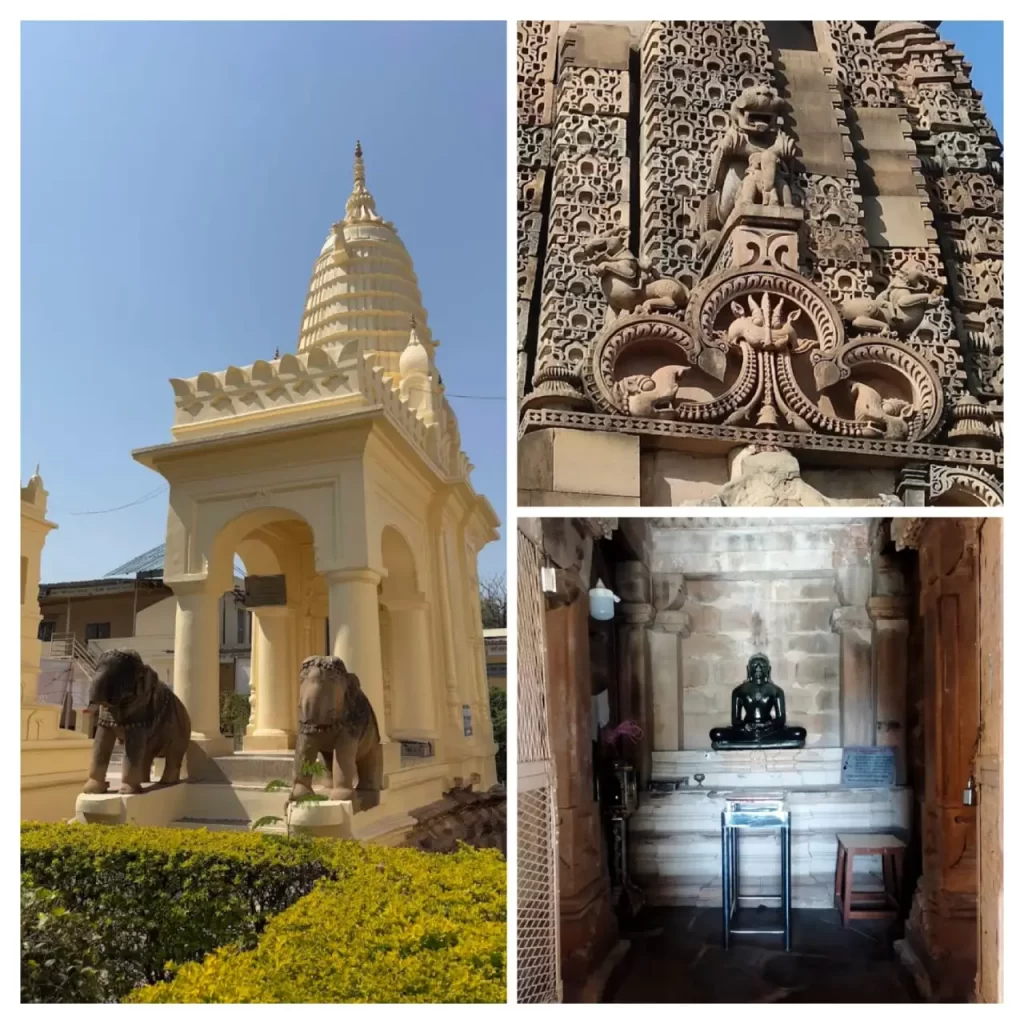
In the 19th century, when the Jain community revived active worship at the site, a new flat-roofed front hall with cusped masonry arches and plastered walls was built in front of the surviving medieval vestibule. This explains why, when you look at the temple today, the front entrance looks like a 19th-century arched pavilion while the back tower looks like a richly carved 11th-century stone mountain.
Architecture of the Adinath Temple: A Plain-English Walkthrough
Many visitors walk around Khajuraho’s temples admiring the carvings without knowing how the building is put together. The Adinath Temple is actually one of the easiest temples in Khajuraho to understand because of its compact footprint.
1. The Nirandhara Floor Plan (No Inner Walking Path)
Large temples in Khajuraho—like the Kandariya Mahadeva Temple or the neighboring Parsvanath Temple—are Sandhara temples, meaning they have an enclosed indoor path around the sanctum for walking circumambulation (pradakshina).
The Adinath Temple is smaller and follows a Nirandhara plan, which means it does not have an indoor walking passage around the sanctum. Instead, devotees walk around the outside of the temple on the open courtyard platform.
2. Only Two Original Medieval Chambers Survive
Of the original 11th-century sandstone structure, two main parts remain intact:
- Garbhagriha (Inner Sanctum): The sacred dark room housing the idol of Lord Adinath. From the outside, its walls are laid out on a sapta-ratha plan—meaning the stone wall steps outward in seven vertical projections, creating deep shadows that make the sculptures pop out in sunlight.
- Antarala (Vestibule): The small connecting passage right in front of the sanctum doorway.
Attached to the front of the antarala is the modern arched porch added during the later restoration.
3. The Shikhara (Curvilinear Tower)
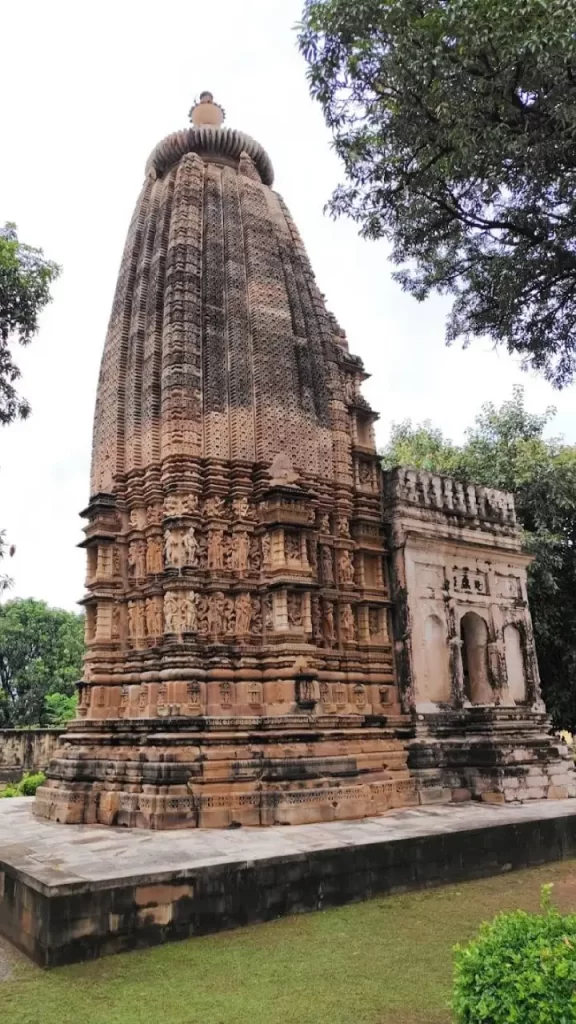
Look up at the tower rising above the sanctum. The Adinath Temple preserves one of the finest single-spire (ekandaka / latina-style) towers in the Eastern Group.
- Unlike larger temples that cluster dozens of mini-towers (urushringas) against the main spire, the Adinath Temple’s tower rises in a clean, graceful curve without heavy side-spires crowding its base.
- The top of the tower is crowned with a large ribbed stone disc called an amalaka, topped by a sacred pot-finial (kalasha).
- The fine geometric lattice-like stonework (gavakshas or arch motifs) covering the spire creates a lacy texture from bottom to top.
Sculptures and Carvings Not to Miss at Adinath Temple
Even though the Adinath Temple is a Jain house of worship dedicated to ascetic detachment, its exterior walls follow the classic Chandela artistic tradition. Unlike some people expect, there are no explicit erotic sculptures on the Adinath Temple. Instead, the carvings celebrate divine protectors, sacred knowledge, music, dance, and everyday grace.
Here is a step-by-step guide to what you should look for on-site:
1. The Three Horizontal Bands of the Outer Wall (Jangha)
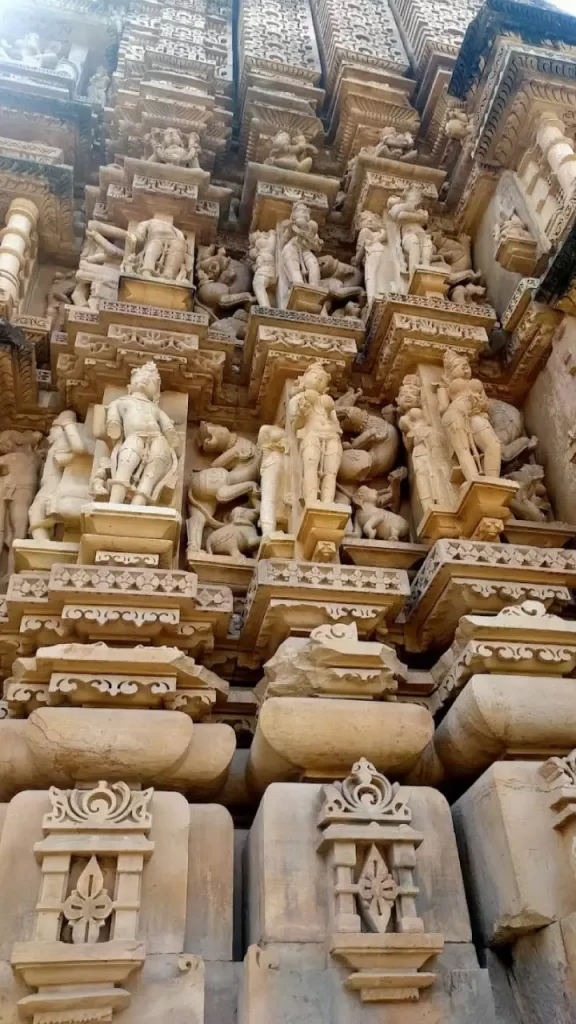
Walk around the back and sides of the sandstone sanctum. Notice how the main wall is divided into three horizontal rows (bands) stacked one above the other:
- The Lower and Middle Bands: Filled with tall, slender figures of Jain Vidyadevis (Goddesses of Sacred Knowledge), Yakshis (protective female nature spirits), Ashtadikpalas (Guardians of the Eight Directions), and Surasundaris (celestial nymphs).
- The Top (Third) Band: A lively frieze showing flying Vidyadharas (celestial beings carrying garlands), musicians playing drums and flutes, and graceful court dancers caught mid-spin.
- Mythical Vyala Figures: Tucked into the recessed corners between the human and divine figures are Vyalas—mythical lion-like beasts with the heads of elephants, parrots, or rams, symbolizing untamed cosmic energy.
2. The Graceful Surasundaris (Celestial Maidens)
The Surasundaris on the Adinath Temple are famous among art historians for their dynamic, twisting postures (tribhanga or three-bend pose) and expressive faces. Look closely to spot maidens:
- Applying kajal (eyeliner) or looking into a handheld mirror.
- Removing a thorn from the sole of a foot.
- Wringing water from wet hair after a bath while a swan waits below to catch the falling drops.
- Dressing and adjusting their ornaments before joining a festival dance.
3. Yakshi Ambika and Yakshi Chakreshwari
As the first Tirthankara, Lord Adinath is traditionally attended by specific guardian deities (Shasanadevatas). On the outer niches and doorway architraves of the temple, look for:
- Yakshi Chakreshwari: The primary protective goddess associated with Lord Adinath, seated on Garuda (the eagle vehicle) and holding multiple weapons, including chakras (discuses), in her hands.
- Yakshi Ambika: The beloved Jain mother-goddess shown seated beneath a cluster of ripe mangoes with a child and a lion nearby.
4. The Ornate Sanctum Doorway (Garbhagriha Dvara)
Before looking inside at the main idol, examine the stone doorframe of the inner sanctum:
- Top Lintel (Lalatabimba): The center of the lintel features a seated Jina image flanked by attendants and auspicious symbols.
- Door Jambs (Shakhas): Carved with scrolling creepers, musicians, protective Dvarapalas (door guardians), and river goddesses Ganga and Yamuna at the base.
- The Threshold (Udumbara): The bottom stone step is carved with a semi-circular Mandaraka (moonstone) projection flanked by protective lions and wealth deities.
How Adinath Temple Compares to Neighboring Jain Temples in Khajuraho
When you enter the Eastern Group Jain complex, you will find three major temples within walking distance of each other, plus the ruined Ghantai Temple just a short distance up the road. Many visitors get confused about which temple is which. Use this comparison table while exploring the compound:
| Temple Name | Century Built | Main Deity | Key Architectural Highlight |
| Adinath Temple | Late 11th Century CE | 1st Tirthankara Adinath (Rishabhanatha) | Compact Nirandhara plan; intact single-curved shikhara paired with a white 19th-century arched front porch. |
| Parsvanath Temple | Mid-10th Century CE | 23rd Tirthankara Parsvanath | The largest and finest Jain temple in Khajuraho; has an indoor walking passage (Sandhara) and famous sculptures like the maiden applying kohl. |
| Shantinath Temple | Modern enclosure with 11th-century parts | 16th Tirthankara Shantinath | A modern courtyard-style temple incorporating ancient Chandela pillars and housing a massive 15-foot (4.5-meter) standing idol of Lord Shantinath dated to 1028 CE. |
| Ghantai Temple | Late 10th Century CE | Jain Tirthankara (Rishabhanatha) | Located just outside the walled enclosure along the village road; an open-pillared ruin famous for pillars carved with chains and bells (ghanti). |
[INTERNAL LINK OPPORTUNITY — EASTERN & SOUTHERN GROUP TEMPLES]: If you have standalone articles on Parsvanath Temple, Ghantai Temple, Javari Temple, Vamana Temple, or Duladeo Temple, link their names in the table or paragraph above.


Practical Visitor Guide: Timings, Entry Fee, and Etiquette
Visiting the Eastern Jain Group is a much calmer experience than visiting the Western Group, provided you know a few practical details beforehand.
Temple Timings and Entry Fee
- Opening Hours: The complex is generally open daily from Sunrise to Sunset (around 6:00 AM to 6:00 PM).
- Entry Ticket: Free of charge. Unlike the Western Group of Monuments (which requires a paid ASI entry ticket for Indian and foreign visitors), the Eastern Group Jain enclosure has no entry fee.
- Photography: Outdoor photography of the Adinath Temple’s exterior walls and shikhara is freely permitted. However, please check posted signs or ask the caretaker before photographing the inner sanctum idols during active worship hours.
Best Time of Day to Visit for Photography and Darshan
- Early Morning (7:00 AM to 9:30 AM): Morning sunlight hits the eastern entrance and illuminates the intricate front doorway and southern wall bands cleanly. You may also witness quiet morning abhisheka (ritual bathing) and prayers at the neighboring Shantinath shrine.
- Late Afternoon (3:30 PM to 5:00 PM): Warm golden afternoon light brings out the deep 3D relief of the three sculptural bands on the western and northern sides of the garbhagriha.
Dress Code and Pilgrimage Etiquette
Because the Eastern Jain enclosure is an active religious compound (Digambara Jain Atishaya Kshetra) alongside being an ASI-protected monument group:
- Remove Footwear: Leave your shoes and socks at the designated shoe stand near the entrance of the compound. In summer (April to June), bring thick cotton socks to walk across the hot stone courtyard.
- Dress Modestly: Wear clothes that cover your shoulders and knees.
- Avoid Leather Items if Entering Active Sanctums: Traditional Jain temple custom discourages carrying leather belts, wallets, or bags close to the inner sanctum.
- Maintain Silence: Respect Jain devotees and monks (munis or aryikas) who may be meditating or performing prayers inside the compound.
Festivals and Special Occasions at Adinath Temple
While the Adinath Temple is peaceful year-round, visiting during these occasions adds cultural depth to your trip:
- Adinath Jayanti (Chaitra Krishna Navami): Celebrated in March or April to mark the birth and initiation (diksha) day of the first Tirthankara, Lord Adinath. Special prayers, chanting of the Bhaktamara Stotra, and ritual offerings take place inside the Jain enclosure.
- Mahavir Jayanti (March/April) & Paryushana Parva (August/September): The local Jain community gathers across the Shantinath, Parsvanath, and Adinath shrines for collective worship, scripture readings, and processions.
- Khajuraho Dance Festival (February): Organized annually by the Department of Culture and detailed on the Madhya Pradesh Tourism official portal, this week-long classical dance festival brings Bharatanatyam, Kathak, Odissi, and Kuchipudi performances to the backdrop of Khajuraho’s illuminated temples, echoing the very court dancers carved on the walls of the Adinath Temple.



How to Reach Adinath Temple, Khajuraho
The Adinath Temple is located in Sevagram (Old Khajuraho Village), roughly 1.5 to 2 kilometers southeast of the main Western Group ticket counter. For civic and regional road updates, travellers can also consult the official Chhatarpur district administration portal.
Moving From the Western Group to the Eastern Jain Group
- By Auto-Rickshaw or E-Rickshaw: Readily available outside the Western Group gate; takes 5 to 7 minutes.
- By Bicycle: One of the best ways to explore the Eastern Group. Many guesthouses and stalls near Shivsagar Lake rent bicycles by the hour or day, allowing you to stop easily at Vamana Temple, Javari Temple, Ghantai Temple, and the Jain Temple Enclosure.
- On Foot: A pleasant 20-to-25-minute walk through the peaceful village lanes past the Old Khajuraho Lake (Khajur Sagar).
Reaching Khajuraho by Air, Train, and Road
- By Air: Khajuraho Airport (HJR) is located only 4 to 5 km south of the Eastern Group. Seasonal and regular flights connect Khajuraho with Delhi and Varanasi. Pre-paid taxis and auto-rickshaws are available outside the terminal.
- By Train: Khajuraho Railway Station (KURJ) is about 7 to 8 km from the temple complex. Direct trains—including the Vande Bharat Express and Gita Jayanti Express—connect Khajuraho to New Delhi, Bhopal, Jhansi, Agra, Jaipur, and Udaipur. Alternatively, Mahoba Junction (65 km) and Jhansi Junction (175 km) serve as major rail hubs with wider national connectivity.
- By Road: Khajuraho is well connected via National Highway 39 (NH 39) to Chhatarpur (45 km), Panna National Park (40 km), Satna (117 km), Jhansi (175 km), and Orchha (170 km). Both state-run buses and private taxis operate daily along these routes.
Facilities Available at the Eastern Jain Temple Complex
Because the Adinath Temple sits inside a well-maintained Jain trust compound, visitors have access to better basic amenities here than at some of the isolated field monuments in Khajuraho:
- Shoe Storage & Drinking Water: Available near the compound entrance gate.
- Small Jain Museum (Sahu Shanti Prasad Jain Art Museum): Located right near the entrance of the Jain enclosure, displaying detached medieval Jain sculptures, Tirthankara idols, and fragments recovered from around Khajuraho.
- Dharamshala / Pilgrim Rest House: Simple accommodation and pure vegetarian/Jain food (bhojanshala) facilities are maintained within the compound primarily for Jain pilgrims.
- Wheelchair & Senior Accessibility: The outer courtyard path to the Adinath Temple is largely flat and paved, though stepping into the raised porch and sanctum area requires climbing a few stone steps.
Suggested 90-Minute Walking Route for the Eastern Group
To make the most of your visit without backtracking, follow this easy loop in the Eastern Group:
- Start at Vamana Temple & Javari Temple (Northern subsection of Eastern Group): Spend 25 minutes admiring these two compact Hindu temples near Khajuraho village.
- Stop at Ghantai Temple (10 minutes): On your way south toward the Jain enclosure, pause at the roadside ruins of Ghantai Temple to photograph its famous bell-and-chain carved pillars.
- Enter the Jain Enclosure (45–50 minutes):
- Visit Parsvanath Temple first to see the grand 10th-century Sandhara design.
- Step right next door to Adinath Temple to compare its 11th-century single-spire Shikhara, three sculptural bands, and 19th-century arched porch.
- Finish at Shantinath Temple to bow before the towering 15-foot monolithic statue of Lord Shantinath.
- Visit the Jain Museum (10 minutes): Browse the circular gallery near the gate before exiting.
Frequently Asked Questions (FAQs) About Adinath Temple, Khajuraho
1. Which group of monuments does the Adinath Temple in Khajuraho belong to?
The Adinath Temple belongs to the Eastern Group of Monuments in Khajuraho. It is located inside the walled Jain Temple Enclosure in Sevagram (Old Khajuraho village), about 1.5 to 2 kilometers southeast of the famous Western Group of Temples.
2. Is there an entry fee to visit the Adinath Temple in Khajuraho?
No, there is no entry fee to visit the Adinath Temple or the other temples inside the Eastern Group Jain complex (Parsvanath and Shantinath temples). Only the Western Group of Monuments in Khajuraho requires a paid ASI entry ticket.
3. Who built the Adinath Temple in Khajuraho and when?
The Adinath Temple was built during the late 11th century CE under the patronage of the Chandela dynasty. It was constructed slightly later than the neighboring 10th-century Parsvanath Temple.
4. Why does the front of the Adinath Temple look modern compared to the back tower?
The original 11th-century pillared hall (mandapa) and porch collapsed centuries ago. In the 19th century, a new flat-roofed entrance porch with arched doorways and plastered walls was added to the front of the surviving medieval vestibule (antarala) and sanctum (garbhagriha).
5. Is the black idol of Lord Adinath inside the temple original to the 11th century?
No. While the temple’s sandstone sanctum, doorway, and outer spire date to the late 11th century CE, the polished black stone statue of Lord Adinath (Rishabhanatha) currently worshipped inside the sanctum is a later installation placed on the historic pedestal.
6. Are there erotic sculptures on the Adinath Temple in Khajuraho?
No, the Adinath Temple does not feature explicit erotic panels. Its three horizontal wall bands are carved with Jain Vidyadevis (goddesses of knowledge), Yakshis (such as Ambika and Chakreshwari), mythical Vyalas, musicians, court dancers, and graceful Surasundaris (celestial maidens) engaged in everyday activities.
7. What is the difference between the Parsvanath Temple and the Adinath Temple?
Both stand side by side in the same Jain compound, but Parsvanath Temple (mid-10th century) is larger and has an indoor circumambulatory path (Sandhara plan). Adinath Temple (late 11th century) is smaller, lacks an indoor walking path (Nirandhara plan), and features a cleaner, single-towered shikhara paired with a 19th-century arched front porch.
8. How much time is needed to visit the Adinath Temple?
You need about 30 to 45 minutes to closely examine the outer sculptures, doorway carvings, and inner sanctum of the Adinath Temple. Allow 1 to 1.5 hours in total to see the entire Eastern Jain enclosure, including the neighboring Parsvanath and Shantinath temples.