Thanumalayan Temple, Suchindram: Complete Guide to the Sacred Trimurti Shrine
The Thanumalayan Temple (also revered as the Sthanumalayan Temple) in Suchindram, Tamil Nadu, is one of India’s most extraordinary pilgrimage destinations. It is one of the rare temples where the Hindu Trinity—Brahma, Vishnu, and Shiva—is worshipped together within a single sanctum as a unified deity called Trimurti.
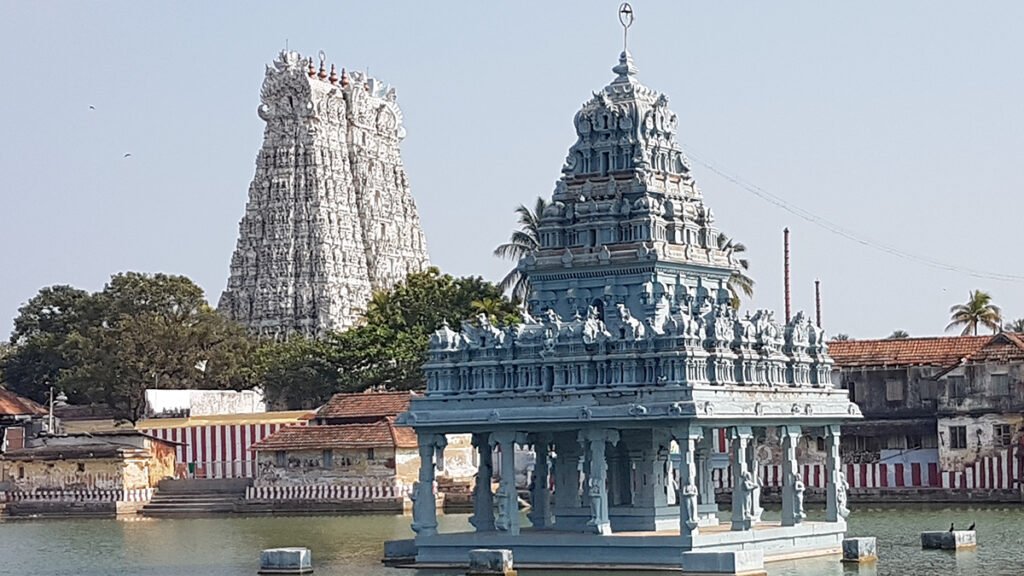
Located just 13 kilometers from Kanyakumari and 6 kilometers from Nagercoil, this 9th-century architectural masterpiece is renowned for its soaring seven-tier white gopuram, musical granite pillars, a massive 22-foot monolithic statue of Lord Hanuman, and deep spiritual traditions connecting sacred Puranic legends with Travancore royal heritage.
Quick Information: Thanumalayan Temple, Suchindram
| Feature | Details |
| Temple Name | Thanumalayan Temple (Sthanumalayan Temple / Suchindram Temple) |
| Primary Deity | Sthanumalayan (Trimurti: Shiva, Vishnu, and Brahma in one Lingam) |
| Location | Suchindram, Kanyakumari District, Tamil Nadu, India |
| Pin Code | 629704 |
| Darshan Timings | Morning: 04:30 AM – 11:30 AM | Evening: 05:00 PM – 08:30 PM |
| Major Festivals | Margazhi Car Festival (Therottam, Dec–Jan), Chithirai Festival (Apr–May) |
| Dress Code | Strict: Men must wear dhoti/veshti (bare chest required; shirts must be removed); Women must wear saree, half-saree, or salwar kameez. |
| Key Architectural Highlights | 134-foot Rajagopuram, 4 Monolithic Musical Pillars, 22-ft Hanuman Monolith |
| Nearest Railway Station | Nagercoil Junction (NCJ) – 6 km; Kanyakumari (CAPE) – 13 km |
| Nearest Airport | Trivandrum International Airport (TRV) – approx. 75 km |
| Administration | Kanyakumari District Devaswom Board / Tamil Nadu HR&CE |
Continue Reading : Kashi Vishalakshi Temple Varanasi.
The Meaning of Thanumalayan: The Trinity in a Single Lingam
The name Thanumalayan (or Sthanumalayan) explains the theological identity of the temple:
Sthanumalayan = Sthanu (Shiva) + Mal (Vishnu) + Ayan (Brahma)
- Sthanu refers to Lord Shiva (the eternal pillar or foundation).
- Mal refers to Lord Vishnu (the protector and preserver).
- Ayan refers to Lord Brahma (the creator born from the lotus).
In traditional Hindu iconography, Shiva, Vishnu, and Brahma are usually worshipped in separate shrines or distinct temples. At Suchindram, the central lingam inside the sanctum sanctorum (Garbhagriha) represents all three deities simultaneously:
- The top portion represents Lord Shiva.
- The middle portion represents Lord Vishnu.
- The base portion represents Lord Brahma.
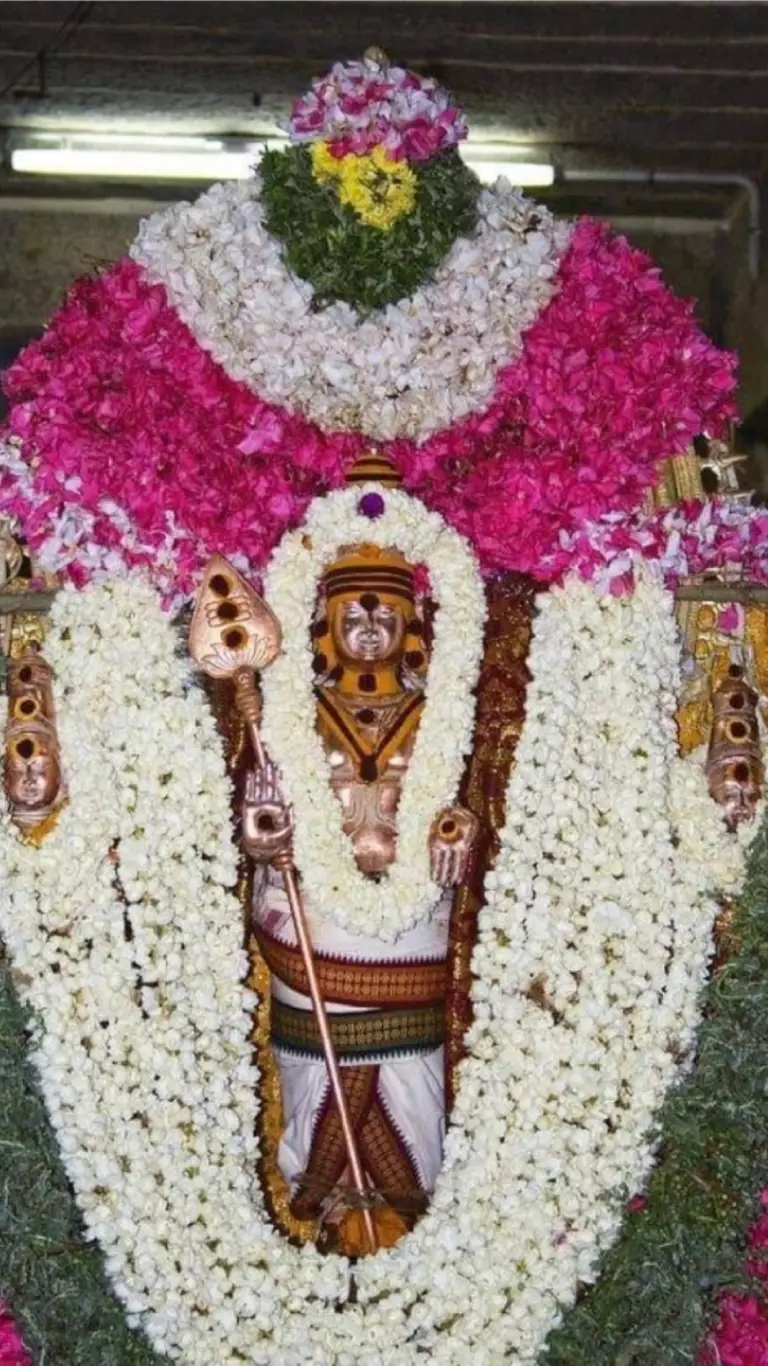
The lingam is adorned with an ornate gold covering (Kavacham) embossed with the divine faces of the Trinity, visually illustrating the underlying philosophical unity of creation, preservation, and dissolution. Devotees seeking harmony between Shaivite and Vaishnavite traditions hold this temple in immense reverence, comparing its spiritual status to the most sacred Shiva temples across South India.
Continue Reading : Attahas Temple Birbhum Shaktipeeth
Sacred Sthala Purana: The Legends of Suchindram
The spiritual heritage of Suchindram is rooted in two celebrated legends recorded in regional Puranic texts: the purification of Lord Indra and the divine test of Sage Atri’s wife, Anasuya.
1. The Purification of Lord Indra (Suchi-Indran)
The word Suchindram is derived from the Sanskrit roots Suchi (meaning pure or cleansed) and Indra (the king of the Devas).
According to temple lore, Lord Indra was cursed by Sage Gautama Maharishi for his deceitful conduct regarding Ahalya. To cleanse himself of this severe spiritual affliction, Indra performed intense penance on the banks of the Pazhayar River at this spot, worshipping the Trimurti lingam.
Pleased by his devotion, the Trinity relieved Indra of his curse and purified him. In gratitude, Indra instituted the practice of performing the midnight puja (Ardhajama Pooja) at the temple. Traditional temple belief holds that Lord Indra visits the sanctum every single night in an invisible form to conduct the final worship ritual after the temple priests lock the outer sanctum doors.
2. The Chastity of Devi Anasuya
Another cherished sthala purana associated with Suchindram tells of Sage Atri and his devout wife, Anasuya. Her unwavering chastity and spiritual purity gained such renown across the cosmos that the Tridevas (Brahma, Vishnu, and Shiva) decided to test her virtue.
Disguised as wandering ascetics (sadhus), the three gods approached Anasuya’s hermitage while Sage Atri was away and asked for alms on one condition: she must serve them food without wearing any clothes.
Using the spiritual power derived from her devotion, Anasuya transformed the three powerful gods into infant babes. She then fed them like a mother, fulfilling their condition without violating her modesty. When Goddesses Saraswati, Lakshmi, and Parvati realized what had happened, they rushed to the hermitage and appealed to Anasuya to return their consorts to their divine forms. Anasuya complied, and in return, the three gods manifested together as a unified divine presence, blessing the hermitage grounds as a sacred realm for all future generations.
Architectural Wonders of Thanumalayan Temple
Covering an expansive area of over two acres, the Thanumalayan Temple showcases an exquisite confluence of Pandya, Chola, Vijayanagara, and Travancore architectural styles.
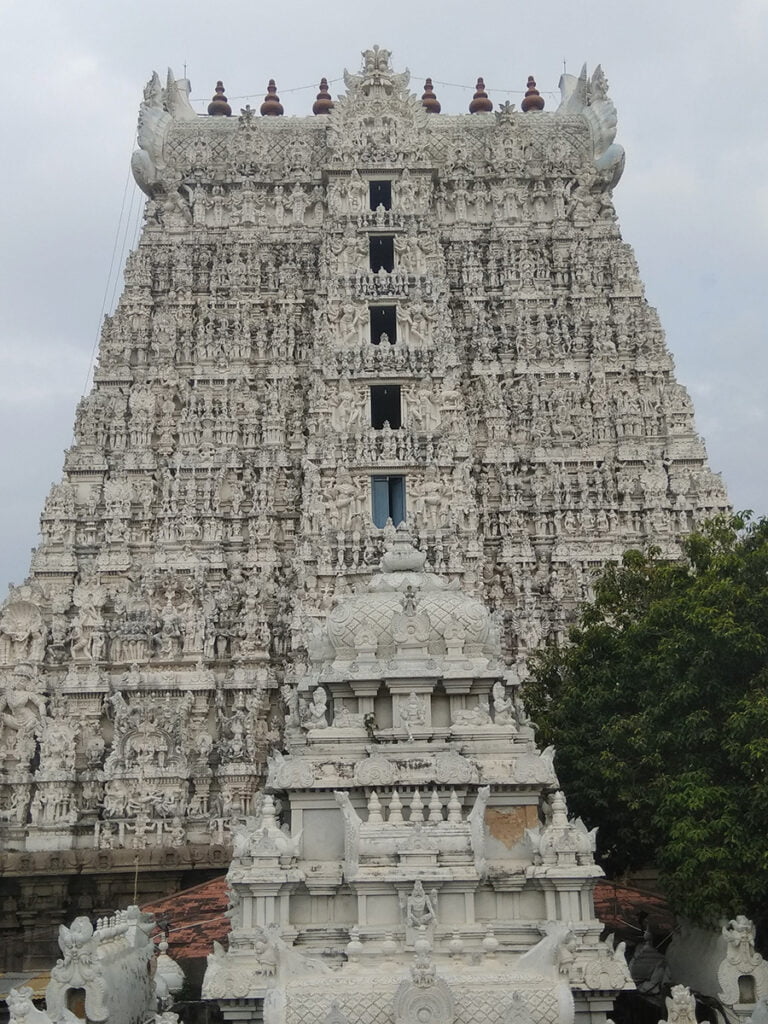
1. The Soaring 134-Foot Rajagopuram
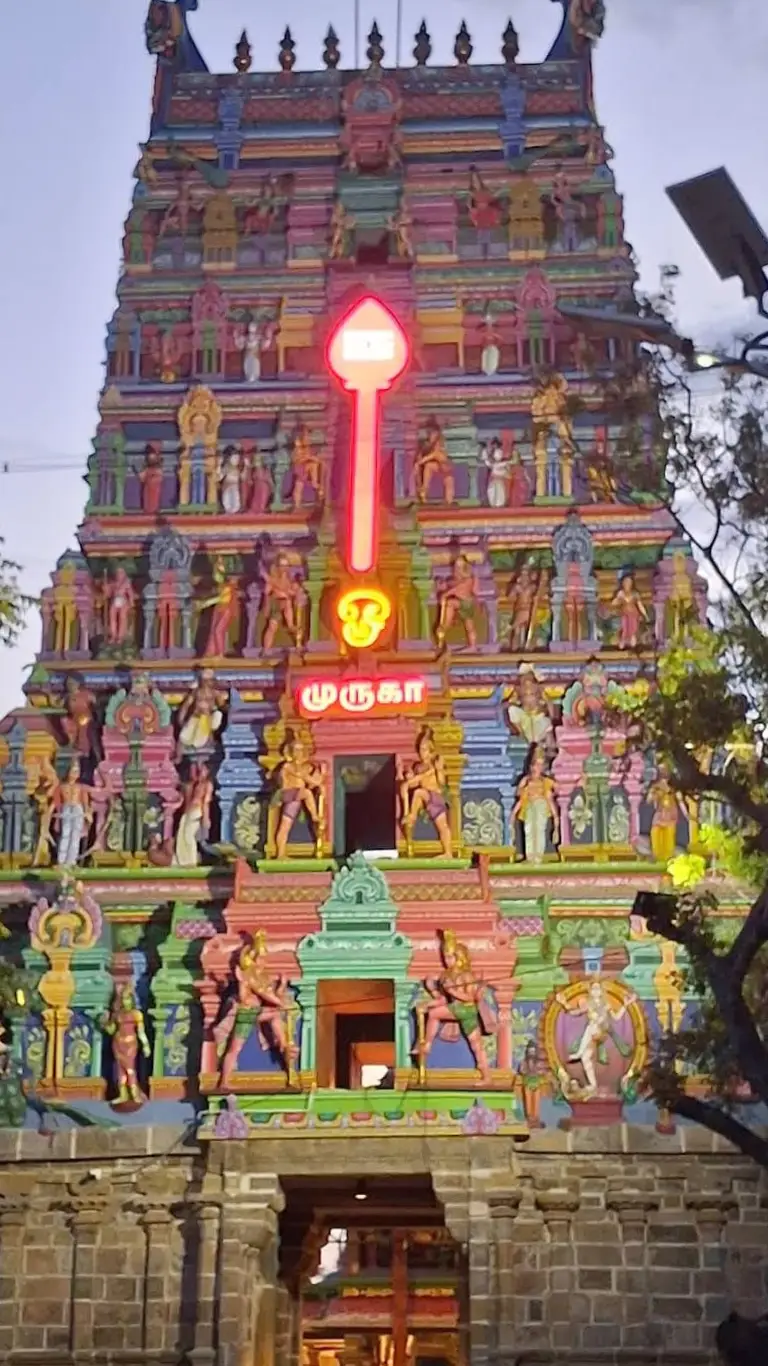
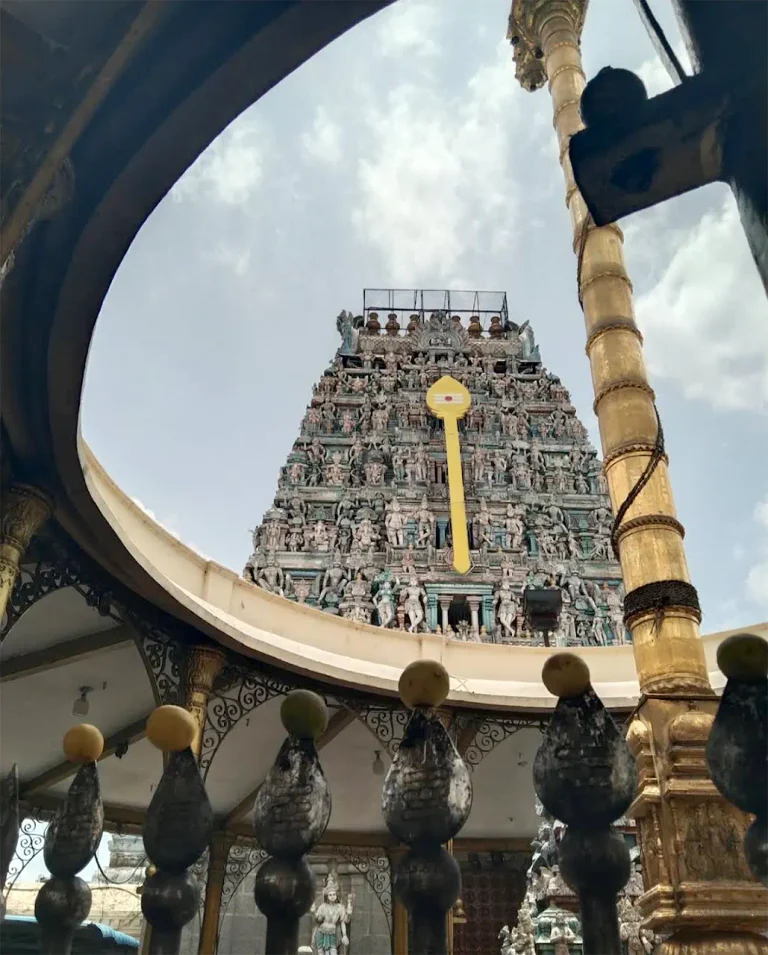
The eastern entrance of the temple is crowned by a magnificent, pristine white seven-tier Rajagopuram rising to a height of 134 feet (approximately 41 meters). Adorned with hundreds of intricately carved stucco sculptures depicting scenes from the Ramayana, the Mahabharata, and the Puranas, this imposing tower is visible from miles across the verdant coconut groves of Kanyakumari district. The entrance doorway is supported by heavy timber frames and massive stone lintels bearing ancient Tamil and Vatteluttu inscriptions.
2. The Acoustic Monolithic Musical Pillars
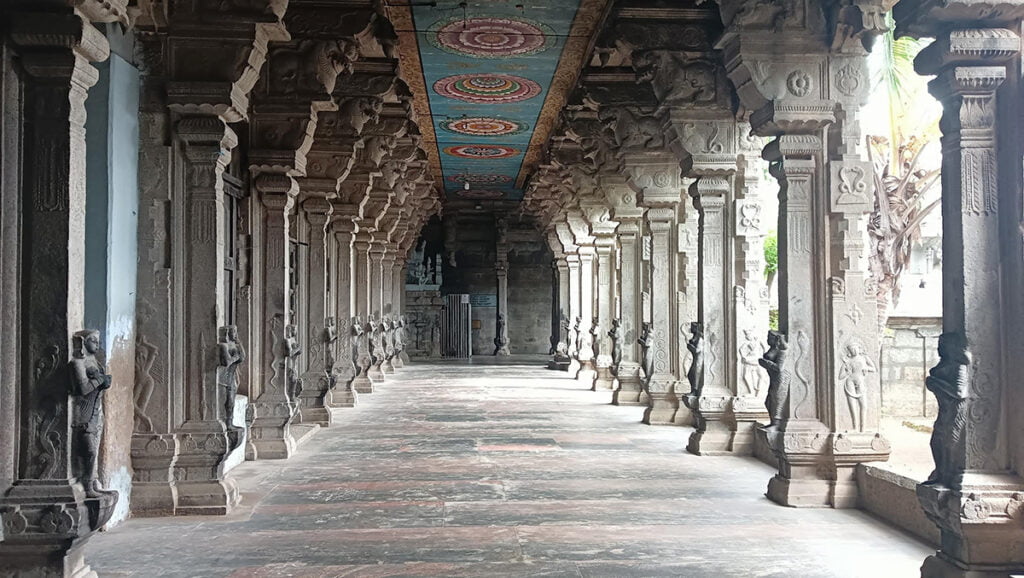
In the Alankara Mandapam (often referred to in connection with the Kulasekhara Mandapam), visitors will encounter four masterfully crafted musical pillars that are celebrated across the world for their acoustic precision.
Each primary pillar is cut from a single granite boulder and comprises a central column surrounded by a cluster of 24 to 33 slender, hollow-sounding stone balusters. When tapped gently with the knuckle or a wooden mallet, these stone shafts produce distinct musical notes (Swaras) corresponding to Indian classical music scales. The architectural mastery required to quarry, carve, and tune granite stone to specific acoustic frequencies without cracking the block remains a source of fascination for acoustic engineers and historians alike.
Visitor Etiquette Note: To protect these ancient stone pillars from erosion and acoustic degradation, the temple administration strictly regulates direct physical contact. Visitors are requested to admire them respectfully and follow the instructions of the temple guides and Devaswom staff.
Continue Reading >> Chelamattom Sreekrishna Swami Temple: Powerful Temple for Ancestors
3. The Colossal 22-Foot Monolithic Anjaneyar (Hanuman)
Another central marvel of the Suchindram temple is the majestic monolithic statue of Lord Anjaneyar (Hanuman). Standing at an imposing height of 22 feet (6.7 meters), this colossal granite murti is one of the largest ancient Hanuman statues in India.
- The figure depicts Hanuman in a humble, devoted posture with his hands folded across his chest and his tail arching upward behind his head.
- Historical Concealment: In the 18th century, fearing attacks during regional military invasions, temple priests carefully buried the colossal idol underground in the temple premises to prevent desecration.
- Rediscovery in 1930: The sacred statue was successfully rediscovered and re-installed in its present position in 1930, where it now draws thousands of devotees seeking courage, protection, and relief from planetary afflictions. Special butter-offering rituals (Vennai Kaapu) are regularly performed on this monolithic deity.
4. The Navagraha Mandapam Ceiling
In front of the sanctum sanctorum, the ceiling of the outer hall features a rare, intricately carved stone panel depicting the Navagrahas (the nine astrological planetary deities) along with the twelve signs of the zodiac (Rasis). Unlike typical temple arrangements where the nine planets are installed on an elevated rectangular pedestal, this ceiling installation allows devotees to walk beneath the planetary alignments, a sacred spatial arrangement found in select ancient Navagraha temples of South India.
Continue Reading : Shri Jogadya Shaktipeeth, Kshirgram, West Bengal
Historical Timeline & Inscriptions
The epigraphic history of Suchindram spans over a millennium, documenting patronage from multiple South Indian dynasties:
- Early Medieval Era (9th Century): The earliest surviving stone inscriptions date back to the reign of the imperial Cholas and early Pandyas. Inscriptions from the time of Parantaka Chola I and Rajaraja Chola I document land grants, gold endowments, and oil provisions for perpetual temple lamps (Nanda Deepam).
- Venad and Travancore Patronage (15th–18th Century): Suchindram served as one of the premier state temples of the Venad Kingdom and later the Kingdom of Travancore. The rulers of Travancore undertook monumental renovations, adding the towering gopuram, massive cloistered mandapams, and the royal silver vahanas.
- Modern Administration: While historically managed within the Travancore state framework, following the 1956 States Reorganisation Act, Kanyakumari district became part of Tamil Nadu. Today, the shrine is administered under the dedicated supervision of the Kanyakumari District Devaswom Board under the Hindu Religious and Charitable Endowments (HR&CE) framework.
Continue Reading >> 11 CE Adinath Temple Khajuraho
Suchindram Temple Timings: Daily Darshan and Pooja
The temple maintains a traditional split-hour schedule, opening early in the morning for morning oblations and closing during the afternoon before reopening for evening rituals.
- Morning Opening & Vishwaroopa Darshan: 04:30 AM
- Usha Pooja (Morning Rituals): 06:00 AM
- Uchikala Pooja (Midday Rituals): 11:00 AM
- Morning Temple Closure: 11:30 AM
- Evening Temple Reopening: 05:00 PM
- Sayarakshai (Sunset Deeparadhana): 06:30 PM
- Ardhajama Pooja (Night Closure Ritual): 08:00 PM
- Night Temple Closure: 08:30 PM
Note: Timings are subject to minor adjustments during solar/lunar eclipses and major temple festivals like Margazhi.
Continue Reading >> Basara Gnana Saraswati Temple.


Dress Code, Rules, and Visitor Etiquette
The Thanumalayan Temple adheres strictly to traditional Travancore spiritual protocol. Visitors who fail to comply with the dress code are not permitted past the inner courtyard entrance.
- Dress Code for Men:
- Men must wear a clean Dhoti (Veshti) or traditional pyjama.
- Shirtless Rule: Men must remove their shirts, vests, and upper garments before entering the main temple enclosures. Wearing an angavastram (cloth draped over the shoulders) is permitted, but it must be removed or folded respectfully when standing directly before the sanctum.
- Prohibited: Trousers, jeans, shorts, Bermuda shorts, t-shirts, and caps.
- Dress Code for Women:
- Traditional attire is mandatory: Sarees, half-sarees (Pavadai Dhavani), or modest Salwar Kameez with a dupatta.
- Prohibited: Jeans, skirts, sleeveless tops, western dresses, and shorts.
- Photography and Electronics:
- Photography, videography, and mobile phone usage are strictly prohibited inside the temple premises. Mobile phones must be deposited at the official counter or kept in vehicles.
- Footwear:
- Footwear must be removed and deposited at the designated shoe stand located outside the main gopuram entrance.
Continue Reading >> Kanchi Kamakshi Temple: One of Powerful 18 Shakti Peethas
Major Festivals Celebrated at Suchindram
1. Margazhi Perunthiruvizha (December – January)
The Margazhi Car Festival is the most celebrated annual event at the Thanumalayan Temple. Spanning 10 continuous days, this vibrant winter festival attracts tens of thousands of pilgrims from across Tamil Nadu and Kerala.
- The Grand Car Procession (Therottam): On the ninth day of the festival, three colossal, intricately carved wooden temple chariots (Thers) carrying Lord Thanumalayan, Goddess Aramvalartha Nayaki (Amman), and Lord Ganesha are pulled along the four broad car streets surrounding the temple by thousands of chanting devotees.
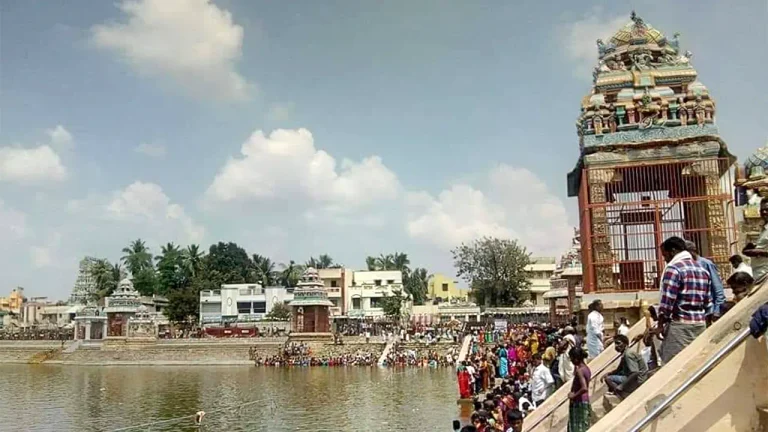
- The Divine Reunion (Vettai & Theppam): The festival also features the sacred temple float festival (Theppotsavam) conducted in the expansive sacred temple tank located directly across the temple entrance.
2. Chithirai Festival (April – May)
Celebrated in the Tamil month of Chithirai, this festival marks special annual poojas, musical processions, and traditional temple drum performances (Chenda Melam), honoring the seasonal renewal.
3. Hanuman Jayanti (December – January)
Hanuman Jayanti is celebrated with deep devotional fervor at the 22-foot Anjaneyar shrine. The colossal deity is sanctified with thousands of liters of milk, panchamritam, sandal paste, and a massive garland made of tens of thousands of betel leaves or deep-fried vadas (Vada Malai).
Continue Reading >> Vidyashankara Temple Sringeri 12 Pillars Reveal Your Destiny
How to Reach Thanumalayan Temple
Suchindram is situated right off National Highway 47 (NH 47), making road connectivity seamless from all parts of southern Tamil Nadu and Kerala.
- From Nagercoil (6 km): Nagercoil is the primary transit gateway. State government buses (TNSTC) run every 5 to 10 minutes between the Anna Bus Stand in Nagercoil and Suchindram. Auto-rickshaws and taxis are readily available outside the Nagercoil railway station.
- From Kanyakumari (13 km): Local town buses connecting Kanyakumari and Nagercoil halt directly at the Suchindram temple bus stop. The travel time by car or bus is approximately 20 to 25 minutes. Devotees planning coastal pilgrimages can easily integrate this shrine into their Kanyakumari itinerary alongside the celebrated coastal sanctums.
- By Train:
- Nagercoil Junction (NCJ): 6 km away (connects major express trains across India).
- Kanyakumari Railway Station (CAPE): 13 km away.
- By Air: The nearest airport is Trivandrum International Airport (TRV) in Thiruvananthapuram, Kerala, located approximately 75 kilometers away (approx. 2 to 2.5 hours by road via NH 66).
Practical Pilgrimage Tips for Visitors
- Beat the Heat and Crowds: The optimal time to experience darshan is early in the morning between 05:00 AM and 07:00 AM. The stone courtyards can become quite warm by midday.
- Estimated Visit Duration: Plan for at least 1.5 to 2 hours to comfortably complete darshan, admire the musical pillars, and circumambulate the 22-foot Hanuman shrine.
- Temple Tank (Kalyani): Take a moment to sit by the historic temple tank, known as the Pragya Theertham, located right opposite the Rajagopuram. It offers a majestic panoramic view of the temple tower reflected against the sacred waters.
- Nearby Sacred Sites: You can easily combine your visit to Suchindram with other significant spiritual sites in the circuit, such as the Nagaraja Temple in Nagercoil (7 km) or the ancient rock-cut cave temples of Thirunanthikarai.
Frequently Asked Questions (FAQs)
What is unique about the deity at Thanumalayan Temple?
The temple features a rare unified representation of the Hindu Trinity in a single lingam: Lord Shiva (Sthanu), Lord Vishnu (Mal), and Lord Brahma (Ayan), symbolizing the unity of creation, preservation, and dissolution.
What are the darshan timings at Suchindram Temple?
The temple is open daily in two sessions: morning from 04:30 AM to 11:30 AM, and evening from 05:00 PM to 08:30 PM.
Is there an entry fee at Thanumalayan Temple?
General entrance to the temple is free for all devotees. During peak festival seasons and crowded weekends, dedicated special darshan queues may be arranged by the Devaswom Board for a nominal token fee.
What is the height of the Hanuman statue in Suchindram?
The monolithic granite statue of Lord Anjaneyar (Hanuman) at Suchindram stands 22 feet (approximately 6.7 meters) tall and is carved out of a single piece of granite.
Can men wear shirts inside the temple?
No. In keeping with ancient Travancore temple traditions, men are strictly required to remove their shirts, t-shirts, and vests before entering the temple corridors. They must wear a traditional dhoti or veshti.
Which is the nearest railway station to Suchindram Temple?
The nearest major railhead is Nagercoil Junction (NCJ), situated just 6 km away, which offers broad direct rail connectivity to Chennai, Bengaluru, Mumbai, and New Delhi.