Hoysaleshwara Temple at Halebidu: Complete Guide to History, Timings, Architecture, and Travel
Hoysaleshwara Temple at Halebidu is a magnificent 12th-century Hindu temple dedicated to Lord Shiva, located in the Hassan district of Karnataka, India. Built during the height of the Hoysala Empire, it stands as one of the greatest masterpieces of medieval Indian art, celebrated worldwide for its dual-sanctum design, twin monolithic Nandi shrines, and thousands of intricate soapstone wall carvings. In September 2023, UNESCO officially inscribed this sacred site on the World Heritage list as part of the Sacred Ensembles of the Hoysalas.
Whether you are a pilgrim offering devotion to Lord Shiva, a lover of ancient art, or a family planning a road trip across South India, this complete visitor guide covers the temple’s royal history, daily timings, architectural wonders, and essential travel tips.
Quick Information: Hoysaleshwara Temple at a Glance
| Feature | Verified Detail |
| Temple Name | Hoysaleshwara Temple (also spelled Hoysaleswara) |
| Main Deity | Lord Shiva (enshrined as Hoysaleshwara and Shantaleshwara Lingas) |
| Location | Halebidu, Hassan District, Karnataka, India |
| Pin Code | 573121 |
| Historical Era | 12th Century CE (Begun c. 1121 CE under King Vishnuvardhana) |
| Architectural Style | Karnata Dravida / Hoysala Architecture (Star-shaped Soapstone layout) |
| Heritage Status | UNESCO World Heritage Site (Inscribed September 2023) |
| Daily Visiting Hours | 6:30 AM to 6:30 PM (Open all days) |
| ASI Museum Timings | 9:00 AM to 5:00 PM (Closed on Fridays) |
| Entry Fee | Free entry to the temple complex; nominal fee for the ASI Site Museum |
| Best Time to Visit | October to March (Pleasant winter weather) |
| Nearest Railway Station | Hassan Junction (Approx. 31 km) |
| Nearest International Airport | Kempegowda International Airport, Bengaluru (Approx. 225 km) |
| Dress Code | Modest and respectful attire suited for a sacred Hindu monument |
Why Hoysaleshwara Temple is Famous
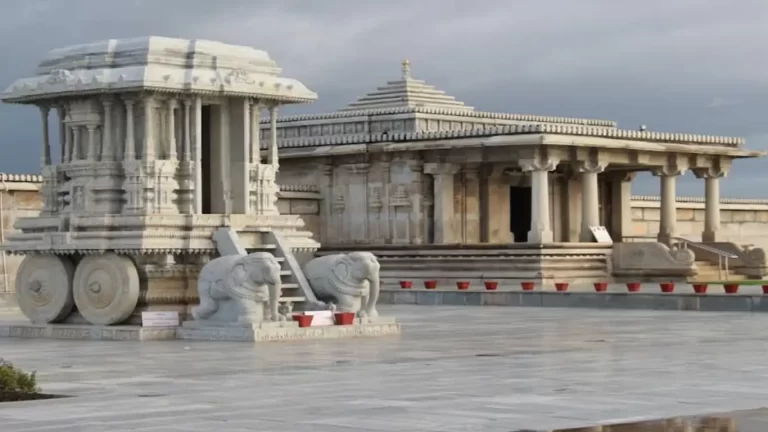
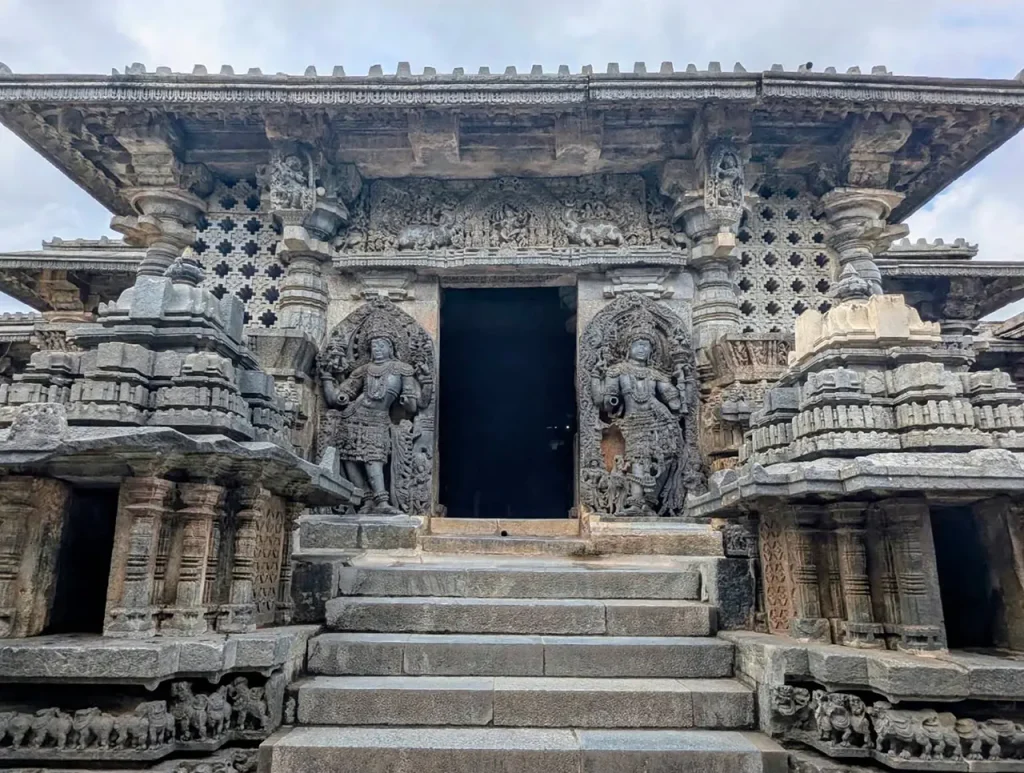
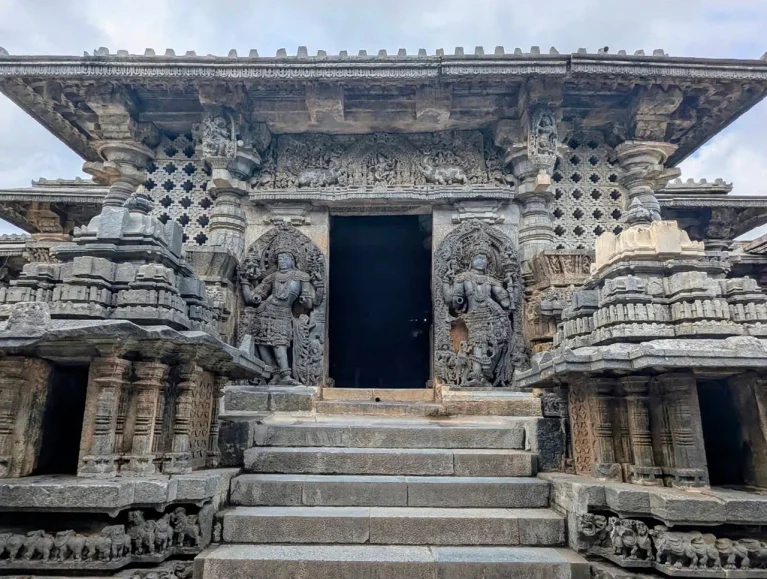
When you first step onto the grounds of Halebidu, the sheer scale of the temple takes your breath away. Most ancient temples feature a single central sanctum under a soaring tower. Hoysaleshwara Temple is different: it is a dvikuta, or twin-temple complex, built side by side on an expansive, raised star-shaped stone platform.
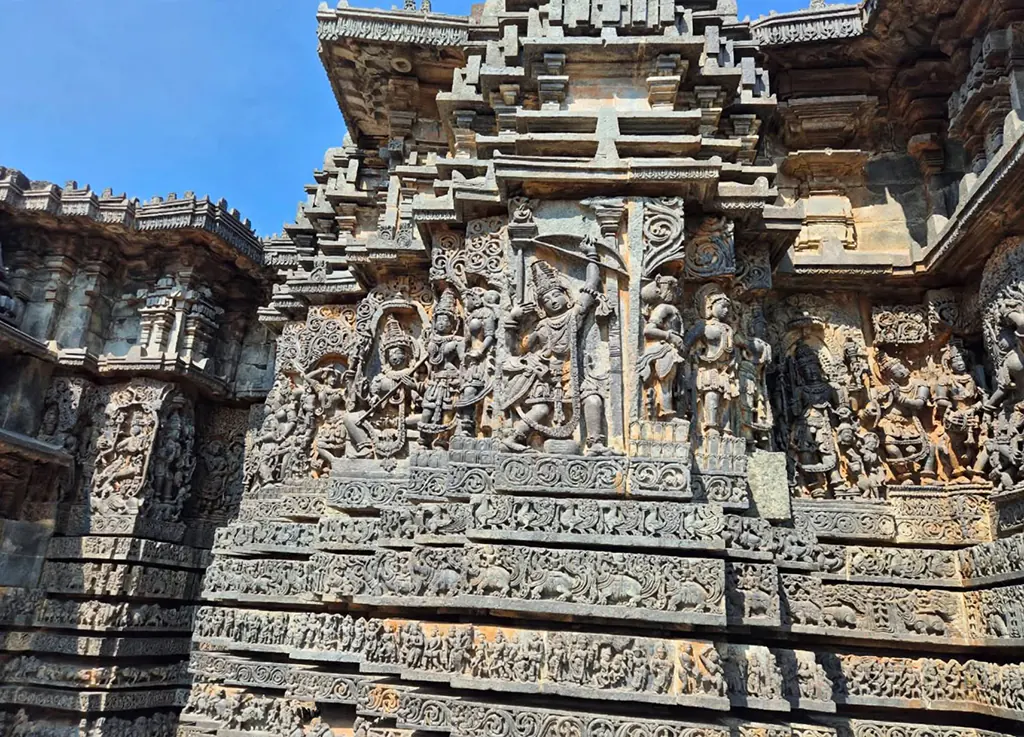
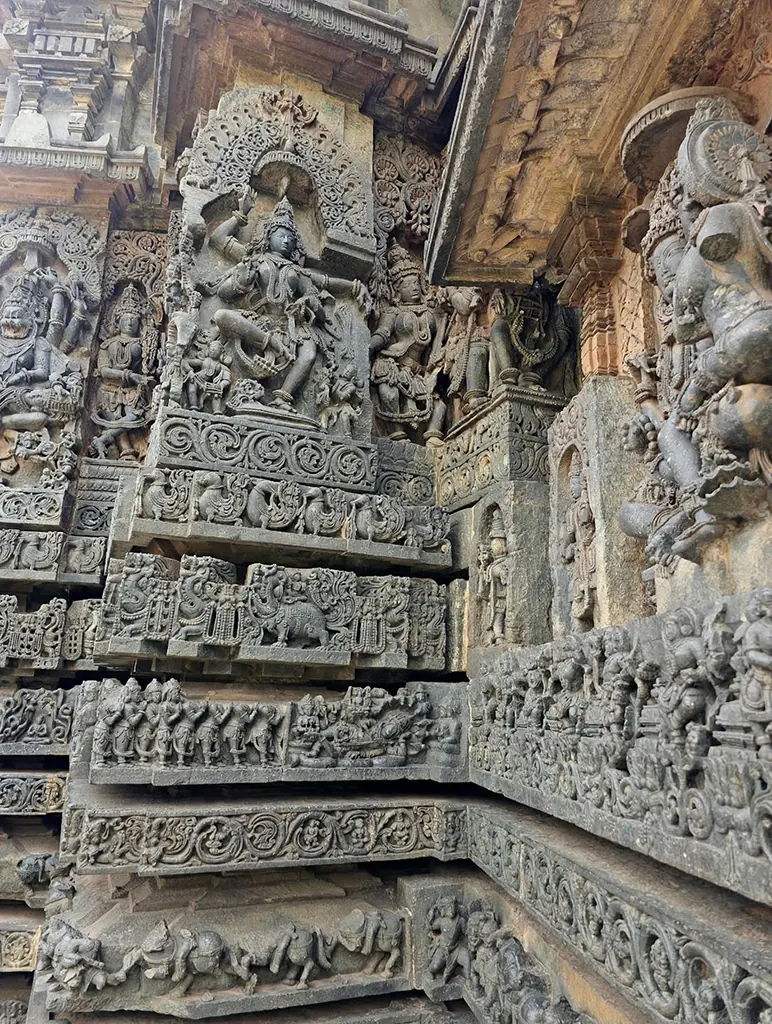
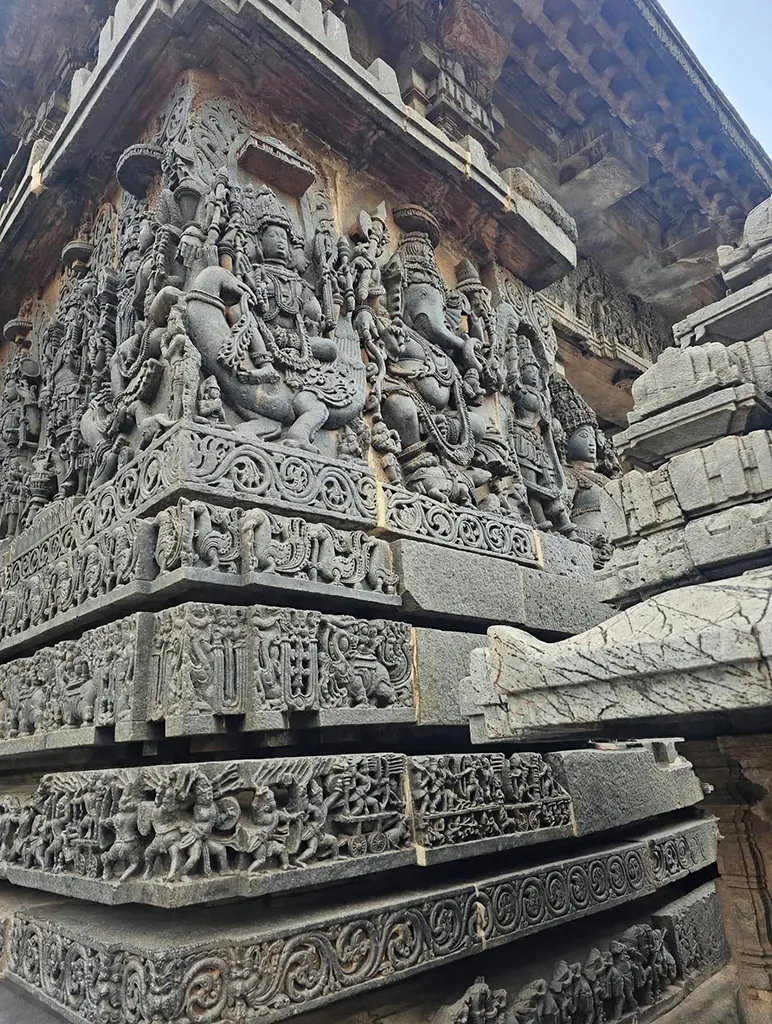
The temple is globally renowned because every single square foot of its outer soapstone walls is carved with breathtaking precision. From charging war elephants and roaring lions to miniature dancers, celestial musicians, and towering depictions of Hindu deities, the relief work looks more like delicate ivory carving than chiselled rock.
In recognition of its peerless artistic and cultural value, the UNESCO World Heritage Centre listing honored the site as part of the Sacred Ensembles of the Hoysalas alongside its sister monuments at Belur and Somanathapura. Among the many famous Shiva temples in Karnataka, Halebidu stands out as an unmatched crown jewel where deep spiritual faith meets architectural perfection.
The Royal History of Halebidu and the Hoysala Dynasty
To truly appreciate the temple, one must step back into the golden age of medieval Karnataka. During the 12th century, Halebidu was known as Dorasamudra (or Dwarasamudra), the bustling, fortified royal capital of the Hoysala Empire. The city took its name from a vast man-made lake (samudra) built to ensure steady water supply for the kingdom’s citizens and defensive moats.
Commissioning the Monument
Construction of this grand Shiva temple began around 1121 CE during the reign of King Vishnuvardhana, a visionary monarch who transformed the Hoysalas into a dominant southern power. Royal records and stone inscriptions reveal that the principal funding for the project came from Ketamalla, a devoted wealthy officer (Dandanayaka) in the royal court, aided by merchant guilds and royal patronage. The master architect who oversaw the early works was the celebrated builder Kedaroja, along with talented master sculptors (Rupavaris) such as Malli, Dasoja, and Haripa, who were so proud of their craftsmanship that they inscribed their signatures beneath individual panels.
The Invasions and the Name “Halebidu”
The construction of the temple continued across several decades, spanning the reigns of King Vishnuvardhana and his son Narasimha I. However, the monument faced tragic devastation in the early 14th century. In 1311 CE, the armies of the Delhi Sultanate led by Malik Kafur besieged Dorasamudra, followed by a second military raid in 1326 CE. The grand city was sacked, and its royal towers were damaged or left incomplete.
Following these wars, the Hoysala rulers relocated their capital to Belur. The once-glorious capital of Dorasamudra gradually came to be known as Halebidu, which translates in Kannada to “The Old City” or “The Ruined City.” In spite of the historical damage to its upper superstructures, the vast majority of the lower friezes, sanctums, and monolithic pavilions survived intact, cared for today by the Archaeological Survey of India.
The Sacred Deities: Hoysaleshwara and Shantaleshwara
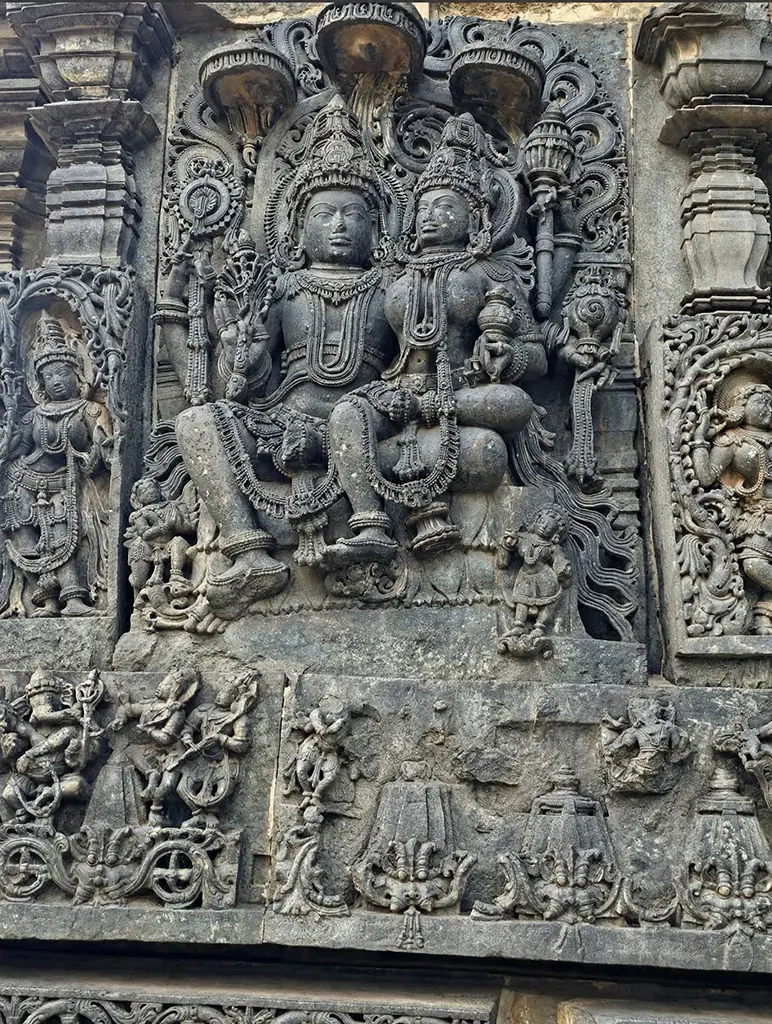
Unlike single-shrine temples, Hoysaleshwara Temple houses two distinct, parallel sanctums facing east toward the rising sun:
- The Hoysaleshwara Sanctum (Southern Shrine): Enshrines a large, polished black stone Shiva Linga named in honour of King Vishnuvardhana and the Hoysala royal house.
- The Shantaleshwara Sanctum (Northern Shrine): Enshrines an equally majestic Shiva Linga named in honour of Queen Shantala Devi, the beloved queen consort renowned for her administrative wisdom, devotion, and patronage of music and classical dance.
Both shrines feature wide, open vestibules that lead into serene inner sanctums. The spiritual energy inside is cool, quiet, and deeply meditative, contrasting with the dramatic storytelling carved into the sunlit outer walls.
The Twin Monolithic Nandi Pavilions
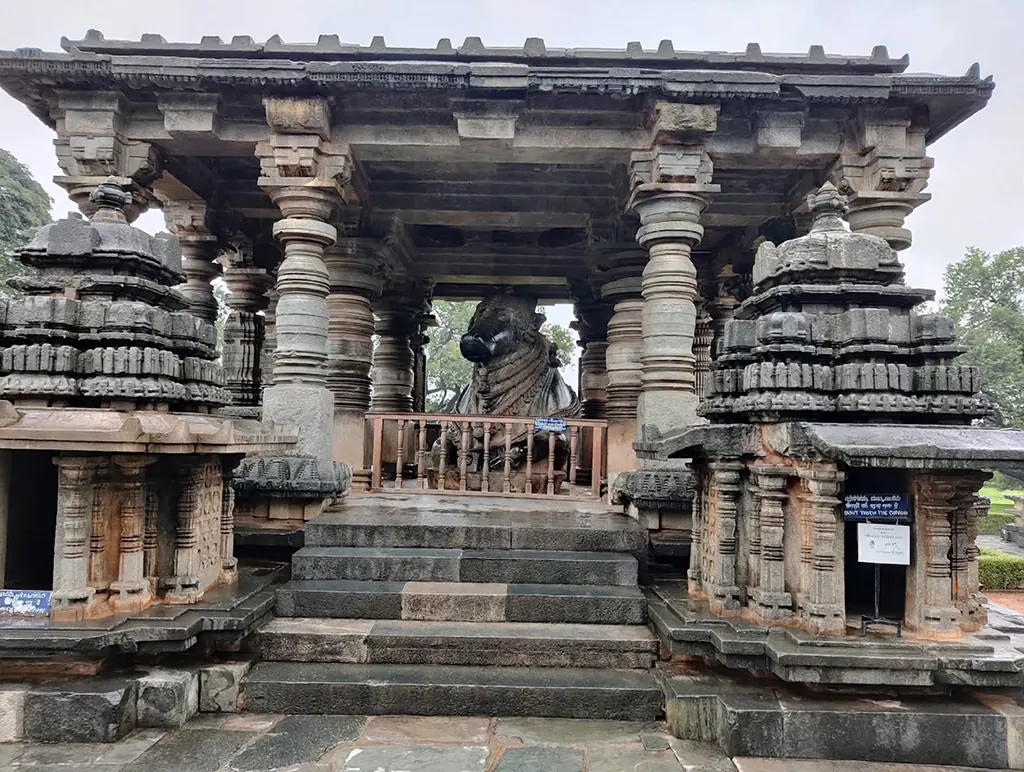
Directly facing each sanctum stands an open-sided pavilion housing a colossal monolithic statue of Nandi, the sacred bull and foremost devotee of Lord Shiva.
- The southern Nandi statue is exceptionally large, measuring nearly 16 feet in length and over 9 feet in height.
- Carved from a single massive block of dark chloritic schist (soapstone), the bull rests serenely with folded legs, wearing intricate necklaces, beaded bells, and jewelled headstraps carved with micro-level detail.
- Walking around these figures helps visitors discover why sacred Nandi statues in Indian temples hold such high esteem among sculptors and devotees alike. Behind the southern Nandi pavilion, you can also admire a celebrated shrine to Lord Surya, the Sun God, holding blooming lotus buds in both hands.
Architectural Marvels: How to Read the Outer Wall Carvings
The temple was constructed using chloritic schist, commonly referred to as soapstone. When freshly quarried, soapstone is relatively soft, allowing master artisans to carve razor-sharp edges, undercut patterns, and fluid body curves. Upon sustained exposure to air and weather over centuries, the stone oxidizes and hardens into resilient rock.
The entire structure sits on an elevated platform called a jagati. Instead of entering through a high gateway tower (gopuram), visitors walk onto this platform to circumnavigate the temple in a clockwise direction (pradakshina).
The Eight Horizontal Narrative Bands
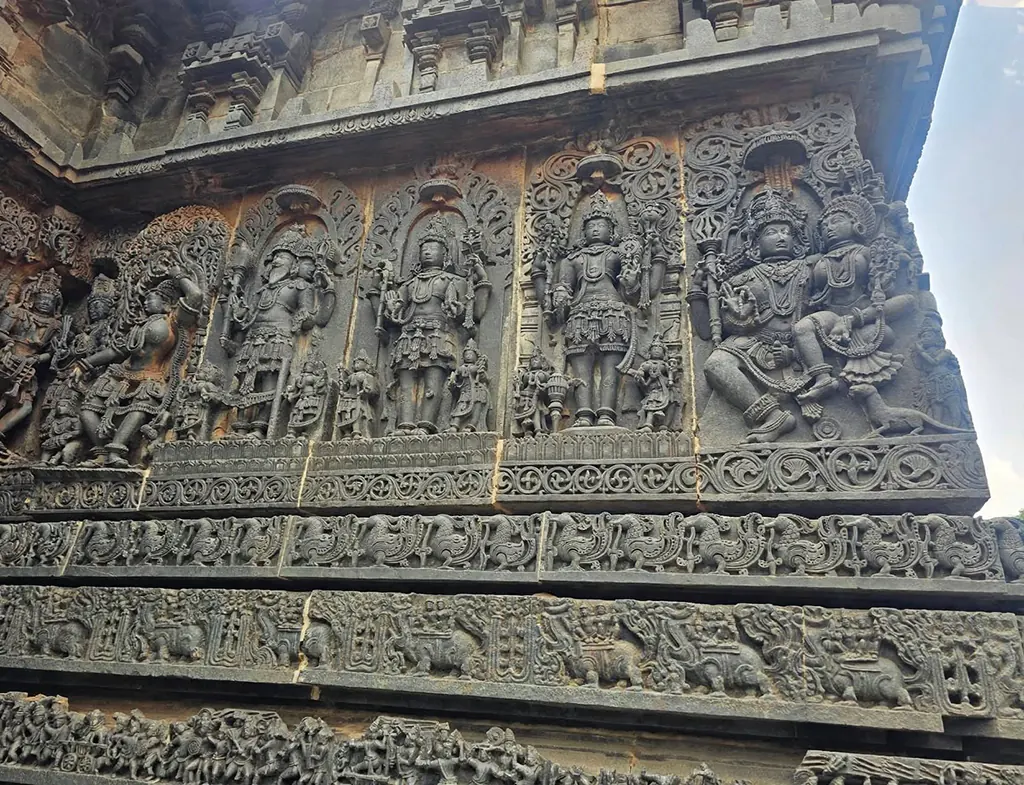
As you walk along the outer basement of the temple, look closely at the base of the walls. The master architects arranged the carvings into eight continuous horizontal friezes running around the entire perimeter:
- The Lowest Band (Elephants): Over 2,000 elephants march along the base. In Hindu iconography, the elephant represents immense strength, stability, and peaceful burden-bearing. Remarkably, no two elephants among these thousands share the exact same posture.
- The Second Band (Lions / Yalis): Symbolizing courage, royal valour, and protective power.
- The Third Band (Floral Scrolls): Flowing creeper motifs (patralata) representing nature’s delicate beauty and growth.
- The Fourth Band (Cavalry Horses): Galloping horses and armed riders representing military speed, discipline, and agility.
- The Fifth Band (More Foliage): A bead-work and vine band that separates the worldly registers from the spiritual stories above.
- The Sixth Band (The Great Epics): Detailed panoramic panels that recount continuous narrative scenes from the Ramayana, the Mahabharata, and the Bhagavata Purana. You can identify scenes of Rama hunting the golden deer, Ravana attempting to lift Mount Kailash, and Arjuna shooting his arrow at the fish target in Draupadi’s swayamvara.
- The Seventh Band (Makaras): Mythical sea creatures symbolizing water, fertility, and cosmic protection.
- The Eighth Band (Hamsas / Swans): Graceful celestial swans symbolizing spiritual discernment—the ability to separate milk from water, or truth from illusion.
Upper Wall Panels: The Dance of Divinity
Above the narrative bands, the walls widen into large, dramatic relief panels featuring the pantheon of Hindu gods:
- Dancing Shiva (Nataraja): Depicted with multiple arms holding divine weapons, rhythmically crushing ignorance beneath his feet.
- Gajasurasamhara: Shiva emerging victorious from inside the slain elephant demon, holding the elephant skin outstretched like a dramatic backdrop.
- Varaha rescuing Bhudevi: Lord Vishnu’s boar avatar lifting Mother Earth from the cosmic depths.
- Goddess Durga as Mahishasuramardini: Piercing the demon buffalo with her trident with an expression of divine calm rather than violent rage.
- The Dancing Ganesha: A cheerful, pot-bellied Lord Ganesha caught mid-twirl, wearing a crown decorated with tiny jewels.
The Garuda Pillar: A Testament to Undying Loyalty
Standing in the courtyard of the temple complex is a tall, carved stone pillar known as the Garuda Pillar. This monument commemorates an extraordinary custom of the Hoysala court: the dedication of the Garudas.
The Garudas were an elite royal bodyguard unit of sworn knights. They took a sacred vow to protect their king with their own lives, pledging to never survive their master. When King Ballala II passed away, his faithful commander Kuvara Lakshma, accompanied by his wife and loyal soldiers, fulfilled this sacred oath. The pillar carries inscriptions and relief sculptures honouring their fierce loyalty and spiritual self-sacrifice.
Temple Timings, Darshan, and Rituals
Because Hoysaleshwara Temple is under the care of the Archaeological Survey of India, it remains open throughout daylight hours every single day of the year.
- Morning Opening Time: 6:30 AM
- Evening Closing Time: 6:30 PM
- Best Time of Day for Photography: Early morning (7:00 AM – 9:30 AM) and late afternoon (4:00 PM – 6:00 PM). During these golden hours, sunlight strikes the east-facing soapstone panels, making the deep shadow carvings come to life.
- Pooja and Worship: While the monument functions primarily as a protected national heritage site, local priests conduct daily morning and evening traditional archana and lamp lighting at the sanctums. Special poojas, community chanting, and festival gatherings are celebrated with great devotion during Maha Shivaratri in February or March.
How to Reach Halebidu
Halebidu is located in south-central Karnataka and is well-connected by road networks linking it to Hassan, Belur, Mysuru, and Bengaluru.
1. By Air
The nearest major airport is Kempegowda International Airport (BLR) in Bengaluru, situated approximately 225 km away. The airport connects to all major Indian hubs and international destinations. From Bengaluru airport, you can hire a private taxi directly to Halebidu or take a luxury KSRTC bus to Hassan.
2. By Train
The most convenient railhead is Hassan Junction (HAS), located about 31 km from Halebidu. Hassan is a busy railway junction served by daily express trains connecting Bengaluru, Mysuru, Mangaluru, and Hubballi. From Hassan railway station, local taxis, auto-rickshaws, and government feeder buses run frequently to Halebidu throughout the day.
3. By Road and Bus
- From Bengaluru (Approx. 215 km): Take National Highway 75 (Bengaluru–Mangaluru highway) through Nelamangala, Kunigal, and Channarayapatna up to Hassan. From Hassan, turn onto the state highway leading directly to Halebidu. The road drive is smooth and usually takes 4 to 4.5 hours.
- From Hassan (Approx. 31 km): State transport (KSRTC) buses depart Hassan Central Bus Stand for Halebidu every 30 to 45 minutes.
- From Belur (Approx. 16 km): Regular private and government buses, as well as shared taxis, shuttle between Belur and Halebidu in just 25 to 30 minutes.

Best Time to Visit and Weather Conditions
Planning your visit around local weather makes exploring the outdoor stone grounds far more enjoyable:
- Winter Season (October to March): RECOMMENDED. Daytime temperatures hover comfortably between 20°C and 28°C. The air is cool and skies are clear, making it the perfect season for walking around the sprawling open courtyard.
- Monsoon Season (July to September): The Hassan region receives moderate to heavy rainfall. The temple gardens turn lush green and rain washes the dark soapstone walls clean, giving them a rich, lustrous shine. However, outdoor stone surfaces can become slippery, requiring extra caution while walking.
- Summer Season (April to June): Midday temperatures often exceed 34°C. The unshaded stone platform heats up rapidly under direct sunlight. If visiting during summer, make sure to arrive early in the morning before 10:00 AM or after 4:00 PM.
Visitor Guidelines, Footwear, and Accessibility
To make your trip smooth and respectful, keep these practical points in mind:
- Footwear Storage: Shoes, sandals, and leather footwear must be removed before stepping onto the raised temple platform (jagati). A monitored shoe-keeping counter is available near the entrance garden gate for a small nominal tip.
- Wear Thick Cotton Socks: During warm afternoons, the stone floors can become uncomfortably hot to walk on with bare feet. Wearing a pair of clean, thick white cotton socks will protect your feet from heat while adhering strictly to temple rules.
- Hire an Authorized Guide: The thousands of mythological panels along the walls are filled with subtle storytelling details that are easy to miss on your own. Licensed ASI guides are available near the entrance ticket counter. Agree on the fee upfront before starting the tour.
- ASI Site Museum: Located just outside the temple garden complex, the Archaeological Museum maintained by the ASI houses an outstanding collection of recovered 12th-century stone sculptures, hero stones (viragallu), and ancient inscriptions. It is open from 9:00 AM to 5:00 PM and remains closed on Fridays.
- Accessibility for Elders: The outer gardens have level, paved pathways suitable for walking. However, climbing onto the main temple platform requires navigating several wide stone steps without handrails. Senior visitors may need light walking assistance.
- Dress Code: There is no rigid ceremonial dress code, but visitors are expected to dress modestly in respectful attire covering shoulders and knees out of respect for active worship spaces.
Nearby Temples on the Hoysala Heritage Circuit
A trip to Halebidu is best experienced by combining it with neighbouring architectural wonders across the Hassan heritage belt:
- Chennakeshava Temple at Belur (16 km away): Built by King Vishnuvardhana to celebrate his victory in battle, this active Vaishnavite shrine is famous for its gravity-defying Madanika bracket figures and mirror-polished interior pillars. Belur and Halebidu form the twin pillars of any journey exploring pilgrimage places in South India.
- Kedareshwara Temple, Halebidu (1 km away): Located within walking distance of the main Hoysaleshwara complex, this quiet, lesser-known jewel is dedicated to Lord Shiva and sits beside the sacred Dorasamudra lake embankment.
- Jain Basadi Complex at Bastihalli (Less than 1 km away): Three historic 12th-century Jain temples dedicated to Parshvanatha, Shantinatha, and Adinatha, renowned for their mirror-like, lathe-turned black stone pillars.
Frequently Asked Questions (FAQs)
1. Is Hoysaleshwara Temple an active temple or a monument?
It functions as both. The complex is maintained and protected as a national monument and UNESCO World Heritage Site by the Archaeological Survey of India. Concurrently, regular morning and evening worship, lamp offerings, and annual Maha Shivaratri festivals are observed inside the sanctums.
2. Why is Hoysaleshwara Temple considered unfinished?
Despite decades of continuous carving, parts of the upper towers (vimanas) were either never completed or suffered destruction during the 14th-century regional invasions. The roofs of the sanctums remain flat rather than rising into typical pyramidal towers.
3. How much time is needed to visit the temple?
Plan to spend at least 1.5 to 2 hours at the temple. If you appreciate ancient sculpture, hire a guide, and visit the nearby ASI museum, you can easily spend 3 hours exploring the grounds.
4. Is photography allowed inside Hoysaleshwara Temple?
Still photography of the outer walls, gardens, and general architecture is permitted. However, using heavy tripods, professional movie rigs, or flash photography inside the sanctums requires special written permission from the ASI. Always respect signboards prohibiting flash near active altars.
5. Where should travellers stay when visiting Halebidu?
Halebidu is a small heritage town with limited budget guest houses. Most travellers choose to stay in Hassan city (31 km away), which offers a wide selection of comfortable family hotels, multi-cuisine restaurants, and transport facilities. Alternatively, heritage boutique resorts are available along the Belur-Chikkamagaluru highway.
Plan Your Sacred Heritage Journey
Standing before the stone walls of Hoysaleshwara Temple, watching centuries of devotion and craftsmanship frozen in dark soapstone, is an unforgettable cultural experience. As you walk along its star-shaped terraces, each carving tells a story of faith, valor, and artistic patience that has endured through nine hundred years of history.
When you plan your journey through Karnataka’s heritage heartland, take time to visit both Halebidu and Belur together—a pair of sacred monuments that bring the soul of the ancient Hoysala kingdom brilliantly to life.