Bhadrakali Temple Warangal: Timings, History, and Pilgrim Guide
Bhadrakali Temple Warangal is an ancient Hindu shrine dedicated to Goddess Bhadrakali, located on the banks of the scenic Bhadrakali Lake between Hanamkonda and Warangal in Telangana, India. Revered as one of the oldest mother-goddess temples in the Deccan region, it is celebrated for its rare seated rock-carved deity, its historical links to the medieval Kakatiya dynasty, and the grand annual Shakambari Navratri festival.
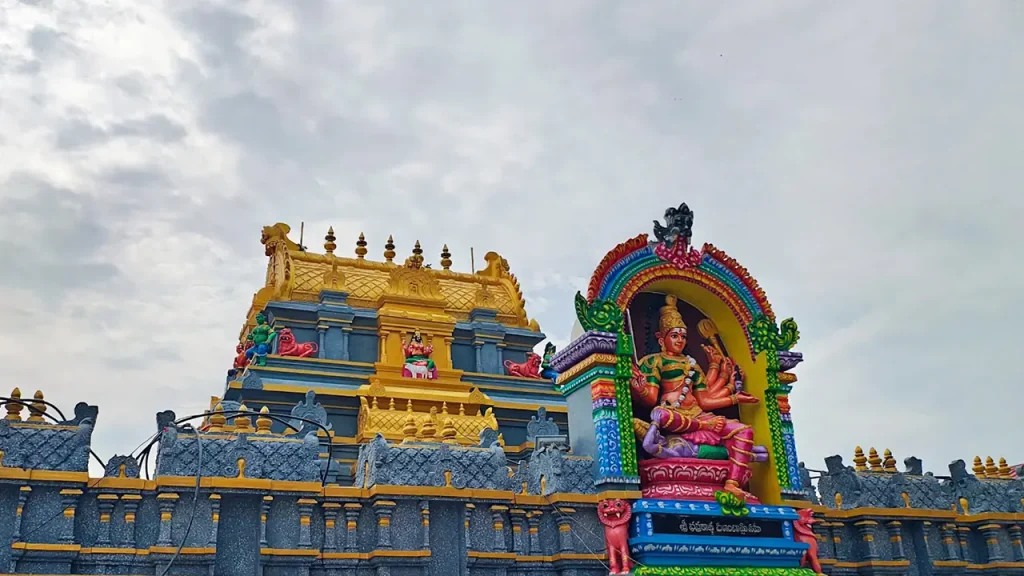
The temple sits peacefully on a gentle hillock overlooking quiet waters. Pilgrims visit this holy site every day to seek courage, inner peace, and relief from life challenges through special archana and Rahu Ketu poojas.
Quick Information for Visitors
| Feature | Details |
| Temple Name | Sri Bhadrakali Devasthanam |
| Location | Between Hanamkonda and Warangal, Telangana, India |
| Presiding Deity | Goddess Bhadrakali (Maha Kali) |
| Form of Deity | 8-armed seated stone sculpture (padmasana) |
| Morning Darshan Timings | 5:00 AM to 1:00 PM |
| Evening Darshan Timings | 3:00 PM to 8:30 PM |
| Best Time to Visit | October to March, or during Ashadha Shakambari Utsavam |
| Major Festivals | Shakambari Navratri, Devi Sharad Navratri, Vasant Navratri |
| Nearest Railway Station | Kazipet Junction (5 km), Warangal Station (5 km) |
| Nearest Airport | Rajiv Gandhi International Airport, Hyderabad (~170 km) |
| Entry Fee | Free general darshan; nominal fees for special darshan/pooja |
| Dress Code | Traditional Indian attire recommended (no shorts or nightwear) |
| Official Administrative Body | Telangana Endowments Department |
Sacred Significance of Bhadrakali Temple
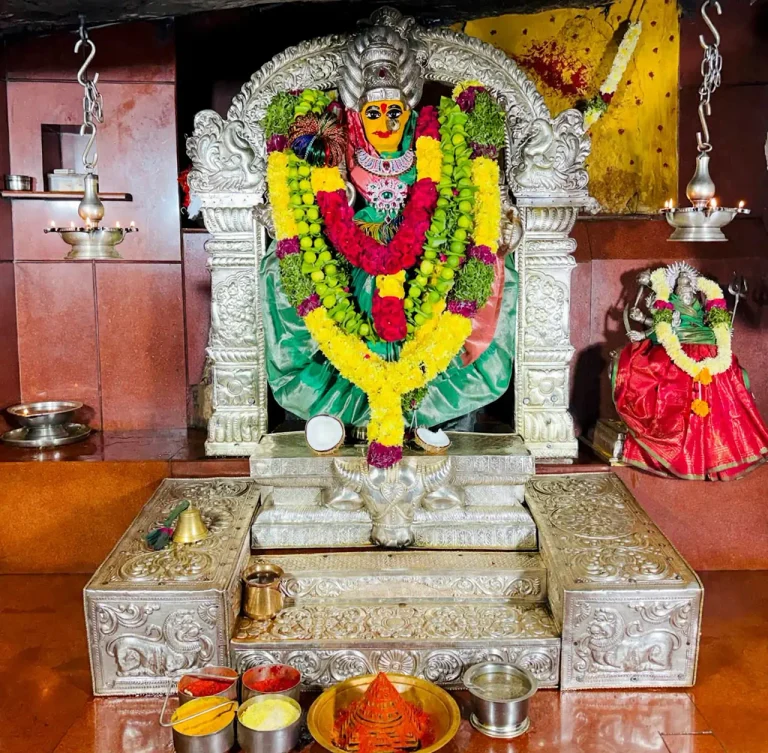
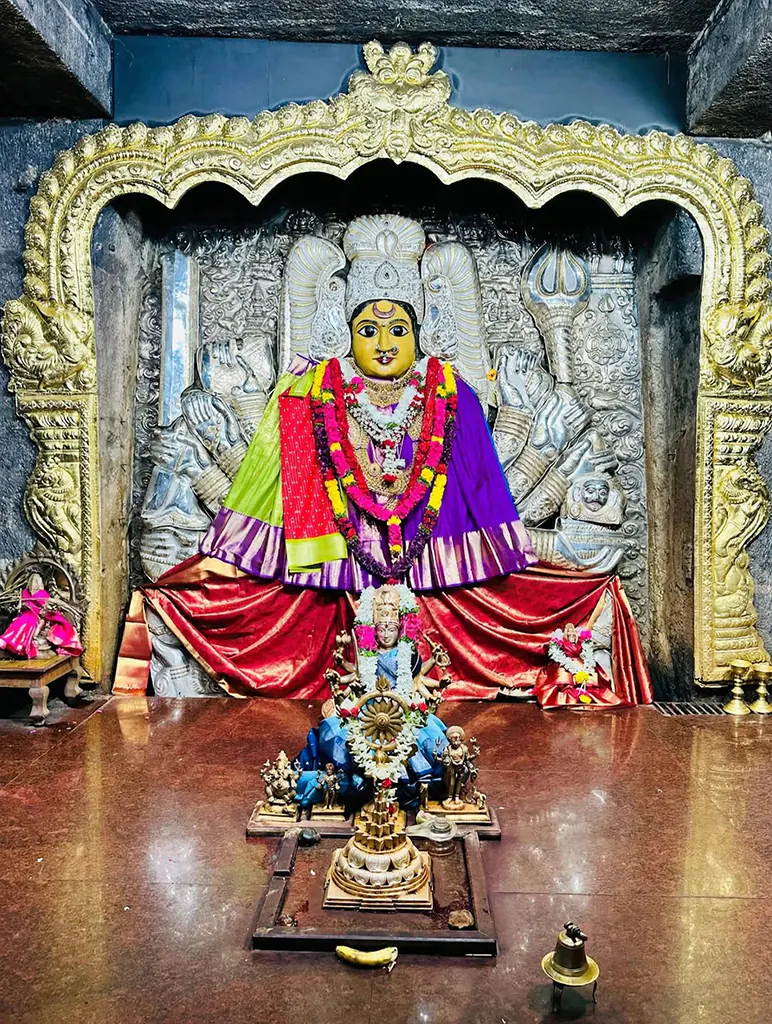
In Hindu traditions, Goddess Bhadrakali represents the protective, benevolent face of cosmic energy. The Sanskrit word Bhadra means noble, auspicious, or protective. While Kali is often shown in fierce battle forms standing over negativity, the deity at Warangal carries a calm and motherly expression.
She has large, wide eyes and sits in a peaceful posture known as padmasana. Devotees believe that praying to Mother Bhadrakali here removes fear, heals mental distress, and grants courage to face difficult times.
The temple is also considered an important center for Shakta worship in South India. Because the stone relief of the Mother faces west toward the lake, early morning and sunset hours create a calm atmosphere that invites prayer and meditation.
Historical Origins and the Kakatiya Legacy
The story of the temple combines ancient dynastic history with deep local devotion.
Early Foundations under the Chalukyas
Local historical traditions and regional accounts trace the original foundation of the shrine to around 625 CE, during the reign of the early Western Chalukya monarchs. King Pulakeshin II is traditionally believed to have established this shrine to commemorate his military campaigns in the Vengi region. The original sanctuary was carved directly around a natural granite formation, creating an enduring rock-cut shrine.
Royal Patronage under the Kakatiyas
The temple reached its height of royal glory during the 12th and 13th centuries under the Kakatiya rulers, whose capital was Orugallu (modern Warangal). Monarchs such as Ganapati Deva, Rani Rudrama Devi, and King Prataparudra revered Goddess Bhadrakali as their Kula Devatha (family guardian deity).
The Kakatiyas expanded the sanctuary by building stone pillared pavilions, lake bund walls, and defensive outposts around the hill. Before marching into major campaigns, Kakatiya rulers visited the goddess to seek her blessings for victory and protection of their citizens. Many of the medieval stone techniques developed during this period share similarities with Dravidian stone carving techniques, which shaped temple compounds across Southern India.
The 1950s Revival
Following the fall of the Kakatiya kingdom in the early 14th century, the temple suffered from neglect for centuries. Vegetation covered the lake hillock, and regular worship paused.
In the early 1950s, a devoted scholar and local resident named Sri Ganesh Rao Sastri, along with passionate citizens and local merchants, worked together to clear the grounds, restore the stone mandapams, and restart daily Vaidika poojas. Today, under the management of the Endowments Department, the temple is once again a thriving center of worship in northern Telangana. Further heritage records are maintained by the Hanamkonda District Administration.
Sacred Legend of the Shrine
According to local temple lore, the natural granite boulder where the deity is carved has radiated spiritual energy for thousands of years. Rishis and sages wandered across these granite outcrops in the ancient Dandakaranya forest, performing penance to obtain the vision of the Supreme Mother.
Moved by their devotion, the Divine Mother revealed herself in a protective form, assuring them that she would remain on this rock forever to safeguard everyone who called upon her. Rather than taking a terrifying battle posture, she agreed to dwell here in a gentle, seated form, radiating peace (shanti) over the lake waters.
Unique Temple Architecture and Natural Rock Iconography
The architecture of Bhadrakali Temple Warangal is a striking mix of natural geology and medieval South Indian temple craft.
The Sacred Stone Relief
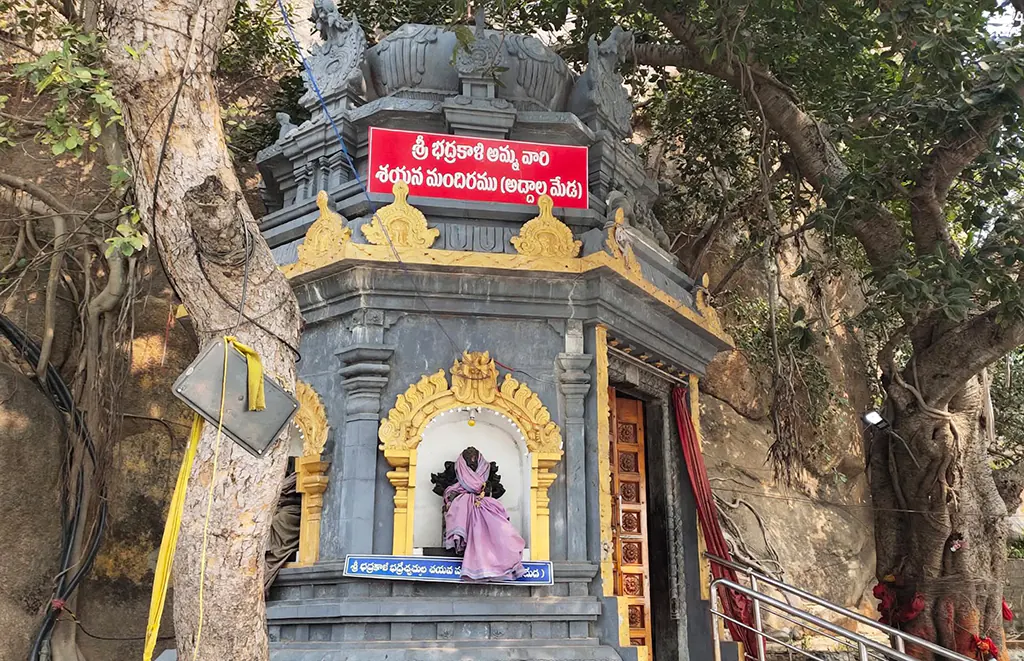
The primary image of Goddess Bhadrakali is not a detached idol brought from outside. It is carved directly into a large vertical granite rock wall measuring roughly 2.7 meters by 2.7 meters.
- Eight Arms: The Mother holds celestial weapons including a sword, shield, trident, bow, and bell.
- Protective Posture: Unlike moving forms, she sits steadily in the cross-legged padmasana pose.
- Golden Crown and Eyes: The sanctum features polished silver and gold coverings, highlighting her wide, expressive eyes.
The Gopuram and Courtyards
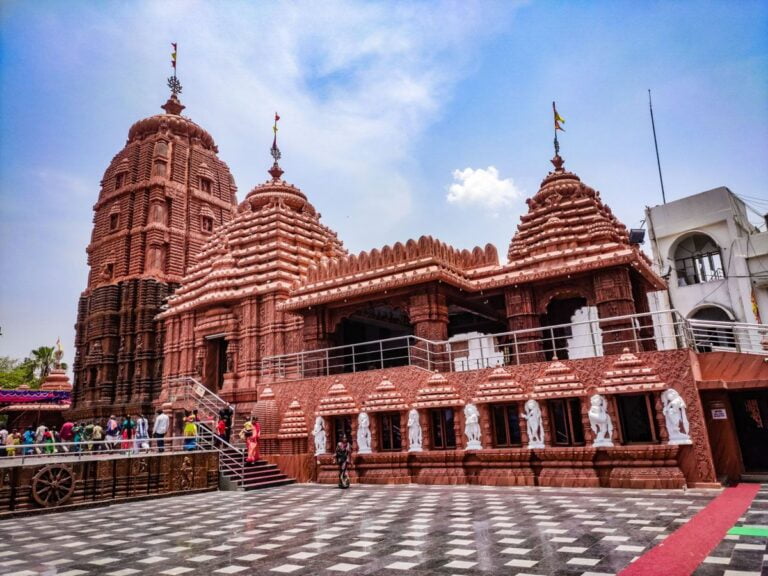
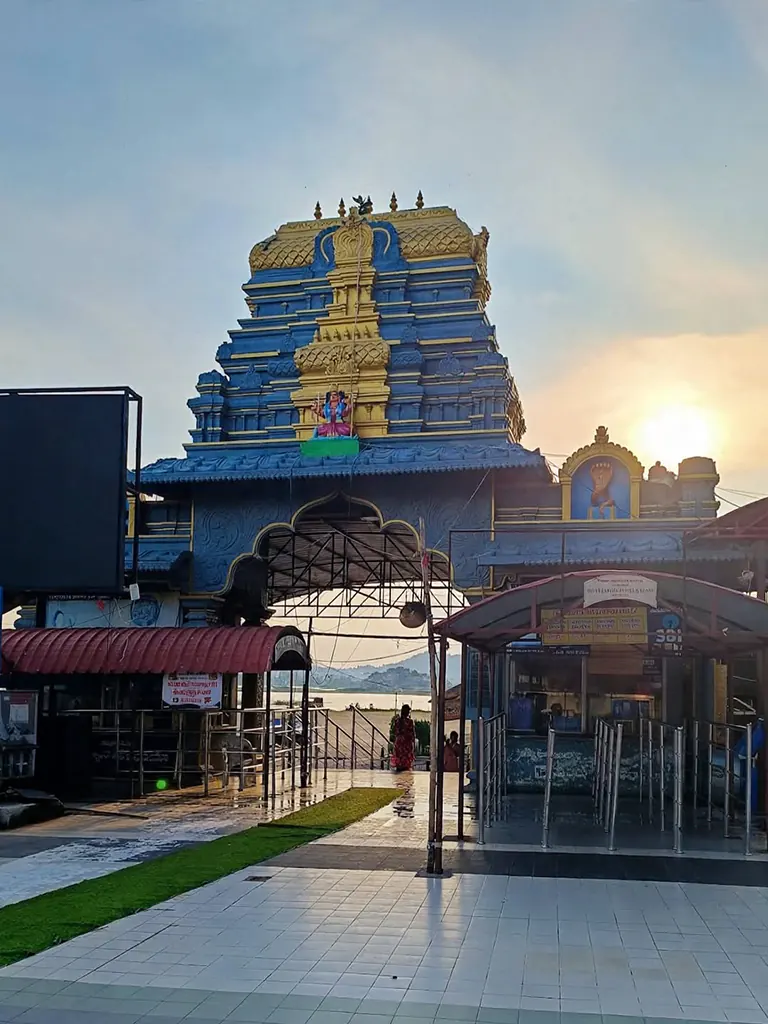
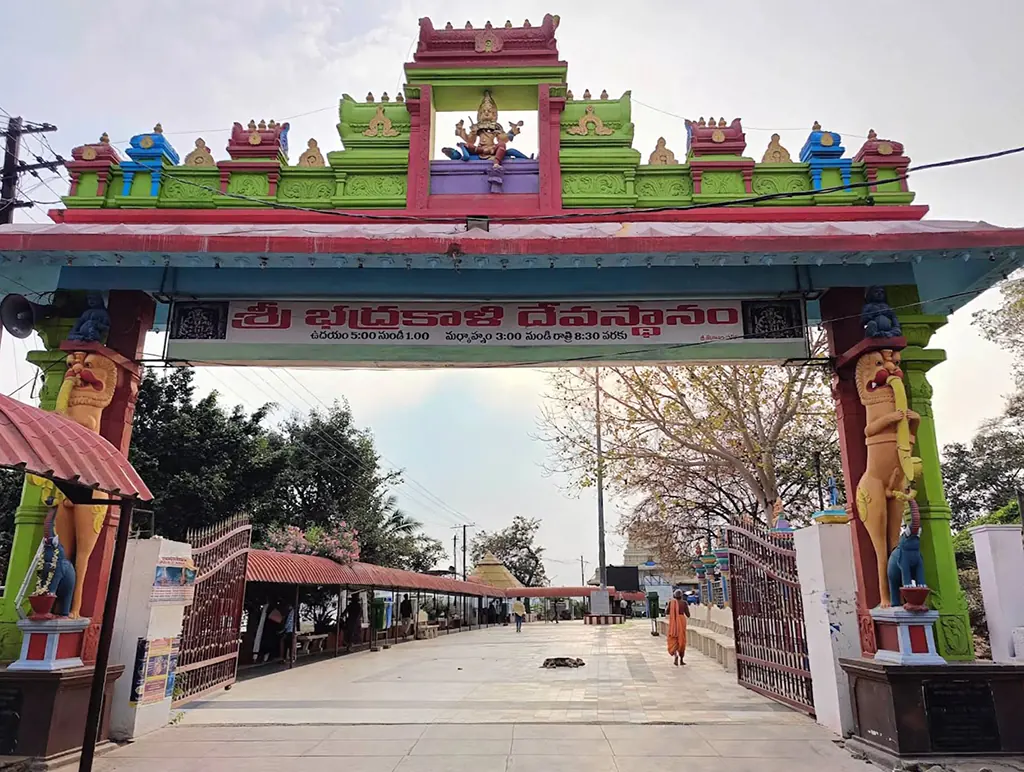
At the entrance stands a colorful multi-tiered gopuram (tower) adorned with sculptural figures of Hindu deities. Passing through the main gate leads visitors into an open stone courtyard (prakaram) paved with dressed granite slabs.
Surrounding the central sanctum are smaller shrines dedicated to:
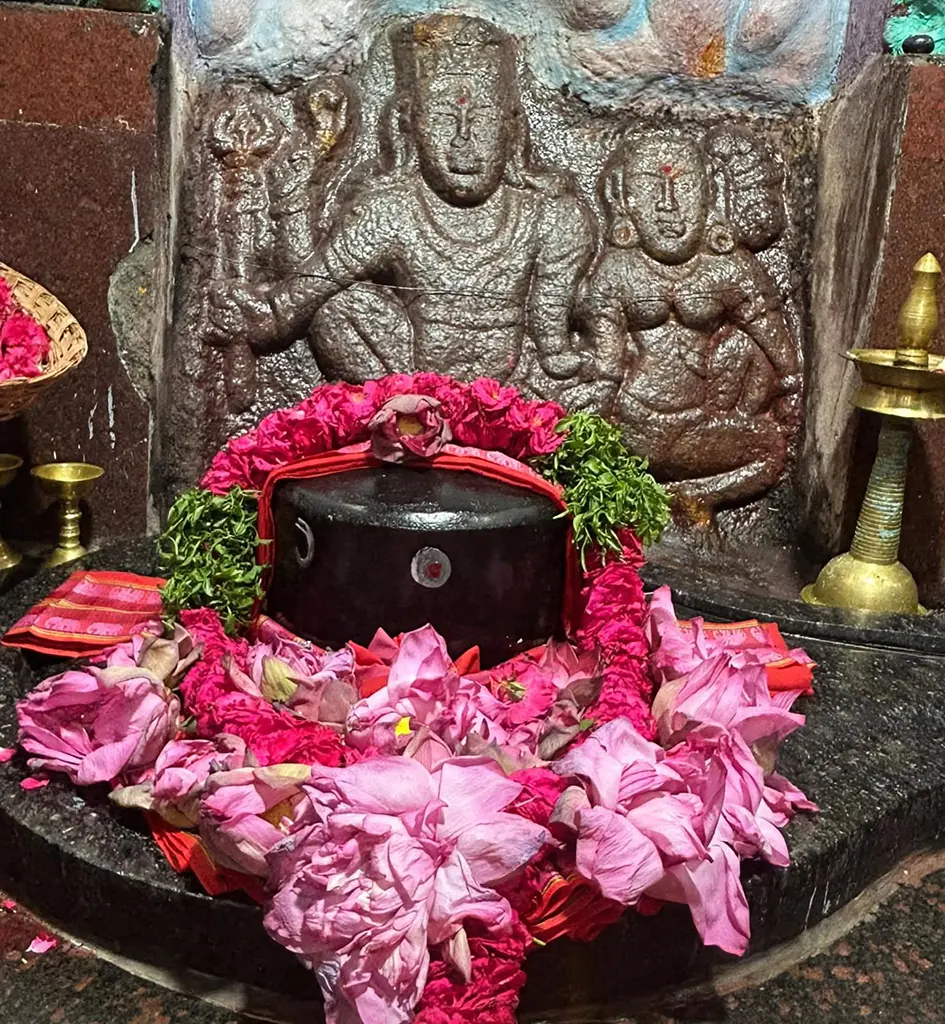
- Lord Shiva (Bhadrakali Sametha Sundareswara): Celebrating the sacred union of Shiva and Shakti.
- Lord Subrahmanya (Murugan): Worshipped alongside snake stones for family prosperity.
- Lord Ganesha: Placed near the entrance to remove obstacles for visiting pilgrims.
- Navagrahas: The nine planetary deities, visited frequently for dosha-nivarana rituals.
The use of stone courtyards aligned with seasonal sunlight mirrors the sacred geometry seen in astronomical pillar design in ancient shrines, making the temple a testament to ancient spatial planning.
Bhadrakali Temple Timings, Daily Darshan and Pooja
The temple follows an organized daily schedule. Visiting early in the morning allows pilgrims to observe holy bathing rituals (abhishekam) and enjoy peaceful darshan before crowds gather.
Regular Daily Timings
| Session | Timings | Ritual Performed |
| Morning Opening | 5:00 AM | Suprabhata Seva & Temple Door Opening |
| Morning Abhishekam | 5:30 AM – 7:00 AM | Holy Bath to Utsava Murtis and Special Archana |
| General Morning Darshan | 7:00 AM – 1:00 PM | Continuous Pilgrim Darshan & Special Sevas |
| Afternoon Break | 1:00 PM – 3:00 PM | Sanctum Doors Closed for Deity Rest |
| Evening Reopening | 3:00 PM | Evening Temple Door Opening |
| Maha Mangala Harathi | 6:30 PM – 7:15 PM | Grand Lamp Offering with Musical Accompaniment |
| Night Closure | 8:30 PM | Ekantha Seva & Final Door Closure |
Note: On special festival days, solar eclipses, and lunar eclipses, the temple doors may open earlier or close temporarily for purification rites.
Major Festivals and Celebrations
Special festivals bring vibrant devotion, traditional temple music, and thousands of pilgrims to the shores of Bhadrakali Lake.
1. Shakambari Navratri Festival (Ashadha Masam)
The most famous festival at Bhadrakali Temple is the Shakambari Utsavam, celebrated during the bright half of the lunar month of Ashadha (usually June or July).
During this week-long festival:
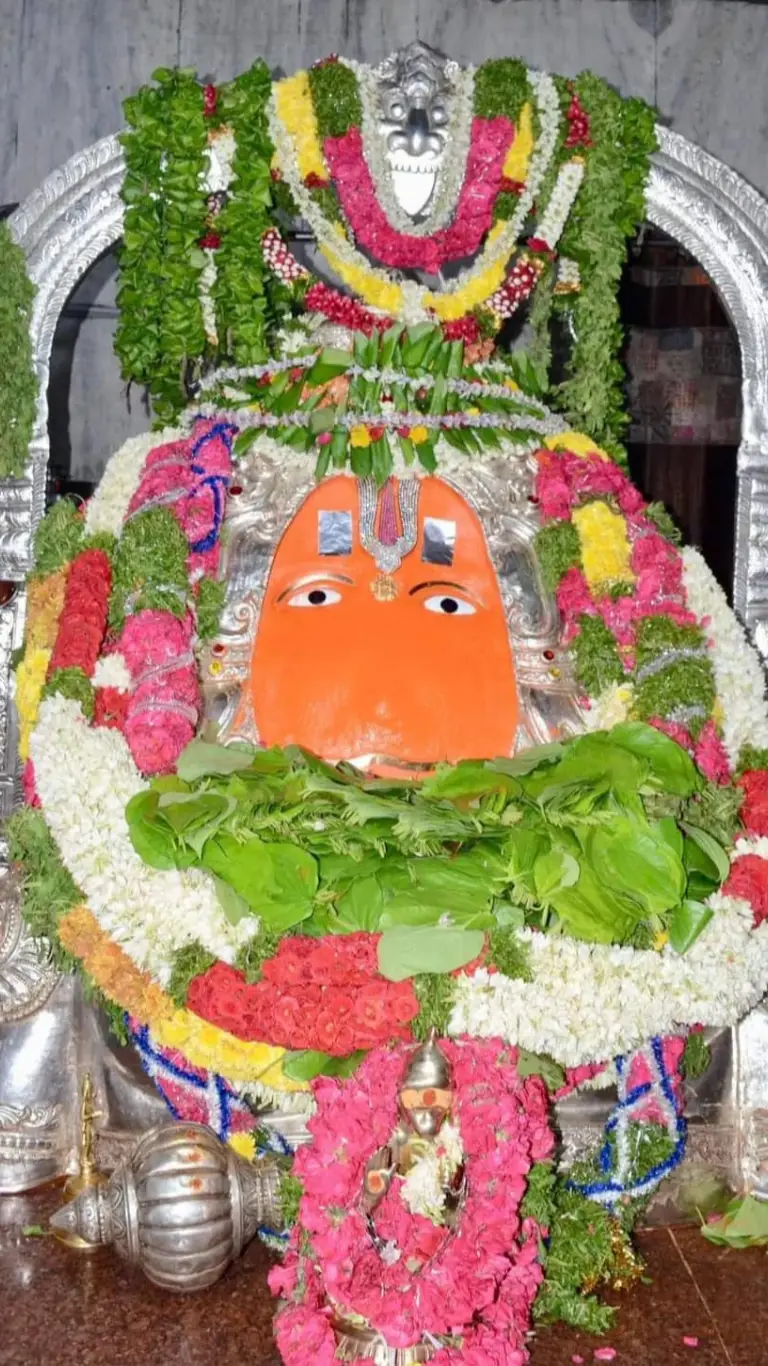
- The presiding goddess is decorated entirely with fresh vegetables, green leaves, fruits, grains, and flowers.
- Over several days, tons of vegetables are offered by farmers and devotees to thank Mother Earth for rains and bountiful harvests.
- On the final full moon day (Ashadha Pournami), the deity appears as Mother Shakambari, the goddess of food and nourishment. The offered produce is later cooked and served to devotees as holy prasadam.
2. Sharad Navratri (September – October)
Celebrated during Ashwin month alongside nationwide Dussehra festivities, Navratri is observed with great pageantry. The goddess is decorated in a different sacred form (Alankaram) each day, representing different avatars of Durga, Lakshmi, and Saraswati. The ninth day features Chandi Homa, followed by the Vijayadashami procession.
3. Vasant Navratri and Shivaratri
In the spring season (Chaitra month), Vasant Navratri brings special music concerts and sacred recitations to the temple mandapam. During Maha Shivaratri, devotees offer special prayers at the adjacent Sundareswara shrine, fasting and singing hymns through the night.
How to Reach Bhadrakali Temple Warangal
Bhadrakali Temple is easily accessible by rail, road, and air, thanks to its central location in the historic tri-city area of Warangal, Hanamkonda, and Kazipet.
By Train
Train travel is one of the most convenient ways to reach the temple:
- Kazipet Junction (KZJ): Located roughly 5 km west of the temple, Kazipet is a major railway junction connecting New Delhi, Chennai, Hyderabad, and Kolkata.
- Warangal Railway Station (WL): Located roughly 5 km south-east of the temple, Warangal station handles dozens of daily express trains.
Auto-rickshaws, pre-paid taxis, and local city buses are available outside both railway stations to take visitors straight to the temple gates in 15 to 20 minutes.
By Road
Warangal has excellent road links with all parts of Telangana and neighboring states:
- From Hyderabad: The distance is approximately 145 km via the four-lane National Highway 163 (Hyderabad-Bhopalpatnam Highway). The drive takes around 3 to 3.5 hours.
- Bus Services: TSRTC runs continuous non-stop Super Luxury, Deluxe, and express bus services between Hyderabad (JBS and MGBS bus stations) and the Hanamkonda Bus Station. From Hanamkonda bus stand, the temple is only 2.5 km away.
By Air
The nearest commercial airport is Rajiv Gandhi International Airport (HYD) in Hyderabad, roughly 170 km from the temple. From the airport, visitors can hire private cabs or take airport shuttle buses to the city center and catch a train or taxi to Warangal. More destination and transport details can be explored via the Telangana Tourism Portal.
Visitor Facilities, Dress Code, and Temple Rules
To enjoy a smooth and respectful visit, pilgrims should keep a few practical points in mind:
Dress Code Recommendations
While there is no strict dress enforcement booth for general visitors, modest and traditional clothing is strongly encouraged:
- Men: Dhotis with shirts or kurtas, or neat trousers and shirts. (Shorts and sleeveless tops are discouraged).
- Women: Sarees, half-sarees, or salwar kameez with dupattas.
Footwear and Electronic Devices
- Footwear Counters: A free managed shoe storage stand is situated near the northern entrance gate. Footwear must be removed before entering the stone courtyard.
- Photography: Photography and video recording are strictly prohibited inside the inner sanctum. Visitors may photograph the exterior gopuram, gardens, and the lakefront promenade.
- Mobile Phones: Phones must be placed on silent mode before passing through the entrance doors.
Bhadrakali Lake Bund Promenade
A paved lakefront promenade has been developed along the edge of the temple lake. It features walking paths, ornamental lighting, stone benches, and boat ride points run by tourism authorities. Visitors often walk along this lakeside path after morning or evening darshan to enjoy the cool breeze and take photos of the hills.
Nearby Pilgrimage Sites in Warangal Circuit
Visitors coming to Bhadrakali Temple can easily explore other important heritage sites within a 15-kilometer radius:
- Thousand Pillar Temple (Sri Rudreswara Swamy Temple): Located just 3 km away in Hanamkonda, this 12th-century marvel features star-shaped temple foundations, carved stone pillars, and an iconic monolithic Nandi.
- Warangal Fort: Situated roughly 7 km to the south, this ancient citadel features stone ruins, mud ramparts, and the famous four carved Kakatiya arches (Kirti Toranas) that serve as the official emblem of Telangana.
- Padmakshi Temple: Located 2.5 km away on a nearby rocky hill, this ancient shrine features rock-cut Jain carvings and a scenic hilltop view of Hanamkonda.
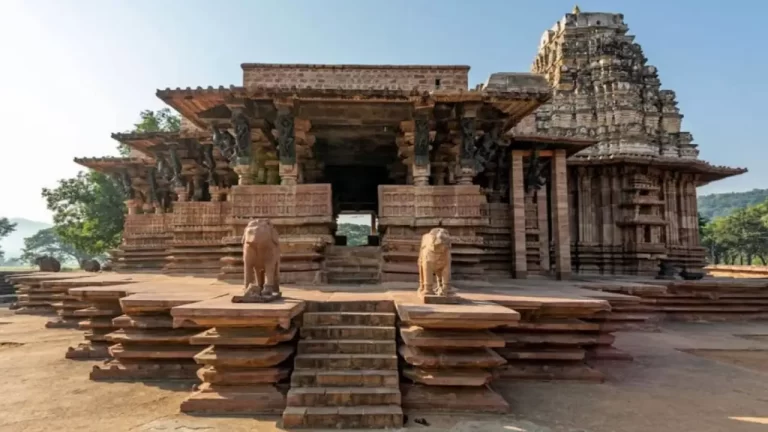
- Ramappa Temple (Palampet): Located approximately 65 km away, this UNESCO World Heritage Site is world-renowned for its lightweight floating bricks, sandbox foundations, and carved black basalt sculptures.
Frequently Asked Questions About Bhadrakali Temple
What are the main darshan timings of Bhadrakali Temple Warangal?
The temple is open every day from 5:00 AM to 1:00 PM in the morning and from 3:00 PM to 8:30 PM in the evening. The sanctum doors remain closed for two hours in the afternoon.
How much does entry cost at the temple?
General darshan is completely free. The temple administration offers special quick-darshan tickets (ranging from ₹20 to ₹100 depending on festival rush) and specific tickets for personal archana, abhishekam, and vehicle pooja.
Why is the Shakambari festival celebrated here?
Shakambari Utsavam is celebrated during the lunar month of Ashadha to worship Mother Nature as the provider of food and life. The goddess is decorated with tons of fresh vegetables and grains to pray for timely monsoon rains and prosperous harvests.
Is the temple accessible for elderly visitors?
Yes. The path from the car parking area to the main courtyard is paved and flat. While a few steps lead up to the sanctum door, handrails are installed, and basic wheelchair assistance can be arranged by asking the temple security staff.
Can we reach Bhadrakali Temple easily from Kazipet?
Yes. Kazipet Railway Junction is only 5 km away. Auto-rickshaws and app-based cabs take approximately 15 minutes to reach the temple entrance from the station.
Bhadrakali Temple Warangal stands as a living bridge between medieval history and timeless Hindu devotion. Whether you visit to admire the centuries-old rock-carved deity, sit quietly along the shores of Bhadrakali Lake, or witness the colorful spectacle of the Shakambari festival, this sacred sanctuary offers an unforgettable pilgrimage experience in the heart of Telangana.