
Kailashnath Temple: Kailasa Temple Mystery at Ellora Caves
Kailashnath Temple Ellora: Situated in the midst of Maharashtra, India, close to the city of Aurangabad, this awe-inspiring rock-cut temple is no mere building of stone; it’s a manifestation of human intelligence, piety, and an unmatched artistic imagination that still stuns tourists from around the world.
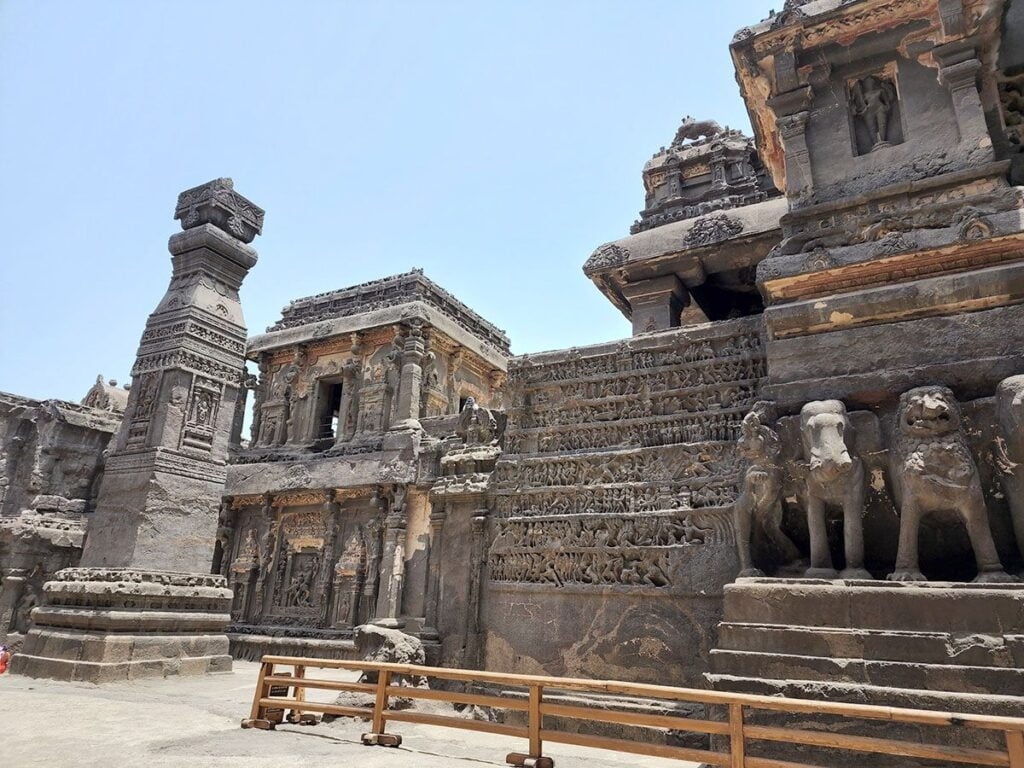
Picture with me, for a while, standing in front of a gigantic mountain. Now, picture not building a temple on it, but from it – carving an entire multi-storied complex, complete with courtyards, pillars, and intricate sculptures, out of a single, massive piece of rock. That, my friends, is the magic of the Kailasa Temple at Ellora. It’s an experience that transcends mere sightseeing; it’s a profound encounter with history, faith, and the sheer audacity of human ambition.
Contents
- 1 A Journey to the Heart of Stone
- 2 Kailashnath Temple History: Deciphering the Rashtrakuta Heritage
- 3 Legend of the Temple: Miracles and Monarchs
- 4 Cultural, Spiritual, and Mythological Significance of the Temple
- 5 Festivals, Special Days, and Rituals
- 6 Unique Architectural Styles and Carvings: A Masterpiece Unveiled
- 7 Myths and Beliefs: Whispers in the Stone
- 8 Ellora Caves Temple Timings and Crowded Days
- 9 Hindu Sites to See Near the Temple
- 10 Accommodation Options Near the Temple
- 11 How to Reach the Temple
- 12 Trending Questions regarding Kailasa Temple Ellora
A Journey to the Heart of Stone
Welcome to Ellora Caves, a UNESCO World Heritage Site that shelters an extraordinary symphony of rock-cut architecture. Of the 34 caves – a harmonious mix of Buddhist, Hindu, and Jain monuments – stands out the unparalleled Kailasa Temple Ellora (Cave 16), a gem in the crown of Indian heritage. This is no ordinary temple; it’s the world’s largest monolithic building, hewn out of a single block of basalt stone.
When you enter its courts, you are entering a story carved in stone, a tale of gods, kings, and unshakeable fervor of faith. The sheer magnitude and ornate detailing of the Ellora Temple are sufficient to leave anyone awestruck. It is almost as if the gods themselves came down to form this holy place.
Kailashnath Temple History: Deciphering the Rashtrakuta Heritage
The building of the Kailasa Temple Ellora is itself an interesting story, surrounded in part by mystery because no clear inscriptions exist. Yet, historical opinion assigns this colossal work to the great Rashtrakuta King Krishna I, who ruled from 756 to 773 CE. Can you envision the vision he had to have?
To design such an edifice, not to be constructed brick by brick, but to be carved, from top to bottom, out of a living mountain! King Krishna I is said to have been highly influenced by the Virupaksha Temple at Pattadakal in Karnataka, a state famous for its resplendent temples. He wanted to build something even more majestic, a heavenly home for Lord Shiva that would transcend normal comprehension of architecture.
The sheer devotion and craftsmanship involved are staggering. Historians place the estimate of constructing such an undertaking in hundreds and possibly thousands of years by skilled hands, although some common mythology has it completed much sooner, even 18 years, a witness to its seemingly impossible construction. The Ellora Temple is really the epitome of Rashtrakuta art and engineering. They not only constructed but carved a complete mountain into a heavenly kingdom.
Read More>> Vajreshwari Temple Maharashtra
Legend of the Temple: Miracles and Monarchs
Aside from the edifices of history, the Kailasa Temple Ellora has equally enthralling legends that make it all the more fascinating. One such common Marathi lore, documented in the Katha-Kalpataru by Krishna Yajnavalki (13th century CE), is a heartening narrative:
There was a king of Elapura (another name for Ellora) who was seriously ill. His queen, being a staunch devotee of Shiva, promised to construct a temple in the name of Shiva if her husband would be restored to health. She undertook to fast until she saw the shikhara of the temple. Several architects were consulted, but none of them could assure so speedy a construction. Then came forward a talented architect by the name of Kokasa (also known as Manikesvara in some versions). He promised the queen that she would behold the shikhara in a week!
Kokasa and his workers set to work not from the ground level, as it was usual, but from the summit of the rock, carefully sculpting downwards. This novel top-down method enabled quick work on the shikhara, completing the queen’s promise. Upon witnessing the crowning glory of the temple, the queen’s joy knew no bounds, and the king was miraculously cured.
In honor of the queen and this miraculous recovery, the temple was named Manikeshwar (a variation of Manikavati, the queen’s name) or Kailasa Temple, symbolizing Mount Kailash, Lord Shiva’s abode. This legend, though fully fact or perhaps invented after the fact, aptly describes the deep faith and sheer hard work that went into the making of this masterpiece.
Read More>> Kalaram Temple Nashik
Cultural, Spiritual, and Mythological Significance of the Temple
Kailasa Temple Ellora is so much more than a beautiful building; it’s a living testament to India’s rich cultural, spiritual, and mythological heritage.
Cultural Significance: Being a part of the greater Ellora Caves complex, the Kailasa Temple is an emblem of the religious tolerance that existed in ancient India. The Ellora Caves have sanctuaries of Buddhism, Hinduism, and Jainism, existing side by side, with a remarkable attitude of tolerance and co-existence. The architecture and art of the Kailasa Temple depict a blend of different regional styles, featuring touches from the Pallava, Chalukya, and Rashtrakuta dynasties, which turns it into a melting pot of cultural influences. It’s a painting depicting the rich artistic traditions of its period.
Spiritual Significance: To the devotees, the Ellora Temple is a rich spiritual place. Located in Lord Shiva’s honor, the destroyer and rebirth agent of the Hindu Trinity, this temple is thought to be a earthly replica of Mount Kailash, the mythological dwelling of Shiva within the Himalayas. A visit to this temple is thought to be equivalent to a pilgrimage to the holy mountain itself, providing a very spiritual experience. The location of the Shivalinga within the sanctum sanctorum is used as an anchor for worship and meditation. The very act of marveling at its creation can evoke a sense of the divine, of something beyond human capability.
Mythological Importance: The walls of the Kailasa Temple Ellora are a veritable encyclopedia of Hindu mythology. Every carving, every sculpture, tells a story from the ancient epics and Puranas. You’ll find vivid depictions of:
The Ramayana: The epic story of Lord Rama is beautifully represented, with panels describing events such as Rama’s banishment, Sita’s kidnapping by Ravana, and the final battle.
The Mahabharata: Scenes from this great epic, such as scenes from the war of Kurukshetra and the history of the Pandavas and Kauravas, are depicted on the temple walls.
Dashavatara Panel: Perhaps the most memorable aspect is a horizontal panel depicting the ten avatars of the preserver god Lord Vishnu, stretched out in sequence from fish (Matsya) to warrior (Parashurama) and enlightened one (Buddha). These carvings represent the divine interventions of cosmic history.
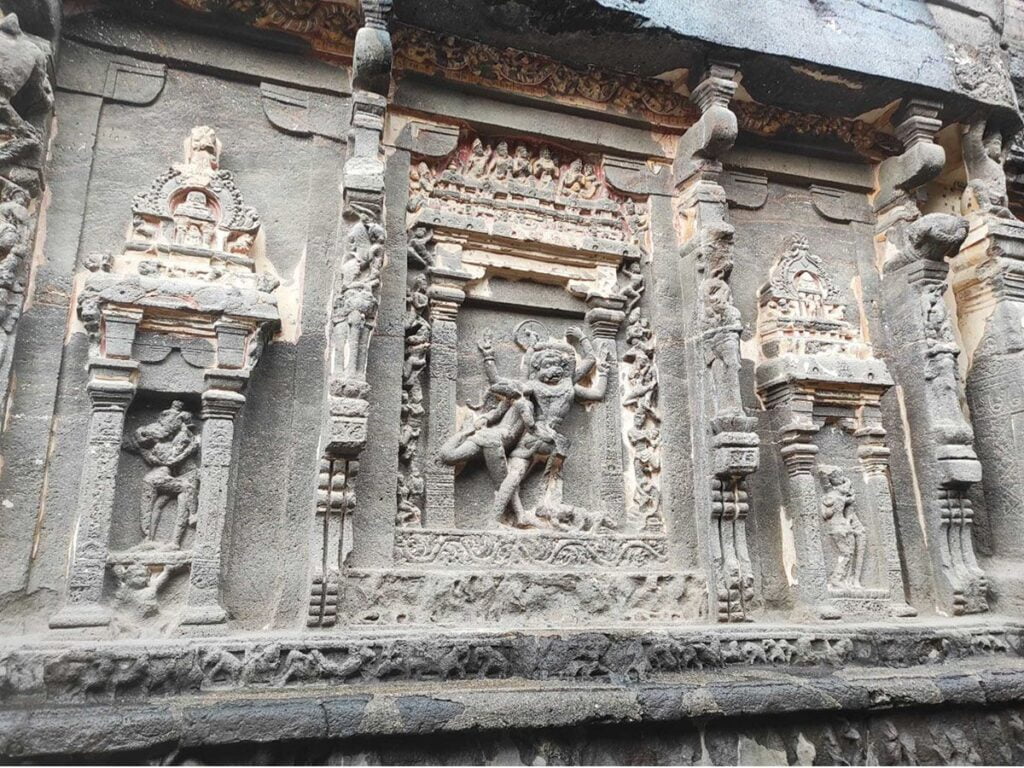
Ravana Shaking Mount Kailash: One of the most iconic carvings in the temple, placed on the rear wall behind the statue of Nandi. It is a strong image of the demon king Ravana trying to pick up Mount Kailash in order to interrupt Lord Shiva’s meditation. Shiva, in a touch of his toe, keeps Ravana under the mountain, demonstrating his unrivaled strength and peace.
This episode is cited frequently in Hindu holy books. The Uttara Kanda of the Ramayana, for example, narrates this event, detailing Ravana’s hubris and Shiva’s divine power. It’s an anecdote about the price of defying the cosmic order. The seamless narration through all these carvings allows pilgrims to identify strongly with their religion and learn the myths that are the foundation of Hinduism. It’s essentially a mythical pilgrimage.
Festivals, Special Days, and Rituals
Though everyday rituals and prayers are followed, the Kailasa Temple Ellora really is brought to life on some special days. Being a temple of Shiva, Maha Shivaratri is most certainly the most important festival.
Maha Shivaratri: Feted once a year in the name of Lord Shiva, this festival draws thousands of pilgrims. The temple compound hums with activity, with round-the-clock chanting of “Om Namah Shivaya,” special abhishekams (ritual bath of the god), and pujas conducted through the night. Pilgrims tend to take fasts and perform abhishekams using bilva leaves, milk, and water on the Shivalinga. The air is filled with piety, and the temple, decked up for the event, appears even more otherworldly. If you are visiting at this time, be warned of huge crowds, but also of a once-in-a-lifetime spiritual experience.
Kartik Purnima: Yet another significant day for Shiva worship, Kartik Purnima witnesses devotees offering special aartis and pujas.
Daily Rituals: The priests of the temple perform routine pujas and aartis (lamp worship) all day long. Although there are no very “special” or elaborate public poojas to which non-devotees can attend, the daily rituals are themselves a lovely thing to see. Locals and pilgrims will often be seen doting over flowers, incense, and prayers in front of Lord Shiva.
Busy Days: In general, weekends and public holidays are busier. In the high-tourist-season months of October to March, particularly during winter holidays and school vacations, the Ellora Caves complex, and by extension the Kailasa Temple, receives a high volume of visitors. If you want a less busy experience, try going on a weekday morning.
Read More>> Chelamattom Sreekrishna Swami Temple: Powerful Temple for Ancestors
Unique Architectural Styles and Carvings: A Masterpiece Unveiled
Now, let’s discuss why the Kailasa Temple Ellora is so special. It’s not only big; it’s an architectural oddity, a marvel that continues to confound and awe architects and engineers all over the world.
Monolithic Marvel: As I said, the most shocking aspect is that the whole temple, including its huge courtyard, the gateway, the central temple, and all its detailed sculptures, was carved from one, gigantic basalt rock. There are no seams, no individual pieces of stone fitted together. It’s one continuous, stunning sculpture. Think of the accuracy and pre-vision needed for this!
Top-Down Carving: In contrast to conventional building, where foundations are first established and then structures rise upwards, the Kailasa Temple was carved from the top downward. This is an engineering marvel. The sculptors would have begun by carving huge amounts of rock off the cliff top, working their way downwards slowly, defining the roof, then the walls, and finally the base.
It’s estimated that there were hundreds of thousands of tons of rock dug out to produce this masterpiece. This technique permitted the development of complex interior spaces and exterior facades all at once, showing a staggering amount of planning and execution. There was no margin for mistake; once a rock had been removed, it couldn’t be replaced!
Dimensions and Layout: The temple is situated within a huge courtyard, with an approximate length of 164 feet from east to west and 109 feet from north to south, and the chief temple growing to a height of around 90-100 feet. The complex comprises:
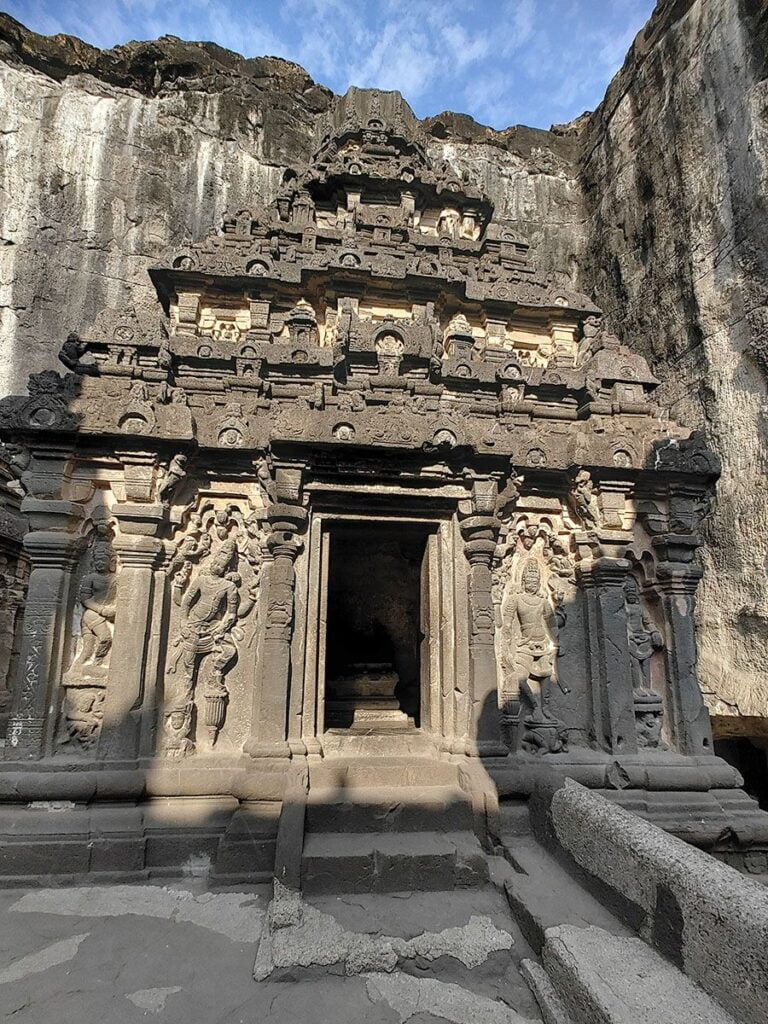
- Gateway (Gopuram): A big entrance that is decorated with resplendent sculptures.
- Nandi Mandapa: A pavilion housing a colossal sculpture of Nandi, Lord Shiva’s sacred bull, facing the main shrine. This Nandi Mandapa itself is a two-storied structure carved from the rock.
- Main Temple: The main center of the complex, where there is the lingam of Lord Shiva. It has a multi-levelled shikhara (tower) symbolizing visually Mount Kailash.
- Pillars and Courtyards: Two gigantic dhwajastambhas (flagstaffs) are present in the courtyard, and there are intricately carved elephant statues, as if protecting the sacred area.
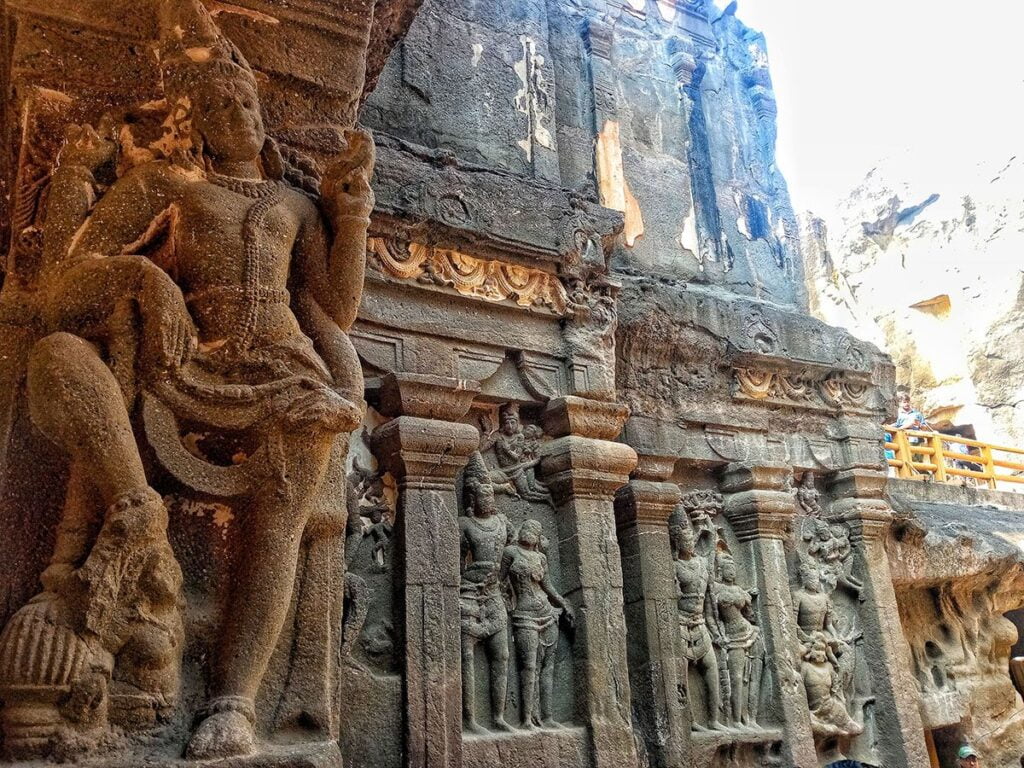
Labyrinthine Carvings and Sculptures: The whole temple surface, both outside and inside, is a work of art unmatched in the world. The space available is crammed with elaborate carvings:
- Gods and Goddesses: There’s a galaxy of Hindu gods and goddesses, such as Brahma, Vishnu, Ganesha, Kartikeya, and Durga, seen in different postures and myths.
- Mythological Scenes: As noted above, the narratives from the Ramayana, Mahabharata, and other Puranas are sculpted with precision and storytelling quality. The Ravana Shaking Mount Kailash scene is a classic illustration of the dynamism and emotional intensity of these statues.
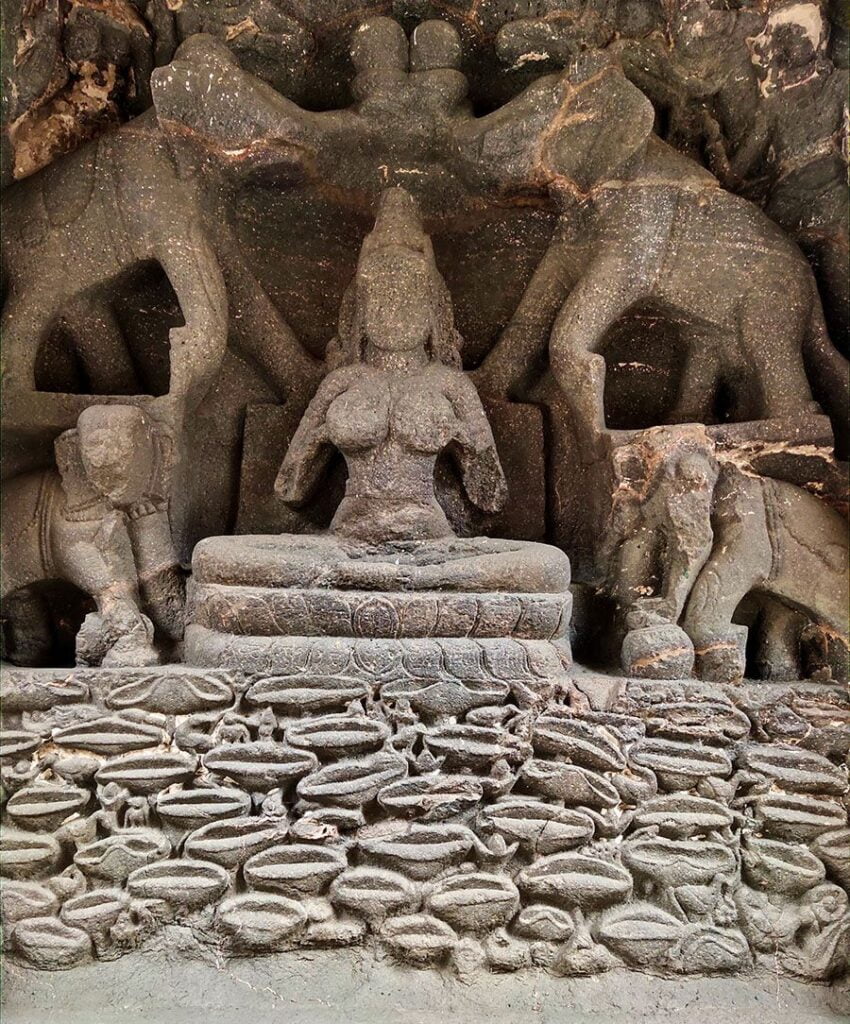
- Animal and Myths: Lions, elephants, griffins, and other mythical creatures grace the base and walls, contributing to majesty and symbolic representation of the gods. The towering elephant sculptures flanking the entrance are awe-inspiring, as if they are supporting the whole temple on their backs.
- Jalis (Latticework): Stone latticework with intricate detail lets light and air penetrate specific areas, providing a dance of light and shadow to enhance the mystique of the temple.
The architectural brilliance and artistic flair exhibited at the Kailasa Temple Ellora are nothing short of astonishing. It’s a testamony to the extraordinary skill and vision of ancient Indian craftsmen and engineers who, with no aid from contemporary tools, produced something that still defies normal understanding.
Read More>> Saptashrungi Bhadrakali Temple Nasik
Myths and Beliefs: Whispers in the Stone
Aside from recorded history in and the epic legends chiseled into its walls, the Kailasa Temple Ellora is rich soil for many myths and beliefs that still abound among locals and tourists alike. These only add another layer of mystique to this already remarkable place.
The “Impossible” Construction: Arguably the most common myth is that the construction of the temple was just too massive for human hands to accomplish within a time period they would consider reasonable with only primitive tools. This gives rise to theories, generally hushed, of divine or even extraterrestrial intervention.
While archaeologists and historians have offered reasonable accounts for the top-down excavation technique and sheer devotion of thousands of craftsmen, the size of the project still leaves one questioning the boundaries of human ingenuity. How did they transport such enormous amounts of rock? What happened to all the excavated material? These and other questions continue to fuel the mysterious mystique of the Ellora Temple.
Indestructible Structure: There is a common myth that Mughal emperor Aurangzeb, infamous for his destructive fervor towards Hindu temples, tried to bring down the Kailasa Temple. The myth states that he sent a thousand men for three years, but all they were able to do was damage some of the carvings, not being able to destroy the main structure. This story, even if historically true in part, shows the toughness and long survival of the temple in people’s imagination. This substantiates that the temple is being safeguarded by God.
Underground Passages and Secret Cities: Some hypotheses regard massive underground passageways and even concealed rooms under the Ellora Caves, such as the Kailasa Temple. Although there are some narrow corridors now blocked off, the possibility of an entire lost civilization under the caves adds a fascinating level of speculation. These rumors tend to include theories about ancient knowledge, hidden information, or even little people who may have been involved in its creation.
Power of the Lingam: The Shivalinga inside the sanctum sanctorum is said by devotees to have great spiritual power. A lot of them come with certain prayers and offerings, anticipating that if they visit the Ellora Temple and pray to Lord Shiva, their desires will be fulfilled, they will attain moksha (liberation), or there will be peace and prosperity. The energy inside the principal shrine is described as tangible. These beliefs and myths, although not necessarily scientifically established, are a part of the Kailasa Temple Ellora experience. They reflect the wonder and awe inspired by this phenomenal monument, and the fact that some things are better left to the imagination and have helped keep the temple timeless
Read More>> Trimbakeshwar Jyotirlinga Temple
Ellora Caves Temple Timings and Crowded Days
Planning your visit is key to making the most of your experience at the Kailasa Temple Ellora.
Timings: The Ellora Caves, including the Kailasa Temple, are generally open from 6:00 AM to 6:00 PM.
Closed Day: Please note that the Ellora Caves are closed on Tuesdays. So, plan your trip accordingly!
Entry Fee: There is a nominal entry fee for both Indian and foreign visitors. This fee contributes to the maintenance and preservation of this magnificent UNESCO World Heritage Site.
Crowd Levels:
- Weekends and Public Holidays: As with any major tourist attraction, weekends and Indian public holidays see a significant increase in visitors.
- Peak Season: The period from October to March is usually considered to be the peak tourist season because of favorable weather. Large crowds can be expected during this time, particularly during major festivals like Maha Shivaratri.
- Best Time for a Quieter Visit: If you wish to have a more peaceful experience, I strongly suggest coming during weekday morning, shortly after opening time (between 6:00 AM – 8:00 AM). You get to move around the temple with fewer people around and be able to embrace its majesty fully. Evenings, just before closing time, can also be less busy.
Don’t forget to plan sufficient time for your tour of the Ellora Caves, particularly the Kailasa Temple. You’ll need at least 1-2 hours for the Kailasa Temple alone in order to fully appreciate its intricacies, and several additional hours to visit the other interesting caves in the complex.
Read More>> Trikut Ganesh Temple Nanded

Hindu Sites to See Near the Temple
Your spiritual odyssey need not conclude with the Kailasa Temple Ellora. The area surrounding Ellora and Aurangabad abounds with quite a few other important Hindu temples that merit a visit.
Grishneshwar Jyotirlinga Temple: A very short distance (less than 1 km) from the Ellora Caves, the Grishneshwar Jyotirlinga Temple is one of the twelve sacred Jyotirlingas (light lingams) of Lord Shiva in India. This ancient temple, which is also a highly venerated pilgrimage spot, is famous for its beautiful red-rock structure and peaceful ambiance. It’s such a powerful spot, and to visit here following the Kailasa Temple provides a stronger religious connection to Shiva.
Bhadra Maruti Temple, Khuldabad: Just a few kilometers from Ellora, this unusual Hanuman temple has a reclining idol of Lord Hanuman, a rare finding. It’s a much-visited place for pilgrims to make offerings and pray for blessings.
Aurangabad Caves: Although not Hindu per se, these are a group of Buddhist caves that date back earlier than the Ellora caves and give a glimpse of early Buddhist monastic life. They are comparatively smaller but historically important.
Daulatabad Fort: While mostly a historical fort, it also features some temples within its compound. This grand hill fort is a work of art in itself, with interesting history and sweeping views.
These surrounding attractions enable you to further explore the area’s rich past and religious heritage, and make your visit to the Ellora Caves that much more rewarding.
Read More>> Aundha Nagnath Temple: 8th Jyothirling with Divine Serpents
Accommodation Options Near the Temple
To really get into the experience of a visit to the Kailasa Temple Ellora and the surrounding Ellora Caves, having comfortable accommodation close by is important. You have options, varying in budget and taste:
Hotels at Ellora Village: For the ultimate in convenience, it is an excellent idea to stay at Ellora village itself. These hotels are usually within a walking distance or a very short drive from the cave complex.
Ellora Heritage Resort: Frequently suggested, with good amenities and a comfortable stay. Hotel Kailas: A favorite among most people, for the convenience and reasonable facilities it offers.
Abhayanand Agro Tourism: For a more natural experience and serene ambience, this is an excellent option.
Shri Balaji Resort / Hotel Tulsi Inn / Viceroy Resort / Shivam Residency: These are some other highly rated choices with different standards of comfort.
Aurangabad City hotels: Aurangabad is a bigger city (approximately 30 km from Ellora) and has a greater selection of hotels, ranging from budget guesthouses to luxury resorts. If you want greater urban facilities, better restaurants, and better access to other attractions in the city, it’s worth staying in Aurangabad and visiting Ellora as a day trip.
The Gateway Hotel (Taj) Aurangabad: A high-end choice for a comfortable stay.
Lemon Tree Hotel, Aurangabad: A satisfactory mid-scale option with contemporary amenities.
Accommodation Options Near the Temple: Other decent options.
Tips for Booking Accommodation
- Book early, particularly in peak season or near the major festivals.
- Read reviews to make sure the hotel is what you expect.
- Choose how far from the Ellora Caves you want to be and how you wish to travel.
How to Reach the Temple
Getting to the Kailasa Temple Ellora is relatively easy with good access to Aurangabad, which is the main gateway.
By Air:
Aurangabad Airport (IXU): This is closest airport, approximately 30-40 kilometers away from the Ellora Caves. It has direct flights connecting major Indian cities such as Mumbai, Delhi, Hyderabad, and Bengaluru. After arrival, you can rent a taxi or take ride-sharing to Ellora.
By Train:
The Aurangabad Railway Station (AWB) is the nearest major railway station, connected directly with all major cities of India. From the railway station, you may hire a taxi or take an auto-rickshaw or local bus to the Ellora Caves.
By Road:
From Aurangabad: Ellora Caves are approximately 30 kilometers from Aurangabad. You can easily hire a taxi, take a local bus (Maharashtra State Road Transport Corporation – MSRTC buses are frequent and economical), or even an auto-rickshaw for the journey.
Self-Drive: Driving is an option if you are driving from nearby cities like Pune or Nashik. The roads are quite good. GPS for directions.
Bus Connectivity: There are regular bus services from Aurangabad to other cities in Maharashtra and other surrounding states.
Local Transport within Ellora: Once you reach the Ellora Caves complex, the caves are distributed over a distance of approximately 2 kilometers. One can walk, but it’s exhausting, particularly in summers.
E-rickshaws/Golf Carts: Some of the entrances have electric vehicles or golf carts that you can ride between the caves, which is a relaxing option.
Walking: If walking is your passion, going through the caves on foot gives you the luxury of time to appreciate the minute details. The Kailasa Temple Ellora (Cave 16) is at the center and a convenient stop.
Whichever mode of travel you opt for, traveling to the Ellora Temple itself is an experience, taking you to a unique historical and spiritual destination.
Read More>> 11 CE Adinath Temple Khajuraho
Trending Questions regarding Kailasa Temple Ellora
As your guide, I am frequently asked some popular and interesting questions regarding the Kailasa Temple Ellora. Let’s tackle some of them:
What is the most striking aspect of Kailasa Temple?
Hands down, the most astounding of its features is the fact that it is monolithic and was carved from top to bottom. That a whole temple complex, such fine details and huge as it is, was carved from a single block of rock, top to bottom, without the use of any modern machinery at all, is simply mind-boggling. It attests to the unmatched engineering and artistic abilities of ancient India.
How was the Kailasa Temple excavated?
Carved by a distinctive top-down vertical excavation technique. Picture beginning at the summit of a massive basalt cliff. Artisans sketched out the general structure and then carefully scooped out gigantic quantities of rock from above, working their way down bit by bit to determine the roof, the walls, the pillars, and all the carvings. They would have employed hammers, chisels, and such simple hand tools, depending on stupendous accuracy and a highly detailed blueprint. This process did away with scaffolding, which would have been very hard to put up for such a building.
What is the religious significance of Ellora Caves?
The Ellora Caves are religiously important since they contain monuments of the three great Indian religions: Buddhism, Hinduism, and Jainism, existing in one single complex. This reflects a high degree of religious tolerance and harmony that was typical in ancient India. For the Hindus, the Kailasa Temple Ellora particularly has profound spiritual significance since it is in honor of Lord Shiva and symbolizes his heavenly residence, Mount Kailash. Visiting it is considered a pilgrimage that can bring spiritual merit.
Who built the Kailasa Temple at Ellora?
The construction of the Kailasa Temple Ellora is widely attributed to the Rashtrakuta King Krishna I (reigned 756–773 CE). While direct inscriptions are scarce, historical and epigraphic evidence strongly points to his patronage. For how long was the construction of the Kailasa Temple carried out? The precise length of time is contested. Historians suggest it would have taken hundreds of years with thousands of laborers. Popular mythologies claim much less, sometimes as little as 18 years, perhaps to emphasize the miraculous completion it has been accorded. The reality was probably somewhere in between, by relentless and persistent effort over decades.
Why is Kailasa Temple famous?
It’s renowned for a number of reasons: it’s the biggest monolithic structure in the world, carved completely out of one rock; it illustrates an unprecedented top-down carving method; its architectural size and expressive sculptural details are awe-inspiring; and it’s an imposing testament to ancient Indian engineering and artistry. Its beauty and audacity alone make it a wonder of the world.
Were aliens involved in building Kailasa Temple?
This is a popular myth that often circulates due to the seemingly impossible nature of its construction without modern technology. However, there is no scientific or historical evidence to support claims of extraterrestrial involvement. The construction of the temple bears witness to the enormous capability, design, and perseverance of ancient Indian craftsmen and engineers using what they knew how to do and with what resources were at their disposal. It just increases our vision of what we think was possible.
These questions illustrate the lasting interest and wonder that the Kailasa Temple Ellora still evokes.
Conclusion: A Journey Etched in Time
As we come to the end of our tour of the stunning Kailasa Temple Ellora, I hope you’ve developed a greater sense of wonder for this unrivaled monument. It’s a location that actually defies time, a work of art chiselled not only from stone, but from the very essence of dedication, creativity, and human determination.
2 Comments