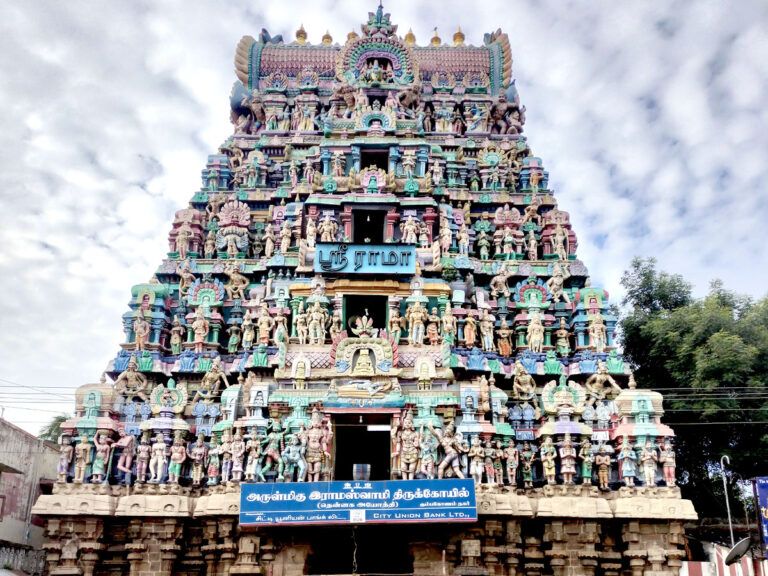
Mahamaham Tank Kumbakonam: History, 16 Mandapams, Festivals, and Visitor Guide
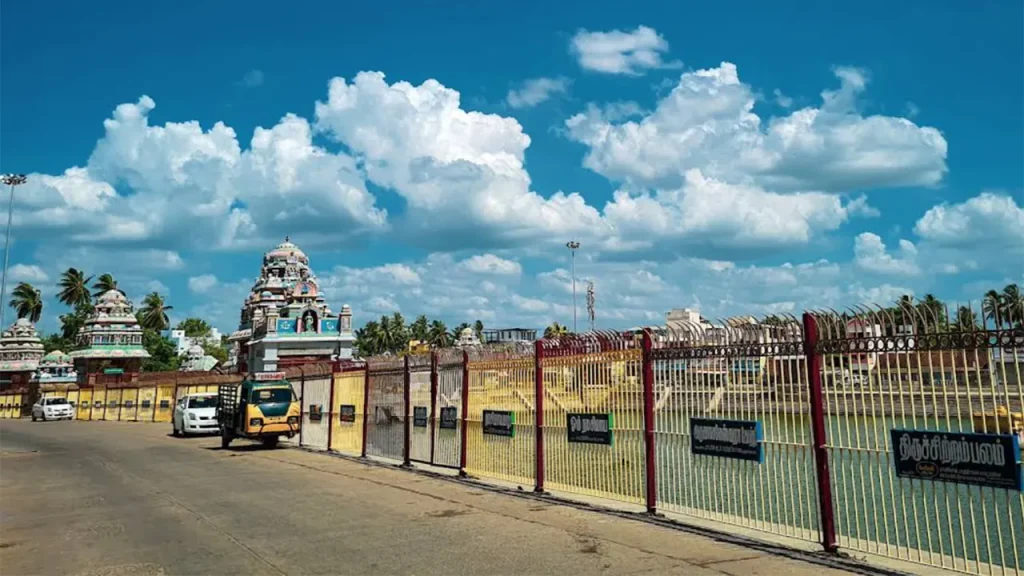
The Mahamaham Tank (known locally as Mahamaham Kulam) is one of the most celebrated sacred water bodies in South India. Situated in the heart of Kumbakonam in Tamil Nadu’s Thanjavur district, this historic reservoir spans nearly 21 acres. It is enclosed by 16 ornate stone pavilions (Shodasa Mandapams) and contains 21 sacred natural wells within its bed.
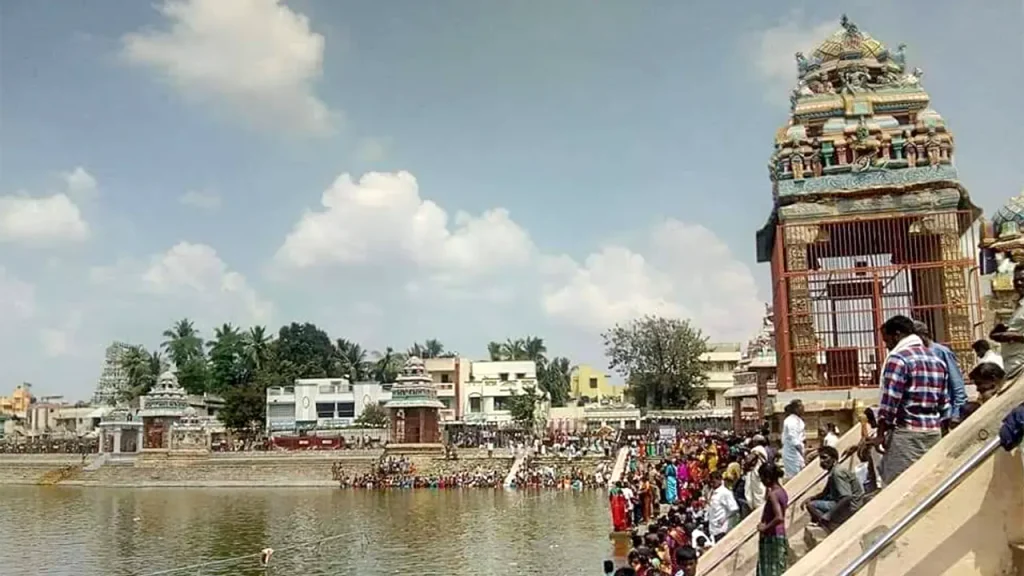
Often described as the venue for the “Kumbh Mela of the South,” Mahamaham Tank attracts hundreds of thousands of pilgrims annually for the Masi Maham festival, and up to two million devotees during the grand Mahamaham festival, which takes place once every 12 years. Devotees believe that a holy dip in these sacred waters cleanses worldly sins, drawing spiritual merit from nine of India’s most revered holy rivers.
Quick Information: Mahamaham Tank at a Glance
| Feature | Details |
| Monument Name | Mahamaham Tank (Mahamaham Kulam) |
| Location | Centre of Kumbakonam town, Thanjavur District, Tamil Nadu, India |
| Monument Type | Sacred Temple Tank (Theertham) and Historic Water Reservoir |
| Area | Approximately 21 acres (trapezoidal layout) |
| Primary Deities Honored | Lord Shiva (across 16 Shodasa Mandapam shrines), Lord Kumbeswarar, Lord Kasi Viswanathar |
| Key Historical Builders | Vijayanagara Emperors; renovated and expanded by Govinda Dikshitar under Thanjavur Nayaks (16th–17th c.) |
| Major Festivals | Mahamaham (once every 12 years), Masi Maham (annual, Feb–Mar), Theppam (Float Festival) |
| Daily Visiting Hours | 6:00 AM to 8:30 PM (Perimeter ghats and walkway) |
| Entry Fee | Free (Public sacred site) |
| Dress Code | Modest traditional attire recommended; footwear prohibited on stone bathing steps |
| Nearest Railway Station | Kumbakonam Railway Station (1.5 km) |
| Nearest Airport | Tiruchirappalli International Airport (TRZ) (approx. 91 km) |
| Administrative Authority | Hindu Religious and Charitable Endowments (HR&CE), Government of Tamil Nadu & Kumbakonam Municipality |
Religious Significance and Sacred Legends
The sanctity of the Mahamaham Tank is woven into the foundational mythology of Kumbakonam itself. The town’s very identity as a premier temple center originates from the divine events said to have created this reservoir.
The Legend of the Amrita Kumbha and Cosmic Creation
According to the Sthala Purana (sacred temple lore) preserved in regional religious chronicles, Lord Brahma, the creator, grew anxious as a cosmic deluge (Pralaya) approached at the end of a previous cosmic era. Brahma prayed to Lord Shiva for guidance on how to protect the seeds of creation and Vedic knowledge from total destruction.
Shiva instructed Brahma to prepare a divine pot (Kumbha) made of clay, infused with divine nectar (Amrita), sacred soil, and the seeds of all living creation. The pot was decorated with mango leaves, bilva twigs, and a sacred coconut, and set afloat upon the surging waters of the deluge.
As the floodwaters rose across the earth, the sacred pot floated southwards. When the waters receded, the pot came to rest at this specific geography in Tamil Nadu. Shiva then assumed the guise of a divine hunter (Kirata) and shot a piercing arrow into the pot.
The celestial pot broke upon impact. The divine nectar spilled out across the earth, pooling into a vast hollow that became the Mahamaham Tank. The fragments of the clay pot scattered across the surrounding soil, and from these sacred spots arose the major Shiva and Vishnu sanctums of the town. Chief among them is the celebrated Adi Kumbeswarar Temple, where Shiva fashioned the primary Lingam from the nectar-soaked clay itself. Because the divine pot (Kumbha) settled here at a sacred corner (Kona), the holy town came to be known as Kumbakonam.
The Meeting of the Nine Holy Rivers
Another sacred belief connected to the tank concerns the personified holy rivers of the Indian subcontinent. Traditional texts recount that the sacred rivers—Ganga, Yamuna, Godavari, Saraswati, Narmada, Sindhu, Kaveri, Sarayu, and Tungabhadra—felt burdened by the collective sins washed into their waters by millions of human pilgrims.
Seeking purification, the river goddesses approached Lord Brahma, who directed them to Lord Shiva. Shiva granted them a divine boon: once every 12 years, during the auspicious astrological conjunction of the Mahamaham festival, all nine rivers would invisibly channel their waters into the Mahamaham Tank. By entering this celestial reservoir of Amrita, the sacred rivers themselves would be purified.
Consequently, bathing in the tank during this period is believed by devotees to yield spiritual merit equal to taking a ceremonial dip in all of India’s holy rivers at the same moment.
Historical Origins and Royal Inscriptions
While local devotion traces the tank to ancient cosmic ages, documented architectural and epigraphical records confirm that the massive stone-paved reservoir seen today was shaped by centuries of royal patronage.
Vijayanagara Imperial Patronage and Krishnadevaraya
During the medieval period, the kings of the Vijayanagara Empire recognized Kumbakonam as an important commercial and cultural center of the Kaveri River Delta. Inscriptions documented by the Archaeological Survey of India Epigraphy branches confirm that Emperor Krishnadevaraya visited Kumbakonam in 1524 CE.
Historical stone inscriptions at Nagalpuram and the Shiva temple in nearby Kuthalam record that Krishnadevaraya arrived with his retinue on the auspicious day of the Mahamaham festival. The emperor took a ceremonial bath in the tank and performed the Tulapurushadana—the ancient ritual of weighing oneself against gold and precious gems and distributing them in charity to religious institutions, scholars, and the public.
The Visionary Contributions of Govinda Dikshitar
The comprehensive urban planning and grand Dravidian stone architecture enclosing the tank today are credited to the Thanjavur Nayak kingdom. In the late 16th and early 17th centuries, Govinda Dikshitar, the revered prime minister and scholar-statesman serving the Nayak kings Sevappa, Achuthappa, and Raghunatha Nayak, undertook a complete renovation of the reservoir.
Dikshitar recognized that the tank required durable civil structures to withstand millions of pilgrims without collapsing into mud or silt. He directed the paving of wide granite steps (ghats) along all four perimeters and financed the construction of the 16 stone mandapams around the water’s edge.
In the northern Gangatirtha Mandapam, visitors can still see carved stone relief sculptures depicting King Raghunatha Nayak and Govinda Dikshitar performing the sacred charity ritual, cementing their enduring link to Kumbakonam’s heritage.
Architectural Marvel: The 16 Mandapams and 21 Wells
The Mahamaham Tank is an engineering marvel of hydraulic design and Dravidian stone masonry, covering an expanse of approximately 21 acres in an irregular trapezoidal plan.
The Shodasa Mandapams (16 Stone Pavilions)
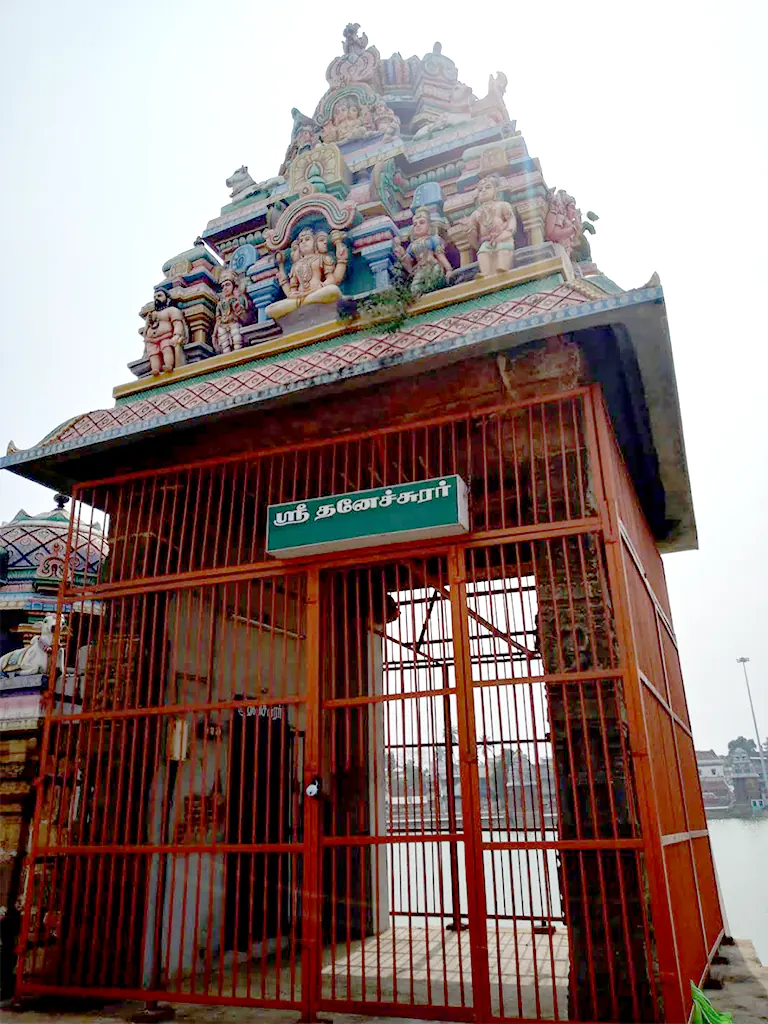
Encircling the granite banks of the tank are 16 ornate stone pavilions known as the Shodasa Mandapams (Shodasa meaning sixteen in Sanskrit). Each mandapam is a classical Dravidian stone pavilion housing an individual Shiva Lingam.
Pilgrims circumambulating the tank offer worship to each of these 16 shrines:
- Brammatheerthan Mandapam
- Mukunthan Mandapam
- Dhaneswaran Mandapam
- Virushabam Mandapam
- Vaneswarar Mandapam
- Koneswarar Mandapam
- Bakthikeswarar Mandapam
- Bhairavar Mandapam
- Agastheswarar Mandapam
- Vyasakeswarar Mandapam
- Umamaheswarar Mandapam
- Nirutheeswarar Mandapam
- Brammeswarar Mandapam
- Gangatheerthan Mandapam
- Muktheswarar Mandapam
- Nayakkar Mandapam
Each mandapam features heavy carved granite pillars adorned with motifs of Yalis (mythical leonine protectors), celestial dancers, and foliage carvings, capped with brick and mortar vimanas finished in decorative stucco work.
The 21 Sacred Wells (Theerthams) in the Tank Bed
The floor of the Mahamaham Tank is not a simple flat basin; it contains 21 natural, spring-fed wells (theerthams). Each well is encased in circular stone or masonry rings and carries a distinct spiritual dedication:
- Vayu Theertham
- Ganga Theertham
- Yamuna Theertham
- Godavari Theertham
- Narmada Theertham
- Saraswati Theertham
- Kaveri Theertham
- Kanya Theertham
- Payoshni Theertham
- Sarayu Theertham
- Indra Theertham
- Yama Theertham
- Niruthi Theertham
- Varuna Theertham
- Agni Theertham
- Isanya Theertham
- Brahma Theertham
- Brihaspati Theertham
- Surya Theertham
- Chandra Theertham
- Devarishi Theertham
These sub-wells allow subterranean natural springs to feed the tank. During major desilting operations conducted by municipal authorities ahead of festivals, the circular lips of these stone wellheads become clearly visible across the exposed bed of the tank.
Festivals and Rituals at Mahamaham Tank
While daily life around the tank is peaceful, the reservoir transforms into an ocean of devotion during major astronomical conjunctions.
The Grand 12-Year Mahamaham Festival
The hallmark celebration is the Mahamaham Festival, held once every 12 years. The festival occurs when astronomical alignments match a specific configuration:
- The planet Jupiter (Guru) transits into the zodiac sign of Leo (Simha Rasi).
- The Sun (Surya) enters the sign of Aquarius (Kumbha Rasi).
- The Moon aligns with the asterism of Makam (Magha Nakshatra) on the full moon day (Purnima) in the Tamil month of Masi (falling in February or March).
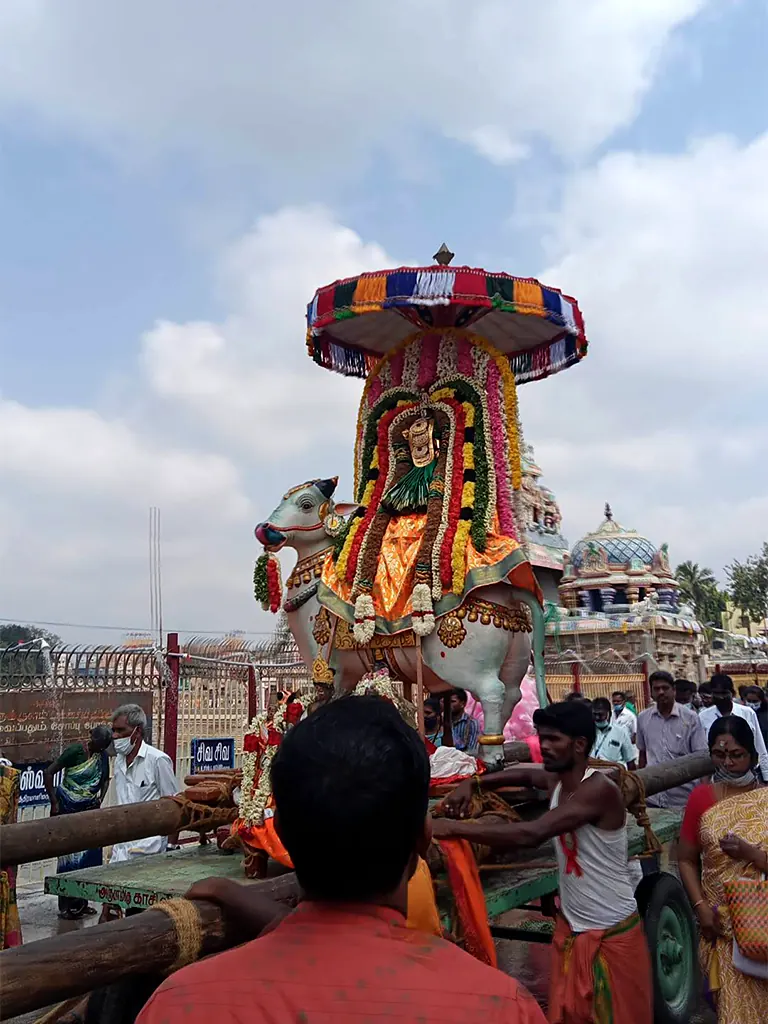
On the climactic day of the festival, known as the Theerthavari, processional deities (utsava murtis) from the twelve principal Shiva temples and five major Vaishnava temples of Kumbakonam are carried in elaborate palanquins to the banks of the tank.
At an astrologically determined moment, temple priests take the sacred ceremonial emblems (Astra Devatas) into the water for a ceremonial bath. Simultaneously, hundreds of thousands of pilgrims step into the water to take their purification dip. The most recent Mahamaham festival occurred in February 2016, drawing over two million visitors, with the next conjunction set to occur in 2028.
The Annual Masi Maham and Theppam (Float) Celebrations
For pilgrims who cannot attend the 12-year festival, the annual Masi Maham festival held every February or March serves as an important yearly observance. While smaller in scale than the 12-year festival, it still attracts tens of thousands of devotees who take part in morning baths and watch temple processions.
During the festive season, the town also celebrates the Theppam (Float Festival). Deities are placed on brightly illuminated, flower-decked floating rafts that are pulled across the dark waters of the tank at night, accompanied by the playing of traditional nadaswaram music and Vedic chants.
Practical Visitor Guide: Timings, Rituals, and Guidelines
Planning a visit to Mahamaham Tank is straightforward, as it is located centrally within Kumbakonam town.
Timings and Access
- Walkway and Shrines: The perimeter road, stone steps, and mandapam shrines are generally open daily from 6:00 AM to 8:30 PM.
- Bathing Access: Depending on current civic water management, municipal water quality, and rainfall, direct bathing access may be regulated by local authorities. Visitors wishing to take a ritual dip or sprinkle holy water on their heads should restrict themselves to designated, shallow steps along the perimeter ghats.
Etiquette and Dress Code
- Footwear: Footwear must be removed before descending onto the granite bathing steps or approaching any of the 16 stone mandapam shrines. Footwear stands are available along the outer perimeter road.
- Clothing: Modest attire is expected around the sacred ghats. Dhoti, kurta, or pyjamas for men, and sarees or salwar suits for women are customary. Changing rooms are set up along the outer banks during festival seasons.
- Cleanliness: To preserve the historic water body, visitors are strictly prohibited from using chemical soaps, shampoos, or washing clothes in the tank. Plastic disposal is strictly monitored under local municipal laws.
How to Reach Kumbakonam
Kumbakonam is one of the most accessible temple towns in Tamil Nadu, supported by strong road and rail networks across the Kaveri Delta.
- By Air: The nearest airport is Tiruchirappalli International Airport (TRZ), situated approximately 91 km west of Kumbakonam. Taxis and regular state express buses connect the airport to Kumbakonam in approximately 2 to 2.5 hours via NH36.
- By Train: Kumbakonam Railway Station (Station Code: KMU) is a major rail hub located just 1.5 km from Mahamaham Tank. It connects directly to Chennai Egmore, Thanjavur, Madurai, Tiruchirappalli, Mayiladuthurai, and Bengaluru via regular express trains like the Cholan Express and Uzhavan Express.
- By Road: Kumbakonam is well serviced by Tamil Nadu State Transport Corporation (TNSTC) and private omnibus operators. Frequent buses run from Thanjavur (40 km), Mayiladuthurai (34 km), Chidambaram (72 km), and Chennai (approx. 290 km). Auto-rickshaws and cycle-rickshaws are readily available at the bus terminus and railway station to take visitors to the tank.
For local civic updates, transit advisories, and administrative notices, visitors can consult the Thanjavur District Administration Portal.
Prominent Temples Surrounding the Tank
Because the breaking of the sacred Amrita Kumbha is believed to have scattered divinity throughout the town, visitors to the Mahamaham Tank can easily explore several ancient temples within walking distance:
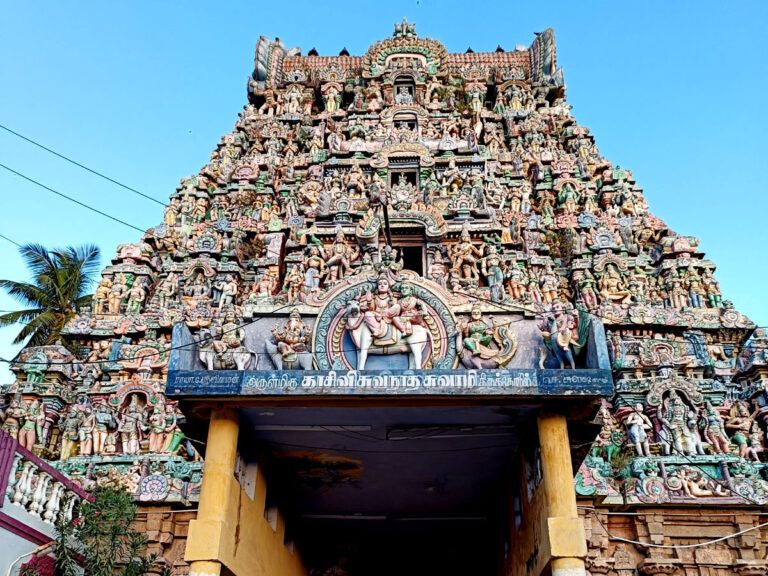
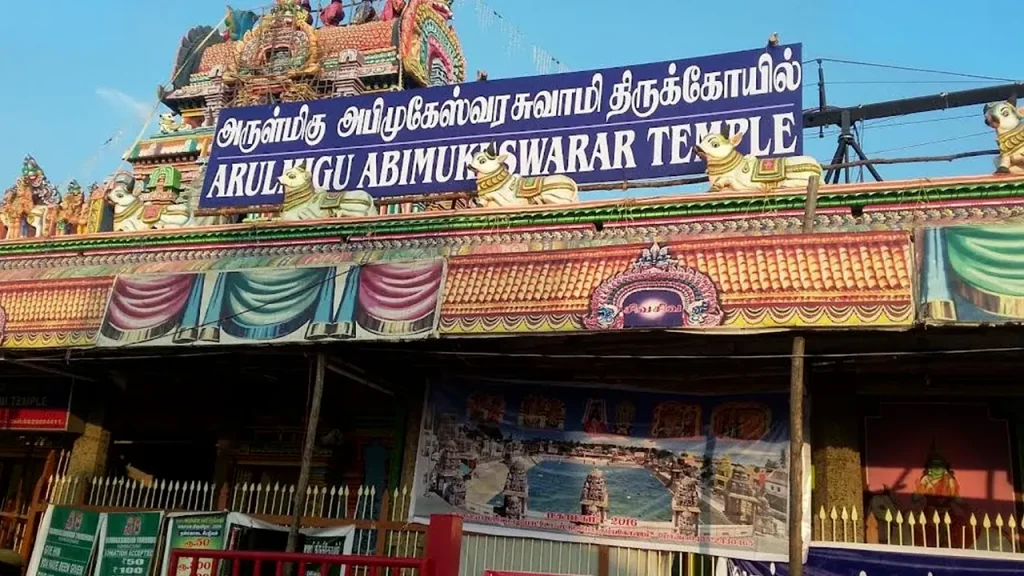
- Kasi Viswanathar Temple: Located directly on the northern bank of the Mahamaham Tank, this ancient Shiva temple is an essential stop for pilgrims taking a holy bath. It features unique shrines dedicated to the nine holy river goddesses (Navakanniyar).
- Adi Kumbeswarar Temple: Situated just 800 meters northwest of the tank, this is the premier Shiva shrine of Kumbakonam, featuring expansive Chola courtyards, majestic gopurams, and the primary Lingam made of sacred earth and divine nectar.
- Sarangapani Temple: Located approximately 1 km to the north, this temple is one of the celebrated 108 Divya Desams dedicated to Lord Vishnu. Its inner sanctum is sculpted in the likeness of a grand stone chariot pulled by horses and elephants.
- Nearby Heritage Excursions: For travelers touring the wider heritage corridor, the UNESCO World Heritage-listed Airavatesvara Temple in Darasuram is located just 4 km away, while the monumental Brihadeeswarar Temple in Thanjavur lies 40 km to the southwest.
For comprehensive state-level travel planning, pilgrimage guides, and regional festival schedules, consult the Tamil Nadu Tourism Official Website.
Frequently Asked Questions about Mahamaham Tank Kumbakonam
When is the next 12-year Mahamaham Festival?
The last Mahamaham festival took place on February 22, 2016. Because the festival depends on the 12-year transit of Jupiter into the constellation of Leo (Simha Rasi) alongside specific lunar alignments in the Tamil month of Masi, the next grand Mahamaham festival will be celebrated in the year 2028.
Can visitors bathe in the Mahamaham Tank every day?
Yes, pilgrims are permitted to step onto the masonry steps and sprinkle or bathe in the waters daily, provided municipal water levels and maintenance conditions permit. Visitors are requested to exercise care on wet stone steps and avoid the use of chemical detergents or soaps.
Is there an entry ticket for Mahamaham Tank?
No. The Mahamaham Tank is an open, historic public reservoir with free access for all visitors and pilgrims.
What are the 16 mandapams around the tank?
The 16 stone pavilions (Shodasa Mandapams) were constructed in the 16th and 17th centuries by Govinda Dikshitar, prime minister of the Thanjavur Nayak kingdom. Each pavilion features stone-carved Dravidian pillars and enshrines a dedicated Shiva Lingam representing different divine facets.
How deep is the water in Mahamaham Tank?
The water depth varies depending on the season, rainfall, and whether the municipal authorities have filled or desilted the basin. While the outer steps slope gently, the floor of the tank features 21 deep, historic wellheads, meaning visitors should remain on the designated shallow stone steps and avoid swimming into the central basin.
Conclusion and Pilgrimage Planning Tips
The Mahamaham Tank is not merely an ancient reservoir; it represents the living spiritual heart of Kumbakonam. From its roots in the cosmic myth of the Amrita Kumbha to the stone masonry left behind by the Vijayanagara emperors and Thanjavur Nayaks, every granite block and pavilion tells a story of enduring faith and architectural skill.
When visiting, take the time to walk around the perimeter road in the cool hours of the early morning. Observe the distinct carvings on each of the 16 Shodasa Mandapams, take in the atmosphere of the Kasi Viswanathar shrine on the northern bank, and explore the ancient temple streets that have welcomed pilgrims for centuries. Whether visiting during the quiet winter months or amidst the colorful pageantry of Masi Maham, the sacred reservoir offers a peaceful and memorable glimpse into South India’s deep temple heritage.