Shree Neelkanth Mahadev Temple
Shree Neelkanth Mahadev Temple is situated about 32 kilometers away from Rishikesh in the Pauri Garhwal district of Uttarakhand, India. It rests gently at an elevation of about 1,330 meters (around 4,363 feet) amidst dense forests and three major valleys: the Manikoot, Brahmakoot, and Vishnukoot. A place where every particle of air feels filled with divinity, the view is simply breathtaking. Ready? Let’s start!
Contents
- 1 Introduction to Shree Neelkanth Mahadev Temple
- 2 History of the Temple: Ancient Roots
- 3 Legend of the Temple: Samudra Manthan
- 4 Scriptural Evidence: Mentions in Puranas
- 5 Cultural, Spiritual, and Mythological Importance
- 6 Festivals and Special Days: A Crowd of Devotion
- 7 Unique Architectural Style and Carvings
- 8 Special Poojas and Sacred Bath
- 9 Myths, Beliefs, and Trending Questions
- 10 Trending Questions Answered
- 11 Shree Neelkanth Mahadev Temple Timing:
- 12 How to Reach the Temple
- 13 Accommodation Options
- 13.0.1 Nageshwar Jyotirlinga Dwaraka: 7th CE Temple with Divine Powers
- 13.0.2 Grishneshwar Temple: Wealth and Pleasure at Shiva’s Feet
- 13.0.3 Kedarnath Temple: One of Jyotirling & Char Dham
- 13.0.4 Trimbakeshwar Jyotirlinga Temple
- 13.0.5 Sacred Kashi Vishwanath Temple: 11th Jyotirling of Liberation
- 13.0.6 Aundha Nagnath Temple: 8th Jyothirling with Divine Serpents
- 14 Hindu Places to Visit Near the Temple
Introduction to Shree Neelkanth Mahadev Temple
Imagine a temple that stands as a permanent symbol of sacrifice. That’s exactly what the Shree Neelkanth Mahadev Temple is. The very name, Neelkanth, is a title for Lord Shiva, and it means “The Blue-Throated One.” As a seasoned guide, I can tell you that understanding this name is the key to understanding the profound significance of this entire pilgrimage site. It’s an easy-to-read story of divine intervention that saved the universe, and I promise to explain every mesmerizing detail.
This isn’t just a destination for religious devotees; it’s a haven for nature lovers, trekkers, and anyone seeking a moment of peaceful solitude away from the hustle and bustle of city life. The journey here is as rewarding as the destination itself, winding through lush greenery and offering panoramic views of the hills. It truly is a unique blend of spiritual fervor and natural beauty.
History of the Temple: Ancient Roots
While the exact historical date of the construction of the temple is lost, as in most ancient Indian shrines, its roots are undeniably ancient and profoundly mythological. Many sources attribute the temple’s modern structure and formal establishment to the great 8th-century philosopher and saint, Adi Shankaracharya. Believed to have played an important role in revitalizing many key pilgrimage destinations across the country, this holy site was most definitely one among them. The tradition of worshipping Lord Shiva herein actually preceded the formal construction by centuries.
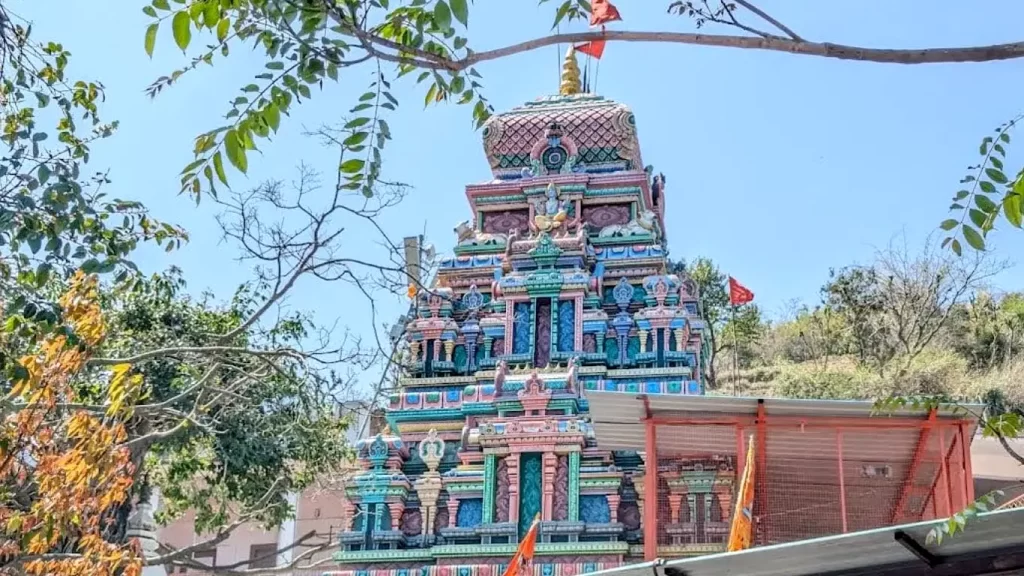
The temple we see today reflects a beautiful blend of North Indian architectural styles, though some elements, like the towering Shikhara (spire), are also reminiscent of certain Southern Indian temple styles. The whole structure is painted in a vibrant, welcoming blue and white, perfectly fitting the temple’s central legend.
Legend of the Temple: Samudra Manthan
This is where the story becomes really interesting, and why the Shree Neelkanth Mahadev Temple is significant. The temple is inextricably linked to the most famous cosmic event in Hindu mythology, known as the Samudra Manthan or “Churning of the Ocean of Milk.”
The Churning for Amrit
As the ancient texts say, the Devas, or gods, and the Asuras, or demons, once decided to churn the ocean to get the Amrit, the nectar of immortality. They took Mount Mandara as the churning rod and the great serpent king Vasuki as the churning rope.
The Emergence of Halahala
Now, as the churning began, it didn’t immediately yield the Amrit. The first thing to emerge was not a blessing, but a terrifying curse: the Halahala, a deadly, potent poison capable of destroying all life in the universe—gods, demons, and mortals alike.
Panic spread everywhere. The Devas and the Asuras had no clue how to stop the spreading of this disastrous poison. Faced with universal terror, they looked for the help of a being who was reputed for his vast power, compassion, and detachment: Lord Shiva.
Shiva’s Compassionate Act
Because He felt infinite compassion for the entire creation, Lord Shiva, the Mahadeva or Great God, came forward. He gathered the whole quantity of the deadly Halahala into His hands and swallowed it.
However, his divine consort, Goddess Parvati, intervened immediately and pressed his throat, preventing the poison from descending into his body and causing him harm, but also stopping it from reaching his stomach, which would have destroyed the entire universe contained within him.
The poison was thus contained in his throat, and because of its immense potency, it turned his throat a deep, vibrant blue. It is for this selfless, magnificent act that he got the eternal name: Neelkanth.
As a matter of faith, it is believed that the very spot where Lord Shiva consumed and then held the poison and meditated to subdue its lingering effect is the place where Shree Neelkanth Mahadev Temple stands.
Read More>> Gangapur Dattatreya Temple
Scriptural Evidence: Mentions in Puranas
It is not a mere myth but one of the basic stories deeply enshrined in Hindu scripture. The origin of Shiva as Neelkanth finds a place of pride in many of the Puranas, a set of ancient Hindu texts containing mythological narratives.
The Bhagavata Purana
The most powerful reference comes from the Bhagavata Purana, which gives a similar account of Samudra Manthan in the eighth Skandha or canto. These texts describe the terror of the poison and, even more so, Shiva’s response. Although the lines are in complex Sanskrit, their sense is beautifully rendered:
“When the Lord Shiva, who is always benevolent to all living beings, saw the suffering caused by the poison, he compassionately took it upon himself and held it in his throat, thereby earning the name Neelkanth.”
The Shiva Purana
You can just imagine the Shiva Purana, in praise of Lord Shiva, having verses to this great act. This shows the compassion and the nature of being the ultimate protector.
“The great Lord Shiva, out of his infinite compassion, swallowed the deadly poison, which turned his throat blue, making him renowned as Neelkanth.”
These sacred texts lend irrefutable scriptural proof to the fact that the legend of Neelkanth forms one of the core beliefs, hence making this temple a site of extraordinary mythological and spiritual weight.
Cultural, Spiritual, and Mythological Importance
The Shree Neelkanth Mahadev Temple is important on so many counts because it touches upon our culture, spirituality, and deepest mythologies all at once.
Mythological Significance
It is the very spot with which we are acquainted where Lord Shiva made the greatest sacrifice. Visiting here means, mythologically, to stand on the ground sanctified by a world-saving divine act. This represents the victory of good over evil, transcendence over suffering, and the compassionate protection accorded by the Divine.
Spiritual Significance: The Story of Neelkanth
The Neelkanth story conveys a deep life lesson for a spiritual seeker: the poison, or Halahala, can be seen to stand as a metaphor for all the negativity in our own lives-anger, jealousy, suffering, and worldly troubles.
Lord Shiva didn’t allow the poison to destroy the world, nor did he expel it—he contained it. This teaches us the importance of transcendence and containment. Instead of letting negativity spread and harm others, or letting it consume us entirely, we should strive to contain and transform it through wisdom and spiritual practice. When you visit Shree Neelkanth Mahadev Temple, you seek the strength to hold your own ‘poison’ and remain untouched by it.
Cultural Significance: The Kanwar Yatra
Culturally, the temple is one of the most important destinations for the annual Kanwar Yatra. This is a massive pilgrimage where devotees, known as Kawarias (or Kanwariyas), walk barefoot—often for hundreds of kilometers—to collect sacred water from the Ganges River, usually at Haridwar, and carry it in decorated pots (the Kanwars).
Their journey culminates at major Shiva temples, and the Shree Neelkanth Mahadev Temple is one of the most revered end-points. Offering the holy Ganga water to the Shivling here is considered an act of supreme devotion.
Read More>> Uttarkashi Temple Kashi Vishwanath
Festivals and Special Days: A Crowd of Devotion
Special days and festivals totally change the atmosphere at the temple. If you want a quiet visit, avoid those times. But if you want to see the absolute peak of Hindu devotion, this is when you must come!
Maha Shivaratri: The Great Night of Shiva
- When: Usually falls in February or March.
- The Vibe: Arguably the largest and most vibrant festival at the Shree Neelkanth Mahadev Temple, it is beautifully decorated and lighted up by thousands of lamps. Special all-night Pujas are performed. Though the crowds are huge, the energy is electric. Devotees fast, sing bhajans (devotional songs), and keep vigil all night.
Shravan Maas (Holy Month of Shravan)
- When: The Hindu lunar month of Shravan, corresponding to July-August, during the monsoon.
- The Crowded Days: Mondays falling in Shravan are believed to be highly auspicious days to worship Lord Shiva. You can just imagine how crowded it would be, especially each and every Monday of this month. This is the time when the Kanwar Yatra gains momentum and the number of saffron-clad pilgrims creates quite a busy atmosphere while driving and inside the temple premises.
- Special Rituals: Abhishekam is performed by bathings the Shivling with milk, water, honey, curd, and Bael (wood apple) leaves throughout the day.
Somvati Amavasya
- When: Any Amavasya (new moon day) that falls on a Monday (Somvar).
- The Significance: This is a rare and highly sacred day. Devotees believe that performing prayers and rituals at a Shiva temple like Shree Neelkanth Mahadev Temple on Somvati Amavasya is equivalent to undertaking many pilgrimages. Expect high foot traffic, though usually less than a Shravan Monday.
Unique Architectural Style and Carvings
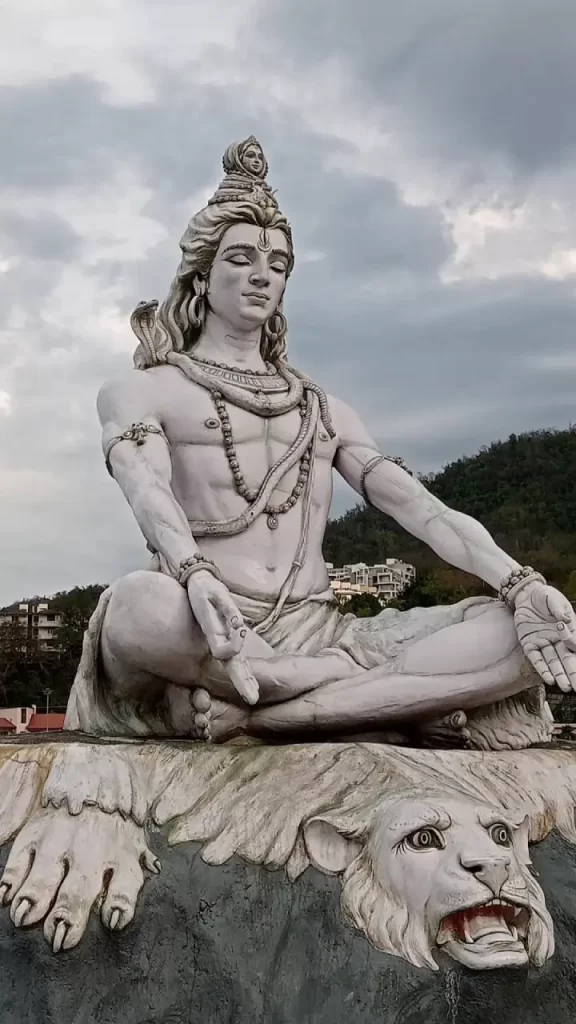
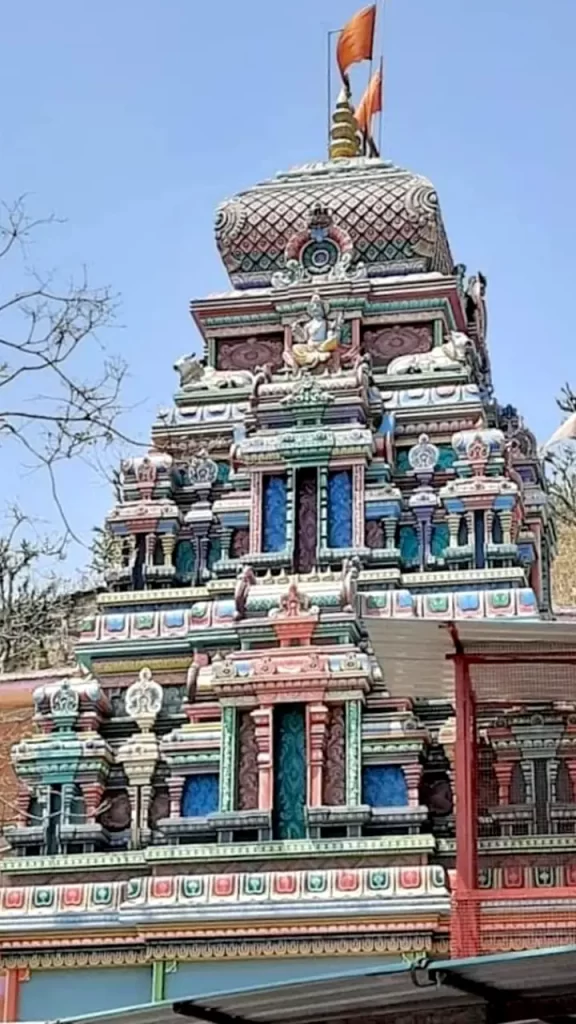
As you approach the temple, you’ll immediately notice its unique appearance. Unlike the typical stone-grey temples, the Shree Neelkanth Mahadev Temple is known for its bright, colorful, and detailed murals.
The Main Structure
The structure is predominantly of the traditional North Indian Shikhara style, meaning it has a tapering spire. This Shikhara is intricately carved and rises majestically above the main shrine, drawing the eye skyward towards the divine.
The Mythological Depictions
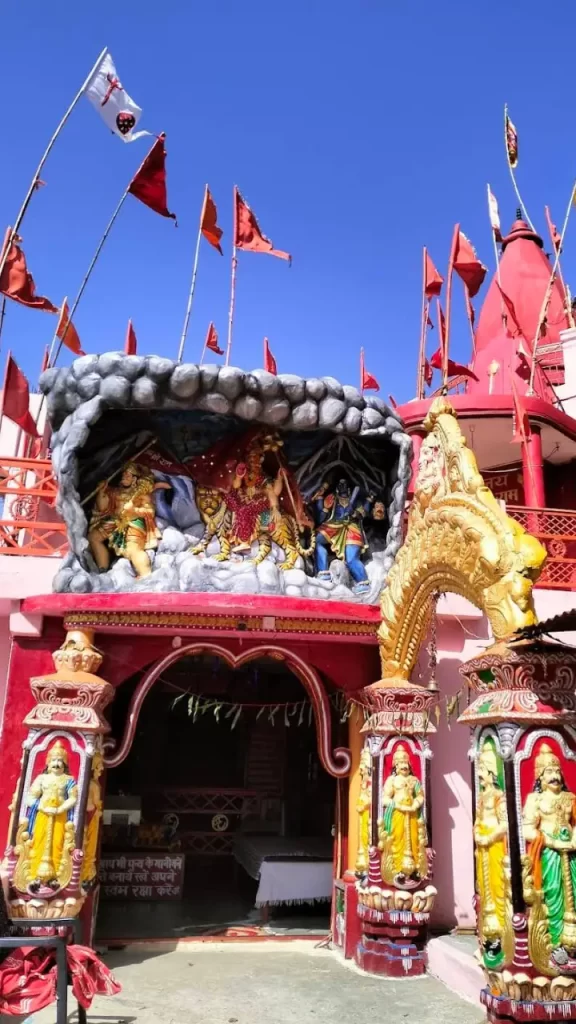
The most striking feature that catches the eye of every visitor, and which must be seen by you, is the colorful depiction of Samudra Manthan sculpted right above the main entrance gate.
- You can clearly see the Gods and Demons on either side, using the serpent Vasuki to churn the ocean.
- The entire wall of the temple is often brightly painted, with murals and sculptures of the various deities and scenes from Hindu mythology, making it a beautiful open-air gallery of devotion.
The Holy of Holies (Garbha Griha)
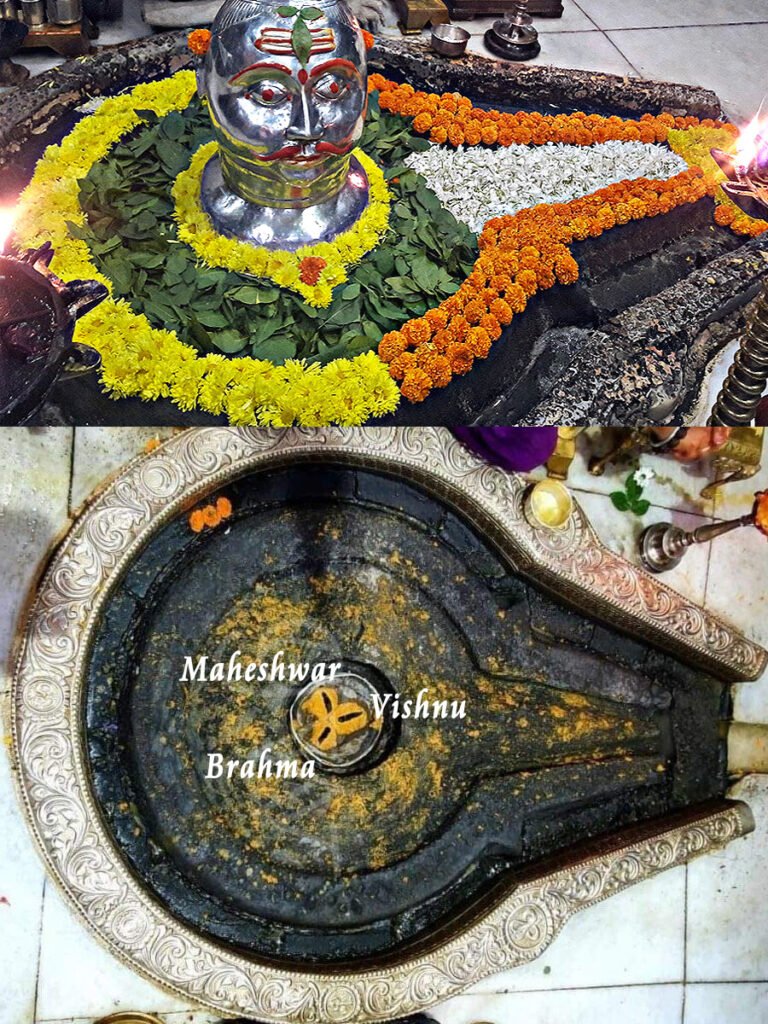
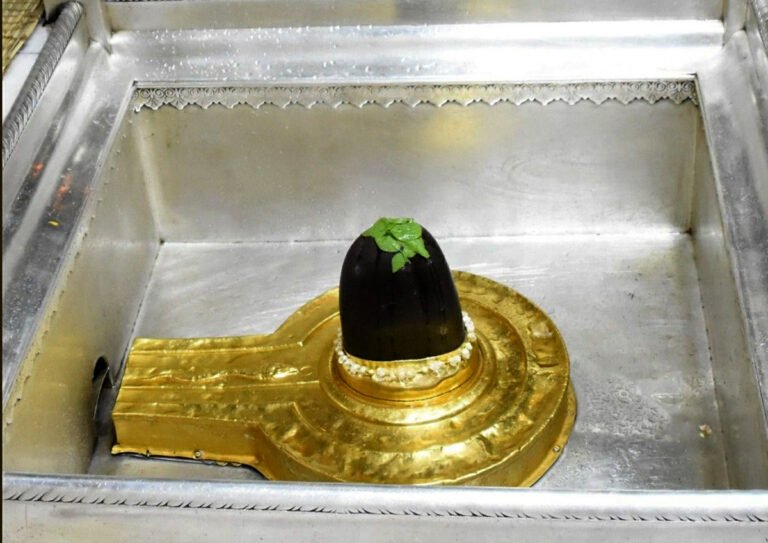
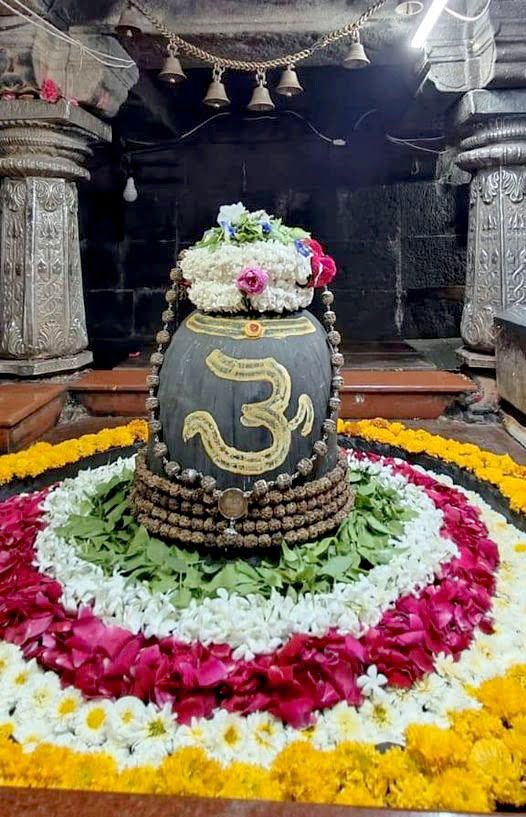
The sanctum sanctorum of the Shree Neelkanth Mahadev Temple is called the Garbha Griha. Here, the main deity is worshipped in the form of a Shivlingam—a symbolic representation of Lord Shiva.
Uniquely, the Shivlingam here is described as blue at the top, symbolizing Shiva’s throat that turned blue after consuming the poison. Devotees make offerings of water, flowers, and the sacred Bael leaf to this divine symbol.
Read More>> Sri Kshetra Dharmasthala Temple: Miracles of Lord Manjunatha
Special Poojas and Sacred Bath
The ritualistic worship (Puja) is the main activity here, and there are a few special things to know about.
Daily Abhishekam
The most common and important ritual is Abhishekam-the ritual bathing of Shivlingam. Devotees offer pure Gangajal (water from the Ganges), milk, honey, yogurt, clarified butter (ghee), and sugar to the deity. This is not just an offering; it’s a deep spiritual act meant to cool the ‘heat’ of the poison and symbolize devotion.
The Amrit Kund (Sacred Spring)
Before entering the main temple, one finds a natural spring within the temple complex, which is known as Amrit Kund. It is a very important part of the pilgrimage.
They usually take a holy dip or at least sprinkle the water on themselves before entering the Garbha Griha. The ritual purification cleanses the body and mind to prepare the soul to meet the divine.
Myths, Beliefs, and Trending Questions
Every important pilgrimage site gathers its own local myths and popular beliefs, and Shree Neelkanth Mahadev Temple is no exception.
Panchpani Tree – A Myth
Local lore suggests that after consuming the poison, Lord Shiva meditated for thousands of years under a Panchpani (Five-leaf) tree near the confluence of the Pankaja and Madhumati rivers, which meet here. The current location of the Garbha Griha is believed to be built over this exact spot of meditation. This adds another layer of historical sanctity.
Belief: The Power to Heal
A strong belief among devotees is that praying at the Shree Neelkanth Mahadev Temple can help overcome life’s greatest poisons—be it chronic illness, deep personal suffering, or financial ruin. Just as Lord Shiva contained the world’s poison, the Lord here is believed to grant the strength to endure and overcome personal ‘poisons’ by seeking his protection.
Read More>> Hidden Power of Haridwar Mansa Devi Temple: #1 Wish Granted!
Trending Questions Answered
Many first-time visitors have similar questions when planning their trip. Here are some I often get asked:
How difficult is trekking to Neelkanth Mahadev Temple?
Yes, you can reach the temple by a scenic road, but the trekking route is from Ram Jhula in Rishikesh, a trail of 12 to 14 kilometers. It’s a fairly rewarding trek through the dense forests. It is moderately challenging and takes about 4 to 5 hours for one way. You should begin early and be physically prepared.
Is it safe to visit during the monsoon, i.e., Shravan month?
The best time, or the most auspicious period, is during the Shravan month (monsoon) of July-August. During this time, however, the road to the temple often becomes really risky because of heavy rainfall and possible landslides. If driving, be extremely careful. If trekking, the paths become very slippery. The atmosphere, though, is at its devotional best.
Which are the best months for a pleasant visit?
The best time for a pleasant trip, with moderate weather and clear skies, is from February to June and September to November.
Read More>> Kanchi Kamakshi Temple: One of Powerful 18 Shakti Peethas
Shree Neelkanth Mahadev Temple Timing:
It’s always best to check the exact timings upon arrival, as they can sometimes change during festivals. However, the general schedule for the Shree Neelkanth Mahadev Temple is as follows:
| Activity | Typical Timing | Note |
| Temple Opening | 5:00 AM | Early morning is the best time for peaceful Darshan. |
| Morning Darshan | 5:00 AM – 12:00 PM | The most crowded time during Shravan. |
| Midday Break / Bhog | 12:00 PM – 1:00 PM | The temple may close briefly for offerings and rest. |
| Afternoon Darshan | 1:00 PM – 6:00 PM / 8:00 PM | Timings are variable, especially in winter. |
| Evening Aarti | 6:00 PM – 7:30 PM | A very spiritual and beautiful time to visit. |
Pro Tip: Arrive early in the morning (around 5:30 AM to 6:00 AM) to experience the morning rituals and enjoy the most peaceful, less-crowded Darshan.
Read More>> Bhoo Varaha Swamy Temple Kallahalli
How to Reach the Temple
Since the Shree Neelkanth Mahadev Temple has good connectivity to Rishikesh, this pilgrimage is well within reach.
By Road from Rishikesh
- Distance: Approximately 32 km by the motorable road.
- Time: It takes approximately 1.5 to 2 hours considering the hilly and winding nature of the road.
- Options: You can hire a private taxi, a shared jeep (easily available near Ram Jhula), or even a local bus from Rishikesh. The journey is scenic, passing through thick forests.
Nearest Railway Station
- The nearest major railhead is Rishikesh Railway Station (RKSH), approximately 32 km from the temple.
- The Haridwar Railway Station (HW), larger and better-connected, is about 55 km away.
Nearest Airport
- The nearest airport is the Jolly Grant Airport (DED) in Dehradun, approximately 49 km from the temple. From the airport, you easily get a pre-paid taxi to proceed directly to the temple or to Rishikesh first.
Read More>> Chamundeshwari Temple Mysore: Architectural Marvel & Spiritual Wonder
Accommodation Options
Since the Shree Neelkanth Mahadev Temple is located in a relatively remote, forested area, accommodation options right at the temple premises are generally simple and limited.
Simple Stays near the Temple
- There are some basic Dharamshalas, besides simple ashram-style guest houses in the vicinity of the temple to accommodate the overnight-staying pilgrims. These offer very basic facilities.
- Sometimes, Irrigation or Forest Rest Houses may be available, but prior bookings are essential for them.
In Rishikesh: Wide Variety
The best and most comfortable option is to stay in Rishikesh itself, which offers an extremely wide range of accommodation:
- Ashrams: spiritual, low-cost places to stay, such as Parmarth Niketan or Swarg Ashram area.
geo-hotels: Budget hotels up to luxury resorts. - Hostels: Many backpacker hostels for the budget traveler.
Most people prefer to stay in Rishikesh and make a day trip to the temple.



Hindu Places to Visit Near the Temple
Your spiritual journey need not end at the Shree Neelkanth Mahadev Temple, as holy sites abound in Rishikesh and its environs.
- Ram Jhula & Lakshman Jhula: Both of these suspension bridges over the Ganga have become iconic. They connect the main parts of Rishikesh and give wonderful views of the river and the temples around.
- Triveni Ghat: This is considered the most sacred bathing spot in Rishikesh, and the evening Ganga Aarti here is a truly unforgettable and deeply spiritual experience in itself.
- Parmarth Niketan Ashram: A very famous ashram on the banks of the Ganges, known for its yoga, meditation classes, and especially for its own impressive evening Ganga Aarti.
- Tera Manzil Temple (Trayambakeshwar Temple): A unique, multi-storey temple with shrines to numerous deities, offering a panoramic view from its upper levels.
One Comment