Shree Somnath Jyotirlinga Temple: Complete Pilgrimage, Timings, and History Guide
Shree Somnath Jyotirlinga Temple, located at Prabhas Patan near Veraval in Gujarat, stands on the western coast of India overlooking the Arabian Sea. Revered in Hindu tradition as the Prathama Jyotirlinga—the first of the twelve sacred Jyotirlinga shrines dedicated to Bhagwan Shiva—Somnath represents an enduring symbol of spiritual devotion, cultural heritage, and architectural resilience.
Visiting Somnath requires basic logistical preparation, including understanding daily darshan and aarti schedules, strict security rules regarding electronic devices, and seasonal weather patterns along the Saurashtra coast. Whether you are planning a family pilgrimage, visiting the coastal Gujarat temple circuit alongside the Dwarkadhish Temple in Dwarka, or exploring India’s historic stone architecture, this guide covers verified timings, ritual protocols, transport options, and the profound history behind this sacred coastal shrine.
Quick Information: Somnath Temple at a Glance
| Feature | Verified Detail |
| Temple Name | Shree Somnath Temple (also known as Somnath Jyotirlinga / Deo Pattan) |
| Main Deity | Bhagwan Shiva (worshipped as Someshwara / Somnath) |
| Location | Prabhas Patan, Veraval, Gir Somnath District, Gujarat, India (PIN: 362268) |
| Temple Opening Hours | 06:00 AM to 10:00 PM (Daily, uninterrupted darshan except during brief shringar) |
| Daily Aarti Timings | Prataha Aarti: 07:00 AM | Madhyanha Aarti: 12:00 PM | Sandhya Aarti: 07:00 PM |
| Light & Sound Show | 08:00 PM to 09:00 PM nightly (Jay Somnath show, subject to weather conditions) |
| Entry Fee | Free general entry; special pooja/darshan slips bookable via trust counter or online |
| Dress Code | Traditional, modest clothing recommended (Avoid shorts, mini-skirts, or sleeveless attire) |
| Electronic Items | Strictly prohibited inside inner premises (Mobile phones, smartwatches, cameras must be deposited) |
| Facilities Available | Free footwear counters, digital baggage lockers, wheelchair ramps, guest houses, prasad counters |
| Nearest Railway Station | Veraval Junction (VRL) – approximately 6 km away |
| Nearest Operational Airports | Diu Airport (DIU – ~85 km) | Rajkot International Airport (Hirasar – ~200 km) |
| Best Time to Visit | October to March (Pleasant coastal winter climate) |
| Official Website | Shree Somnath Trust (somnath.org) |
The Spiritual Significance of the First Jyotirlinga
In the Shiva Purana and classical Hindu tradition, a Jyotirlinga represents the supreme, formless reality of Bhagwan Shiva appearing as an infinite column of divine light (Jyoti). While hundreds of ancient Shiva temples dot the Indian subcontinent, twelve specific shrines hold supreme canonical significance. Among them, the traditional Sanskrit hymn begins:
“Saurashtre Somanatham cha Srisaile Mallikarjunam…”
This shloka establishes Somnath in the historic Saurashtra region as the foundational shrine of the Jyotirlinga pilgrimage.
The Sacred Legend of Chandra Dev and Prabhas Patan
The sacred name Somnath translates literally to “Lord of the Moon” (Soma meaning Moon, and Nath meaning Lord). According to Hindu tradition documented in the Mahabharata and the Skanda Purana, Chandra Dev (the Moon God) was married to the twenty-seven daughters of Prajapati Daksha, representing the twenty-seven lunar constellations (nakshatras).
Among his wives, Chandra favored Rohini above the others, causing distress to his other wives. Aggrieved by this imbalance, Prajapati Daksha admonished Chandra multiple times. When Chandra failed to mend his ways, Daksha cursed him to lose his celestial brilliance and wither away through consumption (Kshaya roga).
As the Moon withered, darkness engulfed the cosmic rhythm, and living beings suffered. Seeking salvation, Chandra approached Bhagwan Brahma, who advised him to travel to the sacred meeting place of rivers and the sea at Prabhas Kshetra. There, Chandra established a Shivalinga, performed rigorous penance (tapasya), and chanted the Mahamrityunjaya Mantra for thousands of years.
Pleased by his intense devotion, Bhagwan Shiva appeared before Chandra. While the curse of a Prajapati could not be entirely obliterated, Shiva modified it: during one fortnight (Krishna Paksha), the moon would wane daily, and during the following fortnight (Shukla Paksha), it would wax and regain its full radiant splendor. To commemorate this divine grace and cosmic balance, Bhagwan Shiva manifested permanently at this coastal spot as Someshwara, granting Chandra liberation and giving the region the name Prabhas (“the place of radiant light”).
Daily Darshan, Pooja, and Aarti Timings
The administration of the temple is managed systematically by the Shree Somnath Trust, ensuring smooth queue movements for thousands of visiting devotees daily.
General Darshan Schedule
- Morning Opening: The temple gates open at 06:00 AM.
- Evening Closure: The temple gates close at 10:00 PM.
- Afternoon Darshan: Unlike several North Indian temples that close their sanctum for extensive afternoon periods, Somnath remains open throughout the afternoon for continuous darshan, pausing only briefly for daily deity shringar (adornment) and altar cleaning.
The Three Daily Aartis (Somnath Aarti Timings)
Attending an aarti at Somnath is an unforgettable sensory experience. As Vedic chants reverberate through the high stone ceilings, large brass bells, nagadas, and the roaring waves of the Arabian Sea outside join in rhythmic harmony.
- Prataha Aarti (Morning Aarti): 07:00 AMIdeal for early risers who wish to begin their day with the morning rituals of the temple.
- Madhyanha Aarti (Noon Aarti): 12:00 PMConducted at midday following the morning offerings and naivedya.
- Sandhya Aarti (Evening Aarti): 07:00 PMThe most heavily attended aarti of the day. Devotees gather inside the Sabha Mandap as lamps are illuminated against the coastal twilight.
Visitor Tip: To secure a standing spot inside the central Sabha Mandap during the morning or evening aartis, pass through the security checkpoints at least 45 to 60 minutes before the scheduled time, as entry into the inner hall is regulated once capacity is reached.

The Evening Sound and Light Show: Jay Somnath
Every evening, the grounds of the temple host a popular Sound and Light Show titled “Jay Somnath” against the backdrop of the illuminated stone facade and the dark sea.
- Show Timing: Approximately 08:00 PM to 09:00 PM (commences shortly after the completion of the 07:00 PM Sandhya Aarti).
- Language: Hindi (featuring the deep, resonant narration of legendary actor Amitabh Bachchan).
- Theme: The narrative chronicles the rise of the temple, its cosmic origin, centuries of turbulent medieval invasions, the devotion of local warriors who laid down their lives defending the shrine, and its post-independence reconstruction as a triumph of cultural preservation.
- Seating & Tickets: Open-air seaside seating is arranged south of the main structure. Nominal admission tickets can be purchased at the trust booking counter situated near the main entrance plaza. The show is dependent on clear weather and is suspended during heavy monsoon rains or severe sea winds.
Architectural Marvel: The Kailash Mahameru Prasad Style
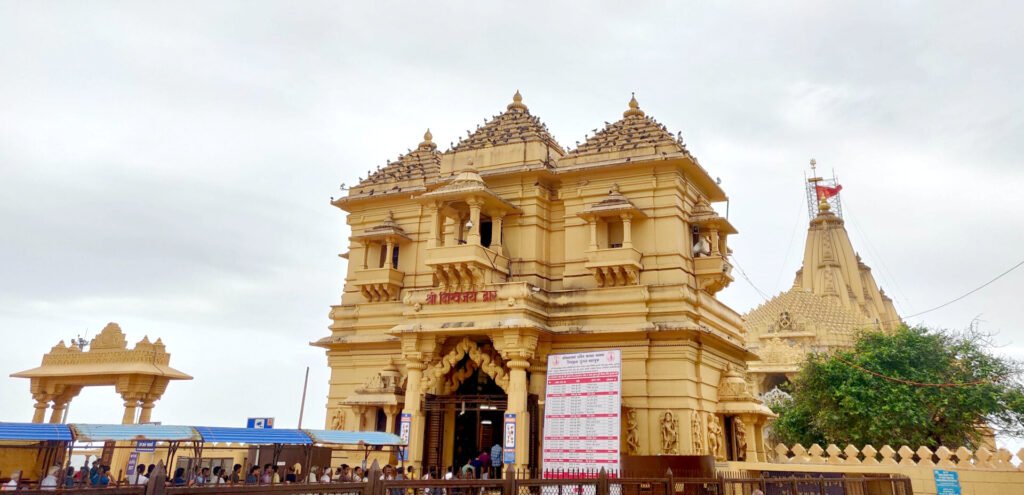
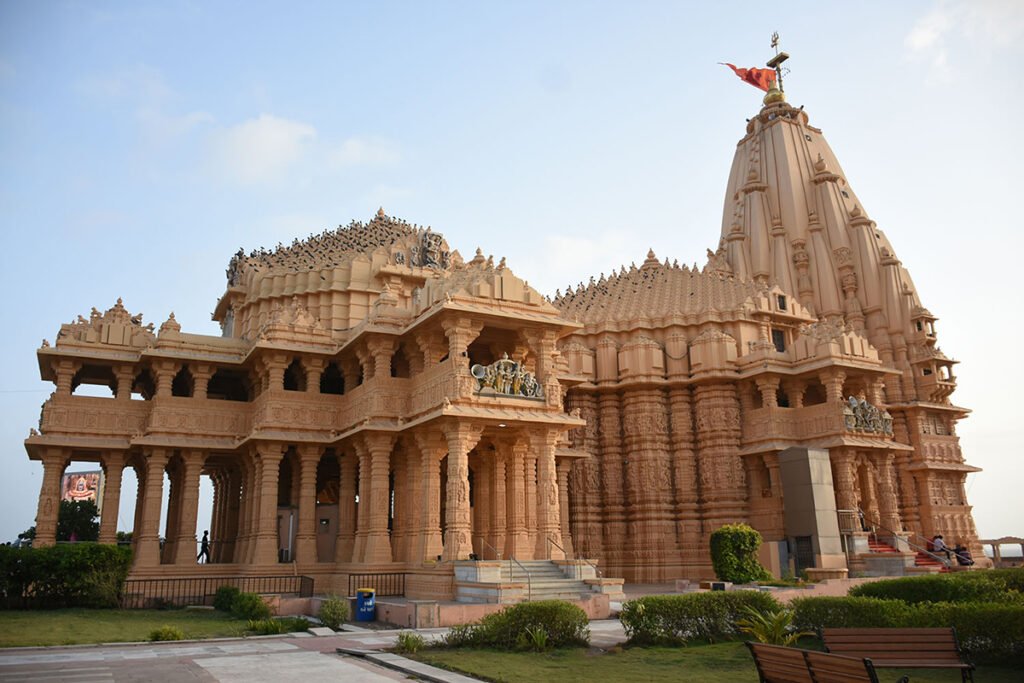
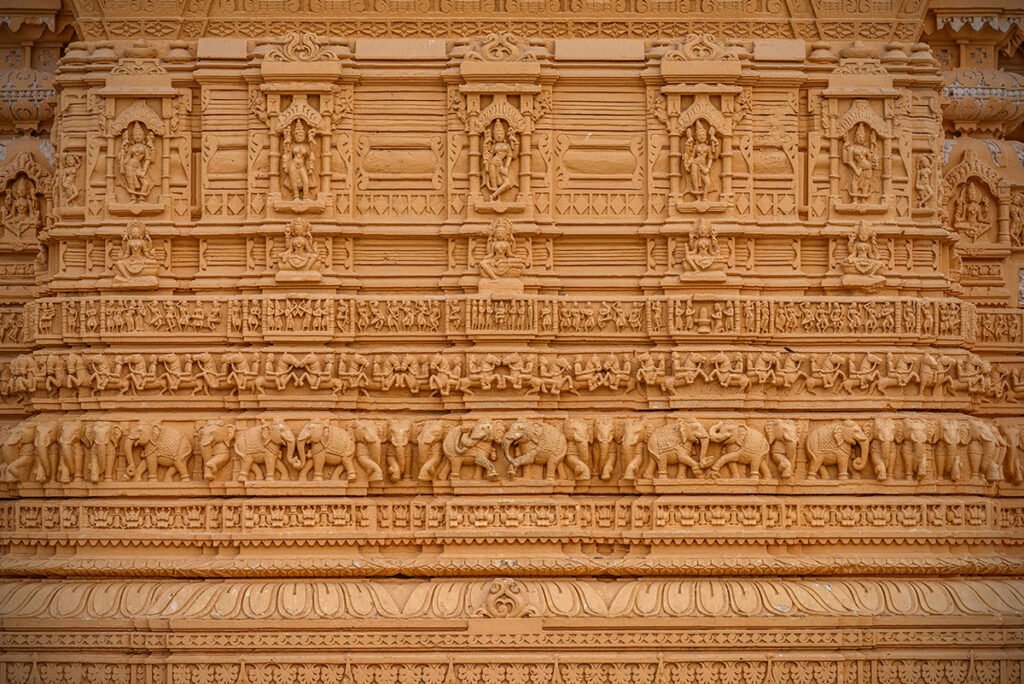
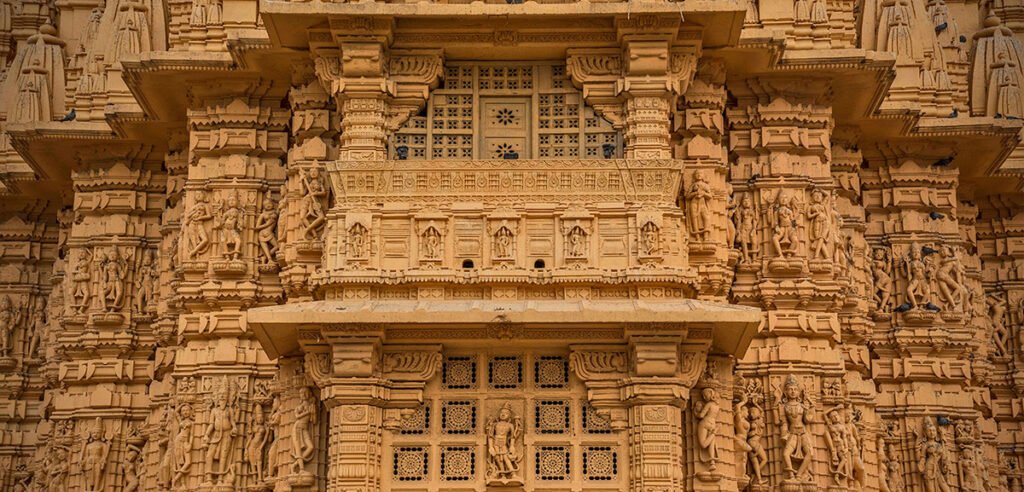
The present temple structure stands as a masterpiece of the Chalukya style (also known as Solanki architecture), the signature stone-building tradition that flourished across Gujarat and Rajasthan between the 10th and 13th centuries.
Designed by the renowned Sompura Salat family—traditional temple master architects from Gujarat who have preserved ancient Shilpa Shastra traditions across generations—the temple is built from fine-grained, golden-yellowish porous sandstone quarried locally.
Key Architectural Elements
- The Shikhara (Spire): The main tower rises to an imposing height of 155 feet (approximately 50 meters) above the ocean floor. At the apex rests a magnificent 10-tonne stone Amalaka, surmounted by a sacred water pot (Kalash) and a flagstaff (Dhwaja-danda) carrying the divine flag of Bhagwan Shiva, visible from nautical miles out at sea.
- The Mandapas: Devotees enter through the grand entrance gateway (Digvijay Dwar) and pass through the pillared corridors into the Sabha Mandapa (Assembly Hall). The interior ceilings feature intricate concentric corbelled domes, meticulously carved with floral motifs, dancing celestial figures (apsaras), and geometric stonework.
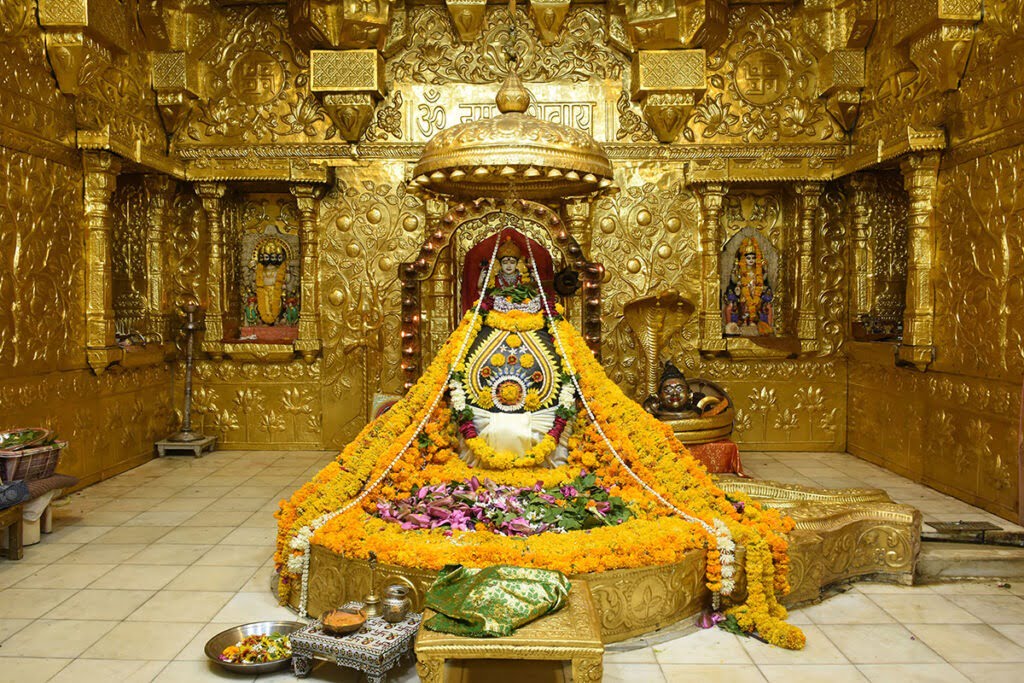
- The Garbhagriha (Sanctum): The sanctum houses the sacred Jyotirlinga, set in a spacious silver yoni-base, continuously cooled by a ceremonial silver pot (jaladhari) suspended overhead. The atmosphere within the sanctum is cool, fragrant with sandalwood and bilva leaves, and illuminated by brass oil lamps.
The Mystery of the Baan Stambh (Arrow Pillar)
Positioned on the sea-facing protection wall within the southern courtyard of the temple complex stands an intriguing stone pillar known as the Baan Stambh (Arrow Pillar).
Erected as part of the temple’s coastal defense layout, the pillar features an arrow carved near its top, pointing southward toward the vast expanse of the ocean. Below the arrow is an ancient Sanskrit inscription that reads:
आसमुद्रांत दक्षिण ध्रुव पर्यंत अबाधित ज्योतिर्मार्ग
(A-samudranta Dakshin Dhruva Paryant Abadhita Jyotirmarga)
Translated into English, this declaration states:
“From this point of the sea coast to the South Pole (Antarctica), there is an unobstructed path of light (free of any landmass).”
The Geographical Reality
Modern cartography and satellite geography confirm this ancient observation. If you draw a straight longitudinal line directly south from the coordinates of Somnath (approximately 20.8880° N, 70.4012° E) toward the South Pole (-90° S), not a single piece of land or continental island obstructs the path. The line travels across the open waters of the Indian Ocean and the Southern Ocean until it strikes the ice sheet of Antarctica.
How ancient Indian astronomers, navigators, and temple builders possessed the geographical and nautical knowledge to map this open oceanic corridor centuries before modern navigation instruments existed remains one of the most compelling subjects of historical study at Somnath.
The Historical Resilience and Modern Reconstruction
Few monuments anywhere in the world have demonstrated the historical resilience of Somnath. Situated on an open, wealthy coastal trade route, the temple endured repeated cycles of invasion, plundering, and destruction across medieval centuries, followed by repeated community reconstruction.
Documented Cycles of Renewal
- Historical records and archaeological excavations conducted by the Archaeological Survey of India (ASI) reveal that multiple layers of stone and wood temples were erected at this site across classical antiquity.
- In the 18th century, seeing the ruins of the coastal structure, the saintly Maratha queen Rani Ahilyabai Holkar of Indore recognized the ongoing religious importance of the site. In 1783, she constructed an underground temple nearby to preserve the sacred Shiva linga safely away from potential desecration. This shrine, located just a short walk from the modern complex, is revered today as the Old Somnath Temple or Ahilyabai Somnath Mandir.
The Post-Independence Restoration
The rebirth of the grand coastal temple took place immediately following Indian independence in 1947.
- The Pledge (November 1947): On November 13, 1947, Sardar Vallabhbhai Patel, then Deputy Prime Minister and Home Minister of India, visited Junagadh and Prabhas Patan. Moved by the ruined coastal plinth, he stood by the waters of the Arabian Sea and took a historic public pledge that a grand new temple would be built on the original sacred site.
- The Leadership of K.M. Munshi: Following Patel’s vision, eminent scholar and politician K.M. Munshi spearheaded the construction efforts under the auspices of an autonomous public charitable trust—the Shree Somnath Trust—deliberately keeping the funding community-driven rather than state-funded.
- The Consecration (May 11, 1951): On May 11, 1951, India’s first President, Dr. Rajendra Prasad, performed the ceremonial Pran-Pratistha (installation of the sacred deity). In his historic address, Dr. Rajendra Prasad remarked that the power of reconstruction is infinitely greater than the power of destruction, stating that Somnath rose again like the phoenix from its ashes because its true sanctuary existed within the hearts of millions of people.
Essential Practical Advice for Pilgrims and Visitors
To ensure a smooth and peaceful pilgrimage experience, visitors should take note of several important on-ground guidelines and operational facilities.
Strict Security and Electronic Ban
Security at Somnath is managed under strict protocols due to its coastal location.
- Prohibited Items: Mobile phones, digital smartwatches, smart bands, cameras, portable power banks, audio recording equipment, pen drives, and metal weapons/scissors are strictly forbidden beyond the primary security barrier.
- Locker Facilities: The trust provides well-organized, digital-token locker counters located in the outer plaza before the entrance gates. devotess can safely deposit their bags and electronics free of charge (or for a nominal token fee). Keep the locker token securely in your pocket.
- Footwear Management: Free shoe and chappal storage stands are maintained by volunteers outside the main stone gates. It is advisable to remember your counter row number before walking toward the security lanes.
Dress Code Recommendations
While the trust maintains an inclusive approach for devotees, traditional and respectful attire is expected to preserve the sanctity of the temple:
- For Men: Dhoti with kurta, pyjama with kurta, or simple trousers and formal shirts. Wearing shorts, Bermuda pants, or lungis above knee height is discouraged.
- For Women: Sarees, salwar suits, chudidars with dupattas, or modest Indian traditional wear. Sleeveless tops and short dresses are not permitted inside the inner sanctum corridors.
Facilities for Senior Citizens and Differently Abled Visitors
- Wheelchair Access: Wide ramps are constructed alongside the main stone steps leading from the outer courtyard into the main temple plinth.
- Assistance Counters: The trust maintains dedicated mobility assistance desks near the entrance where wheelchairs can be obtained. Attendants are available for elderly pilgrims requiring assistance through the queues.
- Shaded Waiting Lanes: The queue lines are covered with canvas canopies to protect devotees from the coastal afternoon heat.
Important Sacred Sites Around Somnath (The Prabhas Circuit)
A pilgrimage to Somnath is traditionally considered complete only after visiting the associated sacred landmarks situated within a three-kilometer radius in Prabhas Patan.
1. Triveni Sangam Snan Ghat
Located approximately 1.5 km east of the main temple, the Triveni Sangam is the holy confluence where three sacred rivers—the Hiran, the Kapila, and the mythical underground Saraswati—merge into the open Arabian Sea.
- Devotees gather here at sunrise to take a holy dip (snan) and perform ancestral rites (Pinda Daan / Shraddha tarpana).
- Beautiful stone ghats, boat rides along the river mouth, and peaceful morning breeze make this a deeply reverent spot.
2. Bhalka Tirth
Situated roughly 4 km from the main temple along the road toward Veraval, Bhalka Tirth marks one of the most poignant episodes in Hindu tradition.
- It is the sacred location where Bhagwan Shri Krishna, resting under a peepal tree in a forest glade, was mistakenly struck in the foot by an arrow fired by the hunter named Jara.
- The temple houses a serene marble murti of Shri Krishna in a reclining posture, alongside the repentant hunter Jara seeking forgiveness. This event marked the conclusion of the Dvapara Yuga and the beginning of the Kali Yuga.
3. Ahilyabai Somnath Mandir (Old Somnath)
Located directly opposite the modern temple entrance plaza, this quiet underground shrine built by Rani Ahilyabai Holkar in 1783 features a Shivalinga placed below ground level. It offers a meditative, peaceful atmosphere, contrasting with the large pilgrim movements in the primary complex.
4. Gita Mandir and Laxminarayan Temple
Built close to the Triveni Sangam by the Birla family, the Gita Mandir is an elegant marble structure whose pillars are inscribed with all 700 verses of the Srimad Bhagavad Gita. The temple acoustic design allows soft chants to resonate throughout the marble hall.
How to Reach Somnath Temple
Prabhas Patan and Veraval are well-integrated into the regional highway, railway, and airline networks of Western India.
1. By Air
- Diu Airport (DIU): Located approximately 85 km east of Somnath, Diu has regular regional domestic flight connections with Mumbai and other select hubs. Private taxis and state buses operate directly from Diu to Somnath (approximately 2 hours by road).
- Rajkot International Airport (Hirasar – HSR): Located approximately 200 km north, Rajkot serves as the primary aviation hub for Saurashtra, offering multiple daily connections to Delhi, Mumbai, Bengaluru, and Hyderabad. Taxis and express buses connect Rajkot to Somnath in approximately 4 to 5 hours via clean four-lane highways.
- Keshod Airport (IXK): Located about 55 km away, this airport hosts select seasonal flights under the UDAN regional connectivity scheme. Check availability depending on the travel season.
2. By Rail
- Veraval Junction Railway Station (Station Code: VRL): Veraval is the primary rail terminus, situated just 6 km from the temple gates.
- Regular daily express and superfast trains connect Veraval directly to Ahmedabad, Surat, Vadodara, Mumbai (Bandra Terminus), Pune, Jabalpur, and Bhopal.
- From Veraval station, auto-rickshaws and shared battery-operated e-rickshaws run continuously to Somnath (fare typically ranges between ₹100 and ₹150 for a private ride; shared seats available at ₹20–₹30).
3. By Road
- Gujarat features some of the finest highway infrastructure in India. Somnath is connected directly via National Highway 51 (NH 51) and state express corridors.
- Distance from Key Cities:
- Veraval: 6 km
- Junagadh: 85 km (approx. 2 hours)
- Sasan Gir (Gir National Park): 45 km (approx. 1 hour)
- Dwarka: 235 km (approx. 4.5 to 5 hours along the coastal highway)
- Rajkot: 195 km (approx. 4 hours)
- Ahmedabad: 410 km (approx. 7.5 to 8 hours)
- The Gujarat State Road Transport Corporation (GSRTC) operates reliable AC sleeper, Gurjarnagari, and express buses connecting Somnath to Ahmedabad, Baroda, Rajkot, and Dwarka.
Combining Somnath with the Saurashtra Pilgrimage Circuit
Most travelers and devotees combine their journey to Somnath with the broader Saurashtra Coastal Circuit, which creates a comprehensive week-long spiritual and wildlife tour:
- The Double Jyotirlinga Yatra: Many pilgrims travel along the scenic coastal highway from Somnath northwest to visit the sacred Nageshwar Jyotirlinga temple near the ancient port of Dwarka, thereby completing two of India’s twelve Jyotirlingas in a single circuit.
- Dwarka (Char Dham): Conclude your pilgrimage at the grand 2,500-year-old Dwarkadhish Temple in Dwarka, honoring Bhagwan Krishna at the western cornerstone of the All-India Char Dham.
- Gir National Park: Located just 45 km inland from Somnath lies the Sasan Gir forest, the last natural sanctuary of the Asiatic Lion (Panthera leo persica), making it an effortless addition for families traveling with children.
- Junagadh Heritage: Situated 85 km north along the rail line, Junagadh offers historic excursions to the ancient Uparkot Fort, the rock edicts of Emperor Ashoka, and the holy Girnar mountain pilgrimage steps.
Frequently Asked Questions (FAQs)
What are the main aarti timings at Somnath Temple?
The three daily aartis take place at 07:00 AM (Prataha Aarti), 12:00 PM (Madhyanha Aarti), and 07:00 PM (Sandhya Aarti). The evening Sandhya Aarti is the most popular; arrive 45 to 60 minutes early to secure a place inside the main hall.
Are mobile phones or cameras allowed inside Somnath Temple?
No. Mobile phones, digital smartwatches, fitness trackers, cameras, and all electronic devices are strictly prohibited inside the inner security boundary. Free and safe locker counters are provided by the Shree Somnath Trust in the outer plaza to store your belongings before entering the security queue.
How much time is needed for darshan at Somnath?
On normal weekdays, general darshan takes between 30 to 45 minutes from entry to exit. On weekends, during Shravan month (July–August), Shivratri, and major public holidays, queue wait times can extend from 1.5 to 3 hours.
Is there an entry fee for visiting Somnath Temple?
No, general entry and darshan are completely free for all devotees. If you wish to book special ritual poojas (such as Someshwar Mahapooja, Dhwaja Puja, or Rudrabhishek), these can be booked at authorized trust counters inside the complex or in advance via the official Shree Somnath Trust website.
What is the best month to visit Somnath?
The ideal period is between October and March, when coastal temperatures remain cool and comfortable (ranging between 15°C and 28°C), making outdoor walking and queue waiting pleasant. Summers (April to June) can be warm and humid, while the monsoon (July to September) brings powerful sea tides and scenic, dramatic skies.
Where can visitors stay in Somnath?
The Shree Somnath Trust operates several clean, well-managed, affordable guest houses and VIP rest houses (including Sagar Darshan, Maheshwari Bhawan, and Lilavati Bhawan) located within walking distance of the temple. Devotees can book rooms directly through the official trust booking portal. Numerous private hotels and coastal resorts are also available across Prabhas Patan and Veraval.