
Veerabhadra Swamy Temple Lepakshi: 26Ft Huge Nandi, Hanging Pillar
Veerabhadra Swamy Temple in the charming and traditional village of Lepakshi, which lies within the Anantapur district of Andhra Pradesh. Be prepared to be awestruck by its majesty, intrigued by its history, and perhaps even a little baffled by its legendary hanging pillar.
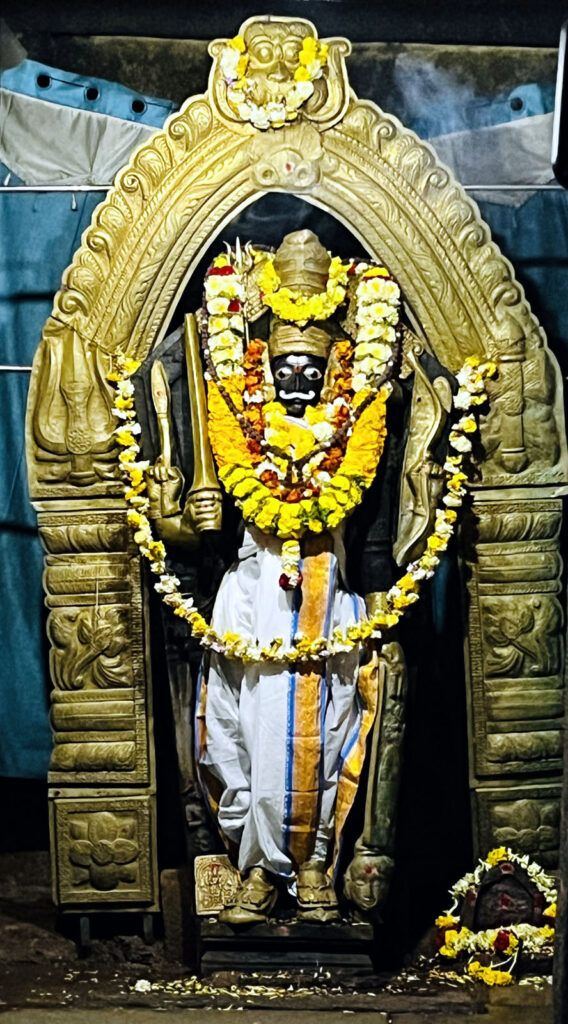
This is not any temple; this is a vibrant canvas of the artistic genius of the Vijayanagara Empire, a temple where each stone, each carving, and each fresco speaks volumes. From mythological tales to engineering wonders, Veerabhadra Swamy Temple has something unique to offer, which resonates within the soul.
As we stroll on these sacred grounds, I want you to feel like you’re going back in time, feeling the devotion and artistic excellence of those who constructed this glorious shrine. So, let’s start our discovery!
Contents
- 1 Lepakshi Temple History: A Glimpse into the Vijayanagara Glory
- 2 Legend of the Temple: Where Mythology Meets Reality
- 3 Cultural, Spiritual, and Mythological Significance of the Temple
- 4 Festivals: A Kaleidoscope of Devotion and Celebration
- 5 Distinct Architectural Forms and Decorations: A Canvas in Stone
- 6 Myths and Beliefs: Unraveling the Enigma
- 7 Lepakshi Temple Timing: Plan Your Visit
- 8 Places to Visit Near the Temple: Extend Your Spiritual Journey
- 9 Hanging Pillar at Veerabhadra Swamy Temple in Lepakshi:
- 10 Places to visit near Veerabhadra Swamy Temple in Lepakshi:
- 11 Accommodation Options: Resting Your Pilgrim Feet
- 12 How to Reach the Temple: Your Journey to Lepakshi
- 13 FAQs: Satisfying Your Curiosities
Lepakshi Temple History: A Glimpse into the Vijayanagara Glory
The Veerabhadra Swamy Temple at Lepakshi has its history inextricably linked with the golden days of the Vijayanagara Empire. Constructed in the 16th century, specifically in 1530 AD or 1540 AD, this architectural marvel was mainly ordered by two brothers, Virupanna Nayaka and Viranna. They were governors of the Vijayanagar King Achyuta Deva Raya and ruled from Penukonda. The brothers, hailing from the Veerashaiva Vani community (a warrior merchant caste), heart and soul went into building this temple, a reflection of their passion and the prosperity of the empire.
It is said that the temple was built without a clear prior sanction from the king, and in some legends, it is even said that Virupanna spent treasury money building it. This action, either out of blind devotion or misjudgement, apparently irked the king, and there is a tragic tale about the king mandating that Virupanna be blinded. The iconic “blood stains” on a wall somewhere in the temple grounds are commonly attributed to this tragic story, some local lore even suggesting that Virupanna himself inflicted the wound as a gesture of defiance or penance. Though they have been verified by scientists as human bloodstains, the specifics of the story form part of the temple’s intriguing folk lore.
The architecture of the temple is a pure specimen of the Vijayanagara era, with its intricate carvings, high gopurams, and an overabundance of sculptures and paintings on nearly every surface to be found. It’s amazing in itself that a building constructed several hundred years ago can still stand tall, with its rich artistic and religious legacy intact. The mere fact that it’s deemed to be among the centrally protected monuments of national significance by the Archaeological Survey of India (ASI) talks volumes about its importance.
Read More>> Enchanted Pashupatinath Temple: 5th Century Sacred Hindu Temple
Legend of the Temple: Where Mythology Meets Reality
Lepakshi temple is filled with intriguing myths connecting it closely with Hindu mythology, especially the epic Ramayana. There are a few well-known stories that give us insights into how the name of the village came about and how it’s holy.
The Legend of Jatayu and “Le Pakshi”
One of the most popularly told legends is its association with Lord Rama. It is said that during the Ramayana period, after Ravana had kidnapped Sita and was returning to Lanka in the air, the heroic divine bird Jatayu attempted to stop him. In the fierce combat, Ravana cut off the wings of Jatayu using his strong sword and brought him down to the ground. This is said to have occurred right here at Lepakshi.
When Lord Rama and Lakshmana went looking for Sita, they came across the dead bird Jatayu. On seeing the dying bird, Lord Rama, who was full of mercy, said, “Le Pakshi” which in Telugu “Rise, bird” or “Get up, bird,” bestowing moksha (salvation) upon him. It is from this sad occasion that the village Lepakshi gets its name. This tradition not only emphasizes the sacred nature of the place but also endows it with an aura of divine intervention and mercy.
Although I could not find direct quotes from the original Ramayana text clearly naming “Lepakshi” per se, the Ramayana does recount Jatayu’s heroic battle and his meeting with Rama prior to his death. Local tradition and popular culture widely connect this place to that pivotal event.
The Giant Footprint: Sita’s Padam?
One other fascinating element within the temple compound is a huge footprint etched on a stone. Most see it as the footprint of Goddess Sita, further establishing the temple’s link to the Ramayana. Though some attribute it to Lord Hanuman too, the footprint of Sita provides a deeper spiritual meaning for the devotees and thus becomes a sacred place for worship.
The Curse of Virupanka’s Eyes As noted in the history, the sad story of Virupanna is another well-rooted legend. The blood marks on the wall serve as a stark reminder of the king’s anger and Virupanna’s final act of self-punishment or sacrifice. This legend adds an element of human drama and emotional significance to the history of the temple, pointing to the extreme devotion and possibly the price to be paid for errors, even though not deliberate. It’s a narrative which deeply connects with tourists, leading them to reflect upon the nature of power, religion, and sacrifice.
Read More>> 2500 Years Dwarkadhish Temple: Where Miracles Still Happen
Cultural, Spiritual, and Mythological Significance of the Temple
The Veerabhadra Swamy Temple is of great cultural, spiritual, and mythological importance, thus being a crucial pilgrimage destination and a heritage gem.
A Divyakshetra of Lord Shiva
As per the Skanda Purana, a celebrated one among the eighteen Mahapuranas within Hinduism, the Lepakshi Temple has been described as a Divyakshetra. This word refers to a significant pilgrimage place in honor of Lord Shiva. This pilgrimage in such a sacred scripture enhances its spiritual value, drawing Shiva worshippers from all over the world. The deity who occupies the throne, Lord Veerabhadra, is a powerful and fierce form of Lord Shiva, born out of Shiva’s hairs to ruin Daksha’s yagna and punish Daksha for disrespecting Shiva and Sati. The worshipping of Veerabhadra is said to procure safety from wickedness, dispel impediments, and bestow bravery.
A Congregation of Gods
Though the temple is mainly devoted to Veerabhadra, it’s also special in the sense that it contains shrines for other gods and goddesses as well, like Lord Vishnu (as Papananeswara) and Goddess Durga (as Parvathy). This unification of multiple deities in one complex reflects the tolerant spirit of Hinduism and the oneness of the different divine forms. This makes Veerabhadra Swamy Temple a holy place where devotees can pray to various forms of the divine under the same roof.
Artistic and Architectural Masterpiece
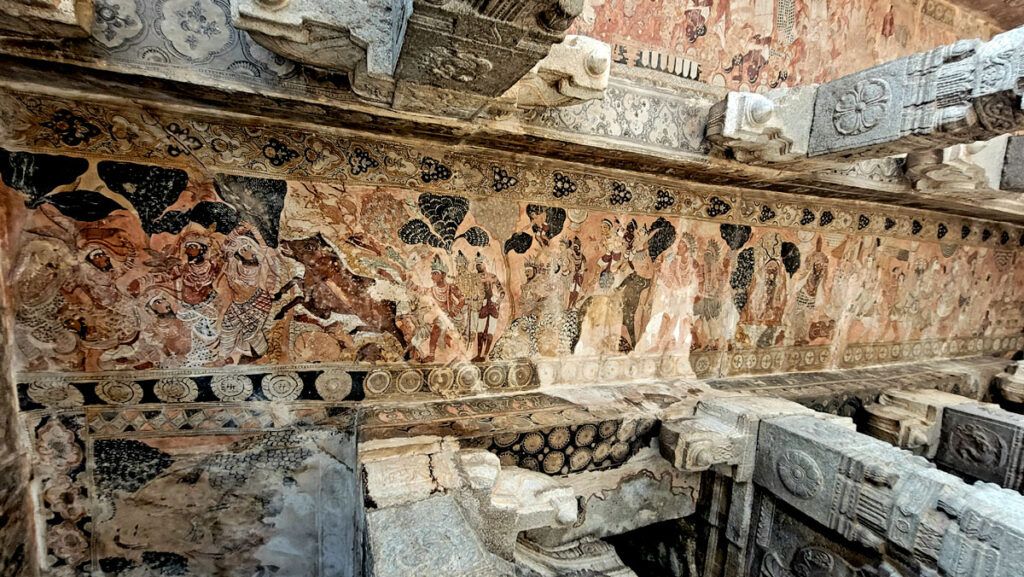
At a cultural level, the temple is an awe-inspiring reflection of the artistic and architectural genius of the Vijayanagara era. The intricate frescoes, ornate carvings, and colossal sculptures are a visual encyclopedia of Hindu mythology, everyday life, and the dominant art forms of the 16th century. These works of art are not merely for adornment; they are stone carvings and ceiling paintings that tell stories and provide clues to the cultural customs, faiths, and artistic tastes of the time. Simply upholding these works of art is a great added contribution to the cultural heritage of India.
A Symbol of Engineering Excellence: The Hanging Pillar
And then, of course, we cannot discuss the significance of Lepakshi temple without referring to the hanging pillar. This single architectural marvel elevates the temple from merely a religious site to a wonder of ancient Indian engineering. Its ability to seemingly defy gravity, with a small gap beneath it allowing a thin cloth or paper to pass through, continues to baffle engineers and visitors alike. This pillar, one of the seventy pillars in the Natyamandapa (dance hall), is not only a curiosity; it’s a testament to the sophisticated knowledge and skill that existed in India centuries ago. It’s a source of great pride and a demonstration of the genius of our forebears.
Inspiring Modern Art and Design
Notably, the elaborate designs and patterns on the columns of the Lata Mantapa (Creepers’ Hall), portraying different flowering creepers and climbers, are said to have been the inspiration for the iconic Lepakshi sari border motifs. This is a reflection of how the temple’s art reaches out beyond its walls, to modern crafts and traditions, ensuring its cultural heritage is maintained.
Read More>> Arunachalam Giri Pradakshina: Sacred 8 Lingams of Tiruvannamalai
Festivals: A Kaleidoscope of Devotion and Celebration
The Veerabhadra Swamy Temple in Lepakshi bursts forth with vibrant festivities during its annual festivals, drawing pilgrims from far and wide. These religious festivals are not merely religious practices; they are a spectacular exhibition of devotion, culture, and communal spirit.
Maha Shivaratri Brahmotsavams
This is perhaps the most important festival that is celebrated at Lepakshi temple. Maha Shivaratri (the Great Night of Shiva), dedicated to Lord Shiva, is celebrated with great fervor and pageantry. The temple becomes the hub of religious fervor, with believers thronging to pray, perform special poojas such as Rudrabhishekam (spiritual bath of the Shiva Lingam), and gain the blessings of Lord Shiva. The Brahmotsavams, the grand annual festival related to Maha Shivaratri, takes place over a few days and comprises:
• Chandra Shekara Sudarsana Homam: A homam (fire ritual) for Lord Ganesha and Sudarshana Chakra to bestow well-being and success.
• Gramotsavam: A street procession of the deities, blessing the population.
• Dwajarohana: Flag hoisting ceremony that officially announces the start of the festival.
• Kalyanotsavam: The divine wedding of Lord Shiva and Goddess Parvati, a stunning and sacred ceremony.
• Deepotsavam: Festival of lights, where thousands of candles and lamps light up the temple complex, forming a dazzling display.
• Rathotsavam (Chariot Festival): A grand festival in which the temple deities are seated on beautifully decorated chariots and pulled along the streets by rapturous devotees, a great privilege.
• Chandi Homam & Mutyala Pallaki: A fire ceremony performed for Goddess Chandi to protect and prosper, and a procession in which the deities are borne in a palanquin covered with pearls.
• Vasantotsavam, Dwajavarohanam, Sayanotsavam: Spring-related celebrations, flag-lowering ceremony, and ceremonial resting of the deities.
At Maha Shivaratri, the atmosphere is filled with sacred chants, devotional songs, and the scent of incense, and one gets immersed in an aura of extreme divinity. It is believed that paying respects to Lord Shiva on this sacred day, particularly at a Divyakshetra like Lepakshi, brings joy, prosperity, and emancipation.
Ugadi (Telugu New Year)
Ugadi, the Telugu New Year, is another festive occasion in Lepakshi Temple. The festival starts with ritual worship and the Panchanga Sravanam (almanac reading) is conducted, foretelling the fortunes of the year. The devotees turn up to receive blessings for a good year to come, wishing each other and taking part in the traditional Ugadi Pachadi.
Karthika Deepam
This light festival, usually celebrated in the month of Karthika, illuminates the whole Lepakshi temple complex using thousands of lamps and candles. It’s simply breathtaking, signifying the triumph of light over darkness and ignorance. People light lamps, as they believe it drives away negativity and bestows blessings upon them.
Diwali (Festival of Lights)
Diwali is a time for deep and enthusiastic celebration, as devotees decorate with light, burst fireworks (though typically off the main temple grounds to preserve sanctity), and pray. The colorful and lighted sculptures during Diwali make for a wondrous experience.
Special Rituals and Pujas
Through the year, the Veerabhadra Swamy Temple observes a series of special pujas and rituals. These may involve abhishekams (sacred bathing of the idols), archanas (flower, fruit, and prayer offerings), and homas (fire ceremonies) offered for particular purposes such as good health, success, or protection against evil influences. While there are daily poojas performed, anyone may place an order for special abhishekams or archanas for a small donation, and so individualize their visit and enhance spiritually.
Crowded Days
Of course, the temple sees serious crowds during the big festivals such as Maha Shivaratri and Ugadi. Weekends, particularly long weekends and holidays, also witness a larger crowd of visitors and pilgrims. If you’re someone who wants a less crowded experience to appreciate the architecture and religious atmosphere, going there on week days during non-festival time is recommended. But if you want to see the huge celebrations and the collective fervor, timing your visit during these festival periods would be an experience never to be forgotten.
Read More>> Pancharama Kshetras: Kartikeya Breaks the Shivalinga into 5
Distinct Architectural Forms and Decorations: A Canvas in Stone
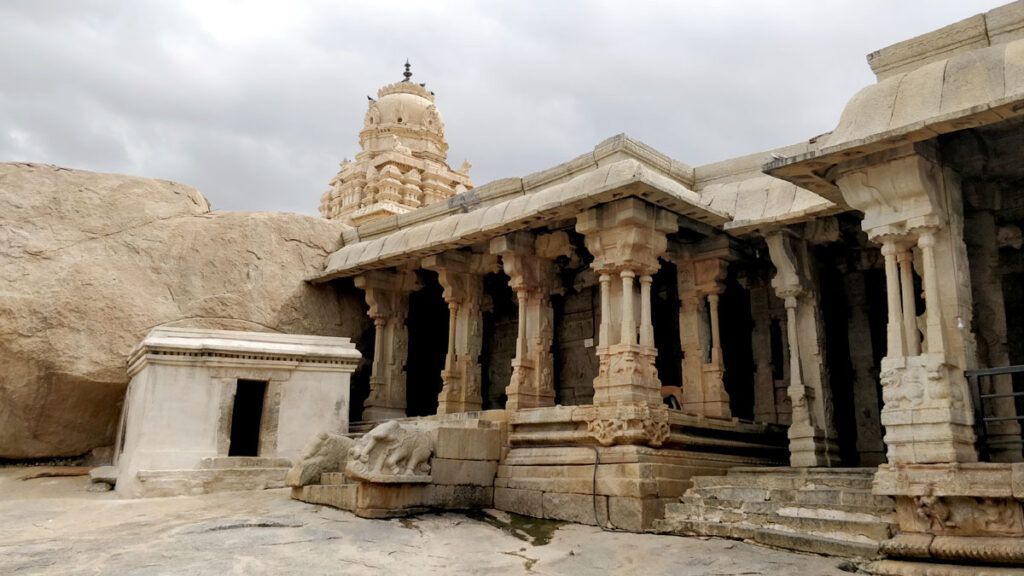
The Veerabhadra Swamy Temple at Lepakshi is not only a religious site; it’s an open-air museum, a brilliant exemplar of Vijayanagara architectural genius. Each inch of this temple, from the lofty gopurams to the intricately carved mandapams, is bristling with carvings and paintings that tell us a lot about the skill of its creators.
The temple is constructed upon a low-altitude hillock, which is purportedly in the form of a tortoise and hence also called Kurma Saila (Tortoise Hill). The distinctive natural environment only contributes to its aura. The temple complex itself is surrounded by two enclosures with three gates, though the northern gate is usually employed for entrance.
The main temple building is schematically segmented into three parts:
1. Mukha Mantapa (or Natya Mantapa/Ranga Mantapa): It is the dance hall or the assembly hall.
2. Arda Mantapa (or Antarala): The ante-chamber that opens to the sanctum.
3. Garbhagriha: The sanctum sanctorum, where the presiding deity resides.
Let’s proceed to some of the distinctive architectural features and the stunning carvings:
The Pillars: Stories in Stone
The columns of the Lepakshi temple are its crowning jewel. There are approximately 70 columns in Mukha Mantapa and Natya Mantapa, each a work of refined sculpture. You will get to see:
Mythological Illustrations: The columns dramatically tell stories of Hindu mythology, events of the Ramayana, Mahabharata, and the Puranas. You can witness images of Lord Rama shattering Shiva’s bow, Surpanakha drawing near to Lord Rama, and different divine entities.
Gods and Goddesses: Sculptures of Lord Shiva in all his forms (such as his 14 avatars), Lord Vishnu, Lord Brahma, Goddess Lakshmi, and numerous other gods are found on these pillars.
Musicians and Dancers: The pillars of Natyamandapa (dance hall) are particularly fascinating, with realistic depictions of musicians with instruments, heavenly dancers (Apsaras), and divine performers, depicting the rich classical arts of India.
Yali Pillars: A repeated theme is the ‘Yali,’ a mythical beast with the body of a lion and the head of an elephant. The ‘Yali pillars’ are a testimony to exceptional craftsmanship and are a characteristic feature of Vijayanagara architecture.
Floral Motifs and Sari Designs: In the Lata Mantapa (Hall of Creepers), nearly 30 pillars are carved with precise patterns of flowering creepers and climbers. These fragile and gorgeous designs are believed to have influenced the well-known Lepakshi sari border patterns, a gorgeous example of how temple art infused everyday life.
Read More>> Shri Bettada Byraveshwara Temple
The Hanging Pillar: An Engineering Enigma
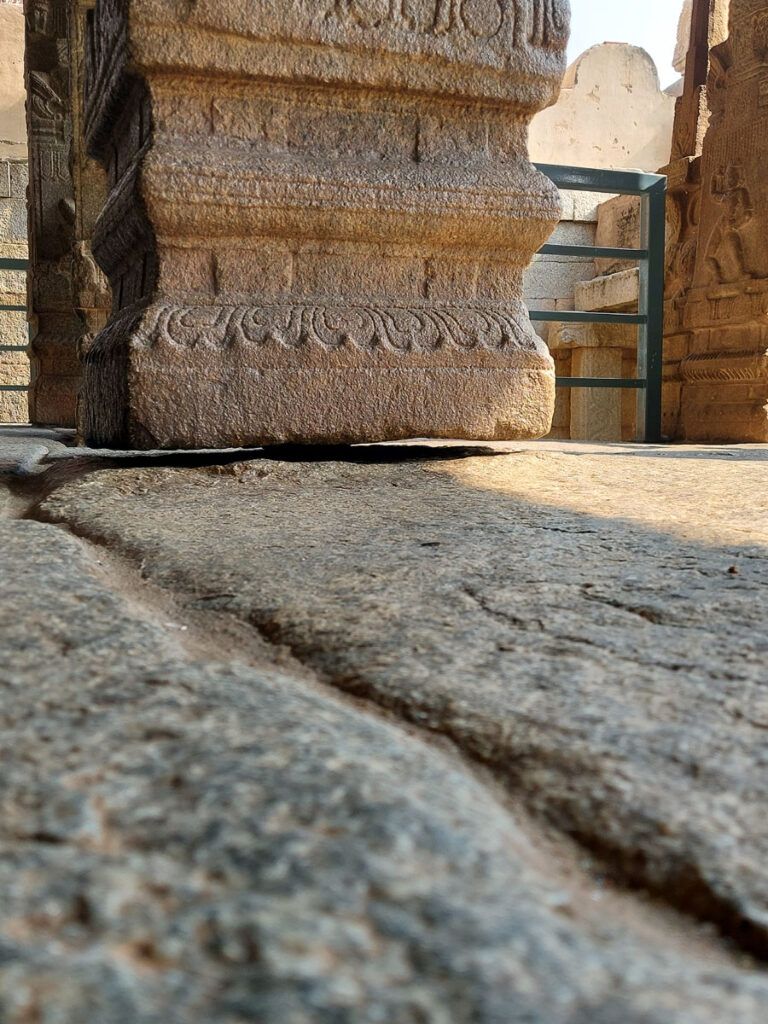
Naturally, the main attraction is the iconic hanging pillar. Located in the Mukha Mantapa, the pillar appears to go against gravity, with a visible space between its bottom and the temple floor. You can quite literally pass a thin sheet of paper or cloth from one side to the other to verify that it does not actually touch the ground.
The secret to this hanging pillar has intrigued researchers and travelers for centuries. While locals have explained it to be the result of divine intervention or a brilliant architect’s magic, there are some scientific theories that suggest ingenious engineering methods through careful distribution and alignment of weights. Tradition also has it that a British engineer, in colonial times, tried to shift the pillar in order to open its secret, and succeeded in displacing it somewhat, which may still be seen today, but was unable to solve its mystery. This architectural peculiarity really stands out in the Veerabhadra Swamy Temple.
Fresco Paintings: A Colorful Chronicle
Aside from the carvings, the Veerabhadra Swamy Temple is famous for its beautiful fresco paintings on the ceiling of Arda Mantapa and Mukha Mantapa. The colorful murals, painted with natural pigments, are some of the finest works of Vijayanagara pictorial art in India.
Asia’s Biggest Fresco: The ceiling fresco of the Arda Mantapa is also notable since it’s Asia’s largest fresco painting, standing an enormous 23 by 13 feet in size. The 14 avatars of Lord Shiva are painted here, and each of them is painted with great detail and delicate color, demonstrating the magnificence of the Vijayanagara era.
Epic Painting: Other works of art depict scenes from the Ramayana, Mahabharata, and other Puranas, giving life to these ancient tales in rich colors. You can find illustrations of gods and goddesses, musicians, dancing girls, saints, and protectors, creating a visual record of the cultural and religious life of the period.
Builders’ Portraits: Surprisingly, the ceiling over the main deity of the Garbhagriha sports portraits of the builders of the temple, Virupanna and Viranna, resplendent in their attire and posture of devout prayer, proffering sacred ashes. This is a personal touch that offers an intimate glimpse of the life of the individuals who devoted themselves to this monumental endeavor.
Monolithic Sculptures: Greatness in Stone
The Lepakshi temple complex further has some stunning monolithic sculptures carved from single pieces of stone:
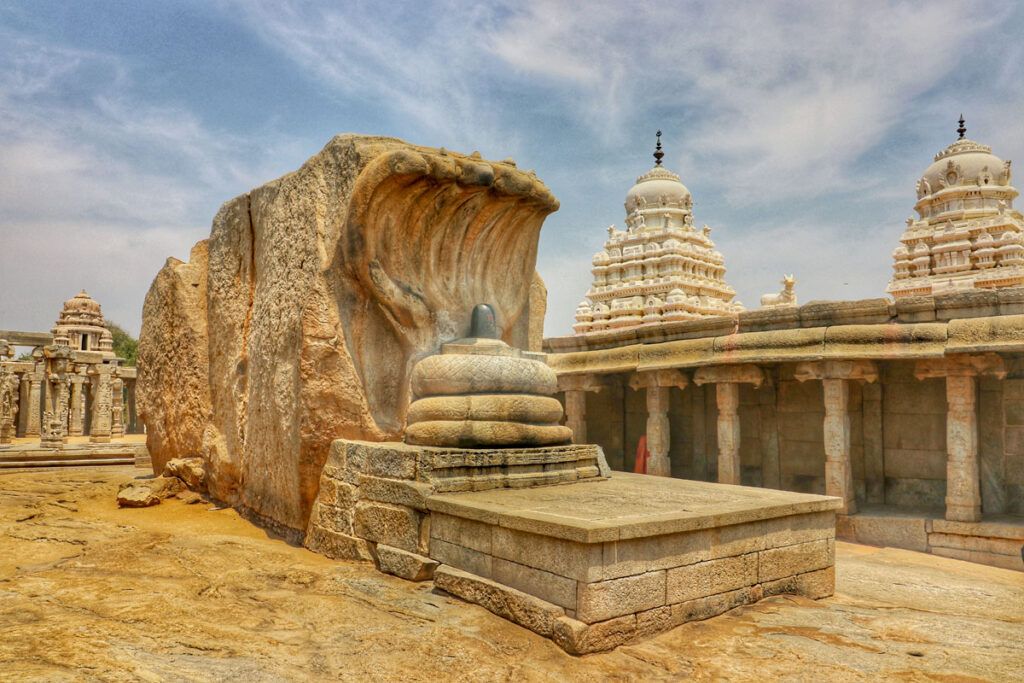
Nagalinga: Inside the temple complex, towards the east, you can spot a gigantic granite boulder featuring a multi-hooded serpent (Naga) wrapping its body around a Linga, giving it an umbrella-shaped cover. This Nagalinga is said to be among the biggest monolithic Nagalingas in India. According to legend, the sculptors carved this within an incredibly brief duration of time when their lunch was being prepared!
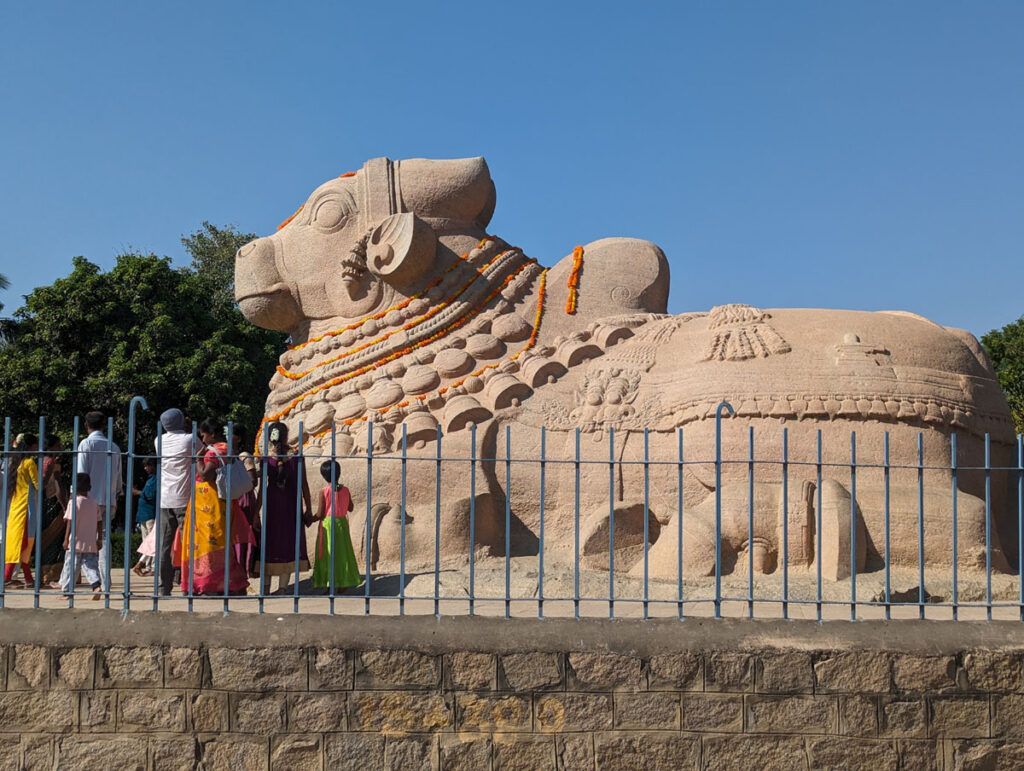
Giant Nandi: There is a giant monolithic Nandi, Shiva’s vehicle, located around 200 meters from the central temple. Sculpted out of one granite block, this giant Nandi is among the biggest in the world, looking straight at the main deity in the temple. Its enormity and intricate carvings are breathtaking.
These architectural details, carvings, and paintings turn the Veerabhadra Swamy Temple into an altogether exceptional experience, in which art, history, and religion come together in an awe-inspiring spectacle. Each corner is a new discovery, a new tale inscribed in stone, inviting you to wonder at the genius of its architects.
Read More>> Brihadeeswarar Temple: Timeless Marvel of Chola Architecture
Myths and Beliefs: Unraveling the Enigma
Aside from the majesty of its architecture and the splendor of its paintings, the Veerabhadra Swamy Temple at Lepakshi contains a treasure trove of legends and myths that have been handed down the ages. These legends infuse the temple with layers of wonder and mystique, sometimes obscuring the boundaries between fact and legend.
The Mystery of the Hanging Pillar
The hanging pillar is, by far, the most discussed and enigmatic aspect of the Lepakshi temple. The common belief is that this pillar is a reflection of the superior engineering understanding of ancient India, a conscious architectural achievement created to demonstrate their proficiency. It is believed by many locals and worshippers to be a godly wonder, practically defying the laws of physics because of its religious importance.
Good Fortune and Blessings
Most devotees have a common belief that passing or touching items (such as a cloth or piece of paper) under the suspended pillar results in good luck, prosperity, and God’s blessings. It is common to observe the visitors gently trying this out, usually with a reverent and hopeful approach.
The British Engineer’s Fiasco
The story of the British engineer who attempted to push the pillar off to reveal its secret, resulting only in a slight lean and failure in the attempt, is an ongoing myth. This legend adds fuel to the belief that the engineering of the pillar was beyond the capabilities of even contemporary minds at the time, again enhancing its mysterious status. It is a story that tends to bring a smile of pride among locals for the foresight of their elders.
The Virupanna Bloodstains
The reddish-brown, dark stains on a wall within the temple are notoriously attributed to Virupanna, a temple builder. It is said in the myth that when King Achyuta Deva Raya, enraged at Virupanna’s unauthorized use of royal treasury money, condemned him to be blinded, Virupanna, as a symbol of deep regret, defiance, or as a move to save others the repulsive job, gouged out his own eyes and cast them on the wall.
The spots are said to be his blood dried up. Although scientific examination has verified them to be human blood, the exact circumstances are still part of the intriguing folklore. The myth creates a strong realization of tragedy and sacrifice so that visitors stand frozen in mind by the tale.
The Swiftly Carved Nagalinga
The monolithic sculpture of Nagalinga, its seven-headed cobra guarding a Shiva Lingam, is another cause of local folklore. The common myth is that this gigantic sculpture was sculpted in a very short time – some claim in only an hour – by the artists as they waited for their lunch to be cooked. Whatever truth lies in this story, it reflects the amazing technical, commitment and possibly spiritual inspiration of the artisans of the Vijayanagara era. It’s a reflection of their control over stone and their skill to create large designs with incredible speed.
Sita’s Footprint or Hanuman’s?
The big footprint on the rocky ground inside the temple complex is a center of controversy and faith. While several people religiously believe it to be the Padam (footprint) of Goddess Sita, adding to the temple’s association with the Ramayana, others also opine that it might be that of Lord Hanuman’s. No matter which specific attribution it carries, its very existence significantly enriches the temple’s religious importance, rendering it a holy place for worship and a reminder of the great story surrounding the location.
These myths and legends are a part of the Veerabhadra Swamy Temple experience. They are not just ancient tales; they are living stories which create the imagery of the temple, contribute to its mystique, and enhance the spiritual experience for millions of devotees and tourists alike. They make the imposing stone building human by giving it an aura of age-old wisdom, divine influence, and human passion.
Read More>> Konark Sun Temple 13th Century Gem
Lepakshi Temple Timing: Plan Your Visit
Temple Timings: For those intending to dive into the spiritual and historical majesty of the Veerabhadra Swamy Temple at Lepakshi, having knowledge about the temple timings is a must.
Typically, the Lepakshi temple remains accessible to tourists between:
Morning: 6:00 AM and 12:30 PM
Evening: 4:00 PM and 8:30 PM
Note: These hours are occasionally adjusted a little around the big festivals or special events. Always best to check around locally or with temple authorities if planning your visit around a particular festival time.
There is no fee to visit the temple, so it is open to all. There are, however, perhaps arrangements for special poojas or offerings that can be made available for a minimal cost.
Best Time to Visit to Steer Clear of Crowds:
If you like having a less crowded experience to view the architecture and sculptures without masses of people, weekdays (Monday through Friday) tend to be less crowded, particularly outside of festival times. Early morning (6:00 AM to 8:00 AM) or late afternoon/early evening (4:00 PM to 6:00 PM) can also provide a calmer environment.
Best Season to Visit:
The climate in this area can be very hot. Hence, it’s the best time to travel to Lepakshi and the Veerabhadra Swamy Temple between the cooler months of October to March. Between this time of the year, the weather is very pleasant with the temperature lying in the range of 20-30°C, which is perfect for sightseeing the temple and its environs. The nights can be chilly, so a light jacket may come handy.
Summer (April to June) can be extremely hot with days reaching temperatures of 35-40°C, which could be uncomfortable for extensive outdoor discovery. July to September is the rainy season with monsoons, which can turn the landscape green and lush but may also create difficulties in traveling and sightseeing, although it is less touristy then.
Read More>> Vidyashankara Temple Sringeri 12 Pillars Reveal Your Destiny
Places to Visit Near the Temple: Extend Your Spiritual Journey
Your visit to the Veerabhadra Swamy Temple at Lepakshi can be part of a wider cultural and spiritual discovery of the area. Although Lepakshi itself is the main point of interest, there are a number of other important Hindu sites and attractions in the area that you may want to visit, further informing your knowledge of the local heritage.
1. Monolithic Nandi (Lepakshi): This is literally only 200 meters away from the Veerabhadra Swamy Temple. You simply can’t help but see it. This gigantic sculpture of Shiva’s mount, cut from a single granite rock, is one of India’s biggest monolithic Nandi statues and an example of Vijayanagara craftsmanship. It faces the central deity in the temple, forming a strong spiritual axis.
2. Penukonda Fort (Anantapur District): Approximately 35 km from Lepakshi lies Penukonda, which was a significant fortified town and the second capital of the Vijayanagara Empire following the defeat of Hampi. The fort and the remains that can be seen today are of high historical significance, with temples and buildings still standing, giving a glimpse into the strategic strength of the empire.
3. ISKCON Temple, Anantapur: Around 105 km away from Lepakshi, in the city of Anantapur, is a stunning ISKCON (International Society for Krishna Consciousness) temple. This temple, dedicated to Lord Krishna, is a peaceful spot for worship and provides a unique architectural and spiritual experience other than the ancient Vijayanagara style.
4. Dharmavaram (Anantapur District): Though not a temple itself, Dharmavaram, roughly 100 km from Lepakshi, is famous across the globe for its beautiful silk sarees. Several of these sarees feature motifs based on the intricate pillar carvings of the Lepakshi temple. Visiting here would be a cultural extension, and you could see the living legacy of the temple’s art.
5. Puttaparthi (Sri Sathya Sai Prasanthi Nilayam): Situated approximately 80 km away from Lepakshi, Puttaparthi is the spiritual home of the late Sri Sathya Sai Baba. His ashram, Prasanthi Nilayam, is visited by millions of devotees from across the globe and remains an important pilgrimage center. The Chaitanya Jyoti Museum here also extols Sai Baba’s life and teachings in a beautiful manner.
6. Nandi Hills (near Bangalore): Though a little out of the way (about 90-100 km from Lepakshi, near Bangalore), Nandi Hills is a favorite weekend destination for its scenery, sunrises, and old temples. The Bhoga Nandeeshwara Temple at the foot of the hills and the Yoga Nandeeshwara Temple at the top are old Shiva temples one should visit if there is time to spare.
7. Ghati Subramanya Temple (near Doddaballapur, Karnataka): Located approximately 60 km from Lepakshi, this is a unique and ancient temple dedicated to Lord Subramanya (Kartikeya) and Lord Narasimha. What makes it unique is that Lord Subramanya faces east, while Lord Narasimha faces west, making it a significant site for devotees seeking blessings from both deities.
These nearby attractions offer a chance to extend your journey, delve deeper into the region’s spiritual tapestry, and appreciate the diverse cultural heritage of this part of India. Remember to plan your travel accordingly, considering the distances and time required for each visit.
Read More>> Char Dham Yatra – A Complete Guide to Spiritual Destination
Hanging Pillar at Veerabhadra Swamy Temple in Lepakshi:
“The Hanging Pillar of the Veerabhadra Swamy Temple in Lepakshi, Andhra Pradesh, India, is one of the most mysterious and intriguing architectural features in the world. The pillar, which is located in the main hall of the temple, is about 13 feet tall and weighs about 30 tons. It is supported by a single, delicate stone bracket that is only about 4 inches thick.
The pillar has been the subject of much speculation and debate over the centuries. Some believe that it was built by using a complex system of pulleys and counterweights, while others believe that it is simply a natural phenomenon. There is no scientific consensus on how the pillar was constructed, and it remains one of the temple’s most enduring mysteries.
The temple itself is a beautiful example of Vijayanagara architecture. It was built in the 16th century by the brothers Virupanna and Viranna, who were governors of the region under the Vijayanagara Empire. The temple is dedicated to the Hindu god Veerabhadra, who is an incarnation of Shiva.
Read More>> Dhandayuthapani Swamy Temple, Palani
Places to visit near Veerabhadra Swamy Temple in Lepakshi:
Lepakshi Nandi: Located close to the Veerabhadra Swamy Temple, the colossal monolithic Nandi (bull) statue is a must-see. It’s one of the largest Nandi sculptures in India and is carved from a single block of granite.
Virupaksha Temple, Hampi: Hampi, a UNESCO World Heritage Site, is not too far from Lepakshi. The Virupaksha Temple is one of the most important temples in Hampi, known for its historical and architectural significance.
Tadipatri: Tadipatri is another town in Andhra Pradesh, famous for its ancient temples and architectural heritage. The Bugga Ramalingeswara Temple and the Chintala Venkataramana Swamy Temple are worth visiting.
Hindupur: This nearby town has a few attractions such as the Isvara Temple and the Sri Raghavendra Swamy Mutt, a religious and spiritual center.
Horsley Hills: About 120 kilometers from Lepakshi, Horsley Hills is a charming hill station known for its natural beauty, pleasant climate, and viewpoints.
Gandikota: Also known as the “Grand Canyon of India,” Gandikota is a picturesque gorge formed by the Pennar River. It offers stunning views and is home to the Gandikota Fort, a historic site.
Belum Caves: Located about 80 kilometers from Lepakshi, the Belum Caves are the second-largest natural caves in the Indian subcontinent. They are known for their unique stalactite and stalagmite formations.
Anantapur: The city of Anantapur is known for its historical and cultural heritage. Some of the attractions include the Sri Kadiri Lakshmi Narasimha Swamy Temple and the ISKCON Temple.
Nandi Hills: While not very close, Nandi Hills is a popular hill station and weekend getaway from Bangalore. It’s known for its scenic beauty and the Nandi Temple at the hilltop.
Puttaparthi: If you’re interested in spiritual and religious experiences, you can visit Puttaparthi, the birthplace of Sri Sathya Sai Baba. The Prasanthi Nilayam Ashram is a significant place of interest.
Read More>> Airavatesvara Temple Darasuram
Accommodation Options: Resting Your Pilgrim Feet
Following a day of walking around the stunning Veerabhadra Swamy Temple and the surrounding historical monuments, you will require a welcoming place to sleep. Although Lepakshi itself is a small village, there are a few good options for accommodation there, and more are available in nearby towns.
1. Local Guest Houses and Budget Stays in Lepakshi
You might find some basic guest houses or lodges directly in Lepakshi village. These are usually no-frills accommodations, ideal for pilgrims or budget travelers looking for a simple stay very close to the temple. These might not be listed on major booking platforms, so inquiring locally upon arrival might be the best way to find them.
2. Nandi Farm Resort & Hotel (Cholasamudram, near Lepakshi):
It seems to be one of the better-organized and cozy options very near Lepakshi, at a distance of about 5-7 km from the temple. It provides facilities such as an outdoor pool, garden, free Wi-Fi, and a restaurant. They have a family room and try to offer a good stay to tourists. This would be a suitable option if you want a resort-style experience nearer to the temple.
3. Hotels in Hindupur:
The nearest major town to Lepakshi is Hindupur, 14-15 km away. It’s a better-developed town and has a wider choice of hotels, ranging from budget to mid-level. It’s best to stay in Hindupur since there are more food choices and local transportation. You can drive or take a bus or taxi from Hindupur to Lepakshi temple.
4. Hotels in Anantapur:
The district headquarters of Anantapur is situated approximately 105 km from Lepakshi. Although it is farther off, it has a much greater variety of accommodation options, including star hotels, if you need more luxury options and do not mind the drive. This could be an option if Lepakshi is part of a day’s outing from a longer visit to Anantapur.
5. Hotels in Bangalore (Bengaluru):
Most tourists go to Lepakshi as a day trip from Bangalore, which is some 120-140 km away. There are a wide range of accommodation options in Bangalore, ranging from luxury hotels to cheap hostels. If you don’t want to stay in a big city with everything and go to Lepakshi for the day, this is a very popular choice.
Tips for Accommodation
Advance booking: Particularly in peak season, weekends, or during popular festivals like Maha Shivaratri, advance booking of your accommodation is strongly recommended, since options may be scarce.
Read reviews: Always read online reviews before booking to understand the quality and service of the accommodation.
Think about travel time: If you opt to reside in Hindupur or Anantapur, consider the traveling time to and from the Veerabhadra Swamy Temple.
Regardless of what you’d like or can afford, you’ll be able to find an appropriate place to stay, which will enable you to fully appreciate your trip to the unbelievable Lepakshi temple.
Read More>> Bhoo Varaha Swamy Temple Kallahalli
How to Reach the Temple: Your Journey to Lepakshi
Reaching the Veerabhadra Swamy Temple at Lepakshi is quite easy, courtesy of its well-developed location. Below is a step-by-step on how to reach it:
By Air:
Nearest Airport: The nearest major airport is the Kempegowda International Airport (BLR) in Bangalore (Bengaluru), Karnataka. It is about 100-140 km away.
You may take a pre-paid taxi from Bangalore airport, ride-sharing services, or a bus to Lepakshi. The journey is approximately 2.5 to 3.5 hours, depending on the route and traffic.
By Train:
Nearest Railway Station: The closest railway station to Lepakshi is Hindupur Railway Station (HUP), which is roughly 14-15 km away.
Hindupur Railway Station is connected well by train to major cities such as Bangalore, Hyderabad, Chennai, and Mumbai.
From Hindupur railway station, it is simple to get the local bus or take an auto-rickshaw or taxi to the Veerabhadra Swamy Temple. The journey is quite short, about 30-45 minutes.
By Road:
Lepakshi is well connected by road and thus is a favorite destination for road travel, particularly from Bangalore. From Bangalore: Distance: About 120-140 km.
- Drive: The most popular and easy route is to use the NH44 (Bangalore-Hyderabad Highway). You have to turn west at the Kodikonda checkpost on the highway, and Lepakshi is around 12-14 km from there. Road conditions are mostly good, and you can drive in comfort.
- Buses: There are regular state-run and private buses from Bangalore to Hindupur. Take a further local bus or an auto-rickshaw to Lepakshi from Hindupur. Lepakshi may have direct buses less often but available.
- Private Vehicles/Taxis: Taking a private taxi or your own car is the most convenient and flexible choice, and you may travel as you please.
From Anantapur:
- Distance: About 105 km.
- Buses: Bus services run regularly from Hindupur to Lepakshi.
- Private Vehicles/Taxis: Alternatively, you can hire a taxi or drive down from Hindupur.
From Hyderabad:
- Distance: Around 480 km.
- Route: You can use the NH44 (Hyderabad-Bangalore Highway). It’s a bit of a longer route, so an overnight halt or splitting the journey may be better.
- Buses: Long-distance buses operate between Hyderabad and Hindupur.
Trains: Various trains operate between Hyderabad and Hindupur.
Local Transport in Lepakshi
When you arrive at Lepakshi, the temple and the monolithic Nandi are walking distance of one another. For travel to the immediate village or nearby landmarks, auto-rickshaws are plentiful.
Whatever your mode of transportation, your trip to the Veerabhadra Swamy Temple in Lepakshi will be a rich experience that brings you to a point where history, art, and spirituality meet in a virtually breathtaking manner.
Read More>> Bhojpur Shiva Temple | Bhojeshwar Temple Holds Huge Lingam
FAQs: Satisfying Your Curiosities
Being a tour guide, I usually receive numerous questions regarding the Veerabhadra Swamy Temple and Lepakshi. Let’s satisfy some of the trending topics and FAQs to enable you to enjoy your visit to the fullest!
Q1: Why was the Prime Minister’s visit to Lepakshi important lately?
A: The Veerabhadra Swamy Temple at Lepakshi recently received much national prominence when the Prime Minister of India came to the temple. He was on his 11-day special ritual in the run-up to the consecration of Lord Ram’s idol at the Ayodhya Ram temple. The pilgrimage reinforced Lepakshi’s strong identification with the Ramayana in the form of the legend of Jatayu and Sita’s footprint, bringing attention to its status as a holy place within the wider Hindu spiritual tradition. It rendered the historical and mythological value of the temple all the more prominent.
Q2: Is the “hanging pillar” an actual phenomenon or merely a myth?
A: Yes, the hanging pillar at the Lepakshi temple is definitely a real phenomenon that you can see for yourself! It is not a myth in the sense of its existence and in the sense of its appearance to defy gravity. Though the precise scientific or engineering reason remains a topic of fascination and discussion, the fact that you are able to push a thin piece of paper or a cloth beneath it attests that it does not lie completely on the ground. It is a genuine architectural wonder and a feature of any trip to the Veerabhadra Swamy Temple.
Q3: How would you best experience the Lepakshi temple’s architecture and art?
A: In order to get the most out of the Lepakshi temple’s architecture and art, my suggestion is to go slow. Don’t hurry.
- Hire a local guide: A local guide will be able to tell you about the intricate carvings, the narratives behind the frescoes, and the meaning behind different sections, bringing the temple to life.
- Attention to detail: See closely the pillars in the Natyamandapa and Lata Mantapa for the amazing detail in musician, dancer, mythological scene, and flower motif carvings.
- Notice the frescoes: Take time to look at the ceiling paintings, particularly the large fresco of Shiva’s avatars, observing the colors and facial expressions.
- Walk around the entire complex: Don’t just stick to the main shrine. Explore the outer courtyards to see the monolithic Nagalinga and, of course, the giant Nandi statue.
- Visit early morning or late afternoon: The softer light at these times enhances the beauty of the stone carvings and also helps avoid the midday heat and larger crowds.
Q4: Are there any specific rituals or poojas that devotees should know about?
A: Although the temple conducts daily pujas and rituals, special poojas can be ordered by the devotees. These usually involve abhishekams (divine bathing of deities) and archanas (offering of prayers with names). There are solemn ceremonies and processions (Rathotsavam, Kalyanotsavam) during important festivals such as Maha Shivaratri. If you want to attend a particular puja, it’s best to ask the temple office when you arrive or check with a local priest. They will advise on timings, donations, and costs involved.
Q5: How long should I spend at the Veerabhadra Swamy Temple?
A: To truly absorb the essence of the Veerabhadra Swamy Temple and its surroundings, I would suggest allocating at least 2 to 3 hours. This allows you enough time to:
- Explore the main temple complex, including the Mukha Mantapa, Arda Mantapa, and Garbhagriha.
- Carefully observe the intricate carvings on the pillars and the beautiful frescoes on the ceilings.
- Experience the hanging pillar mystery.
- Visit the monolithic Nagalinga within the temple complex.
- Walk to the colossal Nandi statue, which is a short distance away.
- Spend some quiet moments in contemplation.
If you plan to visit nearby attractions like Penukonda or Puttaparthi, then you’ll need to allocate additional time, possibly making it a full-day or multi-day trip.
Q6: Is the temple accessible for people with mobility issues?
A: The Veerabhadra Swamy Temple is a very old building, and as such, complete access for individuals with severe mobility impairments may be difficult. The temple complex is relatively level, but there are a few steps to reach the main shrine area and certain areas. It is advisable to come with the expectation of walking on uneven terrain. Although there are no special ramps, help from fellow travelers or local volunteers is normally available for users who require it.
These FAQs address some of the frequently asked questions and offer helpful tips for your trip. The Veerabhadra Swamy Temple is a place that draws you in, and I hope this information adds value to your experience!
One Comment