Gangaikonda Cholapuram Temple
Gangaikonda Cholapuram Temple, the hidden gem in the small village of Gangaikonda Cholapuram, situated in the Ariyalur district of Tamil Nadu, India.
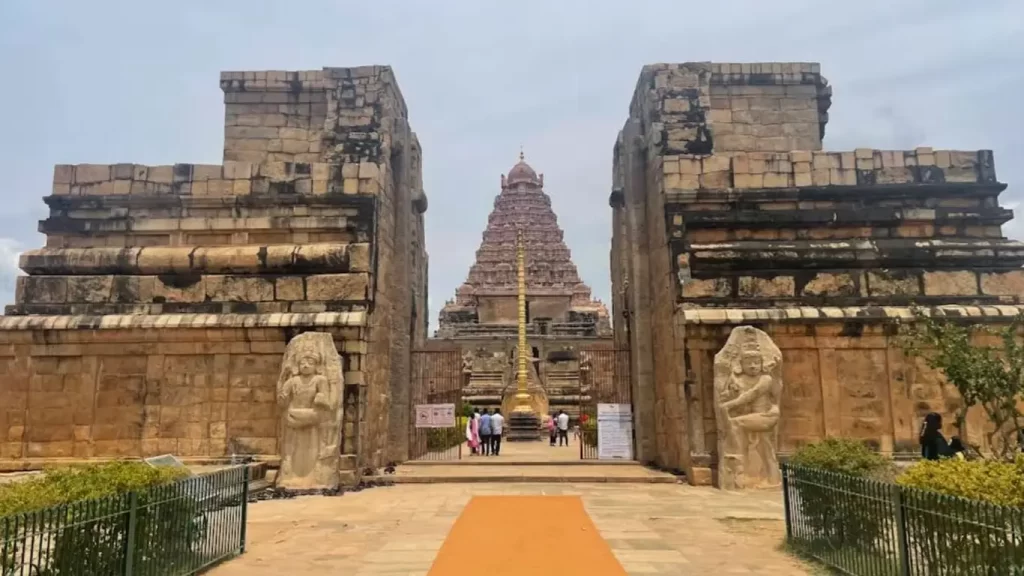
Picture a magnificent monument, constructed not only of bricks and mortar, but of pride, power, and piety of a great empire. That’s precisely what the Gangaikonda Cholapuram Temple is. It’s a UNESCO World Heritage Site, and once you set foot here, you’ll know why it’s rated as one of the “Great Living Chola Temples.” It’s a spot that will leave you utterly speechless, transporting you to a glorious history. So, let’s start exploring!
Introduction: A Symbol of Chola Grandeur
When we speak of the Gangaikonda Cholapuram Temple, we are not speaking of a temple alone; we are speaking of a monument of unspeakable historical and architectural importance. It is a testament to the sheer genius of the Chola empire, particularly their best emperor, Rajendra Chola I. This temple is not just a building; it’s an announcement, a testament to his triumphant journey to the Ganges and a deep expression of his faith.
Similar to its illustrious brother, the Brihadeeswarar Temple at Thanjavur, constructed by his father Raja Raja Chola I, the Gangaikonda Cholapuram Temple is a gargantuan testament to Lord Shiva. But it is different in its own right, a less rugged, more refined beauty that sets it apart. As we move through its holy precincts, you sense the whispers of a millennium, a rich heritage that still lives and breathes in these timeless walls.
Read More>> Hidden Power of Haridwar Mansa Devi Temple: #1 Wish Granted!
Gangaikonda Cholapuram Temple History: A Conqueror’s Legacy
The history of the Gangaikonda Cholapuram Temple is inextricably linked with the life and career of Rajendra Chola I. He was a great king, a visionary who took the Chola empire to unprecedented success.
Rajendra Chola I took the throne in 1014 CE, following his equally renowned father. He was not satisfied with simply holding his father’s empire; he had a vision of a greater dominion. His desire took him on a bold campaign to the north, right up to the Gangetic plains. This was a record military achievement for its time, evidence of the strength and strategic brilliance of the Chola army.
When he returned victorious in about 1023 CE, accompanied by holy water from the Ganges River, Rajendra Chola I resolved to create a new capital. This new capital city, appropriately called Gangaikonda Cholapuram, literally translates to “The City of the Chola who Conquered the Ganges.” And at the center of this new capital, he had this great temple built, in honor of Lord Shiva.
The building of the Gangaikonda Cholapuram Temple started sometime around 1025 CE and was well underway by 1035 CE. It was the Chola capital for about 250 years, until the fall of the Chola dynasty. Picture, for more than two hundred years, this city and this temple were the pulsating center of one of Asia’s greatest empires!
The temple was not only constructed as a center of worship, but also as a political and cultural hub. It was intended to challenge the Brihadeeswarar Temple in Thanjavur, and in most aspects, it does so even more in its beautiful proportions and finer details. It is an ever-living proof of the “silver age of the religious revival” in South India, as historian K.A. Nilakanta Sastri puts it. The Chola era, ruled by leaders such as Rajaraja I and Rajendra I, achieved unparalleled political integration of the south at a time when North India was dealing with numerous problems.
Legend of the Temple: The Ganga’s Blessing
Each great temple has a legend, a myth that interweaves itself into the very essence of its being, and the Gangaikonda Cholapuram Temple is no different. The most notable legend surrounding this temple is closely linked with its name and Rajendra Chola I’s remarkable campaign to the north.
It is said that following his triumphant campaign to the Ganges, Rajendra Chola I returned with pots of holy Ganga water. This water wasn’t merely a trophy; it was a sign of his divine mandate and a spiritual oblation. He then used that same water to consecrate the Shiva Lingam in this temple. This was considered a great blessing, symbolically uniting the sacred waters of the north with the spiritual heartland of the south, and creating a new spiritual center under the guardianship of Lord Shiva.
Yet another sweet legend is that although Rajendra Chola I desired his new temple to be magnificent and handsome, he humbly made sure that its vimana (tower) was a bit lower than his father’s at Thanjavur. This was a deep show of respect, as he was paying tribute to his father’s path-breaking effort while making a work of art of his own. Rather than mere height, he centered on making the temple more elaborate, more artistically polished, an actual gem of Chola artwork. This combination of ambition and respect serves to make the Gangaikonda Cholapuram Temple even more lovable.
Read More>> Sivanmalai Temple: Murugan’s Sacred Box Predicts the Future
Cultural, Spiritual, and Mythological Significance of the Temple: An Intersection of Religion and Art
The Gangaikonda Cholapuram Temple is not merely a historical monument, but a living reminder of South India’s rich cultural, spiritual, and mythological heritage.
Cultural Significance
The temple is a peak of Chola art and architecture, reflecting the advanced artistic sensibilities of the period. The intricate carvings, the elegant proportions, and the grand scale of the temple tell a great deal about the artistic skills and engineering feats of the Chola era. It was a hub of art, culture, and learning, with scholars, artists, and pilgrims flocking to it from all corners of the world. The temple was also a storehouse of information, with many inscriptions providing information about the past, administration, and social life during the period.
The beautiful bronze images, especially the ones of Lord Shiva in his different avatars, are a masterpiece of Chola sculptures and are much coveted by museums and collectors across the globe. The life of the temple today continues to influence artists, historians, and the faithful, perpetuating the memory of a golden age.
Spiritual Significance
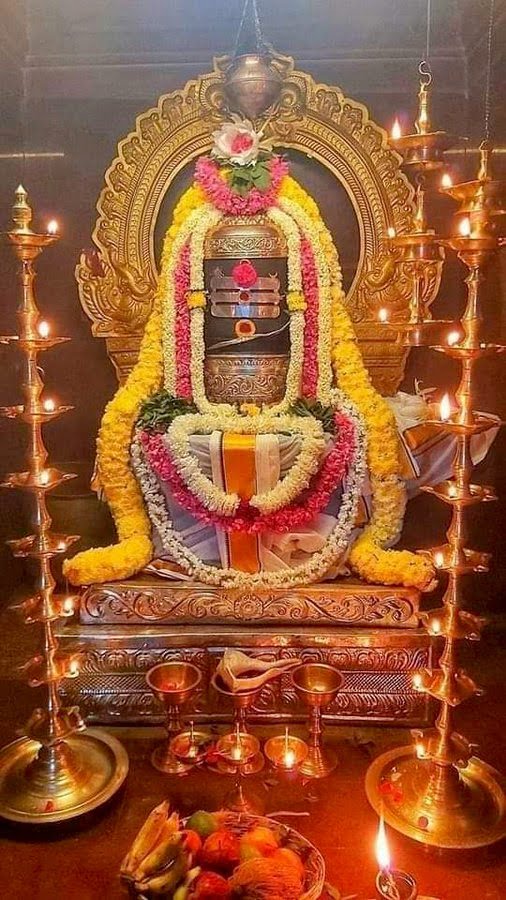
For Shaivites, the Gangaikonda Cholapuram Temple possesses extraordinary spiritual significance. It is dedicated to Brihadeeswarar, one of the forms of Lord Shiva, and the giant Shiva Lingam inside the sanctum is worshipped as a potent image of universal consciousness and the creative force of the universe. Worshipers feel that going to this temple and praying here may bring about spiritual awakening and blessings.
Even the act of going around the temple, looking at its heavenly sculptures, and meditating in its peaceful environment is a highly spiritual activity. Grand celebrations like Maha Shivaratri are organized with great devotion, attracting thousands of devotees who come to connect with the divine presence of Lord Shiva. The temple is a place of ritual, prayer, and festival, and it reinforces a strong sense of belonging and piety among those who visit it.
Mythological Significance
Although the Gangaikonda Cholapuram Temple is fundamentally historical, its very existence is based on a mythological story constructed around the victory of Rajendra Chola I over the Ganges. The process of performing the pralaya, bringing in Ganga water, and consecrating the Lingam is not only a historical fact but also has deep mythological significance, connecting the temple to India’s sacred geography. It is a symbol of a spiritual victory, unifying the country under the divine blessing of Shiva.
While direct quotations from ancient Hindu scriptures or Puranas particularly stating the building of this specific temple are not easily found, the Shiv Purana frequently discusses the beauty of Lord Shiva, the importance of Shiva Lingams, and the merits of worship and temple construction. For instance, in the Shatarudra Samhita of the Shiv Purana, one finds descriptions of Shiva in several forms and the merits of worshipping Him.
Even though it doesn’t particularly mention this temple, the spirit of its religious intent and the piety that it embodies is in adherence with the precepts contained within these holy books. The mere act of transporting Ganga water to the temple is in keeping with mythological importance of the Ganges as a cleansing and holy river, usually described as flowing from Lord Shiva’s matted hair. This mythological association transforms the temple from a historical monument to a site filled with divine grace and intense spiritual power.
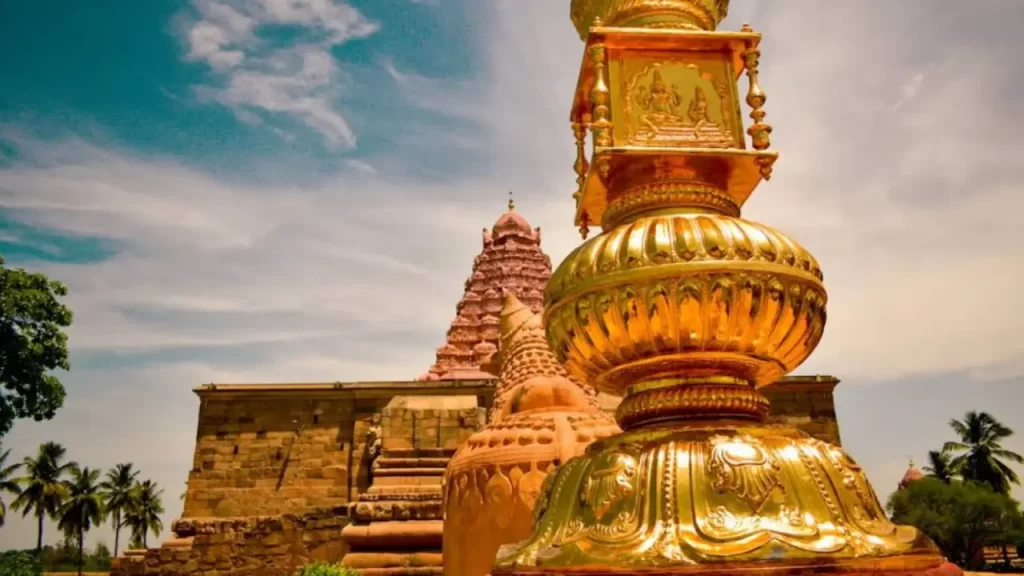
Festivals: Celebrating the Divine at Gangaikonda Cholapuram Temple
The Gangaikonda Cholapuram Temple is not only a static monument; it’s a living center of spiritual action, pulsating with activity during its various festivals. These festivals are a lovely combination of ancient customs, intense devotion, and popular spirit. The most celebrated festivals here are:
Maha Shivaratri: This is the largest and most important festival in the Gangaikonda Cholapuram Temple. It is celebrated during the Tamil month of Masi (February-March) and is in honor of Lord Shiva and the night when Shiva danced the Tandava, his cosmic dance. Worshipers go on fasts, say prayers, recite mantras, and keep vigil the entire night, presenting Bilva leaves and water to the Shiva Lingam. The temple grounds are filled with activity, special pujas are conducted all night, and the air is electric with devotion. It is one of the busiest days at the temple, with pilgrims from far and wide.
Aippasi Pournami (Anna Abhishekam): This is a special and visually beautiful festival, which falls on the full moon day of the Tamil month of Aippasi (October-November). In Anna Abhishekam, the entire Shiva Lingam is smothered with cooked rice to represent abundance and prosperity. It is a ritual conducted for food sufficiency through the prosperity of agricultural fields and a bounty of agricultural yields, generally following a harvest season. The cooked rice, usually made in different shapes such as Pongal, curd rice, sweet Pongal, tamarind rice, and payasam, is further distributed as prasad to pilgrims, animals, and birds. This is a highly unique and nice offering, reflecting the strong bond of faith and nourishment.
Margazhi Thiruvadhirai: Celebrated during the Tamil month of Margazhi (December-January), Thiruvadhirai is another important festival in honor of Lord Shiva, especially in his manifestation of Nataraja, the cosmic dancer. The day is auspicious for wishing blessings for a good harvest and religious progress. Special abhishekams (ritual bathing) and arthanas (prayers) are offered to the deity. The Aadi Thiruvathirai festival, especially, has become famous as it usually is the birthday anniversary of Rajendra Chola I and his sea voyages. This is a fairly busy day with devotes and culture lovers.
During these auspicious days, the temple reverberates with traditional music, devotional songs (Thevaram recitals by Odhuvars), and cultural events, giving the visitor an experience of a lifetime. In addition to these big festivals, daily rituals and routine pujas are conducted keeping the spiritual vigour of the Gangaikonda Cholapuram Temple alive. Weekends, particularly Saturdays, and public holidays also attract more crowds than ordinary weekdays. For an exclusive visit, make a choice to visit on a weekday morning.
Read More >> Kanchi Kamakshi Temple: One of Powerful 18 Shakti Peethas
Unique Architectural Styles: A Study in Chola Grandeur
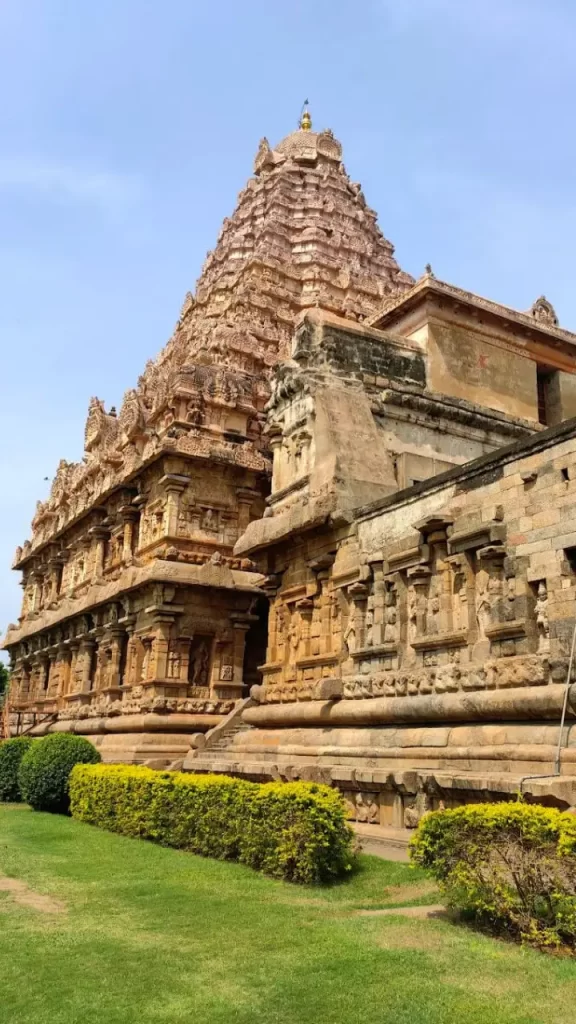
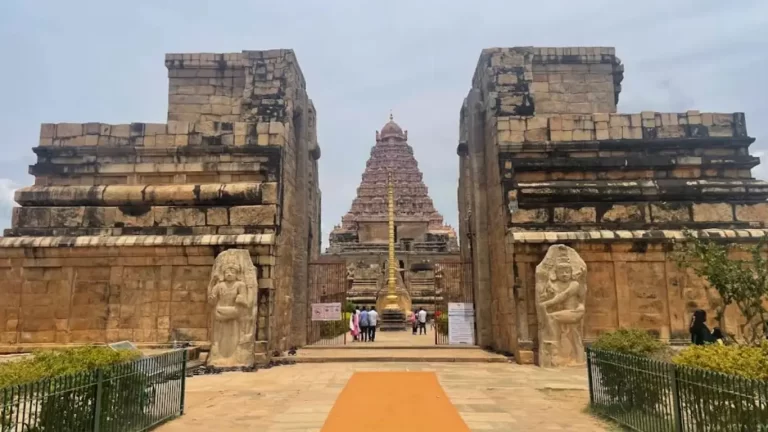
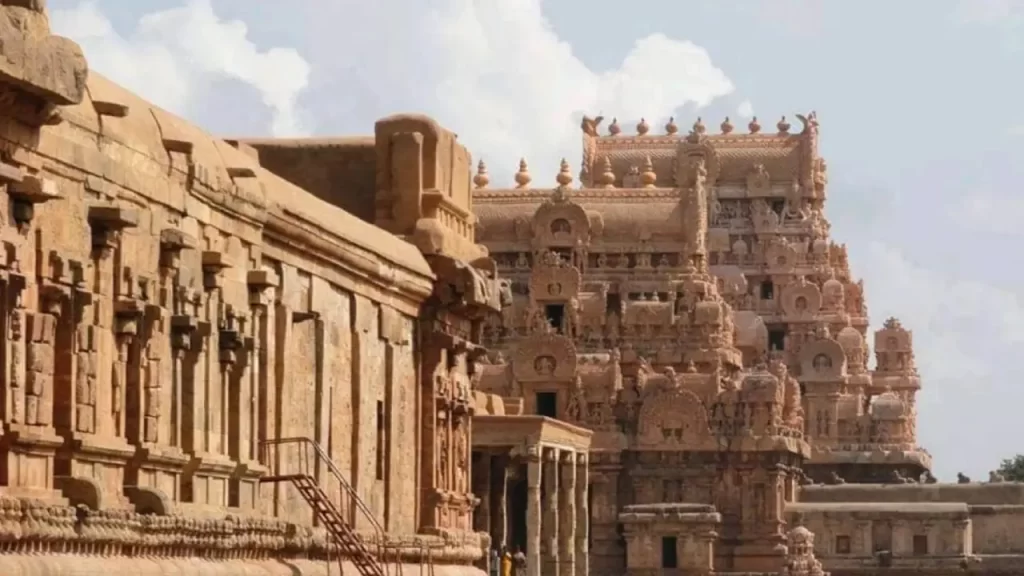
The Gangaikonda Cholapuram Temple itself is a masterpiece of Dravidian architecture, and an engineering and artistic wonder of the Chola era. Though it equals its predecessor, the Brihadeeswarar Temple at Thanjavur, in grandeur, it has its own unique charm and architectural niceties.
Its most noteworthy feature is its vimana, the massive structure above the sanctum. Though slightly lower than Thanjavur, measuring about 182 feet, it is more delicate and graceful in appearance. The gentle curves of the vimana create a softer, more feminine and dainty look in contrast to the straight and stiff lines of Thanjavur’s tower, earning it the nickname “feminine version” of the Brihadeeswarar Temple.
This soft curve is a characteristic of the advanced Chola architectural development. The temple is constructed on a raised platform with a rectangular courtyard following a square plan, a characteristic in Dravidian temple architecture. The garbhagriha (sanctum sanctorum) and other mandapas (halls) are all in line on an east-west axis, facing the sunrise, indicating harmony of the cosmos.
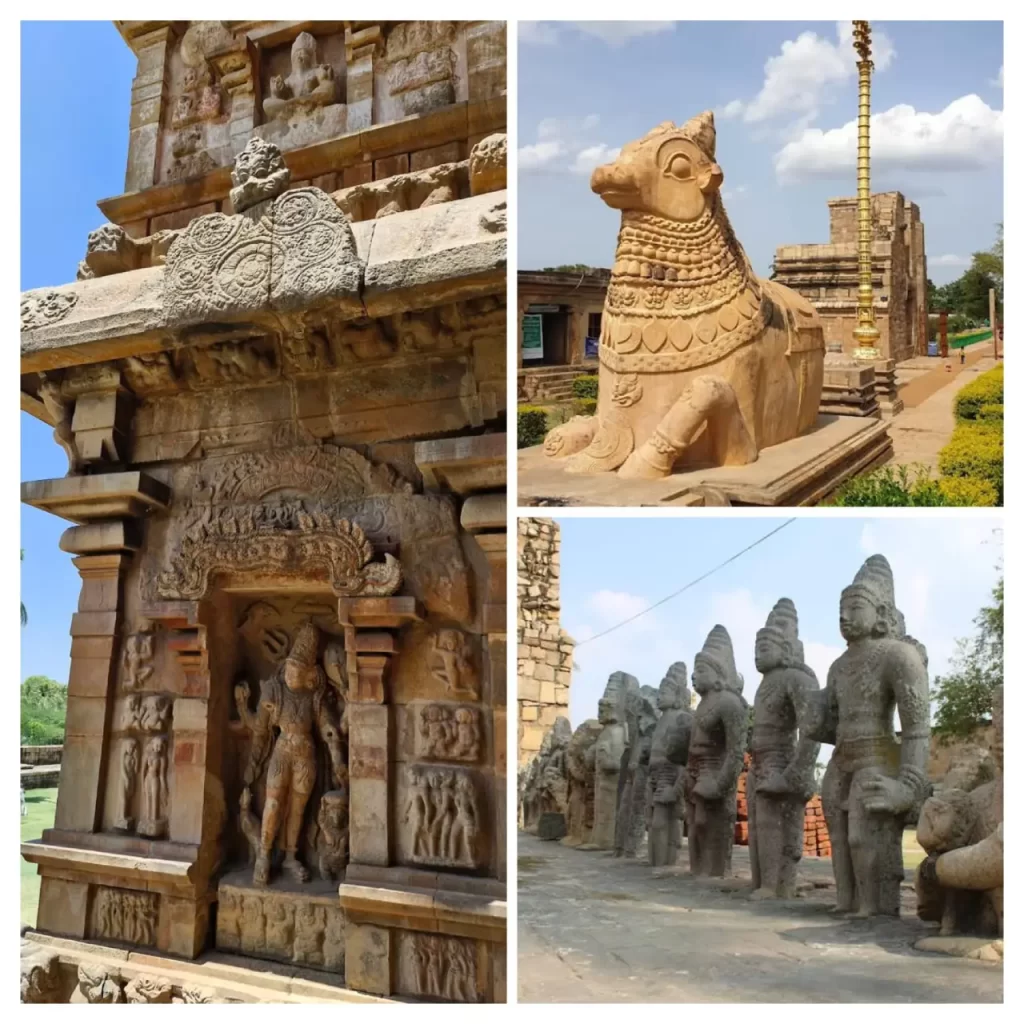
The doorway to the main shrine is guarded by huge dwarapalakas (protector deities), finely sculpted and almost 6 feet tall, inviting the faithful into the holy precincts. The sanctum sanctorum contains one of India’s biggest Shiva Lingams, reaching a height of 13 feet. The employment of grey granite, carefully cut and fitted without mortar, demonstrates the phenomenal engineering expertise of the Chola artisans. The accuracy with which these huge pieces of stone were quarried, moved, and fitted together is really breathtaking.
Another intriguing architectural feature is the Nandi (sacred bull) idol looking directly into the sanctum. It is designed in such a manner that it is said to throw reflections of sunlight directly into the sanctum onto the Shiva Lingam. This clever design says a lot about the Chola architects’ knowledge of light and space.
The temple complex itself also had a two-storied hall along its outer side, although only traces exist today since most of its stone was utilized in the building of the Lower Anaicut dam. Though the elevated platform on which the hall rested is now used to exhibit idols salvaged from the destroyed sections of the temple, no other part of the hall survives today.
Gangaikonda Cholapuram Temple is a witness to the Chola dynasty’s adherence to monumental architecture, a reflection of their prosperity, power, and their intense religious devotion. Its grandeur and grace presented in a style distinct from all other temples make it a unique example of Dravidian temple architecture.
Read More>> Vidyashankara Temple Sringeri 12 Pillars Reveal Your Destiny
Carvings: Stories Etched in Stone
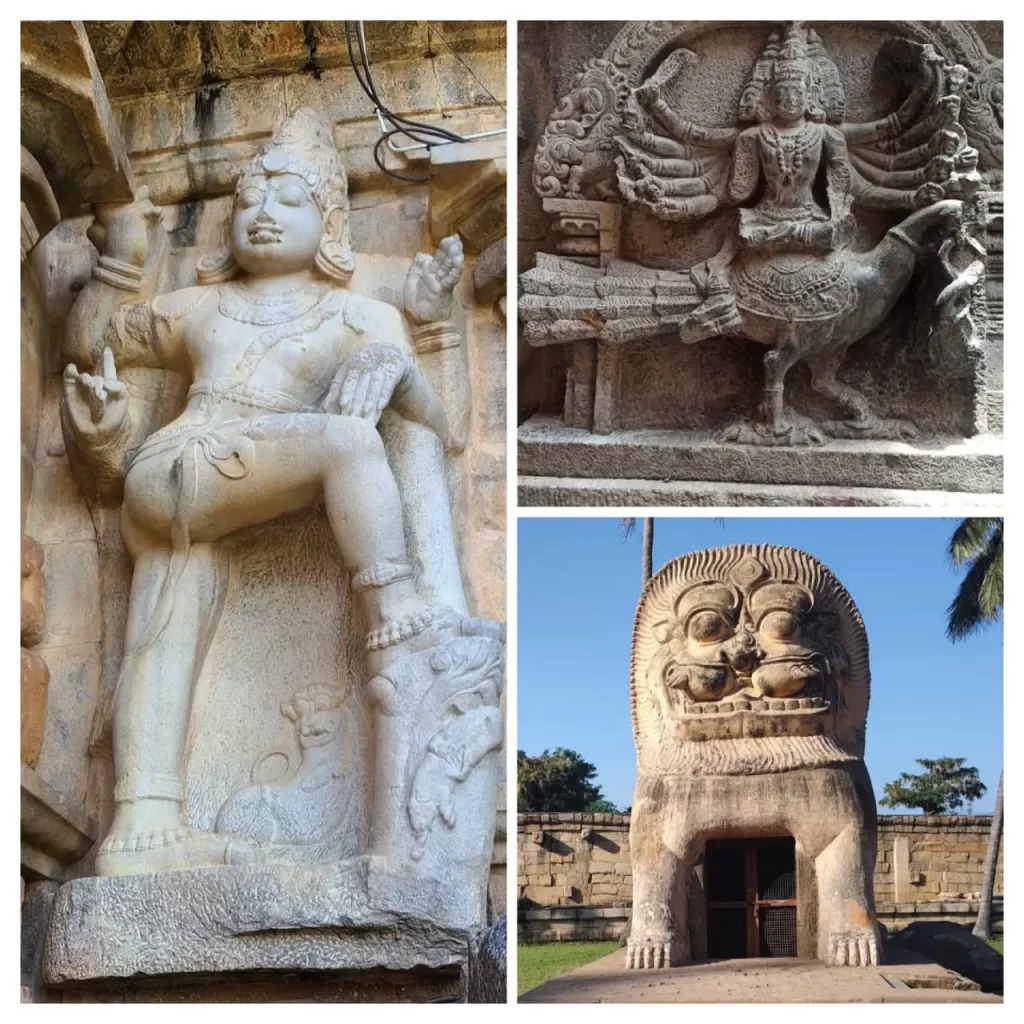
Wandering the periphery of the Gangaikonda Cholapuram Temple, you are drawn in by the mastery of the carvings that decorate its facade. These are not mere ornamental details; they are elaborate stories, set in stone, recounting mythological stories, heavenly forms, and vignettes of life in the Chola era.
Along the sanctum walls, you’ll find roughly fifty sculptural reliefs, every one a work of art. Some of the most striking and awe-inspiring are:
- Nataraja: The celestial dancer, Lord Shiva in his classical dance stance, representing the universe’s creation, preservation, and destruction. The relief of Nataraja here is especially kinetic, conveying the spirit of movement and divine power.
- Saraswati: The goddess of arts, music, and wisdom, usually represented carrying a Veena (a stringed instrument). Her calm and gracious demeanor enriches the temple’s richness of art.
- Shiva garlanding a devotee: This beautiful sculpture is evidence of the individual devotion of the Chola monarchs. It shows Lord Shiva bestowing blessings on a devotee, whom many believe is Rajendra Chola I himself. This carving specifically speaks volumes about the king’s religiosity and his faith in the deity.
You will also see many other carvings showing several deities of the Hindu pantheon, supernatural beings, mythical beings, and scenes from Hindu epics and Puranas. The walls on either side of the side entrances are particularly full of intricate carvings showing scenes from Shaivite mythology, such as the legend of the saint Chandikeshwara, a very revered saint in this area and one who even has his own shrine inside the complex.
The accuracy and nuance of these sculptures are remarkable, indicative of the skillful artistiy of the Chola artisans. Each muscle, each expression, each piece of jewelry is carefully depicted, infusing these stone statues with a sense of life. They are a visual dictionary of Chola iconography and a deep insight into the religious and cultural precepts of the era. Spend time studying them properly; you’ll discover new observations with each look!
Myths and Beliefs: Reflections of the Past
Apart from the historical events and architectural wonders, the Gangaikonda Cholapuram Temple is full of a rich mesh of myths and beliefs that have been accumulated over the centuries. These myths and beliefs introduce an element of mysticism and enchantment into the temple and make it more than a worship site.
One of the common assumptions, as noted above, is that the slightly curved vimana of this temple, compared to the straight tower of the Thanjavur temple, was a deliberate choice by Rajendra Chola I. It is said he did so on purpose, making it more elegant and possibly shorter as a show of respect for his father’s work, not wanting to rudely surpass it. This says a lot about the filial piety and cultural sensitivities of the Chola period.
One other interesting belief is about the Simhakeni, a round well protected by a lion statue to the northeast of the vimana. It is said that Rajendra Chola I filled the pots of Ganges water which he had brought back from his campaign in the north into this well. This action established the temple’s association with the holy Ganges and gave a special sanctity to the water in the well.
Pilgrims usually take a few drops of this well, for they feel that it has the blessings of holy Ganga. There is also a local superstition that the stone called Chandrakanta, which is said to have been placed in the sanctum, possesses a special characteristic of keeping the space cool in summers and warm in winters.
Though scientifically impossible to prove, such beliefs contribute to the charm and sanctity of the temple in the minds of its devotees. A few of the older tales indicate that the huge power and magnificence of the Gangaikonda Cholapuram Temple were so intense that even local financial transactions in the past used to be done on occasion in the name of Chandikeshwara, a great saint of Lord Shiva and whose temple exists in the temple grounds.
This is indicative of the strong integration of the temple into the region’s daily lives and societal hierarchies. These myths and legends, historically authentic or not, are part of the Gangaikonda Cholapuram Temple experience. They are a reflection on the strength of belief, the human need to reach out to the divine, and how history and spirituality merge to make a truly singular and holy space.
Read More>> Chamundeshwari Temple Mysore: Architectural Marvel & Spiritual Wonder
Gangaikonda Cholapuram Temple Timings: Plan Your Visit
In order to have a peaceful and enjoyable trip to the Gangaikonda Cholapuram Temple, it is essential to be aware of the temple timings.
The temple tends to open early in the morning and close for a short while in the afternoon before reopening. The following are the usual timings:
- Morning Hours: 6:00 AM to 12:00 PM (Noon)
- Evening Hours: 4:00 PM to 8:00 PM
Please be advised that these hours are subject to variation, particularly during festive festival days or public holidays. It is always best to verify them locally if you are going to plan your visit around these times.
As a helpful guide, I would recommend going early in the morning, shortly after opening. The light is stunning for photography, the temperature is generally agreeable, and you may find a more peaceful ambiance before the crowds arrive. Evenings around sunset are also very special with their magic glow to the ancient stone for a most unforgettable experience.
Places to Visit Near the Temple: Extend Your Spiritual Journey
While the Gangaikonda Cholapuram Temple is definitely the jewel, the surrounding area is full of history, natural landscapes, and other important Hindu attractions. If you have extra time, I highly suggest visiting these closeby places to complement your spiritual and cultural experience. Some of the highlights are as follows:
- Brihadeeswarar Temple, Thanjavur: This one is a must see, since it’s the older brother of the Gangaikonda Cholapuram Temple, constructed by the father of Rajendra Chola I, Raja Raja Chola I. A UNESCO World Heritage Site too, it lies around 70 kilometers southwest of Gangaikonda Cholapuram. Seeing both of them gives you an amazing comparative study of how Chola architecture evolved. It’s commonly referred to as the “Big Temple” and for good reasons – its magnificence is simply awe-inspiring.
- Airavatesvara Temple, Darasuram: Another World Heritage Site and one of the “Great Living Chola Temples,” this temple, constructed by Rajaraja Chola II (later Chola king), is famous for its delicate and fine carvings, especially its musical steps. It’s roughly 35-40 kilometers from Gangaikonda Cholapuram. This temple elegantly complements the other two grand ones, highlighting the more artistic finer points of Chola art.
- Chidambaram Nataraja Temple: Situated around 45-50 kilometers to the east, this ancient temple is among India’s most important Shiva temples, one of the revered Pancha Bootha Sthalams (symbolizing the element of Akash or Space). It’s a temple for the Lord Nataraja, the cosmic dancer, and a happening hub of Shaivism. The architecture and the spiritual energy here are the very best.
- Poompuhar (Kavery Poompattinam): For whoever is interested in ancient port towns and naval history, Poompuhar, roughly 80-90 kilometers inland along the coast, was a great Chola port. Not a temple, it is still an interesting site to visit because of its historical value and its association with the Cholas’ maritime excellence.
- Gopal Pond and Rajendra Cholan Palace Ruins: In Gangaikonda Cholapuram itself, you can see the ruins of Rajendra Chola’s palace and the Gopal Pond that would have been a part of the royal complex. Not much of the palace survives, but a walk through the space helps you imagine the scale of the ancient capital.
- Karaivetti Birds Sanctuary: For the nature enthusiast, this bird sanctuary is a nice deviation, particularly in migratory seasons. It’s not very distant from Gangaikonda Cholapuram and provides a peaceful natural atmosphere.
Visiting these sites will provide you with an extensive insight into the architectural splendor, spiritual richness, and historical significance of the Chola period. Each destination provides a different viewpoint and another dimension to your appreciation for this captivating region.

Accommodation Options: Where to Rest Your Head
Though Gangaikonda Cholapuram itself is a comparatively small town, there are numerous accommodation options in close-by towns and cities to suit various budgets and tastes. You will not find big luxury hotels right at the temple but have reasonable options within easy driving distance. Below are some popular towns and accommodation types to look into:
Jayankondam: This is the nearest bigger town to Gangaikonda Cholapuram, and it’s only a few kilometers away. You’ll see some low-budget guesthouses and small hotels. They have simple facilities, good enough for a short term stay.
Kumbakonam: About 35-40 kilometers from the temple, Kumbakonam is a bigger and busier temple town, famous for its many ancient temples. It has a greater variety of accommodation from economical lodges to mid-range hotels and even some heritage-style hotels. This is a useful base if you are planning to visit several temples in the area, such as Darasuram and Thanjavur.
Examples: Lilac Kumbakonam, Mantra Koodam – CGH Earth (a higher-end heritage choice), Vinayaga by Poppys Kumbakonam.
Thanjavur (Tanjore): Approximately 70 kilometers from here, Thanjavur is a busy city with plenty of hotels from budget to deluxe. If you want comfort, a greater variety of restaurants, and are not concerned about the drive, staying in Thanjavur is a viable alternative, particularly if you intend to make several visits to the Brihadeeswarar Temple or tour the city’s other sights.
Examples: Sangam Hotel Thanjavur, Hotel Abis Grand, Grand Ashok.
Tiruchirappalli (Trichy): About 110-115 kilometers from Gangaikonda Cholapuram, Trichy is a main city with an international airport and the largest selection of accommodation options, ranging from chain hotels. If you’re flying in to Trichy and intend to see a larger area of Tamil Nadu, it might be used as a base, but it’s a bit further to commute to the temple.
Tips for Choosing Accommodation:
Budget: Pre-determine your budget. Guesthouses at Jayankondam will be the most budget-friendly.
Proximity vs. Amenities: Think about whether you would like to be extremely close to the temple (Jayankondam) or be a bit farther away but have more facilities and restaurants (Kumbakonam or Thanjavur).
Booking in Advance: Particularly in the peak season or during festival seasons, it would be a good idea to book your accommodation well in advance.
Reviews: Always read online reviews prior to booking to see if the quality and services are what you expect.
Although an overnight stay from Thanjavur or Kumbakonam is typical, staying nearer in Jayankondam could provide you a more immersive experience of rural life near the historical site.
How to Reach the Temple: Your Travel Guide
Accessing the Gangaikonda Cholapuram Temple is not a big deal, whether by flight, train, or car. Below is how you can go about it:
By Air:
- Nearest Airport: The nearest major airport is Tiruchirappalli International Airport (TRZ), but commonly known as Trichy Airport. It is about 110-115 kilometers southwest of Gangaikonda Cholapuram.
- From Airport: You can drive down from Trichy in a taxi or bus to Gangaikonda Cholapuram. The journey takes around 2.5 to 3 hours depending on the traffic and road.
By Train:
- Nearest Convenient Railway Station: The closest railway station is Kutralam Junction (KTM), just 19 kilometers away. However, it may not be directly connected to all the major cities.
- Major Railway Stations: More convenient and better-connected railway stations are:
- Kumbakonam (KMU): About 35-40 km from the temple. Kumbakonam is a key rail junction with frequent and good rail connectivity to Chennai, Bangalore, Madurai, and other important cities of South India.
- Thanjavur Junction (TJ): About 70 km from the temple, also well connected to major cities.
- Ariyalur (AII): This is the district headquarters and possesses a railway station, roughly 30 kilometers from the temple.
From the Station: After reaching any one of these railway stations, you can easily take a taxi, auto-rickshaw (if you reach from nearer stations like Kumbakonam or Ariyalur), or a local bus to Gangaikonda Cholapuram.
By Road:
- Bus Services: Tamil Nadu has a good fleet of state-owned buses. Direct buses to Jayankondam (the local town) or even to Gangaikonda Cholapuram itself are available from large cities such as Chennai, Trichy, Thanjavur, and Kumbakonam. Bus journeys are often the cheapest way.
- Private Taxis/Cabs: Taking a private taxi or cab is the most convenient and flexible option to travel to the temple, if you’re going with family or don’t want a roundabout journey. Taxis are available for hire from any major Tamil Nadu city.
- Self-Drive: If you enjoy driving, you can rent a car and drive to the temple. The roads in Tamil Nadu are generally well-maintained, and the route to Gangaikonda Cholapuram is scenic.
Distances from major cities:
- From Chennai: Approximately 270-280 kilometers (around 5-6 hours drive).
- From Bangalore: Around 400 kilometers (about 7-8 hours journey).
- From Madurai: Around 200 kilometers (about 4-5 hours journey).
Local Transport within Gangaikonda Cholapuram:
When you arrive at the village, the Gangaikonda Cholapuram Temple is central and easy to find. You may walk within the temple grounds, and if you prefer to travel to other nearby locations, auto-rickshaws are available.
Regardless of the way you go, your journey to the Gangaikonda Cholapuram Temple is part of the experience that takes you to one of India’s most remarkable historical and spiritual destinations.
Read More>> Bhojpur Shiva Temple | Bhojeshwar Temple Holds Huge Lingam
Trending Questions regarding Gangaikonda Cholapuram Temple
Being a tour guide, I tend to receive different questions regarding this world-class temple. Below are some of the most trending questions and their respective answers, to educate you further on the Gangaikonda Cholapuram Temple:
Is Gangaikonda Cholapuram Temple a UNESCO World Heritage Site?
Yes, indeed! Gangaikonda Cholapuram Temple was inscribed as a UNESCO World Heritage Site in 2004, as part of the Brihadeeswarar Temple at Thanjavur and the Airavatesvara Temple at Darasuram. Collectively, they are referred to as the “Great Living Chola Temples,” a testament to their exceptional universal value.
What is unique about Gangaikonda Cholapuram Temple?
There are many things that make this temple unique! Its curvilinear vimana (tower), unlike the Thanjavur temple, which is less imposing and more beautiful, is a distinguishing feature. It becomes historically important due to the fact that it was constructed by Rajendra Chola I to celebrate his triumph over the Ganga territory and as the Chola capital for more than two centuries.
The huge Shiva Lingam, the clever reflection of sunlight off the Nandi into the sanctum, and the stunning Chola bronzes and carvings are all simply extraordinary. It’s rated as a peak of Chola architecture and sculpture.
Why was Gangaikonda Cholapuram constructed?
The city of Gangaikonda Cholapuram and its magnificent temple were constructed by Rajendra Chola I to celebrate his successful military campaign to the Gangetic plains. He returned with holy water from the Ganges and used it to consecrate the Shiva Lingam in the temple, representing his victory and creating a new capital that would symbolize the might and religious influence of the Chola Empire. It was a deliberate action to relocate the capital and a pompous declaration of his imperial power and piety.
Is the Gangaikonda Cholapuram Temple larger than the Thanjavur Temple?
No, the Gangaikonda Cholapuram Temple is somewhat smaller than the Brihadeeswarar Temple at Thanjavur, specifically its vimana. The Thanjavur vimana is higher. But most art historians and travelers find the Gangaikonda Cholapuram Temple more refined, more elegant, and more artistically elaborate in its details and proportions, commonly dubbed the “feminine counterpart” to Thanjavur’s more “masculine” grandiosity.
Who is the central deity of Gangaikonda Cholapuram Temple?
Lord Shiva is the central deity of the Gangaikonda Cholapuram Temple, worshipped in the form of Brihadeeswarar, similar to the Thanjavur temple. The huge Shiva Lingam in the sanctum is the main object of worship.
Are there other significant structures within the Gangaikonda Cholapuram Temple compound?
Yes, apart from the central shrine, there are a few minor shrines within the complex, such as that of Chandikeshwara, a saint and devotee of Shiva worshipped by many. Remains of other buildings like the gopuras (gateway towers) and the mandapas also exist, although some are lost or damaged today. The pavilion of Nandi and the Simhakeni well are also notable features.
How long do I require to visit the Gangaikonda Cholapuram Temple?
In order to fully enjoy the architecture, carvings, and absorb the ambiance, I suggest you allocate a minimum of 2 to 3 hours for visiting. If you’re history- or art-conscious, you may need even more time to sit back and absorb the finer details.
Is there an entry fee for the temple?
No, as a living temple, there is typically no entry fee for the Gangaikonda Cholapuram Temple. However, there might be small charges for specific services like parking or for cameras in certain areas, though these are usually minimal.
Is it necessary to dress traditionally when visiting?
Although there’s no formal dress code imposed on visitors, it’s only polite to dress sensibly when attending any Hindu temple. This typically involves covering your shoulders and knees. Traditional Indian dress is always a welcome sight but not a requirement.
These are the very questions that reflect people’s general interest in this grand site, and I hope these responses add depth to your knowledge and appreciation of the Gangaikonda Cholapuram Temple.
Conclusion: A Timeless Masterpiece
As we end our virtual tour of the Gangaikonda Cholapuram Temple, I should like to believe that you’ve developed a profound appreciation for this phenomenal monument. It is not merely an assemblage of ancient stones; it is a rich tapestry embroidered with history, art, spirituality, and human initiative.
From its magnificent but elegant vimana to its finely carved stories, each aspect of the Gangaikonda Cholapuram Temple speaks of a glorious history, of a mighty empire, and of a king’s deep devotion. It is a taciturn sentinel, silently witnessing centuries of human devotion and artistic mastery. The Gangaikonda Cholapuram Temple is literally a gem in the crown of Indian heritage, a site where you will experience the vibrations of a thousand years and feel connected to a tradition that still inspires.
So, book your next trip and don’t forget to include this great site in your travel plans. You will not merely be going to a temple; you’ll be entering into a living work of history, a site that truly represents the essence of Chola splendor and religious profundity. It’s an experience that will linger with you long after you depart its holy grounds.