Ahobilam Temple: Complete Guide to Nava Narasimha Shrines, History, Trekking & Timings
Deep in the green, winding ranges of the Nallamala Hills in Andhra Pradesh lies Ahobilam, one of the most sacred pilgrimage sites in India. Ahobilam is celebrated as the holy place where Lord Vishnu took the fierce and loving form of Lord Narasimha—half-lion and half-man—to protect his young devotee, Prahlada, and defeat the demon king, Hiranyakashipu.
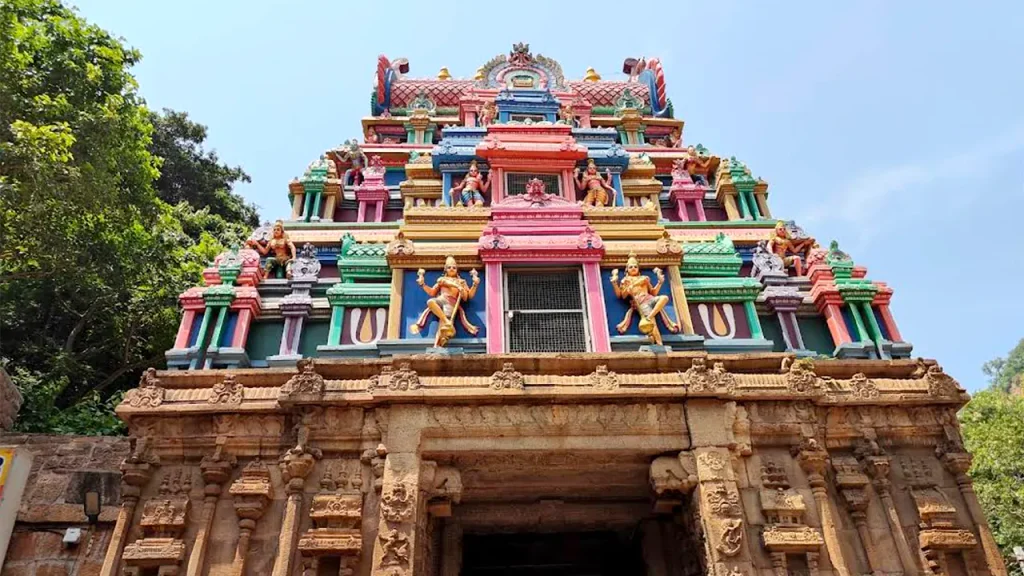
Ahobilam is unique because it is the only sacred spot on earth where devotees can worship all nine distinct forms of Lord Narasimha, known together as the Nava Narasimha. The shrines are spread across quiet forest trails, cool mountain caves, and grand stone courtyards. Whether you are a pilgrim seeking deep spiritual blessings, a lover of ancient stone carvings, or an adventurer ready to walk forest paths, Ahobilam offers an unforgettable journey into ancient Indian heritage.
Quick Information: Ahobilam Temple
| Feature | Details |
| Temple Name | Sri Ahobila Lakshmi Narasimha Swamy Temple |
| Main Deity | Lord Narasimha (Nine Sacred Forms / Nava Narasimha) |
| Consort | Goddess Lakshmi (Amrithavalli) & Goddess Chenchu Lakshmi |
| Location | Ahobilam, Allagadda Mandal, Nandyal District, Andhra Pradesh, India |
| Geographic Divisions | Lower Ahobilam (Diguva) & Upper Ahobilam (Eguva) – 8 km apart |
| Religious Classification | 97th Divya Desam (Singavel Kundram) of Sri Vaishnava tradition |
| Temple Administration | Sri Ahobila Math (Hereditary Trusteeship of the 46th Jeeyar) |
| Daily Darshan Timings | Lower Ahobilam: 6:30 AM to 1:00 PM, 3:30 PM to 8:30 PM Upper Ahobilam: 6:00 AM to 1:00 PM, 3:00 PM to 8:00 PM |
| Best Time to Visit | October to March (Pleasant weather for forest trekking) |
| Major Festivals | Brahmotsavam (February/March), Narasimha Jayanti (May), Swathi Nakshatra (Monthly) |
| Nearest Railway Station | Nandyal Railway Station (NDL) – ~66 km; Kondapuram – ~65 km |
| Nearest Airport | Kadapa Airport (CDP) – ~110 km; Rajiv Gandhi International Airport, Hyderabad (HYD) – ~360 km |
| Dress Code | Traditional Indian attire (Dhoti/Kurta for men; Saree/Salwar for women). Western casuals discouraged inside sanctums. |
| Trekking Difficulty | Easy (Lower shrines by road) to Challenging/Strenuous (Upper shrines, Jwala, and Ugra Stambham) |
| Official Administrative Site | Sri Ahobila Math |
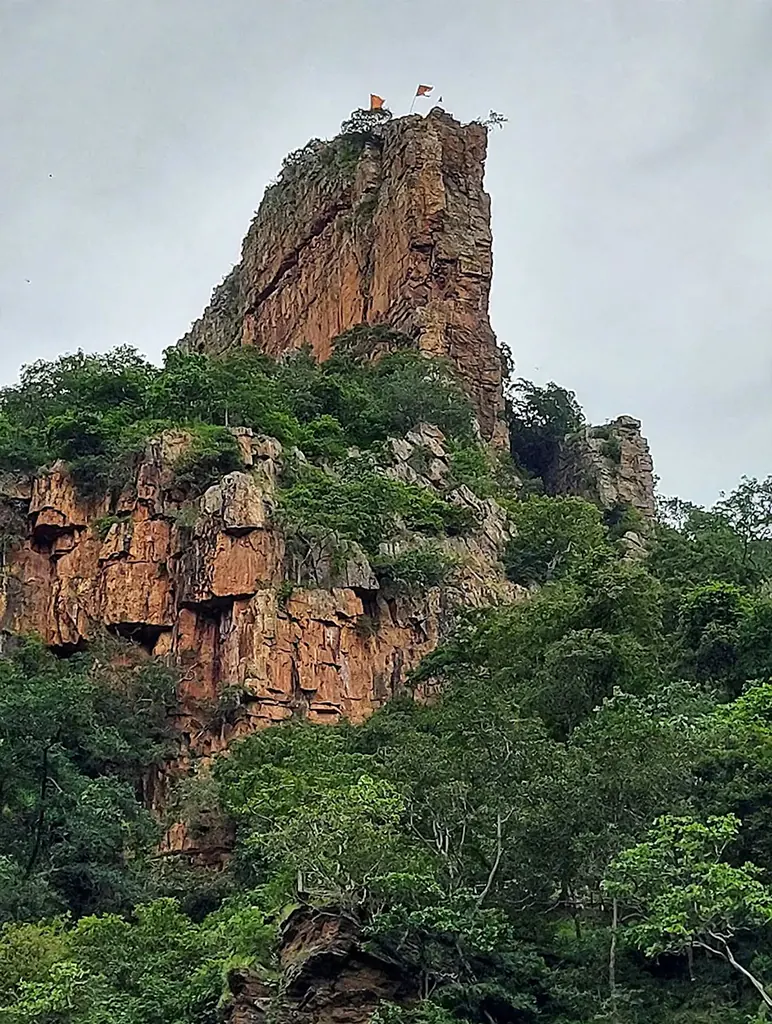
In Hindu belief, Lord Vishnu takes an avatar whenever the world needs protection from evil. His fourth avatar was Lord Narasimha. While other famous temples honor one form of this incarnation—such as the majestic Simhachalam Varaha Lakshmi Narasimha Temple on the northern coast of Andhra Pradesh—Ahobilam contains nine different forms located within a single sacred landscape.
The sacred hills of Ahobilam form part of the Eastern Ghats. Traditional scriptures say that the entire Nallamala range represents Adisesha, the cosmic serpent upon whom Lord Vishnu rests. The great mountain chain is viewed as a living divine form:
- The head of Adisesha is at the sacred Tirupati Balaji Temple at Tirumala.
- The middle of the serpent’s body is at Ahobilam.
- The tail of Adisesha rests at the holy Jyotirlinga town of Srisailam.
Ahobilam is counted as the 97th Divya Desam, one of the 108 most revered Vishnu temples praised by the Tamil poet-saints called the Alvars. Over a thousand years ago, Thirumangai Alvar sang devotional verses praising this place as Singavel Kundram, describing it as a majestic, cloud-capped mountain forest where only true devotion can guide a traveler through the thick woods.
Continue Reading >> Gudimallam Parashurameshwara Swamy Temple: History, Oldest Shiva Lingam, Timings & How to Reach
The Sacred Legend (Sthala Purana) of Ahobilam
The story of Ahobilam begins in the ancient Satya Yuga. The demon king Hiranyakashipu gained a powerful boon from Lord Brahma: he could not be killed by man or animal, neither indoors nor outdoors, neither during the day nor at night, neither on earth nor in the sky, and by no weapon made by hands.
Blinded by pride, the king demanded that everyone worship him as God. But his own young son, Prahlada, remained a steadfast devotee of Lord Narayana. Angered by the boy’s unwavering faith, Hiranyakashipu pointed to a stone pillar in his palace hall and demanded: “Is your God in this pillar?”
Prahlada calmly replied that the Lord lives everywhere, from the highest heavens to the smallest particle of dust.
In a fury, the king struck the stone pillar with his iron mace. With a sound that shook the earth and sky, the pillar split apart. Lord Vishnu sprang forth in an awe-inspiring form—neither fully man nor animal, bearing the head of a lion and the body of a man.
He caught the demon king at twilight (neither day nor night), carried him to the doorway threshold (neither inside nor outside), placed him upon his lap (neither earth nor sky), and tore him apart with his sharp claws (using no weapon). In doing so, the Lord kept every condition of Brahma’s boon while protecting his child devotee.
When the devas (heavenly beings) looked down and saw this divine power, they shouted with joy:
“Aho Veeryam! Aho Shauryam! Aho Bahu Parakramam! Narasimham Param Daivam Ahobilam! Ahobalam!”
(Oh, what courage! Oh, what supreme valor! Oh, what mighty strength! Lord Narasimha is the ultimate God! What a wondrous cave! What infinite power!)
Because the devas proclaimed “Aho-Balam” (Oh, what great strength) and “Aho-Bilam” (Oh, what a wondrous cave), the sacred land became known forever as Ahobilam.
Continue Reading >> Sri Prasanna Ganapati Temple, Koramangala: Darshan Timings, Sevas, and Visitor Guide
The Legend of Chenchu Lakshmi
According to local tradition, after defeating Hiranyakashipu, the Lord’s anger remained white-hot. He walked through the dense forests of the Nallamala hills. To bring peace to his heart, the local forest tribe known as the Chenchus prayed for him. Goddess Lakshmi took birth among them as a gentle tribal princess named Chenchu Lakshmi.
When the Lord met her in the jungle, his fierce anger melted into deep peace and love. Even today, the Chenchu people consider Lord Narasimha as their divine son-in-law (Obulesu), and devotees offer special prayers to Chenchu Lakshmi alongside Lord Narasimha.
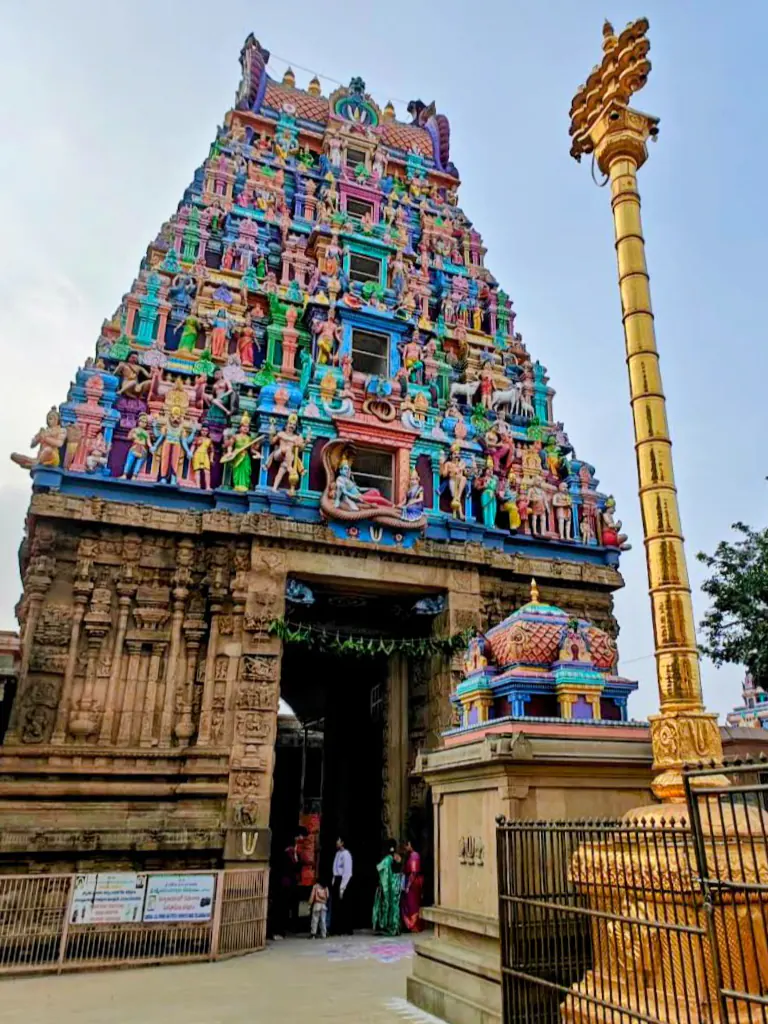
Understanding Upper Ahobilam vs. Lower Ahobilam
Before you begin your pilgrimage, you must understand how the town is laid out. Ahobilam is divided into two distinct areas located 8 kilometers apart:
1. Lower Ahobilam (Diguva Ahobilam)
Lower Ahobilam is situated on flat land at the base of the hills. This is where most buses, private taxis, and pilgrims arrive first. It houses:
- The large, grand temple of Sri Prahlada Varada Lakshmi Narasimha Swamy.
- The main administrative offices, guest houses, and dining halls operated by the historic Sri Ahobila Math.
- Smooth paved roads leading to three of the nine Narasimha temples: Bhargava, Yogananda, and Chatravata.
Lower Ahobilam is peaceful and easy to walk around. It has broad stone courtyards, high temple towers (gopurams), and comfortable facilities for visiting families.
2. Upper Ahobilam (Eguva Ahobilam)
Upper Ahobilam sits higher in the hills, surrounded by thick forest and steep rocky cliffs. A paved road allows cars, auto-rickshaws, and buses to travel the 8 km from Lower to Upper Ahobilam.
Once you reach Upper Ahobilam, modern roads end. To visit the sacred cave temples located here, you must walk along stone steps, earthen forest paths, and rocky mountain ledges. Upper Ahobilam is the spiritual heart of the pilgrimage, housing the original cave where the Lord manifested, along with the starting points for the mountain treks.
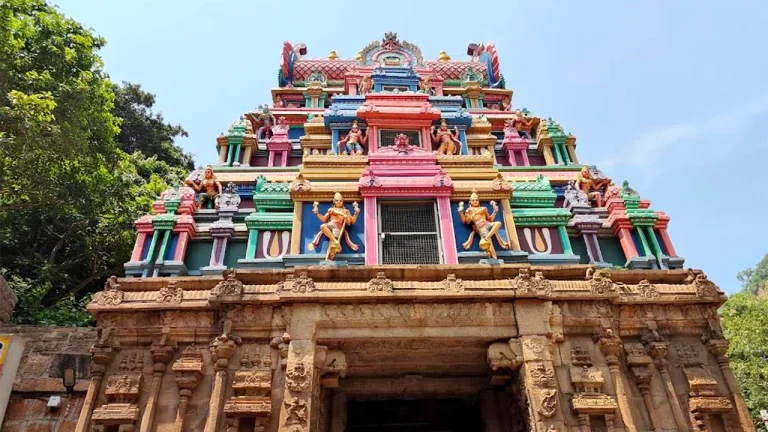
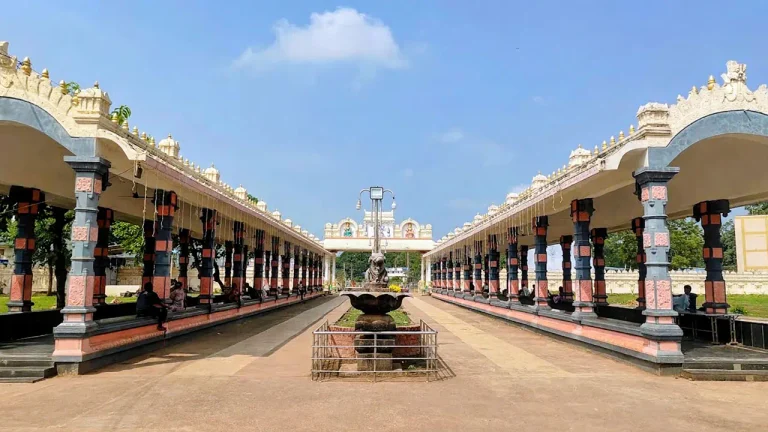
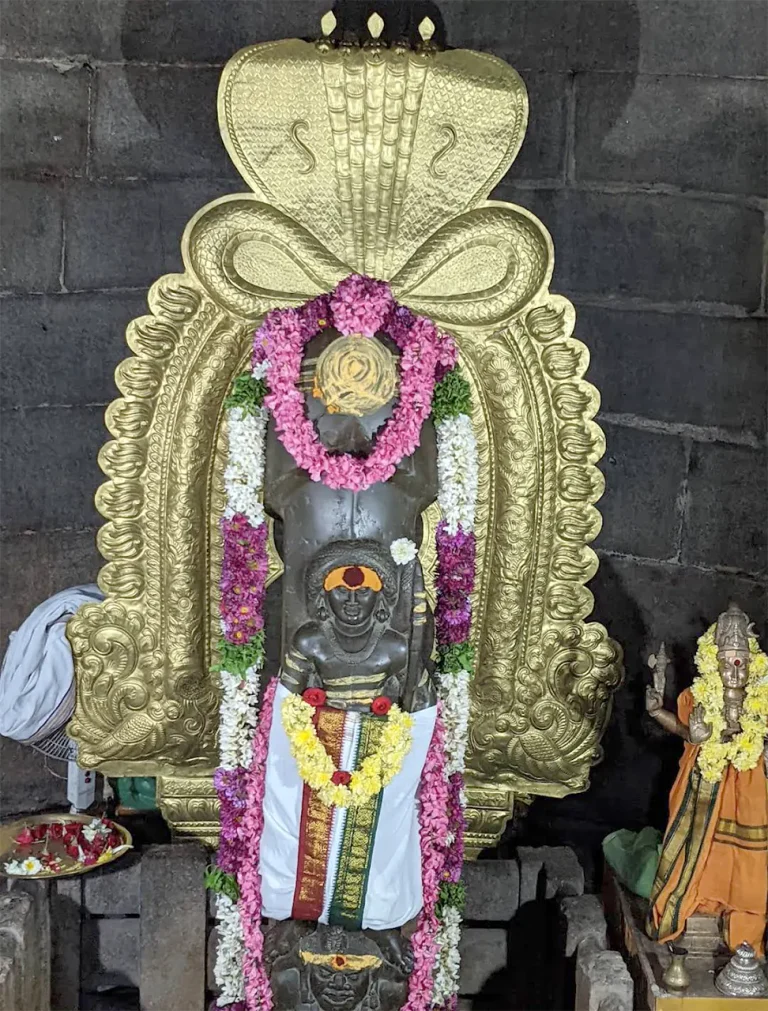
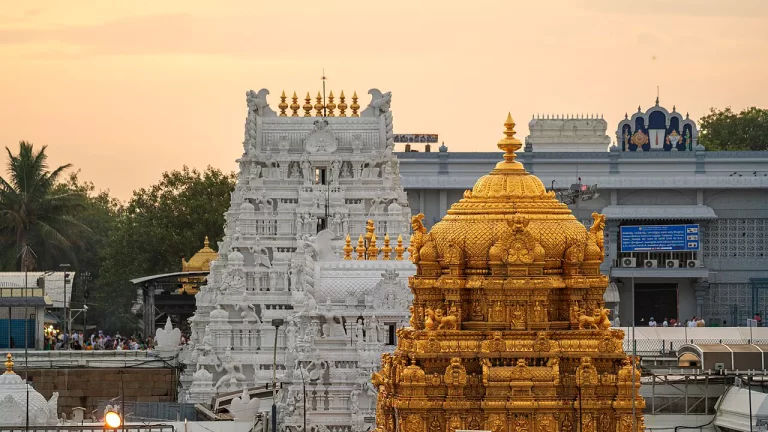
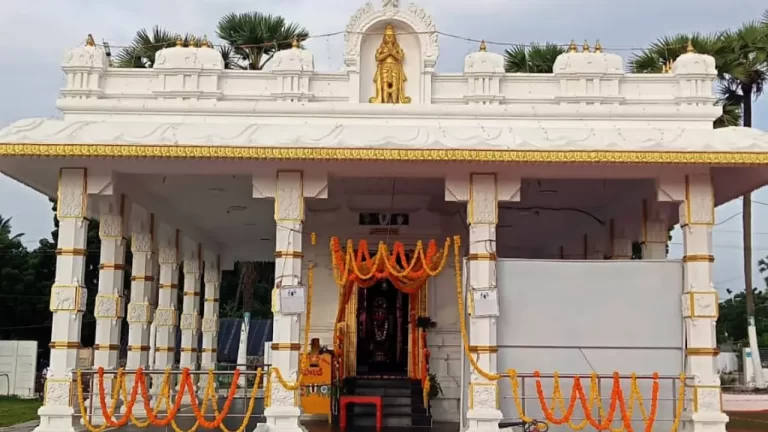

Every visitor comes to Ahobilam to receive the grace of the nine forms of the Lord. Here is the complete breakdown of every shrine, including what makes it sacred and how to reach it.
1. Sri Ahobila Narasimha Swamy (Upper Ahobilam)
- Location: Upper Ahobilam (end of the main road).
- Physical Access: Easy; just a few steps from the vehicle parking ground.
- Significance: This is the primary temple of Upper Ahobilam and the oldest among all nine shrines. The sanctum sanctorum is built inside a natural rock cavern. Here, the deity is Svayambhu (self-manifested from the rock). The Lord appears in his fierce Ugra form, seated in deep majesty. Next to him is a small, revered idol of his young devotee, Prahlada.
2. Sri Krodha (Varaha) Narasimha Swamy
- Location: Approximately 1 km walk from the main Upper Ahobilam temple.
- Physical Access: Moderate walk along a stone-paved riverside path.
- Significance: In this unique shrine, the Lord has the face of a boar (Varaha) and the body of a lion-man. He is shown holding Mother Earth (Bhudevi) gently with his tusks. Worshiping here is believed to heal past family karma, cure physical illness, and bring peace to the mind.
3. Sri Malola Narasimha Swamy
- Location: Situated on a scenic hill terrace, about 2 km from Upper Ahobilam.
- Physical Access: Moderate hike up well-laid stone steps.
- Significance: The word Malola comes from two words: Maa (Goddess Lakshmi) and Lola (beloved). Unlike his fierce forms, here Lord Narasimha appears completely calm, graceful, and peaceful (Shantha Swaroopa). Mother Lakshmi sits lovingly upon his left lap. This peaceful deity holds a special place in the hearts of devotees, representing protection, wealth, and spiritual wisdom.
4. Sri Jwala Narasimha Swamy
- Location: Perched high on the mountain cliff of Achalachaya Meru, beyond Malola Narasimha.
- Physical Access: Challenging. Requires climbing rough stone steps, crossing the flowing Bhavanashani stream, and walking along a narrow, railed rock ledge.
- Significance: This is the exact sacred spot where Lord Narasimha tore open Hiranyakashipu. The deity here has eight arms, showing the Lord destroying the demon king across his lap. Nearby is the Rakta Kunda, a natural mountain pool. Legend tells us that the Lord washed his blood-stained hands here after the battle, turning the water red. The atmosphere here is quiet, sacred, and filled with spiritual energy.
Continue Reading >> Thiruporur Murugan Temple: The Unbathed Idol Mystery
5. Sri Pavana Narasimha Swamy
- Location: Deep within the forest hills near the Pavana River.
- Physical Access: Two options:
- A steep, 6-kilometer forest trek involving hundreds of stone steps up the mountain behind Upper Ahobilam.
- A bumpy 4-wheel-drive Jeep ride (about 25 km through rugged dirt forest trails from Lower Ahobilam).
- Significance: Pavana means pure. Sage Bharadwaja performed deep penance here to wash away ancient sins. The Lord sits gracefully with Goddess Lakshmi by his side. It is believed that worshiping Pavana Narasimha cleanses the heart of all past misdeeds. Because of the rugged jeep ride, visiting this temple is an exciting adventure for pilgrims.
6. Sri Karanja Narasimha Swamy
- Location: Situated midway between Lower and Upper Ahobilam, right along the main road.
- Physical Access: Very easy; located directly beside the road with zero trekking.
- Significance: The deity is installed beneath the shade of a sacred Karanja tree (Indian Beech). According to scripture, Lord Hanuman did penance here. Because Hanuman wanted to see his beloved Lord Rama, Lord Narasimha appeared before him holding a bow and arrow along with his divine discus (Chakra). This is the only place in India where Lord Narasimha holds a bow!
7. Sri Bhargava Narasimha Swamy
- Location: About 2.5 km away from Lower Ahobilam, near a quiet forest lake.
- Physical Access: Reachable by auto-rickshaw or local jeep, followed by a short climb of roughly 130 stone steps.
- Significance: Legend says that Bhargava Rama (Lord Parashurama) performed intense penance at the bank of the holy pond called Akshaya Theertha to catch a direct vision of Lord Narasimha. Pleased with his devotion, the Lord appeared here in an impressive, four-armed form.
8. Sri Yogananda Narasimha Swamy
- Location: Roughly 3 km southeast of Lower Ahobilam.
- Physical Access: Fully accessible by car, auto-rickshaw, or paved road.
- Significance: After defeating Hiranyakashipu, the Lord taught Prahlada the sacred secrets of yoga postures and meditation. Here, Lord Narasimha sits in a peaceful meditative posture with his legs crossed in the yogic Padmasana stance, bound by a meditation band (Yogapatta). Students and spiritual seekers come here to pray for concentration, peace of mind, and inner wisdom.
9. Sri Chatravata Narasimha Swamy
- Location: Located about 3.5 km from Lower Ahobilam along a peaceful farm road.
- Physical Access: Easy; vehicles park right in front of the temple gate.
- Significance: The word Chatra means umbrella or canopy. The Lord is enshrined beneath the natural canopy of a sprawling banyan tree (Vata Vriksha). Two heavenly musicians, Haha and Huhu, sang beautiful melodies to please the Lord here. Because of this, Chatravata Narasimha has a gentle smile on his face and is known as a lover of classical music. Devotees often sing songs and chant hymns before this smiling deity.
The Challenging Treks: Ugra Stambham and Prahlada Mettu
For young pilgrims and adventure lovers, Ahobilam offers two famous mountain climbs that test both faith and physical stamina.
1. Ugra Stambham (The Pillar of Fury)
High above Jwala Narasimha, at the very summit of the mountain, stands a towering pillar-like rock outcropping known as Ugra Stambham. Devotees believe this mountain rock is the true physical remains of the stone pillar that burst open when Lord Vishnu appeared.
- The Trail: The climb starts from Jwala Narasimha. There are no built steps here; the path is an unpaved mountain trail over loose rocks, steep cliff edges, and exposed roots.
- The Final Climb: At the very top, hikers must pull themselves up a steep rock cleft using an iron handrail installed into the stone.
- Safety Warning: This trek is not recommended for young children, elderly visitors, or anyone with vertigo or knee problems. Wear sturdy trekking shoes with excellent grip. Avoid climbing this peak during heavy rains when the rock face becomes dangerously slippery.
2. Prahlada Mettu (Prahlada’s School)
Nestled on the cliff trail between Malola and Jwala Narasimha is a small rock cavern called Prahlada Mettu (or Prahlada Baddi). Tradition says this was the school where the demon children were taught by their teachers, and where Prahlada carved the holy name of Lord Narayana onto the cave walls. Inside the cool rock cleft, you can see ancient carving marks and receive blessings from a priest.
Continue Reading >> A Walk Through the Kumbalgodu Ayyappa Temple
Historical Origins and Royal Inscriptions
While Hindu tradition traces Ahobilam back to ancient spiritual eras, documented historical records show centuries of royal care and devotion:
- The Western Chalukyas and Kakatiyas: The earliest written stone inscriptions found in the region date back to the Chalukyas of Kalyani. Later, King Prataparudra of the Kakatiya dynasty made lavish donations to the shrine. Inscriptions note that the king gifted a sacred golden idol of Narasimha to the temple, amazed by its spiritual power.
- The Vijayanagara Golden Age: Ahobilam reached the height of its architectural beauty during the 15th and 16th centuries under the emperors of the Vijayanagara Empire. Emperor Sri Krishnadevaraya visited Ahobilam in the winter of 1515 CE after his military victories in the east. He made offerings of gold, jewels, and villages to support daily worship.
- The Foundation of Sri Ahobila Math: In the year 1398 CE, a young scholar named Srinivasacharya was instructed in a dream to go to Ahobilam. There, Lord Narasimha himself initiated him as a sanyasi, giving him the spiritual name Sri Adivan Sathakopa Swami. He founded Sri Ahobila Math, an illustrious Sri Vaishnava spiritual institution that has carefully managed, protected, and conducted rituals at Ahobilam for more than 600 years without interruption.
Continue Reading >> Marleshwar Temple: Mystery, Cobras, Waterfall & Cave Shrine
Temple Architecture and Sculptural Wonders
The architecture of Ahobilam reflects the brilliant stonework of South Indian artisans:
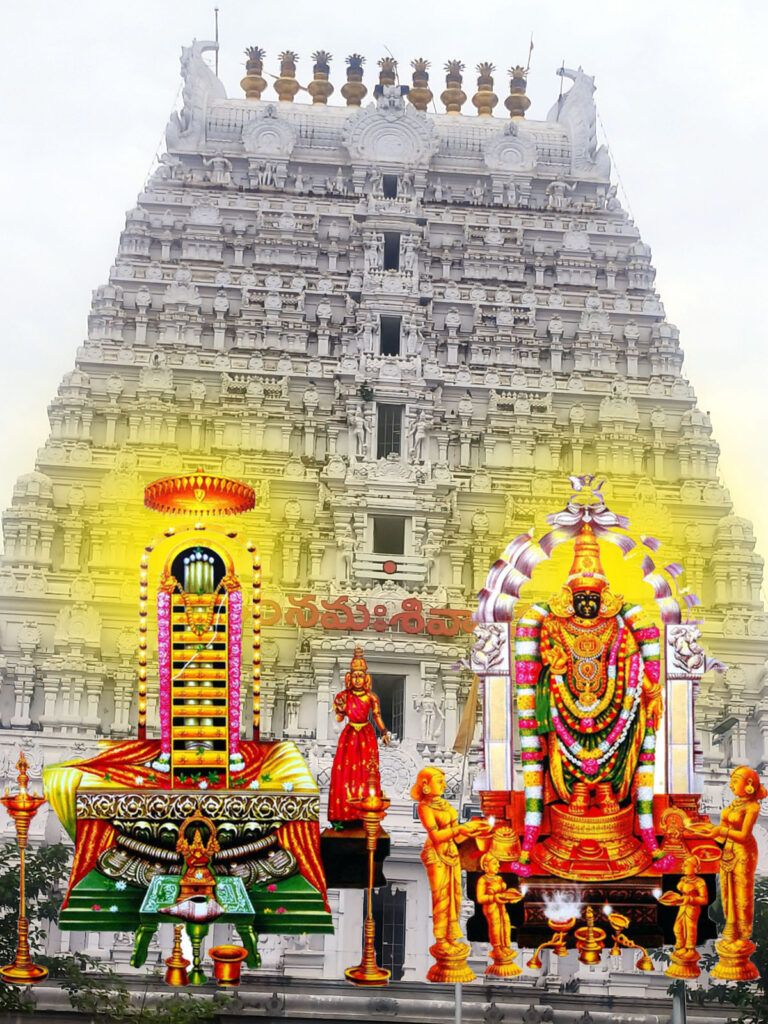
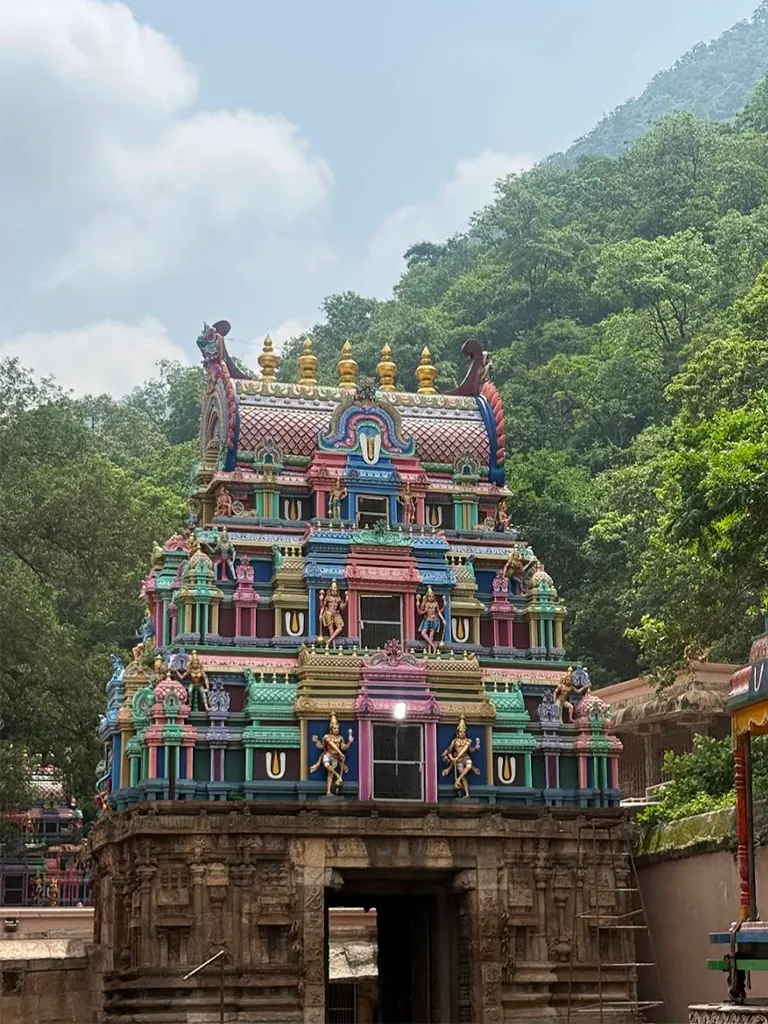
- Lower Ahobilam Temple Complex: Built in the classic Vijayanagara style, the main temple features a magnificent five-tiered entrance tower (Raja Gopuram). Inside, you walk into broad stone courtyards filled with dozens of carved pillars.
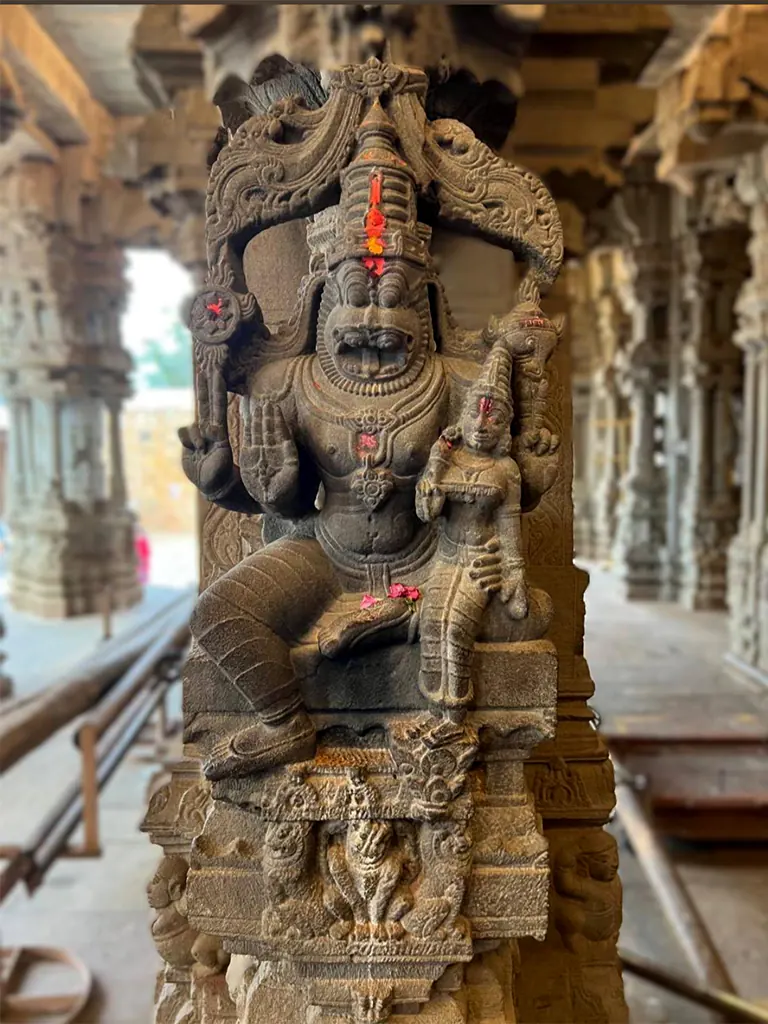
- The Kalyana Mandapam: This open stone hall in Lower Ahobilam is considered a masterpiece of stone architecture. Every pillar is carved from solid granite with depictions of rearing mythical lions (Yalis), riders on horseback, dancing maidens, and scenes from the Ramayana and Bhagavata Purana. If you tap certain slender stone columns in this hall, they produce clear, ringing musical tones!
- Cave Shrines of Upper Ahobilam: In contrast to the polished halls below, the upper shrines keep their ancient, wild character. The inner sanctums of Ahobilam Narasimha, Varaha, and Jwala are carved straight into the living rock of the mountain cliffs, making you feel as though you have stepped back thousands of years into a peaceful rishi’s hermitage.
Daily Darshan Timings and Pooja Schedules
Because several temples are located inside forest areas, opening times follow nature’s daylight hours closely.
Lower Ahobilam Temples
- Morning Darshan: 6:30 AM to 1:00 PM
- Evening Darshan: 3:30 PM to 8:30 PM
- (Note: Bhargava, Yogananda, and Chatravata temples generally close by 6:00 PM or 6:30 PM as dusk falls.)
Upper Ahobilam Temples
- Main Cave Temple: 6:00 AM to 1:00 PM and 3:00 PM to 8:00 PM.
- Forest Cave Shrines (Jwala, Malola, Varaha): 7:00 AM to 4:00 PM / 5:00 PM.
- Pavana Narasimha: 8:00 AM to 4:00 PM.
Important Travel Note: The forest pathways leading to Jwala Narasimha and the trail to Pavana Narasimha are locked or closed by forest guards by 4:30 PM or 5:00 PM. Wild animals, including leopards and sloth bears, live in the Nallamala forest reserve. Never remain on the upper mountain paths after sunset. Always return to the base camp before nightfall.
Continue Reading >> Badami Cave Temples: 6CE India’s Ultimate Ancient Adventure
Major Festivals at Ahobilam
Visiting during a temple festival brings the holy town to life with music, processions, and vibrant devotion:
- Ahobila Brahmotsavam: Celebrated during the Telugu month of Phalguna (usually February or March), this is the biggest festival of the year. It lasts for 10 joyous days. The divine wedding (Kalyanotsavam) of Lord Narasimha with Goddess Lakshmi and Chenchu Lakshmi is performed with grand celebration, drawing thousands of pilgrims from across India.
- Narasimha Jayanti: Celebrated in the month of Vaisakha (May), this festival marks the sacred appearance day of Lord Narasimha. Special milk and herbal water ceremonies (Maha Abhishekam) take place in all nine shrines simultaneously.
- Monthly Swathi Nakshatra: The birth star (nakshatra) of Lord Narasimha is Swathi. Every month on this day, the temple priests perform special fire rituals (homams) and sacred bathing ceremonies for the deities.
How to Reach Ahobilam: Air, Rail, and Road Routes
Ahobilam is located in the Nandyal District of Andhra Pradesh. The nearby town of Allagadda (24 km away) serves as the primary gateway for buses and highway travelers.
1. By Air
- Kadapa Airport (CDP): Located roughly 110 km away. It has regional flights connecting to Bengaluru and Chennai.
- Rajiv Gandhi International Airport, Hyderabad (HYD): Located about 360 km away. Hyderabad has major domestic and international flights. From the airport, you can drive to Ahobilam via the smooth NH 44 highway in about 6 to 7 hours.
- Tirupati Airport (TIR): Located roughly 230 km away, making it a great option if you plan to visit Tirupati Balaji along the same route.
2. By Train
- Nandyal Railway Station (NDL): The closest major railhead, located 66 km away. It is well connected to cities like Vijayawada, Guntur, Bengaluru, and Hyderabad.
- Kondapuram (KDC): Situated about 65 km away on the Guntakal-Chennai line.
- From either railway station, you can take a state transport bus or taxi to Allagadda, and then proceed onward to Ahobilam.
3. By Road and Bus
- The roads leading to Ahobilam are well-maintained. Government buses operated by the Andhra Pradesh Tourism Development Corporation and APSRTC run regular services from major cities like Kurnool, Tirupati, Kadapa, and Hyderabad to Allagadda.
- Frequent local shuttle buses, auto-rickshaws, and private cabs connect Allagadda to Lower Ahobilam every 30 to 45 minutes.
Accommodation, Food, and Pilgrim Facilities
Because Ahobilam is a quiet forest village rather than a bustling commercial city, planning your stay in advance is essential.
Where to Stay
- Sri Ahobila Math Guest Houses: The math operates several large pilgrim guest houses (Malola Nilayam, Bhashyakar Sannidhi) in Lower Ahobilam. Rooms are simple, clean, and budget-friendly. Both AC and non-AC rooms are available. Bookings can be made directly at the temple office upon arrival or requested via the Sri Ahobila Math Official Portal.
- AP Tourism Haritha Hotel: Located in Lower Ahobilam, this state-run facility offers comfortable rooms, secure parking, and an on-site vegetarian restaurant.
- Private Lodges in Allagadda: If rooms in Ahobilam are fully booked during peak festival weekends, comfortable hotels and lodges are readily available in Allagadda (24 km away).
Food and Annadanam
- Temple Annadanam: Free, wholesome vegetarian lunch is served daily to visiting pilgrims at the Sri Ahobila Math Annadana Hall in Lower Ahobilam.
- Local Eateries: A few modest South Indian vegetarian canteens and mess halls in Lower Ahobilam serve hot idlis, dosas, and traditional Andhra meals. Food options in Upper Ahobilam are very limited, so always eat your meals in Lower Ahobilam before starting your trek.
A visit to Ahobilam requires both devotion and practical preparation. Follow these simple tips to make your journey safe and enjoyable:
- Hire a Local Guide for Upper Shrines: While temples like Ahobila Narasimha and Karanja are easy to find, reaching Jwala Narasimha, Ugra Stambham, and Pavana requires navigating forest tracks. Hiring an authorized local guide from the Lower Ahobilam taxi stand provides valuable trail guidance and helps keep local families employed.
- Arrange a 4WD Jeep for Pavana Narasimha: The dirt track to Pavana Narasimha is filled with river boulders and deep ruts. Standard passenger cars cannot travel this road. Book an authorized 4-wheel-drive Jeep at Lower Ahobilam early in the morning.
- Doli (Palanquin) Facilities for Seniors: For elderly pilgrims or devotees who cannot climb steep stairs, local workers operate dolis (wooden chairs carried by two or four men). You can hire them at Upper Ahobilam to visit Varaha, Malola, and Jwala temples.
- Beware of Forest Monkeys: The hills are home to hundreds of playful wild macaques. Never hold plastic bags, bananas, or open food items in your hands while walking on the trails. Keep all phones, spectacles, and bags zipped securely inside a backpack.
- Carry Cash and Water: Digital payment connectivity can be unreliable in the hills due to limited mobile network coverage. Carry enough cash for temple poojas, auto fares, and guide tips. Always carry a reusable water bottle to stay hydrated during your hike.
- Dress Modestly: Ahobilam is an orthodox pilgrimage center. Wear loose, comfortable traditional clothing. Avoid wearing shorts or sleeveless shirts when entering sanctum areas.
Nearby Sacred Temples to Visit
If you are planning an extended pilgrimage through Andhra Pradesh, you can easily combine your Ahobilam trip with these famous nearby spiritual centers:
- Mahanandi Temple: Located just 60 km from Ahobilam, this ancient Shiva temple is world-famous for its crystal-clear mineral spring water that flows year-round into natural temple bathing tanks.
- Srisailam Temple: Situated roughly 180 km away through the scenic Nallamala forest, this world-renowned shrine is one of the rare places that is both a Jyotirlinga and a Maha Shakti Peetha.
- Yaganti Uma Maheshwara Swamy Temple: Located about 85 km from Ahobilam, this famous temple is known for its growing Nandi stone bull statue and natural cave shrines.
- Mangalagiri Panakala Swamy Temple: Another ancient hill temple dedicated to Lord Narasimha, where the deity miraculously drinks sweet jaggery water offered by devotees.
Frequently Asked Questions (FAQs)
1. How many days are needed to visit all nine Narasimha temples in Ahobilam?
To visit all nine temples at a comfortable pace, you will need two full days. On Day 1, you can visit the road-accessible temples in Lower Ahobilam (Bhargava, Yogananda, Chatravata, Karanja) and take the 4WD jeep to Pavana Narasimha. On Day 2, you can dedicate the morning to hiking the mountain cave shrines of Upper Ahobilam (Ahobila, Varaha, Malola, Jwala, and Ugra Stambham).
2. Can elderly pilgrims visit the Nava Narasimha shrines?
Yes, but with planning. Four temples (Lower Ahobilam, Karanja, Yogananda, and Chatravata) have zero steps and can be reached directly by car. For the mountain cave temples in Upper Ahobilam, elderly devotees can hire local palanquin (doli) services. The trek to Ugra Stambham, however, should be avoided by seniors due to the steep rock climb.
3. Which is the best month to plan a trip to Ahobilam?
The best months to visit are from October to March. During these winter months, the weather is cool, pleasant, and ideal for walking the forest paths. Summers (April to June) are extremely hot, with temperatures often crossing 40°C (104°F).
4. Are private vehicles allowed up to Upper Ahobilam?
Yes. There is a well-paved, two-lane road connecting Lower Ahobilam to Upper Ahobilam (8 km). Cars, private vans, two-wheelers, and auto-rickshaws can easily drive up to the parking lot of the main Upper Ahobilam temple. From that point onward, travel is strictly on foot.
5. Is food easily available on the trekking paths?
No. There are only a few small stalls selling bottled water, fresh lime juice, and tender coconuts along the trail between Upper Ahobilam and Jwala Narasimha. You should have a wholesome breakfast in Lower Ahobilam and carry light snacks or fruits in your backpack.
6. Who manages the Ahobilam temple administration?
Ahobilam is managed by the historic Sri Ahobila Math, under the direct leadership of its revered pontiff, the 46th Jeeyar. The administration ensures that traditional Pancharatra Agama rituals and daily free meals (annadanam) are maintained according to ancient scripture.
Planning Your Ahobilam Yatra
A journey to Ahobilam is far more than an ordinary holiday; it is an uplifting spiritual adventure. Walking through the quiet paths of the Nallamala forest, listening to the gentle murmur of the holy Bhavanashani stream, and standing inside cool rock caves carved by nature and faith fills the mind with deep peace.
Whether you come to worship the miraculous nine forms of Lord Narasimha, marvel at the intricate stone pillars carved by Vijayanagara artists, or stand atop the mountain heights of Ugra Stambham, Ahobilam welcomes every traveler with open arms and timeless grace. Pack your walking shoes, carry a humble heart, and step into the sacred forest where faith conquered fear centuries ago.