Gudimallam Parashurameshwara Swamy Temple: History, Oldest Shiva Lingam, Timings & How to Reach
Gudimallam Parashurameshwara Swamy Temple is an ancient Hindu temple dedicated to Lord Shiva in Gudimallam village, Tirupati District, Andhra Pradesh. Situated about 28 kilometers from Tirupati, it houses the oldest known surviving Shiva Lingam in India, carved between the 3rd and 1st centuries BCE and still worshipped every day.
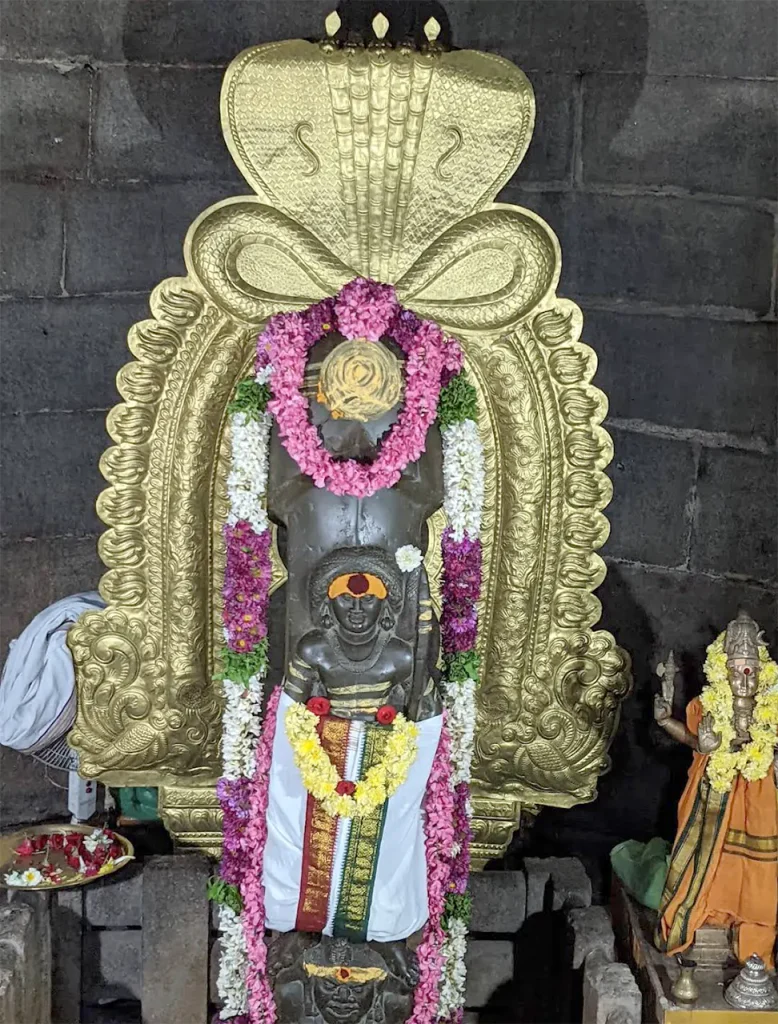
Tucked away in a quiet rural village near the banks of the Swarnamukhi River, this sacred shrine offers something very rare in India. Most ancient stone carvings from over two thousand years ago now sit inside glass cases in museums. At Gudimallam, however, the ancient dark-brown stone Lingam remains in the exact spot where it was installed during the Satavahana period. Priests still perform daily rituals here while the Archaeological Survey of India (ASI) protects the surrounding monument.
Whether you are planning a quiet side trip from Tirupati and Srikalahasti or want to understand why historians and devotees alike revere this five-foot carved Shiva Lingam, this complete guide covers the temple’s history, sacred legends, timings, and travel routes.
Quick Information: Gudimallam Parashurameshwara Swamy Temple
| Feature | Details |
| Temple Name | Sri Parashurameshwara Swamy Temple (Gudimallam Temple) |
| Historical Inscriptional Name | Viprapitha Ishwara / Parasuramesvara |
| Main Deity | Lord Shiva (as Parashurameshwara) |
| Goddess (Consort) | Goddess Anandavalli Amman (Parvati) |
| Other Shrines in Complex | Lord Subramanya Swamy (with Valli and Devasena), Lord Suryanarayana Swamy, Lord Ganesha |
| Location | Gudimallam Village, Yerpedu Mandal |
| District & State | Tirupati District (formerly Chittoor District), Andhra Pradesh, India |
| River Nearby | Swarnamukhi River |
| Age of Main Shiva Lingam | 3rd Century BCE to 1st Century BCE (Satavahana Era) |
| Current Stone Temple Structure | Pallava, Bana, and Chola periods (Major stone reconstruction in 1126 CE under Vikrama Chola) |
| Heritage Protection | Monument of National Importance under the Archaeological Survey of India (since 1954) |
| Typical Daily Darshan Timings | Morning: 6:00 AM – 1:00 PM; Evening: 4:00 PM – 8:00 PM (Subject to local priest and ASI schedules; confirm locally on festival days) |
| Typical Abhishekam Timings | Morning around 6:30 AM; Evening around 6:00 PM |
| Entry Fee | Free entry for darshan |
| Distance from Key Hubs | Renigunta Junction: ~13 km | Tirupati: ~28 km | Srikalahasti: ~28 km | Chennai: ~125 km |
| Nearest Railway Station | Renigunta Junction (13 km) and Tirupati Main (28 km) |
| Nearest Airport | Tirupati Airport at Renigunta (~15 km) |
| Best Time to Visit | November to February (pleasant winter weather) |
| Major Festivals | Maha Shivaratri, Karthika Masam, Masa Shivaratri, Pradosham, Sankranti |
| Photography Rules | Exterior photography permitted; photography inside the inner sanctum (garbhagriha) is strictly prohibited |
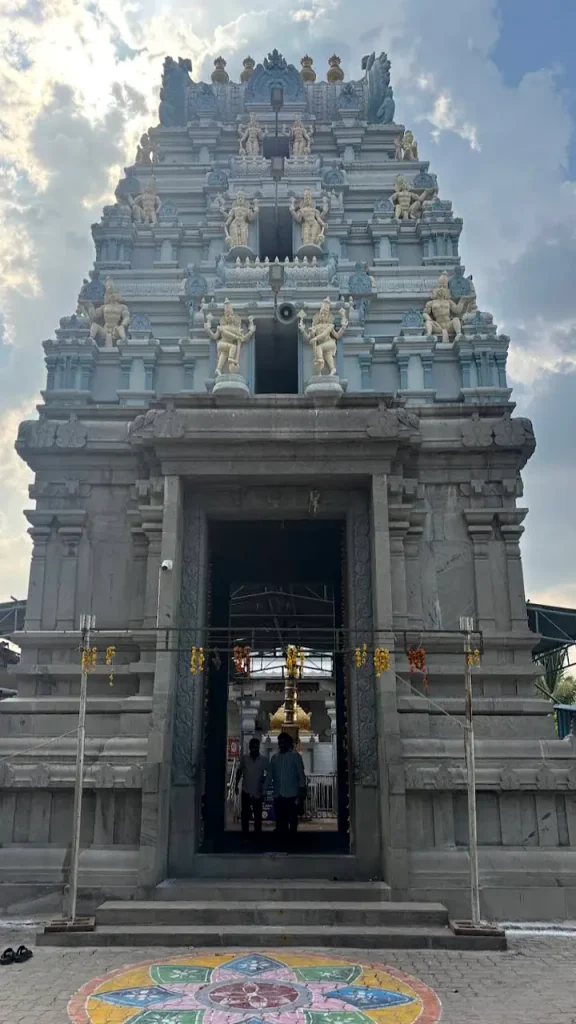
Why Gudimallam Temple Is Famous: The Oldest Known Shiva Lingam
For millions of pilgrims who visit Tirupati and Srikalahasti every year, Gudimallam is a hidden treasure hiding just twenty minutes off the main highway. While the surrounding stone walls look like a peaceful medieval South Indian village temple, the inner sanctum holds a priceless piece of religious and artistic history.
Archaeologists and historians recognize the Gudimallam Shiva Lingam as the earliest surviving stone Shiva Lingam discovered in its original place of worship. Carved between the 3rd and 1st centuries BCE, it predates the famous classical temple complexes of South India by several hundred years. Since 1954, the Archaeological Survey of India (ASI) has protected the complex as a Monument of National Importance.
It is helpful for pilgrims to know one clear distinction before visiting. Although Gudimallam houses the oldest surviving carved stone Lingam, it is not one of the traditional 12 Jyotirlinga temples in India. Instead, Gudimallam holds its own unique place in Shaiva heritage as an ancient Murti-Lingam—a sacred emblem that combines the cylindrical form of the Shiva Lingam with a full, life-sized carving of Lord Shiva on its front surface.
Even more remarkable is the fact that Gudimallam is a living temple. In many archaeological sites across India, formal worship stopped centuries ago. At Gudimallam, local temple priests still chant Vedic hymns, offer fresh flowers, and perform daily abhishekam (sacred water bath) to the very same stone sculpture that devotees worshipped more than two millennia ago.
Up Close with the Gudimallam Shiva Lingam: What You See Inside the Sanctum
When you walk through the outer porch and stand before the doorway of the inner sanctum (garbhagriha), your eyes need a moment to adjust to the dim light. Unlike almost every other Shiva temple where a smooth, rounded black stone rests on a circular base (peetham or yoni), the Gudimallam Lingam looks entirely different.
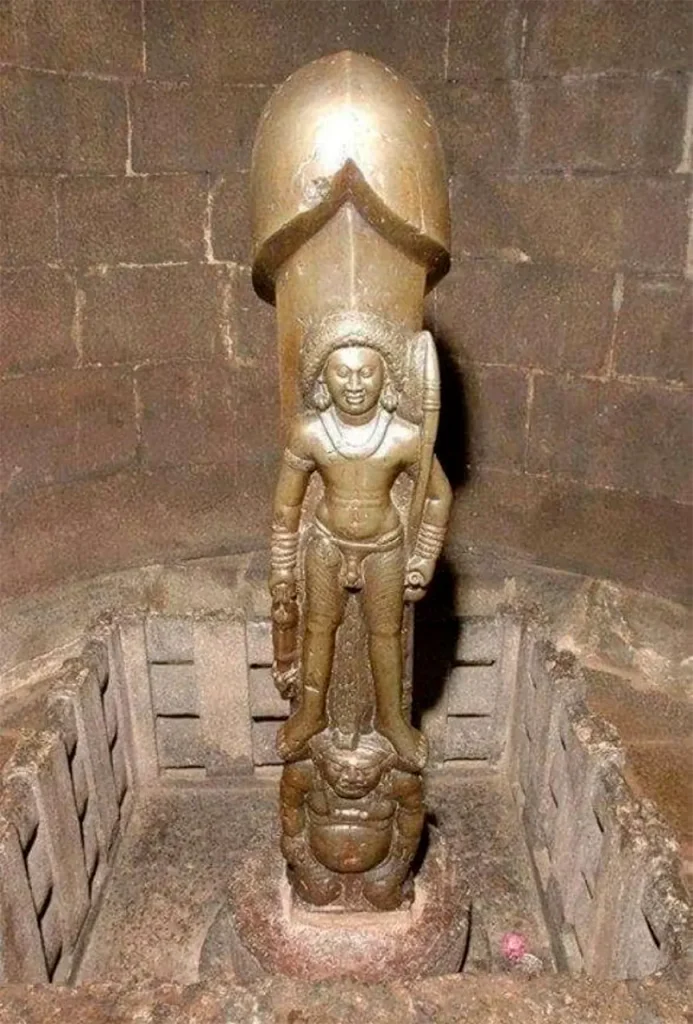
Carved from a single block of hard, dark-brown local igneous stone (often polished over centuries to a deep, lustrous sheen), the Lingam rises nearly five feet above the floor and measures roughly a foot thick.
1. The Five-Foot Carving of Hunter-Ascetic Shiva
Carved in bold, high relief across the front of the shaft is a striking two-armed figure of Lord Shiva. Here, Shiva is shown in his ancient Vedic form as Rudra—the fierce yet benevolent lord of the forest, animals, and ascetic power.
He stands straight and firm, looking directly forward with calm, wide eyes. His hair is braided and wrapped neatly inside a turban-like headdress, a style commonly seen in early Indian sculptures from Bharhut and Sanchi during the 2nd century BCE. Large, heavy rings adorn his ears, an ornamental torque rests around his neck, and richly carved bracelets and armlets circle his arms.
Look closely at his torso and you will notice two fascinating details recorded by art historians:
- No Sacred Thread: The figure does not wear a yajnopavita (sacred thread) across his chest.
- Ascetic Strength: Although he wears a thin, flowing lower cloth (dhoti) secured at the waist with a sash, the carving clearly displays the urdhvaretas symbol of complete yogic celibacy and creative cosmic energy, while the top of the stone pillar curves into an unmistakable phallic Lingam crown.
2. The Crouching Dwarf (Apasmara) at the Base
Instead of standing on the flat ground, the five-foot figure of Shiva stands squarely on the shoulders of a muscular, crouching dwarf spirit known as Apasmara Purusha (often called Musalagan in South Indian tradition).
In Hindu symbolism, Apasmara represents spiritual ignorance, ego, and forgetfulness. Because ignorance can never be destroyed completely without upsetting cosmic balance, Lord Shiva stands upon the dwarf to keep ignorance forever pinned beneath his feet. The dwarf at Gudimallam has pointed ears, bulging eyes, joyful cheeks, and bent knees braced against the floor to support the weight of the Lord.
3. The Ram, the Water Pot, and the Battle-Axe
Unlike later statues of Shiva that show four arms holding a trident (trishula) and a small drum (damaru), the ancient Gudimallam Shiva has only two arms, holding three specific objects:
- In his right hand: He holds a horned ram (male sheep) by its hind legs, with its head hanging downward. Historians connect this either to the Vedic sacrifice (yajna) where Rudra is the lord of sacrificial offerings, or to the hunter form of Shiva protecting forest creatures.
- In his left hand: He holds a small water pot (kamandalu), a classic symbol of a wandering sage (rishi) who performs penance and purifies the world.
- Resting on his left shoulder: A long-handled battle-axe (parashu) leans against his left shoulder. In devotional tradition, this axe connects the deity directly to Sage Parashurama, giving the Lord the name Parashurameshwara (“The Lord of Parashurama”).
4. Why the Sanctum Sits Below Ground Level
When you look into the sanctum from the viewing doorway, you look down rather than straight ahead. The main floor of the garbhagriha sits several feet below the surrounding stone floor of the temple hall.
Furthermore, the Lingam does not sit on a conventional circular avudaiyar (the spouted base seen in later temples). Instead, it rises directly out of the floor at the center of a square stone railing (vedika) carved with decorative patterns. Visitors must step down carefully to the viewing threshold to witness the deity from base to crown.
Temple Legend (Sthala Purana): Parashurama, Chitrasen, and the Trimurti
Alongside its documented archaeological history, Gudimallam is steeped in sacred oral tradition (sthala purana) passed down through generations of devotees and priests.
Sage Parashurama’s Penance and the Sacred Lotus Pond
According to traditional temple lore, after fulfilling his earthly mission of defeating corrupt rulers, Sage Parashurama—the sixth avatar of Lord Vishnu—sought a peaceful forest to perform deep penance and wash away the karma of warfare. Guided by sacred intuition, he arrived at this quiet stretch along the Swarnamukhi River, known in ancient lore as Viprapitha.
Here, Parashurama discovered a self-manifested (Swayambhu) Shiva Lingam and created a beautiful pond (pushkarini) nearby. By the power of his devotion, a single golden lotus bloomed in the pond every morning, which Parashurama offered to Lord Shiva during his daily worship.
One day, a celestial being (Vidhyadhara) named Chitrasen passed through the forest, saw the radiant flowers in the pond, and plucked one before Parashurama arrived. When Parashurama discovered the missing flower, a fierce battle broke out between the warrior-sage and Chitrasen. Neither could defeat the other across days of combat.
Pleased by the unwavering devotion at the heart of their struggle, the Supreme Divine intervened to restore peace.
How Devotees See Brahma, Vishnu, and Shiva in One Lingam
In the traditional devotional view of the temple, the Trimurti—Lord Brahma, Lord Vishnu, and Lord Shiva—appeared together before Parashurama and merged their forms into the single Gudimallam Lingam so that all three cosmic powers could be worshipped at once:
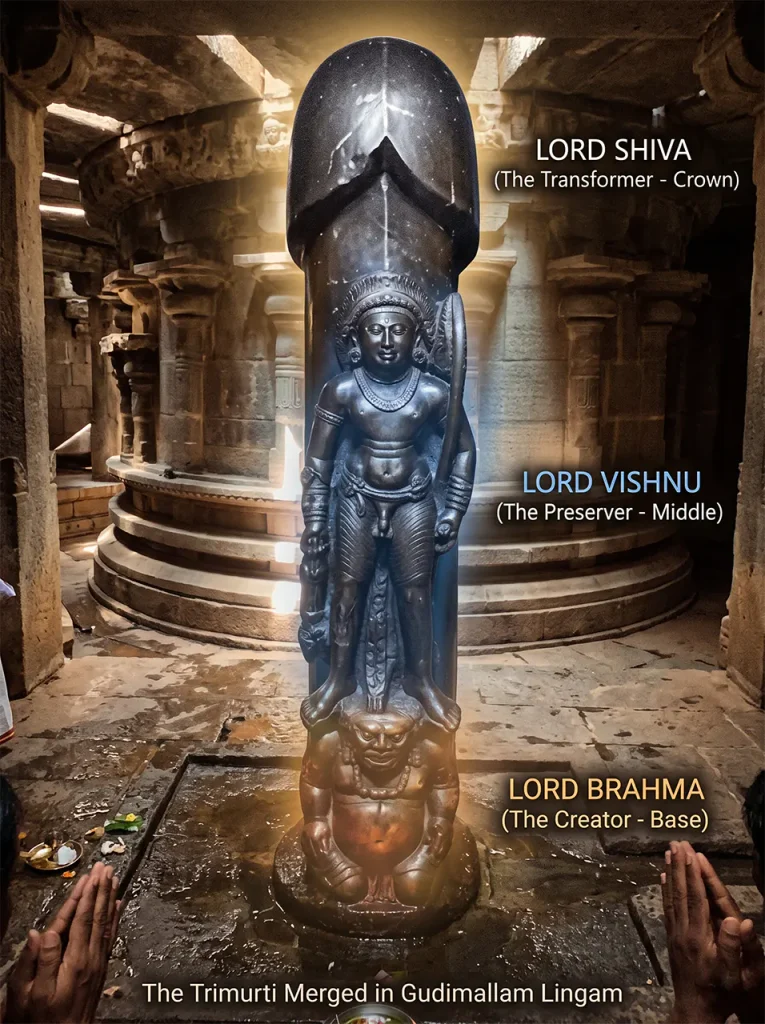
- Lord Brahma (The Creator): Devotees identify the crouching figure at the very bottom of the pillar with the energy of Brahma forming the base (Brahma-bhaga).
- Lord Vishnu (The Preserver): Devotees see the standing figure in the middle—whose calm facial features and connection to Parashurama’s penance recall Vishnu—as the preserving aspect (Vishnu-bhaga).
- Lord Shiva (The Transformer): The overarching cylindrical Lingam shaft and the ascetic Rudra attributes represent Lord Shiva (Rudra-bhaga) crowning the entire form.
Because Lord Shiva blessed Parashurama here and wears the battle-axe (parashu) on his shoulder, the deity came to be worshipped as Parashurameshwara Swamy.
The Local Belief About the 60-Year Water Miracle
One of the most famous devotional beliefs associated with Gudimallam involves water rising inside the sunken sanctum.
Local tradition states that once every 60 years—marking a complete cycle of the traditional Hindu Samvatsara calendar, typically in early December—underground water mysteriously wells up inside the sunken garbhagriha even during dry weather. According to local lore, the water rises high enough to touch the top of the five-foot Shiva Lingam, performs a natural abhishekam (sacred bath) on its own, and then recedes within a day. Devotees also link this phenomenon to the shrine of Suryanarayana Swamy (the Sun God) within the complex, noting that the late-autumn angles of sunlight reach into the sanctum during the same season.
From a geological perspective, the temple sits in the low-lying alluvial basin of the Swarnamukhi River, and its sanctum floor lies below the surrounding ground level. Whenever the underground water table rises significantly—such as after heavy northeast monsoon rains in November and December—water naturally seeps into the ancient stone pit. For believers, this harmony between underground water, sunlight, and the ancient sunken Lingam is a powerful sign of a living sacred site.
Documented History and Archaeological Excavations
While sacred legends explain the spiritual heart of Gudimallam, stone inscriptions and modern archaeological excavations tell an equally fascinating story of how this temple developed over more than two thousand years.
If you visit Gudimallam today, it helps to know that the temple was not built all at once. It grew through three major historical phases:
Phase 1: The Satavahana Open-Air Shrine (3rd–1st Century BCE)
When the five-foot Shiva Lingam was first carved and installed between the 3rd and 1st centuries BCE (during the early Satavahana period), there was no dark stone roof over it.
Instead, the Lingam stood as a sacred open-air shrine (hypaethral temple), surrounded by a low, square stone railing (vedika) measuring about 5.5 feet on each side, likely shaded by a sacred tree. This open-air railing style was very common in early Indian sacred architecture across both Hindu and Buddhist traditions of the 2nd century BCE.
Phase 2: Pallava and Bana Royal Patronage (4th–10th Century CE)
Centuries later, during the early Pallava and Bana dynasties (especially between the 8th and 10th centuries CE), a brick structure was built around the Lingam to shelter it.
Stone inscriptions found at the temple from the reigns of Pallava rulers such as Nandivarman and Dantivarman, along with local Bana kings (such as Vijayaditya), show that Gudimallam was already a highly respected pilgrimage center over a thousand years ago. These kings and local assemblies gifted agricultural land, gold, and herds of sheep and cows so that the temple could maintain perpetual oil and ghee lamps (nandavilakku) and feed devotees.
Phase 3: The Chola Stone Reconstruction by Vikrama Chola (1126 CE)
By the early 12th century, the older brick walls needed a permanent stone replacement. Around 1126 CE (the eighth regnal year of the Chola Emperor Vikrama Chola), the sanctum and main hall were completely rebuilt in dressed granite stone, with the superstructure finished in stucco and brick.
Remarkably, the Chola builders took extreme care not to disturb or raise the ancient Shiva Lingam from its original spot. Because the surrounding ground level of the village had risen over a thousand years, building the new Chola temple floor at the higher medieval ground level left the original Satavahana Lingam sitting inside a sunken pit—which is why visitors still look down into the sanctum today.



What the 1973–1974 ASI Excavation Discovered
For many years, historians debated the exact age of the Gudimallam Lingam. In 1973–1974, the 1973–1974 archaeological excavation at Gudimallam led by renowned archaeologist Dr. I.K. Sarma carefully dug beneath the floor slabs inside the sanctum without disturbing the deity.
The excavation revealed scientific proof of the temple’s great age:
- Original Foundation: The team uncovered the complete Satavahana-era square stone railing (vedika) still surrounding the base of the Lingam, resting in original soil layers.
- Ancient Pottery: Archaeologists found polished Black-and-Red Ware and Russet-Coated Painted Ware pottery shards dating from the 2nd century BCE to the 3rd century CE.
- No Drain Spout: In the earliest phase, there was no stone water drain (pranala) attached to the Lingam. Instead, small earthenware bowls were used to catch offerings during early worship before a stone drainage channel was added in later centuries.
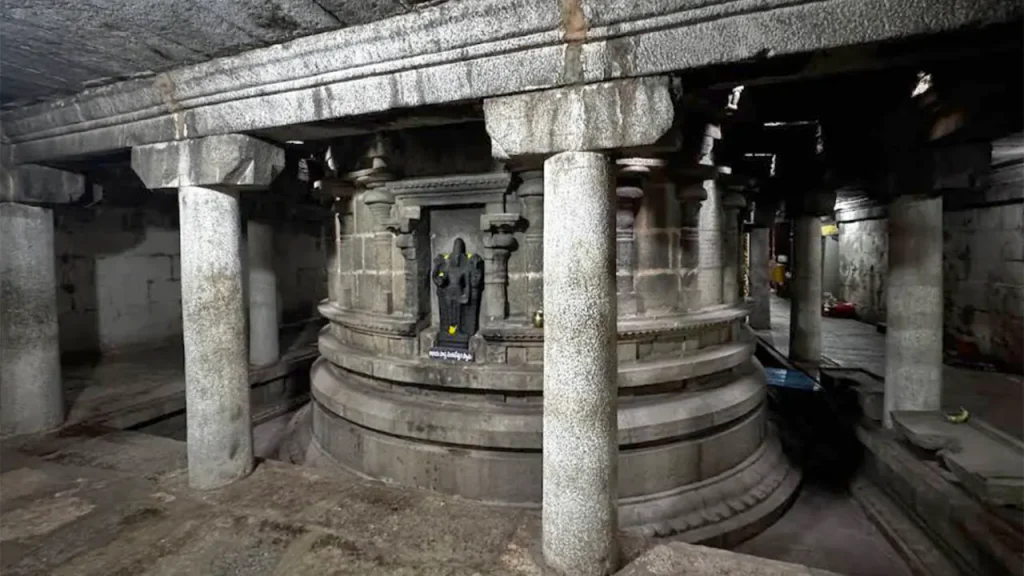
Temple Architecture and Subsidiary Shrines
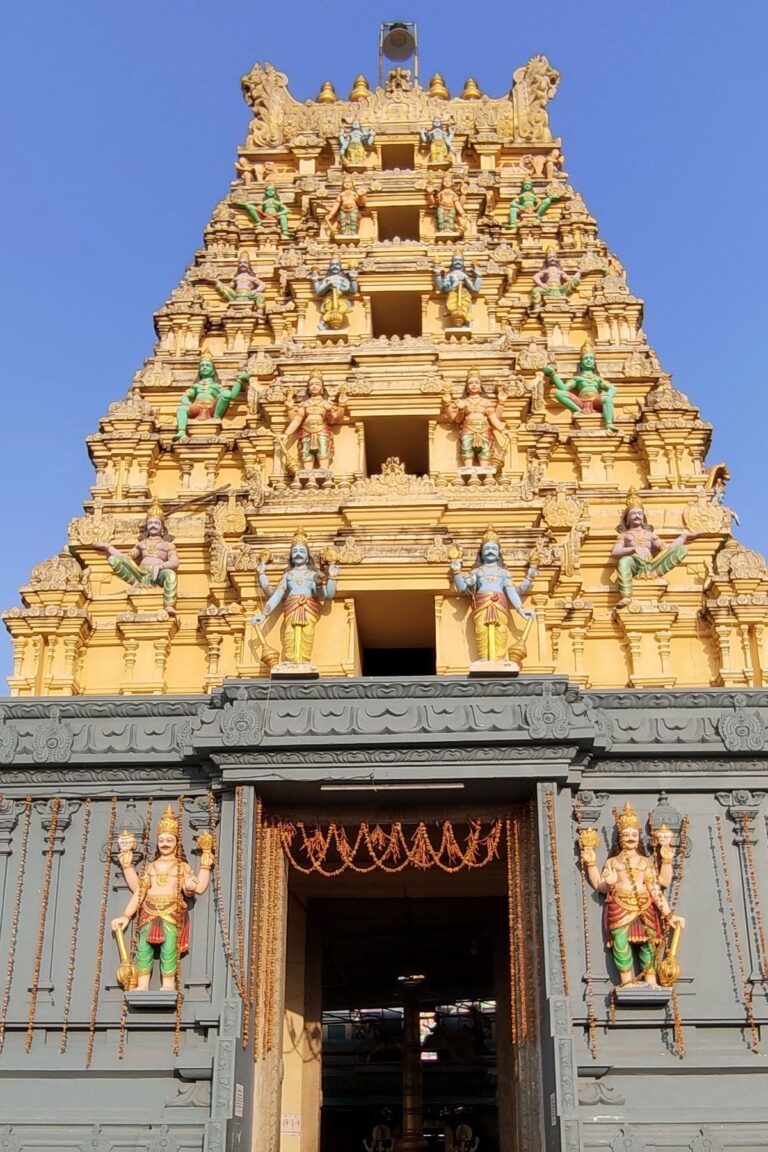
Walking through the entrance of Gudimallam Parashurameshwara Swamy Temple feels like stepping into a classic South Indian heritage courtyard. A high compound wall (prakaram) encloses the peaceful complex, keeping out village noise.
The Boat-Shaped (Gajaprishtha) Sanctum
If you walk around the outside of the main sanctum for pradakshina (circumambulation), look up at the roof tower (vimana) above the main shrine. Instead of a square pyramid, the back of the sanctum curves in a semi-circle, looking like the rounded back of a resting elephant or an overturned boat.
In Indian temple architecture, this apsidal style is called Gajaprishtha (“elephant-back”). It is a signature architectural style of the ancient Tondaimandalam region (covering parts of southern Andhra Pradesh and northern Tamil Nadu) during the late Pallava and Chola eras.
The exterior walls of the main shrine feature carved stone pilasters and niches holding stone images of Dakshinamurthy, Maha Vishnu, Brahma, Durga, and Ganesha, along with finely carved Tamil and Grantha script inscriptions running along the stone base (adhisthana). The temple is also historically noted for fine Chola-era bronze icons created for festival processions.
Shrines Inside the Temple Courtyard
Before or after offering prayers at the main sanctum of Parashurameshwara Swamy, take time to visit the subsidiary shrines located inside the courtyard:
- Goddess Anandavalli Amman Shrine: Located in a separate shrine within the complex, Goddess Anandavalli (a serene form of Goddess Parvati) faces south. Devotees pray to her for family harmony, peace of mind, and blessings for children.
- Lord Valli Devasena Subramanya Swamy Shrine: Dedicated to Lord Kartikeya (Murugan) flanked by his consorts Valli and Devasena.
- Lord Suryanarayana Swamy Shrine: Facing the main sanctum is a dedicated shrine to Surya, the Sun God, reflecting the temple’s strong connection to solar alignments.
- Vinayaka (Ganesha) and Chandikeshwara Shrines: Smaller shrines inside the compound complete the traditional Shaiva temple layout.
Daily Darshan, Pooja Timings, and Major Festivals
Because Gudimallam is a tranquil village temple rather than a crowded commercial complex, darshan here is peaceful and unhurried on most days of the year.
Typical Daily Opening and Abhishekam Schedule
- Morning Darshan: 6:00 AM to 1:00 PM
- Evening Darshan: 4:00 PM to 8:00 PM
- Daily Abhishekam: Typically performed in the early morning around 6:30 AM and in the evening around 6:00 PM.
Important Visitor Note on Timings: Because the temple is jointly managed for heritage protection by the ASI and served by local temple priests, opening and closing hours can shift slightly during local festivals, solar or lunar eclipses, or seasonal days. If you plan to attend the early morning or evening abhishekam, aim to arrive at least 15 minutes early.
Because the ancient Lingam is a protected national monument over two thousand years old, strict conservation guidelines apply inside the garbhagriha. Priests perform traditional water abhishekam, flower decoration (alankaram), and deeparadhana (camphor/lamp offering), while avoiding harsh chemical powders or heavy oil soot that could damage the ancient stone. Visitors watch the rituals clearly from the viewing threshold just outside the sunken pit.
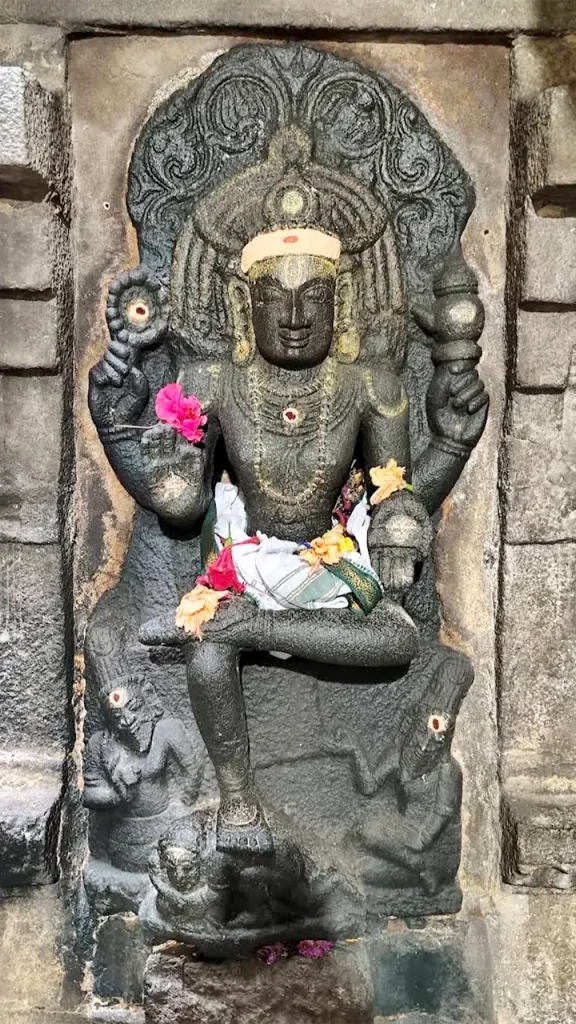
Major Annual Festivals at Gudimallam
While Gudimallam is quiet on regular weekdays, the village comes alive with Vedic chanting and oil lamps during major Shaiva observances:
- Maha Shivaratri (February or March): The grandest annual festival at the temple. Thousands of devotees from Tirupati, Renigunta, Yerpedu, and nearby villages gather for special abhishekams, Rudram chanting, and night-long vigil prayers on Maha Shivaratri.
- Karthika Masam (October to December): Every Monday (Karthika Somavaram) and the full moon day (Karthika Pournami) draw steady streams of family pilgrims who light traditional earthen lamps in the courtyard.
- Pradosham (Twice Every Lunar Month): Falling on the 13th day (Trayodashi) of each lunar fortnight, evening Pradosham prayers between 4:30 PM and 6:00 PM are considered especially auspicious for worshipping Parashurameshwara Swamy and Nandi.
- Makar Sankranti & Masa Shivaratri: Marked by special floral decorations and community prayers.
How to Reach Gudimallam Temple from Tirupati, Renigunta, and Srikalahasti
Gudimallam village is located in Yerpedu Mandal of Tirupati District, well connected by paved rural roads to the main highway between Renigunta and Srikalahasti. For full regional maps and civic administration details, travellers can also check the Tirupati District official portal.
1. By Road via Papanaidupeta (Best Option for Families)
Driving by private car or hired taxi is the smoothest and fastest way to reach the temple.
- Route from Tirupati (Approx. 28–30 km | 45 to 55 minutes):Start from Tirupati → Drive to Renigunta → Take the road toward Papanaidupeta → Turn south from Papanaidupeta onto the Gudimallam village road → Reach Gudimallam Temple.
- Route from Srikalahasti (Approx. 28 km | 45 minutes):Drive west from Srikalahasti along the NH-716 corridor toward Yerpedu → Take the turn toward Papanaidupeta → Follow local signboards for Gudimallam.
- Route from Chennai (Approx. 125 km | 3 hours):Can be approached via the Chennai–Tirupati highway (via Tiruttani/Puttur or Naidupeta/Srikalahasti depending on your chosen route) with a detour through Papanaidupeta.
2. By Train (Nearest Railway Station)
- Renigunta Junction (RU) — ~13 km away: Renigunta is the closest major railhead and a huge railway junction serving trains from Chennai, Hyderabad, Bengaluru, Vijayawada, Mumbai, and Delhi. From outside Renigunta railway station, you can hire a direct auto-rickshaw or taxi to Gudimallam in about 25 minutes.
- Tirupati Main Railway Station (TPTY) — ~28 km away: Convenient if you are staying in Tirupati hotels; pre-paid taxis and cabs are easily available outside the station. You can check train arrival schedules on the Indian Railways passenger enquiry portal before booking your local cab.
3. By Air (Nearest Airport)
- Tirupati International Airport (TIR) at Renigunta — ~15 km away: Located very close to the Papanaidupeta turn-off. In fact, Gudimallam is only a 25-to-30-minute cab ride from the airport terminal, making it easy to visit either right after landing or before catching an afternoon flight home.
Important Local Transport Tip for Returning to Tirupati
While APSRTC rural buses and shared autos run between Renigunta, Papanaidupeta, and Gudimallam, direct bus frequency into Gudimallam village is limited, and shared autos stop running regularly after dusk.
- Practical Recommendation: If you do not have your own vehicle, hire a round-trip cab from Tirupati or a round-trip auto-rickshaw from Renigunta/Papanaidupeta and ask the driver to wait for 45 to 60 minutes while you complete your darshan. This saves you from waiting in the village for a return vehicle.
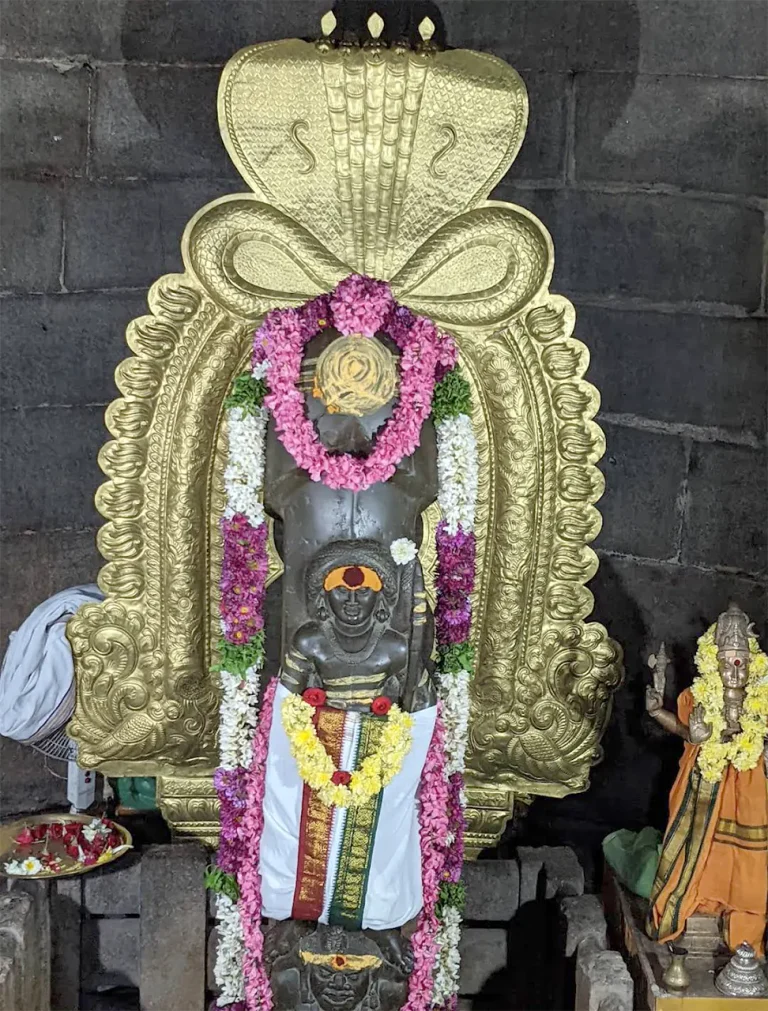
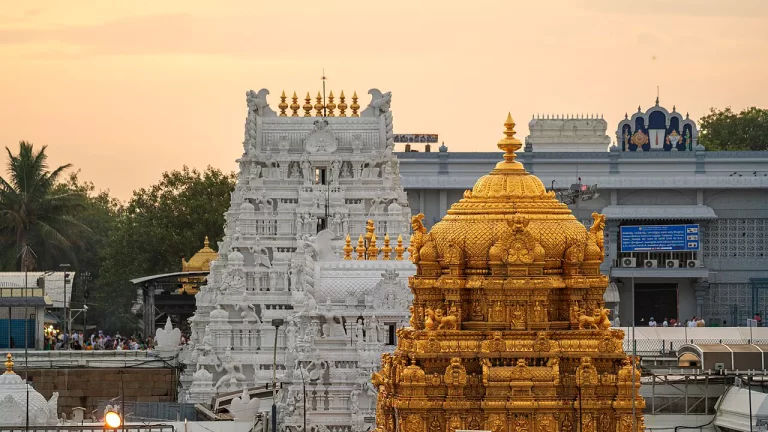

Best Time to Visit, Dress Code, and Visitor Rules
Best Season and Time of Day
- Best Months (November to February): Winter is the ideal season. Daytime temperatures range comfortably between 20°C and 29°C, making the countryside drive and barefoot walk across the stone courtyard very pleasant.
- Summer Warning (March to June): Daytime temperatures in the Tirupati and Renigunta plains frequently cross 40°C (104°F). If you visit during summer, arrive before 8:30 AM or after 5:00 PM so the open stone floor does not burn your feet.
- Monsoon Season (July to October): Lush green paddy fields and full river channels make the drive scenic, though occasional heavy showers occur during the northeast monsoon in October and November.
Dress Code and Temple Etiquette
Although there is no strict ticketed dress enforcement counter at the gate like at Tirumala, Gudimallam is a traditional living village shrine:
- For Men: Dhoti (pancha), kurta-pajama, or formal trousers with a shirt are appropriate.
- For Women: Sarees, half-sarees, or salwar kameez with a dupatta are recommended.
- Avoid shorts, sleeveless tops, and beachwear out of respect for local village customs.
Accessibility and Facilities What to Expect
Because Gudimallam is a protected archaeological monument in a small village, visitor facilities are modest compared to mega-temples like Tirumala:
- Stepping Viewpoint: To view the full five-foot Lingam inside the sunken sanctum, visitors step down a few stone steps at the sanctum entrance. Elderly visitors with knee pain should hold the side wall or doorway frame carefully while stepping down and up.
- Footwear & Parking: Open space is available just outside the temple compound wall for parking cars and two-wheelers. Leave footwear outside the main entrance gate.
- Food & Water: Carry your own bottled drinking water and light snacks, especially when travelling with children or senior citizens. There are no large restaurants or hotel complexes in Gudimallam village itself; the best dining and clean restroom options are back in Renigunta, Tirupati, or Srikalahasti.
- Strict Photography Rule: You may take photographs of the exterior courtyard, the boat-shaped gajaprishtha roof, and the outer walls. Photography or videography of the main Shiva Lingam inside the inner sanctum is strictly forbidden by both temple tradition and ASI regulations.
Nearby Temples to Combine in a One-Day Pilgrimage Circuit
Because darshan at Gudimallam typically takes 45 to 60 minutes, most pilgrims combine it with nearby famous temples around Tirupati. Here is the most practical way to group them into a single day:
| Temple Name | Distance from Gudimallam | Why Visit on the Same Trip |
| Srikalahasti Temple | ~28 km (45 mins) | Revered as the Vayu Lingam (Wind Element) among the five Panchabhoota Stalas of Lord Shiva and famous for Rahu-Ketu Sarpa Dosha pooja. Connects directly via the Papanaidupeta–Yerpedu road. |
| Tiruchanur Padmavathi Ammavari Temple | ~24 km (40 mins) | The sacred shrine of Goddess Padmavathi (consort of Lord Venkateswara), located right on your return route from Renigunta toward Tirupati. |
| Kapila Theertham (Kapileswara Swamy Temple) | ~30 km (50 mins) | The only major Shiva temple located directly at the foot of the Tirumala hills in Tirupati town, featuring a sacred waterfall tank during monsoon months. |
| Tirumala Venkateswara Temple | ~48 km (1 hr 30 mins) | Most pilgrims base themselves in Tirupati for Lord Venkateswara darshan and dedicate a peaceful half-day either the day before or after to visit Gudimallam and Srikalahasti. |
Frequently Asked Questions About Gudimallam Temple
1. How old is the Shiva Lingam at Gudimallam Temple?
Archaeologists and art historians date the Gudimallam Shiva Lingam to between the 3rd century BCE and 1st century BCE (during the Satavahana period), making it more than 2,100 to 2,200 years old. Stratified excavations conducted by the Archaeological Survey of India in 1973–1974 confirmed its pre-Common Era foundation.
2. Why is the Gudimallam Shiva Lingam carved like a human figure?
The Gudimallam Lingam was carved during an early stage of Hindu art when sculptors combined the symbolic pillar of the Shiva Lingam with the human form of Vedic Rudra. The five-foot stone shaft shows a two-armed hunter-ascetic Shiva standing on the dwarf Apasmara, holding a ram, a water pot (kamandalu), and a battle-axe (parashu).
3. Is daily pooja still performed at Gudimallam Parashurameshwara Temple?
Yes. Even though the Archaeological Survey of India (ASI) protects the building as a Monument of National Importance, Gudimallam remains an active, living Hindu temple. Local priests perform daily morning and evening abhishekam and archana according to traditional rituals.
4. Does the Gudimallam sanctum really fill with water every 60 years?
According to deeply held local tradition, underground water rises inside the sunken sanctum once every 60 years in early December to bathe the Shiva Lingam up to its top before receding. Physically, because the sanctum sits below ground level near the Swarnamukhi River basin, periods of high groundwater tables and heavy monsoon rains also cause water to seep naturally into the pit.
5. How far is Gudimallam Temple from Tirupati and Srikalahasti?
Gudimallam Temple is approximately 28 to 30 kilometers from Tirupati, 13 kilometers from Renigunta Railway Junction, and 28 kilometers from Srikalahasti Temple via the Papanaidupeta road corridor.
6. Is photography allowed inside the Gudimallam Temple sanctum?
No. Photography and video recording inside the inner sanctum (garbhagriha) are strictly prohibited. Visitors are welcome to photograph the outer temple courtyard, stone inscriptions, and the boat-shaped (gajaprishtha) exterior roof structure.
7. How much time is needed for darshan at Gudimallam Temple?
On regular days, the temple has very little crowd, and you can comfortably view the main Shiva Lingam, offer prayers at the subsidiary shrines of Anandavalli Amman and Subramanya Swamy, and admire the Chola-era architecture within 45 to 60 minutes.
Conclusion: Planning Your Visit to Gudimallam
Visiting Gudimallam Parashurameshwara Swamy Temple offers a rare quiet pause away from the busy queues of larger pilgrimage towns. Standing at the threshold of its sunken sanctum, you can look upon a five-foot stone carving of Lord Shiva that has received prayers continuously since the age of the Satavahanas, sheltered later by Pallava, Bana, and Chola kings.
If you are planning a trip to Tirupati or Srikalahasti, set aside two to three hours in the morning or late afternoon, hire a round-trip cab via Renigunta and Papanaidupeta, and experience one of India’s oldest living Shiva shrines in person.