Thiruporur Murugan Temple: The Unbathed Idol Mystery
Thiruporur Murugan Temple, formally known as the Arulmigu Kandaswamy Temple, is an ancient Hindu shrine situated in the coastal town of Thiruporur in the Chengalpattu district of Tamil Nadu. Positioned directly along the Old Mahabalipuram Road (OMR, State Highway 49A), the temple lies approximately 45 kilometres south of Chennai and 16 kilometres north of the UNESCO World Heritage town of Mamallapuram. Dedicated to Lord Murugan (Skanda or Kartikeya), worshipped here in the fierce, commanding aspect of Sri Kandaswamy, this sacred shrine is revered as one of the most prominent Murugan pilgrimage centers in northern Tamil Nadu.
The name Thiruporur translates literally in Tamil to the “Sacred Place of the Holy War” (Thiru meaning sacred, Por meaning war, and Ur meaning town). According to temple tradition and the local Sthala Purana, this is the battlefield where Lord Murugan vanquished the demon Tarakasura and the Asuric forces on earth, balancing the celestial battle at Tiruchendur (in the sea) and Tiruparankundram (on land).
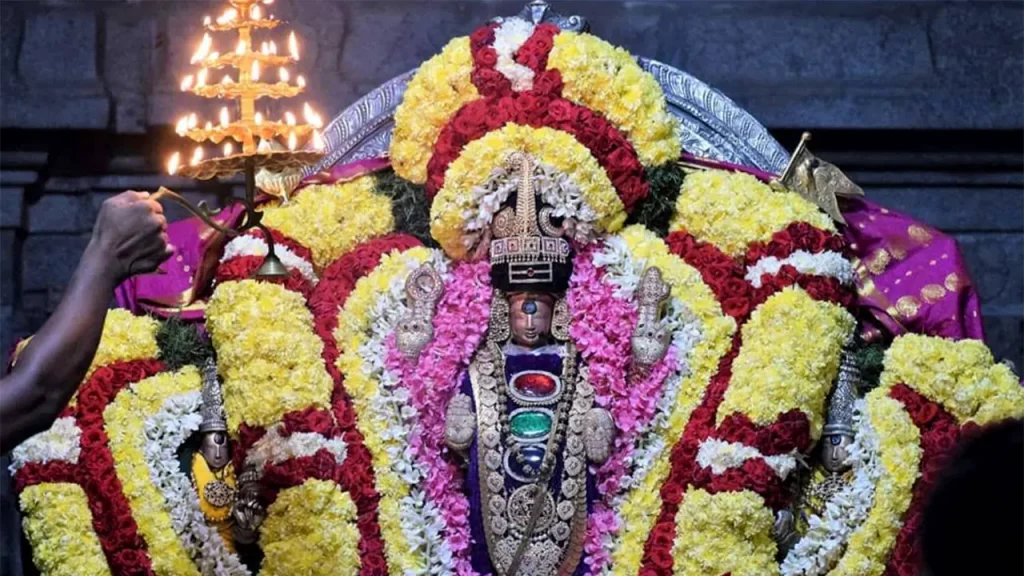
What sets Thiruporur Murugan Temple apart is its unique sanctum configuration. The presiding deity, Lord Kandaswamy, stands as a Swayambhu (self-manifested) stone murti on an earthen palm-tree hillock. Because of the delicate, natural earthen nature of this Swayambhu idol, no direct water Abhishekam (ritual bathing) is performed on it. Instead, all daily libations and continuous rituals are dedicated to a secondary consecrated stone idol of Lord Murugan flanked by His consorts, Valli and Deivanai, placed right alongside a mystical, energized metal emblem known as the Sri Chakra Yantra, consecrated by the 17th-century saint Chidambara Swamigal.
For pilgrims and cultural travellers, visiting Thiruporur provides a complete immersion into classical Dravidian temple architecture, Shaivite agamic worship, centuries of living Tamil devotional literature, and a tranquil coastal-corridor atmosphere. Whether you are seeking spiritual solace, undertaking vows for overcoming personal hurdles, or exploring the historical temple corridors of Tamil Nadu, this guide provides every detail necessary to plan your journey with clarity and confidence.
Quick Information Table
| Information Category | Verified Details |
| Temple Name | Arulmigu Kandaswamy Temple (Thiruporur Murugan Temple) |
| Main Deity | Lord Kandaswamy (Lord Murugan / Shanmukha / Subrahmanya) |
| Consorts | Goddess Valli and Goddess Deivanai |
| Location | Thiruporur Town, Old Mahabalipuram Road (OMR), Chengalpattu District |
| State & Country | Tamil Nadu, India |
| Geographical Coordinates | 12.7238° N, 80.1884° E |
| Temple Type | Ancient Hindu Temple (Shaivite / Kaumaram tradition) |
| Governing Body | Hindu Religious and Charitable Endowments (HR&CE) Dept., Govt. of Tamil Nadu |
| Major Festivals | Brahmotsavam (Masi), Skanda Sashti (Aippasi), Vaikasi Visakam, Thai Poosam |
| Daily Timings | Morning: 06:00 AM – 12:30 PM | Evening: 03:30 PM – 08:30 PM (Extended on festival days) |
| Key Rituals | Viswaroopa Darshan, Kalasanthi, Uchikala, Sayaraksha, Arthajama Pooja |
| Sacred Tank (Theertham) | Valliyar Odai / Saravana Poigai / Pranavashrithan Theertham |
| Best Time to Visit | October to March (Cooler weather); early morning hours on weekdays |
| Dress Code | Traditional Indian attire (Dhoti/Kurta for men; Saree/Salwar for women). Western casuals (shorts, sleeveless) strictly prohibited. |
| Nearest Railway Station | Chengalpattu Junction (CGL – ~26 km); Tambaram (TBM – ~30 km) |
| Nearest Airport | Chennai International Airport (MAA – ~40 km) |
| Entry Fee | General Darshan is Free. Special Darshan passes: ₹20 to ₹100 (subject to HR&CE notices). |
History of Thiruporur Murugan Temple
Origin and Founding Story
The historical origins of the Thiruporur Murugan Temple trace a fascinating trajectory that intertwines ancient epigraphical history with medieval spiritual revival. While religious tradition dates the sanctity of the soil to prehistoric Puranic eras, physical epigraphical and architectural evidence confirms that a stone temple dedicated to Subrahmanya stood here during the middle-to-late imperial Chola period (circa 10th to 12th century CE).
Over the centuries following the decline of the Chola empire and the subsequent geopolitical instability across the northern Tamil plain (Thondai Nadu), the original stone structure fell into neglect, gradually getting buried under dense sand dunes, wild thorny overgrowth, and palm groves. By the early 17th century, the sanctum was lost to public memory.
The modern rediscovery and re-establishment of the temple took place in the mid-17th century through the ascetic Saint Chidambara Swamigal, a revered spiritual master belonging to the Shaiva Siddhanta lineage tracing his origins to Madurai. Directed by a divine vision of Goddess Meenakshi and Lord Murugan, Saint Chidambara Swamigal travelled north to the historic Thondai Mandalam. Guided by local cowherds and inner spiritual direction, he located the exact mound covered by palmyra trees beneath which the self-manifested stone form of Lord Kandaswamy lay buried.
With the assistance of local chieftains, landholders, and devout villagers, the saint unearthed the sacred icon, constructed a comprehensive granite Garbhagriha (sanctum), restored the traditional water tanks, and systematised the ritual protocols (Agamas) that continue unbroken to this day.
Read More >> Arupadaiveedu – Six major abodes of Lord Murugan
Historical Development and Renovations
Following its rediscovery in the 1600s, the shrine expanded systematically:
- Mid-17th Century: Initial granite construction of the primary sanctum, the Ardha Mandapa, and installation of the copper Sri Chakra Yantra by Saint Chidambara Swamigal.
- Late 18th Century: Construction of the peripheral cloisters (Prakaram walls) and sub-shrines dedicated to Lord Shiva (Vaneswarar) and Goddess Parvati (Punnyavathi).
- Early 20th Century: Upkeep and expansion by hereditary trustees and local merchant guilds (Chettiars and Mudaliars), including the renovation of the primary seven-tiered Rajagopuram facing east.
- Post-Independence Era to Present: Systematic preservation and renovation under the Hindu Religious and Charitable Endowments (HR&CE) Department of the Government of Tamil Nadu, leading to periodic Kumbhabhishekams (consecration ceremonies), modern crowd-management queue systems, paved pathways, and illuminated parikramas.
Kings, Dynasties, and Epigraphical Records
Historical research on Thiruporur is supported by epigraphical records found within the temple complex and neighbouring villages in the Chengalpattu region:
- Imperial Chola Inscriptions: Fragments of stone inscriptions found in the temple basement exhibit late Chola script styles mentioning donations of land, oil for perennial lamps (nanda vilakku), and livestock to the Subrahmanya Pillaiyar (Lord Murugan) of Thiruporur.
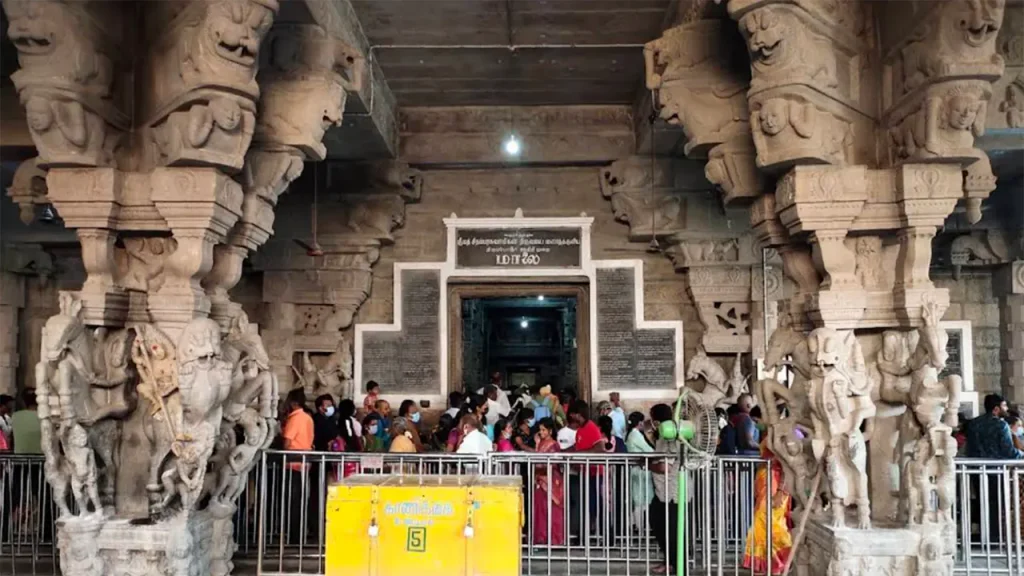
- Vijayanagara and Nayaka Influences: The decorative pillared corridors featuring rearing Yalis (mythical leonine beasts) and sculptured soldier-horse motifs reflect the unmistakable architectural idiom introduced during the Vijayanagara and post-Vijayanagara Gingee/Madurai Nayaka eras (16th–17th centuries).
- Local Zamindars and Chieftains: Historical documents preserved in the local mutts record substantial tax-free land grants (Sarvamanya) endowed by 17th-century local chieftains to Saint Chidambara Swamigal to support the temple’s daily Annadanam (sacred food offering) and festival expenditures.
Saints, Poets, and Devotional Literature
Thiruporur occupies a celebrated place in Tamil devotional literature. While the grand 15th-century poet Arunagirinathar composed his celebrated Tiruppugazh hymns across numerous Murugan abodes in Thondai Nadu, Thiruporur specifically flourished through dedicated poetical treatises:
- Saint Chidambara Swamigal: Composed monumental works here, including the Thiruporur Sthala Puranam, Thiruporur Sannidhi Murai, and Kandar Kalivenba. His poetic hymns explore profound Shaiva Siddhanta metaphysics, using the battle of Thiruporur as a metaphor for the destruction of human ego (Anava), karmic bondages (Kanma), and illusion (Maya).
- Ramalinga Swamigal (Vallalar): The celebrated 19th-century saint and poet of Vadalur, Vallalar, visited Thiruporur in his youth and composed soul-stirring verses praising Lord Kandaswamy, emphasizing universal compassion, spiritual illumination (Arutperunjothi), and internal purity.
Legends Associated with Thiruporur Murugan Temple
The Slaying of Tarakasura (The Earthly War)
In Hindu puranic tradition, the supreme purpose of Lord Murugan’s avatar was the destruction of the demon king Surapadman and his brothers Tarakasura and Simhamukha, who had subjugated the Devas and seized the cosmos.
According to the Skanda Purana and the Thiruporur Sthala Purana, this cosmic warfare spanned three principal physical realms:
- The Celestial Realm (Akasha): Spiritual conflicts associated with the skies at Tiruparankundram.
- The Oceanic Realm (Jala): The final water battle against Surapadman at Tiruchendur.
- The Terrestrial Realm (Bhumi): The land battle fought at Thiruporur.
At Thiruporur, Lord Murugan confronted the demon Tarakasura, who possessed mastery over earthly matter and elemental forces. Armed with His divine lance (Vel), granted by Goddess Parvati, Murugan shattered the deceptive magical barriers erected by the Asura. The confrontation ended with the piercing of Tarakasura’s heart, liberating the Devas and cleansing the earth from tyrannical forces. Because the sacred war (Por) concluded here with absolute righteousness, the soil came to be known as Thiruporur, the sacred battlefield of light overcoming darkness.
The Legend of Saint Chidambara Swamigal and the Palm Grove
A fundamental legend preserved by generations of temple priests concerns the miraculous unearthing of the murtis:
As Saint Chidambara Swamigal meditated in Madurai, Goddess Meenakshi instructed him to proceed to Thondai Nadu to resurrect a buried temple of Skanda. When the saint arrived at Thiruporur, the entire area was an impenetrable forest of palmyra palms (Panankadu).
Observing a domestic cow spontaneously shedding its milk over an anthill mound beneath a palm tree, the saint realized the location of the divine presence. With deep reverence, he excavated the mound to discover the Swayambhu stone idol of Lord Murugan standing victorious over an asura peetham. Rather than displacing the natural mud base, the saint constructed the stone Garbhagriha directly around it.
Read More >> 90 Temples to Visit in and Around Tirupati: Ultimate Guide
The Miracle of the Consecrated Yantra
To ensure the eternal spiritual potency of the shrine and protect visiting devotees from malevolent planetary influences, witchcraft, and mental afflictions, Saint Chidambara Swamigal etched and energized a massive Sri Chakra Subrahmanya Yantra on a copper plate.
Tradition records that during the Prana Pratishtha (consecration) ceremony, negative elemental spirits attempted to disrupt the ritual. The saint invoked the fierce protective power of Lord Kandaswamy’s Vel into the Yantra, completely pacifying the surroundings. Today, this Yantra sits prominently inside the inner sanctum, receiving continuous floral offerings and camphor arati alongside the processional deities.
Scriptural Connections and Tamil Devotional Verses
The spiritual essence of Thiruporur is deeply rooted in the devotional hymnology of the Kaumaram tradition. Saint Chidambara Swamigal composed the celebrated Thiruporur Sannidhi Murai, which mirrors the structural sanctity of classic Tamil Shaivite devotional compositions.
Below is a verified verse from the Kandar Kalivenba composed by Saint Chidambara Swamigal at Thiruporur:
Original Tamil Verse:
பூமருவும் செங்கமலப் போதொதுங்கி வானவர் தொழும்
தாமரையின் பொற்றாள்தாழ் போரூரா – தூமவுல
காளும் பவக்கடலில் ஆழ்ந்தேனைத் தேற்றி நின்தாள்
ஆளும் கருணையினை ஈ.
- Transliteration:Pūmaruvum ceṅkamalap pōtoṭuṅki vāṉavar toḻumTāmaraiyiṉ poṟṟāḷtāḻ pōrūrā – tūmavulaKāḷum pavakkaṭalil āḻntēṉait tēṟṟi niṉtāḷĀḷum karuṇaiyiṉai ī.
- English Translation:“O Lord of Porur, whose golden lotus feet are worshipped by the celestial gods bowing down with fragrant red lotuses! Unto me, who is drowning helplessly in the perilous ocean of worldly existence (Samsara), grant solace, redeem my soul, and bestow the grace of your sovereign lotus feet.”
- Context & Spiritual Meaning:In this foundational verse, the poet approaches Lord Kandaswamy not merely as a warrior deity who vanquished external demons at Thiruporur, but as the supreme inner Guru who slays the internal demons of pride, ignorance, and suffering, pulling the humble devotee out of worldly despair.
Read More >> Pancharamalu List in andhra pradesh
Religious and Cultural Significance
Thiruporur Murugan Temple holds immense religious importance in South Indian Hinduism, characterized by several vital spiritual aspects:
- Swayambhu Earthen Sanctum: The primary idol is not carved by human sculptors; it is a self-manifested earthen stone structure. Because it represents the fiery, untamed energy of Lord Murugan right after the war with Tarakasura, it is kept shielded by sacred covers (Kavacham) and never subjected to direct water contact.
- Shatru Samhara Sthalam (Relief from Enmities): Devotees universally regard Thiruporur as a premier shrine for overcoming chronic legal disputes, family conflicts, business obstacles, and personal animosities. Prayers offered at the Yantra shrine are believed to clear internal psychological blockages and external hostilities.
- Removal of Angaraka (Mars) and Sarpa Doshas: Lord Murugan is the ruling deity of the planet Mars (Angaraka/Kuja) and the master of serpents in Tamil astrology. Devotees afflicted by Kuja Dosha (marital delays), Rahu-Ketu Dosha, or childlessness regularly perform milk abhishekam and offer metal Vels (spears) at this shrine.
- Spiritual Lineage of the Thiruporur Adheenam: The spiritual mutt established by Saint Chidambara Swamigal near the temple remains an active center of Shaiva Siddhanta philosophy, traditional Tamil scriptural publishing, and spiritual philanthropy.


Who Is Worshipped at Thiruporur Murugan Temple?
The divine pantheon inside the Thiruporur temple complex includes:
1. Sri Kandaswamy (Lord Murugan) – The Presiding Deity
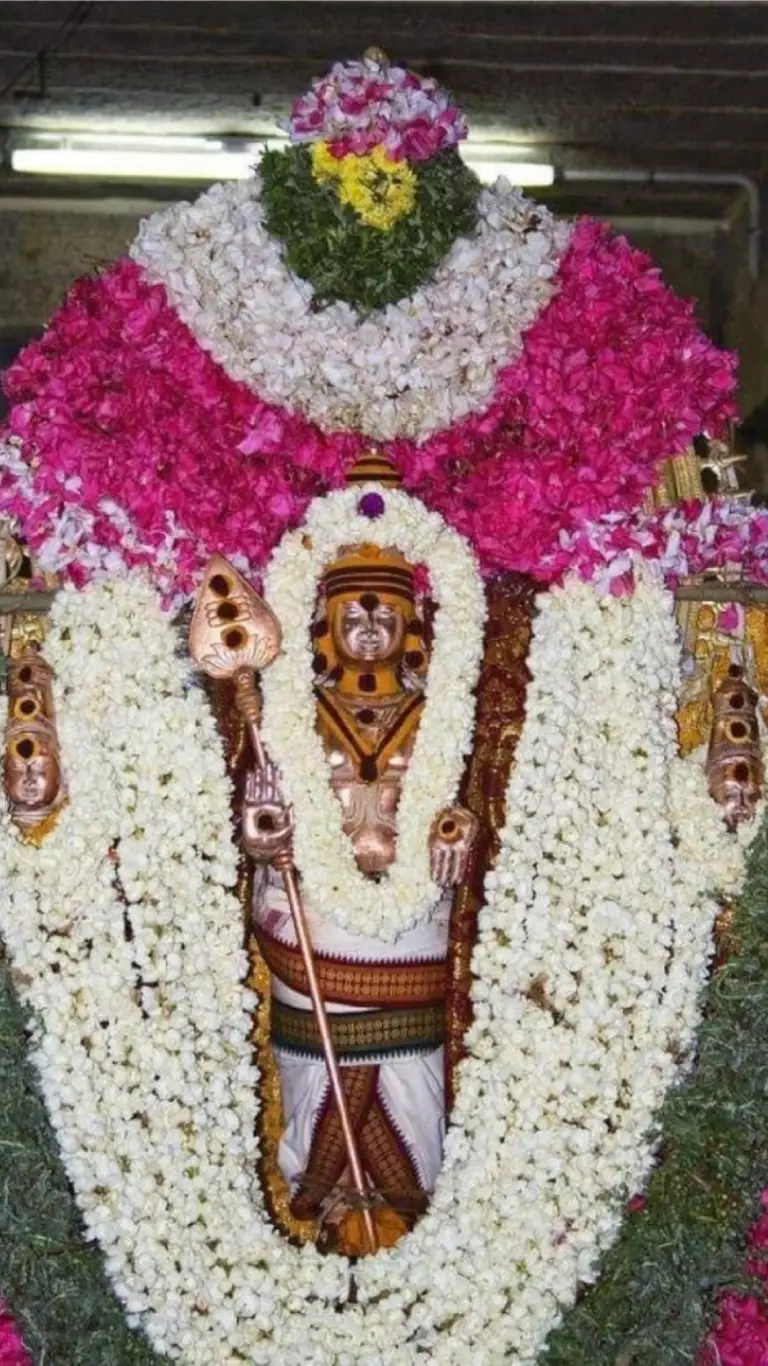
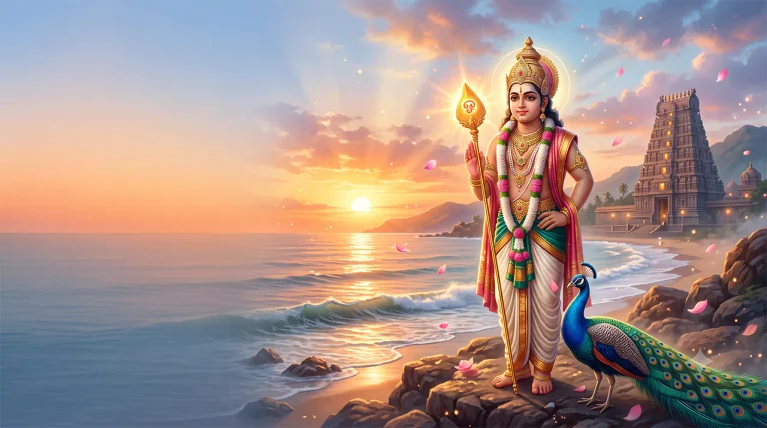
The supreme lord of the temple, depicted in a standing post-battle posture. The natural Swayambhu form rises from the earth, while the adjacent consecrated icon shows Lord Murugan with four arms:
- The upper right hand holds the divine Shakti Ayudha / Vel (the spear representing spiritual wisdom).
- The upper left hand holds the Vajra (thunderbolt).
- The lower right hand displays Abhaya Mudra (the gesture of protection and fearlessness).
- The lower left hand displays Uru Hasta (resting gracefully upon His thigh/hip).
His divine vehicle (Vahana), the Mayil (peacock representing subdued pride), stands behind Him, and the green banner of the rooster (Seval Kodi representing dawn and spiritual awakening) is displayed nearby.
2. Goddess Valli and Goddess Deivanai
Flanking the processional icon within the main shrine are the two divine consorts:
- Deivanai (Devasena): Represents Kriya Shakti (action energy) and celestial order.
- Valli: Represents Iccha Shakti (devotional will/love energy) and the individual human soul seeking divine union.
- Lord Kandaswamy Himself embodies Jnana Shakti (transcendental wisdom).
3. Sri Vaneswarar and Sri Punnyavathi Ambal
Towards the inner circumambulatory path stand independent sanctums for Lord Shiva (revered as Vaneswarar, Lord of the Sacred Forest) and Goddess Parvati (worshipped as Punnyavathi Ambal). This underlines the traditional agamic rule that no major Murugan temple stands without honouring His divine parents.
4. Lord Vinayaka (Ganesha)
Revered at the entrance as Karpaga Vinayakar and Sundara Vinayakar, ensuring obstacle-free darshan for pilgrims before entering the main hall.
5. Bhairavar, Chandikeshwarar, and Navagrahas
The north-eastern quadrant of the outer prakaram houses Lord Bhairava, the sub-shrine for Chandikeshwarar, and a separate enclosure for the Navagrahas (nine planetary deities) oriented according to traditional Shaivite temple norms.
Architecture of Thiruporur Murugan Temple
The Thiruporur Murugan Temple represents a classic embodiment of Dravidian Temple Architecture, exhibiting composite elements from the late Chola, Vijayanagara, and early modern eras.
Architectural Style and Layout
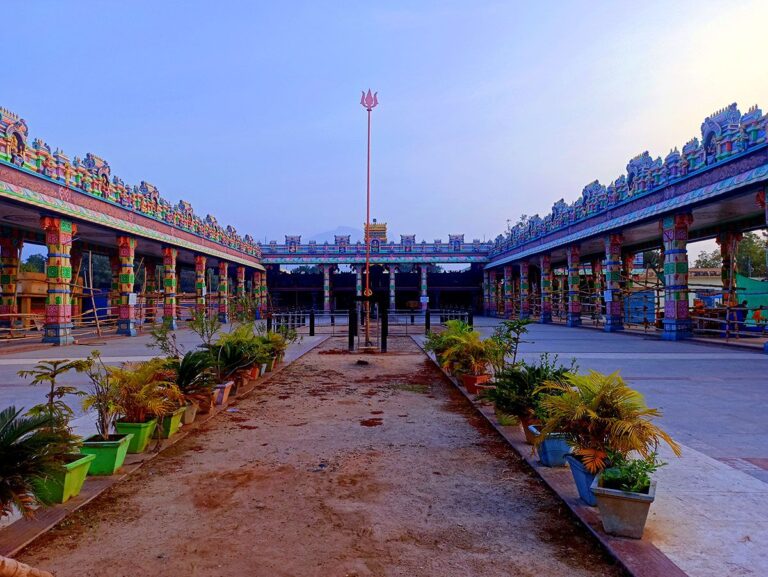
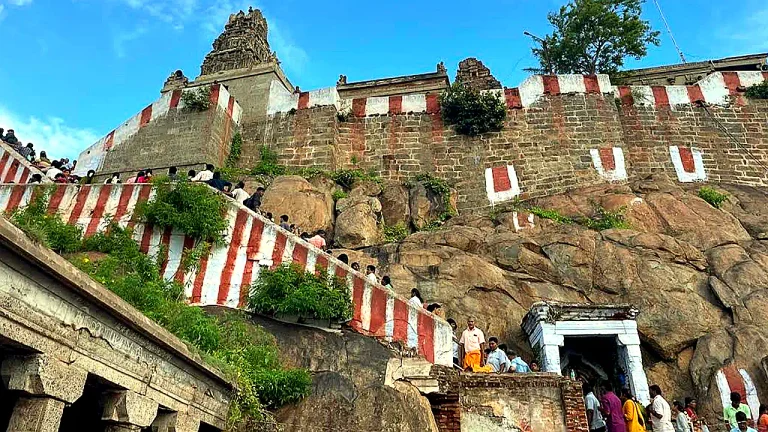
The temple follows an east-facing axial orientation. The entire layout is structured according to the Kamika Agama, featuring concentric rectangular enclosures (Prakarams), massive stone-paved courtyards, raised halls (Mandapams), and high perimeter protective stone walls (Mathil Suvar).
The Rajagopuram (Gateway Tower)
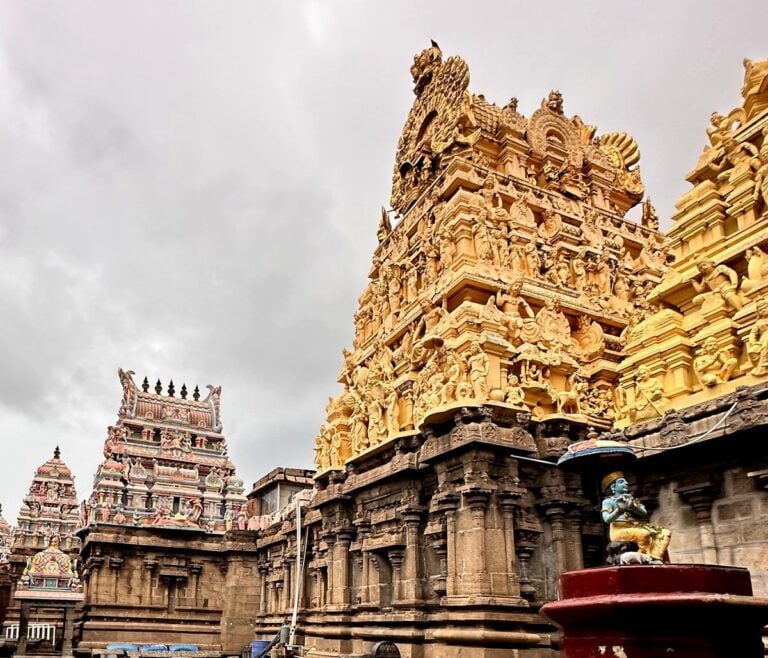
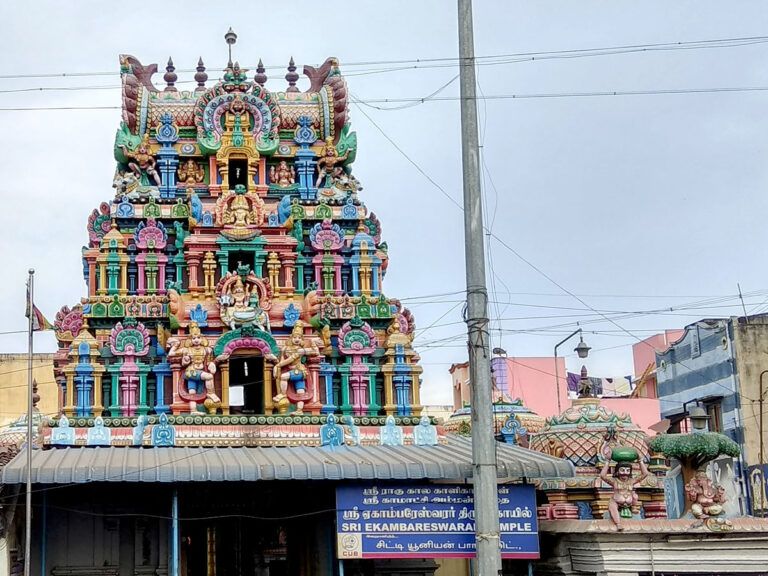
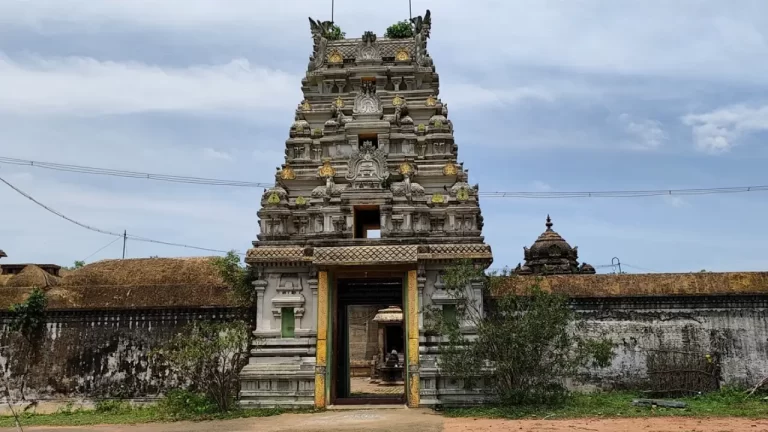
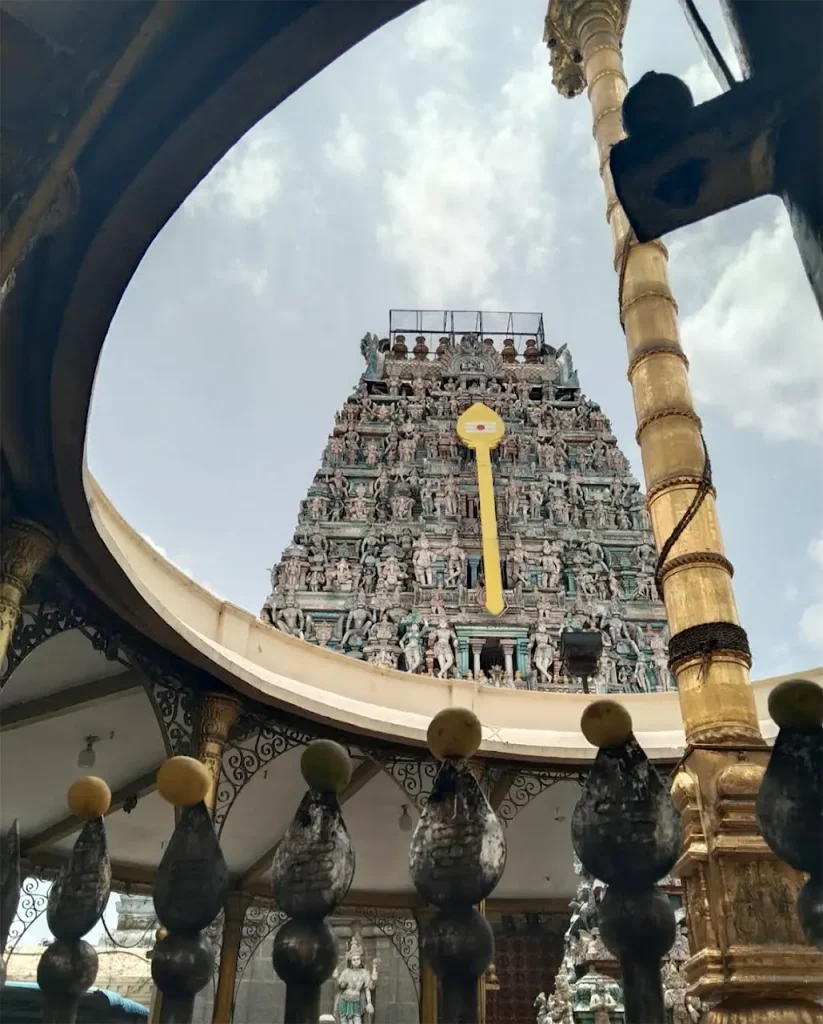
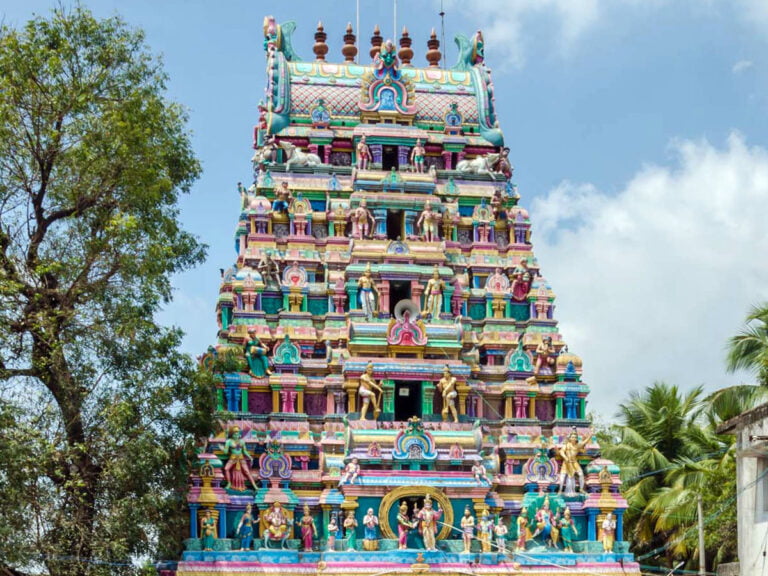
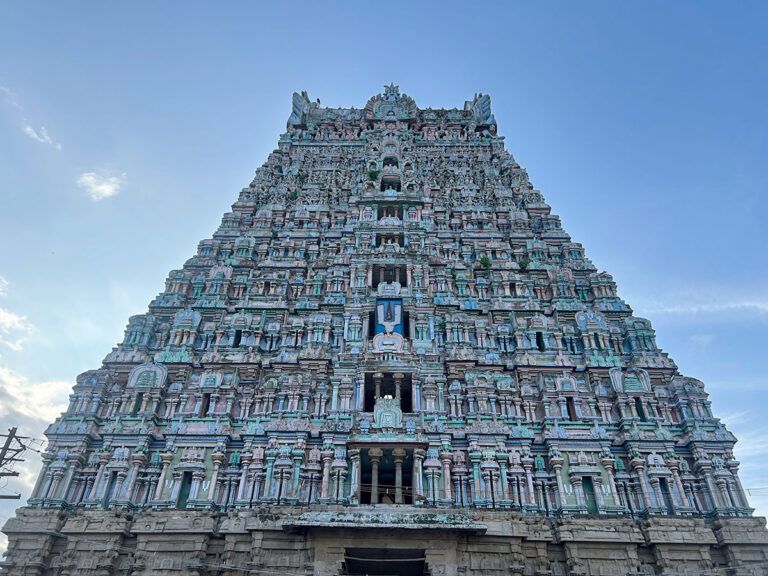
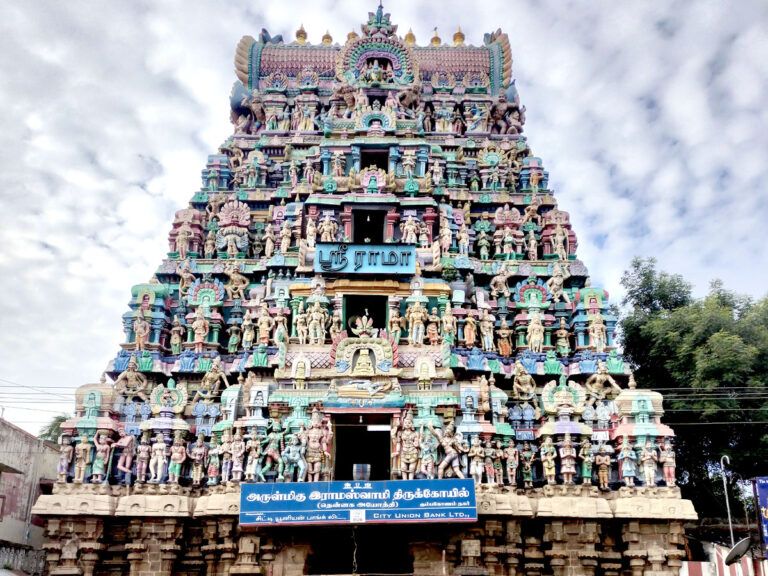
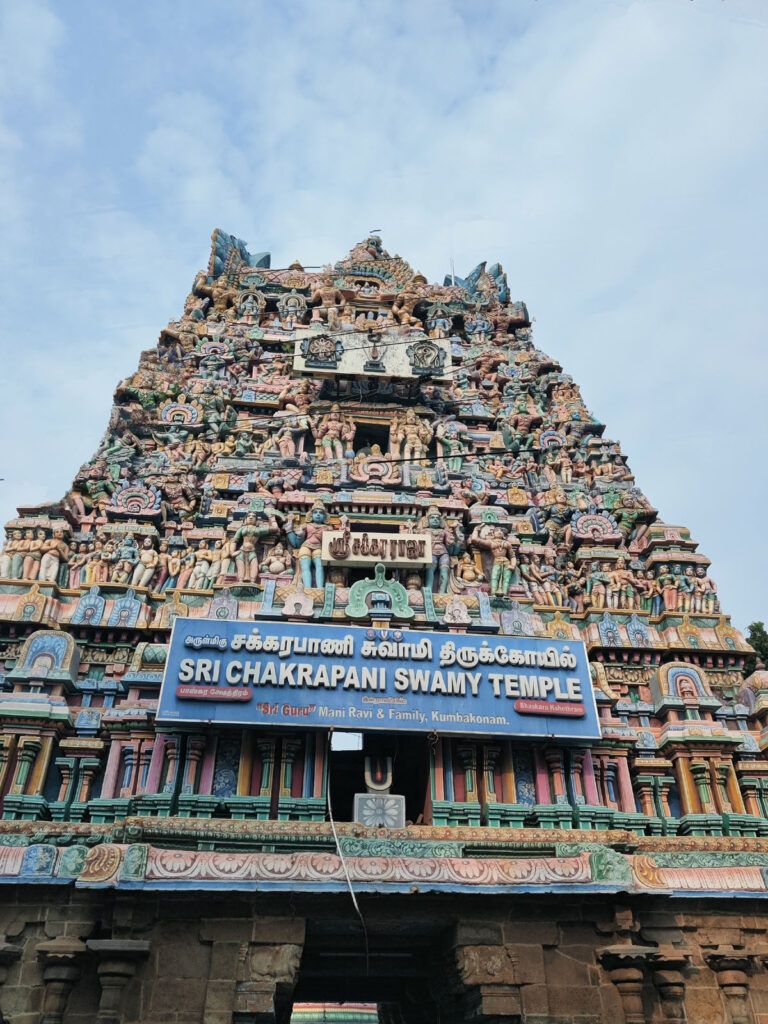
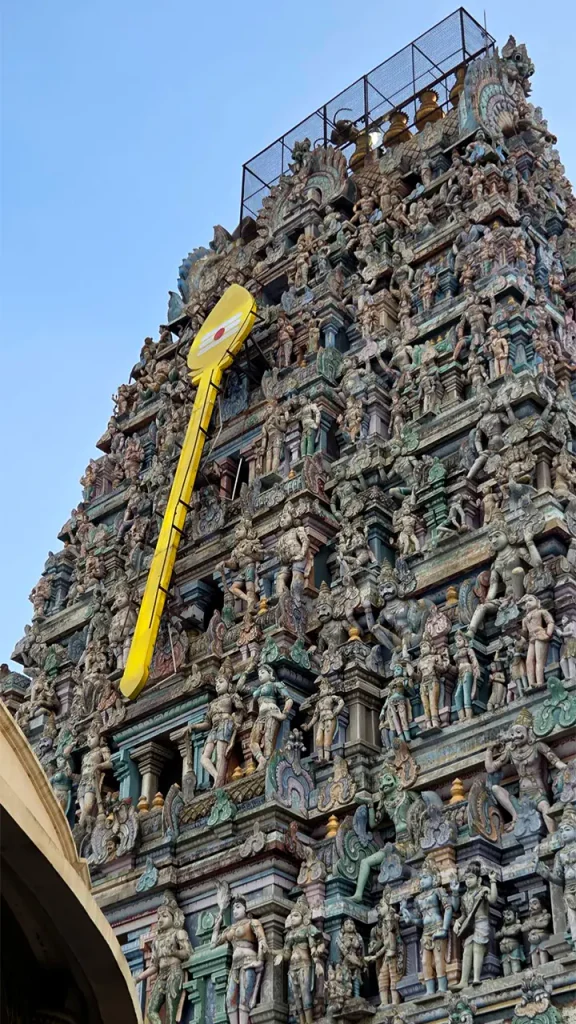
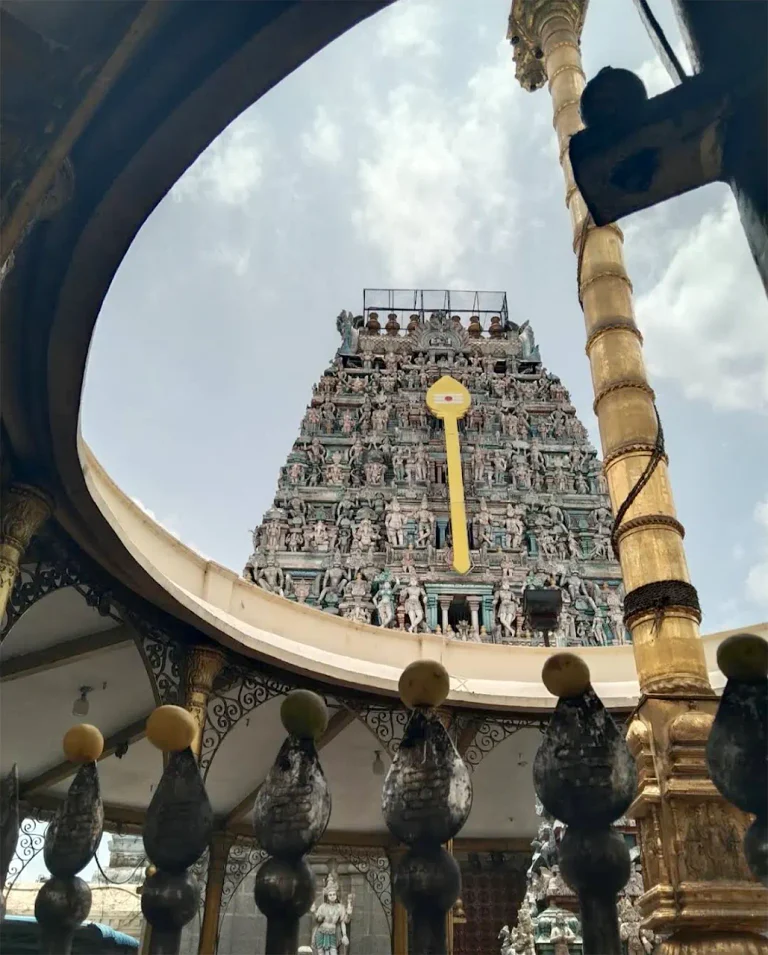
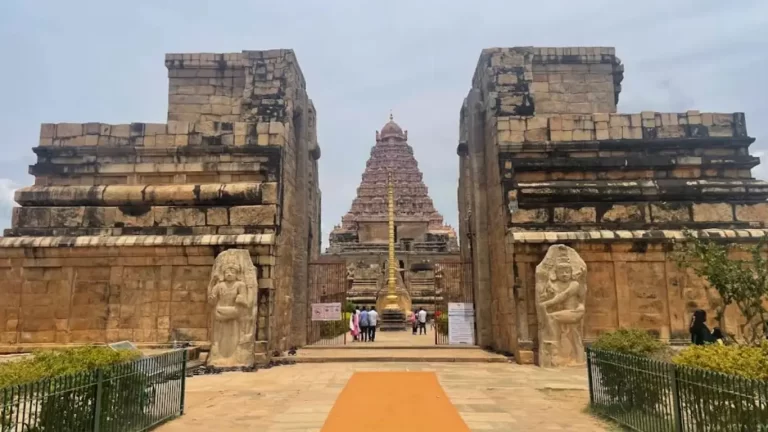
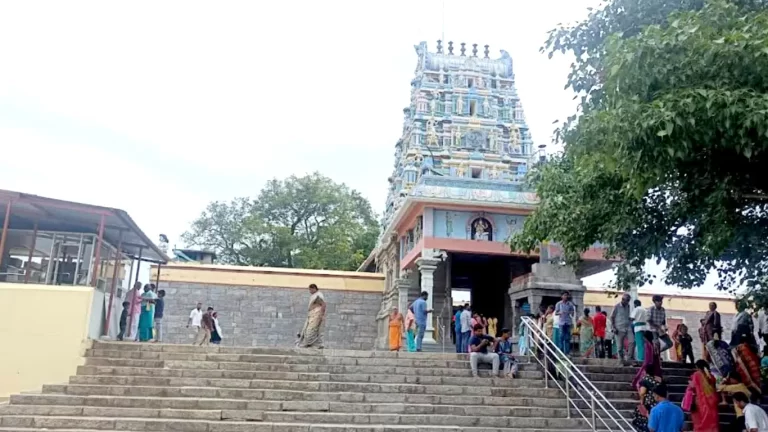
The main entrance is dominated by a majestic seven-tiered Rajagopuram rising to a height of approximately 85 feet. The pyramidal tower features intricate stucco (Sudhai) sculptures depicting various episodes from the Kanda Puranam, including:
- The birth of Kartikeya from the spark of Shiva’s third eye.
- The penance of Goddess Parvati.
- Murugan commanding the celestial army.
- The battle with Surapadman and Tarakasura.
- The celestial wedding of Murugan with Valli and Deivanai.
The Sanctum Sanctorum and Vimana
The Garbhagriha is a square granite cell that maintains a cool, sanctified interior. Directly above the sanctum rises the Kandaswamy Vimana, a stone and stucco pyramidal superstructure crowned by a single gilded metal Kalasa (finial). The outer niches (Koshtas) around the sanctum wall house finely carved figures of Dakshinamurthy, Vishnu, Brahma, and Durga.
Mandapams and Pillars
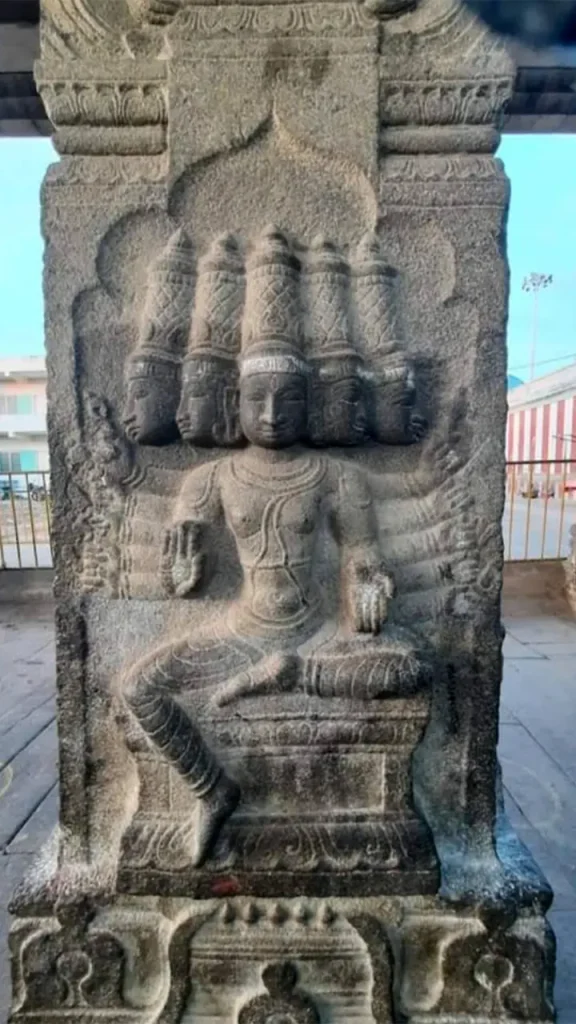
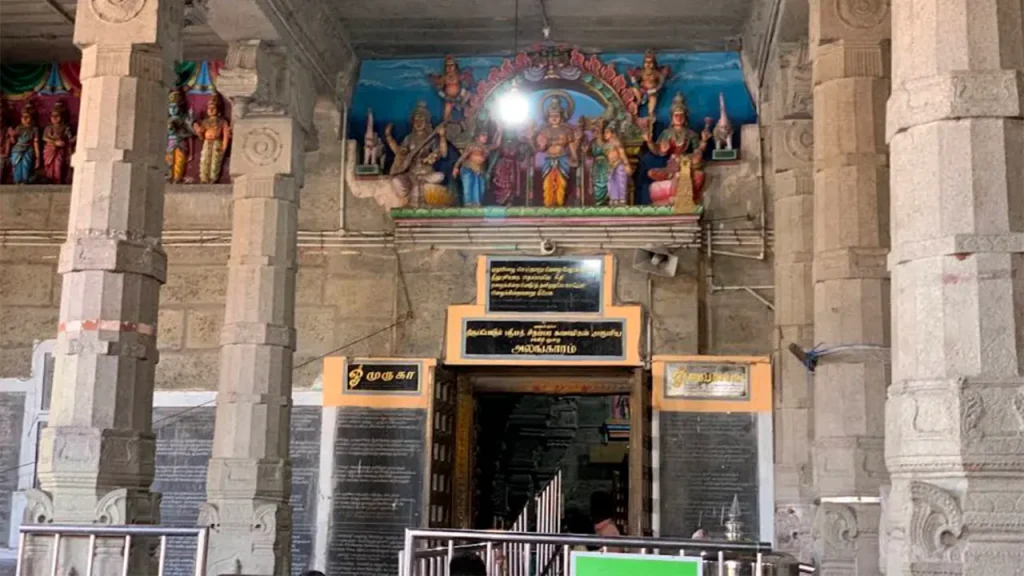
- Maha Mandapam: A grand, pillared hall directly preceding the sanctum, supported by monolithic granite columns featuring high-relief carvings of Yalis (mythical horned beasts resting on elephants), warriors on rearing stallions, and various forms of Lord Subrahmanya (such as Shanmukha with twelve arms).
- Mukha Mandapam: The exterior open hall where devotees gather for congregational worship, illuminated by brass oil lamps suspended from carved stone brackets.
- Kalyana Mandapam: Situated on the northern edge of the outer courtyard, used for conducting ceremonial divine weddings (Thirukalyanam) during major annual festivals.
Temple Tank: The Sacred Theertham
Located immediately opposite the main eastern entrance across the road lies the expansive temple tank, known as Valliyar Odai (or Saravana Poigai). This massive stone-stepped rectangular tank covers several acres, featuring a central decorative stone pavilion (Neeravi Mandapam). Pilgrims traditionally wash their feet and sprinkle its waters on their heads before passing through the Rajagopuram.
What to See Inside Thiruporur Murugan Temple
When stepping through the eastern gateway, follow this comprehensive step-by-step walking sequence to ensure a complete and spiritually rewarding experience:
- The East Rajagopuram Entrance: Pause beneath the towering stone portal to observe the floral relief work carved into the massive granite doorposts.
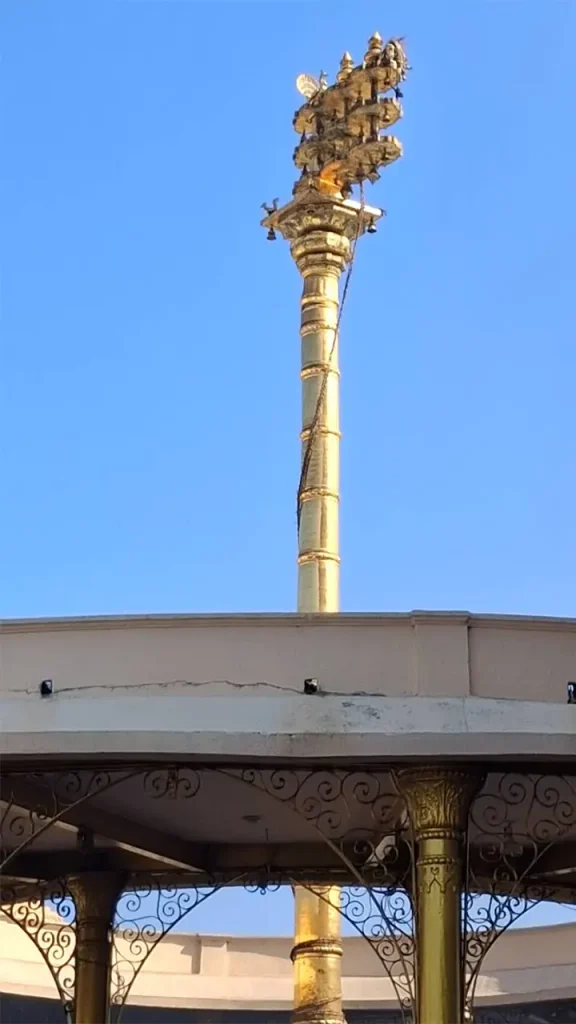
- Dhwajasthambam (Flagstaff) and Bali Peetham: Located in the outer courtyard in direct line with the sanctum. Devotees offer full prostrations (Ashtanga Namaskaram) on the floor here before advancing inwards.
- Deepa Sthambam (Stone Lamp Pillar): A tall monolithic granite pillar where brass lamps are lit during Tuesday, Friday, and Krithigai evenings.
- Sundara Vinayakar Shrine: Offer your initial prayers to Lord Ganesha to remove obstacles during the pilgrimage.
- The Outer Prakaram Walkway: Walk clockwise along the broad, stone-flagged circumambulatory corridor lined with neem and vilva trees.
- Shrine of Lord Shiva (Vaneswarar): Located in the inner cloister, housing a pristine granite Shivalinga facing east.
- Shrine of Goddess Punnyavathi Ambal: The separate shrine for Mother Parvati, radiating maternal grace.
- The Inner Ardha Mandapa: Enter the semi-darkened, incense-scented antechamber leading to the sanctum threshold.
- The Sanctum Sanctorum (Main Darshan): Witness the radiant sight of Sri Kandaswamy, the consecrated Murti with Valli and Deivanai, and the sacred Sri Chakra Yantra shining under rows of flickering pure-ghee brass lamps.
- Chandikeshwarar Shrine: Dedicated to the divine accountant of the temple; clap hands softly and pray in silence to register your visit.
- Navagraha Enclosure: Complete nine circumambulations around the planetary deities to alleviate astrological afflictions.
- The Samadhi Temple of Saint Chidambara Swamigal: Located a short walk (approx. 500 metres) from the main temple complex, this peaceful hermitage houses the sacred tomb of the saint who revived the shrine.
Daily Poojas and Rituals
The Thiruporur Murugan Temple strictly follows the traditional Shaiva-Agamic ritual schedule, conducting worship across six distinct daily periods (Aaru Kala Pooja):
1. Viswaroopa Darshan (06:00 AM – 06:30 AM)
The temple doors open to the resonant sounds of the Nadaswaram (pipe) and Thavil (drum). The deities are awakened, morning hymns are chanted, and the first darshan of the day is offered to devotees.
2. Kalasanthi Pooja (08:00 AM – 09:00 AM)
The morning ritual begins with milk, curd, honey, panchamirtham, and fragrant herbal water Abhishekam to the processional murtis and the Yantra. Fresh flower garlands (Alankaram) are adorned, followed by Naivedyam (food offering) and Deeparadhana.
3. Uchikala Pooja (11:30 AM – 12:00 PM)
The grand midday pooja where elaborate cooked rice offerings (such as curd rice, sambar rice, and sweet pongal) are consecrated and offered. A major camphor arati is waved before the shrine closes for the afternoon break at 12:30 PM.
4. Sayaraksha Pooja (05:30 PM – 06:30 PM)
The evening twilight worship service. The sanctum glows with dozens of oil lamps, aromatic sambrani (benzoin resin) smoke fills the halls, and priests perform archana with continuous chanting of the Sahasranama (thousand names).
5. Rakkalam Pooja (07:30 PM – 08:00 PM)
The post-dusk worship service attended by evening pilgrims returning from work or travels along the OMR corridor.
6. Arthajama Pooja (08:15 PM – 08:30 PM)
The concluding ritual of the night. A special milk offering is made, the divine presence is symbolically escorted to the Palliyarai (sacred resting chamber) accompanied by devotional lullabies, and the sanctum doors are formally locked.
Read More >> Badami Cave Temples: 6CE India’s Ultimate Ancient Adventure
Special Poojas and Devotional Offerings
Devotees can participate in several special individual and congregational rituals at Thiruporur:
- Shatru Samhara Trishati Archana: An intense, powerful ritual where 300 sacred names invoking Lord Murugan’s warrior attributes are chanted with continuous red flower offerings, intended to overcome insurmountable challenges, court cases, and severe mental distress.
- Panchamirtham & Milk Abhishekam: Performed to the bronze Utsava Murti using cow’s milk, honey, sugarcane jaggery, hill plantains, ghee, and cardamom. Devotees collect the consecrated panchamirtham as blessed prasadam.
- Vel Pooja & Metal Spear Offerings: Devotees who take vows (Prarthana) present miniature silver, brass, or copper Vels to the temple authorities to be placed at Lord Kandaswamy’s feet for blessing.
- Kavadi Offerings: Pilgrims carry decorated wooden semicircular arches (Kavadi) decorated with peacock feathers and brass pots of milk (Pal Kavadi) or holy water on their shoulders across miles as an act of ascetic thanksgiving.
- Thanga Theri (Golden Chariot) Procession: Conducted on designated auspicious evenings upon booking through the temple administrative counter, where the processional deity is taken in circumambulation around the prakaram in a splendidly illuminated golden car.


Festivals Celebrated at Thiruporur
The temple celebrates a rich calendar of traditional Tamil festivals with great devotional splendour:
1. Masi Brahmotsavam (February – March)
The grandest annual celebration of the temple, lasting 12 days during the Tamil month of Masi. Highlights include:
- Daily flag hoisting (Dwajarohanam).
- Processions on various animal vehicles (Vahanas) including the silver peacock, elephant, and swan.
- Ther Thiruvizha (Temple Car Festival): The monumental wooden chariot carrying Sri Kandaswamy is drawn by thousands of ecstatic devotees through the four perimeter car streets of Thiruporur.
- Theerthavari (sacred tank immersion ceremony) in the temple tank.
2. Skanda Sashti & Soorasamharam (October – November)
Observed over six days during the waxing phase of the moon in the month of Aippasi. Devotees maintain strict water or fruit fasts. On the sixth evening, the legendary Soorasamharam is re-enacted on the open temple streets, depicting the dramatic annihilation of the demons Tarakasura and Surapadman, followed by the grand Thirukalyanam (celestial marriage) on the seventh day.
3. Thai Poosam (January – February)
A vibrant festival celebrating the occasion when Goddess Parvati handed the victorious Vel to Murugan. Tens of thousands of pilgrims walk barefoot (Pada Yatra) from Chennai, Kanchipuram, and Chengalpattu carrying milk pots and floral Kavadis into the shrine.
4. Vaikasi Visakam (May – June)
Commemorates the incarnation day of Lord Murugan. Continuous cooling Abhishekas with tender coconut water, sandalwood paste, and rose water are conducted throughout the day to soothe the fiery energy of the deity during peak summer.
5. Monthly Krithigai and Sashti Days
Every month on the day of the Karthigai / Krithigai star and Shukla Paksha Sashti tithi, the temple witnesses substantial pilgrim footfalls, continuous homams, and special evening silver chariot processions.
Best Time to Visit and Crowd Management
Climate and Seasonality
- Ideal Season (October to March): Winter months offer pleasant temperatures (22°C to 29°C) and breezy coastal weather, making it comfortable to navigate the outdoor granite courtyards.
- Summer Season (April to June): Extremely hot and humid (temperatures crossing 38°C). The stone floors inside the temple courtyards become very warm by 10:30 AM; visitors are advised to finish morning darshan before 09:00 AM.
Managing Crowd Footfalls
- Fastest Darshan: Monday, Wednesday, and Thursday mornings between 07:00 AM and 09:30 AM usually take under 20 minutes from entrance to exit.
- Peak Congestion: Expect long queues stretching outside the Rajagopuram during Monthly Krithigai, Sashti, New Year’s Day, Thai Pongal, and weekends. On these days, opt for special paid queue lines managed by HR&CE if traveling with small children or seniors.
Temple Timings and Schedule
The temple maintains consistent operating hours throughout the year, with extensions during major festivals and auspicious days:
Standard Daily Timings
- Morning Session: 06:00 AM to 12:30 PM
- Afternoon Break: 12:30 PM to 03:30 PM (Sanctum closed)
- Evening Session: 03:30 PM to 08:30 PM
Special Timings on Auspicious Days
On Monthly Krithigai, Sashti, Thai Poosam, and during Brahmotsavam, the temple remains open continuously without the afternoon break, typically operating from 05:00 AM to 09:30 PM.
Note: Temple timings can change on festival days, solar/lunar eclipses, and special administrative occasions. Visitors should verify the latest schedule locally before travelling.
Dress Code and Temple Etiquette
The temple enforces traditional clothing norms set by the Hindu Religious and Charitable Endowments (HR&CE) Department of Tamil Nadu:
Approved Clothing
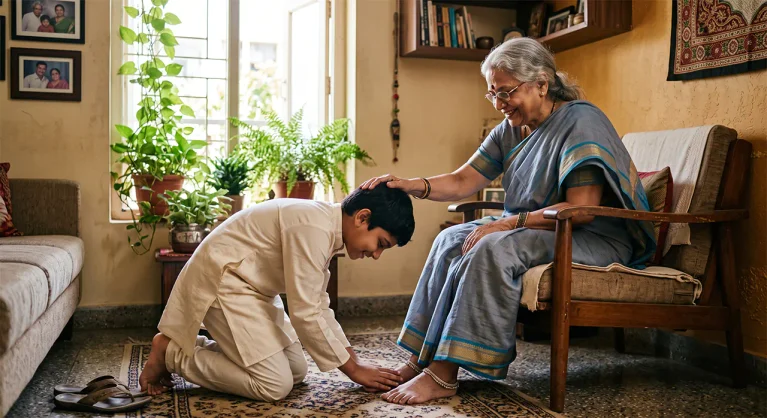
- For Men: Traditional Dhoti (Veshti) with an Angavastram (upper cloth) or a modest Kurta-pyjama. While shirts are permitted, men are traditionally encouraged to remove shirts or keep their chests uncovered when entering the inner Garbhagriha corridor during special abhishekam.
- For Women: Traditional Saree, half-saree, or Salwar Kameez / Churidar with a properly draped dupatta.
- For Children: Modest traditional Indian wear or standard casual clothing with full coverage.
Strictly Prohibited Items and Attire
- Western leisure casuals such as shorts, mini-skirts, sleeveless tops, lungis, ripped jeans, and tight sportswear are strictly not permitted.
- Footwear: Strictly forbidden beyond the entrance gates. Designated free and token-based shoe stands operate outside the eastern Rajagopuram.
- Photography & Videography: Mobile phones must be kept on silent mode. Photography and video recordings inside the sanctum sanctorum are strictly prohibited by law.
How to Reach Thiruporur Murugan Temple
Thiruporur is exceptionally well connected via high-speed road networks directly linking Chennai and other major cultural hubs in northern Tamil Nadu.
1. By Road
Thiruporur lies right on the Old Mahabalipuram Road (OMR / SH-49A), also known as the Rajiv Gandhi IT Expressway corridor.
- From Chennai Central / City Centre (~45 km): Drive straight down Rajiv Gandhi Salai (OMR) passing through Thoraipakkam, Sholinganallur, Siruseri IT Park, and Kelambakkam to reach Thiruporur town center.
- From East Coast Road (ECR): Take the diversion at Kovalam junction onto the Kovalam–Kelambakkam Link Road and proceed 7 km south to Thiruporur.
- By Bus (MTC & TNSTC): Regular Metropolitan Transport Corporation (MTC) city buses connect Chennai city directly to Thiruporur bus terminus:
- Route 102: Broadway (Chennai Central) to Thiruporur
- Route 519: T. Nagar to Thiruporur
- Route 570 / 570V: CMBT (Koyambedu) to Thiruporur / Kelambakkam
- Frequent government buses (TNSTC) operating from Tambaram, Chengalpattu, and Kanchipuram stop right outside the temple gate.
2. By Train
- Nearest Major Station: Chengalpattu Junction (CGL) – Approx. 26 km west. Frequent auto-rickshaws, shared taxis, and direct TNSTC buses connect Chengalpattu station to Thiruporur (approx. 40 minutes travel time).
- Tambaram Railway Station (TBM) – Approx. 30 km north-west. Ideal for suburban train connections from Chennai Central and Egmore; direct MTC buses run frequently from Tambaram bus stand to Thiruporur.
3. By Air
- Chennai International Airport (MAA) is the closest airport, situated approximately 40 km away. Pre-paid airport taxis, app-based cabs (Uber/Ola), and rental cars can reach Thiruporur in 60 to 75 minutes via the Outer Ring Road / Vandalur-Kelambakkam corridor.
Entry Fees, Facilities, and Infrastructure
| Facility / Service | Availability & Approximate Costs |
| General Admission | Free for all devotees |
| Special Quick Darshan | ₹20 to ₹100 per person (available at official HR&CE counters during peak days) |
| Special Archana | ₹5 to ₹25 (inclusive of camphor and flower prasadam) |
| Footwear Stand | Available near the eastern Rajagopuram (Nominal charge of ₹2–₹5 per pair) |
| Prasadam Stall | Official HR&CE stall selling Puliyodarai (Tamarind Rice), Laddu, and Panchamirtham |
| Annadanam | Free daily midday meals provided to hundreds of pilgrims under the Tamil Nadu Government Annadanam Scheme (12:15 PM daily) |
| Vehicle Parking | Dedicated municipal and temple parking lots situated 150m from the East Gopuram (₹20 for two-wheelers; ₹50–₹100 for four-wheelers) |
| Restrooms | Clean, pay-and-use public restrooms situated near the bus stand and parking zone |
Accessibility and Guidance for Senior Citizens
The temple administration has made significant adjustments to accommodate senior citizens and visitors with physical challenges:
- Level Entrances: The eastern Rajagopuram courtyard is mostly flat with stone flagstones. Ramps are installed at the primary mandapam entrance to bypass steps.
- Wheelchair Access: Wheelchairs can generally be navigated through the outer prakaram up to the entrance of the Maha Mandapam. Entering the innermost Ardha Mandapam requires stepping over low traditional stone thresholds (Vasalpadigal).
- Seating Provisions: Stone benches and covered queue corridors with fans are situated along the outer prakaram for elderly pilgrims to rest during busy festival days.
- Priority Queue for Elderly: During heavy weekends, temple guards and volunteers assist senior citizens and disabled devotees through dedicated entry points near the main gate.
Dos and Don’ts for Pilgrims
Dos
- Do wash your feet and hands at the water taps before entering the sacred temple precincts.
- Do dress strictly in modest, traditional Indian attire adhering to the dress guidelines.
- Do complete a clockwise circumambulation (Pradakshina) around the outer prakaram before proceeding into the inner sanctum.
- Do maintain silent contemplation and queue discipline inside the Ardha Mandapam.
- Do accept holy ash (Vibhuti) and vermillion (Kumkum) using your right hand only.
- Do visit the Samadhi shrine of Saint Chidambara Swamigal nearby to pay respect to the master who revived the temple.
Don’ts
- Do not wear western leisure casuals like shorts, skirts, or sleeveless shirts inside the temple.
- Do not enter the temple complex carrying leather bags, belts, or footwear.
- Do not take photographs or record videos of the deities inside the Garbhagriha.
- Do not touch the stone murtis, yantras, or sacred brass vahanas inside the mandapams.
- Do not consume outside food or litter plastics inside the temple courtyards.
- Do not use mobile phones or speak loudly within the sanctum enclosures.
What Makes Thiruporur Murugan Temple Special?
Thiruporur Murugan Temple is distinct from the hundreds of other Murugan shrines across Tamil Nadu for several compelling reasons:
- The Physical Climax of the Surasamharam: In Tamil Shaivite cosmology, while Tiruchendur marks the oceanic battlefield, Thiruporur marks the culmination of the earthly warfare where physical elemental resistance (Tarakasura) was finally dissolved.
- The Undisturbed Swayambhu Hillock: Unlike temples where an artisan meticulously shaped the central murti out of quarried granite, Kandaswamy here emerged organically from the earth, resting permanently upon its native soil bed.
- The Living Power of the Sri Chakra Yantra: The installation of the energized Yantra by Saint Chidambara Swamigal gives this temple the unique status of being an esoteric center of spiritual healing, planetary remedy, and mantra sadhana.
- Integration of Shaivite and Kaumara Philosophy: The campus harmoniously integrates dedicated shrines for Lord Shiva and Goddess Parvati alongside their warrior son, reinforcing the unity of cosmic wisdom and dynamic power.
- Proximity to Historic Maritime & Cultural Centers: Its strategic position along the historic trade route linking ancient Pallava ports (Mamallapuram) with inland capitals makes it a quintessential representation of Thondai Nadu temple heritage.
Places to Visit Near Thiruporur
Pairing your visit to Thiruporur with surrounding cultural and historical attractions creates a well-rounded day excursion:
Nearby Pilgrimage and Spiritual Sites
- Saint Chidambara Swamigal Samadhi Mutt (Thiruporur town – 500m): The peaceful, sanctified resting place of the saint who revived the temple. Ideal for quiet meditation and understanding the history of the Thiruporur Adheenam.
- Tirukazhukundram Sri Vedagiriswarar Temple (~22 km south-west): A famed ancient hilltop Shiva temple where two sacred eagles traditionally landed at noon for feeding, carrying deep Chola and Pallava historical roots.
- Nithya Kalyana Perumal Temple, Thiruvidanthai (~15 km north-east on ECR): One of the 108 sacred Divya Desams dedicated to Lord Vishnu (Varaha Avatar), renowned as a major pilgrimage center for matrimonial prayers.
Historical and Cultural Attractions
- Mamallapuram (Mahabalipuram) (~16 km south): A world-renowned 7th-century UNESCO World Heritage site showcasing rock-cut cave temples, monolithic Rathas, the dramatic Shore Temple, and the monumental open-air relief Arjuna’s Penance.
- DakshinaChitra Living History Museum (~18 km north): A celebrated open-air heritage museum showcasing authentic restored heritage homes, craft workshops, and folk traditions of Tamil Nadu, Kerala, Karnataka, and Andhra Pradesh.
Nature and Family Attractions
- Madras Crocodile Bank Trust and Centre for Herpetology (~14 km north-east): One of the largest reptile breeding zoos in the world, dedicated to the conservation of crocodiles, alligators, and native turtles.
- Covelong (Kovalam) Beach (~12 km north-east): A serene coastal beach village known for calm waters, water sports, and seaside dining options.
Practical One-Day Pilgrimage Itinerary
Here is a geographically sensible, time-tested one-day itinerary starting from Chennai:
- 06:30 AM – 07:45 AM: Depart Chennai via the Old Mahabalipuram Road (OMR). Stop for a traditional South Indian breakfast (idli, vadai, filter coffee) at Kelambakkam.
- 08:00 AM – 10:00 AM: Arrive at Thiruporur Murugan Temple. Deposit footwear, complete Pradakshina, and attend the morning Kalasanthi darshan and special archana. Purchase prasadams at the counter.
- 10:15 AM – 11:15 AM: Walk down to the nearby Saint Chidambara Swamigal Samadhi Mutt for 30 minutes of quiet meditation and scriptural exploration.
- 11:30 AM – 12:00 PM: Drive south along OMR for 16 km to reach Mamallapuram.
- 12:15 PM – 01:30 PM: Enjoy a relaxed coastal lunch at one of Mamallapuram’s traditional South Indian or seafood restaurants.
- 02:00 PM – 04:30 PM: Explore the monolithic wonders of Mamallapuram: the Five Rathas (Pancha Pandava Rathas), Arjuna’s Penance, and the historic Shore Temple overlooking the Bay of Bengal.
- 05:00 PM – 06:30 PM: Drive north along the picturesque East Coast Road (ECR), making a brief sunset stop at Covelong (Kovalam) Beach or visiting the Thiruvidanthai Nithya Kalyana Perumal Temple.
- 07:00 PM – 08:00 PM: Smooth return drive into Chennai city via ECR or OMR.
Visiting Thiruporur Murugan Temple for the First Time?
If you have never visited this sacred temple before, follow this straightforward walkthrough:
- Before You Leave: Dress in traditional Indian attire (dhoti/kurta or saree/salwar). Keep small cash denominations handy for parking, shoe counters, and temple archana tickets.
- Arrival & Parking: Follow the signboards along OMR into the town of Thiruporur. Turn into the dedicated temple parking lot situated just east of the temple tank.
- Footwear Deposit: Leave your footwear at the authorized token stall located right near the entrance of the Rajagopuram. Never leave shoes unattended along the street.
- Entering the Gateway: Step over the granite threshold with your right foot. Take a moment to admire the massive gopuram carvings above.
- Selecting Your Darshan Queue: On weekdays, walk directly into the Free Darshan line. On busy weekends or festival days, look for the designated Special Darshan counter (₹20–₹100) to minimize waiting time.
- Inside the Sanctum: As you approach the Garbhagriha, fold your hands in reverence. Look first at the radiant Swayambhu murti, followed by the consecrated murtis of Murugan with Valli and Deivanai, and the sacred Sri Chakra Yantra to the side.
- Accepting Prasadam: Receive the blessed holy ash (Vibhuti) with your right hand. Apply a small amount to your forehead using your ring finger and thumb.
- Sub-Shrines & Parikrama: Complete your walk around the inner courtyard to pay respects at the Shiva, Parvati, Vinayaka, and Navagraha shrines.
- Prasadam Purchase: Stop at the official temple counter near the exit to buy freshly prepared Puliyodarai (tamarind rice) or sweet Laddus to take home.
- Samadhi Visit: Before leaving town, drive or walk 500 meters to the Chidambara Swamigal Samadhi for a peaceful conclusion to your pilgrimage.
Frequently Asked Questions About Thiruporur Murugan Temple
1. Where is Thiruporur Murugan Temple located?
Thiruporur Murugan Temple (Arulmigu Kandaswamy Temple) is located in Thiruporur town along the Old Mahabalipuram Road (OMR / SH-49A) in the Chengalpattu district of Tamil Nadu, roughly 45 km south of Chennai.
2. What are the daily temple timings at Thiruporur?
The temple is open daily from 06:00 AM to 12:30 PM in the morning and from 03:30 PM to 08:30 PM in the evening. Timings are extended on festival days and monthly Krithigai.
3. What is Thiruporur Murugan Temple famous for?
The temple is famous for its self-manifested (Swayambhu) earthen idol of Lord Murugan, the energized copper Sri Chakra Subrahmanya Yantra installed by Saint Chidambara Swamigal, and as the sacred battlefield where Murugan defeated Tarakasura on land.
4. Who is the presiding deity of the temple?
The presiding deity is Lord Murugan, worshipped here in His majestic warrior aspect as Sri Kandaswamy, flanked by His consorts Goddess Valli and Goddess Deivanai.
5. Why is Abhishekam not performed directly on the main idol?
The primary Swayambhu idol is naturally composed of earthen stone and sand. To prevent erosion and preserve its natural form, ritual libations (Abhishekam) are performed only on the adjacent consecrated granite deity and the Sri Chakra Yantra.
6. What is the dress code for visiting the temple?
Traditional Indian dress is required. Men should wear a dhoti with angavastram or kurta-pyjama. Women must wear a saree, half-saree, or salwar kameez with a dupatta. Western casuals like shorts and mini-skirts are prohibited.
7. Which are the most crowded days to visit?
The busiest days are Monthly Krithigai, Shukla Paksha Sashti, Tuesdays, Sundays, and major annual festivals such as Thai Poosam, Skanda Sashti, and Masi Brahmotsavam.
8. What is the best time of the week for a peaceful darshan?
Monday, Wednesday, and Thursday mornings between 07:00 AM and 09:30 AM offer the quietest and fastest darshan experience.
9. Is there an entry fee to enter the temple?
General admission (Dharma Darshan) is completely free. Special fast-track queue tickets are available at official counters during peak days for ₹20 to ₹100.
10. How can I reach Thiruporur from Chennai by public transport?
You can take direct MTC buses from Chennai, including Route 102 (from Broadway/Chennai Central), Route 519 (from T. Nagar), and Route 570 (from CMBT Koyambedu), which stop right near the temple.
11. What is the nearest railway station to Thiruporur?
Chengalpattu Junction (CGL, ~26 km) and Tambaram Railway Station (TBM, ~30 km) are the closest major railway hubs.
12. What is the nearest airport to the temple?
Chennai International Airport (MAA), situated approximately 40 km away via the OMR and Vandalur-Kelambakkam link roads.
13. Is parking available near the temple?
Yes, organized municipal and temple parking lots for two-wheelers and four-wheelers are available within 150 meters of the eastern Rajagopuram.
14. Is photography allowed inside Thiruporur Murugan Temple?
Photography and videography inside the inner mandapams and sanctum sanctorum are strictly prohibited. Exterior photography of the Rajagopuram and temple tank is generally permitted.
15. Are there good restaurants and food facilities nearby?
Yes, traditional vegetarian restaurants, South Indian tiffin centers, and modern highway food plazas line the OMR corridor within 1 to 3 km of the temple town.
16. Is the temple accessible for elderly visitors and wheelchair users?
Yes, the outer courtyards have level stone pathways and entrance ramps. However, crossing into the inner sanctum requires negotiating a few low stone thresholds where physical assistance may be helpful.
17. What are the key festivals celebrated here?
Major festivals include the 12-day Masi Brahmotsavam (February/March), Skanda Sashti with Soorasamharam (October/November), Thai Poosam (January/February), and Vaikasi Visakam (May/June).
18. Who was Saint Chidambara Swamigal?
Saint Chidambara Swamigal was a 17th-century Shaivite mystic who unearthed the buried Swayambhu idol of Lord Kandaswamy, re-established the temple structure, consecrated the Sri Chakra Yantra, and composed renowned Tamil devotional hymns.
19. What special prayers are performed for removing obstacles?
Devotees perform the Shatru Samhara Trishati Archana, offer metal Vels (spears), and carry milk Kavadis to seek relief from legal disputes, health issues, and planetary doshas.
20. What other attractions can be visited along with Thiruporur?
You can easily combine your visit with the UNESCO World Heritage monuments at Mamallapuram (16 km), the Chidambara Swamigal Samadhi (500 m), and the coastal beaches along the East Coast Road (ECR).
Conclusion: Why Thiruporur Murugan Temple Is Worth Visiting
Thiruporur Murugan Temple stands as a magnificent testament to Tamil Nadu’s enduring spiritual heritage, classical architecture, and living devotional traditions. Far more than just a convenient highway stop along Chennai’s IT corridor, it is a sanctified battlefield where the symbolic victory of divine wisdom over earthly ego continues to be celebrated daily through agamic rituals, continuous chants of the Tiruppugazh, and deep-rooted community faith.
From its ancient origins and the 17th-century revival by Saint Chidambara Swamigal to the mystic resonance of the Sri Chakra Yantra and the soaring heights of its Dravidian Rajagopuram, Thiruporur offers an enriching pilgrimage experience for families, spiritual seekers, and cultural travellers alike. As you step out of the sanctum into the breezy outer prakaram with holy vibhuti on your brow, the profound peace and historical depth of this ancient abode of Lord Kandaswamy leave an indelible impression on the heart.