Bhimashankar Temple: 6th Jyotirlinga – Lions Seek Blessings
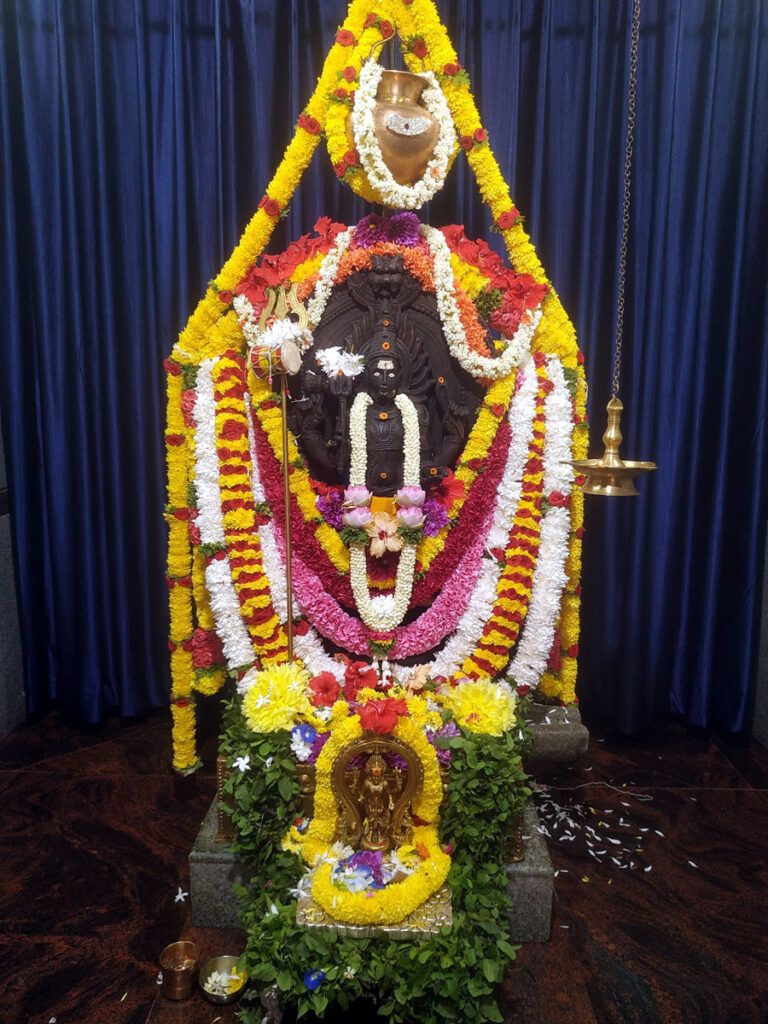
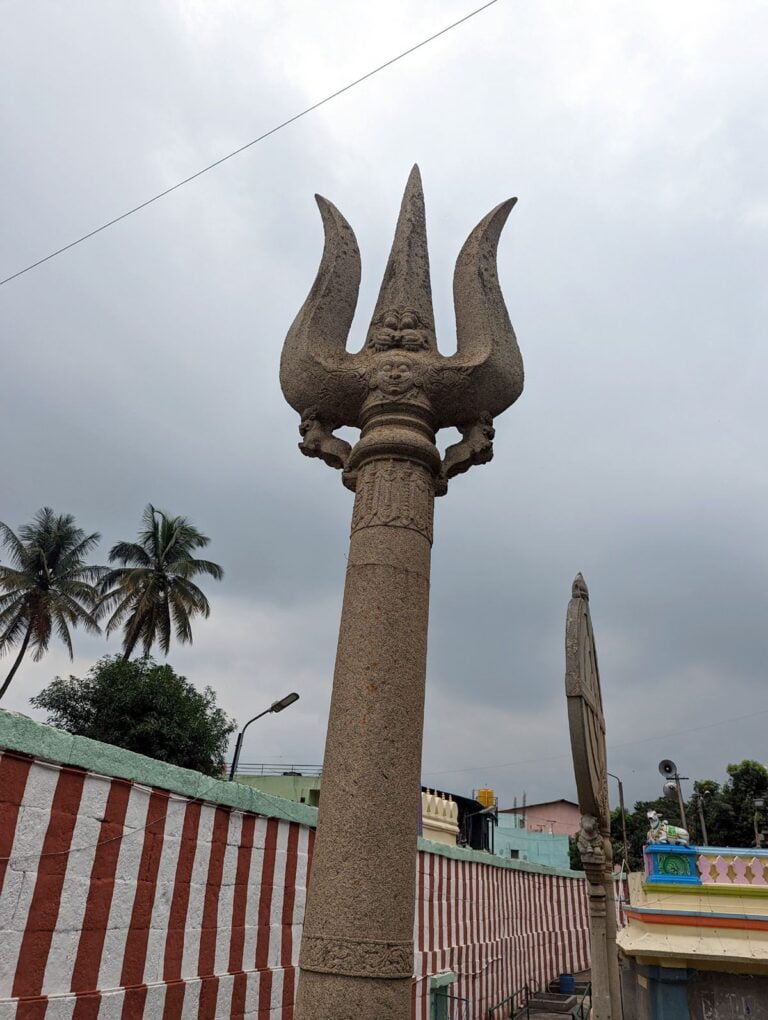
Bhimashankar Temple: Located deep inside the thick forests of the Sahyadri hills in the Pune district of Maharashtra, this is not merely a temple; it is a sacred home, a historical wonder, and a paradise of natural beauty all mixed together in one. I guarantee as your private guide that you’ll depart with a heart full of piety and a mind full of intriguing anecdotes.
Miracle:
You find many wild lives in the forest area and are known for lions. There are also innumerable medicinal herbs. It is said that lions from the forests come to the shrine every night and take the Lord’s blessings.
The Sacred Abode: Bhimashankar Temple
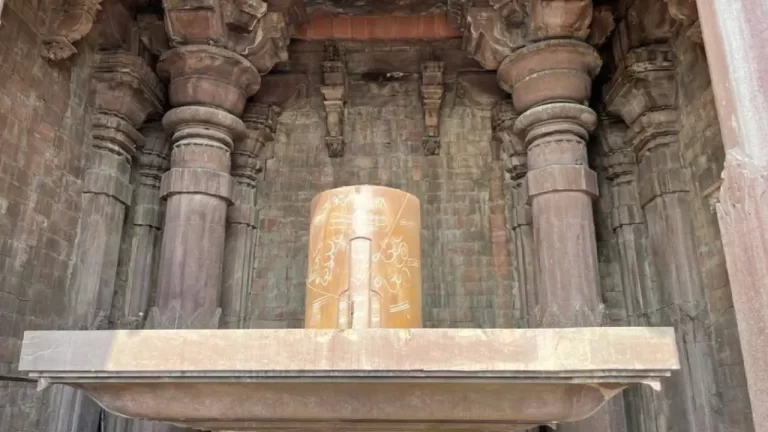
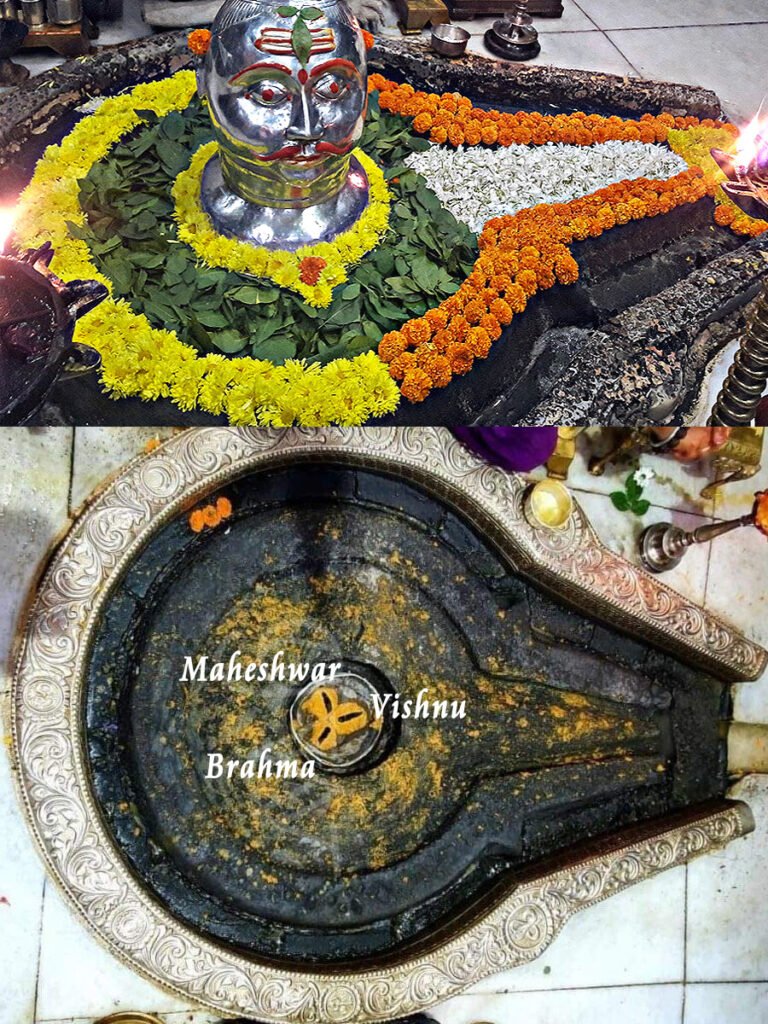
When we mention the Bhimashankar Temple, we are talking about a site of great heritage in Hinduism. It is one of the twelve Jyotirlingas – the luminous forms of Lord Shiva. Picture this, a column of spiritual radiance that resulted from the earth itself! The name Bhimashankar itself inspires awe and serenity, speaking of Lord Shiva in his powerful yet compassionate avatar. Situated at a height of approximately 3,250 feet above sea level, it actually feels like heaven touching the earth.
History of the Temple: Centuries of Devotion Etched in Stone
The Bhimashankar Temple’s history is as fascinating as that of its natural environment. Although the precise origins of the original structure are the subject of historical dispute, most believe that the temple’s core is at least 800 years old, dating back to the early 13th century. Picture all the generations of pilgrims who have trodden these same steps!
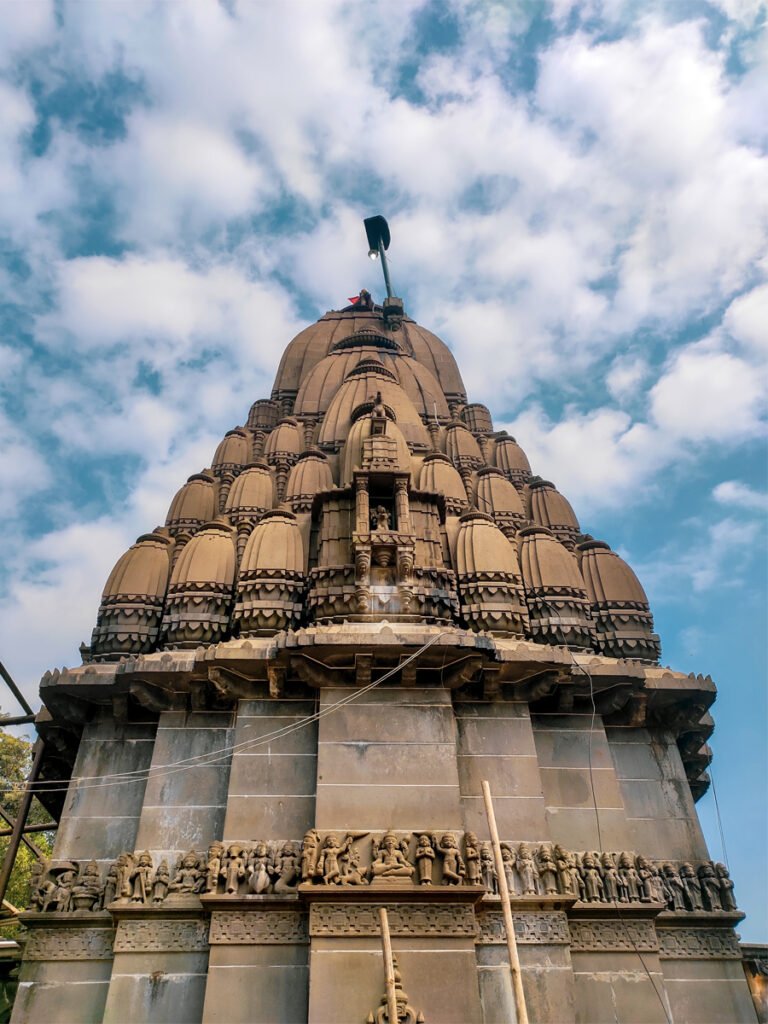
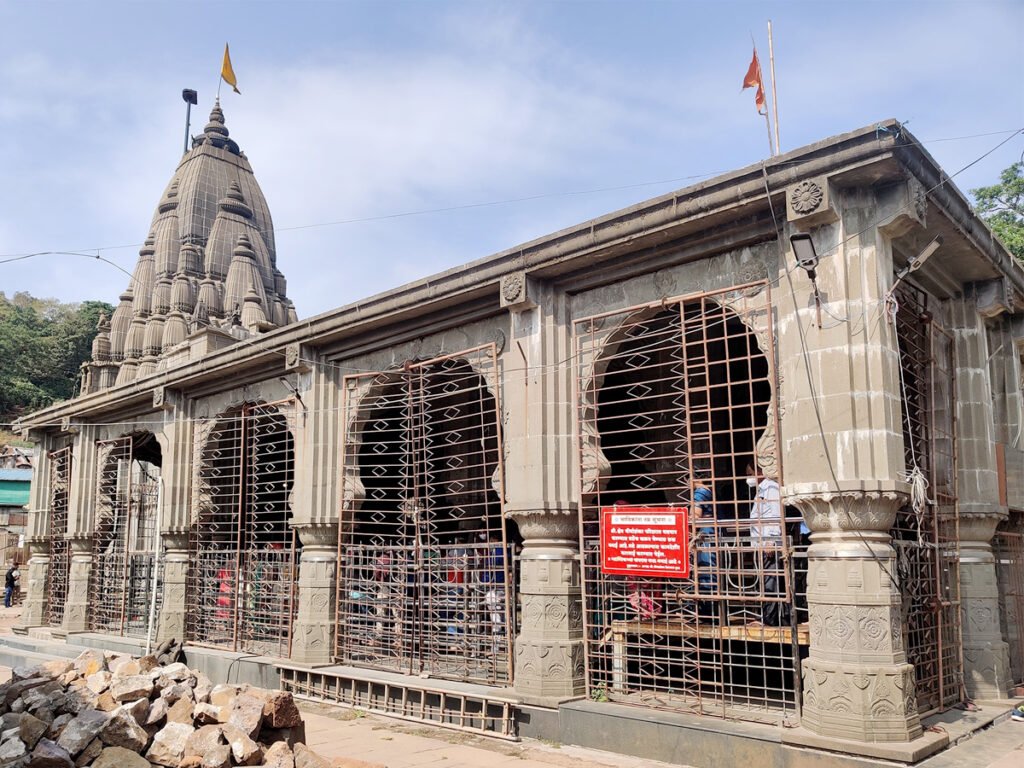
The temple, as we predominantly observe it nowadays, is influenced by the Nagara style of architecture, a separate North Indian temple building art, with some features of the Hemadpanthi style, a common architecture in Maharashtra during the Yadava era (12th-13th centuries). It’s an exquisite mix of art and faith.
One of the greatest additions to the temple’s current shape was made by the Maratha Empire. Chhatrapati Shivaji Maharaj, the great Maratha king, is said to have donated for the upkeep and worship at the temple, realizing its phenomenal spiritual significance. Subsequently, in the 18th century, the great Maratha statesman and Peshwa minister, Nana Phadnavis, was instrumental in the rebuilding of the shikhara (spire) of the temple, bestowing upon it the resplendent look that it is blessed with presently. A 1743 CE inscription also states that a local merchant, Mora Sheti, built some portions of the temple, showing the community’s sustained devotion.
You’ll observe a massive antique Portuguese bell before the “Shani” shrine. This bell, gifted by Chimaji Appa in 1739 after defeating the Portuguese, is yet another historical relic that tells much about the passage of the temple through the ages. It’s literally a living museum of religion and history.
Read More>> Mahakaleshwar Jyotirlinga: Powerful Mahakal Temple in Ujjain
Legend of the Temple: Where Mythology Breathes Life
The legend of the Bhimashankar Temple lies closely intertwined with Hindu mythology, specifically in the Shiva Purana. It’s the saga of a dreaded demon, the intervention of the gods, and the display of Lord Shiva’s vast might.
Pursuant to legend, in the old Dakini jungles (thought to be the place where Bhimashankar exists today) resided a very strong demon called Bhima. This Bhima was son to the younger brother of the great Ravana King, Kumbhakarna, who was killed by Lord Rama. When Bhima discovered that his father had been killed by Lord Vishnu (as Ram) himself, he became extremely angry and promised to take revenge upon him.
For gaining unlimited power, Bhima performed acute penance to satisfy Lord Brahma. Satisfied with his reverence, Brahma awarded him a boon of unlimited strength. This boon, however, made Bhima grow into a haughty and tyrannical ruler. He started frightening the three worlds, disrupting Yagnas, offending Brahmins, and even defeating Lord Indra and capturing the heavens.
His crimes culminated when he jailed a devoted follower of Lord Shiva, Kamrupeshwar, and ordered him to pray to him rather than to Lord Shiva. When Kamrupeshwar obstinately refused, Bhima brought his sword down upon the Shiva Lingam in which Kamrupeshwar was praying.
Just then, Lord Shiva could not bear the demon’s blasphemy and tyranny and appeared in all his grandeur before Bhima. A great fight broke out between Lord Shiva and the demon Bhima. The ground shook, and the sky was witness to the scene in wonder. In this momentous battle, the divine sage Narada did appear and asked Lord Shiva to put an end to the war.
Lord Shiva, in his ferocious avatar, eventually killed the evil demon Bhima by turning him into ashes, thereby freeing the gods and mankind from his oppression. The very place where Lord Shiva appeared and destroyed Bhima is said to be the place where the Bhimashankar Jyotirlinga is presently situated. According to the Shiva Purana, the perspiration that spilled from the body of Lord Shiva during the long battle created the holy Bhimarathi River, which is said to originate from this very location.
At the behest of the gods and sages who saw this divine action, Lord Shiva consented to abide there eternally in the form of the Jyotirlinga and thus was named Bhimashankar. This mighty legend accounts not just for the birth of the temple but also for the awe it inspires. It depicts the victory of virtue over vice and the preservative efficacy of Shiva over his devotees.
Another connected myth has to do with another demon called Tripura, who also acquired enormous powers and wreaked havoc. According to belief, Lord Shiva, as Bhimashankar, defeated Tripura too, establishing his position as the destroyer of evil forces.
Read More>> Tirumala Tirupati Venkateswara Swamy
Cultural, Spiritual, and Mythological Significance of the Temple: A Dhyana of Conviction
The Bhimashankar Temple occupies a most revered position in India’s spiritual realm.
One of the Twelve Jyotirlingas: This is its most prominent claim to renown. Being one of the twelve Jyotirlingas makes it one of the holiest pilgrimage shrines for followers of Lord Shiva. Each Jyotirlinga is a special embodiment of the endless nature of Shiva, a pillar of light that stabbed the earth. A visit and worship at a Jyotirlinga is thought to wash away sins and confer enormous spiritual merit.
Source of the Bhima River: According to myth, the Bhimarathi River, which is a holy river, has its source here, from Lord Shiva’s own sweat after he fought with the demon Bhima. This gives the temple not just a religious but also a sacred origin of a holy river, further sanctifying it. The Kusharanya Tirtha in the temple compound is the real source of the river.
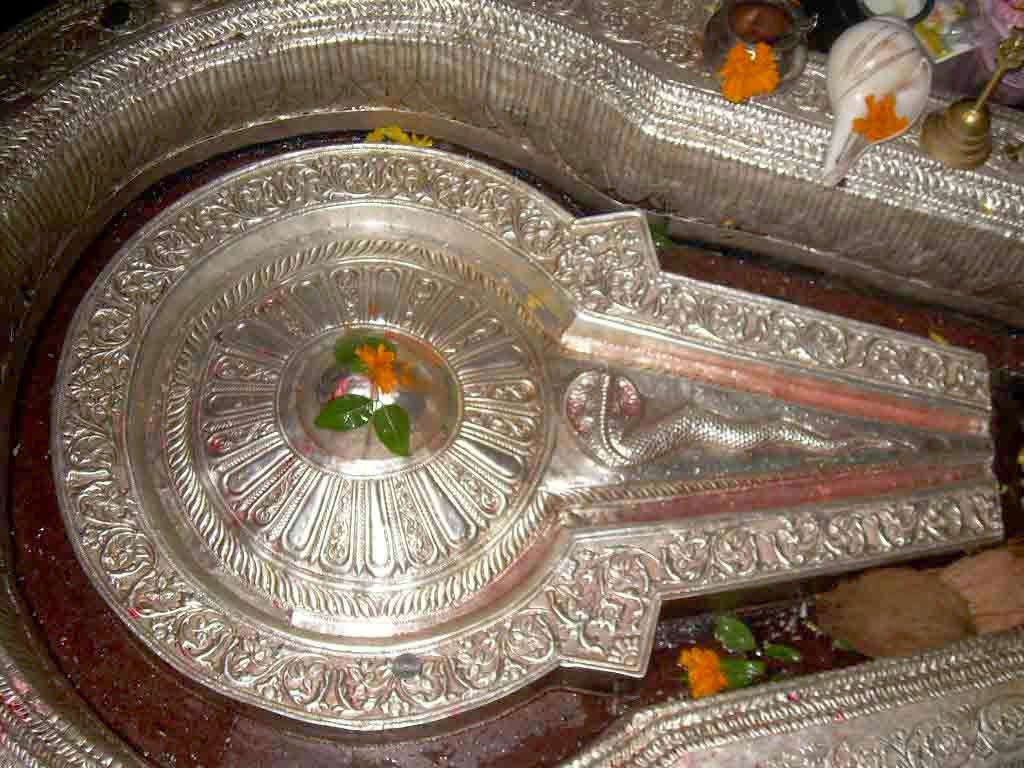
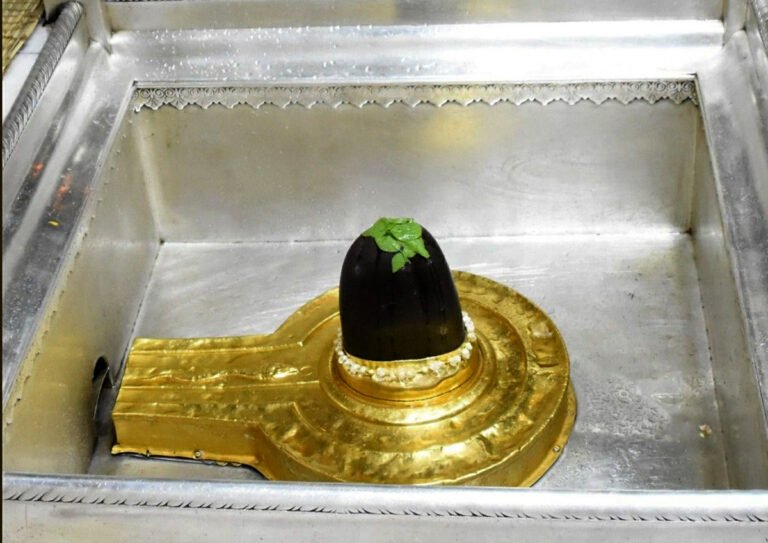
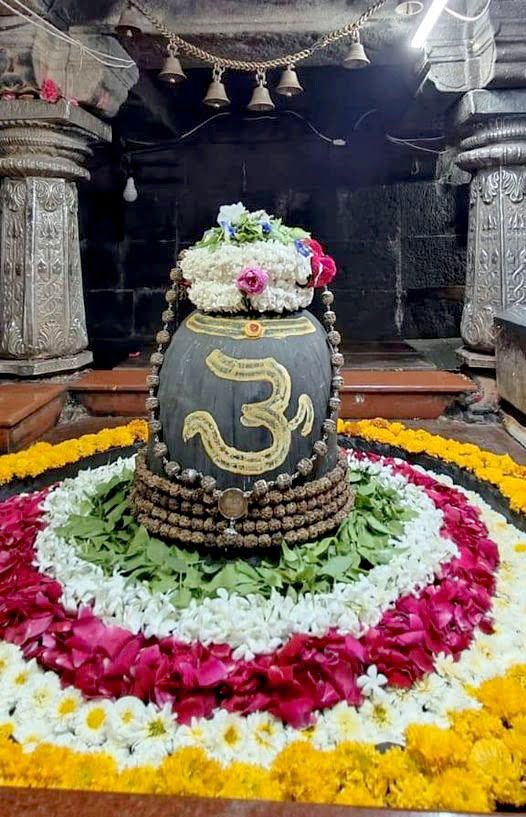
Swayambhu Lingam: Bhimashankar Temple’s Shivlingam is regarded as Swayambhu, or “self-manifested” or “self-originated.” Such natural occurrence of the Lingam also increases its religious power and gains enormous belief, said to free devotees from the birth-rebirth cycle.
Ecological Significance: Distinctly, the temple lies in the Bhimashankar Wildlife Sanctuary, which is a part of the Western Ghats, a UNESCO World Heritage Site. This brings an exceptional ecological aspect to its religious significance. The peaceful environment of the temple, with dense forests, varied flora, and fauna (including Maharashtra’s state animal, the Malabar Giant Squirrel) surrounding it, presents a rare symphony of nature and spirituality. Several documentaries have been created studying this unusual combination.
Symbol of Divine Justice: The mythology surrounding the temple, specifically the victories over the demons Bhima and Tripura, highlights Lord Shiva as the guardian of dharma and destroyer of evil. Pilgrims come to pray for strength, protection, and to conquer their own internal demons.
Association with Saints: The area surrounding Bhimashankar is rich in its association with famous saints. It is said that saints such as Swami Samarth and Swami Jnaneshwar have meditated here, consecrating the land even more and making the temple even more spiritually charged.



Festivals: Celebrating Divine Grandeur and Devotion
The Bhimashankar Temple is brought to life by intense devotion during its festivals, with thousands of pilgrims flocking to see it, creating an electric atmosphere.
Maha Shivaratri (February/March): This is certainly the most important and most majestic festival celebrated at Bhimashankar. It is in honor of the “Great Night of Shiva,” the day on which Lord Shiva danced the Tandava, his cosmic dance, and the night of his wedding to Goddess Parvati. The devotees keep a night-long vigil, conduct elaborate pujas, offer prayers, and recite Vedic mantras. The temple complex is open throughout the night, echoing with the sound of Mahamrityunjaya Mantra mantras. Be prepared for huge gatherings during this period!
Shravan Maas (July/August): The whole Hindu month of Shravan (generally between July and August) is very auspicious to Lord Shiva. During Shravan, particularly on Mondays, pilgrims throng to the Bhimashankar Temple in large numbers to pour milk and do Abhishekam to the Shiva Lingam. The rainy season in Shravan also converts the surrounding forests into a rich, green oasis, enhancing the religious experience.
Kartik Purnima (November): Marked during the sacred month of Kartik, the festival witnesses thousands of oil lamps burning throughout the temple campus, which presents a magical sight in the form of Deep Daan.
Diwali Celebrations (October/November): The festival of lights is observed with immense enthusiasm and comprises special Lakshmi Puja and Maha Rudra Abhishek.
Makar Sankranti (January): This is the sun entering Capricorn. It’s a charity day, prayer and holy ritual day, with believers taking a holy dip in the Bhima River. Annadanam (donation of food) is also arranged.
Pradosh Vrat: Done on the 13th day of both the lunar fortnights, this vrat and special worship to Lord Shiva is done regularly, attracting the devout looking for blessings.
Crowded Days: Besides the peak festivals, Mondays tend to be very crowded, particularly during the Shravan Maas. Weekends and holidays are also usually crowded. If you want to avoid the crowds, attempt to go on weekdays when it is not a major festival time. The winter (October to early December) months are sometimes recommended as a lovely time to visit with slightly fewer tourists than the height of pilgrimage season in December-January.
Read More>> 3BCE Pathala Sembhu Murugan Temple: Underground Copper Pot
Distinct Architectural Designs and Sculptures: An Artistic Wonder
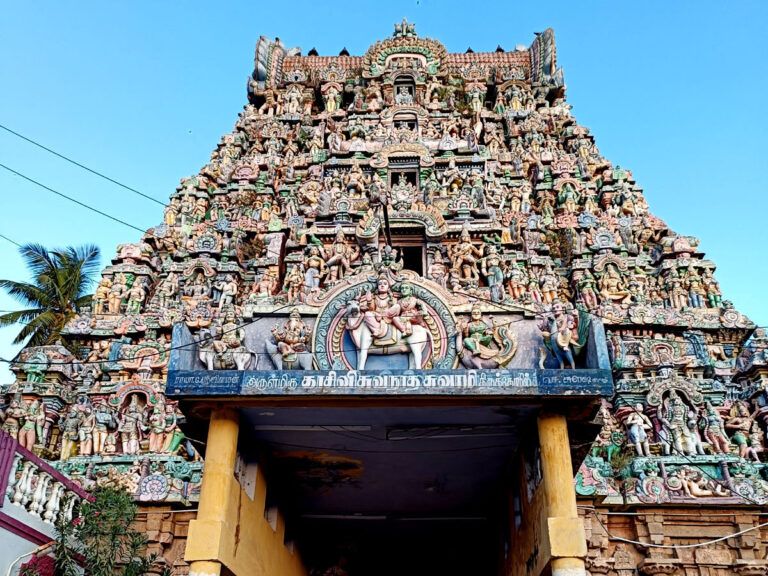
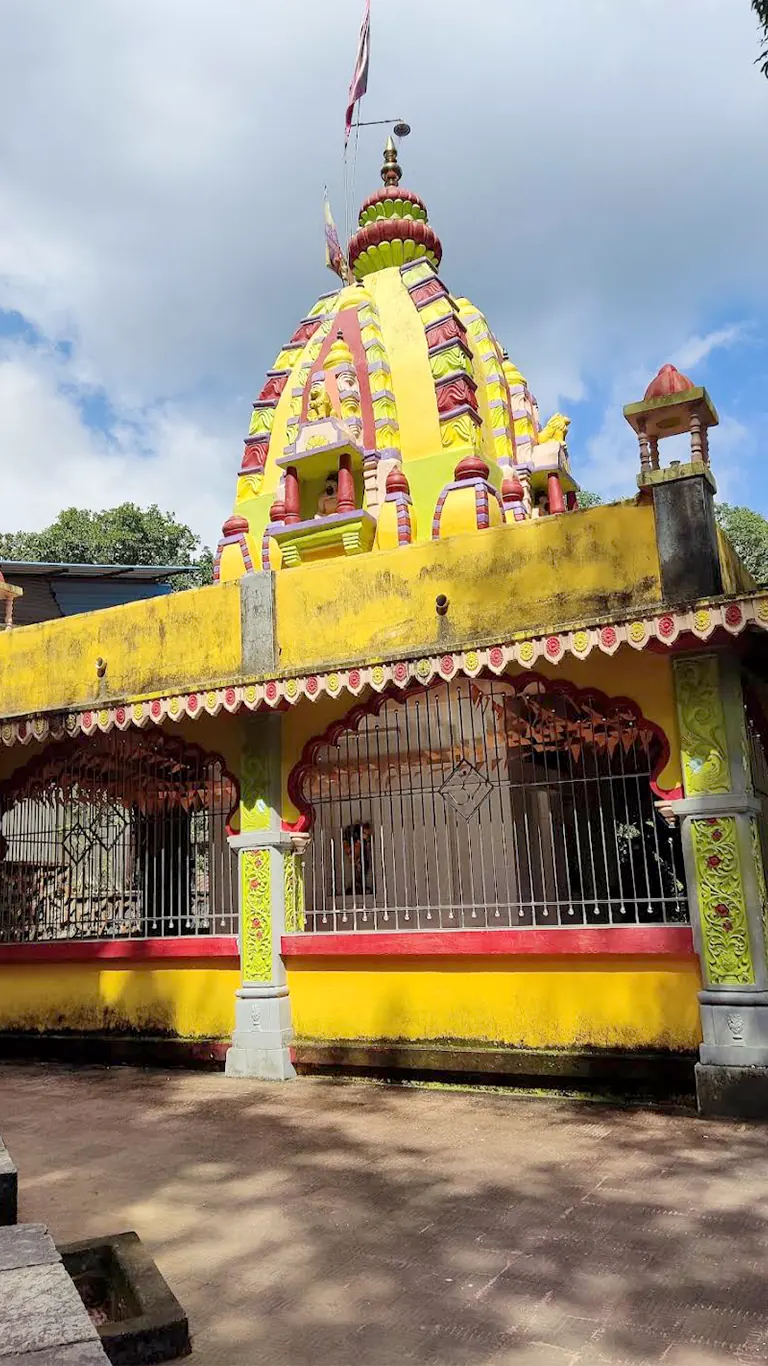
When you approach the Bhimashankar Temple and step inside, take a moment to truly absorb the architectural splendor. The temple is a stunning piece of the Nagara style of architecture, which is prevalent in North India, combined with local Hemadpanthi influences.
Dome-shaped Roof and Shikara: The central shrine of the temple has a characteristic dome-shaped roof and a well-carved shikhara (spire). The shikhara, which was predominantly reconstructed by Nana Phadnavis, includes elaborate Maratha-style carvings of gods and goddesses, made using a blend of lime and sand.
Garbhagriha and Mandapas: The design of the temple consists of a mukhamaṇḍapa (front hall), a gūḍhamaṇḍapa (closed hall), and the holy garbhagṛha (sanctum sanctorum). You will ascend some steps to get to the central adhiṣṭhāna (base), which is the point from which the pradakṣiṇāpatha (circumambulation path) starts around the entire complex.
Intricate Carvings: The temple walls and pillars are adorned with magnificent, intricate sculptures and carvings. These sculptures tend to illustrate different mythological tales, Ramayana scenes, Krishna Leela, Shiv Leela, and Dashavatars (Vishnu’s ten incarnations), lending visual context to the religious ambiance. The attention to detail by ancient Vishwakarma sculptors is apparent.
Portuguese Bell: One of the most interesting things is the huge, old Portuguese bell suspended between two columns in front of the Shani shrine. Dating from 1739, this is both a historical relic and a large item.
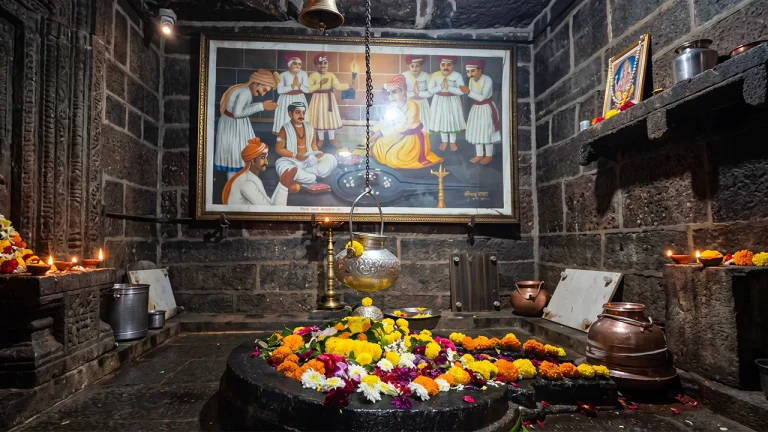
Swayambhu Lingam: Inside the garbhagṛha, the Shivlingam lies exactly in the center, a reflection of its natural occurrence that makes it so revered.
Devakoshtas: Niches (devakoshtas) on the outside walls of garbhagriha, meant for different deities though some may be vacant or house contemporary images.
Gomukha: A gāyamukha (also gomukha, i.e., cow’s mouth) is placed on the northern wall, through which the holy water used in Abhishekam flows out, said to be imbued with blessings from the deity.
The distinctive blending of architectural designs and the intricate fabric of carvings make the Bhimashankar Temple not only a site for worship, but a stunning work of living heritage, testifying to the artistic genius and devout dedication of its creators over centuries.
Myths and Beliefs: Revealing the Mysteries
Over and above the core legend, several interesting myths and beliefs enhance the Bhimashankar Temple’s spiritual atmosphere.
The Incomprehensible Lingam: As in other Jyotirlingas, one prevalent belief is that the Shivlingam at Bhimashankar does not have a perceivable start or end. No matter continuous sacrifices of holy liquids offered during Abhishekams, it is said to soak up everything without spilling over, reflecting Lord Shiva’s boundless and endless nature.
Gupt Bhimashankar: About 2 km from the central temple, there is a site named Gupt Bhimashankar (Hidden Bhimashankar). It is believed that the Bhima River, which originates at the central temple’s Shivlingam, runs underground and manifests itself once again at Gupt Bhimashankar. It is a peaceful place, regularly frequented by devotees for its tranquil natural beauty and spiritual appeal.
Healing Attributes of Bhima River: The Bhima River’s water, which is said to be composed of Lord Shiva’s sweat, is also believed to have healing attributes. The devotees usually take a sacred bath in its waters, especially at the source within the temple compound, for cleansing and to cure diseases.
Moksha Kunda: Situated at the back of the temple, the Moksha Kunda is a holy pond supposed to be connected with Rishi Kaushik, who prayed to Lord Shiva at this place. A dip in this Kunda is said to provide moksha (liberation or salvation from the cycle of birth and rebirth).
The Origin of Big Bell: The big Portuguese bell that is part of the temple complex has a tale to tell. It was allegedly taken by Chimaji Appa as a war booty from the Vasai Fort after winning over the Portuguese in 1739. Its existence is a singular combination of historical achievement and religious devotion.
Dakini Desh: Khed Taluka, in which lies Bhimashankar, is also alternatively called Dakini Desh, which is noteworthy as the Shiva Purana refers particularly to Lord Shiva appearing in the Dakini forest and routing the demon Bhima. This strengthens the geographic connection to the ancient scriptures.
These legends and beliefs, handed down through centuries, strengthen the pilgrims’ bond with the temple, turning their trip not only into a ritual but into a deeply engaging and sacred experience.
Read More>> Enchanted Pashupatinath Temple: 5th Century Sacred Hindu Temple
Bhimashankar Temple Timings: Planning Your Sacred Darshan
To make sure you have a worthwhile visit to the Bhimashankar Temple, it’s necessary to know its working hours. The temple mostly follows a fixed routine, although it may be slightly changed during main festivals.
Here’s an overall idea of the timings for the day:
Kakada Aarti: 4:30 AM (The day starts with this early morning aarti)
Nijarup Darshan: 5:00 AM (First chance of close darshan of the Lingam)
Daily Pooja & Abhishek Begin: 5:30 AM (Ritual bath and prayers commence)
Naivedya Pooja (No Abhishek within): 12:00 PM (Food offering, Abhishek is generally not done within the sanctum at this time)
Daily Pooja & Abhishek Begin: 12:30 PM (Abhishek is resumed)
Madhyan Aarti (No Darshan for 45 min): 3:00 PM (Mid-day aarti, with temporary closure for darshan)
Shringar Darshan (No Abhishek inside): 4:00 PM to 9:30 PM (Deity is adorned, and darshan is possible, but no Abhishek inside the sanctum sanctorum)
Aarti: 7:30 PM (Evening aarti)
Mandir Closed: 9:30 PM
Important Notes:
Abhishekam Timings: Usually, you may do Abhishekam within the temple till 2:00 PM on most days.
Extended Abhishekam: On holidays such as Mondays, Pradosh, Shravan Maas, and Maha Shivaratri, the ability to do Abhishekam within the temple is extended up to 6:00 PM, owing to the enhanced spiritual value and pilgrim traffic.
Long Queues: During peak festival times, weekend days, and the Shravan month, anticipate long queues. Going early in the morning (for the Kakada Aarti or Nijarup Darshan) or late in the evening can occasionally reduce the peak rush.
Read More>> Sacred 12 Jyotirlingas in India: A Symbol of Eternal Spirit
Special Poojas Conducted: Deepening Your Devotion
At Bhimashankar Temple, various special poojas (worship rituals) are conducted during the day and on certain occasions, enabling devotees to feel more connected with Lord Shiva.
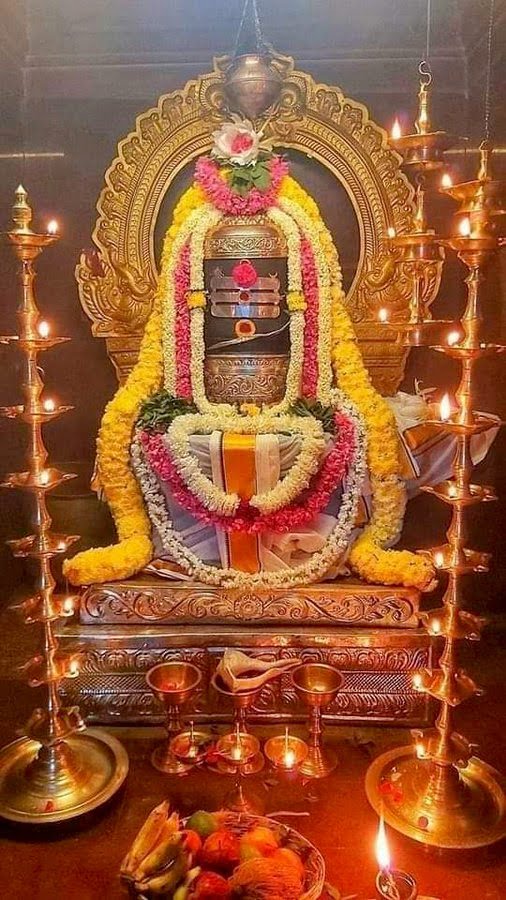
Abhishekam: This is the most popular and important ritual. The devotees pour water, milk, curd, ghee, honey, sugar, and other holy substances on to the Shivlingam. An Abhishekam is believed to cleanse the soul, bestow wishes, and call for the blessings of Lord Shiva. You can organize this with the priests at the temple.
Rudrabhishek: A more complex version of Abhishekam where powerful Rudra mantras are chanted. The puja is done to appease Lord Shiva, gain protection from evil energies, and bring prosperity. It’s usually done during the Shravan Maas.
Laghu Rudra / Maha Rudra: These are long and more intricate versions of Rudrabhishek, with multiple priests and more chants and offerings.
Bhasma Aarti: Though less well-known than Ujjain’s Bhasma Aarti, some temples, such as Jyotirlingas, may have a symbolic use of holy ash (Bhasma) on the deity during morning rituals.
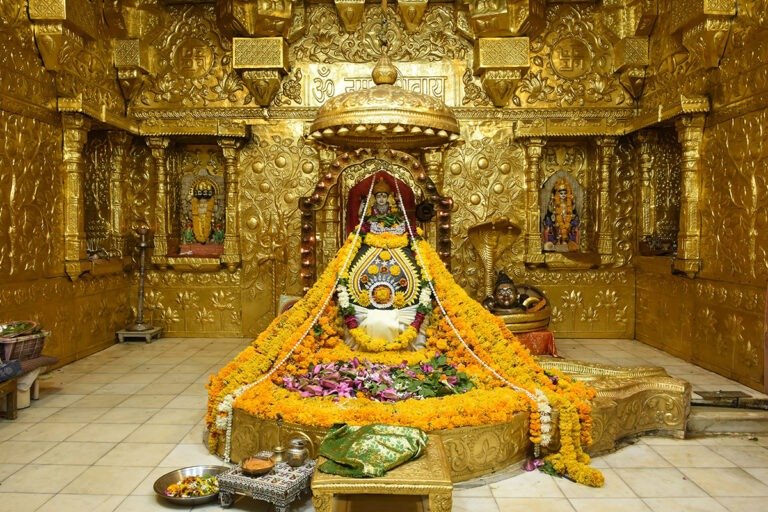
Shringar Darshan: In the evening, the deity is elegantly decorated with ornaments, flowers, and clothes, exhibiting a stunning Shringar Darshan to devotees. No Abhishekam is done at this time, enabling an aesthetic and spiritual experience with a sharp focus.
Archana / Sahasranama Archana: Giving flowers and reciting Lord Shiva’s names (usually 108 or 1000 names, ‘Sahasranama’) during giving of certain leaves such as bilvapatra (बेलपत्र) is another popular and effective pooja.
Engaging in these poojas is a deep experience, making you one with the divine force of the Bhimashankar Jyotirlinga. The temple priests would generally be of assistance in directing devotees who want to do certain poojas.
Sites to See Around the Temple: Enriching Your Spiritual Pilgrimage
Your trip to Bhimashankar is not only about the temple. The landscape around it is endowed with natural splendor and other sites that are inextricably linked with the legends of the temple and the spiritual legacy of the region.
Gupt Bhimashankar: As said, this place, roughly 2 km from the central temple, is where the Bhima River supposedly re-emerges after going underground from the central Lingam. It’s a peaceful trek in the woods, to a peaceful Shiva Lingam and the meandering river.
Moksha Kunda: Situated behind the main temple, this holy pond is where Rishi Kaushik is believed to have prayed. A dip here is supposed to bring liberation.
Sarva Tirtha: Pools to the south of the Bhimashankar Temple, where the gomukha (spout in the shape of a cow’s mouth) from the temple discharges, taking the sacred water offered to the Lingam, is supposed to be the source of the Bhima River.
Kamalaja Mata Mandir: This temple, located close to the bus stand, is in honor of Goddess Kamalaja, an incarnation of Parvati, who is said to have helped Lord Shiva during his war against Tripurasura. She is adored with lotus flowers.
Nagphani Point: It is the highest point of Bhimashankar, roughly 1.5 km away from the bus stand. It provides stunning views of the Sahyadri ranges, particularly during sunset. It’s also a favorite among trekkers, blending adventure with spirituality.
Hanuman Lake: About 2 km from the bus stand, this stunning lake lies in midst of mountains and is said to be the place where Anjani Mata, Hanuman’s mother, did penance before his birth. It’s a picturesque picnic spot where you can see all sorts of animals.
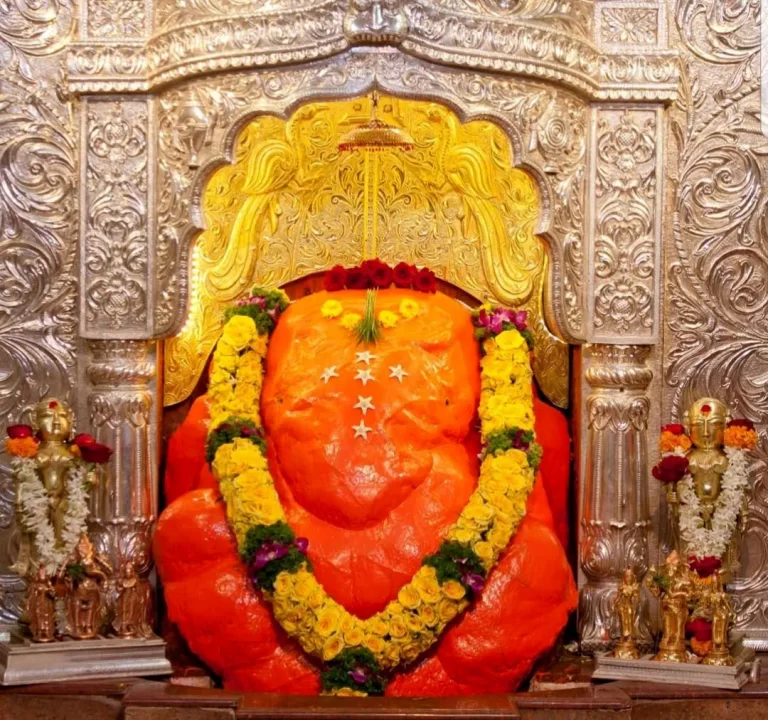
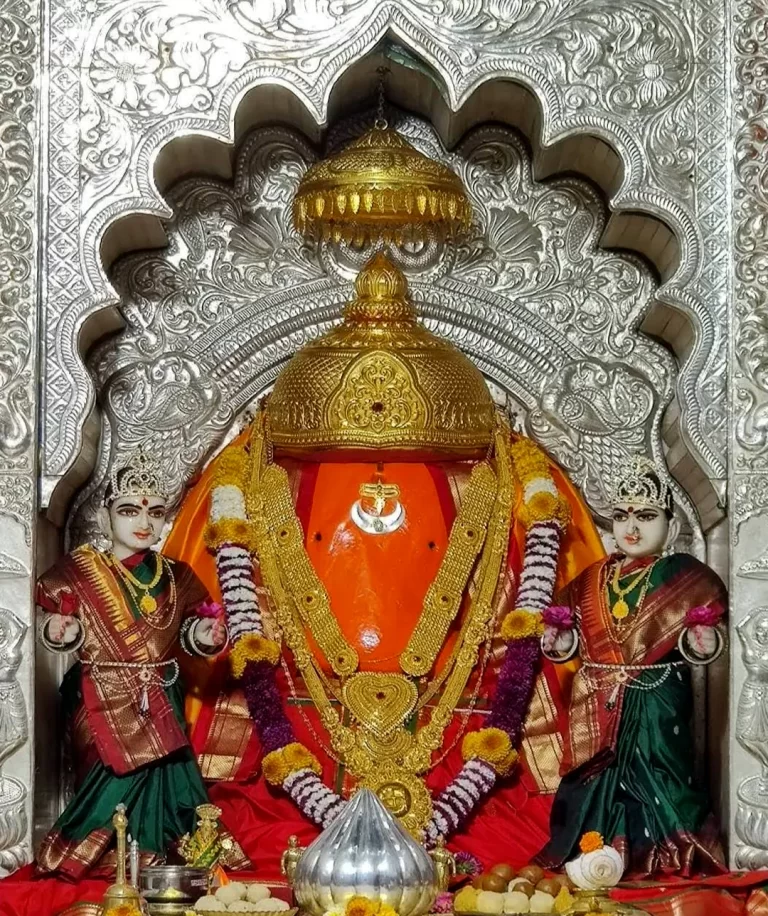
Sakshi Vinayak Temple: Along the way to Gupt Bhimashankar, you’ll come across this tiny temple of Lord Ganesha, who’s revered as the “witness” (Sakshi) to your pilgrimage.
Bombay Point (Kokan-kada) & Vanaspati Point: These spots give breathtaking views of the surrounding mountains and valleys, particularly during sunset. Bombay Point, or Kokan-kada, gives a view towards the Konkan side.
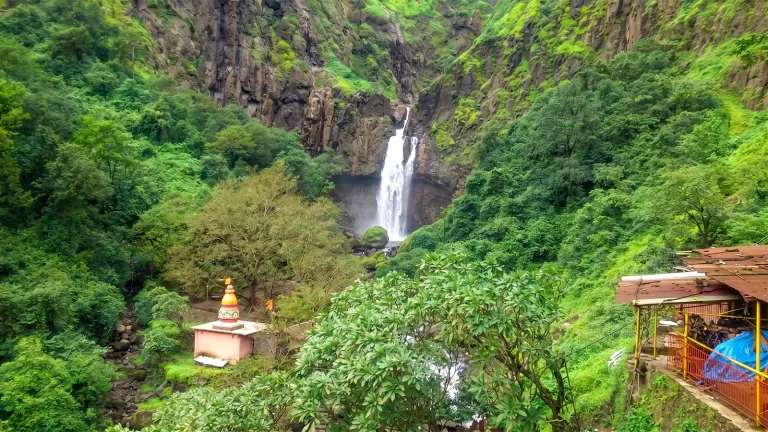
Ahupe Waterfalls: Monsoon period sees this as a stunning spectacle, with lovely views of Dimbhe Dam backwaters. Nature lovers just love it.
These local sites enable you to prolong your religious odyssey and get immersed in the natural scenery and lush mythology of the area around Bhimashankar.
Read More>> Chamundeshwari Temple Mysore: Architectural Marvel & Spiritual Wonder
Accommodation Options: Where to Rest Your Soul
After a day of religious discovery and hiking, you’ll want a comfortable spot to sleep. Rameswaram, being a strong pilgrimage destination, has plenty of accommodation options. Remember that Bhimashankar itself is a relatively small village located within a wildlife sanctuary, so the options are more centered on being comfortable and convenient to the temple and not luxury hotels.
Near Temple/Bus Stand: There are some private guesthouses and lodges that can be reached on foot from the temple and bus stand. These are usually simple, hygienic, and provide basic facilities. These are best suited for pilgrims who are interested in having easy access to the temple for early morning rituals. Some of these are local guesthouses and small lodges.
Resorts & Holiday Homes: For anyone who wants extra comfort and facilities, there are a few resorts and holiday homes that are a bit more distant, even in the midst of nature, for a relaxing getaway. Some of the most popular ones listed are Natraj Holiday Resort Bhimashankar, Blue Mormon Jungle Holiday Resort, and Sonu Resort and Farmhouse. These could have improved views and additional facilities such as gardens or in-house restaurants.
Homestays: You may also be able to find local homestays, providing a more intimate and genuine experience, sometimes with home food.
Key Tip: In the peak seasons (Maha Shivaratri, Shravan Maas, and winters), it is strongly recommended that you book your stay in advance since choices get quickly exhausted by the visiting pilgrims. Being a remote location, don’t hope for much luxury beyond here, but clean and practical stays.
Read More>> Nelluvaya Sree Dhanwanthari Temple
How to Get to the Temple: Your Journey to Bhimashankar
The Bhimashankar Temple can be accessed with a journey into the Sahyadri hills but is easily reachable from the major cities of Maharashtra.
By Air:
Pune International Airport (PNQ) is the closest major airport, about 110-120 km from Bhimashankar. From Pune, you can take a taxi or bus to the temple.
Chhatrapati Shivaji Maharaj International Airport (BOM) in Mumbai is the other choice, situated around 220-230 km away. It is possible to travel by train or bus from Mumbai to Pune and then go to Bhimashankar.
By Rail:
The closest major railway station is Pune Junction (Pune). Pune is very well connected by train to all the major cities of India. You can take an MSRTC bus or a taxi from Pune railway station to Bhimashankar.
Shivajinagar Bus Stand, Pune, is an important stop for buses going to Bhimashankar.
By Road:
From Pune: This is the most used route. Bhimashankar is approximately 110-120 km from Pune. You can go by private car, taxi, or MSRTC bus. The route is generally along the Pune-Nashik highway and then a left turn at Manchar (about 65 km from Pune) towards Bhimashankar. The road then becomes a scenic but winding climb into the hills. The drive generally takes around 3.5 to 4 hours, depending on traffic and road conditions.
From Mumbai: Bhimashankar is roughly 220-230 km from Mumbai. You may drive using the Mumbai-Pune Expressway, then from Pune follow the above described route. The entire trip by car would take roughly 5 to 6 hours.
When you arrive at the Bhimashankar bus station, keep in mind that the temple is accessible by walking down some 200-250 steps. Senior citizens or physically challenged people can hire dolis (palanquins borne on the shoulders of porters) to and from the temple.
Read More>> Bhojpur Shiva Temple | Bhojeshwar Temple Holds Huge Lingam
Frequently Asked Questions (FAQs) About Bhimashankar Temple
As your tour guide, I get asked some recurring questions regarding visiting the Bhimashankar Temple. Let’s answer a few:
Are there changing rooms after Abhishek? Although there aren’t separate, modern-day changing rooms, pilgrims usually cope within the general temple area. Wearing easily drying clothes is recommended.
Are there restrictions on photography within the temple? Restrictions on photography are different. On average, photography within the main garbhagriha (sanctum sanctorum) is not allowed to preserve sanctity and control crowds. You may be permitted to photograph in the periphery or corridors. Check for signs or consult temple officials.
Is it safe to go to visit during monsoon? The monsoon months (June to September) make Bhimashankar a green paradise, and it is extremely picturesque. But the roads are slippery, and also fog gets in the way of visibility. It is safe if you travel carefully and are ready for heavy rain. Trekkers like the monsoon for the fresher greenery and the waterfalls.
What is the significance of the 200+ steps to the temple? The descent of these steps adds to the pilgrimage experience, symbolizing the journey and effort required to reach the divine. For many, it’s a small penance. As mentioned, dolis are available if needed.
Is there network connectivity on mobile phones? Although connectivity is better, it remains patchy in certain distant locations outside Bhimashankar because of its forest surroundings. Avoid complete dependency on mobile internet for navigation or communication.
Why is this Jyotirlinga so important among the five in Maharashtra? Bhimashankar is also among the five Jyotirlingas situated in Maharashtra, together with Trimbakeshwar, Grishneshwar, Aundha Nagnath, and Parli Vaijnath. Its specific positioning in a wildlife sanctuary and its direct association with the myth of Lord Shiva fighting the demon Bhima make it have a special spiritual and ecological value.
Dear friends, as we close our perceptive journey of the awe-inspiring Bhimashankar Temple, I hope you feel a stronger connection to this remarkable place. It is not just a religious shrine; it is a living history of ancient myths, stunning architecture, and the deep power of spirituality. Be it spiritual comfort, historical marvel, or merely the serenity of nature, the Bhimashankar Temple is an experience that will transcend deep into the recesses of your heart. I sincerely hope you undertake this heavenly sojourn yourself and experience the grace of Lord Shiva. Om Namah Shivaya!