Mahalakshmi Temple Mumbai: Complete Darshan, History, and Pilgrim Guide
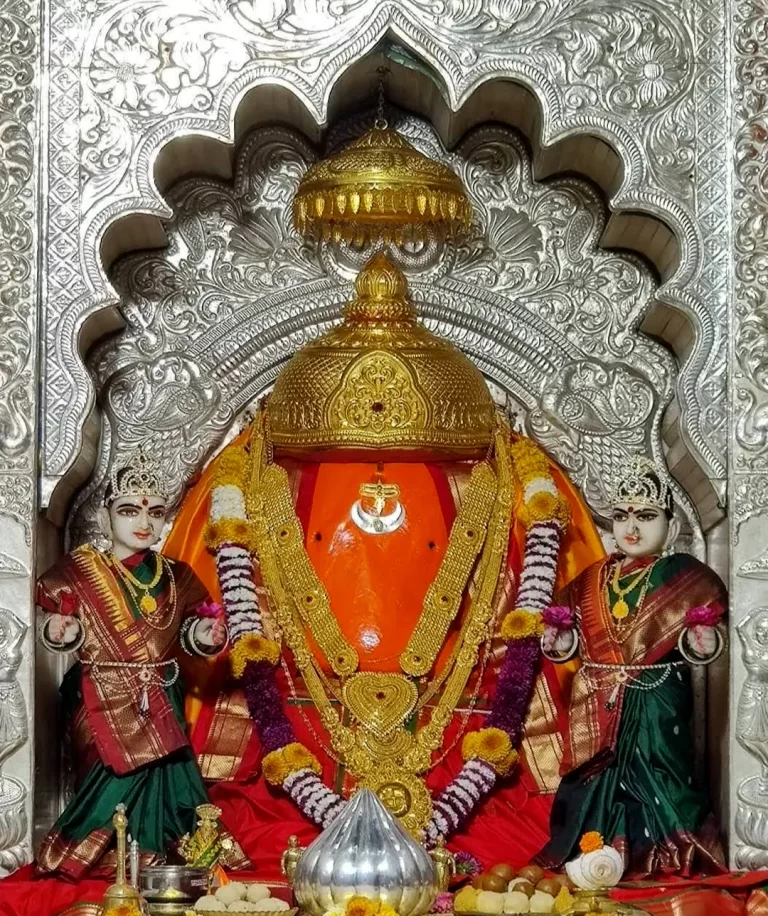
Shri Mahalakshmi Temple in Mumbai is one of Maharashtra’s most revered Hindu shrines, located along the Arabian Sea on Bhulabhai Desai Road (Breach Candy) in South Mumbai. Dedicated to the Tridevi—Goddess Mahalakshmi, Goddess Mahakali, and Goddess Mahasaraswati—the temple opens daily from 6:00 AM to 10:00 PM with free entry for all visitors.

Because the inner sanctum closes temporarily four times a day for sacred aarti and food offerings (including a midday break from 11:45 AM to 12:20 PM), planning your arrival window ensures a smooth, unhurried darshan. Whether you are a local resident visiting on an auspicious Friday or a pilgrim exploring famous temples in Maharashtra, this guide covers verified darshan timings, historical origins, temple architecture, dress code rules, and transport routes.
Quick Information: Shri Mahalakshmi Temple, Mumbai
| Feature | Verified Details |
| Official Temple Name | Shri Mahalakshmi Temple (Managed by Shri Mahalakshmi Temple Charities / Trust) |
| Presiding Deities | Goddess Mahalakshmi (center), Goddess Mahakali (right), and Goddess Mahasaraswati (left) |
| Location & Address | Bhulabhai Desai Road, Mahalaxmi West, Breach Candy, Cumballa Hill, Mumbai – 400026, Maharashtra |
| Daily Temple Hours | 6:00 AM to 10:00 PM (Open all 7 days of the week) |
| Daily Darshan Closure Windows | 6:45 AM – 7:30 AM (Morning Aarti), 11:45 AM – 12:20 PM (Naivedya), 6:15 PM – 6:40 PM (Dhoop Aarti), and 7:20 PM – 7:45 PM (Evening Aarti) |
| Entry Fee & VIP Darshan | Completely free for all devotees; no paid VIP passes (priority queue assistance is available for senior citizens and differently-abled visitors) |
| Major Festivals | Sharad Navratri (Sept/Oct), Vasant Navratri (March/April), Diwali Lakshmi Pujan, Akshaya Tritiya, and Margashirsha Thursdays |
| Best Time to Visit | October to March for pleasant Mumbai weather; early mornings (6:00 AM – 6:45 AM or 7:30 AM – 9:30 AM) on weekdays for minimal queues |
| Nearest Railway Station | Mahalaxmi Railway Station on the Western Line (~1.2 km / 15-minute walk or 5-minute taxi ride) |
| Nearest Airport | Chhatrapati Shivaji Maharaj International Airport (~18 km / 45–60 minutes by road) |
| Dress Code & Key Rules | Modest, shoulder- and knee-covering attire; footwear and leather items prohibited inside; no photography inside the sanctum |
| Facilities | Free footwear stand, cloakroom, drinking water, wheelchair ramp access, prasad stalls |
| Official Website & Contact | Shri Mahalakshmi Temple Trust | Phone: +91 022-2351 4732 |

Daily Darshan and Aarti Timings
According to the official Shri Mahalakshmi Temple Darshan Schedule, the temple gates open every morning at 6:00 AM and close at 10:00 PM. Unlike some shrines where devotees can view the idols continuously throughout opening hours, the sanctum curtains here are drawn during four daily ritual windows so priests can perform ceremonial bathing, dressing, aarti, and food offerings (Naivedya).
| Time Slot | Daily Ritual / Activity | Darshan Status |
| 6:00 AM – 6:45 AM | Temple gates open; early morning worship | Open (Best window for quiet, crowd-free darshan) |
| 6:45 AM – 7:30 AM | Morning Aarti (Vedic chanting and dawn lamp offering) | Closed for Darshan |
| 7:30 AM – 11:45 AM | Morning general darshan session | Open |
| 11:45 AM – 12:20 PM | Midday Naivedya (Sacred afternoon meal offered to the Tridevi) | Closed for Darshan |
| 12:20 PM – 6:15 PM | Afternoon darshan session | Open |
| 6:15 PM – 6:40 PM | Evening Dhoop Aarti (Twilight incense and lamp ritual) | Closed for Darshan |
| 6:40 PM – 7:20 PM | Early evening darshan session | Open |
| 7:20 PM – 7:45 PM | Evening Main Aarti | Closed for Darshan |
| 7:45 PM – 10:00 PM | Night darshan session until gate closure at 10:00 PM | Open |
Tips for Timing Your Visit
- Avoid Midday and Twilight Arrival Delays: If you arrive at 11:45 AM or 6:15 PM, you will need to wait inside the assembly hall (Sabha Mandapa) or queue corridor until the ritual finishes and the sanctum reopens.
- Weekday vs. Weekend Wait Times: On regular Mondays, Wednesdays, and Thursdays, darshan usually takes 15 to 45 minutes. On Fridays (considered especially sacred to Goddess Lakshmi), Tuesdays, weekends, and public holidays, queues can stretch to 1.5 to 3 hours.
- Extended Festival Hours: During Sharad Navratri and Diwali, the temple trust typically opens the doors as early as 4:00 AM to manage the massive surge of devotees.

History and Legend: From the Hornby Vellard to 1831
The history of Mumbai’s Mahalakshmi Temple is woven directly into the physical creation of modern Mumbai. Before the late 18th century, Mumbai consisted of seven separate islands divided by tidal creeks and marshland. Historical records from the Shri Mahalakshmi Temple Trust and archival civic histories of Bombay document two distinct phases in the shrine’s development—often blended together in popular retellings.
1. The Hornby Vellard Reclamation and Discovery (1761–1784)
In the 1760s, a modest shrine dedicated to Goddess Mahalakshmi existed along the western shoreline, frequented by local fishermen and residents. Around 1782–1784, under the governorship of William Hornby, British engineers attempted to build the Hornby Vellard—a massive sea wall and causeway designed to block the Arabian Sea from flooding the low-lying flats between Worli and Malabar Hill.
Twice, powerful monsoon surges breached and destroyed the unfinished sea wall. According to long-standing local tradition, the project’s chief Indian engineer, Ramji Shivji Prabhu (a member of the Pathare Prabhu community), experienced a vivid dream in which Goddess Mahalakshmi appeared to him. She revealed that three sacred idols—Mahalakshmi, Mahakali, and Mahasaraswati—had been hidden beneath the sea near Worli decades earlier to protect them from destruction during periods of conflict. She instructed him to recover the idols from the seabed and enshrine them on the nearby hillock before resuming work on the embankment.
Following the dream, divers recovered the three stone images from the water. Ramji Shivji Prabhu installed them in a shrine on the Cumballa Hill coastal ridge, after which the Hornby Vellard causeway was completed without further collapse. In recognition of his achievement, the colonial administration granted him land on the hillock to maintain the shrine.
2. The Grand Reconstruction by Dhakji Dadaji (1831)
While the recovery of the idols dates to the late 18th century, the permanent stone temple complex seen by visitors today owes its structure to Dhakji Dadaji, a prominent and wealthy Hindu merchant of Bombay. In 1831, Dhakji Dadaji funded a major reconstruction and expansion of the shrine, building an ornate sanctum sanctorum, spacious assembly hall, and traditional entrance gateway.
Over subsequent decades in the late 19th and 20th centuries, additional mandapams, silver adornments, and pilgrim facilities were added under the supervision of the temple trust, turning the coastal shrine into one of Western India’s busiest spiritual landmarks.
Spiritual Significance and the Tridevi Deities
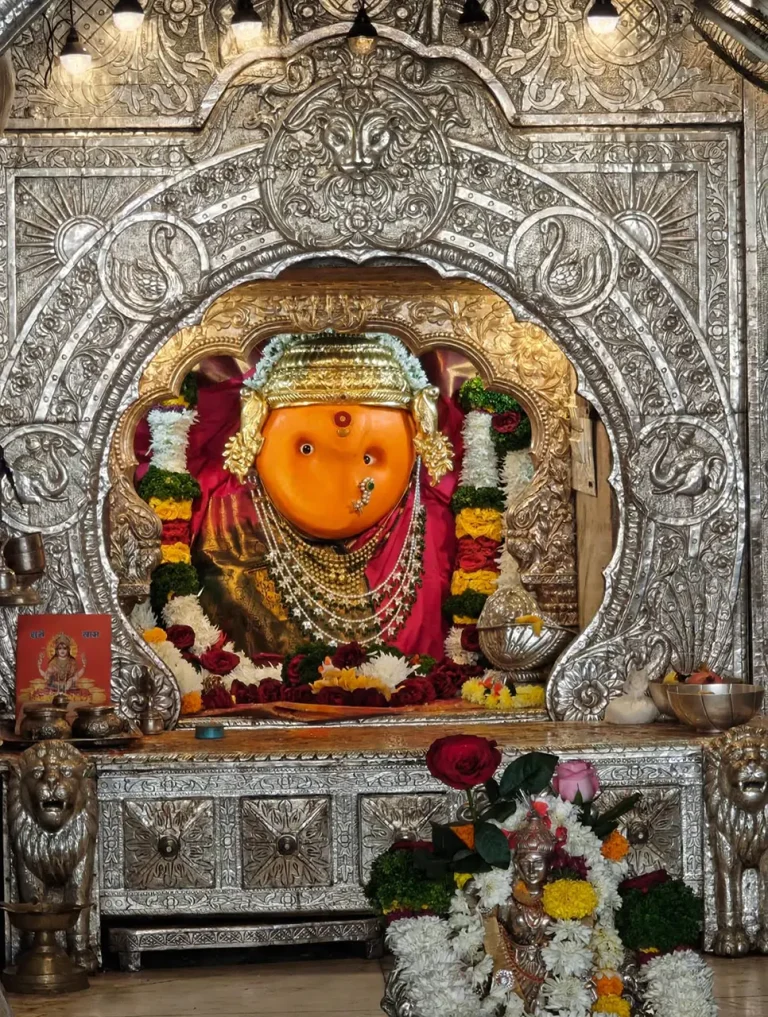
Most Lakshmi temples across India enshrine Goddess Lakshmi alone or alongside Lord Vishnu—such as the famous Mahalakshmi Temple in Kolhapur (Ambabai Temple) or the self-manifested shrine at Goravanahalli Mahalakshmi Temple in Karnataka. Mumbai’s Mahalakshmi Temple stands out because its inner sanctum (Garbhagriha) honors the complete Tridevi—the three supreme feminine manifestations of Adi Parashakti—side by side on silver-plated thrones.
- Goddess Mahalakshmi (Center): Positioned in the middle, she is the presiding deity of wealth, righteous prosperity, grace, and domestic harmony. Her idol holds blooming lotus flowers—symbols of spiritual purity rising untouched above worldly mud. Devotees pray to her for financial stability, business success, and inner contentment.
- Goddess Mahakali (Right): Representing cosmic power (Shakti), time, and the destruction of negativity and ego, Goddess Mahakali protects devotees from fear, obstacles, and harmful influences.
- Goddess Mahasaraswati (Left): The embodiment of learning, wisdom, speech, music, and creative arts, Goddess Mahasaraswati is sought out by students, scholars, writers, and artists before exams or new intellectual ventures.
Inside the sanctum, all three stone idols are lavishly dressed every morning by temple priests in vibrant silk sarees and adorned with traditional Maharashtrian gold nose rings (nath), pearl necklaces, gold bangles, and fresh garlands of marigold, lotus, and hibiscus.
Why Devotees Worship All Three Together: In Hindu philosophy, material wealth without wisdom can lead to arrogance, and knowledge without strength can leave a person vulnerable. Worshipping Mahalakshmi, Mahasaraswati, and Mahakali together symbolizes balanced human flourishing—prosperity guided by wisdom and protected by spiritual courage.

Temple Architecture and Sacred Features
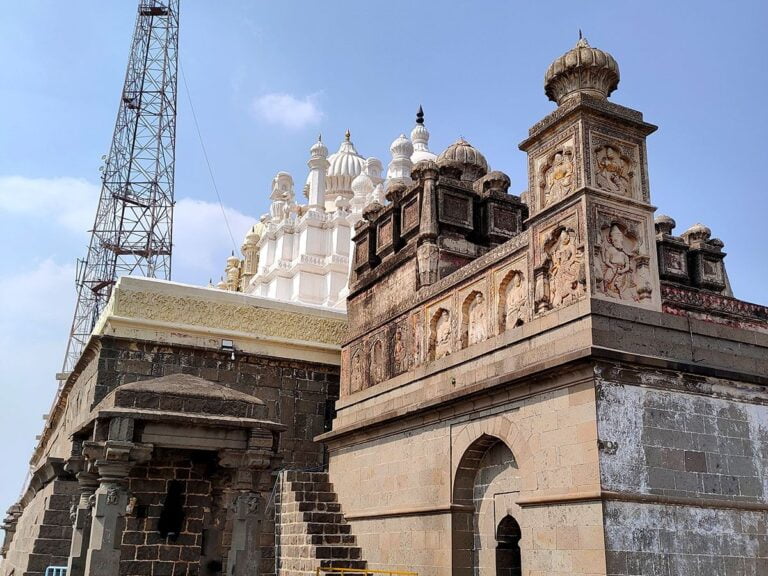
Perched on a rocky coastal elevation overlooking the Arabian Sea, the temple blends traditional western Indian (Konkan/Maratha) stonework with pyramidal tower elements reminiscent of South Indian Vimana architecture. According to structural specifications published by the Shri Mahalakshmi Temple Trust, key features inside the complex include:
- Entrance Gateway and Stone Steps: A carved stone staircase leads devotees up from Bhulabhai Desai Road through an ornate entrance flanked by Dwarapalas—the celestial guardian figures Jaya and Vijaya carved in wood, standing watch before the inner threshold.
- Dhwaja Stambha (Flagpole): Immediately inside the courtyard rises a 10.6-meter-tall wooden flagpole encased in finely embossed silver sheets. In temple architecture, the Dhwaja Stambha acts as the cosmic axis connecting earth and heaven, and a ceremonial flag is hoisted atop it during Navratri and Diwali.
- Deepmala (Lamp Tower): A traditional carved stone lamp pillar stands near the courtyard, illuminated with rows of oil lamps during evening festivals and full-moon nights.
- Sabha Mandapa (Assembly Hall): Covering roughly 100 square meters, the main pillared hall features carved stone columns decorated with sacred geometric and mythological motifs. Inside the hall, a silver-covered lion—the sacred mount (vahana) of the Divine Mother—faces directly toward the three goddesses in the sanctum.
- Shikhara and Golden Kalash: Above the sanctum rises a stepped pyramidal tower crowned by a gleaming golden Kalash reaching approximately 15 meters in height, surrounded by 27 smaller decorative spires along the roofline.
Major Festivals Celebrated at Mahalakshmi Temple
While thousands of devotees visit every week—especially on Tuesdays and Fridays—the temple transforms into a vibrant sea of lamps, flowers, and devotional chanting during several major Hindu festivals:
1. Sharad Navratri (September – October)
Sharad Navratri is the grandest annual celebration at the temple, drawing lakhs of devotees from across Mumbai and Maharashtra over nine nights. Each day features a distinct Alankaram (ornamental dressing of the three goddesses), Vedic havan fire rituals, and extended darshan hours beginning at 4:00 AM. Many devotees who observe Navaratri Akhand Jyoti traditions at home make a pilgrimage here during Ashtami or Navami.
2. Vasant Navratri (March – April)
Celebrated during the spring lunar month of Chaitra, Vasant Navratri honors the renewal of nature and the creative energy of the Divine Mother with fresh seasonal floral decorations and daily chanting.
- The Equinox Sunrise Belief: Local devotees and temple chroniclers frequently highlight a cherished phenomenon during both the spring and autumn Navratri periods: because of the temple’s coastal orientation, the rays of the rising sun are believed to align with the temple entrance for a few brief minutes at dawn, illuminating the idols inside the sanctum.
3. Diwali and Lakshmi Pujan (October – November)
On Amavasya night during Diwali, thousands of clay oil lamps (diyas) and flower garlands illuminate the entire courtyard and Deepmala. Business owners, families, and traders bring account books, gold coins, and sweets to seek Goddess Mahalakshmi’s blessings for the new financial year, reflecting the traditional meaning of lighting a diya to dispel darkness and welcome auspiciousness.
4. Margashirsha Month (November – December)
In Maharashtra, the lunar month of Margashirsha—and particularly every Margashirsha Thursday (Guruvar)—is deeply sacred to Goddess Mahalakshmi. Local tradition holds that the Goddess is especially Jagrut (spiritually vibrant and responsive to prayers) during this month, prompting thousands of women observing the Mahalakshmi Vrat to visit with offerings of lotus flowers, coconut, and sweets.
5. Akshaya Tritiya and Gudi Padwa
On Gudi Padwa (the Maharashtrian New Year) and Akshaya Tritiya (considered an eternally auspicious day for new ventures and gold purchases), the temple hosts special morning abhishekam ceremonies and sees heavy morning footfall.

Visitor Guidelines, Dress Code, and Facilities
To preserve the sanctity of the shrine and keep crowd movement orderly, the Shri Mahalakshmi Temple Trust enforces clear visitor rules:
- Dress Code: Visitors are expected to wear modest, respectful attire that covers the shoulders and knees. Traditional Indian clothing such as sarees, salwar kameez, kurtas, or full-length trousers and shirts is ideal. Shorts, mini-skirts, sleeveless tops, and revealing outfits are not permitted inside the main temple premises.
- Footwear and Leather Restrictions: Shoes and sandals must be removed before entering the temple compound and stored at the designated free footwear counter outside. Carrying leather belts, leather bags, or wallets inside the inner sanctum area is discouraged by temple guidelines.
- Photography Rules: Photography and video recording are strictly prohibited inside the inner sanctum and assembly hall so darshan queues keep moving smoothly and devotees can pray undisturbed. Visitors may take respectful photos only in the outer courtyard and exterior approach.
- Offerings (Prasad): The lane leading up to the temple entrance is lined with licensed stalls selling traditional offering baskets containing fresh lotus flowers, marigolds, coconuts, kumkum (vermilion), haldi (turmeric), bangles, and peda sweets. Separate queues operate for men and women during busy hours.
- Accessibility and Facilities: The temple complex provides wheelchair ramp access, and temple volunteers assist elderly or differently-abled visitors with priority darshan at the entrance. Basic facilities include a free shoe stand, cloakroom for bags, clean drinking water stations, and nearby public restrooms.
- Beware of Touts: There is no paid VIP darshan ticket at Mumbai’s Mahalakshmi Temple. Do not pay unofficial agents outside the temple lane claiming to offer “fast-track passes.” Official puja bookings and donations are handled solely through the temple trust office or its official portal.
How to Reach Mahalakshmi Temple, Mumbai
Situated in South Mumbai near the Mahalaxmi Racecourse and Breach Candy, the temple is easily accessible via Mumbai’s suburban railway network, public buses, and taxis.
By Mumbai Local Train (Fastest & Most Popular)
- Mahalaxmi Railway Station (Western Line): Located approximately 1.2 km away. From the station exit, it is a 15-minute walk westward along Dr. E. Moses Road and Bhulabhai Desai Road, or a 5-minute ride in a black-and-yellow metered taxi.
- Grant Road Station (Western Line): Approximately 2 km south of the temple; taxis are readily available outside the west exit.
- Mumbai Central Station (Western & Outstation Line): Roughly 3 km away, convenient for pilgrims arriving on long-distance trains from Gujarat, Rajasthan, or Delhi.
- Chhatrapati Shivaji Maharaj Terminus — CSMT (Central & Harbour Lines): Roughly 9 km south; takes 25–35 minutes by taxi depending on South Mumbai traffic.
By BEST Bus
Brihanmumbai Electric Supply and Transport (BEST) buses stop directly outside the temple entrance at the Mahalaxmi Temple / Vatsalabai Desai Chowk bus stop. Frequent routes connect the temple to Colaba, Churchgate, Dadar, Bandra, and Worli.
By Taxi, Auto-Rickshaw, or Private Car
Note that auto-rickshaws are not permitted in South Mumbai (south of Bandra/Sion). Visitors traveling within South Mumbai must use metered black-and-yellow taxis, app-based cabs (Uber/Ola), or private cars. Street parking along Bhulabhai Desai Road is tightly restricted, so using public transport or a cab is strongly recommended.
By Air
- Chhatrapati Shivaji Maharaj International Airport (BOM): Located about 18 km north of the temple. Via the Bandra-Worli Sea Link and the Mumbai Coastal Road, the drive takes 40 to 60 minutes depending on traffic.
Nearby Temples and Sacred Sites in Mumbai
Because South Mumbai packs several iconic spiritual landmarks within a few kilometers of each other, you can easily combine your visit to Mahalakshmi Temple with a half-day pilgrimage circuit:
- Haji Ali Dargah (~1.5 to 2.3 km): Visible right from the sea-facing promenade behind Mahalakshmi Temple, this historic 15th-century Indo-Islamic monument sits on a tidal islet connected by a narrow walkway over the Arabian Sea.
- Dhakleshwar Mahadev & Trimbakeshwar Shrines (Adjacent): Immediately beside the Mahalakshmi Temple complex sit smaller historic Shiva shrines—including the Dhakleshwar Mahadev Temple established by Dhakji Dadaji—offering a quiet space for reflection after main darshan.
- Babulnath Temple (~3.5 km): Located near Girgaon Chowpatty on Malabar Hill, the ancient 12th-century Babulnath Temple is one of Mumbai’s oldest Lord Shiva shrines and sits just a 10-minute cab ride south.
- Shree Siddhivinayak Temple (~5.5 km): Traveling north toward Dadar/Prabhadevi brings you to the world-famous Shree Siddhivinayak Temple in Prabhadevi, making it effortless to seek blessings from Lord Ganesha and Goddess Mahalakshmi on the same morning.
- Extended Maharashtra Pilgrimage: Devotees visiting Mumbai from outside the state often pair their city darshan with a weekend Ashtavinayak Temples tour across Pune and Raigad, or travel south to visit the Sri Lakshmi Narayani Golden Temple in Vellore on a broader South Indian temple circuit.
Frequently Asked Questions (FAQs)
1. What are the daily opening and closing timings of Mahalakshmi Temple Mumbai?
The temple is open every day from 6:00 AM to 10:00 PM. However, the inner sanctum closes temporarily for darshan four times a day during rituals: 6:45 AM – 7:30 AM (Morning Aarti), 11:45 AM – 12:20 PM (Midday Naivedya), 6:15 PM – 6:40 PM (Evening Dhoop Aarti), and 7:20 PM – 7:45 PM (Evening Aarti).
2. Is there any entry fee or VIP darshan ticket at Mahalakshmi Temple Mumbai?
No. Entry to Shri Mahalakshmi Temple is 100% free for all devotees, and the temple trust does not sell paid VIP darshan passes. Priority queue entry is offered free of charge to senior citizens and differently-abled visitors with assistance from temple volunteers.
3. Which three deities are worshipped inside the Mahalakshmi Temple in Mumbai?
The sanctum sanctorum houses the Tridevi—Goddess Mahalakshmi (Goddess of wealth and prosperity) in the center, Goddess Mahakali (Goddess of power and protection) on the right, and Goddess Mahasaraswati (Goddess of knowledge and arts) on the left.
4. What is the best day and time to visit to avoid long queues?
The quietest time to visit is between 6:00 AM and 6:45 AM (right when the gates open) or between 7:30 AM and 9:30 AM on Mondays, Wednesdays, or Thursdays. Fridays, weekends, and Navratri days attract large crowds where waiting times can reach two to three hours.
5. What is the dress code for visiting Mahalakshmi Temple Mumbai?
Visitors must dress modestly with shoulders and knees covered. Sarees, salwar suits, kurtas, and full-length pants with shirts are appropriate. Shorts, sleeveless tops, and short skirts are not allowed inside the temple premises, and footwear must be left at the outside stand.
6. Is photography allowed inside the temple?
No. Photography and videography are strictly prohibited inside the inner sanctum and assembly hall. You may take photographs only in the outer courtyard and outside the main entrance gate.
7. Which railway station is closest to Mahalakshmi Temple Mumbai?
Mahalaxmi Railway Station on Mumbai’s Western Line is the nearest station, situated roughly 1.2 km (a 15-minute walk or 5-minute metered taxi ride) from the temple entrance on Bhulabhai Desai Road.