Navaratri Akhand Jyoti Rules & 9-Day Care: Complete Guide
Introduction & Spiritual Significance
An Akhand Jyoti is a sacred, uninterrupted flame lit before the Divine Mother (Ma Durga) throughout the nine nights and ten days of Navaratri. Unlike a standard daily diya that burns for an hour or two before naturally subsiding, Navaratri Akhand Jyoti is established with a formal vow (Sankalpa) to remain continuously illuminated from Pratipada (the first day) through Vijayadashami (the tenth day).
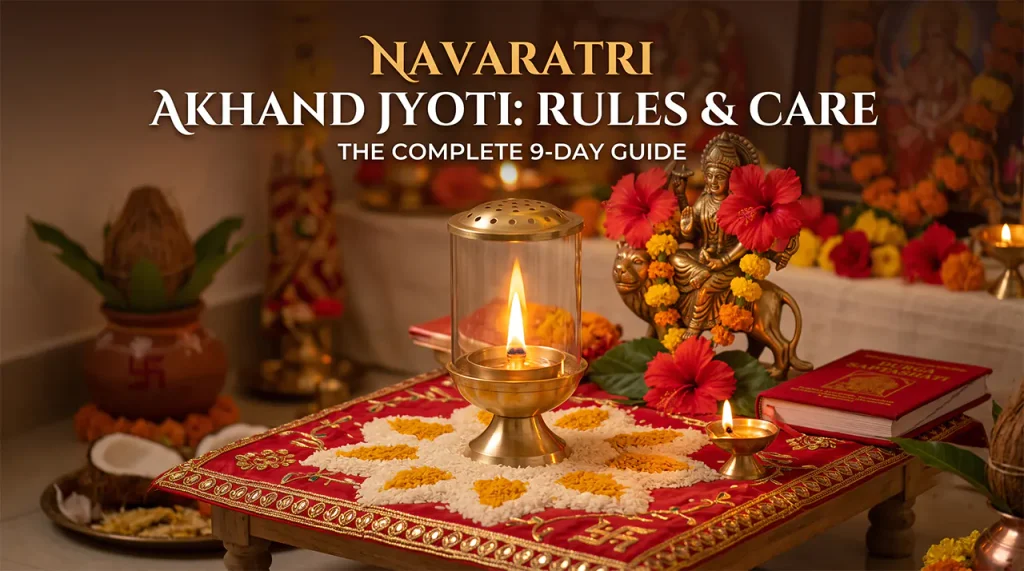
The word Akhand stems from Sanskrit roots: A (non) and Khanda (broken, interrupted, or divided). Jyoti signifies light, illumination, and the divine spark of consciousness. In Hindu philosophy, fire (Agni Tattva) is the sole element that cannot be polluted; it purifies whatever it touches while perpetually rising upward.
Lighting an Akhand Jyoti is not merely a household ritual; it is a profound tantric and vedic sadhana:
- Philosophical Symbolism: The vessel represents the human body, the oil or ghee symbolizes one’s emotional attachments and karmas (Vasanas), and the cotton wick represents the mind (Chitta). As the wick burns away the fuel, spiritual knowledge (Jnana) incinerates latent ego (Ahankara) and material delusions (Maya).
- The Living Presence of Ma Durga: Traditional scriptures, including the Devi Bhagavata Purana and Durga Saptashati, revere the flame as the direct living manifestation (Swaroop) of the Goddess’s brilliance (Tejas). Maintaining the flame serves as a dynamic prayer honoring Her presence within the home.
- Spiritual Benefits: A continuous flame is believed to clear negative energies, pacify malefic planetary influences (particularly Rahu, Ketu, and Mars), invite Mahalakshmi’s enduring grace, and instill spiritual discipline across the household.
Undertaking this practice requires conscious mental preparation. An Akhand Jyoti demands vigilance, care, and equanimity. It must not be undertaken out of peer pressure, spiritual vanity, or fear. The proper approach blends absolute devotion (Bhakti) with clear, practical diligence (Karma).
Read More >> Why Do We Light a Diya? Meaning, Rules, Significance & Oil vs Ghee
Essential Preparations & Auspicious Materials
Maintaining an uninterrupted flame requires quality materials. Inferior wicks unravel, improper oils produce choking soot, and unstable vessels pose fire hazards.
| Material Component | Recommended Option | Secondary Alternative | Options to Avoid |
| Lamp Vessel | Solid Brass / Bronze (Heavy Base) | High-fired Clay / Terracotta (Mitti) | Steel, Aluminum, Thin Glass, Iron |
| Combustion Fuel | Pure Cow Ghee | Cold-Pressed Pure Sesame (Til) Oil | Mustard Oil, Paraffin, Blended Cooking Oils |
| Wick Material | Braided Sacred Red Thread (Mauli/Kalawa) | Long-Staple Raw Cotton Roll (Kacha Soot) | Synthetic blends, loose unbraided cotton |
| Draft Protection | Borosilicate Glass Chimney (Top-vented) | Traditional Perforated Brass Lantern Hood | Solid glass jars without airflow, open drafts |
Selection of Diya: Brass vs. Clay
The physical vessel (Deepapatra) serves as the home for Agni Devata across 240+ continuous hours.
- Brass and Bronze: These alloys are the standard choice for home altars. Brass provides structural stability, will not break under thermal stress, and does not leak or weep oil onto the puja altar (Chowki). Its reflective properties also amplify the flame’s glow.
- Earthen (Mitti) Diyas: Clay represents Mother Earth (Prithvi Tattva) and carries distinct spiritual merit. However, unglazed clay is porous. If you choose an earthen diya, select a large, kiln-fired vessel with thick walls. It must be soaked in clean water for at least 24 to 48 hours prior to the festival, then completely sun-dried. This closes microscopic air pockets, preventing the diya from absorbing your oil or ghee mid-festival.
Ghee vs. Sesame (Til) Oil
Scriptures praise both pure cow’s ghee and unrefined sesame seed (Til) oil for sacred rituals. Your choice dictates your wick preparation, burn characteristics, and budget.
- Desi Cow Ghee: Traditionally associated with the Sattva guna. Ghee produces a golden, warm flame with minimal smoke, emitting an auspicious aroma when burned. From an energy standpoint, cow ghee generates peaceful, spiritual vibrations (Amrit Tatva). It requires warmth: in air-conditioned or cold rooms, ghee solidifies around the perimeter of the diya, necessitating an occasional nudge toward the flame base with a brass pick.
- Sesame (Til) Oil: Highly praised in Agamic literature, sesame oil is associated with deep spiritual protection, burning with an intense, steady heat that pacifies malefic planetary forces (especially Saturn). It burns slower than ghee and remains liquid at any room temperature, making it a reliable choice for beginners.
- Oils to Strictly Avoid: Do not use mustard oil (Sarson) for an Akhand Jyoti unless directed by an authentic family lineage or specific Tantric initiation, as it emits pungent fumes that irritate the eyes over nine continuous days. Never use synthetic, petroleum-based lamp oils or blended vegetable cooking oils.
Wick Preparation (Varti Nirmana)
The wick is the heart of the Akhand Jyoti. A standard round cotton ball will rapidly collapse, drown in the oil, and burn out within twelve hours. You need a stable, elongated wick that can be fed gradually forward over several days.
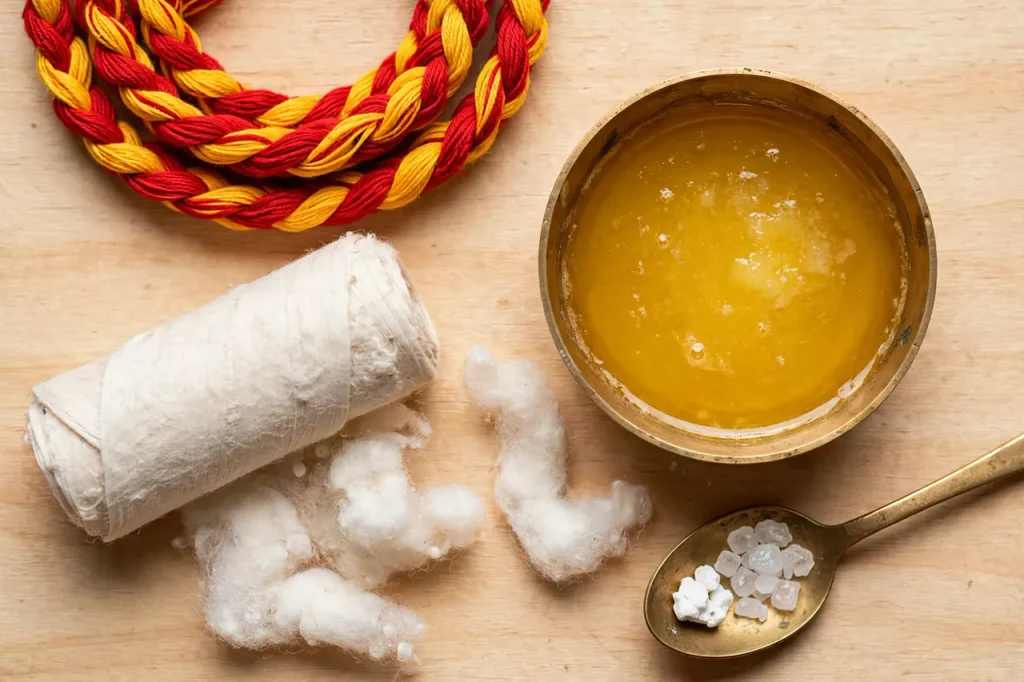
- Using Sacred Red Thread (Mauli or Kalawa): Pure cotton Mauli infused with turmeric and vermilion makes an excellent wick. Measure a strand roughly 10 to 12 inches long. Take three identical strands and braid them tightly together. The braided structure creates capillary action, drawing up fuel efficiently without splitting at the tip.
- Using Raw Cotton Roll (Kacha Soot): If using pure raw cotton, unroll a long, uniform sliver. Moisten your palms with raw milk or Ganga Jal and gently roll the cotton in one direction between your palms until it forms a firm, dense wick of uniform thickness.
- Pre-Conditioning: Soak your completed wick in warm ghee or oil for at least three hours before Ghatasthapana. Roll the soaked wick in a touch of edible camphor (Bhimseni Kapur) powder; this facilitates smooth lighting and creates a steady initial flame.
Glass Chimney Specifications
An uncovered Akhand Jyoti in a modern home faces drafts from ceiling fans, opening doors, and air conditioners. A high-quality borosilicate glass chimney is an absolute necessity.
- Thermal Shock Resistance: Standard soda-lime glass can crack under continuous heat. Insist on laboratory-grade borosilicate glass that withstands high temperatures.
- Airflow Clearance: The chimney must not sit flush against a flat surface, as Agni requires oxygen to burn. Choose a chimney designed with bottom notches or a raised brass base with perforated ventilation holes, along with a wide top opening. The top edge of the glass should extend at least 4 to 6 inches above the tip of the flame to allow convective heat transfer without trapping heat inside the chamber.
Vastu Shastra & Directional Guidelines
Fire is a potent elemental force. In Vastu Shastra, placing the fire element (Agni Tattva) in an inauspicious zone causes energetic imbalances within the home, whereas correct placement invites health, vitality, and prosperity.
Ideal Placement Zones
- Southeast Direction (Agneya Kona): The Southeast corner of the home or the Southeast corner of your puja room is ruled by Agni Devata. Placing the Akhand Jyoti here is considered optimal by Vastu authorities. It channels vitality, prevents domestic discord, and cleanses stale energies.
- East or Northeast Direction (Ishanya Kona): If your home layout prevents a Southeast placement, place the Akhand Jyoti in the East or Northeast corner of the altar room. The East promotes spiritual awakening, intellect, and physical health, while the Northeast connects you to pure sattvic consciousness.
Orientation of the Flame
When positioning the diya, note the direction in which the wick’s tip points:
- Wick Pointing East: Highly auspicious; brings longevity, health, and spiritual focus.
- Wick Pointing North: Auspicious; associated with wealth, abundance, and success.
- Wick Pointing West: Avoid if possible; traditionally associated with mixed outcomes and draining expenses.
- Wick Pointing South: Avoid for domestic worship. The Southern direction (Yama) is reserved for ancestor (Pitru) rituals or specific tantric disciplines, not household Navaratri worship.
Preparing the Sacred Altar Base (Chowki Setup)
Never place an Akhand Jyoti directly on a bare floor or synthetic table. The base should be carefully consecrated:
- The Platform: Lay down a sturdy wooden stool (Patta or Chowki) that does not wobble.
- The Cloth: Cover the chowki with an unstitched piece of new red or yellow cotton or silk cloth.
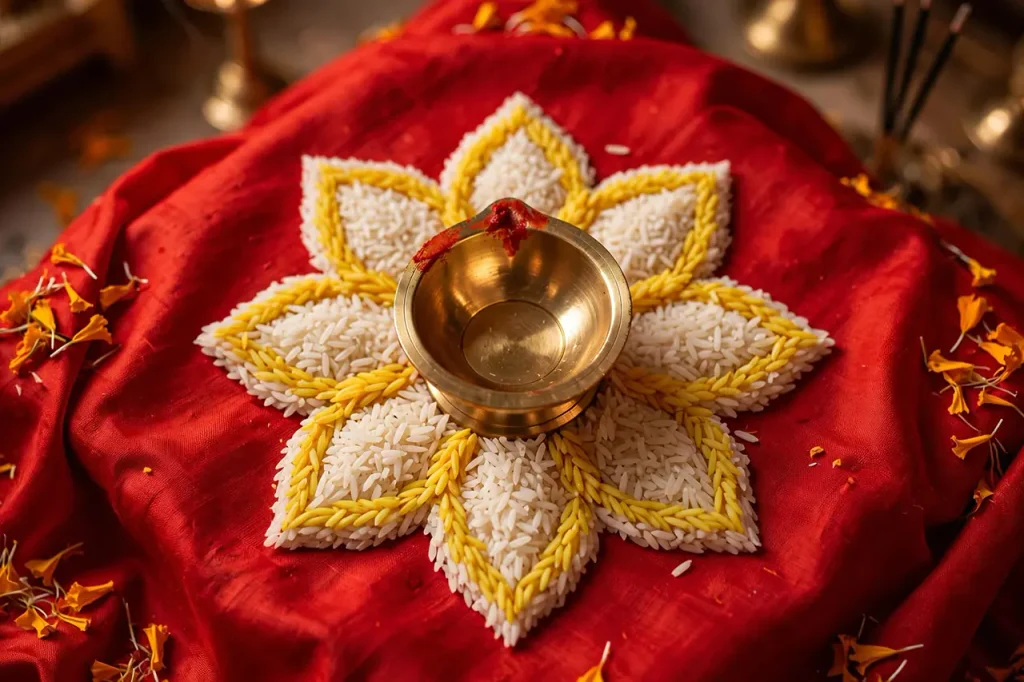
- The Rice Bed (Akshat): Place a brass or copper plate on the cloth. Inside this plate, construct a bed of unbroken, raw white rice grains (Akshat). You can tint a portion of this rice with turmeric (Haldi) or vermilion (Kumkum).
- The Ashtadal Kamal (Eight-Petaled Lotus): Using your fingers, arrange the rice into an eight-petaled lotus shape. The lotus symbolizes the universe and the eight manifestations of Durga (Ashta Lakshmi / Ashta Matrikas). The diya sits squarely in the center of this sacred grain bed, which insulates the platform from bottom heat transfer while grounding the spiritual energy.
Locations to Avoid
- Never place the diya directly under an active ceiling fan or in the direct path of an air-conditioning vent.
- Do not place it behind doors, in narrow walkways where flowing garments could brush against it, or close to lightweight curtains.
- Avoid placing it below your knee height or above your eye line. It should rest between your chest and naval level when you sit down for puja.
Read More >> Sacred Tulsi Plant at Home: Meaning, Worship, Placement & Care
Muhurat & Step-by-Step Lighting Ritual (Pratishtha)
Lighting the Akhand Jyoti is a sacred invocation (Pratishtha), not a casual chore. It takes place on the first day of Navaratri (Pratipada Tithi) during the auspicious Ghatasthapana Muhurat or Abhijit Muhurat.
Step 1: Purification (Atma Shuddhi & Sthala Shuddhi)
Bathe early, put on clean traditional clothing (avoid black or dark brown colors), and sprinkle Ganga Jal over yourself, the puja implements, and the altar space while chanting:
Om Apavitrah Pavitro Va Sarvavastham Gato’pi Va |
Yah Smaret Pundarikaksham Sa Bahyabhyantarah Shuchih ||
(Unclean or clean, whatever state one may be in, whoever remembers the lotus-eyed Lord becomes pure within and without.)
Step 2: Taking the Sankalpa (The Sacred Vow)
Hold a small amount of water, a pinch of unbroken rice (Akshat), a flower, and a clean copper coin in your right palm. Close your eyes, concentrate on Ma Durga, and state your name, your gotra (lineage), your current physical location, and your vow:
“Mother Durga, I [Your Name], establish this Akhand Jyoti before You throughout these nine sacred days of Navaratri. Grant our home peace, remove inner darkness, and bless our family with health, longevity, and spiritual realization. Please protect this flame from all obstacles, forgive any unintentional errors in my service, and accept my devotion.”
Gently let the water and offerings slide from your palm into a brass plate placed before the altar.
Step 3: Consecrating the Base and the Vessel
Anoint the brass diya with sandalwood paste (Chandan), vermilion (Kumkum), and rice grains. Offer a pinch of flowers to the base of the lamp, acknowledging Agni Devata:
Om Agaye Namah | Om Deepanarayanaaya Namah ||
Pour your pre-warmed ghee or pure sesame oil into the vessel, filling it to roughly three-quarters capacity. Ensure the braided wick rests securely in the central or angled groove, pointing East or Southeast, with its tip exposed above the oil line.
Step 4: The Lighting Ceremony
Never light an Akhand Jyoti directly with a modern chemical matchstick inside the vessel, as sulfur fumes pollute the consecrated oil.
- Light an independent wooden splint or a pure piece of camphor (Kapur) using a match.
- Bring that burning camphor or splint directly to the soaked tip of your wick.
- As the flame catches and stabilizes, maintain deep focus and chant the sacred Deepa Jyoti invocation.
Step 5: Recitation of the Invocation Mantras
Sanskrit Mantra:
दीपो ज्योतिः परं ब्रह्म दीपो ज्योतिर्जनार्दनः।
दीपो हरतु मे पापं दीपज्योतिर्नमोऽस्तु ते॥
शुभं करोति कल्याणमारोग्यं धनसंपदः।
शत्रुबुद्धिविनाशाय दीपज्योतिर्नमोऽस्तु ते॥
English Transliteration:
Deepo Jyotih Param Brahma Deepo Jyotir Janardanah |
Deepo Haratu Me Paapam Deepa Jyotir Namo’stu Te ||
Shubham Karoti Kalyaanam Aarogyam Dhana Sampadah |
Shatru Buddhi Vinashaya Deepa Jyotir Namo’stu Te ||
Translation & Meaning:
“The light of this lamp is Supreme Divinity; the light is Lord Janardana (the preserver). May this light cleanse my mistakes and past impressions; salutations to the divine light. May it bestow auspiciousness, prosperity, health, and abundant wealth, and remove negative thoughts and destructive tendencies; salutations to the sacred flame.”
Step 6: Placing the Protective Chimney
Once the flame is burning smoothly and without sputtering, gently lower your borosilicate glass chimney over the lamp. Observe the flame for three full minutes to verify that the convective draft is healthy: the flame should burn straight, vibrant, and quiet, without dancing or seeking oxygen.
24/7 Maintenance & Day-to-Day Care Protocol
An Akhand Jyoti relies on practical management. To keep it lit through nine days and nights, you need a proactive maintenance routine.
1. The Auxiliary Diya Technique (Crucial Protocol)
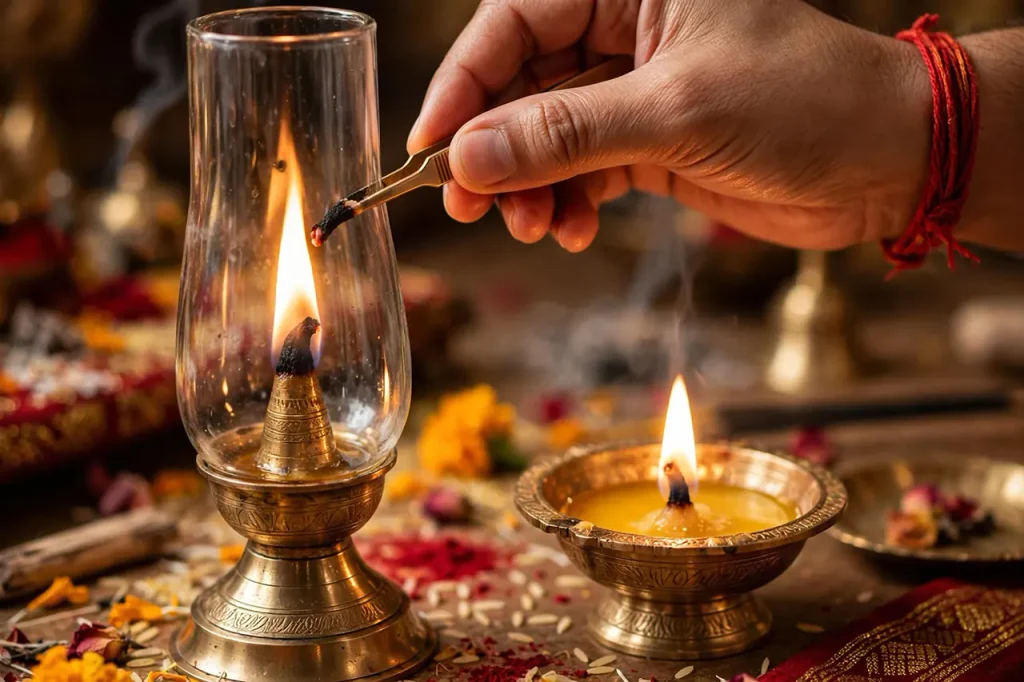
Never adjust, trim, move, or clean an Akhand Jyoti directly without an auxiliary light source. If the main flame flickers out while you are working on it, your vow is interrupted. You can prevent this using an auxiliary lamp (Sahayak Diya).
- Keep a small brass diya, filled with ghee and fitted with a single cotton wick, beside the main altar.
- Before adjusting the Akhand Jyoti’s wick, replenishment, or chimney, light this auxiliary diya from the flame of the Akhand Jyoti.
- Set the auxiliary diya right beside the main vessel. If an unexpected gust or accident snuffs out your primary flame during maintenance, the divine energy lives on in the auxiliary flame. You can immediately transfer the fire back without breaking the Sankalpa.
- Once maintenance is finished and the primary flame is secure, allow the auxiliary diya to naturally run out of fuel or gently waft it out using a flower petal (never blow on it).
2. Fuel Replenishment Schedules
Pouring cold oil or dropping solid ghee into the diya can cool the fuel bed, shrink the flame, or cause violent spitting.
- Frequency: Refill the vessel every 6 to 8 hours. Never let the fuel level dip below one-third of the lamp’s volume.
- Temperature: If using ghee, ensure it is completely melted and slightly warm to the touch before adding it. Cold, solid ghee will snuff out the flame if dropped directly into the pool.
- Pouring Technique: Never pour fuel directly over the wick or right beside the burning head. Use a small, narrow-spouted brass pot (Aachmani or mini-pitcher). Pour slowly along the interior rim of the diya vessel, allowing the warm liquid to settle gently into the base.
- 3. Ash Removal and Wick Elongation
- As cotton threads burn, a carbon crust (Gul) forms at the tip of the wick. If left unmanaged, this carbon head thickens, starves the wick of capillary flow, and causes the flame to dwindle or smoke.
- Tools Required: Fine-tipped brass tweezers, small puja scissors, and a brass pick.
- Timing: Perform wick maintenance every 24 hours, preferably in the morning after completing your bath and personal prayers.
- Technique:
- Ensure your auxiliary diya is lit first.
- Carefully lift off the glass chimney.
- Using the brass pick, gently nudge the unburned length of the braided wick forward by a millimeter or two, raising fresh, fuel-saturated thread into the combustion zone.
- Hold the carbon crust at the tip using the brass tweezers. Gently break off the brittle, dead black ash and deposit it into a small copper bowl. Never allow carbon debris to drop into the clean oil pool below.
- Do not disturb the vibrant white-blue heart of the flame during this adjustment.
- 4. Cleaning Soot from the Glass Chimney
- Continuous burning causes a fine patina of carbon to coat the inner surface of the glass chimney. Left unattended, this obscures the light and restricts radiant heat dissipation.
- The Rotation Method: Maintain two identical borosilicate chimneys.
- Procedure:
- Light your auxiliary diya.
- Put on heat-resistant cotton gloves.
- Carefully lift the warm, sooty chimney off the Akhand Jyoti and place it on a heatproof wooden mat.
- Immediately place the clean, secondary chimney over your flame.
- Wash the sooty glass using warm water, mild soap, and a soft cloth (avoid scratchy metallic scrubbers). Dry it completely so it is ready for the next rotation.
- 5. Night Routine & Draft Protection
- Night brings unique hazards: windows may be closed, draft patterns shift as temperatures drop, and occupants are asleep.
- Air-Conditioner and Fan Adjustments: Turn off any ceiling fan directly overhead. If the room needs air circulation, run a fan on low speed in an adjacent space, or use an oscillating fan positioned well away, angled toward an opposite wall.
- Physical Wind Guards: Place a lightweight wooden or folding cardboard folding screen around the altar chowki at night. This stops sudden cross-breezes without suffocating the room’s oxygen supply.
- Family Rotation Strategy: Divide the night into shifts if multiple family members are observing the vow. One person monitors the diya between 11:00 PM and 3:30 AM; another takes over at Brahmamuhurta (3:30 AM to 7:00 AM). Continuous personal vigilance ensures total peace of mind.
- What If the Akhand Jyoti Goes Off? (Remedies & Expiation)
- Finding an Akhand Jyoti extinguished can cause sudden panic and distress. Superstition leads many to fear terrible misfortune or divine wrath. This anxiety is spiritually unfounded and harmful to true devotion.
Removing Fear and Guilt
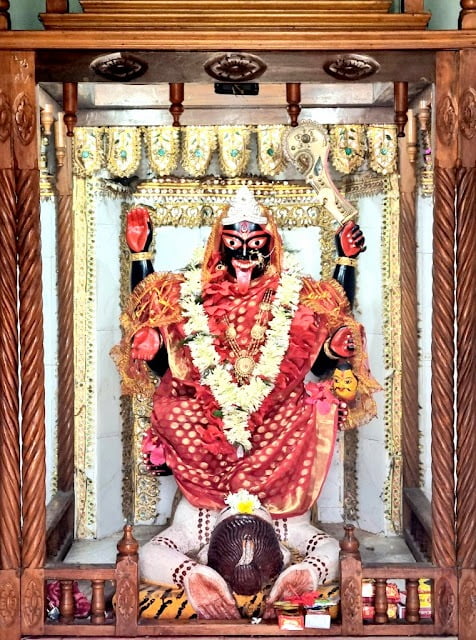
Scriptures emphasize that the Divine Mother is an embodiment of boundless compassion (Karuna Mayi). A gust of wind, a clogged wick, or exhausted fuel is a mechanical failure, not a sign of divine anger. Treat the situation with reverence, composure, and swift action rather than fear.

Step-by-Step Atonement (Prayashchitta) Protocol
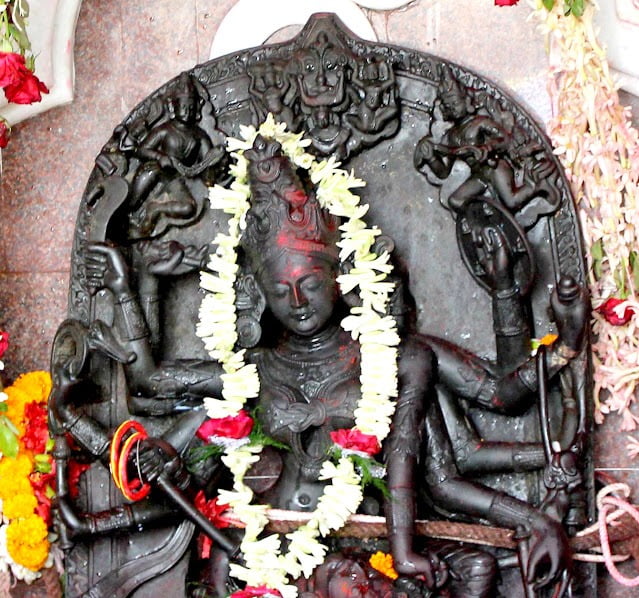
- Immediate Re-ignition: Do not spend time lamenting. If your auxiliary diya is still burning, immediately touch an incense stick or wooden splint to the auxiliary flame and reignite the Akhand Jyoti. If the auxiliary flame has also expired, clean the wick tip, add fresh ghee, and light it using a clean splint or camphor.
- Acknowledge and Apologize (Kshama Prarthana): Fold your hands in front of the rekindled flame and recite the sacred forgiveness verse from the conclusion of the Devi Mahatmyam:
Aparadha Kshamapana Stotram Verse:
अपराधसहस्राणि क्रियन्तेऽहर्निशं मया।
दासोऽयमिति मां मत्वा क्षमस्व परमेश्वरि॥
आवाहनं न जानामि न जानामि विसर्जनम्।
पूजां चैव न जानामि क्षम्यतां परमेश्वरि॥
English Transliteration:
Aparadha Sahasrani Kriyante’har-nisham Maya |
Daso’yam-iti Mam Matva Kshamasva Parameshwari ||
Aavahanam Na Janami Na Janami Visarjanam |
Poojam Chaiva Na Janami Kshamyatam Parameshwari ||
Meaning:
“Thousands of faults and shortcomings are committed by me day and night. Treating me as your humble servant, O Supreme Goddess, please forgive them all. I do not know the mysteries of formal invocation, nor how to bid farewell, nor do I know proper worship; please forgive me, O Divine Mother.”
- Perform Light Atonement:
- Chant one round (108 repetitions) of the Navarna Mantra (Om Aim Hreem Kleem Chamundayai Viche) or the Gayatri Mantra.
- Set aside a small charitable donation of food grains, cow’s milk, or yellow dal to be offered to an elderly person or cow shelter (Gaushala) the following morning.
- Resume your Navaratri sadhana with renewed care, knowing that your sincere devotion cleanses the lapse.
Safety, Child, and Pet Proofing
True spirituality never ignores domestic safety. A continuously burning flame inside a home demands clear, practical safeguards.
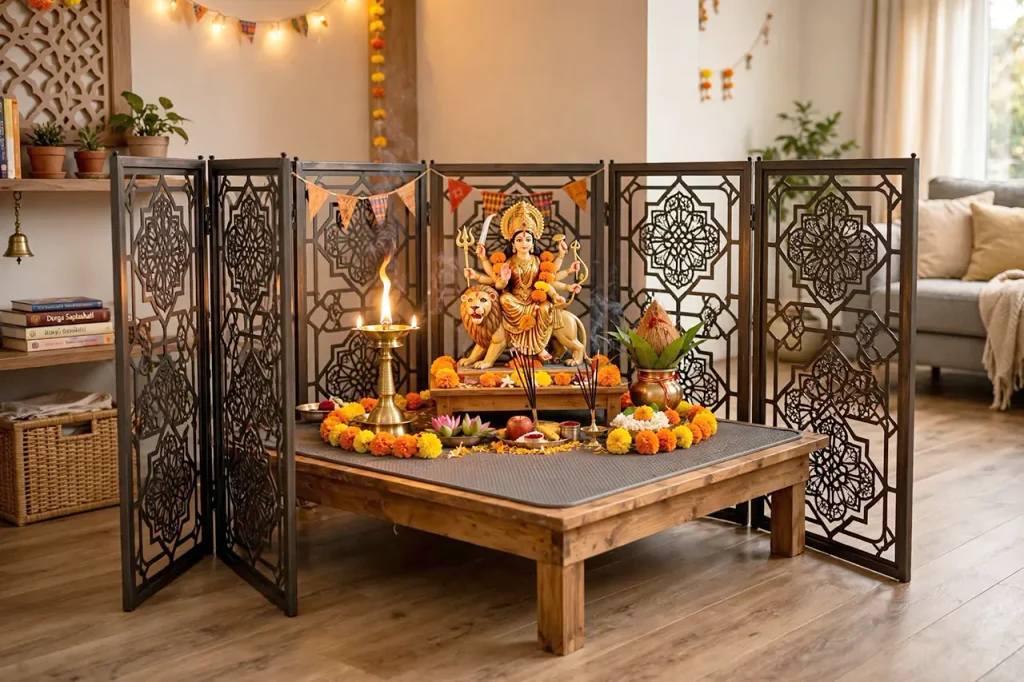
- Establish a Safe Radius: Maintain at least two feet of open clearance on all sides of the diya, and at least four feet of clearance above it. Keep matches, camphor boxes, extra bottles of oil, and paper out of this zone.
- The Non-Flammable Base Mat: Lay a fire-retardant silicone craft mat, ceramic tile, or thick brass sheet underneath the wooden chowki. If a spill happens, hot fuel will not contact carpets, wood flooring, or fabric.
- Child and Pet Safety Barriers: If you have curious toddlers, dogs, or cats, do not leave the puja room accessible. Install a tall safety gate at the room door. If the altar sits in an open floor plan, place a sturdy metal wire fireplace screen around the entire chowki setup.
- Leaving the House Unattended: Traditional rules state that a home with an active Akhand Jyoti should never be left entirely empty. At least one adult family member should remain in the residence. If every family member must leave for an important family commitment, entrust a responsible, spiritually minded relative or neighbor with house keys to check on the flame every three to four hours.
The Akhand Jyoti should not be abruptly blown or pinched out once the tenth day arrives. Concluding the vow requires patience, gratitude, and traditional etiquette.
Day 10 (Dashami) Protocol
After finishing the morning puja, Kanya Puja, and Aparajita Puja on Vijayadashami:
- Perform a heartfelt Aarti of the Akhand Jyoti, offering fresh flowers, sweets, and your sincere thanks.
- Do not add any more ghee or oil to the vessel.
- Allow the remaining fuel to burn down naturally. When the fuel runs out, the flame will quietly subside on its own. This natural conclusion is known as the flame becoming peaceful (Shant Hona). Never blow, wave, or splash water on the flame to put it out.
Handling Sacred Residuals
- Sacred Soot/Ash (Bhasma / Kajal): The black soot accumulated inside the glass chimney or on the wick tip is considered spiritually charged (Tejasvi). Scrape this fine carbon using a clean silver or copper pin, mix it with a drop of cow ghee, and store it in a small box. Applying a tiny dot of this holy kajal on the forehead of family members protects against negative energies.
- The Rice Bed (Akshat): Gather the rice grains that formed the lotus bed beneath the diya. Mix them into your home’s larger storage of daily cooking rice, or scatter them in a clean garden or balcony for birds to consume. Do not throw this consecrated grain into the garbage.
- Remaining Unburned Wick: Place the burned tip of the wick into running water, a sacred river, or bury it respectfully beneath the soil near a Tulsi plant or flowering shrub.
Frequently Asked Questions
Can mustard oil (Sarson ka Tel) be used for Navaratri Akhand Jyoti?
While mustard oil is used in specific protective Saturn or Bhairava rituals, it is generally avoided for household Navaratri Akhand Jyoti. It emits pungent fumes that sting the eyes over continuous days and burns with a heavier smoke profile than cow ghee or cold-pressed sesame (Til) oil.
Can an unmarried girl or single woman light and maintain an Akhand Jyoti?
Yes. Any devoted individual, regardless of gender or marital status, may establish an Akhand Jyoti provided they observe purity, bath disciplines, and regular maintenance. Devotion (Bhakti) and discipline transcend social demographics.
Can the Akhand Jyoti be moved to another room after being lit?
Under standard Vastu and Agamic rules, an Akhand Jyoti must not be shifted once established with a formal Sankalpa. Its position on the altar represents the steady anchoring of fire energy. If an emergency arises (such as structural damage, an electrical short-circuit, or water leakage), light the auxiliary diya, carefully carry the platform without tilting the main lamp, set it in a safe spot, and seek forgiveness for the move.
What should be done if a family member experiences a menstrual cycle during the 9 days?
In traditional Hindu practice, a woman experiencing her menstrual cycle steps back from directly lighting, feeding, or touching the puja altar to rest. Another family member takes over the physical feeding of fuel and maintenance of the Akhand Jyoti. The woman’s personal devotion remains pure, and she can resume close ritual care after her cycle concludes with a purifying bath.
What happens if there is an unexpected birth or death (Sutak / Patak) in the family?
If a birth (Vriddhi Sutak) or death (Patak) occurs within the immediate family line, ritual purity guidelines traditionally apply. The household Akhand Jyoti, having already been consecrated with a solemn vow, should not be extinguished. A non-impacted neighbor, close friend, or family priest can be asked to enter the home to feed the fuel and care for the flame until Vijayadashami.
Can we leave the house locked with the Akhand Jyoti burning inside?
Leaving an open flame locked inside an empty house is dangerous and spiritually discouraged. An Akhand Jyoti represents a living invocation that requires mindful human presence. Organize schedules so that at least one adult is always home.
How do I prevent the flame from flickering erratically?
Erratic flickering usually points to uneven drafts or moisture in the wick. Use a properly vented borosilicate glass chimney, turn off overhead ceiling fans, and make sure your fuel is completely free of water droplets.
Is it acceptable to trim the wick with ordinary household scissors?
Keep a dedicated pair of small brass or stainless steel scissors strictly for puja purposes. Never use scissors that have been used in the kitchen, for cutting hair, or for opening utility packages to trim a sacred wick.
What does it mean if the flame burns with a bright, tall, double-headed tongue?
In folk tradition and the Deepa Shastra, a clear, golden, smoke-free flame that rises steadily without erratic crackling reflects positive devotional alignment, peace, and harmony within the household.
Can we use an electric or LED diya as an Akhand Jyoti?
While an electric diya avoids fire hazards, it lacks the sacred purifying fire element (Agni Tattva) central to Vedic worship. An electric lamp can serve as decorative illumination, but it does not fulfill the scriptural vow of an Akhand Jyoti ritual.
May the brilliant light of this sacred flame illuminate your home with health, clarity, and peace throughout the nine nights of Navaratri. Through patient practical care and pure devotion, the uninterrupted flame outside steadily awakens the divine presence within.