Pradakshina: Meaning, Significance, Rules & Why We Walk Clockwise
Pradakshina involves the act of walking in a clockwise manner around a god or object held sacred in Hinduism, Buddhism, and Jainism. The term is derived from Sanskrit where ‘Pra’ stands for forward or auspicious while ‘Dakshina’ denotes south or right side. When doing pradakshina, you must consciously ensure that the sacred center remains on your right hand. Pradakshina, which is otherwise known as circumambulation, is among the most ancient acts of worship in the world.
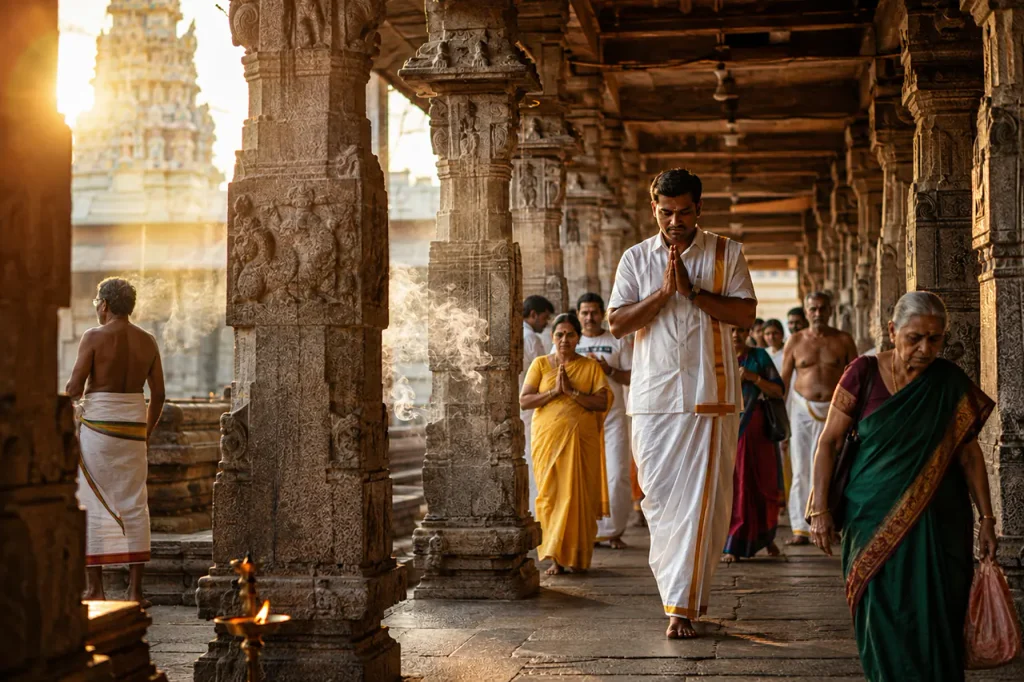
If you have been to an Indian temple, then it is almost certain that you have seen people circumambulating in the inner part of the temple. It feels soothing and rhythmic. However, many people, both young and old, may find themselves asking some questions regarding the reason for doing this particular act. For example, why is pradakshina always done in a clockwise direction? Why do people walk around a shrine instead of staying and praying? Is there any difference in the number of times you walk around a Shiva and Ganesha temple?
From my childhood, whenever I visited temples, I often heard people telling me to do Pradakshina three times. I followed the tradition without giving it much thought. But over the years, I noticed something interesting. During Navagraha pooja, the priest would ask me to do Pradakshina nine times, while in temples dedicated to Lord Balaji or his avatars, I was sometimes told to do it eleven times to fulfil my wishes. This made me wonder—why does the number change? Is there a deeper meaning behind these different counts? I wanted to understand the reason rather than simply follow the practice.
My curiosity grew stronger one day when I visited a temple that had a small library. I was surprised to discover many books about Hindu traditions, temples, rituals, and spiritual practices. While exploring them, I came across a book that explained the significance of Pradakshina in a way I had never heard before. It was fascinating to learn that Pradakshina is not merely walking around a deity; it carries deeper spiritual, symbolic, and devotional meanings.
That discovery encouraged me to explore the subject further. I researched different traditions and references to understand why Pradakshina is performed and why the number of rounds can vary. Through this article, I am excited to share what I learned with you in a simple and interesting way.
This definitive guide explains the history, design principles, spirituality, and regulations behind this holy walk. From the ancient Sanskrit roots all the way up to the stone walkways at historic temples, we cover all aspects of this topic with crystal clarity and answer all your questions.
What Is Pradakshina?
At its most fundamental level, Pradakshina (also spelled Pradakshinam) refers to the act of walking around a sacred person, object, or space along a designated circular path. In religious studies, this physical action is called circumambulation (from the Latin words circum, meaning “around,” and ambulare, meaning “to walk”).
In Hindu temple traditions, worship is not limited to silent mental prayer or verbal chanting. It actively involves the physical body. Devotees offer flowers with their hands (Upachara), prostrate on the stone floor (Namaskara or Sashtanga), receive sanctified water and food (Teertha and Prasada), and trace circles around the divine sanctuary using their feet. Walking around a shrine makes your entire body part of the devotional offering.
Pradakshina Meaning
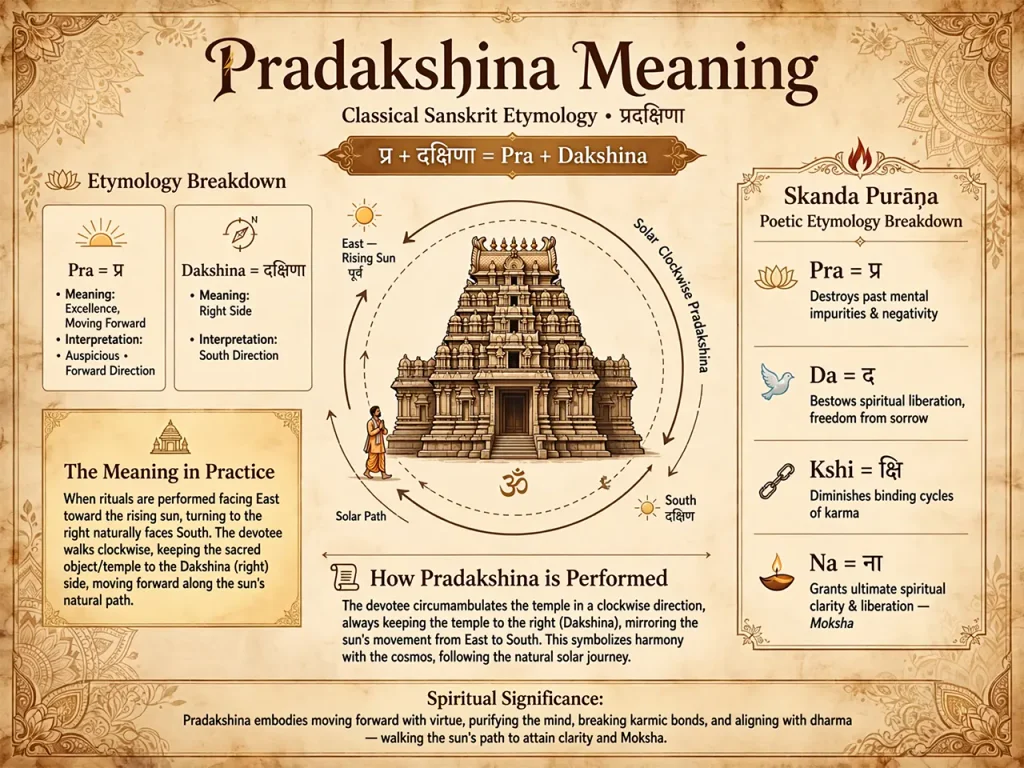
The classical Pradakshina meaning is revealed through its root Sanskrit etymology. The term is a compound formed by two linguistic elements:
Pradakshina = Pra + Dakshina
- Pra (प्र): A prefix denoting excellence, moving forward, or stepping intentionally in an auspicious, forward-moving direction.
- Dakshina (दक्षिण): This word has dual meanings in Sanskrit. It means the “right side” (as opposed to Vama, the left), and it also means the cardinal geographic direction “South.”
When ancient rituals were conducted facing the rising sun in the East, a person turning toward their right hand naturally turned southward. Thus, walking while keeping the sacred object to your Dakshina (right side) means you are moving forward along the solar path.
A well-known traditional verse from the Skanda Purana offers a poetic, symbolic breakdown of each syllable:
“Pra-karshena sarva papani, Da-kshinena tu muktaye,
Kshi-yante janma bandhani, Na-karo moksha dayakah.”
- Pra: Destroys past mental impurities and negativity.
- Da: Bestows spiritual liberation and freedom from sorrow.
- Kshi: Diminishes the binding cycles of karma.
- Na: Grants ultimate spiritual clarity and liberation (Moksha).
While this verse reflects devotional poetry rather than strict linguistic grammar, it captures how Indian philosophy views the practice: as a total reset of the mind and body.
Ever wondered Why Do We Ring the Bell Before Entering a Temple? Shocking Truth
What Does Pradakshina Symbolize?
Why do we walk in a circle rather than a straight line?
A straight line has a distinct starting point and a finish line. It represents linear progress—moving from point A to point B in the everyday material world. In contrast, a circle has no beginning and no end.
- The Wheel of Life (Samsara): Human life is traditionally viewed as a continuous cycle of seasons, days, births, and experiences. Walking in a circle reminds us that existence is cyclical.
- God as the Unchanging Pivot: While the outer circle moves continuously, the absolute center remains completely still. The deity resting in the sanctum symbolizes the unchanging eternal truth (Brahman), while the devotee walking around the perimeter represents the constantly moving material universe (Prakriti).
- Centering Your Life: In daily life, our thoughts revolve around our work, family, worries, and material ambitions. By stepping onto the temple path, you make an intentional mental statement: “For these few moments, I am shifting the center of my universe away from my ego and placing the Divine at the core.”
What Can Be Circumambulated?
While most people encounter Pradakshina inside neighborhood shrines, the practice applies across many sacred contexts in Indian culture:
- Temple Deities & Sanctums (Garbhagriha): Circling the main chamber where the consecrated idol (Murti) is established.
- Sacred Emblems: Walking around the Shiva Linga, the sacrificial altar (Yajna Kunda or Homa Kunda), or sacred flagpoles (Dhwaja Stambha).
- Sacred Botanical Entities: Circling living trees and plants revered in Hindu tradition, such as the Peepal tree (Ficus religiosa), Banyan tree (Ficus benghalensis), and the sacred Tulsi plant (Ocimum sanctum).
- Entire Temples & Complexes: Walking around the massive outer stone boundary walls (Prakara) of expansive temple complexes like those in Thanjavur, Madurai, or Tirupati.
- Sacred Mountains & Hills: Embarking on extensive walking circuits around holy peaks, such as Mount Arunachala (Girivalam) in Tamil Nadu or the Govardhan Hill (Parikrama) in Uttar Pradesh.
- Sacred River Basins: Long-distance walking pilgrimages that follow the entire course of holy rivers, most notably the 2,600-kilometer Narmada Parikrama.
- Living Masters & Elders: In traditional Vedic culture, disciples sometimes walk around their Guru, and during Hindu wedding ceremonies (Vivaha Samskara), the bride and groom circle the holy fire (Saptapadi / Agni Pradakshina) to solemnize their marriage.
Why Is Pradakshina Done Clockwise?
Devotees consistently walk clockwise rather than counter-clockwise during Pradakshina. This is not a random ritual preference; it is anchored in ancient spatial philosophy, cultural etiquette, and astronomical observations.
       [ Northern Axis ]
              ▲
              │
    West ◄─── ┼ ───► East (Facing Sunrise)
              │
              ▼
       [ South / Right ]
    (Dakshina = Right Hand)
Keeping the Deity on the Right
In classical Indian culture, bodily orientation carries deep symbolic meaning. The right side of the body (Dakshina anga) is traditionally associated with nobility, positive action, purity, and spiritual strength, whereas the left side (Vama anga) is historically associated with receptive, passive, or introspective aspects.
When you walk clockwise around any object, your right shoulder and right arm naturally face inward toward the center. This means that throughout the entire circumambulation, your noble, respectful side remains continuously directed toward the consecrated deity. Conversely, if you were to walk counter-clockwise, your left side would face the shrine, which traditional ritual manuals (Agamas and Dharmashastras) view as improper during celebratory worship.
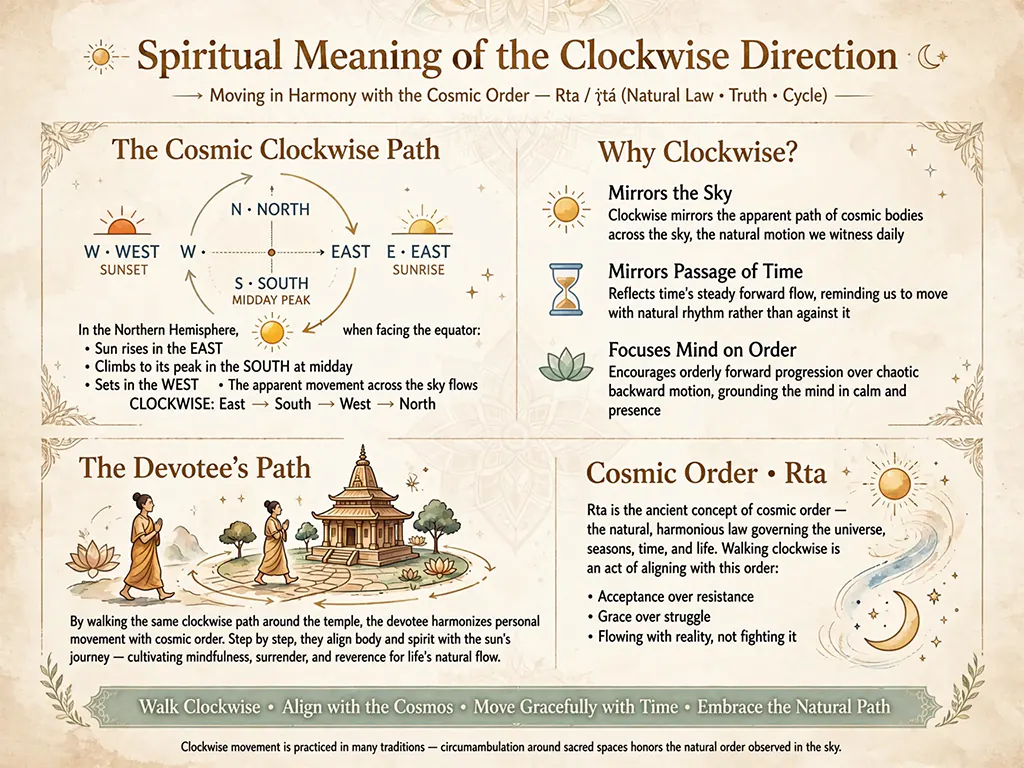
Spiritual Meaning of the Clockwise Direction
The clockwise direction mirrors the apparent path of cosmic bodies across our sky. In the Northern Hemisphere, when one faces the equator and observes the sun rising in the east, climbing to its midday peak in the south, and setting in the west, the visual movement is clockwise (East >> South >> West >> North).
By walking along this same pathway:
- The devotee harmonizes their personal movement with the cosmic order (Rita).
- You mirror the passage of time, reminding yourself to move gracefully along life’s natural path rather than fighting against reality.
- The mind focuses on an orderly, forward progression rather than chaotic or backward motion.
Traditional Symbolism
In Sanskrit texts, counter-clockwise walking is termed Prasavya or Apadasavya. This direction is almost exclusively reserved for funeral rites (Antyeshti) and ancestral death ceremonies (Pitru Tarpan), where normal worldly orders are symbolically reversed to signify departure, dissolution, and return to formless elements.
Performing Pradakshina (clockwise) signifies creation, preservation, life, vitality, and solar celebration. Therefore, inside a temple dedicated to living energy and liberation, one exclusively follows the clockwise flow.
The Sacred Centre and the Devotee
Consider how planetary systems work in astronomy: planets rotate in stable orbital rings around a central gravitational anchor—the Sun. If a planet loses its central focus, it drifts erratically into cold space.
                Devotee Orbit
             ╭───────────────╮
           ╭─╯   (Prakriti)  ╰─╮
          ╭╯                   ╰╮
          │      ┌───────┐      │
          │      │ Deity │      │
          │      │(Centre)      │
          │      └───────┘      │
          ╰╮                   ╭╯
           ╰─╮   (Brahman)   ╭─╯
             ╰───────────────╯
During Pradakshina:
- The Deity (Sanctum) represents the immovable, silent gravitational anchor—the Supreme Consciousness (Brahman).
- The Devotee represents the dynamic, moving orbit of life (Prakriti).
- By keeping yourself centered around that holy core, you remind yourself that your daily life should revolve around higher spiritual values (compassion, honesty, duty, and truth) rather than selfish impulses.
Read More>> Azhimala Shiva Temple 58 ft statue
Spiritual Significance of Pradakshina
While circumambulation looks like simple walking on the surface, its inner spiritual purpose is to engage your entire being in quiet contemplation.
   ┌─────────────────────────────────────────────────────────┐
   │         THE THREE-FOLD DEVOTION (Tri-Karana)            │
   ├──────────────────┬──────────────────┬───────────────────┤
   │  PHYSICAL BODY   │      SPEECH      │       MIND        │
   │     (Kayika)     │     (Vachika)    │    (Manasika)     │
   ├──────────────────┼──────────────────┼───────────────────┤
   │  Rhythmic Steps  │ Chanting Mantras │ Focused Attention │
   │  Folded Hands    │ Silent Breathing │ Divine Centering  │
   └──────────────────┴──────────────────┴───────────────────┘
Expression of Devotion
Sitting down and reading scripture is an intellectual activity (Jnana). Singing hymns is a vocal activity (Kirtana). Pradakshina unites both with physical action (Kayika Seva). Devotees bring their feet, joints, eyes, and posture into harmony. When you fold your hands in Anjali Mudra (Namaste) at chest level and step gently along the stone floor, your entire physical form acts as a living prayer.
Surrender and Humility
Walking slowly around a shrine cultivates genuine humility. In our fast-paced daily lives, we constantly demand quick outcomes, check our watches, and run after appointments.
When you enter a temple walkway:
- You slow down to a steady, deliberate pace.
- You step behind other devotees, moving together as one humble community regardless of social status, wealth, or background.
- You let go of personal pride by acknowledging that you are orbiting something far greater than your personal ego.
Keeping the Divine at the Centre
Many modern struggles come from extreme self-centeredness—worrying endlessly about “My success, my reputation, my possessions, my problems.”
Pradakshina offers a direct mental correction:
- For 10 to 15 minutes, you physically circle something outside yourself.
- It retrains your brain to realize that you are part of a wider, sacred tapestry.
- It grounds racing thoughts by giving your attention a single, beautiful point of focus.
Symbolism of the Circle
In sacred art and geometric philosophy, the circle carries profound universal meanings:
| Geometric Aspect | Spiritual Symbolism |
| Radius (Distance from Wall to Idol) | The personal relationship between the seeker and Truth. |
| Circumference (The Walkway) | The visible realm of worldly existence and human action (Karma). |
| Center Point (The Moolasthanam) | The unmanifest, unmoving Divine source from which everything arises. |
| Closed Loop (Continuous Path) | The cycle of cause and effect, time, and cosmic rebirth. |
Repetition and Concentration
Just as repeating a mantra (Japa) calms an overactive mind, the repetitive physical movement of walking in a circle acts as a moving meditation. The repetition quiets mental chatter. Because the walkway has no sharp turns, dead ends, or road hazards, your mind can safely turn inward without worrying about navigation.
Read More >> Karni Mata Temple Udaipur
Prayer and Meditation
While completing each round, devotees typically recite classical stotras, personal prayers, or simple universal mantras such as:
Om Namah Shivaya or Om Namo Bhagavate Vasudevaya
By combining repetitive physical stepping with silent vocal chanting and mental stillness, the worshiper experiences what classical yoga calls Tri-Karana Shuddhi—the harmonious purification of physical action (Kaya), speech (Vak), and thought (Manas).
How to Perform Pradakshina (Step-by-Step)
To make your temple visit meaningful, follow this simple, authentic step-by-step guide on how to perform Pradakshina properly:
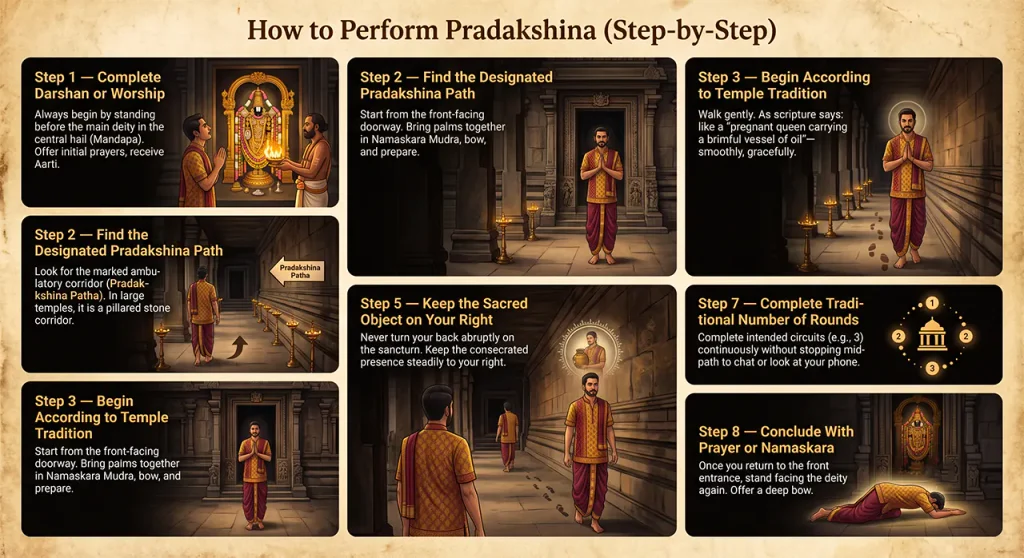
Step 1 — Complete Darshan or Worship
Always begin by standing directly before the main deity in the central hall (Mandapa). Offer your initial prayers, view the holy form (Darshan), and receive the priest’s blessings (Aarti or Prasada) before starting your circular walk.
Step 2 — Find the Designated Pradakshina Path
Look for the marked ambulatory corridor (Pradakshina Patha). In smaller shrines, this is the open space directly surrounding the central room. In larger historical temples, it will be a pillared stone corridor surrounding the sanctum.
Step 3 — Begin According to Temple Tradition
Start your walk from the front-facing eastern or main doorway of the shrine. Stand still for a moment, bring your palms together in Namaskara Mudra at the center of your chest, bow slightly, and prepare your mind for quiet contemplation.
Step 4 — Walk Clockwise Where Tradition Requires It
Begin walking toward your left so that your right shoulder faces the temple wall, moving around the shrine in an orderly clockwise direction.
Step 5 — Keep the Sacred Object on Your Right
Never turn your back abruptly on the sanctum. As you step forward, keep the inner wall and the consecrated presence steadily to your right side throughout the entire circuit.
Step 6 — Maintain a Respectful Attitude
Walk gently and without rushing. The classical scripture Devi Bhagavata Purana poetically states that one should walk during Pradakshina “like a pregnant queen carrying a brimful vessel of oil”—smoothly, gracefully, and attentively, without heavy footfalls, running, or erratic swinging of the arms.
Step 7 — Complete the Traditional Number of Rounds
Complete your intended number of circuits (such as 1, 3, or the traditional count for that specific deity) continuously without stopping mid-path to chat or look at your phone.
Step 8 — Conclude With Prayer or Namaskara
Once you return to the front entrance after your final round:
- Stand facing the deity once more.
- Offer a deep bow or prostrate on the floor (Sashtanga Namaskara or Panchanga Namaskara depending on local custom).
- Stand in peaceful silence for a moment before stepping away from the walkway.
How Many Pradakshinas Should You Perform?
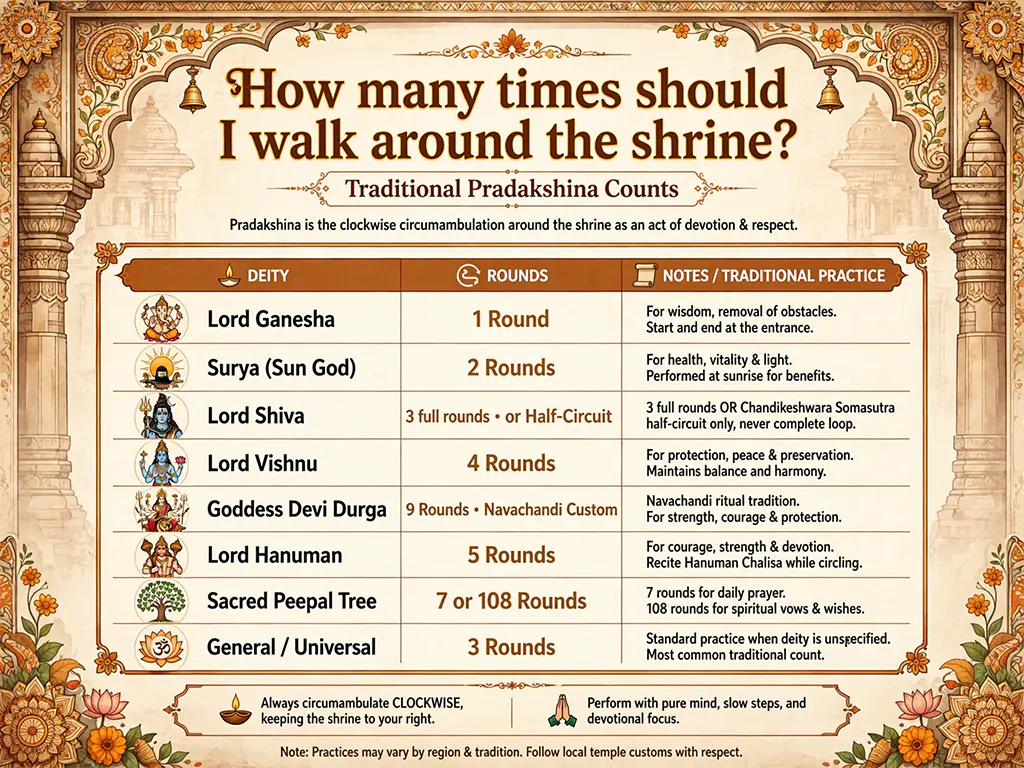
One of the most common questions devotees ask is: “How many times should I walk around the shrine?”
Is There a Universal Number?
There is no single mandatory number that applies across every Hindu temple on Earth. However, three (3) rounds is widely accepted as the standard universal practice across most shrines when no specific count is highlighted.
The number three carries deep philosophical symbolism in Indian thought:
- The Three Worlds (Tribhuvana): Earth (Bhur), Sky (Bhuvar), and Heaven (Svar).
- The Three Gunas (Qualities of Nature): Sattva (purity), Rajas (action/passion), and Tamas (inertia/rest).
- The Three Folders of Time: Past, Present, and Future.
- The Three Bodies of Man: Physical body (Sthula Sharira), Subtle energy body (Sukshma Sharira), and Causal soul seed (Karana Sharira).
By walking three times, the seeker symbolically dedicates every dimension of their life, time, and inner nature to the Divine.
Does the Number Vary by Deity?
Traditional liturgical texts, such as specific Agama Shastras, regional Puranas, and oral temple guidelines, mention traditional counts for different deities:
- Lord Ganesha — 1 Round: Ganesha represents the Muladhara (the foundational root chakra) and the unified, single point of origin. A single focused round honors the unity of the universe.
- Surya (The Sun God) — 2 Rounds: The Sun is honored with two rounds, symbolizing day and night, light and darkness, and the dual solstices (Uttarayana and Dakshinayana).
- Lord Shiva — 3 Rounds: Shiva is the three-eyed lord (Trinetra), master of the trident (Trishula), and sovereign over the three divisions of time.
- Lord Vishnu — 4 Rounds: Vishnu sustains the four corners of the cosmos, holds four divine emblems (Shankha, Chakra, Gada, Padma), and governs the four goals of human life (Dharma, Artha, Kama, Moksha).
- Lord Hanuman — 5 Rounds: Associated with the five elements (Pancha Mahabhuta) and his famous five-faced form (Panchamukha Hanuman).
- Sacred Devi (Durga / Lakshmi / Saraswati) — 9 Rounds: Dedicated to the nine cosmic manifestations of feminine strength celebrated during Navaratri (Navadurga).
Traditional Numbers and Their Symbolism
In special spiritual observances, devotees undertake extended numbers such as 21, 54, or 108 rounds.
The number 108 holds profound significance across Indian astronomy, mathematics, and philosophy:
- In ancient Indian astronomy, the average distance between the Earth and the Sun is roughly 108 times the Sun’s diameter, and the distance between the Earth and the Moon is approximately 108 times the Moon’s diameter.
- Traditional yoga identifies 108 primary energy channels (Nadis) converging at the heart center (Anahata Chakra).
- Performing 108 rounds is regarded as an act of dedicated penance (Tapasya), undertaken for deep meditation, thanksgiving, or personal spiritual milestones.
Why Different Temples Follow Different Practices (h3)
Always remember: Local temple traditions (Sampradaya and Desha-Achara) supersede generic guidelines.
For instance, at certain ancient Vaishnava temples in South India, priests may encourage devotees to complete four rounds, while at an ancient Shakta shrine in Bengal or Assam, devotees might complete a single ceremonial parikrama along the outer wall. When visiting any temple, always observe the local signboards or respectfully ask the temple attendants about their established customs.
Pradakshina Around Different Shrines
Different shrines feature distinct liturgical practices. Understanding these variations helps you feel confident and respectful during your temple visits.
Pradakshina Around Shiva Temples
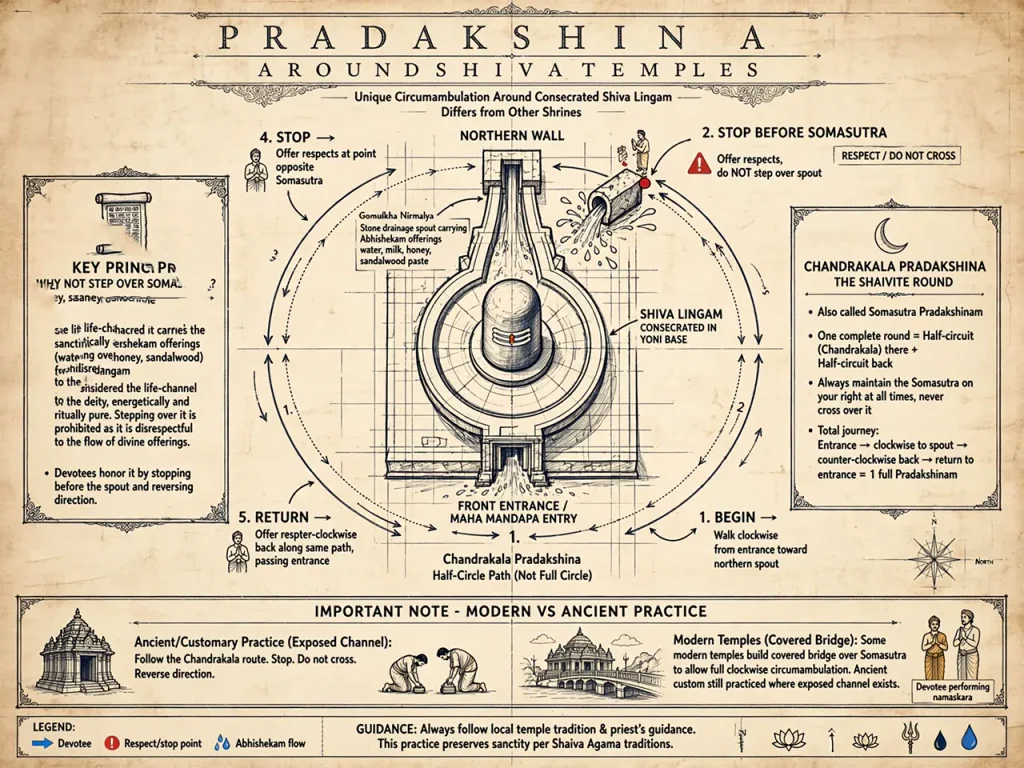
The circumambulation around a consecrated Shiva Linga is unique and differs from almost all other Hindu shrines.
In a Shiva temple, you will notice a stone drainage spout extending out from the northern wall of the sanctum. This spout is called the Gomukha, Nirmalya Chute, or Somasutra. It carries the sacred consecrated bathing liquids (Abhishekam water, milk, honey, and sandalwood paste) offered over the Shiva Linga.
Traditional Shaiva Agamas instruct that devotees should not step over (cross) the Somasutra.
Because of this, the traditional Shiva Pradakshina is performed as a Crescent Half-Circle (Chandrakala Pradakshina):
- Begin at the front entrance and walk clockwise toward the northern spout.
- Stop right before reaching the Somasutra. Offer your respects without stepping over the water channel.
- Turn around and walk counter-clockwise back along the same path, passing the front entrance, until you reach the opposite side of the spout.
- Stop again, offer your respects, turn around, and return to the front entrance.
- This full back-and-forth movement forms one complete traditional Shaivite round (known in South India as Somasutra Pradakshinam).
Note: In modern times, many large temples have built covered bridges or subterranean channels over the spout, allowing devotees to complete a normal circular loop. However, where the exposed channel exists, this ancient crescent custom is still practiced.
Pradakshina Around Vishnu Temples
In Vishnu, Krishna, and Rama temples, circumambulation is straightforward, complete, and fully circular. Devotees walk in full clockwise loops along the covered pillared walkways (Prakaras).
In prominent South Indian Vaishnava temples (such as Srirangam or Tirumala), the complex features multiple concentric rectangular enclosures. Devotees may walk the outer Mada Veedhis (grand perimeter streets) or the immediate inner sanctum walkway (Sampangi Prakaram), maintaining peaceful mental repetition of the sacred Ashtakshari Mantra (Om Namo Narayanaya).
Pradakshina Around Devi Temples
In temples dedicated to the Divine Mother (Durga, Kali, Lakshmi, Parvati, or regional goddesses like Mariamman or Renuka), Pradakshina is celebrated with vibrant joy:
- Devotees often carry auspicious offerings such as lit ghee lamps (Diya or Vilakku) or earthen pots with sacred sprouts (Mulaipari).
- During Tuesday, Friday, and Navaratri festivals, circumambulation is performed with rhythmic devotional songs (Lalitha Sahasranama or regional folk hymns).
- In some Shakta traditions, walking 9 or 108 slow rounds is accompanied by the silent offering of red kumkum or fresh flower petals at designated stations.
Pradakshina Around Ganesha Shrines
Because Lord Ganesha is the remover of obstacles (Vighnaharta) and the lord of new beginnings, a single, highly focused Pradakshina is standard.
In Maharashtra and South India, devotees complement this single round with the traditional practice of Dhorba Namaskaram or Ganesha Thoppukaranam (holding opposite earlobes with crossed arms and performing gentle squats before the idol), followed by lightly tapping their temples with loose fists to awaken internal alertness before prayer.
       Ganesha Worship Flow:
       [ View Deity ] ──► [ 1 Steady Round ] ──► [ Ear-Holding Squat ] ──► [ Silent Prayer ]
Pradakshina Around Hanuman Temples
At shrines dedicated to Lord Hanuman, Tuesdays and Saturdays see devotees performing 5 or 11 rounds.
Worshipers often chant the Hanuman Chalisa or the Sundara Kanda verses while walking. Because Hanuman exemplifies boundless strength, loyalty, and deep focus, devotees maintain strong physical discipline during these rounds—walking barefoot at a steady, measured pace without distraction.
Read More>> Yamai Devi Temple Aundh: Mystery of the Black Stone Goddess
Pradakshina Around Sacred Trees
Venerating living nature is a cornerstone of Indian philosophy. Devotees regularly perform circumambulation around sacred botanical specimens:
   ┌─────────────────────────────────────────────────────────┐
   │            SACRED BOTANICAL CIRCUMAMBULATION            │
   ├──────────────────┬──────────────────┬───────────────────┤
   │   SACRED TREE    │  TYPICAL COUNTS  │  DAY / OBSERVANCE │
   ├──────────────────┼──────────────────┼───────────────────┤
   │  Peepal Tree     │  7 or 108 Rounds │  Saturday Morning │
   │  (Ashvattha)     │                  │  Somavati Amavasya│
   ├──────────────────┼──────────────────┼───────────────────┤
   │  Banyan Tree     │  3 or 7 Rounds   │  Vat Purnima /    │
   │  (Vata Vriksha)  │                  │  Vat Savitri Vrat │
   ├──────────────────┼──────────────────┼───────────────────┤
   │  Tulsi Plant     │  3 Rounds        │  Daily Morning /  │
   │  (Holy Basil)    │                  │  Kartika Masam    │
   └──────────────────┴──────────────────┴───────────────────┘
- The Peepal Tree (Ashvattha): Described in the Bhagavad Gita (Chapter 15) as a living symbol of the cosmic universe. On auspicious new moon mornings falling on Mondays (Somavati Amavasya), devotees—especially women praying for family health and prosperity—tie sacred cotton threads around the trunk while completing 108 clockwise rounds.
- The Banyan Tree (Vat Vriksha): Symbolizing eternal life and endurance. During the festival of Vat Savitri, married women walk around the holy banyan tree, winding sacred thread around its expansive trunk in memory of Savitri’s devotion.
- The Tulsi Shrine (Tulsi Chaura / Brindavan): Found in the courtyards of millions of Indian homes. Every morning after bathing, householders pour fresh water at the base of the plant and complete three small clockwise rounds while chanting the Tulsi Stotram.
Pradakshina Around Sacred Hills
When circumambulation expands to encircle an entire geographical mountain, it becomes an epic pilgrimage. Two prominent examples in India include:
   ┌─────────────────────────────────────────────────────────────────┐
   │                    SACRED HILL PARIKRAMAS                       │
   ├───────────────────────────────┬─────────────────────────────────┤
   │  ARUNACHALA GIRIVALAM         │  GOVARDHAN PARIKRAMA            │
   ├───────────────────────────────┼─────────────────────────────────┤
   │  Location: Tiruvannamalai,    │  Location: Mathura/Vrindavan,   │
   │  Tamil Nadu                   │  Uttar Pradesh                  │
   │  Length: ~14 Kilometers       │  Length: ~21 Kilometers         │
   │  Dedicated to: Lord Shiva     │  Dedicated to: Lord Krishna     │
   │  Special Time: Full Moon      │  Special Time: Govardhan Puja / │
   │  (Pournami) Night Walk        │  Guru Purnima                   │
   └───────────────────────────────┴─────────────────────────────────┘
- Arunachala Girivalam (Tiruvannamalai, Tamil Nadu): The holy red mountain of Arunachala is revered as an embodiment of Lord Shiva as the pillar of fire (Agni Lingam). Every full moon night (Pournami), hundreds of thousands of pilgrims walk the 14-kilometer barefoot perimeter path around the base of the mountain.
- Govardhan Parikrama (Vrindavan / Mathura, Uttar Pradesh): Devotees walk the 21-kilometer circuit around Govardhan Hill, the sacred hill lifted by Lord Krishna on his little finger to protect villagers from torrential storms. Pilgrims complete this walk while singing devotional kirtans and offering prostrations.
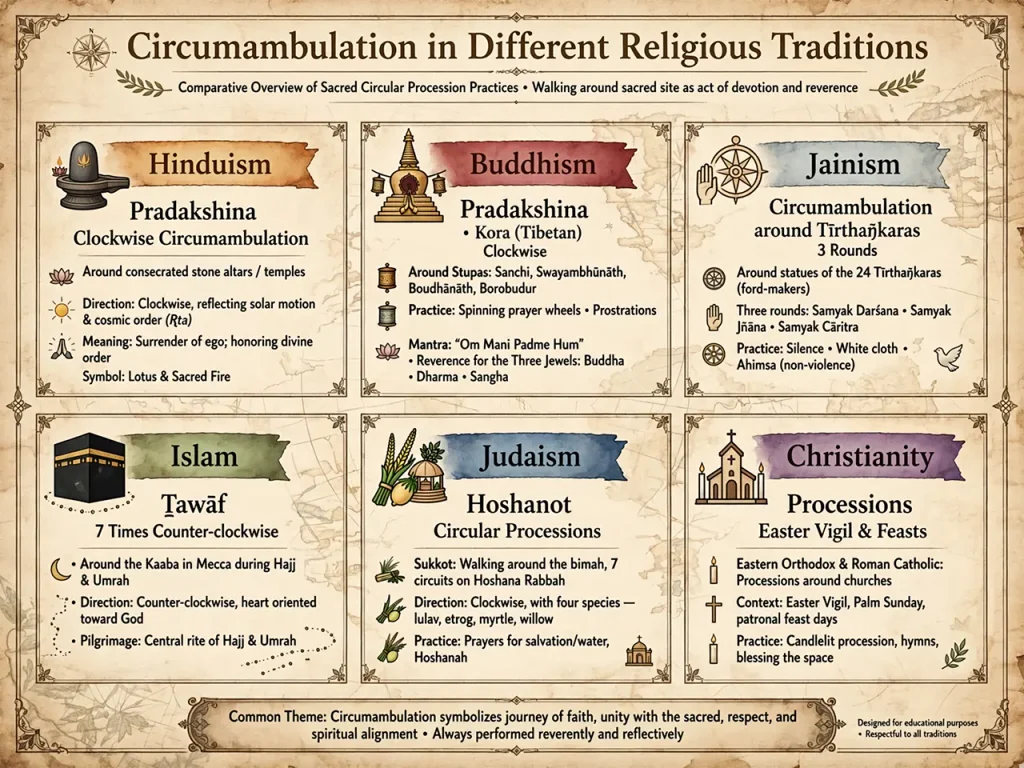
Circumambulation in Different Religious Traditions
Walking in sacred circles is not exclusive to Hinduism. It is a shared human spiritual expression found across major world religions, though each faith brings its own theological meaning to the practice.
Hinduism
In Hinduism, clockwise circumambulation (Pradakshina) honors the immanent and transcendent Divine established within consecrated stone forms, altars, and natural wonders. It reflects solar motion, cosmic order (Rita), and the surrender of personal ego to the supreme center.
Buddhism
In Buddhism, the practice is called Pradaksina in Sanskrit or Kora in Tibetan tradition.
- Devotees walk clockwise around Stupas (such as Sanchi in India, Swayambhunath and Boudhanath in Nepal, or Borobudur in Indonesia) containing holy relics of the historical Buddha or great enlightened teachers.
- As they walk, Buddhist practitioners spin prayer wheels, chant the mantra Om Mani Padme Hum, or perform full-body prostrations on wooden boards.
- The walk expresses reverence for the Three Jewels (Triratna): The Buddha (the Teacher), The Dharma (the Teaching), and The Sangha (the Spiritual Community).
Jainism
In Jainism, circumambulation is performed around the sacred inner sanctum housing images of the Tirthankaras (the 24 ford-makers or liberated teachers).
- Jain devotees complete three clockwise rounds representing the foundational pillars of liberation: Right Faith (Samyak Darshana), Right Knowledge (Samyak Jnana), and Right Conduct (Samyak Charitra).
- Devotees maintain deep mental silence and wear simple, unstitched white cloth (Dhoti and Khes), being mindful of non-violence (Ahimsa) by walking carefully to avoid stepping on tiny insects.
Other World Religions
Sacred walking circles appear across global religious history:
- Islam (Tawaf): During the Hajj and Umrah pilgrimages in Mecca, millions of Muslim pilgrims complete Tawaf—walking seven times counter-clockwise around the sacred Kaaba. The counter-clockwise motion moves against the direction of a clock’s hands, symbolizing the heart turning continuously toward God while aligning with celestial orbital movements.
- Judaism: During the festival of Sukkot, Jewish worshipers make circular processions called Hoshanot around the synagogue bimah carrying the four sacred species, completing seven circuits on Hoshana Rabbah.
- Christianity: In Eastern Orthodox and Roman Catholic traditions, circular processions are performed around churches during Easter Vigil and feast day celebrations.
What Is a Pradakshina Patha in Hindu Temple Architecture?
To truly appreciate why Pradakshina feels so awe-inspiring, we must look at how classical Indian architects designed temples over a thousand years ago.
In Indian architectural treatises (Vastu Shastra, Mayamata, and Manasara), a Hindu temple is not designed simply as a prayer hall. It is structured as a three-dimensional stone model of the cosmic universe and an architectural representation of the human body (Purusha).
 ┌──────────────────────────────────────────────────────────────┐
 │             CLASSICAL TEMPLE CROSS-SECTION                   │
 │                                                              │
 │   ┌──────────────────────────────────────────────────────┐   │
 │   │ Outer Sandhara Corridor (Pradakshina Patha)         │   │
 │   │   ┌──────────────────────────────────────────────┐   │   │
 │   │   │ Thick Stone Enclosure Walls                  │   │   │
 │   │   │   ┌──────────────────────────────────────┐   │   │   │
 │   │   │   │   GARBHAGRIHA (Sanctum Sanctorum)    │   │   │   │
 │   │   │   │   ┌──────────────────────────────┐   │   │   │   │
 │   │   │   │   │         Consecrated          │   │   │   │   │
 │   │   │   │   │            Moolamurti        │   │   │   │   │
 │   │   │   │   │                              │   │   │   │   │
 │   │   │   │   └──────────────────────────────┘   │   │   │   │
 │   │   │   └──────────────────────────────────────┘   │   │   │
 │   │   └──────────────────────────────────────────────┘   │   │
 │   └──────────────────────────────────────────────────────┘   │
 └──────────────────────────────────────────────────────────────┘
Garbhagriha and the Sacred Centre
The absolute core of any Hindu temple (Ex: Ramanathaswamy Temple) is the Garbhagriha, which literally translates to “Womb Chamber.”
- It is a square, dark, windowless stone room where the main deity is installed.
- Its lack of windows and simple interior eliminates all outside visual distraction, focusing all attention on the illuminated deity within.
- The Moolamurti (central consecrated image) is established right over the cosmic ground point (Brahmasthana).
Pradakshina Patha
The Pradakshina Patha is the specially designed architectural walkway that surrounds the Garbhagriha, built specifically so devotees can perform circumambulation safely, comfortably, and reverently.
In historical temple design, temples fall into two architectural categories based on their walkway layout:
   ┌─────────────────────────────────────────────────────────┐
   │            TEMPLE ARCHITECTURAL CATEGORIES              │
   ├────────────────────────────┬────────────────────────────┤
   │  SANDHARA TEMPLES          │  NIRANDHARA TEMPLES        │
   ├────────────────────────────┼────────────────────────────┤
   │  Features an enclosed,     │  Lacks an enclosed inner   │
   │  covered ambulatory        │  gallery. Devotees circle  │
   │  corridor wrapped directly │  around the outside of     │
   │  around the Garbhagriha.   │  the temple structure.     │
   │                            │                            │
   │  Examples: Brihadisvara    │  Examples: Early Gupta     │
   │  Temple (Thanjavur),       │  temples, Deogarh Dash-    │
   │  Kailasanatha (Ellora).    │  avatara shrine.           │
   └────────────────────────────┴────────────────────────────┘
- Sandhara Temples: Shrines built with an enclosed, covered ambulatory corridor wrapped directly between the sanctum wall and the outer enclosing wall. Walking through a Sandhara corridor feels intimate and meditative, with oil lamps lighting the carved stone walls.
- Nirandhara Temples: Shrines designed without an internal covered gallery. In these temples, circumambulation takes place outside on the open, elevated stone platform (Jagati).
- Sarvatobhadra Temples: Rare, grand shrines with access doors on all four cardinal directions, surrounded by concentric walking galleries.
Circumambulatory Corridors
In masterworks of Dravidian architecture—such as the magnificent Ramanathaswamy Temple on Rameswaram Island—the circumambulatory corridors are famous architectural achievements in their own right. Rameswaram features the longest temple corridor in the world, with over 1,200 intricately carved granite pillars forming a walkway over 1.2 kilometers long. Walking through these stone corridors creates a feeling of peace, shielding devotees from the outside world.
 Ramanathaswamy Temple Corridor (Rameswaram):
 [ Granitic Pillar ] ─── Walkway ─── [ Granitic Pillar ]
          ▲                                    ▲
          │          Longest in World          │
          └─────────── (~1.2 km long) ─────────┘
Inner and Outer Pradakshina Paths
Large historical temple complexes feature nested, concentric rings of walkways called Prakaras:
- Antara-Prakara (Innermost Path): Closest to the sanctum, used for quiet, solemn personal circumambulation.
- Madhyama-Prakara (Middle Courtyards): Open stone courtyards housing smaller secondary shrines dedicated to companion deities.
- Bahya-Prakara (Outermost Streets / Mada Veedhis): Broad outer perimeter avenues where grand temple chariots (Rathas) process during annual festivals.
Relationship Between Temple Architecture and Ritual Movement
Every part of a classical temple is designed to guide human movement. As you pass from the bright outer entrance tower (Gopuram or Shikhara), through pillared assembly halls (Mandapas), and into the quiet Pradakshina Patha, the architecture naturally leads your senses from the busy outside world toward inner stillness.
Pradakshina vs Parikrama: What Is the Difference?
People frequently ask: “Are Pradakshina and Parikrama the exact same thing, or is there a difference?”
The short answer is that they refer to the same sacred act of circumambulation, but they carry subtle differences in linguistic origin, geography, and scale.
   ┌─────────────────────────────────────────────────────────┐
   │             PRADAKSHINA  vs  PARIKRAMA                  │
   ├────────────────────────────┬────────────────────────────┤
   │  PRADAKSHINA (प्रदक्षिण)   │  PARIKRAMA (परिक्रमा)      │
   ├────────────────────────────┼────────────────────────────┤
   │  Emphasizes the specific   │  Emphasizes completing a   │
   │  spatial rule: keeping the │  full boundary loop or     │
   │  object to the *right*.    │  geographic perimeter.     │
   ├────────────────────────────┼────────────────────────────┤
   │  Common in South India     │  Common in North, West, &  │
   │  and classical Sanskrit    │  Central India (Hindi,     │
   │  liturgical texts.         │  Marathi, Bengali, etc.).  │
   ├────────────────────────────┼────────────────────────────┤
   │  Often associated with     │  Often used for long-      │
   │  immediate shrine and      │  distance walking circuits │
   │  temple sanctum rounds.    │  (hills, rivers, towns).   │
   └────────────────────────────┴────────────────────────────┘
- Linguistic Nuance: Pradakshina highlights the directional orientation (stepping forward while keeping the sacred on your right hand). Parikrama (from Pari = around, and Krama = step/pace) highlights the complete boundary circuit.
- Scale and Usage: In everyday conversation, a two-minute walk around a local Ganesha shrine is universally called a Pradakshina. A multi-day trek around a holy mountain or river (like the Narmada Parikrama or Braj 84 Kos Parikrama) is almost always called a Parikrama.
- Regional Preferences: Southern states (Tamil Nadu, Kerala, Karnataka, Andhra Pradesh, and Telangana) predominantly use Pradakshina / Pradakshinam, whereas Northern and Western states commonly use Parikrama.
Pradakshina Rules and Temple Etiquette
To keep temple spaces serene and welcoming for everyone, traditional texts and temple administrations encourage simple rules of etiquette:
                  TEMPLE ETIQUETTE RULES
 ┌───────────────────────┐       ┌───────────────────────┐
 │   Maintain Silence    │       │ Walk at a Steady Pace │
 └───────────┬───────────┘       └───────────┬───────────┘
             │                               │
             ▼                               ▼
       [ RESPECTFUL ] ──► [ MINDFUL ] ──► [ INCLUSIVE ]
             ▲                               ▲
             │                               │
 ┌───────────┴───────────┐       ┌───────────┴───────────┐
 │  Leave Footwear Out   │       │   Care for Elders     │
 └───────────────────────┘       └───────────────────────┘
Direction
Always follow the established clockwise direction. If you find yourself walking against the flow of other devotees, stop gently, turn clockwise, and join the natural movement.
Number of Rounds
Decide on your number of rounds before starting, or follow the standard count of three. If the temple is crowded on festival days, completing a single, unhurried round is completely acceptable.
Clothing and Footwear
- Bare Feet: Always remove shoes, sandals, and socks before entering the temple compound. Walking barefoot connects you directly to the cool stone floor and keeps the walkway clean.
- Traditional Clothing: Wear clean, modest clothing. In many South Indian temples, men are requested to wear a traditional Dhoti or Veshti (often removing upper shirts), and women wear a Saree, Salwar Kameez, or long traditional dress.
Chanting Mantras
You can chant aloud softly or repeat mantras silently in your mind. Keep your volume low so you do not disturb fellow worshipers who are praying in silence.
Maintaining Silence or Respectful Conduct
Treat the walkway as a place of sanctuary. Refrain from loud personal conversations, phone calls, or social debates. Silence your mobile devices before beginning your walk.
Photography Restrictions
Most historical and active Hindu temples strictly prohibit photography inside the inner sanctum area. Always respect these rules—never attempt to take photos or record videos while walking along the Pradakshina Patha.
Following Temple Instructions
Every historic shrine has its own unique lineage (Sampradaya). If temple priests or volunteers request that you follow specific queues or bypass certain areas during special rituals, follow their guidance respectfully.
Accessibility for Elderly and Disabled Devotees
True spirituality is based on compassion (Karuna).
- Hindu scriptures make clear exceptions (Apaddharma) for physical limitations: If you are elderly, ill, injured, or using a wheelchair, you are not expected to walk difficult physical rounds.
- Sitting peacefully in the assembly hall and offering sincere prayers in your heart carries the exact same spiritual merit as completing physical rounds on foot.
- Young, healthy devotees should always yield right-of-way to elders, parents carrying young children, and differently-abled visitors on the path.
Common Mistakes to Avoid During Pradakshina
Even sincere devotees occasionally pick up unhelpful habits. Here are the most common mistakes to watch for:
 ┌─────────────────────────────────────────────────────────────┐
 │               COMMON MISTAKES vs WHAT TO DO                 │
 ├──────────────────────────────┬──────────────────────────────┤
 │  MISTAKE                     │  CORRECT ACTION              │
 ├──────────────────────────────┼──────────────────────────────┤
 │  Rushing or running          │  Walk at an unhurried,       │
 │  through your rounds.        │  steady pace.                │
 ├──────────────────────────────┼──────────────────────────────┤
 │  Walking counter-clockwise   │  Always turn clockwise       │
 │  out of haste.               │  around shrines.             │
 ├──────────────────────────────┼──────────────────────────────┤
 │  Using mobile phones or      │  Keep phones silenced and    │
 │  chatting with friends.      │  tucked away in your pocket. │
 ├──────────────────────────────┼──────────────────────────────┤
 │  Abruptly stopping in the    │  Step aside if you need to   │
 │  center of the walkway.      │  pause so others can pass.   │
 ├──────────────────────────────┼──────────────────────────────┤
 │  Stepping over the Shiva     │  Follow the crescent back-   │
 │  Somasutra water channel.    │  and-forth half-circuit.     │
 ├──────────────────────────────┼──────────────────────────────┤
 │  Judging others who cannot   │  Remember sincere mental     │
 │  walk the full distance.     │  devotion is what counts.    │
 └──────────────────────────────┴──────────────────────────────┘
Is There a Scientific Explanation for Pradakshina?
In recent years, social media posts have claimed that temple circumambulation produces “magnetic vortexes,” “cures clinical diseases instantly,” or “generates measurable quantum energy.”
Responsible researchers, spiritual teachers, and cultural scholars clearly distinguish between traditional religious beliefs and verifiable scientific facts.
 ┌──────────────────────────────────────────────────────────────┐
 │         UNDERSTANDING PRADAKSHINA RESPONSIBLY                │
 ├──────────────────────────────┬───────────────────────────────┤
 │  TRADITIONAL BELIEF          │  PSYCHOLOGICAL & PHYSICAL     │
 │  (Devotional Experience)     │  BENEFITS (Observed Reality)  │
 ├──────────────────────────────┼───────────────────────────────┤
 │  Aligns subtle energy bodies │  Low-impact walking releases  │
 │  with the divine center.     │  mental stress and tension.   │
 ├──────────────────────────────┼───────────────────────────────┤
 │  Washes away past negative   │  Repetitive movement lowers   │
 │  karmic impressions.         │  distraction and racing pulse.│
 ├──────────────────────────────┼───────────────────────────────┤
 │  Draws sanctified blessings  │  Shared communal rituals build│
 │  from the consecrated idol.  │  a sense of social belonging. │
 └──────────────────────────────┴───────────────────────────────┘
Traditional Spiritual Understanding
From a traditional standpoint, temples are consecrated through Prana Pratishtha (infusing the idol with life energy using Vedic mantras, precious metals, and sacred herbs buried beneath the sanctum). Devotees believe that walking within this sanctified atmosphere helps absorb peaceful, spiritually uplifting vibrations.
Possible Psychological or Behavioral Effects
From a modern psychological and physiological perspective, the benefits of Pradakshina come from well-documented mind-body practices:
- Mindful Rhythmic Walking: Walking slowly barefoot on smooth, cool stone floors stimulates sensory nerve endings in the feet, promoting physical grounding and sensory awareness.
- Focused Attention & Stress Reduction: Combining gentle physical movement with rhythmic breathing and silent mantra repetition functions as an effective mindfulness exercise. It lowers resting heart rates, eases anxiety, and reduces mental fatigue.
- Cognitive Grounding: Stepping away from bright digital screens into a quiet, dimly lit, aromatic environment (with natural camphor, ghee lamps, and sandalwood) calms overstimulated nervous systems.
- Community Connection: Moving peacefully alongside fellow humans in a unified, quiet circle fosters empathy, social harmony, and a comforting sense of belonging.
Summary: Pradakshina does not require exaggerated or unverified scientific claims to be meaningful. Its beauty lies in how it naturally combines simple physical movement, mindfulness, and heartfelt prayer.
Pradakshina and Sacred Temple Geometry
Classical Hindu architecture uses geometric grid systems known as Vastu Purusha Mandalas. These are sacred floor plans that harmonize physical stone structures with mathematical symmetry.
 ┌──────────────────────────────────────────────────────────┐
 │         VASTU PURUSHA MANDALA (Manduka 8x8 Grid)         │
 │                                                          │
 │   ┌──────┬──────┬──────────────────┬──────┬──────┐       │
 │   │ Paisacha (Outer Material Zone) │      │      │       │
 │   ├──────┼──────┴──────────────────┴──────┼──────┤       │
 │   │      │ Manusha (Human Activity Realm) │      │       │
 │   ├──────┤      ┌──────────────────┐      ├──────┤       │
 │   │      │      │  BRAHMASTHANA    │      │      │       │
 │   │      │      │ (Supreme Center) │      │      │       │
 │   ├──────┤      └──────────────────┘      ├──────┤       │
 │   │      │ Daivika (Divine Energy Realm)  │      │       │
 │   ├──────┼────────────────────────────────┼──────┤       │
 │   │      │                                │      │       │
 │   └──────┴────────────────────────────────┴──────┘       │
 └──────────────────────────────────────────────────────────┘
- The Brahmasthana (Center): The innermost square of the grid represents pure, unmanifest energy where the main deity resides.
- The Concentric Zones: The grid expands outward through designated layers: the divine zone (Daivika), the human zone (Manusha), and the outer physical zone (Paisacha).
- The Walking Path as an Axis: When a devotee walks along the Pradakshina Patha, they are tracing the geometric boundary between the human realm and the divine center. By walking this boundary line in an orderly circle, the architecture helps the mind step from chaotic everyday thoughts into a centered, balanced state of awareness.
Regional and Temple-Specific Variations in Pradakshina
India’s temple traditions are wonderfully rich and varied. While the core philosophy remains consistent, regional customs bring their own local character to the practice:
   ┌─────────────────────────────────────────────────────────┐
   │            REGIONAL PRADAKSHINA VARIATIONS              │
   ├────────────────────────────┬────────────────────────────┤
   │  REGION / TRADITION        │  UNIQUE PRACTICAL CUSTOM   │
   ├────────────────────────────┼────────────────────────────┤
   │  Kerala Temples            │  Devotees circle open stone│
   │  (Sopanam & Chuttambalam)  │  courtyards around wooden/ │
   │                            │  copper-roofed sanctuaries.│
   ├────────────────────────────┼────────────────────────────┤
   │  Tamil Nadu & Andhra       │  Expansive multi-layered   │
   │  (Dravidian Complexes)     │  granite Prakaras with     │
   │                            │  intricately carved pillars│
   ├────────────────────────────┼────────────────────────────┤
   │  North Indian Shrines      │  Open circumambulation on  │
   │  (Nagara Architecture)     │  elevated stone platforms  │
   │                            │  surrounding tall spires.  │
   ├────────────────────────────┼────────────────────────────┤
   │  Maharashtra Traditions    │  Devotees often combine    │
   │  (Warkari Shrines)         │  Pradakshina with ecstatic │
   │                            │  kirtans, bells, and dance.│
   └────────────────────────────┴────────────────────────────┘
- Kerala Temples: In Kerala’s traditional wooden and granite shrines (Kshetrams), the sanctum (Srikovil) is surrounded by an open stone courtyard called the Chuttambalam. Devotees walk quietly on smooth granite pathways illuminated by thousands of small oil lamps (Chuttuvilakku) fixed into the outer walls.
- South Indian Dravidian Shrines: Large temples in Tamil Nadu, Karnataka, and Andhra Pradesh feature grand, enclosed stone corridors (Prakaras) with soaring entrance towers (Gopurams), where daily temple elephant processions accompany the deity around the outer corridors.
- North Indian Nagara Shrines: Temples in Himachal Pradesh, Uttarakhand, Uttar Pradesh, and Madhya Pradesh feature open elevated platforms (Jagatis) where devotees can circle the sanctum while viewing the rising, beehive-shaped spire (Shikhara).
- Warkari Tradition in Maharashtra: At the Vitthal-Rukmini Temple in Pandharpur, pilgrims who complete the long Wari foot pilgrimage celebrate their arrival by singing joyfully during their rounds, expressing love for God as a close, dear friend.
Frequently Asked Questions (FAQs)
1. What is the fundamental Pradakshina meaning?
The word Pradakshina comes from Sanskrit (Pra meaning forward/auspicious and Dakshina meaning right side or south). It refers to the sacred spiritual practice of walking clockwise around a deity, temple, or holy object while keeping it to your right side.
2. Why is Pradakshina performed clockwise?
Devotees walk clockwise so their right side (traditionally viewed as the side of noble action and respect) faces the consecrated deity throughout the walk. Clockwise motion also mirrors the natural solar movement across the sky and represents the forward progression of life.
3. What is the difference between Pradakshina and Parikrama?
Both terms describe sacred circumambulation. Pradakshina is a Sanskrit term emphasizing the directional rule of keeping the sacred center to your right, commonly used in South India and formal temple rituals. Parikrama is a Hindi and regional term highlighting the completion of a full boundary circuit, frequently used for long-distance walks around sacred hills and rivers.
4. How many rounds should you walk if you are unsure?
If you visit a shrine without knowing its specific tradition, three (3) rounds is universally accepted across almost all Hindu temples. It honors the three worlds, the three aspects of time, and the complete dedication of mind, speech, and body.
5. Why do we not cross the drainage spout in Shiva temples?
The drainage spout in a Shiva temple is called the Gomukha or Somasutra, which carries sanctified bathing liquids (Abhishekam) from the Shiva Linga. Traditional Shaiva manuals instruct devotees not to step over this channel out of reverence, leading to the traditional crescent-shaped back-and-forth half-circuit (Chandrakala Pradakshinam).
6. Can pregnant women or elderly devotees perform Pradakshina?
Yes, but only if they are physically comfortable. Hindu traditions emphasize safety and health. Elderly people, pregnant women, and anyone who feels weak can perform a single round, sit quietly in the hall, or offer sincere mental prayers (Manasika Puja), which carries equal spiritual value.
7. What is an architectural Pradakshina Patha?
A Pradakshina Patha is the dedicated stone-paved walkway or pillared corridor built around the inner sanctum (Garbhagriha) of a traditional temple to allow devotees to perform circumambulation safely and peacefully.
8. What should you chant while performing Pradakshina?
You can chant the primary mantra of the deity you are visiting (such as Om Namah Shivaya, Om Namo Bhagavate Vasudevaya, or the Gayatri Mantra), recite traditional stotras, or simply maintain a peaceful, quiet mind.
9. Can I perform Pradakshina around a sacred tree at home?
Yes. Householders regularly perform three clockwise rounds around their home Tulsi plant (Holy Basil) during morning prayers, and seven or 108 rounds around living Peepal trees on auspicious days.
10. Can children do Pradakshina?
Children are warmly welcomed to perform Pradakshina. It is an excellent, gentle way to teach young people about temple customs, mindfulness, and respect for sacred spaces.
11. Is walking counter-clockwise ever permitted in temples?
Counter-clockwise walking (Prasavya) is traditionally reserved for funeral rites and memorial services (Pitru Tarpan). Inside celebratory temple spaces, devotees walk clockwise. The only common exception is the return half-loop in Shiva temples to avoid crossing the Somasutra.
12. What is Atma-Pradakshina?
When you cannot walk around a physical shrine (due to tight space, heavy crowds, or personal illness), devotees perform Atma-Pradakshina by standing in one spot, bringing their palms together, and slowly rotating their body clockwise three times in place, honoring the Divine dwelling within their own heart.
13. What clothing should I wear during Pradakshina?
Wear clean, modest traditional attire (such as a Dhoti, Kurta, Saree, or Salwar Kameez). Always remove your shoes and socks before entering the walkway.
14. Is there scientific proof that Pradakshina cures illnesses?
No verified medical evidence shows that circumambulation cures medical conditions. Its real, observable benefits are psychological and physical: gentle walking barefoot, rhythmic breathing, stress reduction, and mental grounding through mindful focus.
15. Do other world religions practice circumambulation?
Yes. Buddhists walk clockwise around Stupas (Kora), Jains circle images of Tirthankaras, Muslims walk counter-clockwise around the Kaaba (Tawaf), and Jewish and Christian traditions feature ceremonial circular processions during special holy days.