Why Do We Light a Diya? Meaning, Rules, Significance & Oil vs Ghee
Early in the morning, before the rest of the house begins to stir, a familiar rhythm unfolds in millions of Hindu homes. The brass or clay lamp is wiped clean. A rolled cotton wick is set into the groove, resting gently against the rim. Fresh oil or clear, warm ghee is poured until the vessel is gently filled. A match is struck, the flame touches the tip of the wick, and for a quiet second, the room changes. Shadows retreat, the scent of warmth fills the air, and a small pool of golden light settles over the altar.
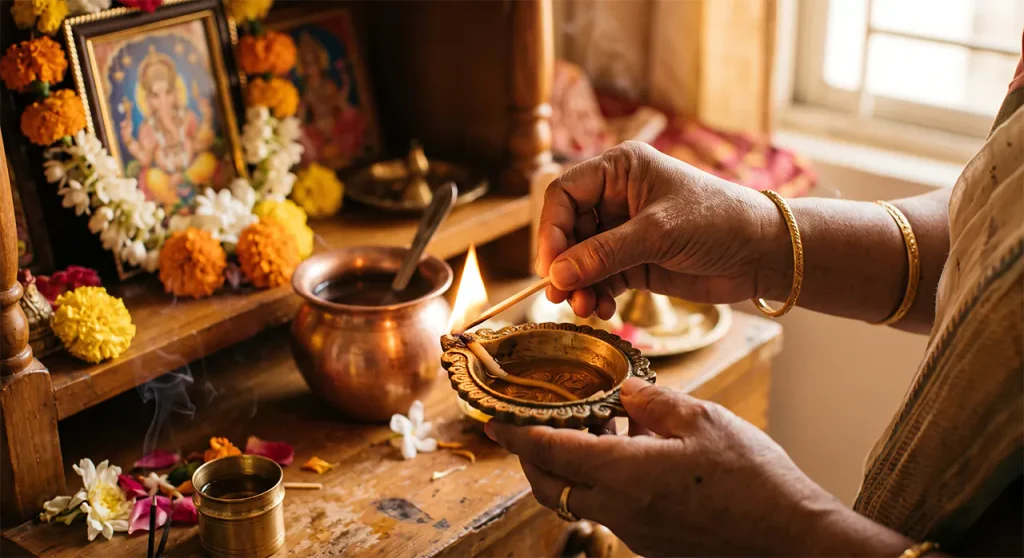
It is an everyday act, so common that many of us grew up watching our grandparents do it without ever pausing to ask why. We see diyas lined up along balcony ledges during Diwali, glowing steadily in temple courtyards during Karthika Masam, and burning quietly beside the framed pictures of deities in small apartments across the world.
Yet this tiny flame is not simply a decorative choice or an old way of lighting a room before electricity existed. In Hindu tradition, lighting a diya carries an layered tapestry of philosophy, devotion, discipline, and symbolism.
In this comprehensive guide, we explore why we light a diya, what each element represents, how traditional rules guide its placement and timing, whether ghee or oil is best suited for your home altar, and the timeless spiritual wisdom hidden within a single drop of fire.
Why Do We Light a Diya?
Direct Answer: In Hindu tradition, we light a diya to invoke divine presence, mark an auspicious beginning, and symbolically dispel ignorance (tamas) with the light of knowledge and spiritual awareness (jyoti or prakasha). The lamp acts as a physical reminder of the inner divine consciousness present within every living being.
At its most fundamental level, the act of lighting a lamp addresses two dimensions of human life: the visible, everyday world and the inner, spiritual world.
Traditionally, an oil or ghee lamp is lit to:
- Invoke auspiciousness (shubhatva): Fire has been viewed since Vedic times as a living witness (sakshi) to all sacred actions. Lighting a lamp marks the boundary between the mundane rush of daily chores and a focused moment of prayer.
- Symbolize the victory of knowledge over ignorance: Darkness in Indian philosophy represents confusion, lethargy, fear, and ignorance of our true nature. Light represents clarity, learning, wisdom, and spiritual awakening.
- Purify and calm the personal space: The gentle glow of a steady flame creates a focused visual center, allowing the wandering mind to settle into meditation or prayer.
- Express personal surrender and devotion (bhakti): As the wick burns and draws up the oil, it steadily consumes itself without leaving behind waste. It serves as an analogy for surrendering selfish ego and worldly attachments in the pursuit of a higher truth.
It is helpful to distinguish between ancient religious belief and practical symbolic understanding. In devotional literature, the flame is often addressed directly as a form of the divine mother or as a physical manifestation of Agni, the sacred fire. In philosophical and psychological terms, lighting a lamp is an intentional grounding ritual—an everyday contemplative practice that helps human beings pause, gather their thoughts, and invite clarity into their lives.
What Does a Diya Symbolize?
A traditional diya is not a single, undifferentiated object. It is an intentional coming-together of distinct elements, each carrying its own traditional symbolism. When an earthen lamp filled with oil burns through a cotton wick, classical Indian thinkers saw an entire model of human life and spiritual evolution.
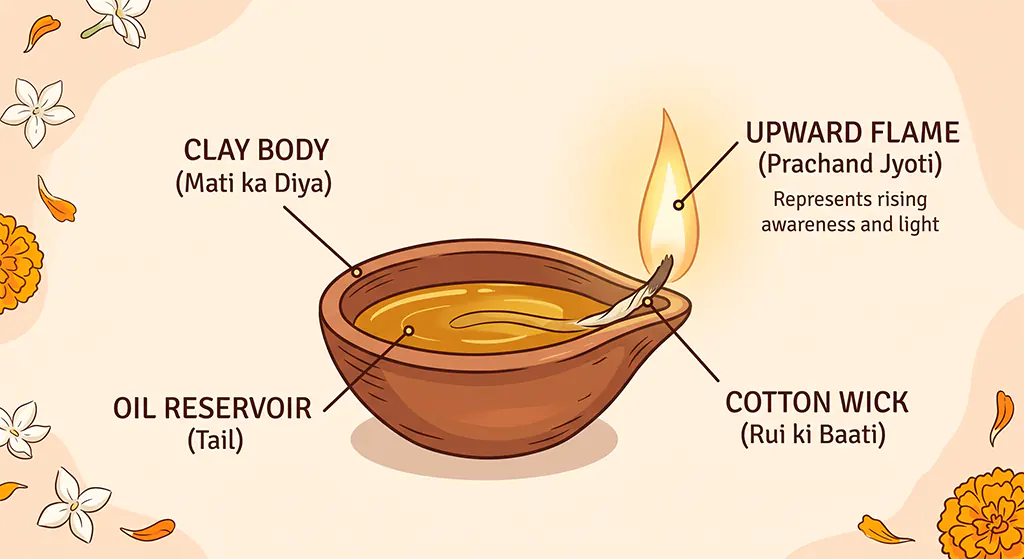
| Diya Component | Traditional Symbolic Meaning | Practical Spiritual Parallel |
| Earthen Lamp (Mitti ka Diya) | The physical human body (sharira), formed of earth and water. | Reminds us of our temporary, mortal nature and grounded humility. |
| Metal Lamp (Brass, Silver, Bronze) | Enduring devotion, structural discipline, and temple tradition. | Reflects stability, cleanliness, and long-term spiritual practice. |
| Oil or Ghee (Sneha) | Human desires, tendencies (vasanas), attachments, and affection. | Fuel that must be channeled, purified, and surrendered upward. |
| Cotton Wick (Batti / Varthi) | The human mind, ego (ahamkara), and focused intellect (buddhi). | The medium through which worldly desires are transformed into light. |
| Flame (Agni Shikha) | Spiritual knowledge (vidya), self-realization, and divine consciousness. | Always points skyward, teaching us to elevate our thoughts and ideals. |
| Radiant Light (Prakasha) | The removal of inner darkness, delusion, and spiritual ignorance. | Clarity and understanding that illuminates the path for oneself and others. |
Meaning of the Flame (Agni Shikha)
The flame of a diya possesses a unique physical quality: no matter which way you tilt the lamp, the tip of the flame always reaches upward toward the sky.
In traditional Indian teaching, this natural tendency represents the aspiration of human consciousness. While our physical senses are drawn downward and outward into transient distractions, our inner intellect is meant to point upward toward truth, virtue, and self-realization. The flame is pure; it consumes impurities without becoming impure itself. It warms without destroying when handled gently, embodying the ideal balance of strength and grace.
Meaning of the Wick (Batti or Varthi)
The cotton wick represents the human ego and individual identity. Left on its own, a dry cotton thread quickly burns away into useless ash. However, when dipped in oil or ghee, it becomes the steady instrument through which fuel is turned into a steady, bright flame.
In spiritual metaphors commonly shared in Vedanta, the wick represents the mind. When our mind remains dry, selfish, or prideful, it flares up destructively. But when saturated with love, devotion, and reverence, the mind becomes an instrument of illumination, exhausting worldly attachments without producing bitter smoke.
Meaning of Oil and Ghee
In classical Sanskrit, one of the words for oil or unctuous liquid is sneha. Intriguingly, sneha also means “love,” “affection,” and “friendship.”
This linguistic connection is deeply intentional in Hindu devotional thought. The oil or ghee placed inside the bowl represents our worldly tendencies, emotional attachments, and latent mental impressions (vasanas). Just as the wick slowly drinks the oil until not a single drop remains, a sincere seeker uses their devotional practice to slowly offer up all personal cravings, selfish desires, and emotional entanglements to the divine flame of wisdom.
Meaning of the Earthen Lamp
While grand temples frequently feature towering lamps made of bronze, bell metal, or silver, the humble clay lamp (mitti ka diya) holds a uniquely revered place in Hindu culture. Clay comes from the soil of the earth, is molded with water, dried by air, and baked in fire.
The earthen lamp represents the physical human body, composed of the fundamental natural elements. It reminds the practitioner that despite all worldly wealth, our physical form is fragile, earthy, and impermanent. A clay diya cannot boast about its grandeur; its sole beauty lies in the light it carries. In this way, it serves as a daily lesson in humility.
Meaning of Light Overcoming Darkness
Light does not need to wage a violent war against darkness. It does not argue, push, or strain. The moment light appears, darkness simply ceases to exist.
This simple physical fact serves as the foundation for the classic Hindu philosophical view of ignorance (avidya). Ignorance is not an active, permanent monster; it is merely the absence of understanding. You cannot sweep darkness out of a room with a broom; you can only bring in a lamp. Similarly, negative emotions such as hatred, jealousy, and fear cannot be driven away by sheer frustration; they dissolve naturally when the light of wisdom, empathy, and understanding is brought into the heart.
Why Is Light Sacred in Hindu Tradition?
Light is not treated as an ordinary physical phenomenon in Hindu culture; it is recognized as a living bridge between the tangible material world and the formless divine. To understand why light holds this elevated status, it helps to explore how ancient Indian thought approached the natural elements.
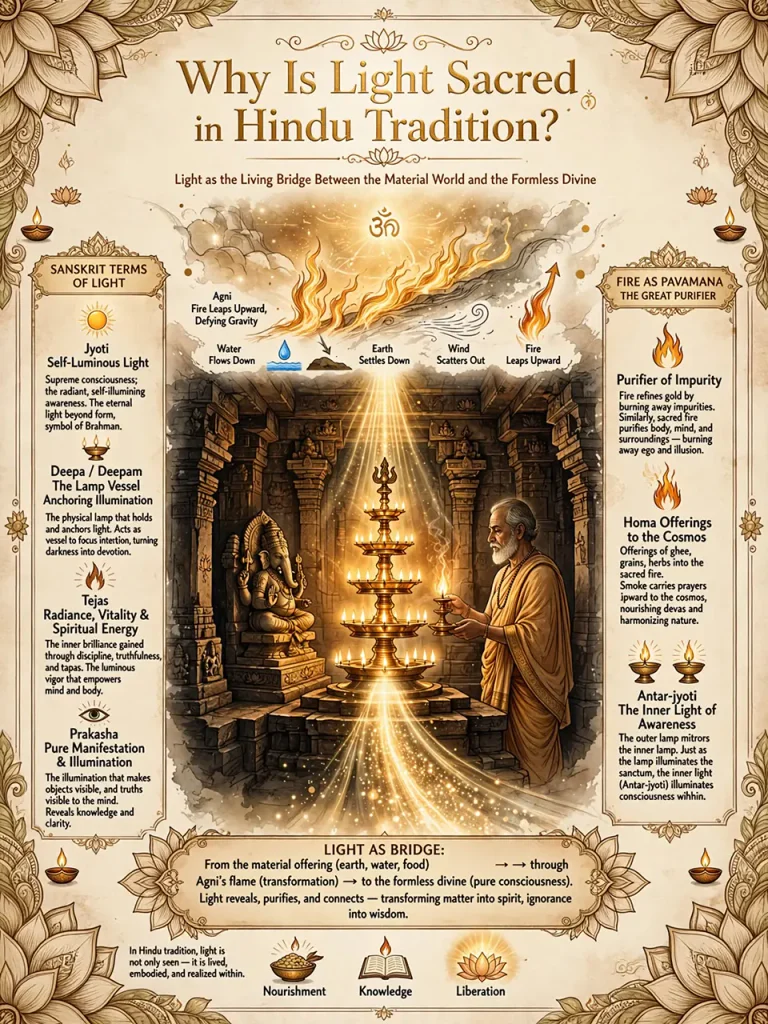
In the Vedic worldview, Agni (fire) is the first element directly accessible to human senses that reaches upward toward the heavens. Water flows downward; earth settles; wind moves horizontally. Only fire defies gravity, continuously leaping toward the sky.
Furthermore, fire acts as the great purifier (pavamana). Gold is refined by fire; food is transformed into nourishment by fire; and the offerings placed in an ancient homa fire were believed to be converted into subtle energies carried directly to the cosmos.
Several classical Sanskrit terms illuminate this deep reverence:
- Jyoti: Divine, self-luminous light. It refers not merely to the yellow flame of a wick, but to the self-existing radiance of the supreme consciousness.
- Deepa / Deepam: The lamp or vessel that holds light; conceptually, the instrument through which divine illumination is anchored into a physical room.
- Tejas: Radiance, vitality, spiritual energy, and inner brilliance born of discipline, truthfulness, and focus.
- Prakasha: Pure manifestation and illumination—that quality which makes objects visible to the eye and truths visible to the mind.
In Hindu temple architecture, the innermost sanctum (garbhagriha) is deliberately kept dim and quiet. It has no large windows and minimal natural light. When the temple priest (archaka) holds up a camphor flame or a multi-tiered brass lamp before the deity, the golden light reveals the calm features of the stone murti piece by piece.
The devotee is meant to recognize that the outer lamp illuminating the stone is identical in nature to the inner light of awareness (Antar-jyoti) that allows our own eyes to see and our minds to think.
Read More >> The Meaning of Pradakshina → Explore the spiritual and philosophical significance of circumambulating deities in Hindu temples.
The Idea of Removing Darkness: Scriptural Foundations
The concept of dispelling darkness through light runs throughout India’s classical literature. Rather than viewing darkness as an evil force, Hindu scriptures traditionally treat it as a state of incompleteness—an unlit room waiting for its lamp.
The Brihadaranyaka Upanishad Prayer
Perhaps the most famous invocation in Indian heritage comes from the Brihadaranyaka Upanishad (1.3.28):
Asato ma sadgamaya
Tamaso ma jyotirgamaya
Mrityor ma amritam gamaya
Translated simply:
- “From the unreal, lead me to the real.”
- “From darkness (tamas), lead me to light (jyoti).”
- “From mortality, lead me to immortality.”
Here, tamas does not mean the literal night sky. It refers to the darkness of spiritual forgetfulness, psychological blind spots, and the heavy sluggishness of mind that prevents a person from living ethically and joyfully. Jyoti is the awakening of wisdom that reveals things as they truly are.
The Traditional Deepa Shloka
In millions of homes across India, when the evening lamp is lit, elders and children recite this traditional Sanskrit verse:
Shubham karoti kalyanam arogyam dhana sampadam
Shatru buddhi vinashaya deepa jyotir namostute
Its meaning is gentle and accessible:
“I bow to the light of the lamp, which brings auspiciousness, well-being, health, and true wealth, and which dissolves the negative, hostile tendencies within the mind.”
Notice that the verse does not pray for the destruction of external human enemies. In classical commentaries, shatru buddhi refers to destructive internal impulses—anger, malice, spite, greed, and arrogance. The light of the lamp is greeted as an ally that helps quiet those toxic impulses, creating peace within the heart of the home.
References in the Bhagavad Gita
In the Bhagavad Gita (Chapter 10, Verse 11), Krishna speaks of the compassionate role of divine knowledge:
“Out of compassion for them, I, dwelling within their hearts, destroy the darkness born of ignorance with the luminous lamp of wisdom (gyana-deepena bhasvata).”
Here again, the lamp is chosen as the ultimate philosophical metaphor. An entire lifetime of accumulated darkness in a deep cavern cannot resist the arrival of a single carried torch. The moment the torch steps inside, darkness vanishes in an instant.



Why Do We Light a Diya Before God?
Walk into any Hindu home during prayer, or step inside a temple anywhere from Kashmir to Kanyakumari, and the first act is almost always the same: before bells are rung, before flowers are offered, and before mantras are chanted, a diya is lit. Why is this always the first step?
- Marking the Transition from the Mundane to the Sacred: Our days are filled with emails, grocery lists, traffic noise, and household concerns. When you strike a match and light a lamp, it provides a physical line between ordinary activity and sacred presence. It signals to your nervous system that it is time to slow down.
- The Living Witness (Agni Sakshi): In Vedic tradition, no sacred ceremony—whether a grand wedding, a housewarming (griha pravesha), or a simple five-minute morning prayer—is complete without fire. Fire is considered neutral, incorruptible, and conscious. Lighting the diya invites fire to stand as an honest, sacred witness to your prayers and heartfelt intentions.
- Preparing the Senses for Worship: Human beings are visual creatures. A static image or statue can sometimes struggle to hold a restless mind’s attention. A living flame, swaying gently with breath and draft, naturally draws the eyes and anchors the gaze. It aids concentration (dharana), helping the practitioner quiet mental chatter before offering heartfelt words.
- Symbolically Welcoming the Deity: In the traditional hospitality rites (upacharas) of Hindu puja, a guest of honor—in this case, the divine presence—is welcomed with water, pleasant fragrance, flowers, and illumination (deepa). Offering light is an act of love, saying: “May your radiance fill my home, and may I see you clearly.”
When Should We Light a Diya?
While a diya may be lit at any moment when one feels the sincere urge to pray, Hindu custom highlights specific times of the day when lighting a lamp carries special cultural and spiritual significance.
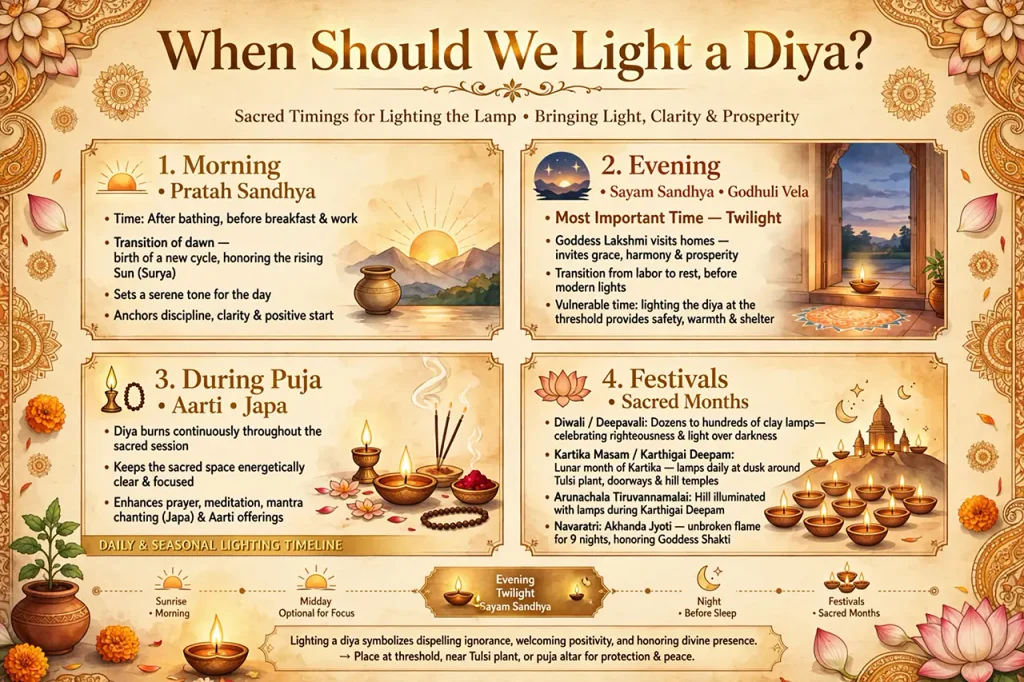
1. Morning (Pratah Sandhya)
Lighting a lamp in the morning typically occurs after bathing and before having breakfast or beginning work.
- The Transition of Dawn: Dawn represents the birth of a new cycle of action. Lighting a diya at dawn honors the rising sun (Surya) and sets an intentional, serene tone for the household before the demands of the day take over.
- Focus for the Day: It provides an anchor of discipline. Starting the day with a clean lamp reminds family members to conduct their work throughout the day with clarity, truthfulness, and goodwill.
2. Evening (Sayam Sandhya or Godhuli Vela)
The evening twilight—when the sun has set but total night has not yet arrived—is traditionally considered the most important time of the day to light a lamp in the home.
- Welcoming Auspiciousness: In popular cultural lore across both North and South India, twilight is the time when Goddess Lakshmi, the embodiment of grace, harmony, and prosperity, visits homes. Leaving an entryway dark during this hour was historically discouraged.
- Transition from Labor to Rest: Historically, before modern street lamps and ceiling lights, dusk was a vulnerable time when shadows lengthened and venomous creatures or intruders could approach undetected. Lighting a brass deepam at the front threshold and inside the living room provided physical safety, warmth, and an emotional feeling of shelter.
3. During Puja, Aarti, and Japa
Whenever personal prayer, chanting of mantras (japa), or ceremonial worship (puja) is conducted, a diya burns continuously throughout the session. It remains alight until the prayers are complete, ensuring that the sacred space stays energetically clear and focused.
4. During Festivals and Sacred Months
Certain calendar periods elevate the simple diya to the center of community life:
- Diwali (Deepavali): The festival of lights celebrates the triumphant return of righteousness, joy, and spiritual light into the world. Homes are adorned with dozens or hundreds of small clay lamps.
- Karthika Masam / Karthigai Deepam: Celebrated across South and East India during the lunar month of Kartika, this entire month is dedicated to light. Devotees light lamps daily at dusk, often setting them around the sacred Tulsi plant, near doorways, and atop hill temples (such as the famed Arunachala hill in Tiruvannamalai).
- Navaratri: An unbroken flame, known as an Akhanda Jyoti, is often kept burning continuously for all nine nights to honor the divine feminine energy (Shakti).
Read More >> Understanding Namaste and Anjali Mudra → Discover the historical roots and deeper meaning behind India’s universal gesture of greeting.
How to Light a Diya Step-by-Step
Lighting a diya is an accessible practice that anyone can learn. While tradition offers guidelines for mindfulness, common sense and fire safety should always come first.
- Clean the Vessel: If using a brass, bronze, or silver diya, wash it thoroughly with water, lemon juice, or tamarind paste to remove old residue. If using a new earthen clay diya, soak it in clean water for about an hour beforehand and let it dry completely. This prevents the porous clay from soaking up all your oil before the wick has a chance to catch fire.
- Choose Your Fuel: Decide whether you will use pure cow’s ghee or a quality vegetable oil like cold-pressed sesame (til) or mustard oil. Ensure the oil is fresh and free from artificial fragrances or chemical additives.
- Prepare the Cotton Wick: Take a clean strip of pure rolled cotton. You can use a long wick (batti) that rests in the groove of the lamp, or a standing, round flower wick (phool batti) that sits upright in the center of an open bowl.
- Position the Wick: Place the wick securely in the diya, ensuring that the tip protrudes just slightly over the rim (approximately 1/4 inch). If the wick sticks out too far, the flame will smoke and consume oil too quickly; if it is tucked in too low, the flame will drown in the liquid.
- Add the Oil or Ghee: Gently pour the fuel into the bowl until it is roughly two-thirds to three-quarters full. Dab a small drop of oil or ghee directly onto the exposed tip of the cotton wick to help it ignite smoothly.
- Set on a Stable Base: Never place a burning diya directly on a bedsheet, unfinished wood, plastic surface, or close to flowing curtains. Traditionally, a diya is set upon a small metal plate, a brass stand, or a small decorative bed of uncooked rice grains or fresh flower petals.
- Light the Flame: Strike a wooden match or use a small taper candle. Touch the flame gently to the tip of the soaked cotton wick until it catches. Hold the match away once the wick burns steadily with its own bright, golden aura.
- Offer a Moment of Silence: Once the flame is steady, close your eyes for five to ten seconds. Express gratitude, recite the Deepa Shloka, or simply breathe deeply. Let the presence of the light settle your thoughts before continuing your day.
Traditional Diya Lighting Rules: Practices to Know
Over centuries, regional customs, family lineages (sampradayas), and temple manuals have developed guidelines for lighting lamps. It is essential to remember that customs vary across communities. These rules are intended as thoughtful, mindful practices—not rigid dogmas designed to cause anxiety or fear.
1. The Direction the Diya Faces
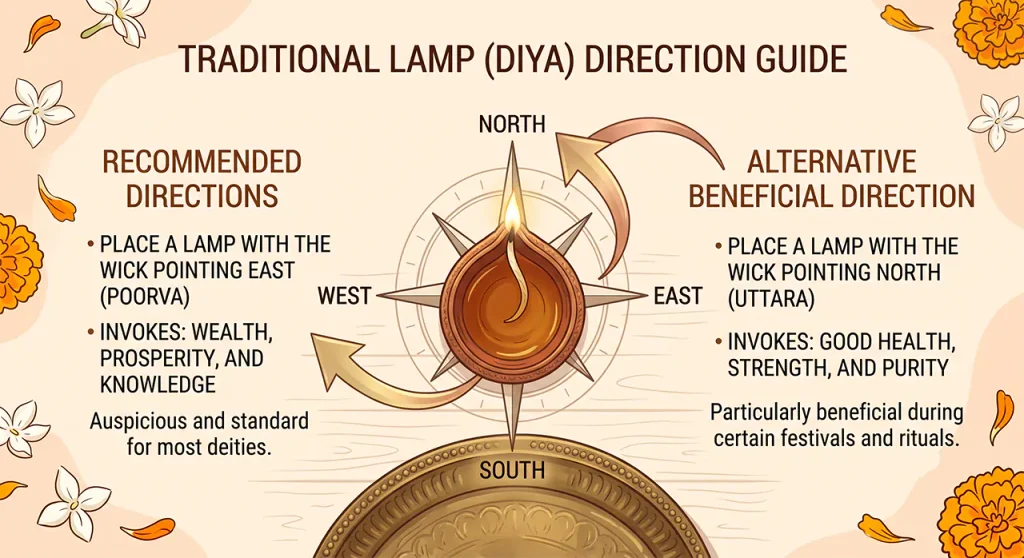
In traditional Vastu Shastra and ritual manuals, the direction toward which the lit wick points carries distinct associations:
- East (Purva): Pointing the wick toward the East is the most common and universally recommended orientation. The East is associated with the rising sun, new beginnings, physical vitality, good health, and peace of mind.
- North (Uttara): Facing the wick toward the North is linked with Kubera (the guardian of wealth) and Goddess Lakshmi. It is traditionally believed to foster prosperity, career focus, and harmonious family stability.
- West (Pashchima): Occasionally used in specific temple rituals or philosophical contemplations, pointing West is associated with the evening sunset, closure, and removal of debts.
- South (Dakshina): In everyday domestic worship, pointing a solitary diya directly toward the South is generally avoided. The South is historically associated with Yama (the deity of death, justice, and ancestors). Diyas are deliberately pointed South only on specific ceremonial occasions, such as during Deepavali’s Yama Deepam or during dedicated ancestral memorial rites (shraddha).
2. Number of Wicks Used
Lamps often feature different wick configurations, each holding traditional meaning:
- Single Wick: The most common setup for everyday prayers. It represents singular focus, one-pointed devotion (ekagrata), and unity of purpose.
- Two Wicks (or Two Twisted Together): Widely seen in South Indian tradition, two wicks twisted into one symbolise the harmonious union of intellect and heart, or the lifelong bond between husband and wife working together in family life (Grihastha dharma).
- Five Wicks (Pancha Deepam): Found commonly in ceremonial brass lamps like the South Indian Kuthuvillakku. The five wicks represent the mastery and purification of the five physical senses (sight, sound, taste, touch, smell) or the five fundamental natural elements (earth, water, fire, air, space).
- Seven or Nine Wicks: Typically reserved for grand temple aartis, festival nights, and elaborate community rituals.
3. Handling the Flame with Respect
In Indian thought, fire is not a lifeless chemical reaction; it is a sacred presence. Therefore, traditional etiquette teaches practitioners never to blow out a diya flame directly with their breath. The human mouth carries saliva droplets, which are considered ritually unhygienic (uchchhishta or jhootha).
If a flame needs to be extinguished before leaving the house:
- Gently use a flower petal or a clean leaf to brush the flame down into the oil.
- Use a small brass bell or candle snuffer.
- Use your right hand to gently wave the air nearby so the breeze softens the flame, without spitting or blowing onto the wick.
Oil Diya vs Ghee Diya
One of the most frequent questions asked by homeowners is whether they should use vegetable oil or clarified butter (ghee) in their daily lamps. Both options have deep roots in Indian heritage, yet they possess distinct qualities, aromas, and symbolic associations.
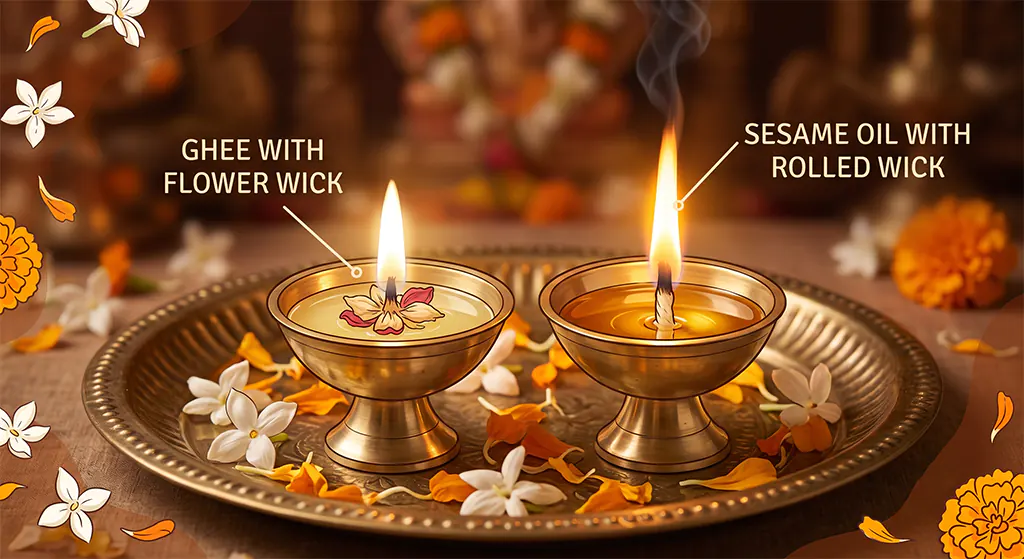
| Comparison Feature | Pure Cow’s Ghee Diya | Vegetable Oil Diya (Sesame / Mustard) |
| Primary Spiritual Association | Sattva Guna (Purity, peace, transcendence). | Rajas Guna / Protective energy (Devotion, focus, warmth). |
| Aroma & Atmosphere | Sweet, warm, subtle fragrance; deeply calming. | Earthy, rich, grounding; distinctly traditional. |
| Flame Quality | Soft, clear, bright golden-white flame; very little smoke. | Steady, robust, deep orange-yellow flame; burns for hours. |
| Burn Duration | Tends to burn faster; ghee solidifies in cold weather. | Burns longer and more economically; stays liquid. |
| Best Suited For | Altar worship, meditation spaces, special pujas. | Daily evening lamps, outdoor entrances, temple lamps. |
| Residue on Brass | Leaves soft, easily washable milky residue. | Leaves sticky, carbonized oil film requiring thorough scrubbing. |
The Ghee Diya
Pure cow’s ghee (shuddha go-ghrita) has held the highest ritual status in Indian sacred literature since the Vedic era. In ancient texts, ghee is celebrated as the purest offering because it comes from the cow, an animal that embodies selfless nourishment, gentleness, and motherhood.
When a ghee lamp burns, it produces a clear, clean, golden flame with virtually no acrid smoke. Its subtle, sweet aroma has an immediate grounding effect on the human nervous system.
In traditional Ayurvedic and yogic thought, ghee is associated with Sattva—the quality of balance, light, purity, and spiritual elevation. For this reason, many families prefer to light a ghee diya inside their quiet meditation corner, directly in front of their home altar, or during sacred rituals like Satyanarayan Puja and Lakshmi Puja.
The Oil Diya
Vegetable oils—especially cold-pressed sesame oil and mustard oil—have been the everyday heartbeat of Indian households and grand temples for thousands of years. While ghee was historically expensive and preserved for cooking and special offerings, oil was abundant, practical, and dependable.
From a practical perspective, vegetable oils have a higher viscosity and burn more slowly than ghee, making them ideal for lamps that need to stay lit for hours, such as evening entryway lamps, temple corridors, and festive terrace rows.
Symbolically, oil represents heartfelt devotion, humility, and the grounded perseverance of daily domestic life. Many grand temples in South India, including the vast corridors of Madurai Meenakshi Amman and Srirangam, burn thousands of liters of sesame oil every week to maintain the quiet, steady glow of their timeless sanctums.
Read More >> Offering Water to Surya (Surya Arghya) → A simple, practical guide to the ancient morning ritual of honoring the sun.
Different Oils Used for Diyas and Their Traditional Significance
If you choose to light an oil lamp, the type of oil you select carries its own cultural history, regional preference, and practical characteristics.
1. Sesame Oil (Til ka Tel or Nallennai)
Sesame oil is widely regarded as the most auspicious vegetable oil for lighting lamps across India, particularly in Maharashtra, Karnataka, Andhra Pradesh, Telangana, and Tamil Nadu (where it is referred to simply as Nallennai, meaning “the good oil”).
- Traditional Associations: Sesame seeds are among the most ancient cultivated seeds in India. In traditional astrology, sesame oil is linked with Shani (Saturn), and lighting a sesame oil diya on Saturdays is a popular domestic remedy for cultivating patience, discipline, and emotional balance during challenging life chapters. It is also deeply associated with Lord Shiva and Goddess Durga.
- Practical Characteristics: Pure sesame oil burns with a remarkably steady, cool, and clean flame. It generates very little soot compared to other vegetable oils and emits a mild, pleasant, nutty fragrance that does not overpower the room.
2. Mustard Oil (Sarson ka Tel)
In North and East India—including Uttar Pradesh, Bihar, Punjab, Bengal, and Odisha—mustard oil is the undisputed king of the household lamp.
- Traditional Associations: Mustard oil has an earthy, sharp, and fiery nature. It is strongly associated with deities known for protection, courage, and boundary-keeping, such as Lord Hanuman, Lord Bhairava, and Goddess Kali. Lighting a mustard oil lamp near the home entrance or on Tuesday and Saturday evenings is a widely observed tradition to invite strength and dispel heavy atmospheric energies.
- Practical Characteristics: Mustard oil is thick and heavy. Its unrefined state has a pungent, tear-inducing aroma when cold, but when heated gently in a diya flame, it acts as a natural insect repellent—a practical blessing during humid monsoon evenings in the river plains of India.
3. Coconut Oil
In the coastal states of India, especially Kerala, coastal Karnataka, and parts of Tamil Nadu, coconut oil is the default oil for both cooking and worship.
- Traditional Associations: The coconut tree is venerated as Kalpavriksha (the wish-fulfilling divine tree) because every single part of the tree—from roots to fronds to fruit—serves human life. In Kerala’s temple tradition (Tantra Sampradaya), clear coconut oil is considered clean, sacred, and cooling, making it the preferred fuel for the towering, ornate bell-metal lamps known as Nilavilakku.
- Practical Characteristics: Coconut oil burns with an exceptionally clear, bright, white-golden flame. It gives off a delicate, soothing tropical aroma. Its primary practical limitation is that in colder winter climates across North India, pure coconut oil solidifies completely inside the bottle and must be warmed before pouring.
4. Castor Oil (Arandi ka Tel)
Castor oil is a thick, highly viscous oil historically used in traditional village lamps and specific regional folk temples.
- Traditional Associations: In some regional customs, castor oil is believed to bring peace, calm heated tempers, and foster long-term marital contentment.
- Practical Characteristics: Because castor oil is thick, it burns slowly and lasts longer than almost any other vegetable oil. However, it requires a sturdy, loosely packed wick; otherwise, the heavy liquid cannot easily travel up the cotton fibers.
5. The Five-Oil Blend (Pancha Deepam Oil)
In South Indian devotional markets, you will often find bottles labeled “Pancha Deepa Ennai” (Five-Lamp Oil). This is a traditional blend composed of specific proportions of:
- Pure cow’s ghee
- Sesame oil
- Castor oil
- Mustard oil (or Mahua oil / Iluppai ennai)
- Coconut oil (or Neem oil)
While popular belief holds that this five-oil combination brings balanced blessings, prosperity, and spiritual harmony to the home, it is a regional devotional custom rather than an absolute scriptural mandate.
A Practical Buying Note: When purchasing oils for your home puja room, be cautious with commercial oils labeled “Pooja Oil.” Many inexpensive brands blend cheap mineral oil, industrial byproducts, and synthetic perfumes. These petroleum-derived oils create harsh black soot, stain ceilings, and irritate sensitive eyes and throats. Always prefer pure, cold-pressed, food-grade vegetable oils for your sacred space.
Which Is Better: Oil or Ghee?
When deciding between oil and ghee, there is no need to worry that one makes your prayer “less effective” than the other.
The most respectful and sustainable approach is to follow your family tradition and practical common sense:
- Choose Ghee if: Your family lineage has always used it, you are conducting a quiet morning meditation, you are performing a specific holiday puja, or you are particularly sensitive to smoke and prefer a clean, sweet aroma in a small room.
- Choose Sesame or Mustard Oil if: You want a lamp that burns steadily for many hours, you are lighting lamps outside the entrance or along balconies, you are conducting evening prayers, or you want an economical, grounded daily practice that honors centuries of domestic Indian custom.
A golden flame fueled by clean sesame oil lit with a loving heart carries immeasurably more spiritual meaning than a flame of expensive ghee lit in anger, rush, or empty pride. The fuel is merely the vehicle; your devotion and quiet presence are the real offering.
Types of Wicks and Why Cotton Is Chosen
The wick (batti or varthi) is the unsung hero of the diya. Without a properly prepared wick, the finest ghee or the purest oil cannot shine.
Why Pure Cotton Is Universally Used
In Hindu tradition, natural fibers are preferred for sacred rituals. Cotton (kapaas) comes directly from the earth, grown under the open sun and rain.
Symbolically, pure white cotton represents purity (shuddhatva), softness, and innocence. Cotton fibers possess natural capillary action—thousands of tiny microscopic tubes that pull liquid fuel upward against gravity to meet the flame. It quietly gives up its own fibers to help the light burn cleanly.
Styles of Cotton Wicks
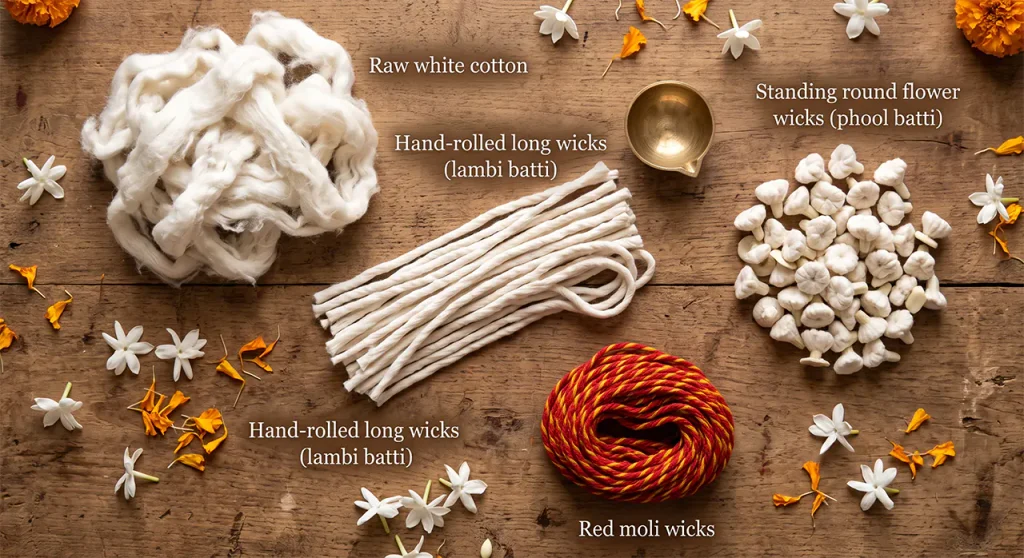
- The Long Rolled Wick (Lambi Batti): Made by taking raw cotton wool, gently moistening the palms with a drop of milk or water, and rolling the fibers into a slender, elongated cord. This wick is laid along the base of the lamp, with its tip resting in the extended spout or groove. It provides a directed, stable flame and is the classic choice for brass lamps and deep clay diyas.
- The Standing Flower Wick (Phool Batti): Shaped like a small blossom, this wick has a broad, flat, fluffy circular base with a single, tightly twisted stem pointing straight up. It is set upright in the center of a flat metal or clay diya. It is particularly popular in North India for ghee lamps, offering an expansive, beautiful round flame.
- The Raw Red/Yellow Sacred Thread Wick (Kalava or Moli): During certain special festivals or Durga Puja rituals, wicks made from sacred hand-spun cotton threads dyed with turmeric and kumkum are used. This reflects celebration, protection, and festive sanctity.
Where Should We Keep the Diya?
Placement of a diya balances traditional ideas of sanctity with the practical layout of a modern household.
1. The Home Altar (Puja Mandir)
Inside your prayer space, the diya is traditionally placed on the right side of the deity (which corresponds to your left-hand side as you face the altar). Alternatively, a central lamp may be placed symmetrically in front of the altar.
- Always set the diya on a small plate or tray to catch warm oil drips or stray match heads.
- Keep the surrounding space free of dried flower garlands, matchboxes, incense packets, and holy books that could accidentally catch fire.
2. The Main Entrance (Dehliz or Vasappadi)
Lighting a lamp at the front threshold of the home at dusk is one of India’s oldest domestic customs.
- The lamp should be placed on a small raised shelf or stable ledge near the doorframe, rather than directly on the floor where it might be kicked by someone walking in.
- Traditionally, as one exits the house, the lamp is placed on the right side of the doorway.
3. The Tulsi Vrindavan
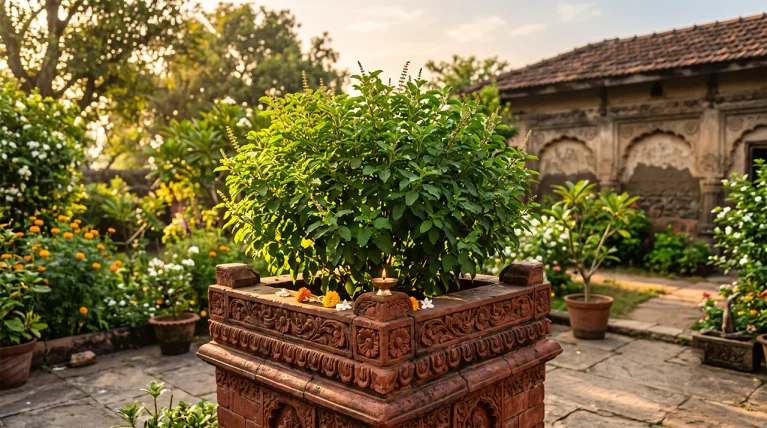
For households with an open courtyard, balcony, or garden featuring a sacred Tulsi (holy basil) plant, lighting an evening diya beside Tulsi is considered an act of deep reverence. It honors the plant’s sacred, health-giving presence and brings gentle light to the green spaces of the home.
Crucial Fire Safety Reminders
No religious tradition encourages recklessness. A flame is a living fire and must be treated with intelligent caution:
- Never leave an open flame unattended when leaving the house or going to sleep.
- Keep away from flowing curtains, open windows, and ceiling fans. A sudden draft can lift a lightweight curtain directly into a diya flame within seconds.
- Keep out of reach of curious young children and household pets.
- If you must leave a lamp burning for ritual reasons, place it inside a deep, protective glass chimney or perforated brass lantern (Akhand Jyoti deepam) that prevents drafts and accidental contact.
Can We Light a Diya at Night?
Questions about lighting lamps late at night often cause unnecessary confusion. Let us clarify the traditional context versus common daily habits:
- Evening vs Late Night: In classical tradition, twilight (Sandhya vela) is the recommended time for household lamps. Lighting a fresh diya at 1:00 AM or 2:00 AM without any specific ritual reason is not typical in standard domestic practice. Late night is recognized as a time for natural sleep, withdrawal of the senses, and rest.
- The Akhanda Jyoti Exception: During festivals like Navaratri, Shivaratri, and Diwali, a dedicated lamp is intentionally kept burning throughout the entire night. This is known as an Akhanda Jyoti (unbroken flame). It is carefully shielded inside a tall glass enclosure or brass container and fed fresh oil regularly by family members taking turns.
- Temples at Night: In major Hindu temples, a ceremony known as Shayana Aarti (bedtime aarti) takes place late in the evening. After this final ceremony, the main temple lamps are carefully put to rest or allowed to subside naturally, leaving only a quiet, protected embers or a minimal oil wick to safeguard the inner sanctum overnight.
What If the Diya Goes Out Accidentally?
Few everyday occurrences create as much sudden, unnecessary panic in a Hindu household as a diya flame flickering out unexpectedly. Many people were raised with the frightening belief that an extinguished lamp signals an immediate curse, bad news, or divine displeasure.
It is time to replace this fear with calm common sense and compassionate traditional wisdom.
The Practical Reasons a Diya Goes Out
A flame is a physical chemical reaction between heat, oxygen, and liquid fuel drawn through cotton. If a diya goes out, it is almost always due to one of four simple physical causes:
- A gentle gust of wind from an open window, an air conditioner vent, or a ceiling fan.
- The oil or ghee ran out because the vessel was too small or underfilled.
- The cotton wick was twisted too tightly, preventing the fuel from climbing the fibers quickly enough to sustain the flame.
- Carbon buildup (charring) formed a heavy black crust at the tip of the wick, choking off the flow of fuel.
The Spiritual Attitude: Grace Over Fear
Hindu philosophical traditions—from the Upanishads to the teachings of modern saints—teach that God is an ocean of compassion, understanding, and love (Karuna Sagara), not a petty tyrant waiting to punish someone over a breeze blowing out a match-lit wick.
If your diya goes out while you are praying:
- Do not panic or assume something terrible is going to happen.
- Take a quiet breath.
- Clean the tip of the wick, trim off any charred carbon, add a fresh drop of oil or ghee, and gently relight the flame with a steady hand.
- Offer a simple mental prayer: “Forgive any distraction; may my devotion remain steady like an unmoving flame in a windless place.”
Spiritual life is about your heart’s intention (bhava), not an exercise in perfectionistic anxiety.
Is There a “Scientific Reason” Behind Lighting a Diya?
In recent years, the internet has seen a flood of exaggerated claims attempting to justify ancient rituals with pseudo-scientific vocabulary—claiming that lighting a diya “destroys all bacteria in a 10-meter radius,” “releases negative ions that cure diseases,” or “realigns the Earth’s magnetic poles.”
It is important to be intellectually honest and separate authentic practical benefits from unsupported sensationalism.
Legitimate Practical and Psychological Observations
While a small clay lamp does not possess magical biochemical powers, its regular use in a home produces several verifiable, tangible benefits:
- Visual Calming and Focus: In yoga traditions, the practice of steadily gazing at a gentle, single-point flame is known as Trataka. Looking at a warm golden flame relaxes the ciliary muscles of the eyes, reduces the rapid back-and-forth eye movements associated with anxious thinking, and helps center wandering thoughts.
- Warm, Natural Color Temperature: Unlike the harsh blue-white light emitted by smartphones, laptop screens, and commercial LED bulbs—which suppresses melatonin and disrupts circadian rhythms—a burning wick produces light in the warm 1800K to 2200K spectrum. This soft golden glow signals safety and rest to our evolutionary biology.
- Mindful Sensory Anchoring: The multisensory act of handling clay, pouring natural oil, rolling cotton, and breathing in the mild, warm scent of burning ghee or sesame oil creates an immediate grounding routine. It acts as a behavioral habit loop, cueing the mind to leave daily stress behind.
Lighting a diya does not need dubious pseudo-scientific claims to justify its worth. Its true value lies in its power as an intentional, contemplative, and culturally rich human practice.
Read More >> Why Do We Ring Bells in Hindu Temples? → The acoustic, symbolic, and ritual purposes of the temple ghanta.
Diya Traditions Across Different Regions of India
One of the most beautiful aspects of Hinduism is that it is not a monolithic, centralized faith with a single rigid rulebook. It is an expansive forest of regional traditions, where different states celebrate light through distinct art forms, metals, and seasonal rhythms.
North India (Uttar Pradesh, Bihar, Punjab, Rajasthan)
In the northern plains, the humble unglazed terracotta lamp (mitti ka diya) is the undisputed star of autumn.
- During Chhoti Diwali and Badi Diwali, courtyards, terraces, and windowsills are lined with dozens of small clay lamps filled with mustard oil.
- Along the ghats of Varanasi, Haridwar, and Prayagraj, thousands gather each evening to witness the grand Ganga Aarti, where priests balance towering, multi-tiered brass lamps weighing dozens of pounds, rotating them in rhythmic circles to honor the sacred river.
South India: Tamil Nadu and Karnataka
In Tamil homes, the graceful Kuthuvillakku—a tall, standing brass or bell-metal lamp crowned with an ornamental bird (often the mythical Hamsa or swan)—is the heart of the domestic altar.
- South Indian families predominantly use pure sesame oil (nallennai).
- During the ancient festival of Karthigai Deepam, giant clay lamps known as Agal Vilakku are placed on every step, windowsill, and threshold of the home. At Tiruvannamalai, a massive copper cauldron filled with thousands of liters of ghee and miles of wick is ignited atop Mount Arunachala, producing a beacon of light visible for dozens of miles across the countryside.
Kerala: The Land of the Nilavilakku
In Kerala, no event—whether a classical Kathakali performance, an Ayurvedic clinic opening, a wedding ceremony, or daily evening prayer—begins without lighting the Nilavilakku.
- Standing gracefully upon a slender base, this heavy bronze lamp is fueled exclusively by pure coconut oil.
- The wicks are often laid out in opposite pairs or four cardinal directions. The lighting of the evening lamp (Deeparadhana) coincides with the singing of devotional verses (Sandhya Namam), creating an atmosphere of deep, unhurried peace.
Eastern India: West Bengal and Odisha
In Bengal and Odisha, brass lamps with intricate peacock handles share space with unique regional creations:
- During specific pujas, lamps are occasionally molded by hand from kneaded rice dough (pitte diya) or scooped-out vegetable rinds, filled with ghee, and offered at the riverbank.
- During the conclusion of Durga Puja, the rhythmic dance of the priests holding smoking clay censers (dhunuchi) and tiered brass lamps creates a dynamic, vibrant expression of community devotion.
Western India: Maharashtra and Gujarat
- In Maharashtra, the Samai—a slender, standing brass lamp with floral petal basins—is an essential fixture of every housewarming, wedding, and Ganeshotsav celebration.
- In Gujarat, during the nine vibrant nights of Navaratri, a special perforated clay pot containing a steady burning diya—known as the Garbha Deep—is placed at the center of the community courtyard. Women and men dance in circular steps around this central lamp, celebrating the divine feminine principle of life glowing steadily within the womb of creation.
Diyas in Temples vs Diyas at Home
While the underlying philosophy of light remains identical, the scale, ritual requirements, and role of lamps differ substantially between a public temple and a personal home altar.
The Temple Lamp
In a traditional Hindu temple, the placement and lighting of lamps are governed by ancient architectural and ritual manuals known as the Agamas.
- Perpetual Sanctity: In many historic shrines, the sanctum flame is an Akhanda Deepam—a perpetual lamp that has been kept burning unbroken across centuries by generations of priests adding fresh oil day and night.
- Ritual Drama (Aarti): During temple aarti, the priest holds tiered lamps representing different geometric forms—the five elements, the single sun, the crescent moon, and the serpentine coils of cosmic time—waving them before the deity to collect the divine grace, which is then offered out to the gathered assembly of devotees who gently cup their hands over the warm air and touch their eyelids.
The Home Diya
In a personal home altar, the atmosphere is informal, affectionate, and personal.
- There are no complex priestly rituals required. A simple, clean lamp lit with clean hands and a sincere heart fulfills the purpose of domestic prayer.
- Its scale is domestic and safe: designed to burn quietly for 30 minutes to an hour while the family gathers, reflects, or begins the tasks of the day.
The Role of Diyas in Major Hindu Festivals
While a diya is a constant companion in daily life, during certain major festivals it takes center stage as the very soul of the celebration.
1. Diwali: The Festival of Lights
Diwali (from the Sanskrit Deepavali, meaning “row of lamps”) is celebrated on the darkest new-moon night (Amavasya) of the autumn month of Kartika.
- Historical Memory: Across different regions, it commemorates the return of Lord Rama to Ayodhya after 14 years of exile, the victory of Krishna over the tyrant Narakasura, or the emergence of Goddess Lakshmi from the churning of the cosmic ocean.
- The Transformative Meaning: By covering every rooftop, balcony, doorway, and garden step with clay diyas, communities collectively assert that no matter how deep the darkness of the new-moon night may seem, thousands of small, united individual flames can turn the night into day.
2. Karthika Masam and Karthigai Deepam
The entire lunar month of Kartika (usually overlapping October and November) is considered the most sacred month for lighting lamps.
- In Andhra Pradesh, Telangana, and Karnataka, devotees observe dawn baths and light daily evening lamps at temples and beneath the sacred Amla (Indian gooseberry) tree.
- In Tamil Nadu, Karthigai Deepam is observed on the full-moon night when the Karthigai constellation aligns with the moon. Huge bonfires of camphor and ghee light up temple towers, and every household burns rows of clay agal vilakkus along their door thresholds to invite boundless grace.
3. Navaratri and the Akhanda Jyoti
During the nine nights of Navaratri, dedicated to the Goddess in her forms as Durga, Lakshmi, and Saraswati, many homes set up a single brass or silver lamp that is never allowed to go out for all 216 hours of the festival. This Akhanda Jyoti is treated as a living guest of honor—representing the unbroken, enduring life force (Prana) that sustains the cosmos.
The Inner Spiritual Meaning of Lighting a Diya
Beyond rules, oils, wicks, and history, there is a quiet, contemplative moment when the flame catches that speaks directly to the human soul. Why does this simple act move us so deeply?
Consider the extraordinary generosity of a flame. If you hold a single lit diya, and ten friends come to you with unlit lamps, you can touch your flame to each of their wicks.
What happens to your flame? Does it become half as bright? Does it lose its warmth? Does it diminish?
Not in the slightest. Your light remains completely whole, even after birthing ten, a hundred, or a thousand new lights.
Indian thinkers saw in this simple physical reality the very definition of love, wisdom, and spiritual truth. When you share genuine knowledge, empathy, or kindness with another human being, you do not lose what you have. You simply multiply the total light available in a dark room. Ignorance hoards; wisdom shares freely.
Furthermore, the lamp reminds us of the beauty of a life lived in gentle service:
- The oil gives itself up willingly.
- The wick offers its own body to the fire.
- The clay bowl quietly bears the heat without complaint.
- And the flame, asking for nothing in return, quietly warms the room and brightens the path for anyone who walks by.
To light a diya each day is to make a quiet, five-second promise to yourself: “Today, let me be like this lamp. Let me burn away my selfish pride. Let me point my thoughts upward. And let me bring a little more light into whatever room I enter.”
Common Mistakes to Avoid While Lighting a Diya
To keep your daily practice safe, respectful, and joyful, keep an eye out for these frequent everyday oversights:
- Using heavily charred, unwashed wicks: Relighting a wick covered in hard black carbon residue produces dense, bitter smoke and causes uneven burning. Gently trim off the burnt crust or replace the cotton wick before lighting a fresh lamp.
- Overfilling the lamp bowl: Pouring oil or ghee right up to the very brim easily leads to hot spills when moving the lamp, staining altar cloths and creating unnecessary fire risks. Fill the vessel comfortably to two-thirds or three-quarters capacity.
- Ignoring modern fire safety: Placing a burning diya on an unstable plastic surface, directly under a low-hanging wall calendar, or within direct reach of blowing curtains is dangerous. Always place your lamp on a broad, heat-resistant metal plate or ceramic base.
- Letting regional customs create personal fear: Becoming terrified because a flame went out in a breeze, or obsessing over whether a wick pointed 10 degrees away from true North, contradicts the peace that spiritual rituals are meant to bring. Tradition offers helpful guardrails; it is never meant to become an engine of anxiety.
- Blowing out the flame directly with breath: As explained in traditional etiquette, avoid blowing saliva droplets onto the sacred flame. Use a flower petal, an upturned spoon, a snuffer, or a gentle wave of your hand to quiet the flame respectfully when necessary.
Myths vs Facts About Lighting a Diya
Misconceptions often circulate through social media forwards and word-of-mouth gossip. Here is how traditional understanding clarifies common popular myths:
| Common Myth | What Tradition and Philosophy Actually Say |
| “If a diya accidentally goes out during prayer, a catastrophe will strike.” | Myth. Flames go out due to physical factors like drafts, uneven wicks, or depleted oil. Gently clean the wick, relight the lamp with a calm heart, and continue your prayer without fear. |
| “Only pure cow’s ghee pleases the divine; vegetable oil is spiritually inferior.” | Myth. Both have been revered for millennia. Pure sesame and mustard oils have supported Indian temple and domestic traditions for thousands of years. Sincerity of heart matters far more than the expense of the fuel. |
| “You must discard clay diyas after using them once; they can never be reused.” | Context-dependent. While inexpensive unglazed clay lamps used outdoors during Diwali are often recycled into the soil, family brass, silver, and well-maintained glazed clay lamps are cleaned and reused daily for generations. |
| “Lighting a diya scientifically destroys all bacteria and cures serious airborne illnesses.” | Myth. A small flame cannot sterilize a room. While warm lighting supports mental calm and reduces evening screen fatigue, spiritual rituals should never be conflated with medical science. |
| “Every Hindu household must follow the exact same wick direction and count.” | Myth. India is rich in regional traditions. Tamil, Bengali, Kashmiri, and Gujarati families each follow beautiful, time-honored variations passed down by their ancestors. |
Frequently Asked Questions
1. Why do we light a diya?
We light a diya to invoke divine presence, mark an auspicious beginning, and symbolically dispel ignorance (tamas) with the light of wisdom, clarity, and devotion (jyoti). It serves as a visual reminder of the inner consciousness that illuminates our minds.
2. Why is a diya lit before beginning puja?
Lighting a lamp is traditionally the first step of worship because fire (Agni) serves as a sacred, neutral witness to our prayers. It visually shifts our attention away from worldly chores, creating an atmosphere of reverence, focus, and quiet concentration.
3. What does the flame of a diya symbolize?
The flame symbolizes spiritual knowledge, purity, and the aspiration of human consciousness. Because a flame naturally points upward regardless of how the lamp is tilted, it serves as a daily reminder to elevate our ideals and thoughts toward truth and virtue.
4. Is ghee better than oil for lighting a diya?
Neither is universally “better.” Ghee is traditionally associated with Sattva (purity, peace, sweet aroma) and is widely used for quiet morning worship and special pujas. Vegetable oils like sesame and mustard are associated with steady, long-lasting devotion, and are ideal for evening lamps, entryways, and temple use.
5. Which oil is best for lighting a daily diya?
Cold-pressed sesame oil (til ka tel) is widely considered the finest all-around oil across India due to its clean, soot-free flame and soothing nutty aroma. In North India, mustard oil is popular for its warming, insect-repelling properties, while coastal regions like Kerala prefer pure coconut oil.
6. Can we use sunflower or soybean cooking oil in a diya?
While not forbidden, refined commercial cooking oils like sunflower, soybean, or palm oil are generally avoided in traditional altars. They are chemically heavily processed, lack traditional cultural context, and tend to produce sticky, stubborn residue on brass lamps.
7. How many wicks should a diya have?
For everyday home worship, a single cotton wick or two wicks twisted into one is standard and meaningful. Multi-wick lamps—such as five-wick (Pancha Deepam) lamps—are traditionally lit during festive occasions, aartis, and temple ceremonies to represent the mastery of the five senses.
8. Which direction should the diya face?
Pointing the wick toward the East is the most common practice, associated with good health, peace of mind, and the rising sun. Pointing toward the North is linked with prosperity and harmony. Pointing directly South is generally reserved for ancestral rituals and specific memorial days.
9. Can we light a diya both in the morning and evening?
Yes. Lighting a lamp at dawn honors the arrival of a new day of focused labor, while lighting at dusk (Godhuli vela / twilight) welcomes auspiciousness, warmth, and peace into the home as daytime activities wind down.
10. Can we light a diya late at night?
Regular domestic worship is traditionally conducted during morning and evening twilights. Except for dedicated festival nights—such as Shivaratri, Diwali, or Navaratri where an Akhanda Jyoti burns through the night—lighting fresh lamps late at night is not typical for household altars.
11. What should I do if the diya goes out by accident?
Do not panic or view it as an omen of bad luck. Check for physical causes: a sudden breeze, low fuel, or a clogged wick. Trim the wick, add fresh oil or ghee, relight the flame calmly, and resume your prayers with a peaceful heart.
12. Can we use the same brass diya every day?
Yes. A brass, bronze, or silver diya can be cleaned, polished, and used daily for generations. Simply clean out old oil and charred wick remnants before adding fresh fuel and cotton for the next prayer.
13. Can we light a diya without doing a full, elaborate puja?
Yes. Simply lighting a clean lamp at twilight, standing quietly before it for a few moments, and expressing sincere gratitude is a complete, self-contained spiritual practice in itself. Elaborate rituals are optional; sincere presence is what matters.
14. Why do we traditionally use pure cotton for the wick?
Pure cotton is a natural, unadulterated plant fiber that absorbs liquid smoothly through capillary action. Symbolically, white cotton represents innocence and purity, quietly offering up its own threads so that the light can shine cleanly.
15. What is the difference between a diya and a deepam?
Both words refer to the same sacred lamp. “Diya” (derived from the Sanskrit Deepa) is the term commonly used across North and Central India, while “Deepam” is the classical Sanskrit and South Indian term (used in Tamil, Telugu, Malayalam, and Kannada).
16. Should a diya be kept on the floor?
It is traditionally considered more respectful and safe to place a diya on a slightly raised surface—such as a small wooden stool, a metal plate, a stone ledge, or a decorative brass stand—rather than directly on bare flooring where it could be accidentally bumped.