Varalakshmi Vratham: Pooja Vidhanam, Vrat Katha & Pooja Items
Varalakshmi Vratham is a highly revered Hindu practice that worships Varalakshmi Devi, the giver of boons, who is the personification of prosperity and auspiciousness. This sacred rite is celebrated mainly by married women from southern parts of India and from other parts of the world where Hindus live, on the Friday before the full moon day of Purnima during the holy month of Shravana (August – September).
Fri, 28 Aug, 2026
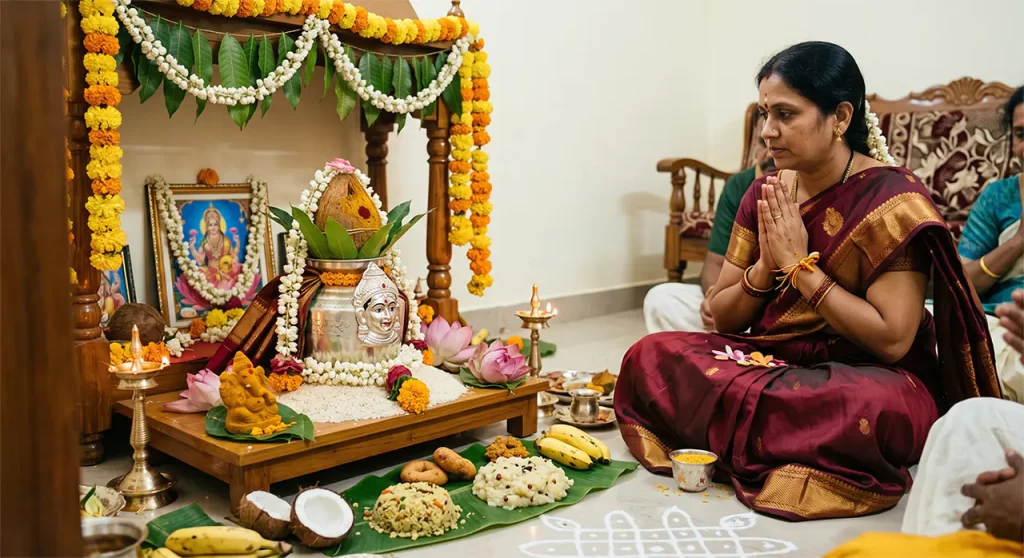
This comprehensive guide gives you all the details that you need for performing the sacred ritual at your home: the basic significance of the vratha, detailed list of all pooja ingredients, genuine Pooja Vidhanam (procedure) in a step-by-step format, the traditional Vrat Katha (legend), mantras, rules of fasting, regional differences, and FAQ’s.
What Is Varalakshmi Vratham?
Varalakshmi Vratham is a vow and worship that originated from Hindu religion. It is performed for Goddess Varalakshmi, an auspicious incarnation of Mahalakshmi, who provides varams or boons.
Meaning of the Name
The meaning of the name is formed out of three essential Sanskrit words:
- Vara – meaning “boon,” “blessing” or “that which is chosen.”
- Lakshmi – an incarnation of divine feminine who symbolizes fortune and beauty.
- Vratham/Vratam – a vow in its most sanctified form.
Who Is Goddess Varalakshmi?
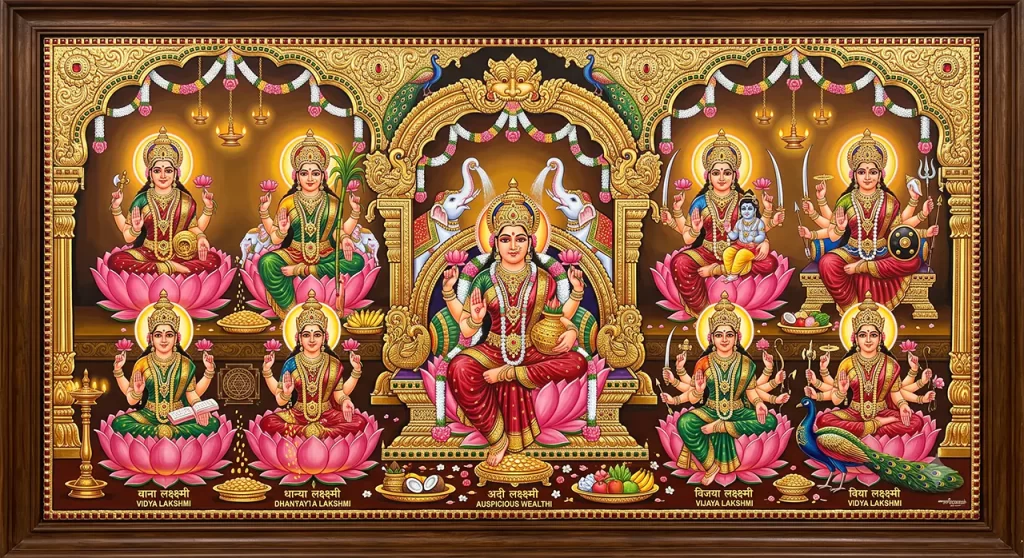
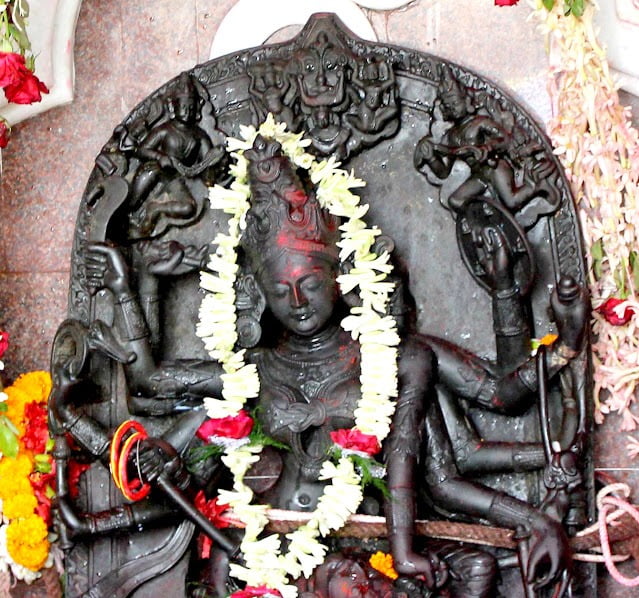
The Goddess Varalakshmi is considered the kind-hearted form of Mahalakshmi. According to the orthodox tradition, worshipping the Goddess Varalakshmi is equal to worshipping the Ashtalakshmi or the eight different forms of Lakshmi which are the controllers of eight essential parts of life in humans, including prosperity, earth, education, affection, fame, peace, enjoyment, and power.
Who Traditionally Observes It?
The vrata is traditionally performed by the Hindu married women (sumangalis) in order to ensure that all goes well with their husbands and children as well as other family members. However, even unmarried women perform the vrata in company with older members of the family for a good spouse in future.
Significance of Varalakshmi Vratham
The celebration of Varalakshmi Vratham assumes great theological, cultural, and domestic significance. It differs from many other religious festivals which are usually celebrated in temples, as the ritual is conducted inside the confines of one’s home itself and turns one’s home into a place of worship.
Spiritual and Religious Importance
As per the Skanda Purana, one of the eighteen principal Puranas of Hinduism, the ritual worship of the Goddess Varalakshmi was revealed directly by Lord Shiva to Goddess Parvati in response to her question regarding a particular ritual that would grant all householders peace, prosperity, and salvation. The ritual acts as a means of worshipping the Divine without undergoing any severe penances or yajnas.
The Ashtalakshmi Connection
It is traditionally believed that the conduct of the Varalakshmi Pooja with true devotion grants the combined blessings of the eight divine aspects of Goddess Lakshmi:
| Manifestation of Lakshmi | Realm of Blessing |
| Adi Lakshmi | Spiritual origin, inner peace, and primal wealth |
| Dhana Lakshmi | Material abundance, currency, and resource security |
| Dhanya Lakshmi | Agricultural wealth, food, and sustenance |
| Gaja Lakshmi | Royalty, dignity, livestock, and grace |
| Santana Lakshmi | Progeny, continuity of lineage, and family welfare |
| Dhairya (Veera) Lakshmi | Courage, perseverance, and emotional strength |
| Vijaya Lakshmi | Victory, success, and conquest over obstacles |
| Vidya Lakshmi | Knowledge, wisdom, art, and intellectual discernment |
Household and Community Value
Apart from personal commitment to the ritual, there are some other benefits as well for performing Varalakshmi Vratam. The women invite their neighbors, friends, and relatives at their house on the evening of the puja to give tamboolam (a holy gift consisting of betel leaves, areca nuts, turmeric, kumkum, fruits, and gifts). This ritual helps in building relationships and respecting the feminine divinity in each guest.
You may also like to check…. Significance of Akshaya Tritiya
When Is Varalakshmi Vratham Celebrated?
As the Hindu calendar is based on a lunisolar calendar system, the Gregorian date keeps changing every year for Varalakshmi Vratam.
Understanding Lunar and Solar Calendar Alignments
- Amanta and Purnimanta Systems: According to the South Indian calendars (the Telugu, Kannada, and Marathi calendars based on the Amanta system), the festival occurs in the bright fortnight (Shukla Paksha) of the Shravana month.
- Tamil Calendar (Aadi Month): In Tamil Nadu, the festival is celebrated on the preceding Friday of the Full Moon day in the solar month of Aadi.
- Contingent Practices: In case of inability to conduct the puja on the specified Friday on account of death in the family, childbirth (asoucham), sickness, or travel outside one’s place of residence, it is customary to conduct the vrata on any other Friday in the same Shravana month or in the ensuing lunar month (Bhadrapada).
It is recommended that readers consult a reliable regional panchangam (almanac) to confirm the precise puja muhurat (time window) since the astronomic timings will differ from region to region with respect to sunrise, Tithi, and Rahu Kalam.
When is Varalakshmi Vratham in 2026?
| Event Year | Date | Auspicious Time Window (Muhurat) |
| 2026 | Friday, August 28, 2026 | The highly auspicious windows are during Simha Lagna (Morning), Vrishchika Lagna (Afternoon), and Kumbha Lagna (Evening). Observance of dusk (Pradosh Kaal) is traditionally considered optimal for inviting Goddess Lakshmi into the household. |
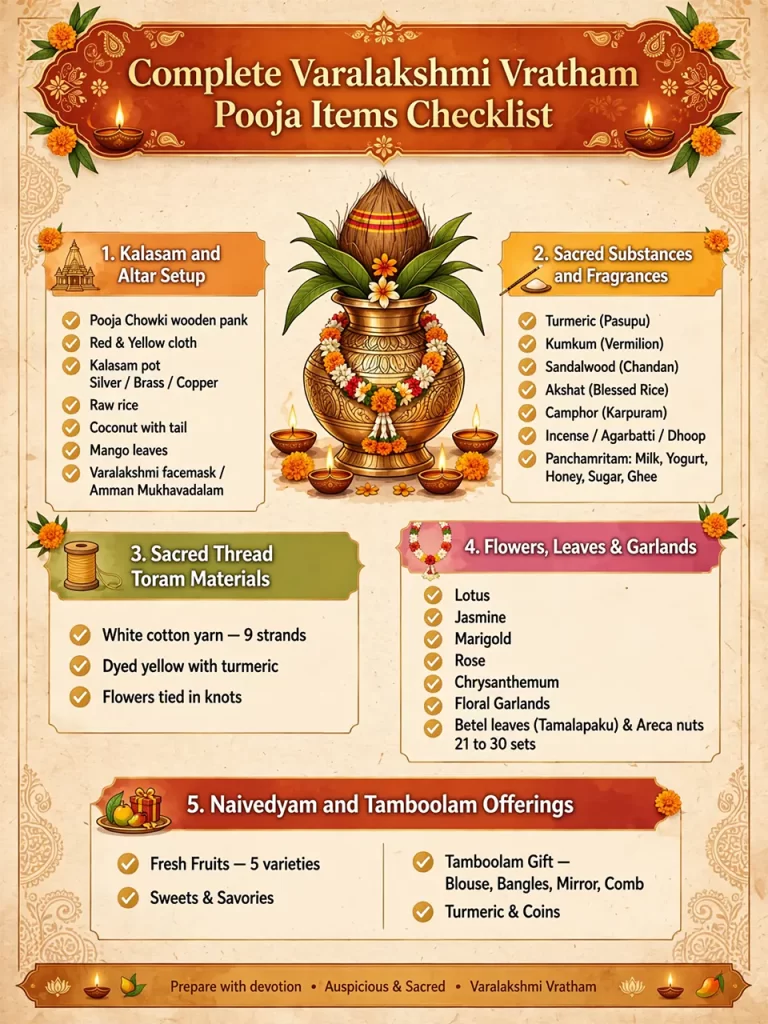
Complete Varalakshmi Vratham Pooja Items Checklist
Preparation is a vital aspect of the ritual experience. Gathering all essential materials (samagri) ahead of time ensures an orderly and tranquil puja environment.
1. Kalasam and Altar Setup
- Pooja Chowki / Wooden Plank: Raised platform for the altar.
- Red or Yellow Cloth: Fresh, unstitched silk or cotton cloth to cover the platform.
- Kalasam Pot: A clean pot made of silver, brass, or copper (earthen pots can also be used).
- Raw Rice: Approximately 1 to 2 cups to fill the kalasam base and scatter on the altar.
- Coconut: A fresh, unblemished coconut with its tail intact.
- Mango Leaves: 5, 7, or 9 fresh, green mango leaves (or betel leaves if mango leaves are unavailable).
- Varalakshmi Face Mask (Amman Mukhavadalam): Silver, brass, or clay face of the Goddess (optional; a decorated coconut is traditionally sufficient).
2. Sacred Substances and Fragrances
- Turmeric Powder (Pasupu / Manjal): For making Ganesha, mixing with rice, and coating the coconut.
- Kumkum (Vermilion): For tilak and archana.
- Sandalwood Paste (Chandan): Freshly made or pure paste.
- Akshat (Akshatalu / Akshathai): Unbroken raw rice grains mixed with a pinch of turmeric and a drop of water or ghee.
- Camphor (Karpuram): For the final Aarti.
- Incense Sticks (Agarbatti) and Dhoop: For pleasant natural fragrance.
- Panchamritam Ingredients: Milk, yogurt, honey, sugar, and ghee mixed in a small cup.
3. Sacred Thread (Toram) Materials
- Toram Thread: White cotton yarn (traditionally 9 strands) dyed yellow with turmeric paste.
- Fresh Flowers: Small yellow or red flowers tied into each of the 9 knots of the thread.
4. Flowers, Leaves, and Garlands
- Lotus Flowers: Highly sacred to Goddess Lakshmi.
- Jasmine, Marigold, Rose, and Chrysanthemum: Fresh blossoms for archana.
- Floral Garlands: To drape over the Kalasam and photographs.
- Betel Leaves (Tamalapaku / Vetrilai) and Areca Nuts: At least 21 to 30 sets.
5. Naivedyam and Tamboolam Offerings
- Fresh Fruits: Bananas, apples, pomegranates, and seasonal varieties (ideally 5 distinct varieties).
- Prepared Sweets and Savories: Traditional recipes (detailed in Section 10).
- Tamboolam Gift Items: Blouse pieces, bangles, small mirrors, combs, turmeric roots, and coins to offer visiting women.
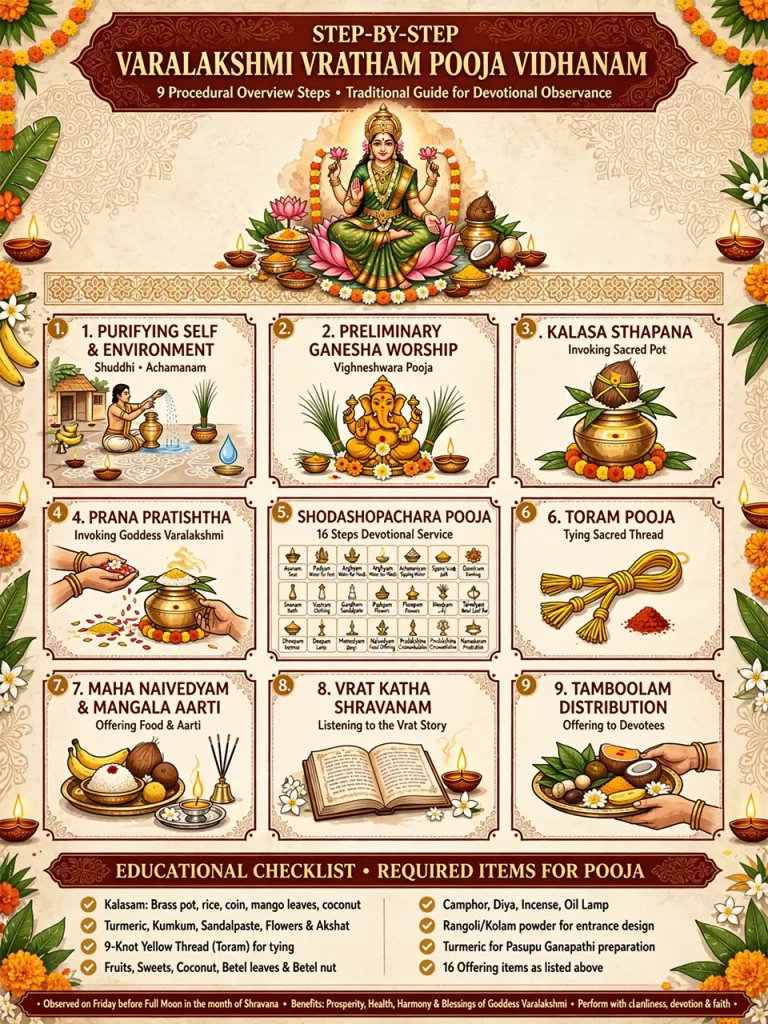
Step-by-Step Varalakshmi Vratham Pooja Vidhanam
The Pooja Vidhanam (ritual process) is conducted following ancient Vedic and Agamic rules but made suitable to suit the domestic shrine. The following are some of the genuine steps that can be taken.
Step 1: Preliminary Cleansing and Setup
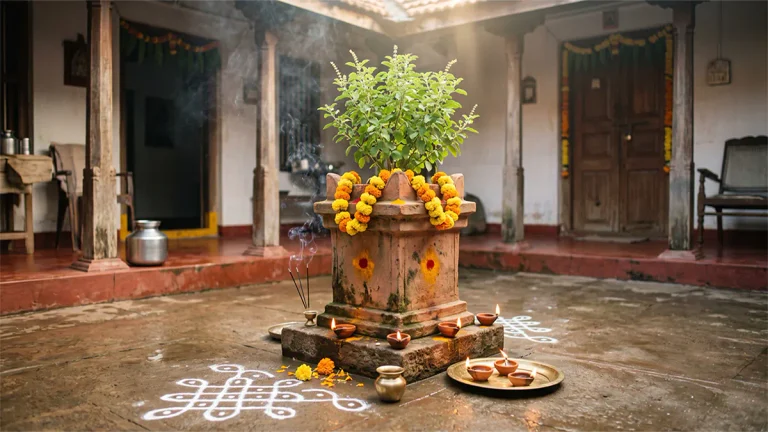
Wake up early morning before sunrise during the Brahma Muhurtha, have a bath, and put on your festive clothes (like silk saree). Cleanse the place you will use to perform your Puja. Draw a Rangoli or Muggu (decorations made by rice flour in geometric designs) in front of the altar.
Place the wooden plank facing towards either east or north. Place a red or yellow cloth on top of it. Place raw rice spread evenly in the middle of the plank where you will place the Kalasam.
Step 2: Ganesha Puja (Vighneshwara Prarthana)
In Hindu tradition, all rituals begin with Lord Ganesha to remove obstacles (vighnas).
- Prepare a small cone of turmeric paste mixed with a few drops of water (known as Pasupu Ganapathi). Place it on a clean betel leaf in front of the main altar.
- Offer a pinch of kumkum, unbroken rice (akshat), and a flower to Lord Ganesha.
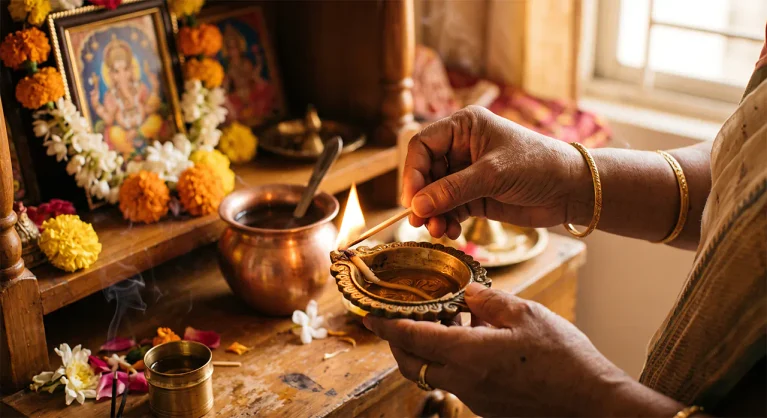
- Light the oil lamps (deepam) on both sides of the altar with sesame oil or pure cow ghee.
- Recite a prayer to Ganesha:“Vakratunda Mahakaya Surya Koti Samaprabha, Nirvighnam Kuru Me Deva Sarva-Karyeshu Sarvada.”
- Offer a small piece of jaggery or a banana as naivedyam to Ganesha, praying for the smooth completion of the vrata.
Step 3: Kalasa Sthapana (Installation of the Sacred Vessel)
The Kalasam represents the physical seat and cosmic energy of the Divine Mother.
Step 4: Avahanam and Prana Pratishtha (Invocation)
With folded hands and holding fresh flowers and akshat, recite verses of invocation to invite Goddess Varalakshmi into the Kalasam:
“Om Sri Varalakshmyai Namah, Avahanam Samarpayami.”
Place the flowers gently at the base of the Kalasam, welcoming the Goddess into the home with reverence and joy.
Step 5: Shodashopachara Pooja (The 16 Sacred Offerings)
Systematically offer the 16 traditional expressions of hospitality:
- Asanam: Offering a seat (offer akshat to the deity).
- Padyam: Symbolic offering of water to wash the feet.
- Arghyam: Offering pure water to wash hands.
- Achamaniyam: Offering water for internal purification.
- Snanam / Panchamritam: Offering symbolic water/panchamrita bath.
- Vastram: Offering fresh clothes or a small piece of cotton thread dipped in turmeric.
- Yagnopavitam / Abharanam: Offering decorative ornaments and jewelry.
- Gandham: Applying fragrant sandalwood paste.
- Kumkum & Akshat: Applying vermilion and sacred consecrated rice.
- Pushpam & Anga Pooja: Offering fresh flowers while chanting names of the Goddess, worshipping each divine aspect from feet to crown.
- Dhoopam: Waving fragrant incense sticks before the deity.
- Deepam: Presenting the warm light of a lit oil lamp.
- Naivedyam: Offering the cooked traditional festive delicacies, fruits, and clean water.
- Tamboolam: Offering betel leaves, areca nuts, and whole fruits.
- Neerajanam (Aarti): Waving lit camphor on a brass plate while singing devotional hymns.
- Pradakshina & Namaskaram: Circling around oneself clockwise three times and offering a prostration of surrender.
Step 6: Toram Pooja (Worship of the Sacred Thread)
Now place the 9 knots of yellow thread (toram) on a betel leaf next to the Kalasam and worship the yellow threads by applying kumkum, chandan, and akshat to the threads along with flowers in the name of the divine beings ruling each knot.
Now take this sacred thread and wear it on your right hand with the help of your elders or husband or you two may wear it for each other with the wish of prosperity and good health.
Step 7: Mangala Aarti and Katha Shravanam
Perform the grand Mangala Aarti using camphor. Afterwards, sit comfortably with family members and read or listen to the sacred Varalakshmi Vrat Katha (detailed in the next section).
Varalakshmi Vratham Vrat Katha
The sacred narrative (Katha) associated with Varalakshmi Vratham originates from the Bhavishyottara Purana (and preserved in local traditions of the Skanda Purana). It illustrates the transformative power of sincere, selfless devotion over ritual vanity.
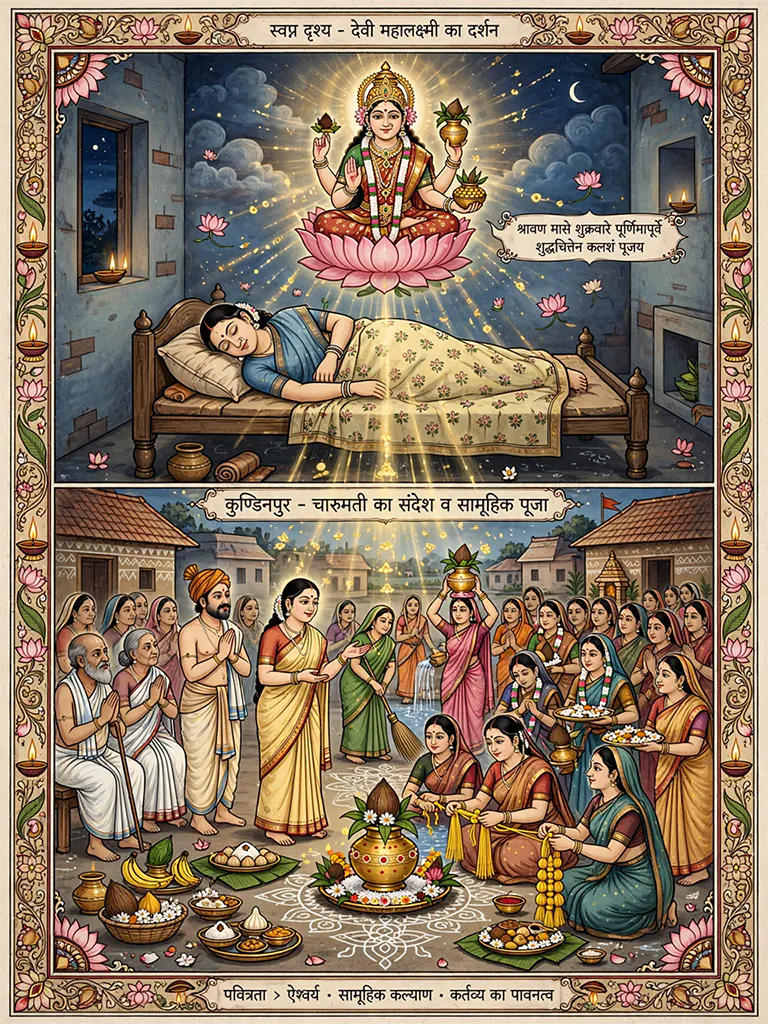
The Sacred Narrative of Charumati
A long time ago, in the wealthy land of Vidarbha, there existed a small town called Kundina (or Kundinapura). This town had in its midst an extremely virtuous and pious woman whose name was Charumati.
Charumati was highly devoted towards her husband, very respectful of her father-in-law and mother-in-law, and merciful towards the poor and the needy. Although life is full of challenges, yet Charumati always kept her mind tranquil, never spoke any harsh words, and performed her household chores as service to the Almighty.
Charmed with Charumati’s ever-chaste heart, Goddess Mahalakshmi appeared before her in her dream just before the break of dawn. The Goddess introduced herself as Varalakshmi, meaning the granter of all pious desires, and said that:
“O Charumati, I am pleased with your devotion and your virtuous conduct. On the Friday immediately preceding the Full Moon in the month of Shravana, worship me with a pure heart and clean surroundings. Offer prayers with devotion, install my sacred Kalasam, and observe this holy vow. By doing so, you and your household shall be blessed with health, abundance, and long-lasting peace.”
Charumati woke up after the dream with extreme thankfulness and happiness and informed her husband and other elders about this divine message. They very happily encouraged her to keep the vrata. This news spread around the town, and many neighboring women were happy to join her on that particular Friday during the month of Shravana.
On that particular day, Charumati and other women from Kundina cleaned their houses, took baths early in the morning, wore fresh clothes, and assembled. They prepared the Kalasam, worshipped the goddess Varalakshmi with faith, tied nine-knotted toram on their hands, and offered pure cooked food along with aromatic flowers.
While completing the pradakshina and offering namaskaram to the deity at the end, divinity showered its grace upon them, and their homes and surroundings got filled with harmony, peace, prosperity, and satisfaction spiritually. Since then, the practice of keeping the Varalakshmi Vratham spread from house to house through generations.
Spiritual Lessons of the Katha
- Humility Over Luxury: What made the Goddess choose Charumati was her humility, empathy, and dedication, and not her affluence and high status.
- For the Good of Many: Charumati was not selfish about the sacred knowledge that she had; she included the whole community in the process of spiritual uplifting.
- Hallowing of Domestic Activities: It is important to note that domestic chores can also be worshiped when they are done in harmony.


Essential Varalakshmi Vratham Mantras and Slokas
Reciting traditional Sanskrit verses during the puja focuses the mind and creates a meditative, uplifted atmosphere.
1. Dhyana Slokam (Meditation on Goddess Varalakshmi)
Sanskrit:
पद्मानने पद्मविपद्मपत्रे पद्मप्रिये पद्मदलायताक्षि ।
विश्वप्रिये विष्णुमनोऽनुकूले त्वत्पादपद्मं मयि संनिधत्स्व ॥
Transliteration:
Padmānane Padma-vipadma-patre Padma-priye Padma-dalāyatākṣi |
Viśva-priye Viṣṇu-mano’nukūle Tvat-pāda-padmaṁ Mayi Sannidhatsva ||
Simple Meaning:
“O Divine Mother, whose face is as beautiful as a blooming lotus, who holds lotuses, who loves lotuses, and whose eyes resemble long lotus petals; You who are beloved by the universe and dearest to the heart of Lord Vishnu, please place Your holy lotus feet in my heart and home.”
2. Kalasa Prarthana Mantra (Prayer to the Sacred Kalasam)
Sanskrit:
कलशस्य मुखे विष्णुः कण्ठे रुद्रः समाश्रितः ।
मूले तत्र स्थितो ब्रह्मा मध्ये मातृगणाः स्मृताः ॥
कुक्षौ तु सागराः सर्वे सप्तद्वीपा वसुंधरा ।
Transliteration:
Kalaśasya Mukhe Viṣṇuḥ Kaṇṭhe Rudraḥ Samāśritaḥ |
Mūle Tatra Sthito Brahmā Madhye Mātṛ-gaṇāḥ Smṛtāḥ ||
Kukṣau Tu Sāgarāḥ Sarve Sapta-dvīpā Vasundharā |
Simple Meaning:
“At the mouth of this sacred vessel resides Lord Vishnu, at the neck rests Lord Shiva, at the base sits Lord Brahma, and in the middle abide the divine Mother energies. Within its womb are all the sacred oceans and the seven continents of the earth.”
3. Toram Bandhana Mantra (Mantra for Tying the Sacred Thread)
Sanskrit:
सर्वमङ्गलमाङ्गल्ये शिवे सर्वार्थसाधिके ।
शरण्ये त्र्यम्बके गौरि नारायणि नमोऽस्तु ते ॥
नवतन्तुसमायुक्तं नवग्रन्थिसमन्वितम् ।
बध्नामि दक्षिणे हस्ते तोरकं हरिवल्लभे ॥
Transliteration:
Sarva-maṅgala-māṅgalye Śive Sarvārtha-sādhike |
Śaraṇye Tryambake Gauri Nārāyaṇi Namo’stu Te ||
Nava-tantu-samāyuktaṁ Nava-granthi-samanvitam |
Badhnāmi Dakṣiṇe Haste Torakaṁ Hari-vallabhe ||
Simple Meaning:
“O auspicious Mother who bestows all auspiciousness, fulfiller of all righteous desires, refuge of all beings; O Narayani, salutations to You. Composed of nine sacred strands and nine sacred knots, I tie this thread upon my right wrist by Your divine grace, O beloved of Lord Hari.”

The Varalakshmi Vratham Toram
The Toram (also called Nomu Daaram in Telugu or Nonbu Kayiru in Tamil) is an essential, distinctive element of the Varalakshmi Vratham.
The Symbolism of the Nine Knots
The nine knots (Nava Granthis) symbolize nine divine forms or protective aspects of the Mother Goddess invoked sequentially during the thread worship:
- Prathama Granthi: Kamalakshyai Namah (The Lotus-Eyed Mother)
- Dvitiya Granthi: Padminyai Namah (She who abides in lotuses)
- Tritiya Granthi: Paramakalyanyai Namah (The embodiment of supreme auspiciousness)
- Chaturtha Granthi: Lokanayikayai Namah (The sovereign guide of the universe)
- Panchama Granthi: Bhutadayinyai Namah (The giver of vitality and life)
- Shashtha Granthi: Nityapustayai Namah (She who provides perpetual nourishment)
- Saptama Granthi: Surapujitayai Namah (She who is revered by the celestial beings)
- Ashtama Granthi: Dhyanagamyayai Namah (She who is realized through meditative contemplation)
- Navama Granthi: Sarvasampatpradayinyai Namah (The bestower of all prosperity and peace)
How to Prepare and Tie the Toram
- Take nine equal strands of white cotton yarn.
- Prepare a solution of turmeric in water to make a thick paste and run the thread through the paste until it turns yellow all over.
- Tie nine tiny knots in the thread. Insert small pieces of flower petals or whole fresh flowers (usually jasmine or yellow chrysanthemums) into the knots.
- Lay the threads in front of the Kalasam on a betel leaf, offer chandan and kumkum and do archana with flowers.
- At the end of the Aarti, after hearing the story, have some senior person tie the thread around your right wrist with three knots, uttering the Toram Bandhana Mantra.
Traditional Prasadam and Naivedyam Offerings
Preparation of the food offerings (Naivedyam) using pure ingredients in a spirit of thankfulness forms an important part of the ritual. According to the traditional custom, a variety of sweet and savory preparations (traditionally five, nine, or eleven in number) need to be prepared.
Classic Festive Dishes
- Kojjajjalu / Modak / Kozhukattai: Dumplings steamed or fried in rice flour with a filling consisting of coconut gratings, jaggery, and cardamom.
- Paramannam / Payasam: Holy sweet pudding that is made by boiling raw rice in milk and seasoning it with organic jaggery or sugar and roasting cashews, raisins, and green cardamom.
- Pulihora / Puliyodarai: Tamarind rice cooked using mustard seeds, curry leaves, green chillies, turmeric, peanuts, and chana dal.
- Chakkara Pongali / Sakkarai Pongal: This dish is a sweet one consisting of rice and split yellow moong dal tempered with jaggery syrup and ghee of pure cow ghee.
- Garelu / Medu Vada: Fritters that are crispy and golden and consist of batter of spicy black gram (urad dal).
- Sundal / Guggillu: Chickpeas (chana) or black eyed peas which are seasoned with mustard seeds, curry leaves, hing (asafoetida), and coconut gratings.
- Appam / Neyyappam: Sweet fritters made from rice flour, mashed banana, and jaggery.
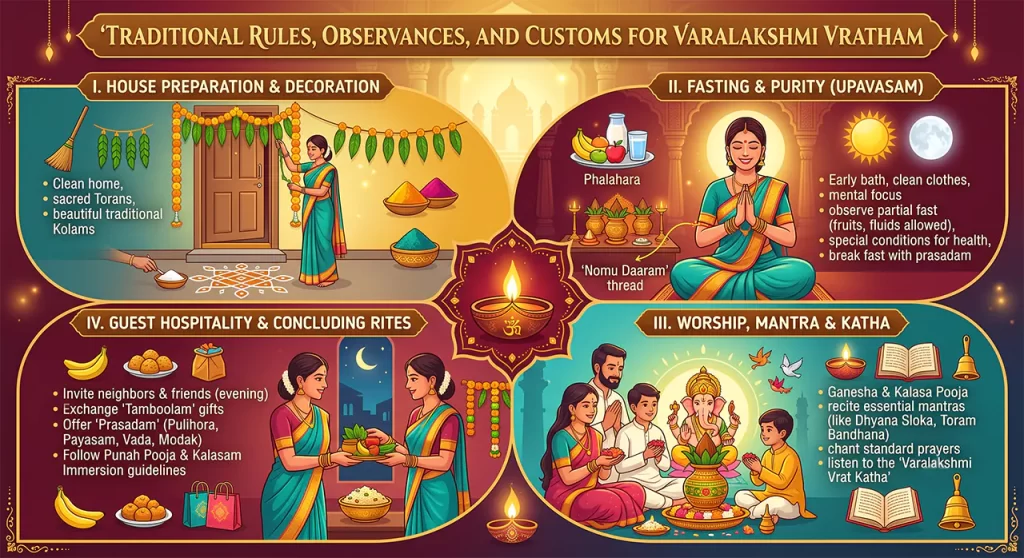
Traditional Rules, Observances, and Customs
Though sincerity and devotion are the two primary elements of worship, there are some customary traditions that the orthodox family follows to keep purity in their worship practices.
1. Fasting Practices (Upavasam)
Different fasting customs apply to different families and areas:
- Phalahara Fast: In most cases, there is a partial fast kept from morning to the end of the archana and Aarti. Water, milk, fruits, or fruits can be eaten, if health permits.
- Meal After Puja: The person keeps the fast till he/she performs archana, listens to katha, offers naivedyam, after which they enjoy prasadam with their family.
- Exceptions for Health Reasons: Pregnant ladies, nursing ladies, senior citizens, and those having some health problems are usually not expected to keep fasts strictly.
2. Purity and House Preparation
The house is cleaned thoroughly a day or two before the celebration. The doors of entrance are adorned with fresh mango leaves (Toranalu) to attract positive energies, while beautiful designs called muggu or kolam are made using powdered rice.
3. Evening Tamboolam Ritual (Vayana Dhanam)
In the evening, women go around to the neighbors’ houses and also invite people to their houses. The guests are seated in front of the deity’s shrine and tamboolam is presented to them. Tamboolam consists of two betel leaves, areca nut, one fruit, turmeric, kumkum, and a small gift item like glass bangles or blouse pieces.
4. Punah Pooja and Kalasam Immersion / Dismantling
Kalasam is not disassembled right after the puja on Friday:
- Punah Pooja (re-worship) ceremony with simple offerings of flowers, water, and deepam takes place either the next morning (Saturday) or on Sunday.
- The coconut is softly moved towards north as the sign of conclusion (Udyapana).
- The holy water from Kalasam is sprinkled into all rooms of the house for bringing peace and blessing, and the remaining water is poured around the roots of Tulsi plant or flowering garden tree, but never into the sewerage.
- The rice from the bottom of Kalasam is usually mixed with the everyday container of rice in the house or made into porridge prasadam.
Regional Variations Across India
While the core reverence for Goddess Lakshmi remains uniform, distinct cultural expressions characterize the festival across South Indian regions.
Andhra Pradesh and Telangana
In Telugu-speaking homes, the festival is observed under the name of Varalakshmi Vratam. The Kalasam preparation takes place with great attention to detail, putting on a silver or gold mask of the Goddess in the form of mukhadwaram. The nine knots of the sacred thread are referred to as Nomu Daaram. Naivedyams include several courses such as Pulihora, Boorelu, and Garelu.
Tamil Nadu
In Tamil-speaking homes, the festival is celebrated under the name of Varalakshmi Nonbu. The entrance of the house is decorated with kolam patterns, which are made with Arisi Maavu, that is, wet rice paste. The sacred thread is known as Nonbu Kayiru. The coconut is dressed up with turmeric, kumkum, and a nose ring.
Karnataka
Respectfully referred to as Varamahalakshmi Habba, the celebration consists of dressing the Kalasam in an Ilayathu Alankara style saree, giving the Kalasam a sitting Goddess-like appearance. Traditionally prepared Karnataka desserts such as Obbattu / Holige (a sweet flatbread made with lentil-jaggery filling) and Kosambari (soaked lentil salad) are also made along with payasa.
Maharashtra and North Indian Community
Though Varalakshmi Vratham is mainly a Southern tradition, many families from Maharashtra and North India worship the Goddess Lakshmi during Shravana Fridays as Shravan Shukravar Lakshmi Pujan.
Frequently Asked Questions
1. What should I do if I cannot perform Varalakshmi Vratham on the main Friday?
In cases where personal emergency, death of family members, ritual impurity (a-soucham), or illness may interfere with the observance of the celebration on the appointed Friday, tradition allows for the celebration to take place on any Friday within the month of Shravana or the following month of Bhadrapada.
2. Can unmarried women perform Varalakshmi Vratham?
Yes. Unmarried women are allowed to do the vrata along with their mothers, sisters, or elders. It is believed to grant inner peace, good nature, and an ideal spouse.
3. Is a metallic mask of Goddess Lakshmi mandatory for the Kalasam?
No, a metal mask is completely optional. In the traditional method, the Goddess is depicted through a perfect coconut that has been painted with turmeric and wears a kumkum tilak amidst mango leaves.
4. What happens to the coconut used on the Kalasam after the pooja?
After the last Punah Pooja, which occurs on Saturday or Sunday, the coconut is broken and used to make a sweet dish, such as coconut payasam, ladoo, or sweet modak, that is eaten as prasadam. The coconut must not be thrown away.
5. Can I perform the pooja if I do not know fluent Sanskrit mantras?
Indeed. Bhakti and Bhava play an essential role in Hindu philosophy. One can chant basic names like “Om Sri Varalakshmyai Namah” or sing localized hymns (stutis/bhajans) in one’s mother tongue.
6. Do males participate in the Varalakshmi Vratham?
Yes. Although the vrata is centered around the female members of the family, the male members help in cleaning the place, arranging the altar, collecting flowers, etc., and take part in praying and reciting the Aarti and Katha.
7. What is the significance of the 9 knots on the Toram thread?
The nine knots symbolize nine different aspects of the Divine Goddess Lakshmi (Lotus-eyed, All-nourishing, and Supreme Bestower of wealth etc.). The worship and wearing of the sacred thread symbolize prayers for overall protection and prosperity.
8. Which direction should the Varalakshmi Kalasam face?
The altar should ideally be placed so that the Kalasam faces either East or North, which are considered auspicious directions that invite positive morning light and spiritual energy.
9. What should be done with the rice placed under the Kalasam?
The raw rice placed on the altar (Dhanya Peetham) can be mixed with the household’s regular rice container to symbolize continuous abundance, or cooked into sweet Pongal or Payasam and distributed to friends and family.
10. Can pregnant women fast during Varalakshmi Vratham?
Pregnant women are explicitly advised by traditional elders not to observe strict or waterless fasts. They can participate fully in all prayers, chants, and rituals while consuming regular nutritious meals, fruits, and fluids.
11. What is the difference between Varalakshmi Vratham and Diwali Lakshmi Puja?
Varalakshmi Vratham takes place in the Shravana month (monsoon/harvest onset) and is primarily a South Indian domestic vow centered on the Kalasam and sacred thread. Diwali Lakshmi Puja occurs during the autumn month of Kartika (Ashwin Amavasya), celebrated nationwide with oil lamps (diyas) and account-book worship (Chopda Pujan).
12. What should I do with the sacred Toram after the festival?
The sacred thread tied to your wrist can be worn for several days, a week, or until the following Friday. When removed, it should be placed near a garden plant or water body with respect, rather than thrown into household waste.
Bringing the Tradition Home
Varalakshmi Vratham is not just another set of directions to be followed as a ritual; it is an everlasting tribute to thankfulness, family unity, and devotion towards the blessings bestowed upon us. By transforming the house into a spiritual oasis of beauty, fragrance, and hospitality, the vratha pays homage to the omnipresent maternal divine force that nurtures the family.
Regardless of whether you organize a lavish ritual that involves several traditional offerings, floral arrangements, or conduct a humble ritual with only the lamp and flowers, the spirit of the festival will always be fulfilled by your devotion-filled heart and peaceful family atmosphere.