Ratha Saptami (Surya Jayanthi): Significance, Rituals, and Sacred Temple Celebrations
Ratha Saptami, also celebrated as Surya Jayanthi or Magha Saptami, is the auspicious Hindu festival dedicated to Surya Bhagavan, the Sun God. Falling on the seventh day (Saptami tithi) of the bright half (Shukla Paksha) of the Hindu lunar month of Magha (January–February), it commemorates the symbolic birth of the Sun God and marks the moment his celestial golden chariot turns toward the northern hemisphere.
Devotees observe Ratha Saptami by taking a sacred pre-dawn bath with Arka (calotropis/giant milkweed) leaves placed upon the body, offering Arghya (water libation) to the rising sun, and preparing traditional rice dishes outdoors under direct sunlight. Across India, major pilgrimage centers—most notably the Tirumala Venkateswara Temple and ancient Sun shrines like Arasavalli—commemorate the festival with breathtaking temple car processions.
Ratha Saptami at a Glance
| Aspect | Key Detail |
| Primary Deity | Surya Bhagavan (The Supreme Solar Deity) |
| Lunar Calendar Date | Shukla Paksha Saptami, Month of Magha (January–February) |
| Alternate Names | Surya Jayanthi, Magha Saptami, Jayanthi Saptami, Arogya Saptami |
| Core Ritual | Arka Patra Snana (Pre-dawn holy bath using 7 Calotropis leaves) |
| Primary Mantra | Gayatri Mantra, Aditya Hridaya Stotram, Surya Ashtakam |
| Sacred Offering (Naivedyam) | Paramannam or Ksheerannam (Rice and jaggery cooked in milk outdoors) |
| Primary Spiritual Benefit | Arogya (Radiant health, longevity, and liberation from chronic ailments and sins) |
| Major Temple Celebrations | Tirumala Tirupati (Saptha Vahana Seva), Arasavalli Sun Temple, Konark, Suryanar Kovil |
Read More>> Oldest Religion in the World
Why Is Ratha Saptami Celebrated? Scriptural Significance & Origins
The word Ratha means chariot, and Saptami refers to the seventh lunar day. Scripturally, Ratha Saptami is venerated for two profound reasons: it marks the cosmic incarnation day of Surya Deva, and it represents the celestial shifting of his chariot toward the northern skies.
1. The Divine Appearance of Surya Bhagavan (Surya Jayanthi)
According to the Matsya Purana and Bhavishya Purana, Surya Deva revealed his radiant, luminous form to the universe on this exact day, born to Sage Kashyapa and his wife Aditi. Because he illuminated a cosmos that was previously engulfed in darkness, this tithi is celebrated as Surya Jayanthi—the birthday of the Sun God. Devotees honor Surya not simply as a celestial orb, but as Pratyaksha Daivam—the only visible embodiment of the Divine whom humankind can see and revere every single day.
2. The Turning of the Solar Chariot
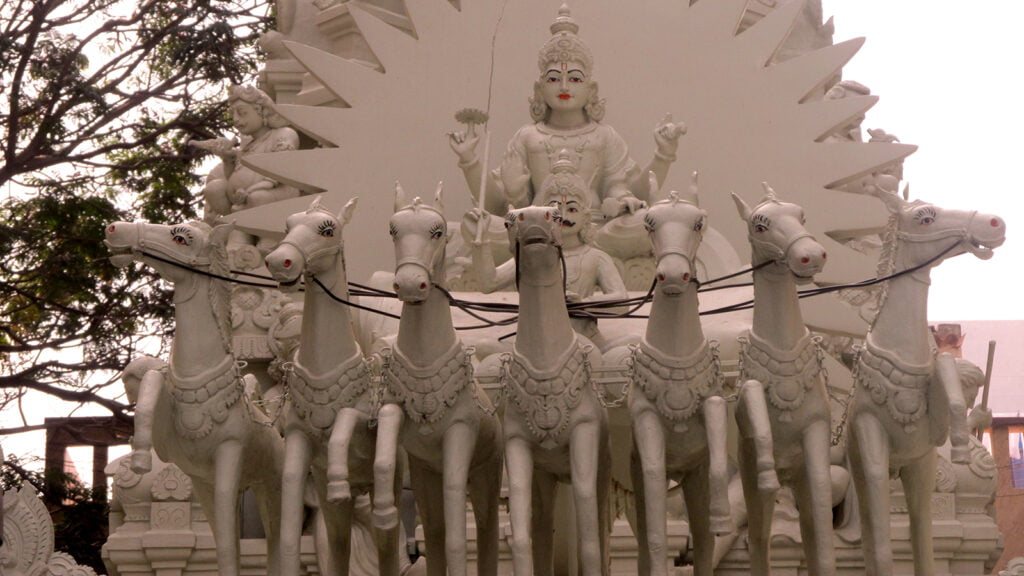
While the astronomical solstice occurs earlier in the month during Makara Sankranti, Ratha Saptami represents the moment the Sun God turns his seven-horse chariot steadily toward the northeast (Ishanya direction). This northern movement (Uttarayana) brings longer days, warmth, and vital energy to Earth, driving away the harsh winter cold and nurturing agricultural crops across the subcontinent.
Read More>> Significance of Swastik Symbol

The Symbolism of Surya’s Chariot: Seven Horses and the Single Wheel
The iconography of Surya Bhagavan riding his majestic chariot across the sky is rich with ancient Vedic mathematics and cosmic philosophy.
- The Seven Horses: The chariot is drawn by seven resplendent horses, led by the charioteer Aruna (the personification of the reddish dawn). In Vedic thought, these seven horses represent:
- The Seven Days of the Week: Signaling the relentless passage of time.
- The Seven Colors of Sunlight: Ancient rishis recognized that white sunlight is composed of seven distinct rays (corresponding to the visible spectrum).
- The Seven Vedic Meters (Chandas): Named Gayatri, Ushnik, Anushtup, Brihati, Pankti, Trishtup, and Jagati, reflecting the musical and rhythmic order of the cosmos.
- The Single Wheel with Twelve Spokes: The chariot balances upon a single giant wheel, which represents the complete cyclic year (Samvatsara). The twelve spokes embedded within the wheel represent the twelve months (Masas) and the twelve signs of the Zodiac (Rasis).
The Sacred Bath: Arka Patra Snana Vidhi
The most critical and distinctive ritual of Ratha Saptami is the morning holy bath, known as Arka Patra Snana (or Erukku Ilai Kuliyal in Tamil Nadu and Jilledu Aaku Snanam in Telugu states).
Tradition holds that taking a bath during the pre-dawn Brahma Muhurta or Arunodaya (dawn period) on this day cleanses one of bodily afflictions and sins accumulated across lifetimes.
Why Are Arka Leaves Used?
The Arka plant (Calotropis gigantea, commonly known as the giant milkweed or crown flower plant) is sacred to Surya Bhagavan. In traditional Indian medicine and Ayurveda, Arka leaves possess warming, therapeutic, and anti-inflammatory properties that help the human body adapt to the seasonal transition from cool winter to warm spring. Symbolically, the leaf absorbs solar rays and transmits healing vitality directly to the nervous system.
Read More>> Why do we Ring Bells in Hindu Temples?
How to Place the Seven Arka Leaves
Devotees gather seven clean Arka leaves, a touch of raw unpolished rice (Akshata), and a pinch of turmeric powder.
- Leaf Placements:
- One leaf on the crown of the head.
- Two leaves on the shoulders (one on the left, one on the right).
- Two leaves on the knees.
- Two leaves on the tops of the feet.
- Traditional Distinction for Genders:
- Men place the seven leaves along with a small amount of raw white rice and Durva grass on their heads and shoulders.
- Women traditionally place turmeric-smeared rice (Akshata) along with the seven Arka leaves.
- The Ritual Bath: While holding the leaves in place, water is poured over the head. Devotees mentally invoke Surya Bhagavan and pray for physical vitality (Arogya) and mental clarity.
The Sacred Snana Sloka
Recite this traditional verse while taking the bath:
“Yad-janma-kritam papam maya sapta-su janmasu |
Tan-me rogam cha shokam cha makari hantu saptami ||”
Meaning: “Whatever sins, diseases, and sorrows I have accumulated across seven lifetimes, may this holy Saptami of the Magha month wash them all away and grant me purity.”
Step-by-Step Ratha Saptami Home Puja Procedure
After the sacred bath, devotees perform the Surya Puja during sunrise. Setting up the puja outdoors on a clean veranda, balcony, or courtyard where morning sunlight falls directly is considered ideal.
1. Drawing the Surya Ratha Rangoli
Cleanse the puja area and draw a traditional floor design (Kolam or Rangoli) depicting Surya Bhagavan seated on his chariot with seven horses. In South Indian households, a swastika or an eight-petaled lotus (Ashtadala Padma) is drawn using rice flour.
2. Offering Arghya (Water Libation)
Fill a clean copper vessel (Kamandalu or Lota) with fresh water. Add:
- Red flowers (such as red hibiscus).
- A pinch of red sandalwood paste (Rakta Chandanam) or Kumkum.
- A few grains of raw rice.
Face eastward toward the rising morning sun. Raise the copper vessel with both hands above eye level and gently pour the water toward the ground in an unbroken stream while gazing toward the solar rays through the water. Recite the Surya Gayatri Mantra:
“Om Bhaskaraya Vidmahe, Divakaraya Dhimahi, Tanno Suryah Prachodayat.”
3. Cooking Traditional Paramannam Outdoors
A beautiful household custom on Ratha Saptami is boiling fresh milk and rice outdoors under direct morning sunlight:
- A new earthen pot (clay pot) is decorated with turmeric and kumkum.
- Fire is made using dried cow-dung cakes and firewood.
- Fresh milk, newly harvested raw rice, and jaggery are cooked together to create Paramannam (also called Ksheerannam or Chakkara Pongal).
- As the milk boils and spills over the rim of the pot, family members chant “Suryo Bha, Surya Narayana Haro Hara”, welcoming abundance and vitality into their household.
- A small portion of this warm, sun-infused sweet rice is placed onto an Arka leaf and offered as Naivedyam to Surya Bhagavan before being shared as prasadam.
4. Reciting Sacred Hymns
Sit facing east and chant sacred texts dedicated to the Sun God:
- Aditya Hridaya Stotram: The supreme hymn taught by Sage Agastya to Lord Rama on the battlefield of Lanka to invoke valor and clarity.
- Surya Ashtakam: An eight-verse prayer praising the dispeller of darkness.
- Gayatri Mantra: Chanted 108 times for spiritual enlightenment and physical well-being.
Major Temple Celebrations Across India
While Ratha Saptami is observed in millions of homes, India’s grandest temples conduct extraordinary festivals on this day.
1. Tirumala Tirupati: The One-Day Brahmotsavam
At the world-renowned Tirumala Venkateswara Temple, Ratha Saptami is celebrated with unmatched grandeur as the Mini-Brahmotsavam or One-Day Brahmotsavam.
On this single day, the processional deity, Lord Malayappa Swamy, accompanied by his consorts Sridevi and Bhudevi, is taken out in majestic processions around the Four Mada Streets on seven distinct vahanas (vehicles) from dawn to dusk:
Pilgrims gather in the hundreds of thousands to witness this spectacle. Seeing Lord Venkateswara mounted upon both the Sun chariot (Surya Prabha) at dawn and the Moon chariot (Chandra Prabha) at night on the same calendar day is considered a once-in-a-lifetime spiritual blessing.
2. Arasavalli Suryanarayana Temple, Andhra Pradesh
Located in Srikakulam district, Andhra Pradesh, the ancient 7th-century Arasavalli Sun Temple is one of India’s few surviving dedicated Surya shrines. On Ratha Saptami, the temple conducts elaborate Kalyanotsavam and Maha Abhishekam ceremonies. The temple’s architectural design allows the early morning rays of the sun to pass straight through the five entrance gateways and directly illuminate the feet, torso, and crown of the primary deity inside the sanctum sanctorum.
3. Konark Sun Temple, Odisha
Though active worship inside the inner sanctum of the 13th-century Konark Sun Temple ceased centuries ago, tens of thousands of pilgrims assemble at the nearby Chandrabhaga beach every year on Ratha Saptami. Devotees take a ceremonial holy dip in the sacred ocean waters at sunrise and offer prayers to Surya Deva amidst the ruins of this UNESCO World Heritage Site.
4. Suryanar Kovil, Tamil Nadu
Situated near Kumbakonam, Suryanar Kovil is the primary shrine among the celebrated Navagraha Temples of Tamil Nadu. On Ratha Saptami, special Surya Homam and elaborate abhishekams with milk, honey, and sandalwood are performed to honor Surya Bhagavan as the chief of the nine planetary deities.
Health and Scientific Benefits of Ratha Saptami Traditions
The customs of Ratha Saptami weave deep observational wisdom into religious observances:
- Vitamin D Synthesis & Circadian Reset: Rising before dawn and standing uncovered under early-morning sunlight allows the body to absorb soft ultraviolet-B (UVB) rays, stimulating healthy Vitamin D synthesis and resetting the body’s natural sleep-wake cycle (circadian rhythm).
- Seasonal Immunity Boost: The transition between winter and spring often brings viral fevers, sluggish digestion, and skin flare-ups. The therapeutic compounds in Calotropis (Arka) leaves act as natural antimicrobials during the bath, while jaggery-infused sweet rice cooked outdoors provides immediate caloric vitality.
- Mental Clarity: The focused meditation upon the rising sun accompanied by Pranayama and the Gayatri Mantra sharpens concentration, reduces stress, and calms the autonomic nervous system.
Frequently Asked Questions About Ratha Saptami
1. What should I do if I cannot find Arka leaves for the bath?
If fresh Arka (Erukku / Jilledu) leaves are unavailable in your city, do not worry. You can substitute them with sacred Tulsi (Holy Basil) leaves or Bilva (Bael) leaves, or add a few drops of holy Ganga water and a pinch of raw rice and turmeric into your bathing bucket while sincerely reciting the Surya mantra. Mental devotion (Bhakti) is supreme.
2. Should one fast on Ratha Saptami?
Many devotees observe a complete fast (Upavasa) from sunrise until sunset, partaking only in fruits, milk, or the sacred Paramannam prasadam during the day. Those who cannot fast entirely may consume a simple vegetarian meal without onion, garlic, or excess salt.
3. What time should the Ratha Saptami bath be taken?
The bath must ideally be completed during the Arunodaya period—approximately 45 minutes to one hour before the actual sunrise. Taking the bath after the sun has climbed high into the sky diminishes the spiritual merit (Punya) of the festival.
4. Can anyone perform the Surya Arghya ritual?
Yes. Unlike certain complex temple rituals, offering water (Arghya) to Surya Bhagavan can be performed by anyone regardless of age, background, or gender. It requires only clean water in a clean vessel and a pure, devoted heart.
Welcoming the Golden Rays of Health and Renewal
Ratha Saptami reminds us of humanity’s timeless gratitude toward the Sun—the inexhaustible giver of life, light, and sustenance. By rising early, bathing with sacred leaves, offering humble water to the morning horizon, and chanting sacred verses, devotees welcome the physical and spiritual warmth of the northern sun into their lives.
Whether observing these rituals quietly at home or standing among the faithful during the grand chariot processions of Tirumala, celebrating Ratha Saptami revitalizes the body, dispels lingering negativity, and fills the year ahead with radiant health and spiritual grace.