Why Do We Touch the Feet of Elders? Charan Sparsh Meaning, Significance & Tradition
It is early morning during a festival. A young boy dressed in a new kurta walks up to his grandmother. He smiles, bends down, and touches the tops of her feet with both hands. His grandmother smiles, places her right hand gently on his head, and says softly, “Ayushman bhava”—may you live a long and healthy life.
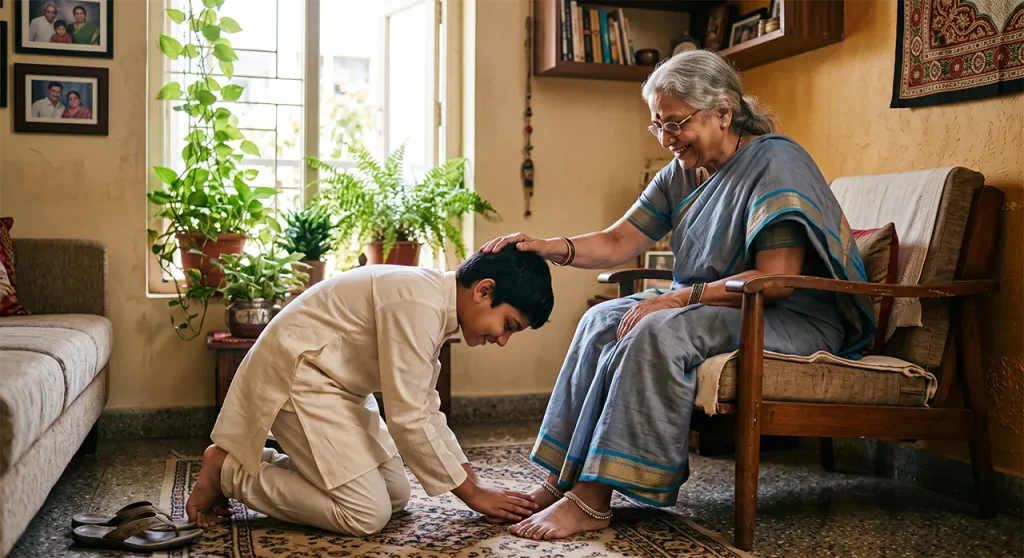
In Indian homes, touching the feet of elders (Charan Sparsh) represents respect, humility, and the receipt of blessings.You see this gesture everywhere across India and in Indian homes around the world. A daughter touches her parents’ feet before heading out for a major school examination. A newly married bride and groom bow down together to touch the feet of their uncles, aunts, and grandparents. An athlete touches the feet of their coach right before stepping onto the playing field. A student touches the feet of a music teacher before picking up an instrument.
Why do we do this? Why do people touch the feet instead of simply shaking hands, waving, or giving a warm hug? Does the tradition carry a deeper spiritual meaning, or is it just an old habit passed down through families? What do ancient Hindu books say about it, and what happens in our minds when we bow down?
Let us walk through the meaning, roots, and daily practice of touching the feet of elders, known in India as Charan Sparsh.
Quick Answer: Why Do We Touch the Feet of Elders?
Touching the feet of elders (Charan Sparsh) is a traditional Indian gesture of deep respect, humility, and gratitude. In Indian culture, the feet symbolize a person’s long journey through life, their wisdom, and their service. By bending down to touch an elder’s feet, a younger person sets aside personal pride and acknowledges the elder’s guidance. In return, the elder places a hand on the person’s head, offering an Ashirvad (a heartfelt blessing of protection, peace, and good health).
What Does Charan Sparsh Mean?
To understand this tradition, it helps to look at the two words that make up its name. The term comes from the ancient Sanskrit language:
$$\text{Charan Sparsh (चरण स्पर्श)} = \text{Charan (Feet)} + \text{Sparsh (Touch)}$$
- Charan (चरण): This word means “feet.” In traditional Indian poetry and philosophy, it often refers to the feet of parents, teachers, spiritual guides, or the Divine.
- Sparsh (स्पर्श): This word means “touch” or “gentle contact.”
Put together, Charan Sparsh (चरण स्पर्श) literally translates to “touching the feet.”
In classical Sanskrit literature, you will also see related words for this act:
- Pada-vandana (पादवन्दन): Praising or honoring someone’s feet.
- Pada-pranama (पादप्रणाम): Bowing deeply at someone’s feet.
- Abhivandana (अभिवादन): A formal, respectful greeting made to an elder or teacher.
At its heart, Charan Sparsh is not an empty formal drill. It is a physical action meant to reflect an inner feeling of respect (Shraddha) and modesty (Vinaya).
Why the Feet? Understanding the Deep Symbolism
To an outsider, or to a young child growing up today, touching someone’s feet can seem unusual. In everyday modern life, feet walk through dust and dirt. They are the lowest part of the human body. Most cultures consider feet unclean.
So why choose the feet for the highest sign of honor?
The tradition chooses the feet precisely because they are at the very bottom of the body. That physical reality carries powerful meaning.
1. Surrendering the Ego
In human psychology, the head is where we locate our thinking, our identity, and our personal pride (called Ahamkara in Sanskrit). When people feel proud or stubborn, they stand tall, tilt their chins up, and refuse to bow.
When you bend your head down until it is level with another person’s feet, you do something counter to personal vanity. You willingly place the highest part of your own body (your head) below the lowest part of theirs (their feet). It is an unmistakable, physical statement:
“I do not stand before you with false pride. I come to you with a quiet, open mind.”
2. Honoring the Long Journey of Life
Our feet carry us through every step of life. An elder’s feet have walked through decades of hardships, victories, mistakes, and learning. Their feet have carried them through joy and grief long before the younger person was even born.
When you touch the feet of an elder, you show appreciation for that long walk. You honor the path they walked to protect, build, and support the family.
3. The Soil and the Tree
Think of a great banyan tree. The leaves at the very top enjoy the bright sun, but they only exist because the roots stay hidden deep down in the soil.
In a family, grandparents and parents are like those roots. Younger children are like fresh green leaves. Touching the feet reminds the younger generation where their life started. It keeps people grounded so they remember their beginnings.
The Core Reasons We Touch Elders’ Feet
While humility is at the center, families across India practice Charan Sparsh for several everyday reasons.
1. A Sincere Sign of Respect
Just as people in Japan bow to greet one another, or people in the West offer a firm handshake, people in India use Charan Sparsh as the most complete physical sign of respect. It signals that you value the other person’s presence, wisdom, and character.
2. A Heartfelt Thank You
Growing up requires immense patience from our caregivers. Parents feed their children, nurse them when they are sick, teach them how to speak, and pay for their schooling. Touching a parent’s feet is a quiet way of saying: “I recognize how much you have done for me, and I do not take your efforts for granted.”
3. Seeking Goodwill and Blessings
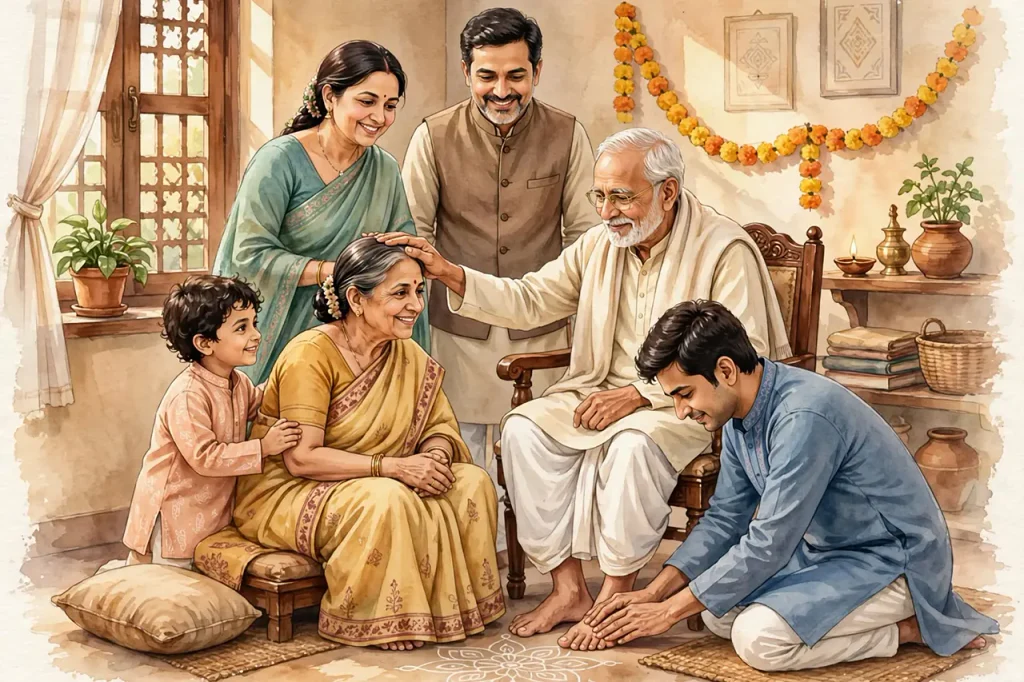
When an elder looks down at a child or young person bowing before them, their natural reaction is warmth and protective care. The elder raises a hand, touches the youth’s head or shoulders, and speaks words of encouragement. In Indian thought, this spoken good wish is an Ashirvad. It provides emotional strength to young people as they step out to face the world.
4. Keeping Families Close Across Generations
In homes where children regularly greet grandparents by touching their feet, the physical distance between generations shrinks. The ritual creates a moment of direct, warm contact every single day. The grandparent looks into the child’s eyes, smiles, and speaks directly to them. This daily habit weaves families tightly together.
Continue reading >> Atithi Devo Bhava: The Sacred Meaning & Significance
What Do Ancient Hindu Scriptures Say?
People often wonder: Did people in ancient India actually touch feet, or is this a modern custom?
Looking into historical Sanskrit literature reveals that paying physical reverence to parents, teachers, and elders is one of the oldest recorded customs in Indian civilization. The practice is anchored in the concept of Abhivandana (reverent greeting).
1. The Taittiriya Upanishad: The Four Sacred Guides
One of the most famous passages on honoring elders comes from the Taittiriya Upanishad (part of the Krishna Yajurveda), in a section known as the Shiksha Valli. When students finished their studies at an ancient school (Gurukul), the teacher gave them clear life instructions before they returned home:
$$\text{मातृदेवो भव । पितृदेवो भव । आचार्यदेवो भव । अतिथिदेवो भव ।}$$
Mātṛdevo bhava. Pitṛdevo bhava. Ācāryadevo bhava. Atithidevo bhava.
Meaning:
“Treat your mother as an embodiment of the Divine. Treat your father as an embodiment of the Divine. Treat your teacher as an embodiment of the Divine. Treat your guest as an embodiment of the Divine.”
— Taittiriya Upanishad, 1.11.1
While this verse does not describe the exact mechanical hand placement for touching feet, it establishes the moral foundation: parents and teachers deserve the utmost honor.
2. Manusmriti: The Power of Daily Greetings
The Manusmriti contains direct verses regarding how a young student should salute elders, bow, and touch their feet.
In Chapter 2, verse 121, the text describes what happens to a person who honors their elders every day:
$$\text{अभिवादनशीलस्य नित्यं वृद्धोपसेविनः ।}$$
$$\text{चत्वारि तस्य वर्धन्ते आयुर्विद्या यशो बलम् ॥}$$
Abhivādana-śīlasya nityaṁ vṛddhopasevinaḥ |
Catvāri tasya vardhante āyur vidyā yaśo balam ||
Meaning:
“For a person who naturally greets elders with respect, and who regularly serves those who are advanced in years and wisdom, four things grow steadily: life span (ayus), knowledge (vidya), good reputation (yashas), and inner strength (bala).”
— Manusmriti, 2.121
A few verses later, in Chapter 2, verse 72, the text describes how a student should respectfully clasp the feet of the teacher during study:
“With crossed hands, the student should touch the feet of the teacher, touching the right foot with the right hand, and the left foot with the left hand.”
— Manusmriti, 2.72
This confirms that touching feet was practiced thousands of years ago in Indian educational settings.
3. The Epics: Ramayana and Mahabharata
In India’s two great epics, heroes and heroines consistently bow to their elders:
- In the Ramayana: Whenever Prince Rama returns to the city of Ayodhya, his very first action is to walk straight to his mothers—Kaushalya, Kaikeyi, and Sumitra—and his father King Dasharatha, bowing low to touch their feet. Even when sent to live in the forest for fourteen years, Rama touches the feet of his parents with a calm, peaceful smile.
- In the Mahabharata: Just before the great battle of Kurukshetra begins, King Yudhishthira takes off his armor, puts down his weapons, and walks on foot across the battlefield toward the enemy lines. Why? He goes straight to his grand-uncle Bhishma, his teacher Drona, and his uncle Kripa. He bows down and touches their feet to ask for their permission and blessings before entering battle. Even when standing on opposing sides of a war, respect for elders and teachers was never abandoned.
How to Perform Charan Sparsh: Traditional Ways
Across different regions, communities, and families, people carry out this gesture in slightly different ways. There is no single rigid rule, but three classical forms are widely recognized across India.
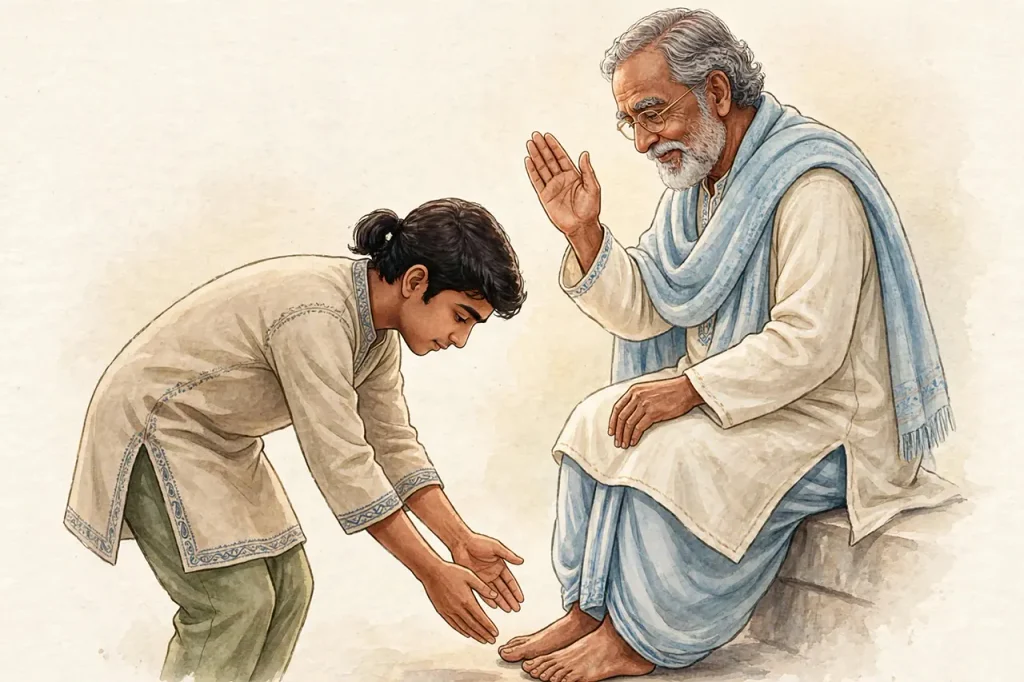
Method 1: Bending from the Waist (The Everyday Method)
This is the most common form used in busy daily life:
- Walk up to the elder at an unhurried, comfortable pace. Stand at a respectful distance (about one step away).
- Bend forward gently from your waist.
- Extend both hands forward toward the elder’s feet.
- Gently touch the top of their feet or shoes (or if you are standing close, gesture toward the floor near their feet).
- Stand back up smoothly and look at the elder with a gentle, appreciative smile to receive their good wishes.
Method 2: Kneeling on the Floor (For Major Occasions)
This form is widely used during religious celebrations, weddings, and deep personal milestones:
- Kneel down so that one or both of your knees rest on the floor.
- Lower your upper body down toward the elder’s feet.
- Touch the tops of their feet with your fingers.
- The elder gently places their hand on your head or your back.
- Rise slowly, feeling calm and composed.
Method 3: Sashtanga Dandavat Pranam (Full Prostration)
The Sanskrit word Sashtanga means “with eight parts of the body.” In this traditional posture, a person lies flat face down on the floor, so that the toes, knees, stomach, chest, hands, chin, nose, and forehead touch the ground.
This posture represents complete surrender. It is traditionally reserved for temples, deities, sannyasis (monks), and supreme spiritual preceptors. In everyday family life, younger people generally do not lie flat on the floor for family members, except in certain regional communities during very special ceremonies.
Continue reading >> Sacred Tulsi Plant at Home: Meaning, Worship, Placement & Care
The Crossed-Hands Technique: What Does It Mean?
In classical traditions, teachers often instructed students to use the crossed-arms method:
- The student’s right hand crosses over to touch the elder’s right foot.
- The student’s left hand crosses over to touch the elder’s left foot.
Why cross the arms? In ancient Indian psychology, the right side of the body was associated with outgoing action and strength, while the left side was associated with patience and receptivity. Crossing the hands formed a simple physical alignment.
Today, many people simply reach their right hand to the right foot and left hand to the left foot without crossing, or simply use both hands to touch both feet together. Both ways are widely accepted because the feeling in your heart matters far more than the exact geometry of your hands.
What Happens When Elders Give Blessings (Ashirvad)?
When you touch an elder’s feet, the interaction is only half complete. The second half belongs entirely to the elder.
As you bend down, the elder naturally lifts their right hand (or both hands). They place their palm gently upon the crown of your head, or tap your shoulder, and speak an encouraging word.
The Meaning of “Ashirvad”
The word Ashirvad (आशीर्वाद) is made of two Sanskrit roots:
- Ashis (आशीस्) = good wish, prayer, or grace.
- Vad (वाद) = spoken word.
An Ashirvad is literally a spoken wish for your well-being. Common blessings spoken by elders include:
- “Ayushman bhava” (आयुष्मान् भव) — May you live a long, healthy life.
- “Yashasvi bhava” (यशस्वी भव) — May you achieve noble success and honor.
- “Kalyanam astu” (कल्याणम् अस्तु) — May all goodness and peace come to you.
- “Khush raho” / “Chiranjeevi bhava” — Stay happy; live with enduring joy.
Why Touch the Head?
The crown of the head is traditionally treated as the center of awareness, thought, and conscious life. When an older person places their hand upon your head, it is a tender, protective gesture. It is an immediate physical expression of safety: “I am here for you. I wish the absolute best for your journey.”
Whose Feet Do People Traditionally Touch?
The practice of Charan Sparsh is not extended to everyone. It is reserved for specific, meaningful relationships built on family care, education, and spiritual guidance.
| Person | Why Their Feet Are Touched |
| Mother and Father | They gave you life, nourished you, and protected you through your vulnerable years. |
| Grandparents | They represent the roots of the entire family and carry generations of wisdom. |
| Teachers and Mentors (Gurus) | They open your eyes to knowledge, guide your skills, and teach you how to think. |
| Spiritual Guides (Sannyasis/Monks) | They have dedicated their lives to spiritual study, prayer, and selflessness. |
| Elder Aunts and Uncles | They serve as secondary pillars of support within the extended family circle. |
| Deities in Temples | Bowing before the Divine represents total surrender of human ego. |
Whose Feet Are Traditionally Not Touched?
Customs vary widely by region, but traditional etiquette generally outlines certain boundaries:
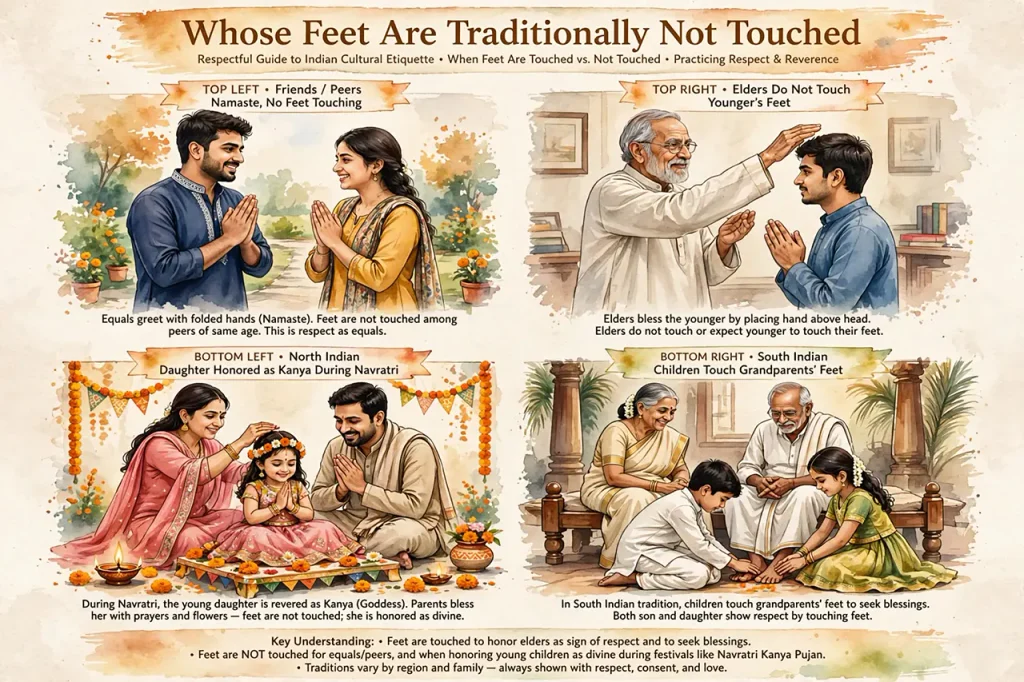
- Peers and Equals: Friends, siblings of roughly the same age, and classmates do not touch each other’s feet. Instead, they greet each other with folded hands (Namaste), an embrace, or a handshake.
- Younger People: Elders do not touch the feet of younger individuals.
- Uncomfortable or Unfamiliar People: One does not touch the feet of strangers in public places without an established relationship of respect.
- Regional Variations with Daughters: In parts of Northern and Western India, parents traditionally do not let their young unmarried daughters touch their feet. In these regions, young girls are affectionately revered as forms of the Goddess (Kanya or Devi). In these homes, parents often touch their daughters’ heads or bow slightly to them during specific festival days like Navratri. In contrast, in many parts of Southern and Eastern India, both boys and girls routinely touch the feet of their parents and grandparents without distinction.
When Is Charan Sparsh Performed?
People do not walk around touching feet every hour of the day. In real life, the practice occurs during specific, meaningful moments.
1. Daily Routines
In many traditional Indian homes, children touch the feet of their parents and resident grandparents first thing in the morning when waking up, or at night before sleeping. It begins and ends the day on a quiet note of peace and gratitude.
2. Major Life Milestones
- Examinations and Interviews: Before walking into a major exam hall or going to a job interview, a student seeks their parents’ blessings for focus and confidence.
- Weddings: During an Indian wedding, the bride and groom together touch the feet of both sets of parents, grandparents, and elder family members, asking for their guidance as they begin their new home.
- Birthdays: On a birthday, before cutting a cake or celebrating with friends, a young person touches their parents’ feet to thank them for the gift of life.
- First Day at Work or College: Starting a new job or stepping into a university campus is traditionally preceded by taking the blessings of family elders.
3. Festivals and Celebrations
During big cultural festivals like Diwali, Ugadi, Pongal, Baisakhi, Durga Puja, and Raksha Bandhan, family members gather together. Younger relatives visit elder relatives to exchange sweets, offer gifts, and touch their feet to receive the New Year’s good wishes.
4. Journeys and Departures
When leaving home for a long trip—such as moving to another city for work or going abroad for higher studies—young people touch their elders’ feet at the door. Upon returning home safely months or years later, the very first gesture on stepping across the threshold is often touching the parents’ feet once again.
Continue reading >> Why Do We Join Our Palms in Namaste? Meaning & Significance
Charan Sparsh vs. Namaste: What Is the Difference?
Both Namaste (or Namaskar) and Charan Sparsh are traditional Indian greetings, but they serve different social contexts.
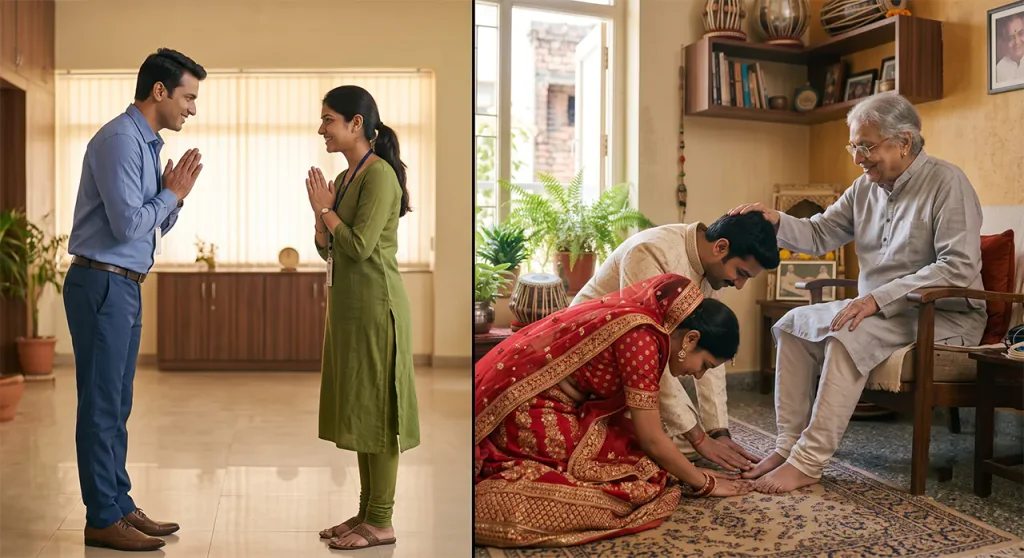
| Feature | Namaste / Namaskar | Charan Sparsh |
| Physical Movement | Palms pressed together at the center of the chest with a light nod. | Bending down to physically touch the elder’s feet with your hands. |
| Physical Contact | No contact between the two people. | Gentle contact with the feet, followed by a hand on the head. |
| Who It Is For | Anyone: friends, equals, strangers, shopkeepers, coworkers, guests. | Reserved for elders, parents, grandparents, gurus, and spiritual preceptors. |
| Core Meaning | “I honor the divine spark within you as an equal soul.” | “I lower my pride to honor your wisdom and ask for your blessings.” |
| Frequency | Used multiple times every day in ordinary conversation. | Used during special meetings, mornings, departures, and life milestones. |
Neither greeting is “better” than the other. Namaste is the universal greeting of equality and hospitality. Charan Sparsh is a focused gesture of family reverence and discipleship.
Continue reading >> Fasting on Ekadashi: Meaning, Rules, Benefits & Food Guide
Is There a Scientific Reason Behind Charan Sparsh?
If you search the internet for the “science of touching feet,” you will run across many colorful claims. Some websites state that touching feet “completes an electrical circuit,” “transfers cosmic radiation,” or “pulls negative ions out of the toes.”
Let us be completely honest and fair: Modern physics, medicine, and biology do not support these claims. Human bodies are not electrical batteries with copper-wire terminals at the head and feet. Claiming that ancient rituals work like household electrical plugs does not help anyone understand tradition accurately.
However, if we look through the lens of psychology, behavioral science, and sociology, touching feet produces very real, measurable human benefits.
1. Embodied Cognition: How the Body Shapes the Mind
Psychologists study a concept called embodied cognition—the idea that our physical postures influence our emotions and thoughts.
When you stand with your arms crossed and your chest puffed out, your brain feels defensive and competitive. But when you physically lower your body, relax your neck, and reach down in a gentle bow, your nervous system responds:
- Muscles in the neck and shoulders soften.
- Feelings of competition and stubbornness decline.
- Your mental state shifts toward openness and listening.
The physical act of bowing makes it easier to actually feel humble on the inside.
2. The Comfort of Touch and Emotional Safety
In an era dominated by smartphone screens and remote messages, genuine human touch has grown rare. When an elder places a warm hand on a young person’s head, the brain releases oxytocin—a hormone linked to feelings of safety, trust, and belonging.
For a nervous student heading into a stressful examination, feeling their grandfather’s calm hand on their head provides reassurance. It reminds them that whatever the exam score turns out to be, they are loved, accepted, and backed by their family.
3. Social Bonding Across Generations
Sociologists observe that families with shared physical traditions often maintain stronger generational ties. When a teenager regularly bows to their grandmother, that teenager cannot easily view the grandparent as an invisible background figure. The ritual forces both individuals to pause, make eye contact, and connect with warmth.
The Teacher-Student Tradition: Touching the Guru’s Feet
In classical Indian education, the relationship between a teacher (Guru) and a student (Shishya) went far beyond modern school tutoring. Students lived with their teachers, worked together, and learned arts, philosophy, archery, or medicine over decades.
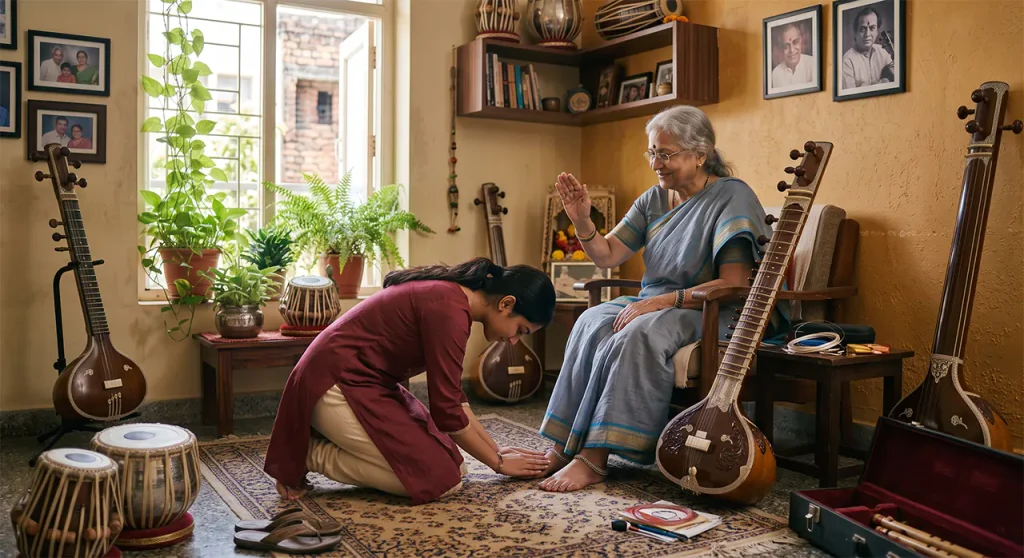
In the Guru-Shishya parampara (the lineage of teacher and disciple), Charan Sparsh is common:
- Before a Lesson: A classical dancer or sitar player touches the feet of their master before picking up their instruments. It signals: “Clear my mind of ego so I can absorb your guidance.”
- After Completing Training: When a student masters a skill and prepares to go out into the world, touching the guru’s feet marks the completion of their apprenticeship.
By touching the teacher’s feet, the student acknowledges that true knowledge requires setting pride aside. A full cup cannot receive fresh water; a student full of conceit cannot absorb wisdom.
Regional and Cultural Variations Across India
India is a vast land with dozens of languages, diverse geographies, and distinct customs. While the underlying sentiment of respecting elders is universal, how it looks in practice varies by state and community.
- North India (Punjab, Uttar Pradesh, Rajasthan, Bihar, Haryana): The practice is widely referred to as Pao Chuna or Charan Sparsh. In Punjab, people commonly say Paeeri Pauna (“I touch your feet”) as an everyday spoken greeting when greeting uncles, aunts, and older relatives.
- South India (Tamil Nadu, Karnataka, Andhra Pradesh, Telangana, Kerala): The gesture is often referred to as Pada-namaskaram or Sashtanga Pranam. It is performed with great reverence during religious ceremonies, temple visits, family weddings, and annual festivals like Pongal, Ugadi, or Vishu.
- East India (Bengal, Odisha, Assam): In Bengal, it is known as Pranam. A well-known custom occurs during the festival of Bijoya Dashami (the final day of Durga Puja), when younger family members touch the feet of all elder relatives and receive sweets (Sandesh) and blessings for the coming year.
- Maharashtra and Gujarat: In Western India, Charan Sparsh is observed during festivals like Diwali and New Year (Bestu Varas). Younger family members visit elder relatives’ homes to bow down, touch feet, and begin the year with clear hearts and peaceful thoughts.
Continue reading >> Applying Tilak or Kumkum on the Forehead: 7 Powerful Reasons
Common Misunderstandings About Charan Sparsh
Because this tradition involves bowing down, people who did not grow up with it—or younger people exploring modern values—sometimes have genuine questions and concerns. Let us look at these misunderstandings calmly.
Misunderstanding 1: “Touching feet degrades your self-respect.”
Reality: Some worry that bowing down before another human being makes someone inferior, weak, or subservient.
In Indian thought, bowing down to an elder has nothing to do with weakness or slavery. It is an act of voluntary humility. Great kings, noble warriors, and famous scholars throughout Indian history touched the feet of their parents and teachers. Bowing to an elder does not mean you have no dignity; it means you have enough self-assurance to honor someone who gave you life and guidance.
Misunderstanding 2: “Every elder is automatically worthy of worship.”
Reality: Does growing older automatically make someone wise, kind, and good? Not necessarily. Age alone does not grant wisdom.
Traditionally, Charan Sparsh was offered to elders who lived lives of honesty, balance, and care for their families. If an elder is abusive, cruel, or deeply dishonest, a person is not morally bound to touch their feet. Respect given out of sheer fear is not respect at all. Genuine Charan Sparsh flows from love and gratitude, not terror or intimidation.
Misunderstanding 3: “It is an unchangeable, compulsory command.”
Reality: Hinduism is not governed by a single book of rigid commands. Different families and communities have different ways of showing love. Some families prefer warm embraces; others prefer folding hands in Namaste; others practice Charan Sparsh every morning. The spirit of love, family care, and mutual honor is what matters most.
Should Children Be Forced to Touch Feet?
This is a question many modern parents ask. Often, when guests or relatives visit, parents command their young children: “Quick, go touch Uncle’s feet!”
When a shy seven-year-old hesitates, parents sometimes feel embarrassed and scold the child. But does forcing a child to perform a physical movement teach them respect?
Explanation Works Better Than Coercion
If children are forced to touch feet without understanding why, the gesture becomes a meaningless, awkward chore. They may even grow to dislike the tradition.
A healthier approach is simple:
- Explain the story behind it: Tell your children, “When we touch Dadi’s feet, we are thanking her for cooking our food, telling us stories, and looking after us. It is our family’s way of giving her a warm hug of respect.”
- Lead by example: When children watch their own parents gracefully touch the grandparents’ feet with love and joy, they absorb the habit naturally. Children copy what they see, not what they are scolded into doing.
- Respect the child’s comfort: If a young child feels shy in front of a distant relative they have never met, do not scold them publicly. Let them offer a warm Namaste with folded hands instead. Over time, as trust grows, the deeper gesture will follow naturally.
Does Charan Sparsh Still Matter Today?
We live in a world of high-speed internet, busy workdays, and changing lifestyles. Many young people live thousands of miles away from their hometowns, studying in distant universities or working in different countries.
In this modern, fast-moving world, does an ancient tradition like touching elders’ feet still have a place?
The answer depends on what you value.
If you view life merely as a series of transactions—working for a salary, buying things, and scrolling on screens—then bowing down to an elder may seem unnecessary.
Charan Sparsh offers a simple moment of connection:
- It pauses our rush. Bending down forces you to stop moving, breathe, and pay attention to another person for five quiet seconds.
- It softens our arrogance. In a culture that encourages people to show off and boast online, bowing reminds us that we did not build our lives completely on our own.
- It keeps generations speaking. A grandmother whose eyes light up when her grandson touches her feet feels valued, respected, and heard in her old age.
Traditions do not survive because people are forced to repeat them. They survive when people understand their meaning and carry them forward with love. Touching the feet of our elders is not about keeping someone higher and someone lower. It is about closing the distance between two human hearts across generations.
FREQUENTLY ASKED QUESTIONS (FAQ)
What is Charan Sparsh?
Charan Sparsh (चरण स्पर्श) is a traditional Indian gesture of greeting and reverence. It literally means “touching the feet.” A younger person bows down to gently touch the feet of an elder, teacher, or spiritual guide, and the elder responds by placing a hand on the younger person’s head to offer blessings (Ashirvad).
Why do we touch the feet of elders?
We touch the feet of elders to show deep respect, practice personal humility, express gratitude, and receive their heartfelt blessings. The gesture honors their life experience, sacrifices, and wisdom while symbolically lowering our personal ego (Ahamkara) before them.
What is the meaning of touching elders’ feet?
Touching an elder’s feet means recognizing that the elder has walked the journey of life before us. Because feet represent a person’s life journey and foundation, reaching down to touch them signifies modesty, gratitude, and a willingness to learn from their guidance.
Why do Hindus touch the feet of parents?
In Hindu tradition, parents are considered a child’s first teachers and living representatives of divine care. The Taittiriya Upanishad teaches Matru Devo Bhava (honor your mother as divine) and Pitru Devo Bhava (honor your father as divine). Touching parents’ feet expresses thanks for their love, protection, and sacrifices.
Why do we touch grandparents’ feet?
Grandparents represent the roots and foundational wisdom of the extended family. Touching their feet acknowledges the generational sacrifices that made the family’s present life possible. It also provides grandparents with a sense of dignity, love, and emotional connection in their later years.
Why do students touch the feet of their teachers (Gurus)?
Students touch their teacher’s feet to express gratitude for knowledge and cultivate an open, receptive mind. In Indian philosophy, learning requires humility. Lowering one’s pride before a teacher signifies that the student is ready to listen, practice discipline, and absorb wisdom without vanity.
Why do elders place their hand on our head during Charan Sparsh?
The crown of the head is traditionally viewed as the center of consciousness and life. When an elder places their hand on a younger person’s head, it is a protective, loving gesture representing safety, care, and an Ashirvad—a sincere wish for health, focus, and long life.
Is Charan Sparsh mentioned in ancient Hindu scriptures?
Yes. Reverence for parents and teachers is taught in ancient texts like the Taittiriya Upanishad, while specific rules for greeting elders by touching feet (Abhivandana) are outlined in texts such as the Manusmriti (Chapter 2). Classical epics like the Ramayana and Mahabharata also describe heroes touching the feet of their parents, teachers, and elders.
Is touching elders’ feet compulsory?
No, touching feet is not a compulsory legal or religious command. It is a cultural expression of devotion, respect, and family affection. Customs differ across communities, regions, and families. Sincere respect shown through kind speech and thoughtful care is always more important than a forced physical gesture.
Is there a scientific reason for touching feet?
While claims about “cosmic energy circuits” or “transmitting electromagnetic waves” are not supported by modern science, the practice offers clear psychological benefits. The physical posture of bowing calms defensiveness, fosters humility through embodied cognition, releases oxytocin through comforting touch, and reinforces healthy family bonds.
Should children be forced to touch feet?
Children should not be forced or scolded into touching feet. When children are coerced, the tradition feels like an unpleasant duty. It is far more effective for parents to explain the meaning gently and lead by example. If a child feels shy, a polite Namaste with folded hands is entirely acceptable.
Can women and girls touch elders’ feet?
In many parts of Southern, Central, and Eastern India, both men and women regularly touch the feet of their parents, grandparents, and teachers. However, in certain North and West Indian communities, parents prefer that young unmarried daughters do not touch their feet, viewing young girls as sacred representations of the Goddess (Kanya). Practices depend on family and regional heritage.
When should Charan Sparsh be performed?
Charan Sparsh is traditionally performed during morning greetings, major festivals (like Diwali or Durga Puja), before long journeys, before important exams or job interviews, on birthdays, during weddings, and when meeting family elders after a long period of separation.
What is the difference between Charan Sparsh and Namaste?
Namaste is a greeting made by joining both palms at the chest; it is used universally between equals, friends, colleagues, and guests to honor the divine spark within everyone. Charan Sparsh is a deeper act of deference and reverence reserved specifically for parents, elders, gurus, and deities.