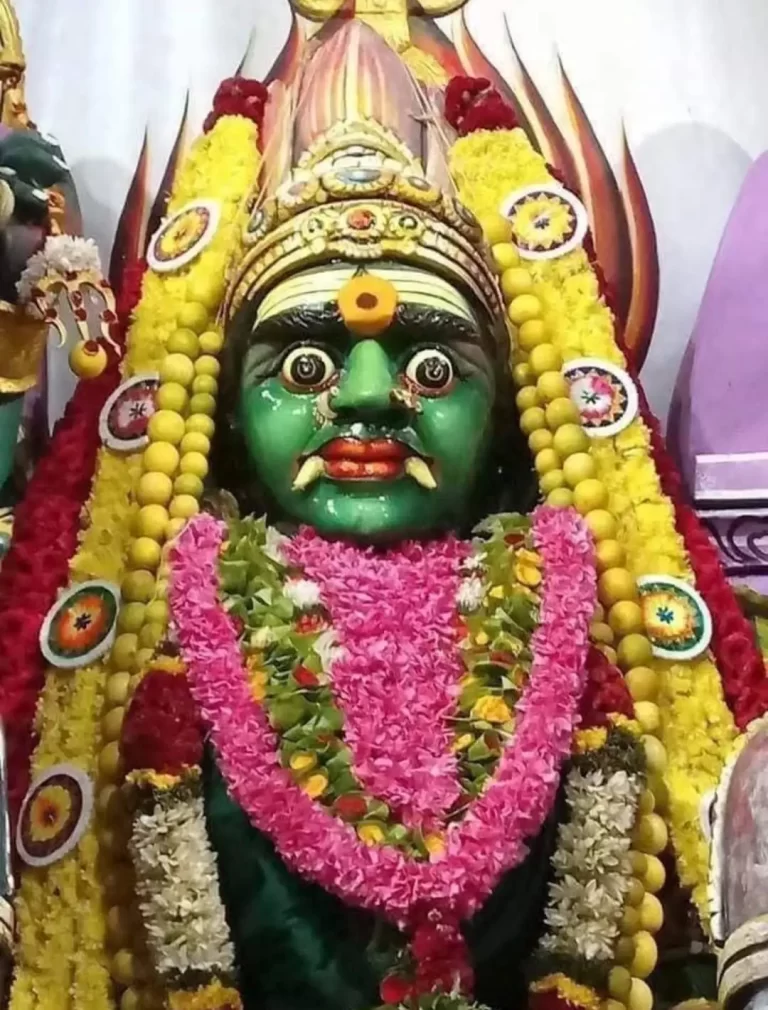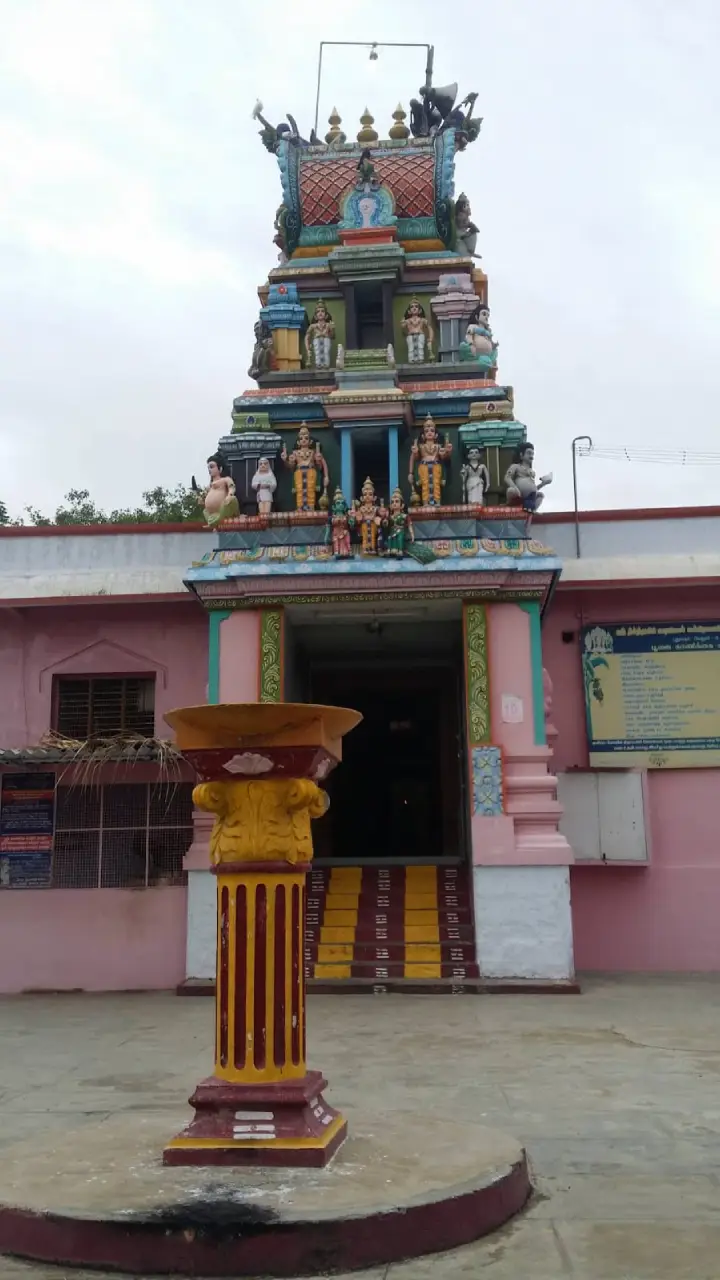
Navagraha Circuit Kumbakonam: 9 Temples Map, Timings, Route & Guide
Navagraha Circuit Kumbakonam: Location, Importance and What to Expect
The Navagraha Circuit Kumbakonam is a sacred network of nine ancient Hindu temples situated across the fertile Cauvery Delta region around Kumbakonam, Thanjavur, and Mayiladuthurai in Tamil Nadu, India. Unlike most Hindu temples across India where the nine planetary deities (Navagrahas) are grouped together inside a single subsidiary enclosure (Navagraha Mandapa), each temple in this unique pilgrimage circuit is dedicated primarily to one specific celestial energy associated with a historic Shaivite or Vaishnavite shrine.
For centuries, pilgrims have journeyed along this trail to seek relief from astrological afflictions (doshas), balance planetary periods (dashas), and immerse themselves in the deep spiritual culture and timeless stone architecture of the Chola heartland.
Whether you are completing a dedicated two-day spiritual circuit (Parihara Yatra) or exploring the monumental temple heritage of Tamil Nadu, navigating these nine temples requires an understanding of their historical contexts, specific pooja offerings, geographical spread, and practical timings.
Quick Information Table
| Information | Details |
|---|---|
| Circuit Name | Navagraha Circuit Kumbakonam (Kumbakonam Navagraha Sthalangal) |
| Primary Base Town | Kumbakonam, Thanjavur District, Tamil Nadu, India |
| Deities Revered | Surya (Sun), Chandra (Moon), Angaraka/Chevvai (Mars), Budha (Mercury), Guru/Brihaspati (Jupiter), Shukra (Venus), Shani (Saturn), Rahu (North Lunar Node), Ketu (South Lunar Node) |
| Total Distance of Circuit | Approximately 220 km to 260 km for a complete round trip starting and ending in Kumbakonam |
| Circuit Duration | 2 full days (recommended for peaceful darshan) or 1 fast-paced day |
| Dominant Architectural Era | Early to Late Medieval Chola Dynasty (9th–13th century CE), with Vijayanagara and Nayaka renovations |
| Key Festivals | Shani Peyarchi (Saturn transit), Guru Peyarchi (Jupiter transit), Rahu-Ketu Peyarchi, Maha Shivaratri, Panguni Uthiram, Thai Poosam |
| Standard Daily Timings | Morning: 6:00 AM – 12:30 PM / 1:00 PM; Evening: 4:00 PM – 8:30 PM / 9:00 PM |
| Nearest Railway Station | Kumbakonam Railway Station (KMU), with Mayiladuthurai (MV) and Thanjavur (TJ) nearby |
| Nearest Airport | Tiruchirappalli International Airport (TRZ), approximately 90 km from Kumbakonam |
| Dress Code | Traditional attire strictly required (Men: Dhoti/Veshti or formal trousers; Women: Saree, Dhavani, or Salwar Kameez) |
| Entry Fee | General entry is free; Special Darshan and Quick Pass tickets range from ₹10 to ₹250 depending on the temple |
| Planet (Graha) | Temple Name | Presiding Shiva / Vishnu Deity | Location & Distance from Kumbakonam | Associated Grain (Dhanyam) | Associated Cloth Colour |
|---|---|---|---|---|---|
| Surya (Sun) | Suryanar Koil | Sri Suryanarayanaswamy | Suryanar Kovil (~15 km northeast) | Whole Wheat (Godhumai) | Red / Orange |
| Chandra (Moon) | Kailasanathar Temple | Sri Kailasanathar & Periyanayaki | Thingalur (~35 km west) | Raw Rice (Arisi) | White |
| Angaraka (Mars) | Vaitheeswaran Koil | Sri Vaidyanathaswamy & Thaiyalnayagi | Vaitheeswaran Koil (~52 km northeast) | Red Gram / Toor Dal (Thuvarai) | Bright Red |
| Budha (Mercury) | Swetharanyeswarar Temple | Sri Swetharanyeswarar & Brahmavidyambigai | Thiruvengadu (~60 km northeast) | Green Gram / Moong Dal (Paasi Payaru) | Light Green |
| Guru (Jupiter) | Abathsahayeswarar Temple | Sri Abathsahayeswarar & Elavarkuzhali | Alangudi (~16 km south) | Bengal Gram / Chickpeas (Kondakadalai) | Bright Yellow / Saffron |
| Shukra (Venus) | Agneeswarar Temple | Sri Agneeswarar & Karpagambal | Kanjanoor (~18 km northeast) | White Field Beans / Mochai (Mochai Payaru) | Pristine White |
| Shani (Saturn) | Dharbaranyeswarar Temple | Sri Dharbaranyeswarar & Pranambigai | Thirunallar (~54 km east, Karaikal UT) | Black Sesame (Ellu) | Dark Blue / Black |
| Rahu (North Node) | Naganathar Temple | Sri Naganathaswamy & Girigujambal | Thirunageswaram (~6 km east) | Black Gram / Urad Dal (Ulundu) | Dark Blue / Multi-color |
| Ketu (South Node) | Naganathaswamy Temple | Sri Naganathaswamy & Soundaranayagi | Keezhaperumpallam (~58 km east) | Horse Gram (Kollu) | Multi-colored / Smoked Grey |
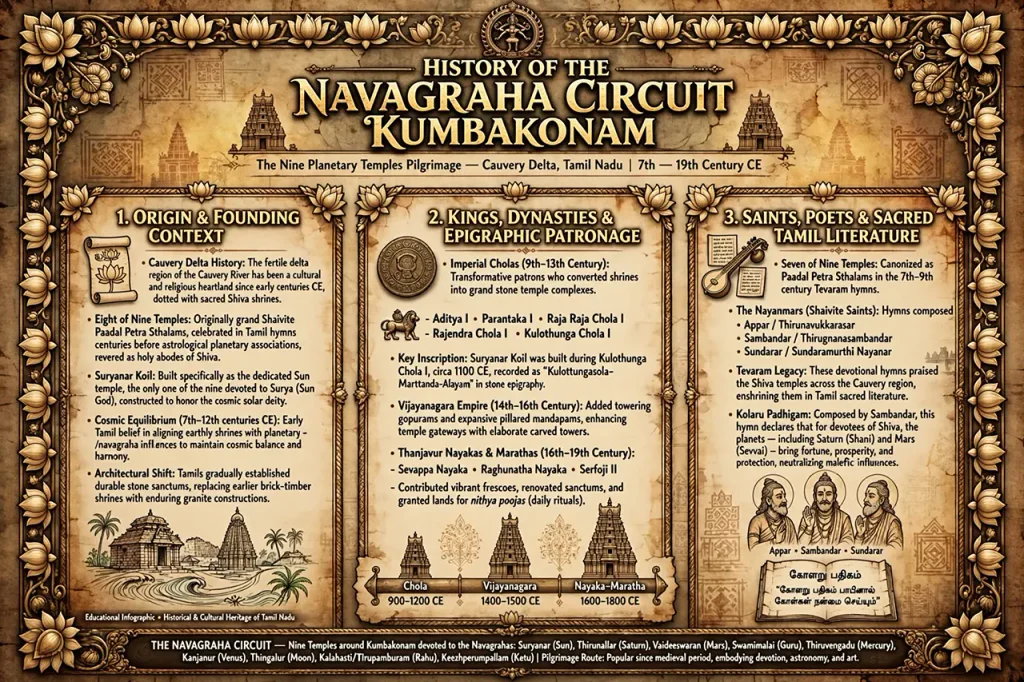
Origin and Founding Context
The temples forming the Navagraha Circuit Kumbakonam are deeply rooted in the history of the Cauvery Delta. With the exception of Suryanar Koil—which was constructed specifically as a dedicated Sun temple—eight of the nine temples were originally consecrated as grand Shaivite shrines (Paadal Petra Sthalams) celebrated in ancient Tamil hymns long before their formal astrological associations became widely recognized.
The practice of seeking cosmic equilibrium through planetary intercession in southern India gained organized structural momentum between the 7th and 12th centuries CE. Ancient Tamils recognized the sacred geography of the fertile river basin, establishing structural stone sanctums over earlier brick-and-timber shrines.
Kings, Dynasties, and Epigraphic Patronage
The architectural landscape of the circuit reflects the patronage of several major Southern Indian dynasties:
- The Imperial Cholas (9th–13th Century CE): Monarchs such as Aditya I, Parantaka I, Raja Raja Chola I, Rajendra Chola I, and Kulothunga Chola I transformed rural shrines into vast stone complexes. Inscriptions at Suryanar Koil confirm that the stone temple was built during the reign of Kulothunga Chola I (circa 1100 CE) under the title Kulottungasola-Marttanda-Alayam.
- The Vijayanagara Empire (14th–16th Century CE): Following the decline of the Chola empire, Vijayanagara rulers fortified these complexes, adding towering stone gopurams (gateway towers) and expansive pillared halls (mandapams).
- The Thanjavur Nayakas and Marathas (16th–19th Century CE): Rulers including Sevappa Nayaka, Raghunatha Nayaka, and subsequent Maratha kings like Serfoji II contributed elaborate ceiling frescoes, renovated inner sanctums, and granted vast parcels of land for the perpetual conduct of daily rituals (nithya poojas).
Saints, Poets, and Sacred Tamil Literature
Seven of the nine temples are celebrated Paadal Petra Sthalams, canonized in the 7th- to 9th-century Tevaram hymns composed by the revered Nayanmars:
- Appar (Thirunavukkarasar)
- Sambandar (Thirugnanasambandar)
- Sundarar (Sundaramurthi Nayanar)
The ancient poets visited these shrines, composing vibrant Tamil verses that praised the supreme grace of Shiva as the ultimate orchestrator of cosmic law and planetary movement. In his famous Kolaru Padhigam, Saint Sambandar sang that for a sincere devotee of Shiva, the planetary bodies—even those deemed fearsome like Saturn and Mars—bring only fortune and spiritual peace.
"வேயுறு தோளிபங்கன் விடமுண்ட கண்டன்
மிகநல்ல வீணை தடவி
மாசறு திங்கள்கங்கை முடிமேல் அணிந்தென்
உளமே புகுந்த அதனால்
ஞாயிறு திங்கள்செவ்வாய் புதன்வியாழன் வெள்ளி
சனிபாம்பு இரண்டும் உடனே
ஆசறு நல்லநல்ல அவைநல்ல நல்ல
அடியாரவர்க்கு மிகவே."

— திருஞானசம்பந்தர் அருளிய கோளறு பதிகம் (முதல் பாடல்)
English Meaning: “Because the Lord—who shares half His form with the slender Goddess, whose throat holds the poison, who plays the pure Veena, and who crowns His locks with the crescent moon and the Ganges—has entered and taken abode within my heart, the Sun, Moon, Mars, Mercury, Jupiter, Venus, Saturn, Rahu, and Ketu are all thoroughly auspicious, supremely benevolent, and unfailingly protective to His devotees.”
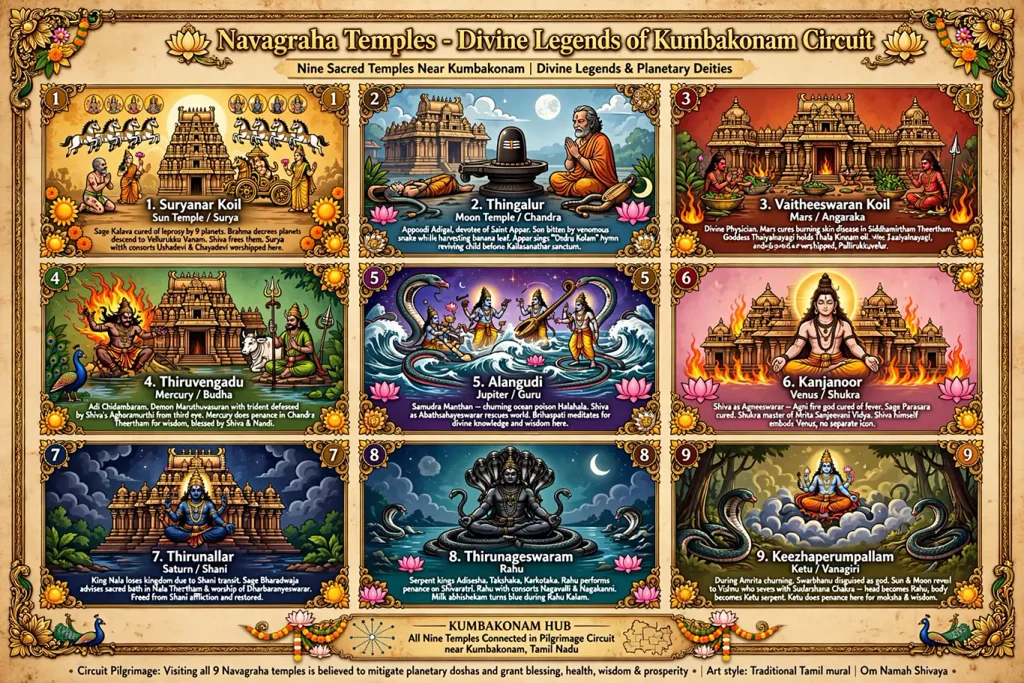
Legends and Sthala Puranas of the 9 Temples
1. Suryanar Koil (Sun Temple)
According to the local Sthala Purana, Sage Kalava was once afflicted by severe leprosy due to severe karmic fruition. Using his yogic powers, he prayed intensely to the nine planetary deities. Pleased by his devotion, the planets granted him complete healing.
However, Lord Brahma took exception, stating that the planets had violated cosmic law by acting independently of Lord Shiva’s supreme justice. Brahma decreed that the nine planets must descend to earth and suffer the very affliction they had cured.
The planets descended to Vellurukku Vanam (modern-day Suryanar Koil) and performed penance to Lord Shiva. Shiva appeared, freed them from the condition, and granted them the power to bless devotees who worship them at this spot. Suryanar Koil is unique because Lord Surya stands prominently with his consorts Ushadevi and Chayadevi, while the other eight planets are enshrined in separate standalone shrines surrounding him.
2. Thingalur (Moon Temple)
The legend of Thingalur centers on Appoodi Adigal, an ardent devotee of Saint Thirunavukkarasar (Appar). Without ever having met Appar in person, Appoodi Adigal named his children, cattle, water stations, and rest houses after the saint.
When Appar finally visited Thingalur, Appoodi Adigal joyfully arranged a feast. While harvesting a banana leaf for the saint’s meal, Appoodi Adigal’s young son was bitten by a venomous snake and died instantly. Not wanting his grief to interrupt the saint’s hospitality, the father hid the boy’s body.
Sensing the tragedy, Appar carried the boy’s body before the sanctum of Lord Kailasanathar and sang the famous hymn Ondru Kolam, reviving the child. The temple is visited to pray for mental clarity, maternal wellbeing, and relief from lunar afflictions (Chandra Doshas).
3. Vaitheeswaran Koil (Mars / Angaraka Temple)
Vaitheeswaran Koil translates to the “Abode of the Divine Physician.” Legend recounts that the planet Mars (Angaraka) once suffered from a burning skin disease and bathed in the temple’s sacred Siddhamirtham Theertham, praying to Lord Vaidyanathaswamy for relief. The Lord cured him, making this a central pilgrimage site for those seeking healing and relief from Mars-related afflictions (Chevvai Dosha).
The temple is also revered as Pullirukkuvelur—named after the four legendary figures who worshipped here: Pul (the divine bird Jatayu), Irukku (the Rig Veda), Vel (Lord Murugan’s spear), and Oor (the Sun). Here, Goddess Thaiyalnayagi stands holding the celestial medicinal oil (Thaila Kinnam) to heal all earthly ailments.
4. Thiruvengadu (Mercury / Budha Temple)
Thiruvengadu is revered as the Adi Chidambaram (the original space of cosmic dance). It is home to Aghoramurthi, a powerful aspect of Shiva.
According to legend, a demon named Maruthuvasuran performed severe austerities and received a trident from Shiva. He then used this divine weapon to terrorize sages and celestial beings.
When the sages sought refuge at Thiruvengadu, Shiva instructed his bull mount, Nandi, to defeat the demon. Nandi broke the demon’s trident, but when the demon attacked again, Shiva manifested his fearsome form of Aghoramurthi through his third eye and subdued the asura beneath his feet.
Mercury (Budha), the deity of intellect, commerce, and communication, performed intense penance at the sacred Chandra Theertham here and was blessed with divine wisdom.
5. Alangudi (Jupiter / Guru Temple)
The temple of Alangudi is situated at the historic site of Thiruvirumpoolai. During the legendary churning of the cosmic ocean of milk (Samudra Manthan), the first substance to emerge was the deadly poison Halahala, threatening all creation.
The devas fled to Lord Shiva at this location. Shiva consumed the poison, protecting the universe, which earned him the name Abathsahayeswarar (“The Lord who rescues in times of danger”).
Lord Brihaspati (Guru), the preceptor of the gods, meditated here on Shiva and was established as the primary teacher of spiritual and worldly knowledge. Devotees visit this shrine to seek wisdom, educational success, and professional advancement.
6. Kanjanoor (Venus / Shukra Temple)
At Kanjanoor, Lord Shiva is worshipped as Agneeswarar. Legend states that Agni, the fire god, once suffered from a burning internal fever and prayed here to be cleansed.
Furthermore, Sage Parasara was cured of his physical afflictions at this site. Shukra (Venus), the preceptor of the Asuras and master of wealth, arts, and marital harmony, meditated here on Lord Shiva to attain mastery over the rejuvenating nectar of life (Mrita Sanjeevani Vidya).
Unlike other planetary temples where an idol of the planet is installed prominently, at Kanjanoor, Lord Shiva himself embodies the benign, creative, and prosperous energies of Shukra. Thus, no separate physical icon for Venus is installed in the main sanctum.
7. Thirunallar (Saturn / Shani Temple)
Thirunallar is one of the most famous planetary shrines in India, located in the Union Territory of Puducherry near Karaikal. The legendary King Nala of the Nishadha kingdom was heavily afflicted by the harsh transit of Lord Shani (Saturn), losing his wealth, kingdom, and family.
After years of wandering, Sage Bharadwaja advised King Nala to bathe in the holy Nala Theertham at Thirunallar and offer sincere worship to Lord Dharbaranyeswarar.
Upon completing his prayers, Nala was freed from Saturn’s afflictions and regained his kingdom and prosperity. Devotees travel from across the country to bathe in Nala Theertham and light sesame-oil lamps to ease difficult planetary transitions.
8. Thirunageswaram (Rahu Temple)
Thirunageswaram is famous for its association with the great serpent kings Adisesha, Takshaka, and Karkotaka, who prayed to Lord Naganathaswamy to be cleansed of curses.
Rahu, the celestial north node of the Moon, performed deep penance here on Lord Shiva and Goddess Girigujambal on Shivaratri nights. Lord Shiva granted Rahu the status of a planetary deity.
A unique feature of this temple is that Rahu is worshipped in human form with his consorts Nagavalli and Nagakanni, rather than purely in serpentine form. During milk abhishekam on Sundays during Rahu Kalam, the white milk poured over the deity’s idol turns a distinct pale blue as it flows off, returning to pure white upon reaching the stone floor.
9. Keezhaperumpallam (Ketu Temple)
Keezhaperumpallam, also known as Vanagiri, is located near the ancient port city of Poompuhar. During the churning of the cosmic ocean, when the divine nectar (Amrita) was distributed, the serpent demon Swarbhanu disguised himself to consume a drop of the nectar.
The Sun and Moon pointed this out to Lord Vishnu, who severed the demon’s body with his Sudarshana Chakra.
The head portion became Rahu, and the body portion, transformed with the head of a serpent, became Ketu. Ketu performed intense penance to Lord Naganathaswamy at Keezhaperumpallam to atone for his actions. Pleased with his devotion, Shiva granted him liberation (Moksha) and the ability to bestow spiritual wisdom, detachment, and occult knowledge upon seekers.
Detailed Temple Breakdown: Architecture, Deities & Worship
=========================================================================================
THE NINE NAVAGRAHA TEMPLES AT A GLANCE
=========================================================================================
1. SURYANAR KOIL (Surya / Sun)
   - Architectural Style: Early-to-Mid Chola Granite Sanctum with 3-tier Rajagopuram
   - Key Deities: Sri Suryanarayanaswamy, Ushadevi, Chayadevi, Brihaspati (facing Surya)
   - Unique Aspect: Dedicated exclusively to the Sun; housing all 9 planets in open pavilions.
-----------------------------------------------------------------------------------------
2. THINGALUR (Chandra / Moon)
   - Architectural Style: Classic Chola Paadal Petra Sthalam layout; serene rural prakaram
   - Key Deities: Sri Kailasanathar, Periyanayaki Amman, Chandra Bhagavan
   - Unique Aspect: Associated with Appoodi Adigal and the miracle of resurrection by Appar.
-----------------------------------------------------------------------------------------
3. VAITHEESWARAN KOIL (Angaraka / Mars)
   - Architectural Style: Vast Chola-Nayaka complex with towering five-tier Gopurams
   - Key Deities: Sri Vaidyanathaswamy, Thaiyalnayagi, Sevvai (Angaraka), Selva Muthukumaraswamy
   - Unique Aspect: Siddhamirtham Tank; sacred medicinal mud tablets (Thiruchandhu Urundai).
-----------------------------------------------------------------------------------------
4. THIRUVENGADU (Budha / Mercury)
   - Architectural Style: Monumental Dravidian complex with three holy tanks (Surya, Chandra, Agni)
   - Key Deities: Sri Swetharanyeswarar, Brahmavidyambigai, Budha Bhagavan, Aghoramurthi
   - Unique Aspect: Revered as Adi Chidambaram; home to the peaceful shrine of Budha.
-----------------------------------------------------------------------------------------
5. ALANGUDI (Guru / Jupiter)
   - Architectural Style: Chola stone mandapams with a polished inner corridor
   - Key Deities: Sri Abathsahayeswarar, Elavarkuzhali Amman, Dakshinamurthy (Guru)
   - Unique Aspect: Dakshinamurthy is worshipped here as the primary embodiment of Jupiter.
-----------------------------------------------------------------------------------------
6. KANJANOOR (Shukra / Venus)
   - Architectural Style: Medieval Chola stone walls with Vijayanagara pillared corridors
   - Key Deities: Sri Agneeswarar, Karpagambal, Nataraja (Mukthi Thandavam)
   - Unique Aspect: Shiva himself represents Shukra; no separate physical planetary idol.
-----------------------------------------------------------------------------------------
7. THIRUNALLAR (Shani / Saturn)
   - Architectural Style: Sprawling Chola-Nayaka pilgrimage temple around Nala Theertham
   - Key Deities: Sri Dharbaranyeswarar, Bogamartha Poonmulayal, Shani Bhagavan (Anugraha Murthy)
   - Unique Aspect: Shani is seated gracefully as a benevolent grantor of boons (Anugraha).
-----------------------------------------------------------------------------------------
8. THIRUNAGESWARAM (Rahu / North Node)
   - Architectural Style: Expansive Chola fortress-temple featuring the 100-pillared mandapam
   - Key Deities: Sri Naganathaswamy, Girigujambal, Rahu Bhagavan (with consorts)
   - Unique Aspect: Famous milk abhishekam where white milk turns light blue over Rahu's idol.
-----------------------------------------------------------------------------------------
9. KEEZHAPERUMPALLAM (Ketu / South Node)
   - Architectural Style: Compact coastal Chola shrine located close to the Bay of Bengal
   - Key Deities: Sri Naganathaswamy, Soundaranayagi Amman, Ketu Bhagavan
   - Unique Aspect: Ketu is depicted with folded hands, worshipping Lord Shiva in total surrender.
=========================================================================================
Complete Pooja & Parihara Guide for the Circuit
Devotees typically undertake the Navagraha pilgrimage to perform specific Pariharas (remedial prayers) to balance challenging astrological placements in their natal charts (Janma Kundali).
Below are the traditional offerings, poojas, and rituals performed at each temple:
[SURYANAR KOIL] ------> Offering: Wheat Rava Sweet, Red Silk Cloth, Red Lotus
                        Ritual: 11 Pradakshinas around the Sun sanctum; Surya Gayatri Japa.

[THINGALUR] ----------> Offering: Raw Rice Kheer, White Silk, White Lotus/Jasmine
                        Ritual: Chandra Shanti Archana on Mondays; lighting ghee lamps.

[VAITHEESWARAN KOIL] -> Offering: Toor Dal, Red Cloth, Red Oleander (Arali)
                        Ritual: Angaraka Parihara Homa, purchasing Thiruchandhu Urundai.

[THIRUVENGADU] -------> Offering: Moong Dal Sundal, Green Silk, Tulsi/Vilva
                        Ritual: Bathing/sprinkling Chandra Theertham; Budha Archana on Wednesdays.

[ALANGUDI] -----------> Offering: Boiled Chickpeas (Kondakadalai) Garland, Yellow Silk
                        Ritual: 24 Pradakshinas around Dakshinamurthy on Thursdays.

[KANJANOOR] ----------> Offering: Mochai Payaru, White Silk, White Fragrant Flowers
                        Ritual: Shukra Shanti Archana on Fridays; offering ghee deepams.

[THIRUNALLAR] --------> Offering: Black Sesame Seeds tied in black cloth, Sesame Oil
                        Ritual: Holy dip in Nala Theertham; lighting Ellu Deepam to Shani.

[THIRUNAGESWARAM] ----> Offering: Urad Dal dishes, Blue/Multi-colored Cloth
                        Ritual: Rahu Kala Ksheerabhishekam (Milk Abhishekam on Sundays).

[KEEZHAPERUMPALLAM] --> Offering: Horse Gram (Kollu) preparation, Multicolored/Grey Cloth
                        Ritual: Ketu Archana; prayer for spiritual liberation and family peace.
Festivals and Astrological Transits
While daily poojas run continuously throughout the year, the Navagraha temples see large gatherings during specific planetary transits (Peyarchi) and seasonal Shaivite festivals:
- Shani Peyarchi (Saturn Transit): Celebrated every 2.5 to 3 years at Thirunallar. Hundreds of thousands of devotees gather to witness the transit of Saturn from one zodiac sign (Rasi) to another, offering sesame lamps and taking a dip in Nala Theertham.
- Guru Peyarchi (Jupiter Transit): Celebrated annually at Alangudi when Jupiter moves between zodiac signs. Elaborate Laksharchana (chanting of 100,000 names) and special homams are conducted.
- Rahu-Ketu Peyarchi: Celebrated every 18 months at Thirunageswaram and Keezhaperumpallam with special Yagasalas and continuous milk abhishekams.
- Maha Shivaratri (February–March): Celebrated across all nine temples with four distinct rounds of midnight abhishekams (Kala Poojas), traditional classical music, and temple-wide illuminations.
- Thai Poosam & Panguni Uthiram: Celebrated on a grand scale at Vaitheeswaran Koil, featuring massive chariot processions for Lord Muthukumaraswamy and Lord Vaidyanathar.
Practical Travel Information: Map & Routes
Geographic Orientation and Distances
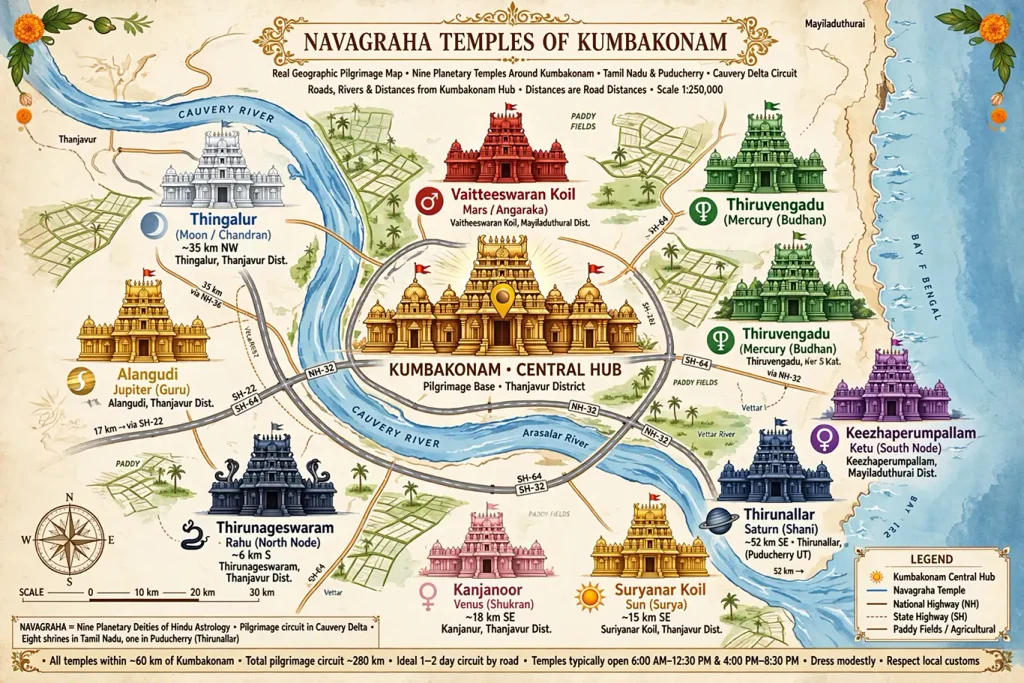
Kumbakonam serves as the ideal hub for completing the Navagraha pilgrimage. The temples are distributed across three main corridors:
[Western Sector]  : Thingalur (35 km west), Alangudi (16 km south)
[Northeast Sector]: Suryanar Koil (15 km), Kanjanoor (18 km), Thirunageswaram (6 km)
[Eastern Sector]  : Vaitheeswaran Koil (52 km), Thiruvengadu (60 km), Keezhaperumpallam (58 km), Thirunallar (54 km)
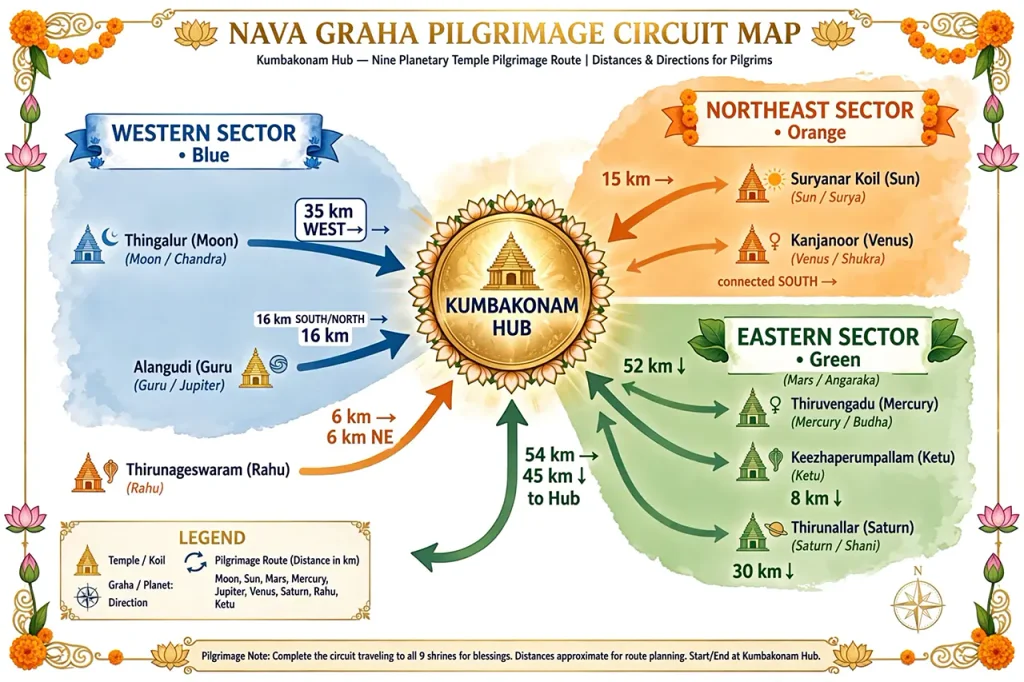
Optimal 2-Day Itinerary (Recommended)
Day 1: The Eastern & Northern Circuit (5 Temples)
- 06:00 AM – 07:30 AM: Depart Kumbakonam and drive to Thingalur (Chandra). Attend the morning opening pooja (35 km, ~45 mins).
- 08:30 AM – 09:30 AM: Return towards Kumbakonam and visit Alangudi (Guru) for morning darshan (30 km, ~45 mins).
- 10:30 AM – 11:45 AM: Proceed to Thirunageswaram (Rahu) for darshan and milk abhishekam (20 km, ~30 mins).
- 12:00 PM – 01:00 PM: Visit Suryanar Koil (Surya) and Kanjanoor (Shukra) before the afternoon temple closures (8 km, ~15 mins).
- 01:30 PM – 03:45 PM: Traditional South Indian lunch in Mayiladuthurai or Kumbakonam and afternoon rest.
- 04:30 PM – 06:00 PM: Drive to Vaitheeswaran Koil (Chevvai) for evening opening darshan.
- 06:30 PM – 08:30 PM: Return to Kumbakonam for dinner and an overnight stay.
Day 2: The Coastal & Karaikal Circuit (4 Temples)
- 06:00 AM – 07:30 AM: Drive to Thiruvengadu (Budha) and attend the serene morning worship (60 km, ~1 hour 15 mins).
- 08:00 AM – 09:15 AM: Drive to nearby Keezhaperumpallam (Ketu) for archana and darshan (8 km, ~15 mins).
- 10:15 AM – 12:30 PM: Proceed to Thirunallar (Shani). Take a holy dip in Nala Theertham and offer sesame deepam (32 km, ~45 mins).
- 01:00 PM – 04:00 PM: Lunch in Karaikal or Mayiladuthurai and begin the return journey.
- 05:00 PM onwards: Return to Kumbakonam or proceed to Tiruchirappalli / Chennai for your onward journey.
Temple Timings and Daily Schedules
Most temples in the Navagraha circuit follow traditional Chola temple schedules, opening early in the morning, closing for a three-to-four-hour afternoon break, and reopening in the evening:
| Temple | Morning Timings | Evening Timings | Peak Crowd Hours |
|---|---|---|---|
| Suryanar Koil | 6:00 AM – 12:30 PM | 4:00 PM – 8:30 PM | Sunday mornings & Ratha Saptami |
| Thingalur | 6:00 AM – 12:30 PM | 4:00 PM – 8:30 PM | Monday evenings & Full Moon (Pournami) |
| Vaitheeswaran Koil | 5:30 AM – 1:00 PM | 4:00 PM – 9:00 PM | Tuesdays, Kiruthigai & festival days |
| Thiruvengadu | 6:00 AM – 12:00 PM | 4:00 PM – 8:30 PM | Wednesday mornings & Pradosham |
| Alangudi | 6:00 AM – 1:00 PM | 4:00 PM – 8:30 PM | Thursdays & Guru Peyarchi days |
| Kanjanoor | 6:00 AM – 12:30 PM | 4:00 PM – 8:30 PM | Friday mornings & evenings |
| Thirunallar | 6:00 AM – 1:00 PM | 4:00 PM – 9:00 PM | Entire Saturdays & Shani Peyarchi |
| Thirunageswaram | 6:00 AM – 1:00 PM | 4:00 PM – 8:30 PM | Sunday Rahu Kalam (4:30 PM – 6:00 PM) |
| Keezhaperumpallam | 6:00 AM – 12:30 PM | 4:00 PM – 8:30 PM | Tuesday evenings & Rahu-Ketu Peyarchi |
Important Note: Temple timings can change during solar/lunar eclipses, annual Brahmotsavams, and major planetary transit days. Visitors are advised to confirm the latest schedules before travelling.
Dress Code, Etiquette & Sacred Customs
The temples of the Kumbakonam Navagraha circuit strictly follow traditional Agamic customs under the administration of the Tamil Nadu HR&CE Department and hereditary trusts (Adheenams):
- Men: Dhoti (Veshti) with an upper cloth (Angavastram), or formal shirt and trousers. Shorts, sleeveless shirts, Bermudas, and track pants are strictly prohibited. At certain inner sanctums, men may be asked to remove their shirts.
- Women: Traditional Sarees, Dhavani (half-sarees), or Salwar Kameez with a pinned dupatta. Western casuals, tight leggings, miniskirts, and shorts are not permitted inside the sanctum.
- Footwear: Strictly prohibited inside temple complexes. Dedicated, attended footwear counters are available at temple entrances for a nominal fee (₹2–₹5).
- Mobile Phones & Photography: Photography of the inner sanctum (Garbhagriha) and stone moolavar idols is strictly forbidden across all nine temples. Mobile phones must be kept on silent or deposited at designated counters where required.
[AIR CONNECTIONS]   --> Tiruchirappalli Airport (TRZ) [90 km] | Chennai Airport (MAA) [280 km]
                                      |
[RAIL CONNECTIONS]  --> Kumbakonam (KMU) | Mayiladuthurai (MV) | Thanjavur (TJ)
                                      |
[ROAD TRANSPORT]    --> NH 36 & State Highways | Hired Private Taxi / TNSTC Circuit Buses
By Air
- Tiruchirappalli International Airport (TRZ): The nearest airport, located approximately 90 km from Kumbakonam. It operates daily flights from major Indian hubs (Chennai, Bengaluru) as well as international flights from Singapore, Malaysia, and the Middle East. Private taxis are available outside the terminal to Kumbakonam (~2 to 2.5 hours).
- Chennai International Airport (MAA): Located approximately 280 km from Kumbakonam. It offers extensive global connectivity. Pilgrims can take a direct express train or travel via the Chennai–Villupuram–Kumbakonam highway.
By Train
- Kumbakonam Railway Station (KMU): Well connected with daily express and superfast trains from Chennai Egmore, Tiruchirappalli, Madurai, Coimbatore, Tirupati, and Bengaluru (e.g., Cholan Express, Uzhawan Express, and Mysuru–Mayiladuthurai Express).
- Mayiladuthurai Junction (MV): Situated 35 km east of Kumbakonam, serving as an excellent railhead for reaching Vaitheeswaran Koil, Thiruvengadu, and Keezhaperumpallam.
By Road & Local Transport
Kumbakonam has well-maintained arterial state and national highways (NH 36). The Tamil Nadu State Transport Corporation (TNSTC) operates special weekend Navagraha Special Buses that cover the nine temples over two days from the Kumbakonam Central Bus Stand.
For families, elderly pilgrims, or small groups, hiring a private air-conditioned taxi from Kumbakonam is the most comfortable and flexible way to complete the circuit.
Facilities, Accessibility & Accommodation
Where to Stay
Kumbakonam is the primary accommodation hub for the circuit, offering options ranging from clean heritage homestays to modern 3-star hotels:
- Heritage & Luxury Stays: Traditional Cauvery Delta heritage resorts along the outskirts of Kumbakonam and Swamimalai (e.g., Mantra Koodam, Indeco Swamimalai).
- Comfort & Business Hotels: Centrally located properties near Kumbakonam Railway Station (e.g., Hotel Sara Regency, Hotel PLA Residency, Quality Inn Viha).
- Budget Lodges & Yatri Niwas: Numerous affordable lodges are situated around the Mahamaham Tank and near the bus stand.
Food & Dining
The region is celebrated for authentic Thanjavur-style pure vegetarian cuisine served on banana leaves, alongside the world-famous Kumbakonam Degree Coffee. Traditional vegetarian restaurants (Bhavans) across town serve hot idlis, dosas, medu vadas, sambar, rasam, and kootu.
Accessibility for Senior Citizens & Differently Abled Visitors
- Most major temples (such as Vaitheeswaran Koil and Thirunallar) have flat stone-paved courtyards with ramped access through select entrance gates.
- Manual wheelchairs are available upon request at temple administrative offices.
- Battery-operated carts operate at large complexes like Thirunallar for elderly visitors.
- Keep in mind that older granite thresholds and centuries-old doorways may still require careful navigation and physical assistance.
Dos
- Begin the pilgrimage with a prayer to Lord Ganesha to ensure a smooth, peaceful journey without obstacles.
- Maintain silence, reverent focus, and patience when standing in queue lines.
- Bathe and wear clean, traditional clothing before starting morning darshans.
- Dispose of pooja waste (banana leaves, earthen oil cups, and flowers) in designated bins.
- Carry sufficient cash in smaller denominations for pooja tickets, flower garlands, and footwear storage.
Don’ts
- Do not attempt to touch the stone moolavar idols, sacred flagpoles (Dhwajasthambam), or inner sanctum boundaries.
- Do not enter holy temple tanks (Theerthams) wearing footwear or use soap/shampoo while bathing.
- Avoid taking photos or recording videos where prohibited by temple signboards.
- Avoid rushing through the circuit in a single day if traveling with elderly relatives or young children.
Nearby Temples & Attractions Around Kumbakonam
If your travel itinerary allows extra time, several of South India’s greatest temple landmarks are located right alongside the Navagraha temples:
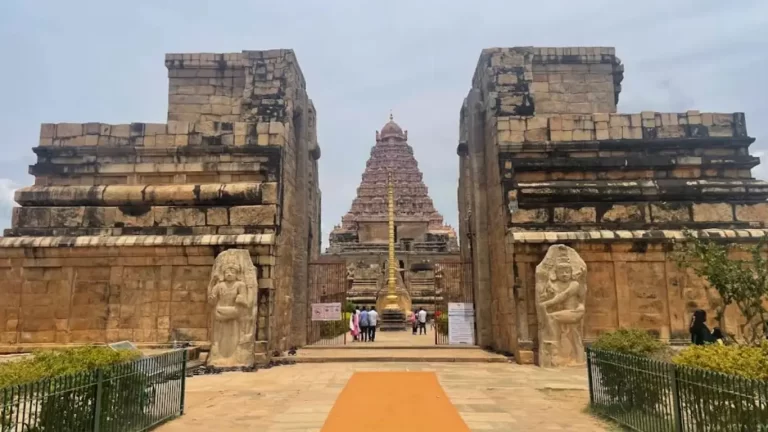
- Brihadisvara Temple, Thanjavur (Great Living Chola Temple): Located 40 km southwest of Kumbakonam. A UNESCO World Heritage Site featuring a massive granite Vimana built by Raja Raja Chola I in 1010 CE.
- Gangaikonda Cholapuram: Located 32 km north of Kumbakonam. Built by Rajendra Chola I to celebrate his victorious military campaign to the river Ganges.
- Airavatesvara Temple, Darasuram: Located 4 km from Kumbakonam. A UNESCO World Heritage monument celebrated for its stone chariot mandapams and delicate miniature carvings.
- Swamimalai Murugan Temple: Located 8 km west of Kumbakonam. One of the Arupadaiveedu (Six Abodes of Lord Murugan), where Murugan taught the meaning of the Pranava Mantra (Om) to his father, Lord Shiva.
- Sarangapani & Uppiliappan Temples: Celebrated Divya Desam temples dedicated to Lord Vishnu, known for chariot-shaped stone sanctums and traditional Vaishnavite worship.
1. What is the Navagraha Circuit Kumbakonam?
The Navagraha Circuit Kumbakonam is a sacred network of nine ancient Hindu temples in the Cauvery Delta region of Tamil Nadu. Each temple is dedicated to one of the nine planetary deities (Navagrahas) of Hindu astrology, situated within historic Shaivite and Vaishnavite temple complexes.
2. Can the entire Navagraha circuit be completed in one day?
While it is technically possible to visit all nine temples in one day by car (starting at 6:00 AM and driving continuously until 9:00 PM), it requires rushing through darshans. A relaxed 2-day itinerary is strongly recommended to enjoy peaceful prayers, manage midday closures, and handle road travel safely.
3. Which is the starting temple of the Navagraha circuit?
Traditionally, pilgrims begin the circuit at Suryanar Koil (Sun Temple) or at Thingalur (Moon Temple), following the classical astrological order of days (Sunday, Monday, Tuesday, etc.). However, there is no strict scriptural mandate, and visitors may choose routes based on geographical convenience.
4. Is there a specific order in which the nine temples must be visited?
While starting with Surya (Sun) and ending with Rahu and Ketu is a widespread custom, temples can be grouped by geography (Western, Eastern, and Northern sectors) to save travel time and avoid temple closures.
5. What are the best days to visit specific temples in the circuit?
- Suryanar Koil: Sundays
- Thingalur: Mondays
- Vaitheeswaran Koil: Tuesdays
- Thiruvengadu: Wednesdays
- Alangudi: Thursdays
- Kanjanoor: Fridays
- Thirunallar: Saturdays
- Thirunageswaram: Sundays during Rahu Kalam (4:30 PM – 6:00 PM)
- Keezhaperumpallam: Tuesdays and Sundays
6. What is the dress code for the Navagraha temples?
Traditional clothing is mandatory. Men must wear a Dhoti (Veshti) or formal trousers with a shirt; women must wear a Saree, Dhavani, or Salwar Kameez. Shorts, miniskirts, and athletic wear are not permitted.
7. What is the nearest airport to Kumbakonam?
The nearest airport is Tiruchirappalli International Airport (TRZ), located about 90 km from Kumbakonam (a 2 to 2.5-hour drive by taxi). Chennai International Airport (MAA) is 280 km away.
8. What is the total travel distance to cover all nine temples?
Starting and ending at Kumbakonam, a complete round trip covers approximately 220 km to 260 km, depending on the exact route taken.
9. Why is Kanjanoor temple unique among Navagraha temples?
At Kanjanoor (the Shukra/Venus temple), there is no separate planetary idol for Shukra. Instead, Lord Shiva (worshipped as Agneeswarar) represents the divine, prosperous qualities of Venus directly.
10. What is special about the milk abhishekam at Thirunageswaram Rahu Temple?
During milk abhishekam performed on Rahu Bhagavan at Thirunageswaram (especially during Rahu Kalam), the pure white milk poured over the idol turns a light blue shade as it flows across the stone surface, turning white again upon leaving the pedestal.
11. Are there accommodation and food options near every temple?
Basic refreshments and local tea stalls are available near all nine temples. However, high-quality hotels, family restaurants, and heritage stays are concentrated primarily in Kumbakonam, Mayiladuthurai, and Karaikal.
12. What is the significance of bathing in Nala Theertham at Thirunallar?
According to the Sthala Purana, King Nala was completely relieved of his severe planetary misfortunes and mental anguish after taking a sacred bath in Nala Theertham and praying to Lord Dharbaranyeswarar. Devotees continue this tradition today to seek relief from Saturn’s afflictions.
13. What are the general daily opening and closing hours?
Most temples are open from 6:00 AM to 12:30 PM / 1:00 PM in the morning and from 4:00 PM to 8:30 PM / 9:00 PM in the evening. They remain closed for afternoon rituals between 1:00 PM and 4:00 PM.
14. Are wheelchair facilities available for senior citizens?
Yes. Major temples such as Thirunallar and Vaitheeswaran Koil provide manual wheelchairs and ramp access at primary entrances. However, older granite steps near inner sanctums require walking assistance.
15. Do I need to book poojas and pariharas in advance?
General darshan, archana, and standard sesame deepam rituals do not require advance booking; tickets can be purchased at on-site counters. Specialized rituals, such as Rahu Kala Ksheerabhishekam or Sahasranama Homams, can be booked in advance via the official Tamil Nadu HR&CE portal or the temple office.
The Navagraha Circuit Kumbakonam is a journey through South India’s living spiritual heritage, ancient stone architecture, and sacred traditions. Beyond its astrological significance, travelling across the Cauvery Delta connects pilgrims and travelers with towering Chola gopurams, sacred temple tanks, serene rural landscapes, and century-old Agamic rituals.
Whether you are visiting to offer prayers for personal balance, admire world-renowned medieval architecture, or enjoy the peaceful atmosphere of Tamil Nadu’s temple heartland, the Navagraha circuit remains one of India’s most rewarding pilgrimage experiences.