Why Do We Join Our Palms in Namaste? Meaning & Significance
Bringing two palms together in front of the chest and bowing slightly is one of the most recognizable gestures in human culture. Known across the world as Namaste or Namaskar, this traditional Indian greeting is far more than a polite way to say hello or goodbye. It is an intentional physical action rooted in ancient Sanskrit linguistics, classical Indian aesthetics, ritual devotion, and philosophical contemplation.
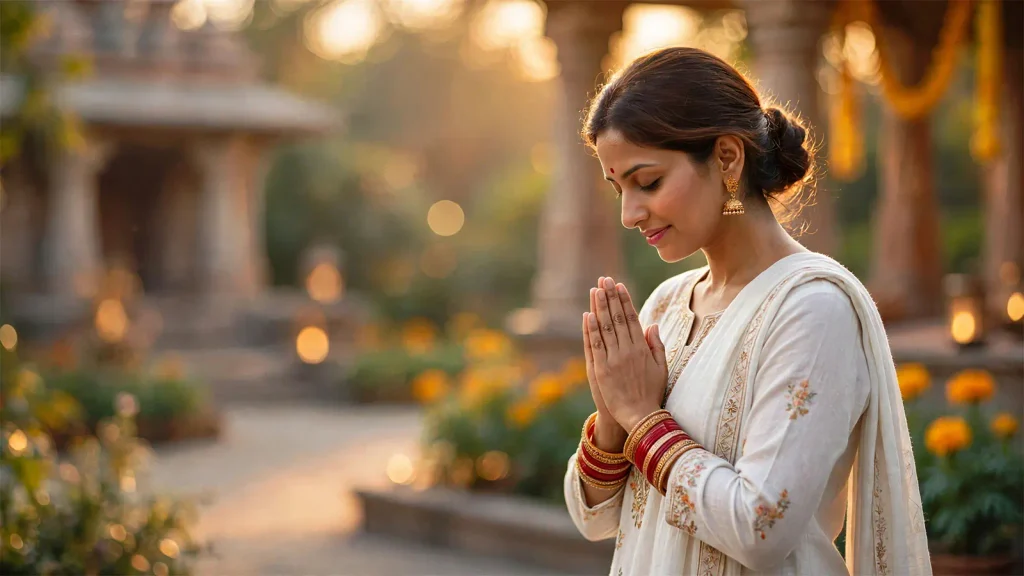
At its surface, the gesture functions as a peaceful, non-contact salutation across South Asia. Beneath that everyday social surface lies a rich matrix of meanings: an acknowledgment of shared human dignity, an embodiment of humility, a yogic seal of balance known as Añjali Mudrā, and an expression of reverent devotion (bhakti) in sacred spaces.
Namaste at a Glance
| Aspect | Summary |
| Primary Expression | Namaste (Sanskrit: नमस्ते) / Namaskar (नमस्कार) |
| Physical Gesture | Añjali Mudrā (palms joined, fingers pointing upward) |
| Standard Placement | Mid-chest, lightly resting near the sternum (heart center) |
| Literal Sanskrit Derivation | Namaḥ (bow/reverence) + Te (to you) = “Obeisance to you” |
| Accompanying Motion | A gentle, respectful forward tilt or bow of the head |
| Cultural Context | Social greeting, formal welcome, devotional prayer, temple worship, yogic practice |
| Universal Significance | Mutual respect, non-aggression, humility, and the dissolution of ego |
What Does Namaste Mean?
To truly understand what the Namaste meaning encompasses, one must separate its precise linguistic origin from the broader philosophical and modern spiritual layers that have grown around it over millennia.
Sanskrit Meaning of Namaste
Linguistically, the word Namaste is a compound formed by two distinct Sanskrit elements governed by classical grammatical rules (sandhi):
- Namaḥ (नमः): A neuter noun and indeclinable derived from the Sanskrit verbal root nam (नम्), which means “to bend,” “to bow,” “to incline,” or “to yield.” In ritual and conversational usage, namaḥ signifies an act of reverence, homage, or respectful submission.
- Te (ते): The enclitic, dative singular form of the second-person personal pronoun tvam (त्वम्), translating accurately to “to you” or “unto you.”
When namaḥ is combined with te, Sanskrit phonetic junction rules (visarga sandhi) transform the terminating visarga (:) followed by the unvoiced dental stop t into an unvoiced sibilant s. Thus:
Namaḥ + Te => Namaste
Grammatically, Namaste functions as an explicit declaration: “Obeisance unto you” or “I bow to you.”
Literal Meaning
In everyday communication, the literal meaning of Namaste is simply an expression of deep respect and cordial salutation. Just as the English word “goodbye” originated from the phrase “God be with ye” without carrying conscious theological weight in every casual modern utterance, Namaste serves as a polite, standard Indian greeting acknowledging the presence of another human being with goodwill and decorum.
Deeper Meaning of Namaste
Beyond its grammatical mechanics, Indian philosophical discourse and cultural customs infuse Namaste with profound social and emotional values:
- The Posture of Non-Ego (Nirahaṅkāra): By verbally stating that one bows, the speaker intentionally places themselves on an equal or deferential plane relative to the other person, diffusing interpersonal tension and pride.
- Recognition of Dignity: The greeting is inherently reciprocal. When two individuals greet each other with folded hands, both perform the same movement simultaneously, establishing a foundation of shared worth and mutual honoring.
- Goodwill and Auspicious Intent (Kalyāṇa Bhāvanā): Offering Namaste is traditionally believed to set a peaceful, non-threatening baseline for any interaction, clearing mental agitation before entering into conversation or business.
Why Do We Join Our Palms in Namaste?
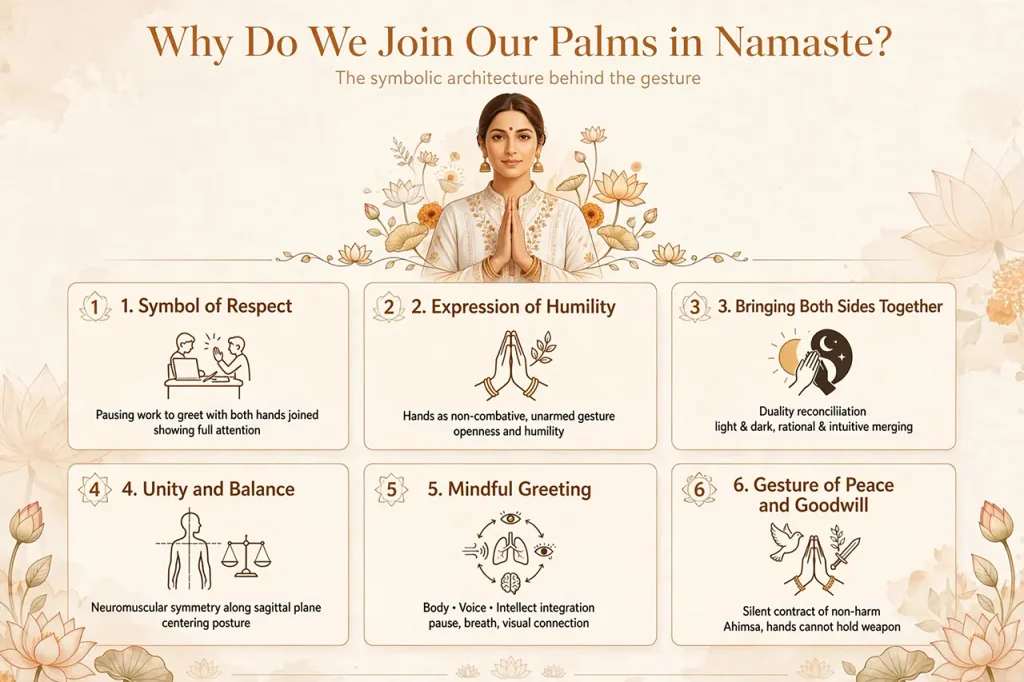
The physical component of bringing the hands together flat against one another is just as meaningful as the spoken word. The act of folding the palms is not a casual flourish; it carries deliberate symbolic architecture.
Symbol of Respect
Joining the palms is a visible declaration that the person before you commands your full attention, honor, and regard. Unlike gestures that can be performed idly with one hand while the other is engaged elsewhere, bringing both hands together requires an individual to pause whatever they are holding or doing, creating an immediate physical and mental commitment to the greeting.
Expression of Humility
The folded hands symbolically neutralize the instruments of self-assertion and physical dominance. Hands are the primary tools by which human beings work, build, grasp, defend, and strike. By bringing the hands together in a closed, non-combative position, the practitioner signals that they come unarmed, without defensive posturing or aggressive intent.
Bringing Both Sides Together
In classical Indian metaphysics, human experience is characterized by dualities: light and dark, rational and intuitive, individual and environment. The two hands represent these split halves of lived reality. Bringing them together visually enacts the reconciliation of opposites into an integrated, harmonious whole.
Unity and Balance
On a neuromuscular and behavioral level, joining the palms aligns the left and right sides of the body along the central sagittal plane. This symmetry physically centers the practitioner, grounding their posture and promoting a momentary state of mental equilibrium before speech begins.
Mindful Greeting
Because Namaste engages both the physical body (the gesture), the voice (the spoken word), and the intellect (the intention), it transforms an automatic, mindless reaction into an act of conscious mindfulness. It requires a brief pause, a steady breath, and deliberate visual connection.
Gesture of Peace and Goodwill
Culturally, joining palms serves as a silent contract of non-harm (Ahimsa). When hands are folded, one cannot grasp an object, push, or brandish a weapon. It is an unambiguous physiological signal that the space between two people is safe, sanctified, and anchored in peace.
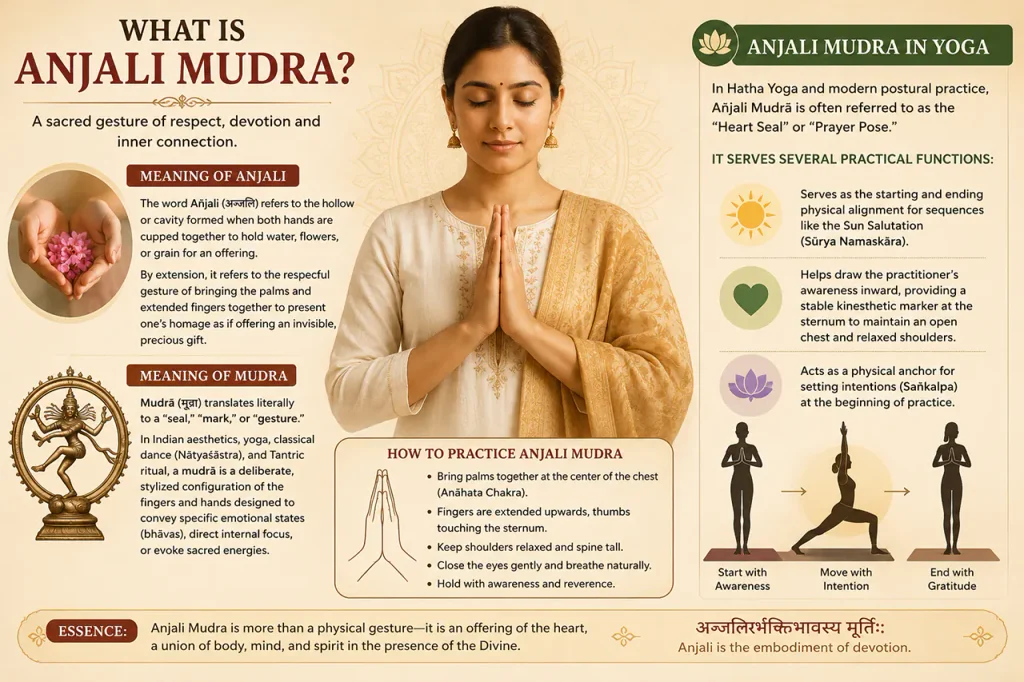
What Is Anjali Mudra?
To understand the technical classification of the folded hands in Indian sculpture, yoga, and classical dance, one must explore the Sanskrit discipline of Mudrā (मुद्रा).
Meaning of Anjali
The word Añjali (अञ्जलि) refers to the hollow or cavity formed when both hands are cupped together to hold water, flowers, or grain for an offering. By extension, it refers to the respectful gesture of bringing the palms and extended fingers together to present one’s homage as if offering an invisible, precious gift.
Meaning of Mudra
Mudrā translates literally to a “seal,” “mark,” or “gesture.” In Indian aesthetics, yoga, classical dance (Nāṭyaśāstra), and Tantric ritual, a mudrā is a deliberate, stylized configuration of the fingers and hands designed to convey specific emotional states (bhāvas), direct internal focus, or evoke sacred energies.
Anjali Mudra in Yoga
In Hatha Yoga and modern postural practice, Añjali Mudrā is often referred to as the “Heart Seal” or “Prayer Pose.”
It serves several practical functions:
- Serves as the starting and ending physical alignment for sequences like the Sun Salutation (Sūrya Namaskāra).
- Helps draw the practitioner’s awareness inward, providing a stable kinesthetic marker at the sternum to maintain an open chest and relaxed shoulders.
- Acts as a physical anchor for setting intentions (Saṅkalpa) at the beginning of practice.
Read More >> Why Do We Offer Water to Sun God? Meaning, Benefits and Surya Arghya
Anjali Mudra in Indian Religious Traditions
In Hinduism, Buddhism, and Jainism, Añjali Mudrā is the foundational posture of devotion (vandanā). It appears across the ancient Buddhist caves of Ajanta, the rock-cut relief carvings of Ellora, and the temple gopurams of Tamil Nadu, symbolizing the surrender of the devotee before the ultimate truth or the divine presence.
Is Namaste the Same as Anjali Mudra?
While frequently used as synonyms in popular conversation, Namaste and Añjali Mudrā belong to different operational categories:
- Namaste is fundamentally a spoken linguistic expression and a broader social ritual. You can say “Namaste” aloud even if your hands are occupied, though folding them is customary.
- Añjali Mudrā is a specific anatomical and sculptural hand gesture. You can hold Añjali Mudrā in silent meditation, pranayama, or dance without ever vocalizing the word Namaste.
- The Intersection: When the physical hand posture (Añjali Mudrā) is executed while uttering the verbal greeting (Namaste), the complete traditional salutation is achieved.
Spiritual Significance of Namaste
Over centuries of contemplation, Indian sages, poets, and philosophical commentators found within this everyday gesture rich metaphors for spiritual realization and cosmic unity.
Seeing the Divine in Others
A pervasive philosophical concept in Indian thought is that the underlying consciousness animates every living being. In this light, greeting another person is not merely an encounter between two personalities, resumes, or social ranks. It becomes an honoring of the sacred spark residing within the other individual.
Important Distinction: The popular contemporary translation “The divine light in me bows to the divine light in you” is a poetic modern paraphrase popularized through global yoga and New Age communities. While it beautifully captures the spirit of Vedantic philosophy, it is an interpretive elaboration rather than the literal Sanskrit translation of the word Namaste.
Humility and Ego
The human ego (Ahaṅkāra) thrives on hierarchy, comparison, and self-aggrandizement. The physical act of lowering the head, softening the gaze, and joining the palms is an antidote to pride. It signals that one is willing to step down from internal self-importance to meet another soul with parity and openness.
Respect for Another Person
In the traditional Indian worldview, respect is not something reserved exclusively for the rich, the powerful, or the accomplished. Because every person is seen as a carrier of life and consciousness, everyone is intrinsically worthy of a respectful salutation.
Inner and Outer Unity
The outer alignment of the body mirrors an inner balancing of the mind. By bringing the split hands together, the practitioner consciously bridges the gap between their subjective internal world and the external objective universe, cultivating harmony between action (karma) and contemplation (jñāna).
Mindfulness and Intention
Automatic habits allow people to greet others while their thoughts wander elsewhere. Performing Namaste correctly requires just enough physical coordination—stopping forward movement, aligning the hands, bowing the neck—to pull the wandering mind back into the present moment.
What Do the Two Palms Represent?
Indian symbolic traditions frequently interpret the two halves of the human body and the two hands as dynamic representations of cosmic and psychological polarities.
- The Individual (Jīvātman) and the Infinite (Paramātman): In traditional schools of dualistic and non-dualistic thought, the right hand represents the higher, universal principle, while the left represents the individual seeker. Bringing them flat against each other portrays the ultimate goal of Indian spirituality: the non-separation of the seeker from Truth.
- Dynamic (Piṅgalā) and Receptive (Iḍā) Currents: In the subtle anatomy of yoga (Nāḍī system), the right side of the body carries solar, active energy, whereas the left side channels lunar, reflective energy. Folding the hands brings these opposing physiological and energetic currents into equilibrium along the central channel (Suṣumnā).
- Reason and Compassion: The right hand represents discernment, structure, and intellect, while the left hand symbolizes feeling, receptivity, and empathy. True wisdom requires both hands to touch; intellect without compassion becomes cold, while compassion without intellect lacks direction.
Why Are the Hands Placed at the Chest?
In classical traditions, the physical placement of the joined hands communicates the context, relationship, and level of reverence intended by the speaker.
The Standard Chest Position
For social interactions, welcoming guests, and greeting peers, the hands rest gently in front of the center of the chest. This aligns anatomically with the sternum and spiritually with the Anāhata Chakra (the heart center). In Indian psychology, the heart—not the brain—is considered the primary seat of pure feeling, unconditional goodwill, and spiritual intuition (hṛdaya). Greeting someone from this region ensures that the exchange is rooted in sincerity rather than intellectual calculation.
Variations by Context and Hierarchy
Traditional etiquette describes three distinct elevations for holding the folded hands:
| Elevation | Anatomical Target | Appropriate Recipient | Traditional Significance |
| Heart Level | Center of sternum (Anāhata) | Friends, colleagues, peers, guests, equals | Sincere social warmth, mutual respect, peaceful interaction |
| Face / Brow Level | Nose bridge or third eye (Ājñā) | Parents, spiritual masters (Gurus), senior elders | Deep reverence, honoring wisdom, seeking instruction |
| Above the Head | Crown of the head (Sahasrāra) | Divine forms, temple sanctums, the Supreme Reality | Complete surrender, transcending personal identity |
How to Perform Namaste Correctly
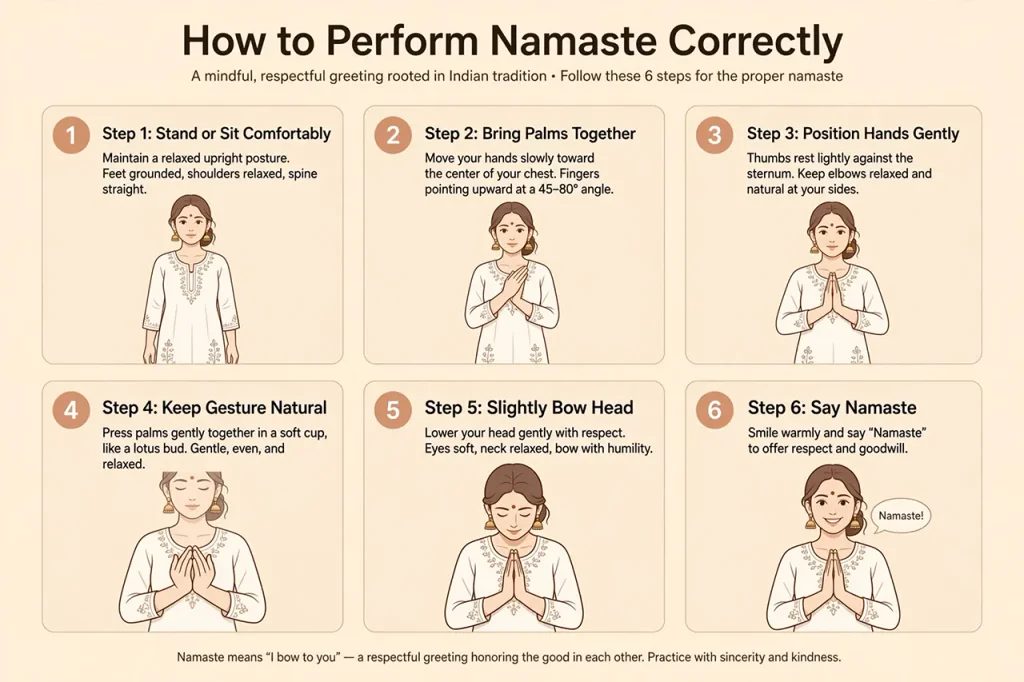
Executing a respectful and authentic Namaste requires no rigid formality, but observing traditional nuances preserves its natural grace and dignity.
Step 1 — Stand or Sit Comfortably
Relax your body, dropping tension from the shoulders, neck, and jaw. Keep your spine comfortably upright and balanced.
Step 2 — Bring the Palms Together
Bring both palms inward along your centerline until they touch flat against each other in front of your chest. Extended fingers should point upward toward the sky at roughly a 45 to 80-degree angle.
Step 3 — Position the Hands Gently
Rest your thumbs lightly against your sternum. The elbows should fall naturally and comfortably to your sides—do not flare them outward aggressively like wings, nor clamp them rigidly against your ribs.
Step 4 — Keep the Gesture Natural
The palms should meet with gentle, even pressure. In classical descriptions, the center of the palms remains slightly cupped rather than squashed completely flat, mimicking a blossoming lotus bud (Kumoḍa or Mukula).
Step 5 — Slightly Bow the Head
Incline your head and neck forward in a smooth, subtle bow. This motion is not a deep waist-bend, but a gentle nodding gesture that signals modesty and yields personal space.
Step 6 — Say “Namaste” or “Namaskar”
Utter the word clearly, softly, and warmly. If in a quiet space (such as a temple, yoga hall, or meditation room), the vocalization can be omitted entirely; the physical gesture alone conveys the complete greeting.
When Do People Use Namaste?
Namaste is remarkably versatile across the Indian cultural sphere, transitioning effortlessly between ordinary social encounters and high sacred rituals.
- Greeting Elders: Younger family members greet grandparents, parents, and seniors with folded hands as an instinctive mark of filial piety and respect.
- Welcoming Guests (Atithi Satkāra): In accordance with the ancient cultural ethos “Atithi Devo Bhava” (the guest is treated with divine honor), hosts greet visitors at the doorway with joined hands.
- Temple Worship: Devotees enter sacred precincts with hands folded continuously during circumambulation (Pradakṣiṇā) and while standing before the sanctum (Garbagṛha).
- Formal and Public Speeches: Indian public figures, educators, and leaders initiate and conclude speeches before large audiences with folded hands to honor the collective assembly.
- Apology and Forgiveness: If one accidentally bumps into someone or makes an unintentional social error, immediately joining the hands and bowing serves as an instant, heartfelt non-verbal apology.
- Departures and Farewells: Namaste serves equally well as a parting blessing, wishing safety and peace upon the traveler as they leave.
Namaste in Hindu Religious Traditions
In the context of traditional Hindu practices (Sanātana Dharma), the folded-hands gesture is central to personal and communal worship.
Puja and Upachara
During formal worship rituals (Pūjā), the priest or householder presents various offerings (upachāras) to the consecrated deity—such as water, incense, lamps (Āratī), and flowers. At several junctures in the ritual liturgy, the texts instruct the worshipper to offer Vandanā or Namaskāra by folding the hands while chanting specific Sanskrit stanzas, symbolizing total dedication of actions to God.
Temple Darshan
When standing before the inner sanctum for Darśana (the reciprocal act of seeing and being seen by the deity), devotees do not reach out to touch the stone image. Instead, they stand quietly with hands folded at the heart or brow, absorbing the sight in silent contemplation.
Receiving Blessings (Ashirvad)
When approaching a guru, an elderly family member, or a temple priest for blessings, one folds the hands while lowering the head. The elder responds by placing their open right palm over or near the devotee’s head in the gesture of fearlessness (Abhaya Mudrā), creating a reciprocal exchange of humility and protective goodwill.
Namaste and Hindu Philosophy
The philosophical foundation of Namaste is intimately connected to the core metaphysical insights of classical Indian traditions.
The Concept of Atman
Central to the Upanishads is the realization that beyond the physical body (annamaya kośa) and changing mental states lies the Ātman—the immortal, conscious essence. When two people greet each other with Namaste, the gesture acknowledges that both share the same fundamental conscious reality, regardless of external social differences.
Ahimsa and Non-Injury
Ahimsa (non-violence in thought, speech, and physical action) is the cornerstone of Hindu, Buddhist, and Jain ethics. Namaste is the physical embodiment of Ahimsa. It maintains a respectful physical perimeter without invading the other person’s boundary, keeping physical interactions clean, calm, and harmless.
Transcending Duality (Dvaita to Advaita)
In the non-dualistic school of Advaita Vedanta, the universe of separate objects is an expression of one non-dual reality (Brahman). Joining the two palms represents the collapsing of apparent dualities—knower and known, sacred and profane, internal and external—into singular awareness.
Namaste vs Namaskar
While often used interchangeably across northern and western India, subtle linguistic and regional distinctions exist between these two familiar greetings.
Linguistic Roots
- Namaste (नमस्ते): Formed from Namaḥ + Te (“Obeisance to you”). It contains an explicit grammatical object (te = “you”), making it a direct relational statement from one individual to another.
- Namaskar / Namaskara (नमस्कार): Formed from Namaḥ + Kāra (“making” or “doing”). It translates literally to “the performance of bowing” or “the offering of homage.” It names the action itself rather than identifying a specific grammatical recipient.
Comparison Table
| Feature | Namaste | Namaskar |
| Sanskrit Construction | Namaḥ + Te (Dative pronoun) | Namaḥ + Kāra (Action noun) |
| Direct Translation | “Bow / reverence to you” | “The making of reverence / homage” |
| Formal Tone | Warm, conversational, intimate | Highly formal, dignified, traditional |
| Audience Scope | Best suited for one-on-one greetings | Can easily greet a collective audience or assembly |
| Regional Preference | Widespread in Hindi belts and worldwide | Dominant in Marathi, Bengali, Odia, and formal Hindi |
| Ritual Usage | Common in social salutations | Common in liturgical compositions (Sūrya Namaskār) |
Namaste vs Anjali Mudra
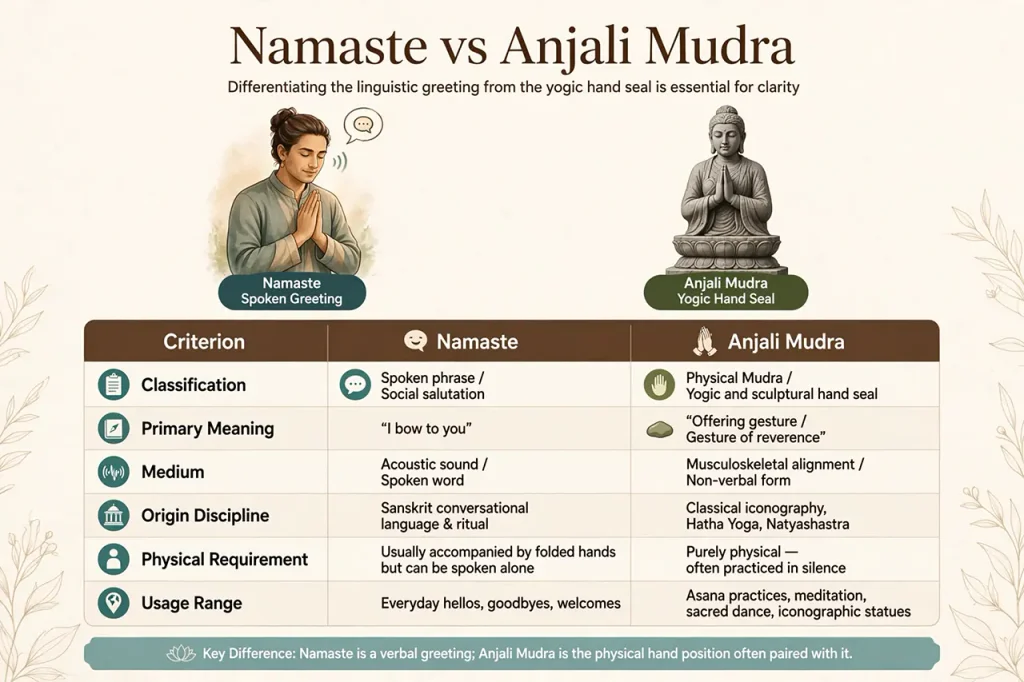
Because Western fitness and wellness contexts often blend these terms, differentiating the linguistic greeting from the yogic hand seal is essential for clarity.
| Criterion | Namaste | Anjali Mudra |
| Classification | Spoken phrase / Social salutation | Physical Mudra / Yogic and sculptural hand seal |
| Primary Meaning | “I bow to you” | “Offering gesture” / “Gesture of reverence” |
| Medium | Acoustic sound / Spoken word | Musculoskeletal alignment / Non-verbal form |
| Origin Discipline | Sanskrit conversational language & ritual | Classical iconography, Hatha Yoga, Nāṭyaśāstra |
| Physical Requirement | Usually accompanied by folded hands, but can be spoken alone | Purely physical; often practiced in complete silence |
| Usage Range | Everyday hellos, goodbyes, welcomes | Asana practices, meditation, sacred dance, iconographic statues |
Namaste Across India: Regional and Linguistic Variations
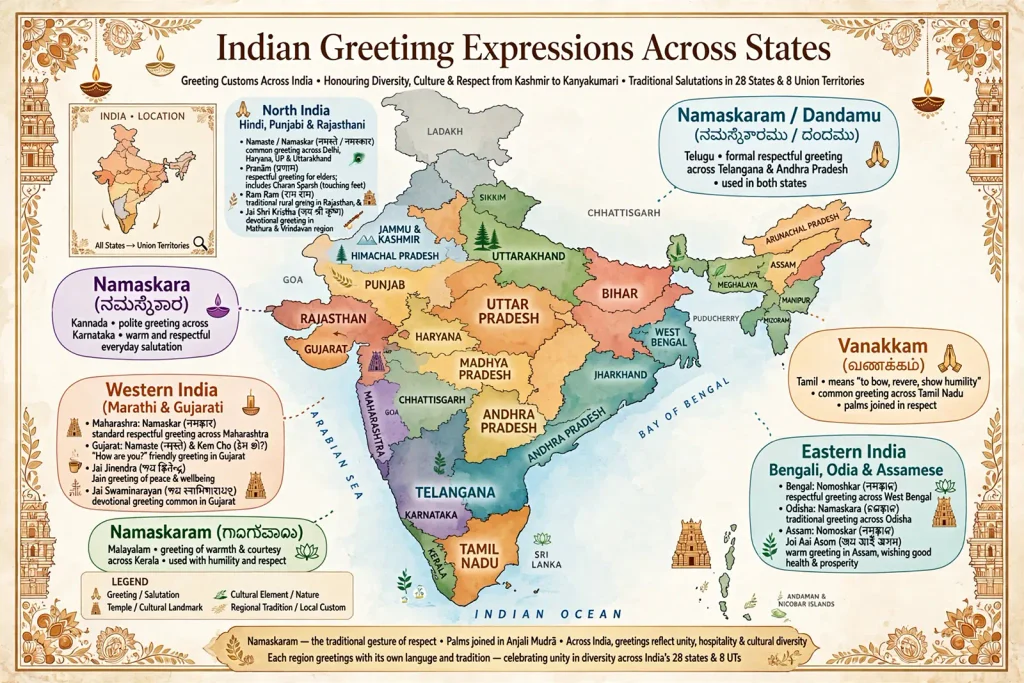
India is a vast subcontinent home to hundreds of languages and regional traditions. While the physical gesture of folding hands is shared across almost every state, the spoken greeting changes across different linguistic landscapes.
North India (Hindi, Punjabi, Rajasthani)
In the northern states, Namaste and Namaskar are widely understood and used. In traditional families, the term Pranām (प्रणाम, meaning “salutation with deep reverence”) is widely used when addressing elders, teachers, or parents, often accompanied by touching the elder’s feet (Charan Sparsh). Rural areas often use devotional salutations such as Ram Ram or Jai Shri Krishna.
Western India (Maharashtra and Gujarat)
In Maharashtra, Namaskār (नमस्कार) is the undisputed standard for both formal and informal respectful greetings. In Gujarat, while Namaste is common, people frequently use informal greetings like Kem Cho (How are you?) in daily life, alongside religious salutations like Jai Jinendra (among Jains) or Jai Swaminarayan.
Eastern India (Bengal, Odisha, Assam)
In Bengal, the greeting is pronounced with soft rounded vowels as Nomoshkār (নমস্কার). In Odisha, it is Namaskāra (ନମସ୍କାର), used gracefully in temple settings and homes alike.
South India (Tamil Nadu, Andhra Pradesh, Telangana, Karnataka, Kerala)
The southern states share the physical gesture of joined palms, but express it through their classical Dravidian and Sanskrit-derived languages:
| State / Region | Language | Spoken Greeting | Meaning & Context |
| Tamil Nadu | Tamil | Vanakkam (வணக்கம்) | Derived from classical Tamil roots meaning “to bow,” “revere,” or “show humility.” Accompanied by identical joined palms. |
| Andhra Pradesh & Telangana | Telugu | Namaskāram (నమస్కారం) / Dandamu | Formal, respectful greeting used across all social tiers. |
| Karnataka | Kannada | Namaskāra (ನಮಸ್ಕಾರ) | The standard polite greeting across urban and rural Karnataka. |
| Kerala | Malayalam | Namaskāram (നമസ്കാരം) | Universal greeting expressing deep courtesy and welcoming warmth. |
Namaste in Indian Temple Culture
Inside an Indian temple, the joined-hands posture ceases to be a social convention and transforms into a focused ritual act of devotion.
Entering the Temple Complex
Devotees pause at the temple entryway (Gopuram or outer threshold) to touch the steps, bow their heads, and fold their hands. This acts as a conscious boundary marker, leaving mundane concerns outside before stepping into the sanctified courtyard.
Posture During Darshan
While standing before the Mūrti (the consecrated image of the deity), devotees hold their hands continuously in Añjali Mudrā. The gesture here is an expression of complete surrender (Śaraṇāgati), declaring that the devotee comes with an open, unburdened heart.
Interacting with Priests and Spiritual Teachers
When greeting temple priests (Pujaris), monks, or spiritual mentors, devotees offer Namaste at the level of the chin or brow. This acknowledges the sacred lineage of learning (Guru Paramparā) that the teacher represents.
History of Namaste
The history of folding hands in salutation stretches back across thousands of years of South Asian civilization, documented in archaeological findings, classical literature, and stone reliefs.
Archaeological Evidence from the Indus Valley
Among the terracotta figurines excavated from ancient Indus Valley sites (such as Harappa and Mohenjo-daro, dating back to roughly 2500 BCE), archaeologists discovered small human figures with their palms pressed together at the chest. While we cannot reconstruct their spoken language with certainty, the physical posture shows that bringing the hands together in a respectful or devotional gesture has very deep roots on the subcontinent.
References in Vedic and Epic Literature
The root Nam and the exclamation Namaḥ appear hundreds of times across the four Vedas. In the Śrī Rudram of the Yajurveda, entire sections consist of repetitive, rhythmic chants of Namaḥ directed toward the divine presence in nature, mountains, waters, craftsmen, and wanderers. In the great epics—the Rāmāyaṇa and the Mahābhārata—characters regularly greet kings, sages, parents, and friends by offering Namaḥ, Pranām, or Añjali.
Evolution of Greeting Customs
In earlier periods, Namaḥ was predominantly liturgical—an utterance directed toward deities and sacred elements during fire sacrifices (Yajña). Over centuries, this language moved seamlessly from ritual spaces into courtly etiquette, everyday social courtesy, and familial life, giving rise to Namaste and Namaskar as universal cultural greetings.
Namaste in Indian Art and Temple Sculpture
Indian artists, sculptors, and bronze casters used the folded-hands motif across stone, plaster, and metal for over two thousand years.
Devotees and Royal Patrons
In major temple complexes—such as the Brihadisvara Temple in Thanjavur or the Vijayanagara ruins at Hampi—pillars frequently feature life-sized stone portraits of kings, queens, and wealthy patrons standing with their hands folded in perpetual Añjali Mudrā, carved forever in an attitude of humble service toward the deity.
Hanuman and Garuda in Temple Iconography
In Hindu iconography, certain deities are almost exclusively depicted with folded hands to emphasize their unshakeable devotion:
- Lord Hanuman: Often portrayed standing slightly bowed with folded hands before Lord Rama, exemplifying pure selfless service (Dāsya Bhakti).
- Garuda: The eagle mount of Lord Vishnu is standardly sculpted with wings spread wide while his two front hands rest in Añjali Mudrā facing the sanctum.
Cultural Significance of Namaste
Beyond philosophy and religion, Namaste acts as an everyday social cornerstone that supports healthy, harmonious community life.
- Hospitality (Atithi Satkāra): Indian culture views hospitality as a sacred duty. Offering Namaste to someone entering your home signals that they are welcome, safe, and honored.
- Respect for Elders: By instinctively folding hands before older generations, younger individuals express gratitude for their guidance and acknowledge the lineage of family and community wisdom.
- Respecting Personal Space: Namaste provides an affectionate, courteous connection without requiring physical contact. It honors each person’s comfort zone, avoiding the awkwardness that can arise from unwanted touch.
- Social Leveling: Because the gesture is identical regardless of who performs it, a CEO and an entry-level worker, a monarch and a citizen, exchange the exact same sign. It serves as a subtle reminder of shared human dignity.
Is Namaste Only a Hindu Greeting?
While Namaste originates from Sanskrit roots and forms an essential part of Hindu practices, its modern usage is broader and more nuanced.
Across South Asia, millions of people use folded hands and the spoken word Namaste (or regional equivalents like Vanakkam and Namaskaram) as an overarching civic and cultural greeting, irrespective of personal faith. It is used on state television, in corporate boardrooms, at airport welcoming desks, and in classrooms throughout India.
Furthermore, Añjali Mudrā is completely integral to Buddhism and Jainism. In Buddhist traditions across Sri Lanka, Thailand, Myanmar, Tibet, Japan, and Cambodia, bowing with joined palms (known as Wai in Thailand, Gassho in Japan, and Sampeah in Cambodia) is the primary gesture of devotion and everyday courtesy.
Is There a Scientific Meaning Behind Namaste?
In recent years, many enthusiastic internet claims have circulated regarding the “scientific benefits” of Namaste. Responsible cultural scholarship requires separating verified physical and psychological realities from pseudo-scientific exaggerations.
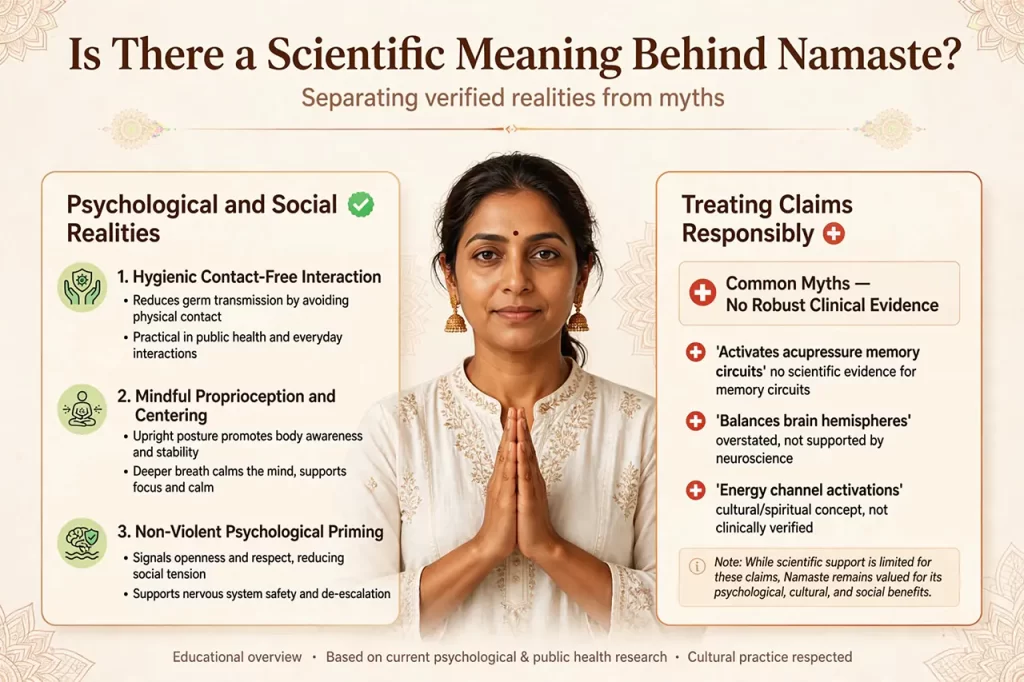
Psychological and Social Realities
- Hygienic Contact-Free Interaction: Hands are primary vectors for bacterial and viral transmission. Contactless greetings naturally eliminate the transfer of surface pathogens, offering a polite, hygienic way to greet others.
- Mindful Proprioception and Centering: Bringing the palms together symmetrically encourages an upright, centered posture. This gentle somatic cue helps settle erratic physical movements, prompting a deeper breath and a calmer mental state.
- Non-Violent Psychological Priming: The human nervous system constantly monitors body language for threat cues. Closed, non-threatening, open-palmed gestures de-escalate tension and foster an atmosphere of safety.
Treating Claims Responsibly
Popular social media posts often claim that pressing fingertips together “activates major acupressure points that stimulate memory circuits and brain hemispheres.” There is currently no robust clinical scientific evidence verifying these specific physiological claims. Namaste is best appreciated for what it truly is: a profound cultural, philosophical, and social gesture of mutual respect, rather than a clinical medical therapy.
Why Did Namaste Become Popular Around the World?
Over the past century, Namaste has expanded far beyond the borders of South Asia to become an internationally recognized symbol of peace, mindfulness, and welcome.
- The Worldwide Spread of Yoga: As modern postural yoga spread across Europe, the Americas, and East Asia, instructors adopted Namaste and Añjali Mudrā as standard rituals to open and close classes, framing the practice with gratitude and respect.
- The Global Indian Diaspora: Indian communities around the world preserved and shared their cultural heritage, making the greeting a familiar sight in international schools, workplaces, and neighborhoods.
- Contactless Greetings During Pandemics: During global health crises (such as the COVID-19 pandemic), world leaders, diplomats, and health organizations highlighted Namaste as an ideal, dignified, non-contact alternative to handshakes.
- Resonance with Modern Mindfulness: Modern seekers appreciate the gesture because it offers a brief, centering pause in a fast-paced, screen-saturated world.
Namaste Etiquette: Practical Guidelines
Knowing how and when to use Namaste helps you navigate both traditional Indian contexts and modern multicultural environments with confidence and ease.
When to Use Namaste
- When traveling in India, Nepal, and South Asia to greet hosts, hotel staff, guides, new acquaintances, and elders.
- When visiting Hindu, Buddhist, or Jain temples, holy shrines, and meditation spaces.
- When opening or concluding a yoga session or cultural event.
- Whenever you want to convey a warm, respectful greeting without physical contact.
Handling Mixed Social Settings (Handshakes vs. Namaste)
In contemporary Indian business environments, professionals often exchange standard handshakes. However, if an acquaintance or elder greets you with folded hands, it is courteous to mirror their gesture and offer Namaste in return.
Avoiding Exaggerations
A common mistake among beginners is performing an overly dramatic, ninety-degree bow or holding the hands rigidly in front of the nose during casual social greetings. Keep the gesture simple, natural, and relaxed—a gentle bringing together of the hands at the chest paired with a warm smile and an inclination of the head is all that is required.
Common Misconceptions About Namaste
Misconception 1: Literal Translation vs. Poetic Adaptation
- The Claim: “Namaste is an ancient Sanskrit word that literally means ‘I bow to the divine light within your heart.’“
- The Reality: Linguistically, Namaste means “Obeisance / reverence to you.” While the philosophical tradition of Vedanta certainly teaches that the divine consciousness resides in all beings, attributing that entire sentence as the literal lexical translation of the single word Namaste is incorrect.
Misconception 2: Exclusively a Hindu Prayer
- The Claim: “Non-Hindus should never use Namaste because it is strictly a religious prayer.”
- The Reality: While it has profound religious roots, Namaste functions widely as a secular and cultural greeting across South Asia, much like “Good morning” or “Welcome.”
Misconception 3: Rigid Anatomical Demands
- The Claim: “If your thumbs do not touch the exact center of your fourth rib, the gesture is invalid.”
- The Reality: Traditional cultural gestures emphasize sincere intent (Bhāva) over rigid anatomical precision. Natural ease and genuine courtesy are what truly matter.
Namaste and Other Traditional Indian Greetings
The Indian subcontinent is home to a rich variety of verbal greetings and gestures.
| Greeting | Language / Tradition | Typical Social Context | Cultural Meaning |
| Namaste | Sanskrit / Hindi / Pan-Indian | General respectful greeting; meetings and departures | “Obeisance to you” |
| Namaskar | Sanskrit / Marathi / Bengali / Odia | Formal meetings, public gatherings, daily greetings | “Offering reverent homage” |
| Pranām | Sanskrit / North Indian | Addressing parents, teachers, and senior elders | “Bowing deeply with total respect” |
| Vanakkam | Tamil | Universal greeting across Tamil communities | “Greeting with humility and reverence” |
| Charan Sparsh | Pan-Indian Hindu custom | Touching the feet of parents, grandparents, and gurus | “Seeking the dust of the elder’s feet for blessings” |
| Sat Sri Akal | Punjabi / Sikh tradition | Universal Sikh greeting | “True is the Timeless Lord” |
| Jai Jinendra | Prakrit / Jain tradition | Universal Jain greeting | “Victory to the inner conquerors (Jinas)” |
Frequently Asked Questions
1. What does Namaste mean?
Namaste is a classical Sanskrit expression formed by combining namaḥ (meaning “reverence,” “bow,” or “homage”) and te (meaning “to you”). Literally translated, it means “Obeisance to you” or “I bow to you.” It is used throughout South Asia as a respectful greeting when meeting or parting from others.
2. What is the meaning of Namaste in Hinduism?
In Hinduism, Namaste carries a deep philosophical layer alongside its everyday social use. It reflects the recognition that the same sacred, conscious reality (Ātman) resides within all beings. By bowing and folding the hands, a person looks past external social differences to honor the divine essence within the individual before them.
3. Why do we join our palms in Namaste?
Joining the palms brings both sides of the body into alignment along the centerline, signaling mental presence, inner balance, and undivided attention. Physically, it neutralizes potential aggression and demonstrates peaceful intent. Spiritually, it symbolizes the integration of opposites—such as thought and action, or the individual self and universal consciousness.
4. What does joining hands together symbolize?
Joining the hands symbolizes humility, mutual respect, and unity. It serves as an embodied statement of Ahimsa (non-harm), indicating that one approaches another person with an open heart, clear boundaries, and no hostile intent.
5. What is Anjali Mudra?
Añjali Mudrā is the classical Sanskrit name for the physical hand posture of pressing both palms together in front of the chest or brow. In yoga, temple rituals, and Indian classical dance, it is known as the “seal of offering” or “prayer posture,” designed to center the mind and cultivate reverent focus.
6. Is Namaste the same as Anjali Mudra?
Not exactly. Namaste is the spoken word and overall social greeting, whereas Añjali Mudrā is the specific physical hand posture. You can form Añjali Mudrā in silent meditation without speaking, or say Namaste as a greeting. Performing both simultaneously creates the complete traditional salutation.
7. What is the difference between Namaste and Namaskar?
Namaste translates to “reverence to you” (directed to a specific person), whereas Namaskar translates to “the offering of reverence” (describing the action itself). Namaskar is often felt to be more formal, and can easily be offered to a large group or assembly.
8. Why are the hands placed near the chest during Namaste?
Placing the hands near the center of the chest connects the gesture to the heart center (Anāhata), which Indian thought views as the seat of sincere feeling, intuition, and goodwill. Greeting someone from the heart emphasizes that the interaction is grounded in warmth and genuine respect rather than cold formality.
9. Is Namaste an exclusively Hindu greeting?
No. While it has deep roots in Sanskrit and Hindu traditions, Namaste functions broadly as an Indian cultural greeting across many communities. Similar gestures of bowing with folded hands are also foundational to Buddhism, Jainism, and broader Asian cultural heritage.
10. Is Namaste used outside India?
Yes. Thanks to the worldwide popularity of yoga, international travel, and Indian cultural influence, Namaste is recognized across the globe as a universal symbol of peace, mindfulness, and respectful welcome.
11. When should you use Namaste?
You can use Namaste whenever welcoming guests, meeting elders, greeting acquaintances, visiting temples, or starting and finishing yoga sessions. It is also an ideal, polite greeting when you wish to show deep respect without physical contact.
12. How do you perform Namaste correctly?
Bring both palms together flat in front of your chest with fingers pointing upward and thumbs resting gently near your sternum. Incline your head forward in a smooth, subtle bow, and say “Namaste” with a warm, calm tone.
13. Why do Indians join their hands when greeting?
Joining hands is a long-standing cultural custom that communicates respect, preserves clean personal boundaries, de-escalates pride, and honors the character and dignity of the person being greeted.
14. What do the two palms represent in Namaste?
Symbolically, the two palms represent dualities: the right hand symbolizes the active, solar principle and wisdom, while the left represents the receptive, lunar principle and intuition. Bringing them together at the chest represents harmony, balance, and the integration of opposites.
15. Is Namaste mentioned in ancient Sanskrit scriptures?
Yes. The root Nam and the word Namaḥ appear extensively throughout the four Vedas (such as the Śrī Rudram of the Yajurveda), the Upanishads, and the epics Rāmāyaṇa and Mahābhārata, primarily as an expression of reverence and devotion.
16. Is Namaste a religious or cultural gesture?
It is both. In temple settings and home rituals, it is an act of spiritual devotion (Bhakti). In everyday life, on public stages, and in homes, it serves as a polite, civic cultural greeting.
17. Is there a scientific explanation for Namaste?
From a practical perspective, Namaste is a hygienic, non-contact greeting that prevents the spread of pathogens. Psychologically, bringing the hands symmetrically to the body’s midline encourages mindful presence, calm breathing, and non-threatening social body language.
18. Is Namaste appropriate in temples?
Yes, it is the primary gesture used inside Hindu, Buddhist, and Jain temples. Devotees fold their hands when entering, while circumambulating the shrine, and during Darshan before the sanctum.
19. Is Namaste used in yoga?
Yes. In yoga, the physical posture (Añjali Mudrā) is used to begin and conclude sequences like the Sun Salutation (Sūrya Namaskāra) and to close classes with a shared expression of focus, balance, and gratitude.
20. Why did Namaste become popular globally?
Global interest in yoga and mindfulness, the contributions of the Indian diaspora, and international appreciation for its peaceful, hygienic, non-contact nature have made Namaste one of the world’s most recognized gestures.