
The Meaning of Sattva, Rajas, and Tamas in Daily Hindu Living
Sattva, Rajas, and Tamas: Have you ever noticed how your state of mind can completely shift from one morning to the next, even when your routine stays the same?
On Monday morning, you might wake up feeling rested, clear-headed, and patient. When someone drops a glass in the kitchen or interrupts your work, you clean it up calmly without a trace of irritation. The day feels spacious.

By Wednesday afternoon, an entirely different energy takes over. You find yourself pacing the floor, refreshing your email every thirty seconds, mentally calculating everything you need to accomplish this month, and feeling a sudden surge of irritation when an internet page loads too slowly. Your heart beats faster, your mind races with plans, and you cannot seem to sit still.
Then comes Saturday. You wake up feeling heavy, sluggish, and foggy. The alarm rings, but your body feels glued to the mattress. Even answering a simple text message or stepping out for fresh air feels like climbing a mountain. You postpone tasks you promised yourself you would finish, pulling the blanket over your head to drift into an unrefreshing haze.
What happened? You are the exact same human being. Your name has not changed. Your values have not vanished. Yet the lens through which you experience the world underwent three distinct shifts.
Thousands of years ago, the sages of ancient India observed this exact rhythm in human nature and the cosmos. They realized that our physical bodies, our emotional reactions, and our mental states are influenced by three fundamental qualities known in Hindu philosophy as the three gunas: Sattva, Rajas, and Tamas.
Understanding these three qualities is not an abstract exercise meant only for scholars or monks living in forest hermitages. It is one of the most practical, compassionate, and life-changing psychological maps ever created. It gives you a clear language to understand your moods, your energy levels, your food cravings, and your spiritual path—without judging yourself harshly.
Let us explore what Sattva, Rajas, and Tamas truly mean, how they operate in your everyday life, and how you can work with them to cultivate lasting peace, purposeful action, and inner clarity.
What Are Sattva, Rajas, and Tamas?
To understand these three qualities, we must first look at what the ancient texts mean by the word guna.
Direct Answer for Search & AI Overviews:
In Hindu philosophy, Sattva, Rajas, and Tamas are the three fundamental qualities, attributes, or operating energies (gunas) that constitute all created nature (Prakriti). Sattva represents balance, clarity, harmony, and light. Rajas represents passion, movement, ambition, and restless desire. Tamas represents heaviness, inertia, darkness, and stability. Together, they shape all matter, thought, emotion, and behavior.
The Meaning of the Word Guna
In everyday conversational Sanskrit, the word guna (pronounced goo-nuh) carries two beautiful, deeply illuminating meanings:
- Quality or Attribute: It refers to the inherent character, nature, or virtue of something. Just as sweet is the guna of sugar and heat is the guna of fire, our minds express different qualities at different times.
- Strand or Thread of a Rope: In classical literature, a guna is a single strand of woven fiber. Just as three individual strands are twisted together to form a strong, binding rope, the three qualities of Sattva, Rajas, and Tamas are woven together to create the entire fabric of the material world and human personality.
These qualities are not visible objects you can hold in your hand. You cannot place a drop of Sattva under a microscope or measure a gram of Rajas on a kitchen scale. Instead, they are underlying tendencies or energetic modes through which nature expresses itself.
The Cosmic Root: Prakriti and the Three Forces(Sattva rajas tamas)
To appreciate where the gunas come from, we turn briefly to one of the six classical systems of Hindu thought: Sankhya philosophy (founded by the sage Kapila), which deeply informs the Bhagavad Gita and the Yoga Sutras.
Sankhya teaches that reality consists of two eternal, co-existing realities:
- Purusha: Pure, unchanging consciousness. This is the true, immortal self (Atman), the silent witness of all life. It has no physical qualities, no movement, and no flaws.
- Prakriti: Primal nature. This is everything that changes, moves, and takes form. It includes the physical universe, stars, planets, our biological bodies, our brain cells, our memories, and our thoughts.
Before the universe took shape, Sankhya explains that Prakriti was in a state of absolute, unmanifest balance. The three gunas existed in perfect equilibrium. The moment that equilibrium shifted, creation burst into motion.
From that cosmic dance down to the smallest thought crossing your mind right now, every single aspect of nature is woven from Sattva, Rajas, and Tamas.
Nothing in the physical world is made purely of one guna. Every physical object, every animal, every human being, and every passing mood is an ever-shifting combination of all three.
- Tamas provides the stable, solid physical structure.
- Rajas provides the energy, chemical reactions, and movement.
- Sattva provides the organization, clarity, intelligence, and harmony that holds the system together.
The Three Gunas at a Glance: A Quick Reference
Before we examine each quality in detail, the table below offers an accessible side-by-side snapshot of how the three gunas express themselves across different dimensions of life.
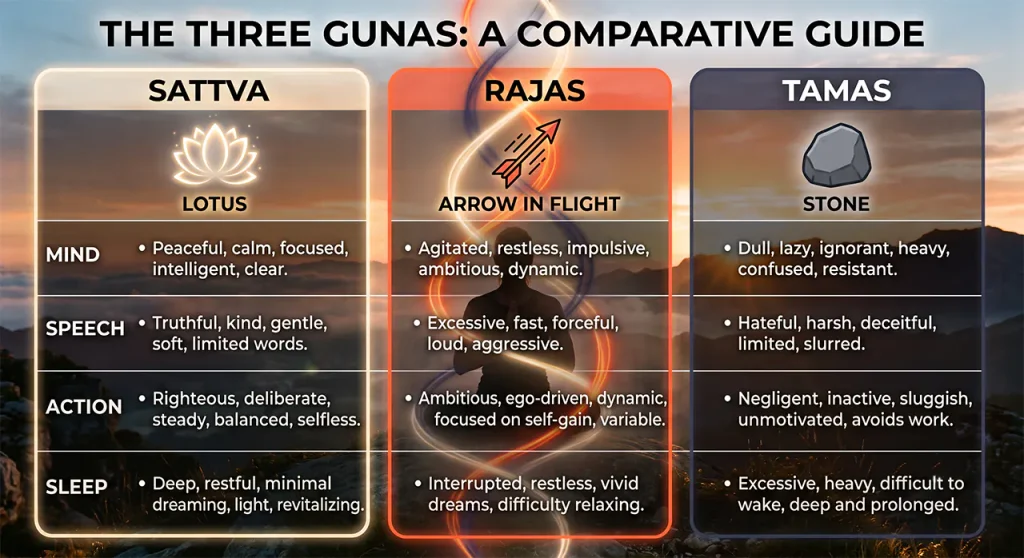
| Dimension | Sattva (Clarity & Harmony) | Rajas (Passion & Activity) | Tamas (Inertia & Heaviness) |
| Core Meaning | Purity, light, balance, wisdom | Energy, movement, desire, drive | Dullness, darkness, rest, obstruction |
| Mental State | Calm, alert, focused, peaceful | Restless, agitated, planning, anxious | Foggy, confused, forgetful, sluggish |
| Primary Motivation | Understanding, truth, service | Achievement, winning, recognition | Comfort, avoiding effort, protection |
| Emotional Tone | Contentment, compassion, joy | Ambition, impatience, craving, pride | Apathy, fear, resentment, stubbornness |
| Relationship to Work | Done with care, without personal greed | Driven by personal ambition and rewards | Delayed through procrastination or neglect |
| Speech | Gentle, truthful, timely, helpful | Fast, persuasive, argumentative, boastful | Harsh, complaining, deceitful, or silent |
| Sleep | Deep, peaceful, restorative (6–8 hrs) | Broken, dream-heavy, racing thoughts | Excessive (9+ hrs), heavy, waking tired |
| Physical Sensation | Light, clean, energized, relaxed | Tense, jittery, tight chest or shoulders | Heavy, stiff, achy, physically drained |
| Daily Analogy | A clean, crystal-clear window | A colored, vibrating stained-glass pane | A window covered in thick layers of mud |
What Is Sattva Guna? The Quality of Light and Balance
The word Sattva comes from the Sanskrit root Sat, which means truth, reality, existence, and goodness. Sattva is the quality of light, clarity, purity, and balance.
In the natural world, Sattva is visible in the gentle warmth of the early morning dawn, the stillness of a mountain lake, the effortless flight of a bird riding an air current, and the balanced health of a living ecosystem.
In human life, Sattva reveals itself whenever the mind becomes quiet, transparent, and joyful without needing external entertainment.

How Sattva Feels in the Mind
When Sattva is dominant within you, your mind feels like a calm, clean body of water. You can see straight to the bottom.
- Your thoughts are orderly and steady.
- You do not feel the urge to rush, panic, or prove your worth to anyone.
- You absorb information quickly and understand complex ideas without mental fatigue.
- You experience a natural, unforced cheerfulness that does not depend on winning a prize or receiving praise.
The Bhagavad Gita describes this state in Chapter 14, Verse 6:
tatra sattvaṁ nirmalatvāt prakāśakam anāmayam
sukha-saṅgena badhnāti jñāna-saṅgena cānagha
(Bhagavad Gita 14.6)
Meaning: “Among these, Sattva, being pure, is luminous and free from sorrow. It binds the soul through attachment to happiness and attachment to knowledge, O sinless one.”
Notice an important detail here: Sri Krishna points out that while Sattva is radiant (prakāśakam) and healthy (anāmayam), it is still a quality of nature. It can still bind the soul if one becomes proud of one’s own goodness, intelligence, or peace. Even so, Sattva is the ideal vehicle for living a wise, kind, and purposeful life.
Sattva in Action, Speech, and Daily Habits
A person experiencing Sattva does not work out of frantic greed or fear of failure. They work with mindful dedication.
- Action: Tasks are performed carefully, thoroughly, and selflessly. The focus remains on doing the work well for the welfare of others (loka-sangraha), rather than obsessing over personal accolades.
- Speech: Words are spoken with truthfulness, gentleness, and necessity. As Sri Krishna outlines in the Bhagavad Gita (17.15), sattvic speech causes no distress, is honest, pleasant, beneficial, and rooted in self-reflection.
- Relationships: Interactions are marked by empathy, active listening, and genuine patience. A sattvic mind does not keep score of small slights and does not hold onto grudges.
Daily Life Examples of Sattva
- The Morning Walk: You walk through a park at sunrise without headphones, breathing in the crisp morning air, appreciating the rustle of leaves, feeling grateful to be alive.
- The Difficult Meeting: A colleague loses their temper during a project review. Instead of retaliating or shutting down, you take a deep, steady breath, listen underneath their frustration, and respond calmly: “Let us look at the numbers together and find a solution.”
- Cooking a Meal: You prepare lunch with fresh vegetables, keeping your workspace clean, smiling as you cook, wishing health and happiness to everyone who will eat the food.
What Is Rajas Guna? The Quality of Passion and Movement
The Sanskrit word Rajas comes from roots associated with passion, color, emotion, and movement. It is the cosmic energy of kinetic activity, change, creation, and driven effort.
Without Rajas, nothing in the universe would ever happen. Plants would not grow toward the sky, planets would not orbit the sun, hearts would not pump blood, and humans would never build homes, write books, or stand up against injustice. Rajas is the engine of action.
However, when Rajas becomes excessive or uncontrolled, it turns into burning desire, intense restlessness, and perpetual dissatisfaction.

The Power and Pain of Desire
In Chapter 14, Verse 7 of the Bhagavad Gita, Sri Krishna explains the essence of Rajas:
rajo rāgātmakaṁ viddhi tṛṣṇā-saṅga-samudbhavam
tan nibadhnāti kaunteya karma-saṅgena dehinam
(Bhagavad Gita 14.7)
Meaning: “Know Rajas to be of the nature of passion, arising from thirst (craving) and intense attachment. It binds the embodied soul, O son of Kunti, by fast attachment to action and its fruits.”
The defining mark of Rajas is trishna (craving or burning thirst). When Rajas dominates, the mind whispers: “I will be happy only when I get that promotion,” “I will relax only when I buy that house,” or “I must convince everyone that my opinion is right.”
The moment a desire is satisfied, Rajas does not bring peace; it creates a new, bigger desire. If an obstacle blocks that desire, Rajas transforms into anger (krodha).
Rajas in Work, Ambition, and Relationships
- At Work: Rajas appears as relentless ambition, hyper-competitiveness, and workaholism. The person works eighty hours a week not out of joy, but out of fear of falling behind or a burning hunger for status, titles, and applause.
- In the Mind: Thoughts jump rapidly from one project to another. The body sits in a chair, but the mind is already rehearsing a conversation taking place next Friday. Relaxation feels like a waste of time.
- In Relationships: Relationships become transactional. A rajasic mindset views people through the lens of utility: “How does knowing this person help my career or social status?” There is high emotional drama, possessiveness, and jealousy.
Daily Life Examples of Rajas
- The Frantic Commute: You sit at a red light with your jaw clenched, gripping the steering wheel tightly, honking at the driver in front of you the instant the light turns green, your heart racing as if you were in a battlefield.
- Shopping for Status: You spend money you do not have on luxury clothing or gadgets you do not need, driven by the urge to appear successful in front of friends, relatives, or social media followers.
- The Workout as a Battle: You go to the gym not to celebrate health, but to punish your body, constantly comparing your physique in the mirror to others around you and feeling insecure.
What Is Tamas Guna? The Quality of Rest and Heaviness
The word Tamas translates to darkness, shadow, dullness, and heaviness. It is the quality of inertia, resistance, and stability.

In popular discussions, Tamas is often dismissed as purely bad, evil, or lazy. That is an inaccurate simplification. In nature, Tamas serves an essential, protective purpose:
- It is the gravity that keeps your feet firmly planted on the earth.
- It is the solid mass of stone that allows a foundation to support a building.
- It is the biological switch that shuts down your conscious thoughts at night so your brain cells can repair themselves in deep sleep.
Without Tamas, your body could never rest, your nervous system would burn out from non-stop rajasic stimulation, and physical matter would dissolve into uncontained energy.
However, when Tamas moves beyond its healthy role as restorative rest and invades your waking consciousness, it turns into fog, procrastination, denial, and destructive neglect.
The Difference Between Healthy Rest and Stagnant Inertia
Chapter 14, Verse 8 of the Bhagavad Gita defines the binding nature of Tamas:
tamas tv ajñāna-jaṁ viddhi mohanaṁ sarva-dehinām
pramādālasya-nidrābhis tan nibadhnāti bhārata
(Bhagavad Gita 14.8)
Meaning: “Know Tamas to be born of ignorance, deluding all embodied beings. It binds, O descendant of Bharata, through negligence (heedlessness), laziness, and excessive sleep.”
Sri Krishna points to three distinct symptoms of waking Tamas:
- Pramada (Negligence or Carelessness): Knowing what is right or necessary, but simply failing to do it because of mental fog or distraction.
- Alasya (Laziness or Inertia): An inner resistance to starting effort. The feeling that your limbs are filled with lead.
- Nidra (Excessive or Inappropriate Sleep): Using sleep, napping, or zoning out as an emotional escape from reality.
When Tamas dominates the mind, truth is inverted. Important tasks seem trivial, unhealthy habits feel comfortable, and constructive advice is dismissed with defensive cynicism.
Tamas in Daily Habits, Avoidance, and Neglect
- Habits: The tamasic state gravitates toward instant, low-effort numbing: mindlessly scrolling short video feeds for hours while lying on an unmade bed, surrounded by clutter and dirty dishes.
- Emotions: Emotions feel flat, heavy, and helpless. The person feels stuck in victimhood, whispering: “Nothing matters anyway. Why bother trying? The world is corrupt, and I cannot change anything.”
- Communication: Speech is either absent (stony silence, passive-aggressive withdrawal) or expressed through chronic complaining, bitter sarcasm, and deceit.
Daily Life Examples of Tamas
- The Dreaded Alarm: The alarm rings at 7:00 AM. You do not just turn it off; you hit snooze five times, finally dragging yourself out of bed at 8:15 AM with a headache, dry eyes, and a sour mood.
- The Ignored Notice: An important official bill arrives in the mail. Instead of opening it and paying it online in two minutes, you toss it onto a pile of papers, pretend you never saw it, and wait until late penalties accumulate.
- The Escapist Binge: You have a major test or work presentation tomorrow. Paralyzed by unconscious fear of failure, you sit on the couch and watch six episodes of a television show while eating cold, greasy takeout food.
Sattva vs. Rajas vs. Tamas: A Direct Comparison
To see how these three forces operate across the entire human experience, let us place them side by side across twelve essential dimensions of life.
1. The Mind
- Sattva: Luminous, still, observant, receptive to wisdom.
- Rajas: Restless, racing, over-analyzing, calculating future gains.
- Tamas: Foggy, dull, forgetful, easily confused, resistant to thinking.
2. Knowledge
- Sattva: Sees unity in diversity. Understands that all beings share the same divine essence (Bhagavad Gita 18.20).
- Rajas: Sees only separation and difference. Categorizes the world into “us vs. them,” “friends vs. enemies,” and “winners vs. losers” (Bhagavad Gita 18.21).
- Tamas: Clings rigidly to a single, narrow, irrational viewpoint without logic or evidence, mistaking ignorance for absolute truth (Bhagavad Gita 18.22).
3. Desire
- Sattva: Desires spiritual growth, truth, wisdom, and the well-being of all living beings.
- Rajas: Desires wealth, fame, status, romantic conquest, and sensory pleasures.
- Tamas: Craves unconsciousness, escape, intoxication, and freedom from responsibility.
4. Action and Work
- Sattva: Action performed as duty, with care, without craving rewards, and without hatred or egoism (Bhagavad Gita 18.23).
- Rajas: Action performed with great strain, driven by pride, ego, and greed for fruits (Bhagavad Gita 18.24).
- Tamas: Action undertaken blindly, causing harm to oneself or others, disregarding consequences, loss, or one’s own capacity (Bhagavad Gita 18.25).
5. The Doer (The Person Acting)
- Sattva: Free from attachment, confident, resolute, unaffected by success or failure (Bhagavad Gita 18.26).
- Rajas: Passionate, greedy, cruel-hearted, easily overjoyed in victory and devastated in defeat (Bhagavad Gita 18.27).
- Tamas: Undisciplined, vulgar, arrogant, deceitful, malicious, lazy, and chronically despondent (Bhagavad Gita 18.28).
6. Food
- Sattva: Fresh, juicy, nourishing, wholesome, pleasant, and promoting long life, strength, and joy (Bhagavad Gita 17.8).
- Rajas: Bitter, sour, excessively salty, burning hot, pungent, dry, and causing burning sensations and illness (Bhagavad Gita 17.9).
- Tamas: Stale, tasteless, putrid, rotten, leftover, unclean, and devoid of life-force (Bhagavad Gita 17.10).
7. Sleep
- Sattva: Moderate, deep, peaceful, waking up naturally before sunrise with a clear mind.
- Rajas: Restless, tossing and turning, vivid dreams of working or fighting, waking up feeling wired yet exhausted.
- Tamas: Heavy, broken, snoring, lasting nine to ten hours, waking up feeling groggy, stiff, and drained.
8. Speech
- Sattva: Truthful, gentle, beneficial, spoken at the right time in a measured voice.
- Rajas: Rapid, loud, argumentative, interrupting others, exaggerating achievements, persuasive for personal benefit.
- Tamas: Slurred, sluggish, muttering, cynical, verbally abusive, or deceptive.
9. Emotions
- Sattva: Equanimity, quiet joy, compassion, gratitude, contentment (santosha).
- Rajas: Excitement, jealousy, anxiety, anger, pride, emotional dependency.
- Tamas: Hopelessness, apathy, spite, irrational fear, emotional numbness.
10. Relationships
- Sattva: Based on mutual respect, unconditional care, healthy boundaries, and spiritual upliftment.
- Rajas: Based on mutual attraction, codependency, bargaining, and keeping score.
- Tamas: Based on manipulation, neglect, emotional abuse, or passive clinging out of fear of change.
11. Spiritual Practice
- Sattva: Daily, steady meditation, contemplation of sacred texts, silent japa, selfless prayer.
- Rajas: Ostentatious rituals performed to show off piety, shopping for spiritual titles, practicing intense austerities for personal power.
- Tamas: Superstition, fear-based rituals, blindly following dogmas without understanding, or mocking spiritual life entirely.
12. Happiness
- Sattva: Poison at first, but like nectar in the end. It arises from the purity of one’s own mind and self-realization (Bhagavad Gita 18.37).
- Rajas: Nectar at first through sensory contact, but turns into bitter poison in the end due to loss and disillusionment (Bhagavad Gita 18.38).
- Tamas: Delusion from beginning to end. It arises from sleep, sluggishness, and carelessness (Bhagavad Gita 18.39).
How the Three Gunas Appear in Everyday Life Situations
To make this ancient philosophy genuinely useful, let us examine how Sattva, Rajas, and Tamas influence typical situations you navigate every single week.

1. Waking Up in the Morning
- Sattvic Response: You wake up at early light (ideally around Brahma Muhurta, the peaceful hour before sunrise). You stretch gently, express gratitude for a new day of life, wash up, drink water, and spend a few quiet minutes in prayer, breathing, or contemplation before touching your phone.
- Rajasic Response: You bolt out of bed the second the alarm chimes. Your mind is already reviewing your calendar and unread emails. You rush through brushing your teeth, drink scalding coffee in two gulps, and bark at family members because you cannot locate your keys.
- Tamasic Response: You pull the pillow over your ears. You curse the morning, hitting snooze repeatedly. When you finally roll out of bed forty minutes late, you feel groggy, skip breakfast, and stumble through the door with an untied shoe.
2. Work, Career, and Studying
- Sattvic Response: You sit down with a clean desk. You prioritize your most important task, work with unbroken focus for an hour, take a quiet breath, and treat your colleagues with respect. You take pride in delivering good work because it serves a real need.
- Rajasic Response: You have twenty-four browser tabs open simultaneously. You send emails while talking on the phone, interrupt people in meetings to show how quick you are, and spend half your mental energy worrying about who gets the credit for the project.
- Tamasic Response: You stare at the blank document on your monitor for an hour, overwhelmed by where to start. You find excuses to leave your chair, wander to the pantry, stare blankly out the window, and push the deadline to tomorrow.
3. Handling Stress, Anger, and Conflict
- Sattvic Response: When someone insults you or makes an unreasonable demand, you pause. You recognize that their hostility is a reflection of their inner pain. You maintain your dignity, speak firmly without raising your voice, and focus on de-escalating the crisis.
- Rajasic Response: Your face turns red. You interrupt the other person, point your finger, bring up mistakes they made three years ago, and vow to win the argument at any cost, even if it damages the relationship permanently.
- Tamasic Response: You look down at the floor, say nothing, swallow your resentment, and shut down emotionally. Later, you seek passive ways to sabotage the person or spend the evening sulking in dark silence.
4. Digital Life and Smartphone Use
- Sattvic Response: You use your smartphone as a deliberate tool. You check messages at designated times, read an inspiring spiritual commentary or educational article, reply warmly to friends, and put the device face down in another room when spending time with loved ones.
- Rajasic Response: You find yourself refreshing your social media analytics every five minutes. You get drawn into intense political arguments in comment sections with complete strangers, feeling your pulse surge with outrage at every notification.
- Tamasic Response: You sit on the couch and scroll through mindless short videos for two straight hours without remembering a single thing you watched. Your neck aches, your eyes burn, yet your thumb keeps swiping in an automatic trance.
5. Relationships and Communication
- Sattvic Response: You listen attentively to your spouse, child, or parent without mentally preparing your rebuttal. You celebrate their successes with pure joy, without feeling a twinge of comparison or jealousy.
- Rajasic Response: Every conversation turns into a story about yourself. When a friend shares that they bought a new car, you immediately talk about the luxury vehicle you are planning to test drive next weekend.
- Tamasic Response: You live in the same house with family members like roommates passing in the hall. You reply in one-word grunts, offer no affection or emotional warmth, and ignore problems until they become domestic emergencies.
6. Money, Possessions, and Shopping
- Sattvic Response: You view money as energy to be used for righteous living (Dharma), caring for your family, and practicing charity (Dana). You buy items that are durable, useful, and simple.
- Rajasic Response: Shopping is retail therapy and a vehicle for self-display. You buy brand-name items to impress neighbors, incur credit card debt for short-lived excitement, and check your investment balances multiple times a day.
- Tamasic Response: Your finances are a disorganized mess. You lose track of your bank statements, fail to maintain the things you own until they rust and break, and spend money impulsively on things you never unpack from their boxes.
How Do I Know Which Guna Is Dominant in Me?
One of the most compassionate aspects of Hindu philosophy is that you are not a label. You are not “a Sattvic person,” “a Rajasic person,” or “a Tamasic person.”
Rather, you are pure consciousness (Atman), observing the dance of these three qualities across your mind and body. At any given moment, one guna sits in the driver’s seat, while the other two sit quietly in the passenger seats.
To understand which guna is currently steering your thoughts, use this gentle, non-judgmental self-reflection framework at the end of the day.
A Gentle Framework for Daily Self-Reflection
Sit quietly for five minutes before bed and ask yourself these honest questions:
1. What was the quality of my mental energy today?
- Was my mind mostly steady and clear, like a calm lake? (Sattva)
- Was my mind constantly leaping from thought to thought, planning and fretting? (Rajas)
- Was my mind heavy, cloudy, and struggling to remember basic things? (Tamas)
2. How did I respond when plans were disrupted?
- Did I adapt peacefully, knowing that I control only my efforts, not the fruits? (Sattva)
- Did I snap with irritation, anger, or frantic attempts to force my will? (Rajas)
- Did I throw my hands up in helpless despair and give up completely? (Tamas)
3. What drove my daily work?
- Was I motivated by the joy of doing something well and being useful to others? (Sattva)
- Was I driven by the fear of being seen as ordinary, or hunger for money and praise? (Rajas)
- Was I just doing the absolute bare minimum so no one would yell at me? (Tamas)
4. How did I treat my physical body?
- Did I feed it clean, fresh food, move it with care, and give it pure water? (Sattva)
- Did I overstimulate it with excessive caffeine, sugar, and adrenaline-fueled workouts? (Rajas)
- Did I feed it heavy, stale junk food, sit immobile for eight hours, and ignore its hygiene? (Tamas)
Remember: Self-reflection is not self-condemnation. The moment you notice that Rajas or Tamas has taken over, you have already brought the light of Sattva (awareness) into the room.
Can the Three Gunas Change?
Yes, absolutely. The gunas are never permanently fixed. They are dynamic, fluid, and constantly responding to your choices.
Chapter 14, Verse 10 of the Bhagavad Gita describes this fluid reality:
rajas tamaś cābhibhūya sattvaṁ bhavati bhārata
rajaḥ sattvaṁ tamaś caiva tamaḥ sattvaṁ rajas tathā
(Bhagavad Gita 14.10)
Meaning: “Sometimes Sattva prevails, overpowering Rajas and Tamas, O Bharata. Sometimes Rajas prevails, overpowering Sattva and Tamas; and sometimes Tamas prevails, overpowering Sattva and Rajas.”
These three forces resemble three children on a playground see-saw. When one goes up, the other two must go down.
The Dynamic Dance Throughout the Day
In a single 24-hour cycle, you naturally experience shifts in the dominant guna:
- Early Morning (4:00 AM – 7:00 AM): Nature is quiet, the air is clean, and the mind is naturally receptive. This is the Sattvic window of the day.
- Midday (9:00 AM – 2:00 PM): The sun is high, hunger (Jatharagni) is strong, and commerce and action dominate the world. This is the Rajasic period of work and production.
- Late Night (10:00 PM – 4:00 AM): Darkness falls, temperature drops, and the biological world winds down into restorative Tamasic sleep.
Because the gunas are malleable, you have the conscious power to shift them. You can deliberately cultivate conditions that invite Sattva, channel Rajas constructively, and keep Tamas in its healthy, restful boundaries.
How to Increase Sattva in Daily Life
Cultivating Sattva does not require moving to the Himalayas or abandoning your family. It is built through small, consistent, daily habits that clear the dust from your awareness.
1. Guard Your Morning (Brahma Muhurta)
The first hour of the day sets the tone for your mind. Try waking up twenty to thirty minutes earlier than usual.
- Do not look at your smartphone screen for the first thirty minutes after waking.
- Wash your face, rinse your mouth, drink a warm glass of water, and sit in silence.
- Light a simple oil lamp (diya) or incense, or simply look out the window at the morning sky. This early morning stillness fills your nervous system with Sattva before the rajasic demands of the world begin.
2. Practice Mindful and Reverent Eating
Food is not just calories; it is the building material of your subtle mind (Chitta).
- Choose freshly prepared, seasonal, plant-based meals whenever possible.
- Sit down comfortably when you eat. Avoid eating while driving, answering emails, or watching television.
- Take a breath before your first bite, feeling gratitude for the farmers, rain, and soil that provided the meal.
3. Cultivate Shaucha (Cleanliness in Your Environment)
In Hindu thought, external cleanliness (shaucha) deeply influences internal clarity. Outer disorder creates inner agitation.
- Keep your sleeping area, desk, and kitchen clean and uncluttered.
- When your room is chaotic, your mind absorbs the low-grade restlessness of that disorder.
- Take a warm shower, wear fresh, comfortable clothes, and open windows to circulate fresh air and sunlight.
4. Choose Inspiring Company (Satsanga)
In the Yoga Vasistha, association with wise, truthful, and calm people (Satsanga) is praised as one of the four gatekeepers to freedom.
- The company you keep shapes your dominant guna.
- If you spend hours with people who gossip, complain, and harbor deep bitterness, your mind sinks into Tamas.
- If you spend time with people driven by vanity, materialistic competition, and endless hustle, you are swept into Rajas.
- Seek friends, teachers, and communities who value truth, kindness, and spiritual growth.
5. Engage in Daily Silent Contemplation
Set aside ten to fifteen minutes every day for silent prayer, japa (mantra repetition), or quiet breath observation (pranayama).
- A few minutes of slow, rhythmic alternate nostril breathing (Nadi Shodhana) calms the sympathetic nervous system, shifting your physiology from rajasic fight-or-flight to sattvic harmony.
How to Calm Excessive Rajas
When you find your thoughts running at light speed, your temper fraying, and your body humming with stress, your Rajas has spiked. Here is how to gently cool the fire.
1. Practice Karma Yoga (Surrender the Fruits of Action)
The classical Hindu antidote to frantic Rajas is found in Chapter 2, Verse 47 of the Bhagavad Gita:
karmaṇy evādhikāras te mā phaleṣu kadācana
mā karma-phala-hetur bhūr mā te saṅgo ’stv akarmaṇi
(Bhagavad Gita 2.47)
Meaning: “You have a right only to perform your prescribed duty, but never to the fruits of action. Never let the fruits of action be your motive, nor let your attachment be to inaction.”
Rajas burns you out because you are desperately trying to control things you cannot: other people’s opinions, market conditions, and future outcomes. When you feel overwhelmed, remind yourself: “My responsibility is to put forth honest, skillful effort right now. The results belong to the cosmic order (Ishvara).” This single realization dissolves performance anxiety.
2. Introduce Deliberate Pauses
Rajas hates stopping because stillness feels like falling behind.
- Build intentional 90-second pauses into your workday.
- Stand up from your computer, step away from screens, place your hand on your heart, and take five long, slow exhales.
- Walking barefoot on green grass or sitting under a tree for ten minutes grounds excess nervous electrical energy.
3. Set Strict Digital Boundaries
Constant smartphone notifications keep the adrenal glands pumping, trapping you in a perpetual rajasic loop.
- Set a hard rule: no screens after 9:00 PM.
- Replace late-night web browsing with reading a sacred text, writing in a personal journal, or drinking warm spiced milk.
How to Overcome Stagnant Tamas
The hardest thing about Tamas is that it destroys your motivation to change. When Tamas is high, reading a list of healthy habits can actually make you feel worse.
The secret to conquering Tamas is to use Rajas as a bridge. You cannot leap directly from deep lethargy (Tamas) into serene wisdom (Sattva). You must first introduce movement, heat, and physical action (Rajas) to shatter the inertia.
1. Move the Physical Body Immediately
Do not wait until you “feel like” exercising; Tamas will never feel like it.
- When your mind feels heavy and numb, get up and take a brisk ten-minute walk in natural sunlight.
- Do ten rounds of Sun Salutations (Surya Namaskar).
- Splash cold water on your face and eyes. Physical movement stimulates circulation and clears brain fog.
2. Break Action into “Micro-Steps”
Tamas thrives on feeling overwhelmed. If cleaning your house feels impossible, do not attempt to clean the whole house.
- Tell yourself: “I will wash just two plates in the sink.”
- Tell yourself: “I will write just one sentence of this report.”
- Once Rajas (action) is activated by taking that single step, the heavy spell of Tamas breaks, and momentum carries you forward.
3. Clear the Stale Air and Bring in Light
Tamas loves darkness, dust, stale smells, and clutter.
- Pull back heavy curtains, open windows to let the breeze in, make your bed, and take out the trash.
- An organized, well-lit room makes it physically difficult for the mind to sink back into dull avoidance.
4. An Important Medical Note on Persistent Fatigue
Hindu philosophy is deeply practical and compassionate. If you experience persistent, chronic exhaustion, feelings of worthlessness, or an inability to function day after day, do not simply dismiss it as “being Tamasic.”
These symptoms can point to clinical depression, vitamin deficiencies (such as low B12 or D3), thyroid imbalances, or other medical conditions. Spiritual wisdom and medical science are partners, not rivals. If chronic fatigue is disrupting your life, seek a professional medical evaluation alongside your lifestyle adjustments.
What Does the Bhagavad Gita Say About the Three Gunas?
While the concept of the gunas appears across various Upanishads and the Mahabharata, the Bhagavad Gita contains the most complete, systematic, and practical discussion of how the three gunas operate in human life.
In the middle of the Kurukshetra battlefield, Arjuna is paralyzed by grief, confusion, and despair—a classic state where Tamas and misguided emotional attachment cloud his inner vision. Lord Krishna systematically teaches Arjuna how to understand nature’s forces, rise to noble action, and realize his eternal self.
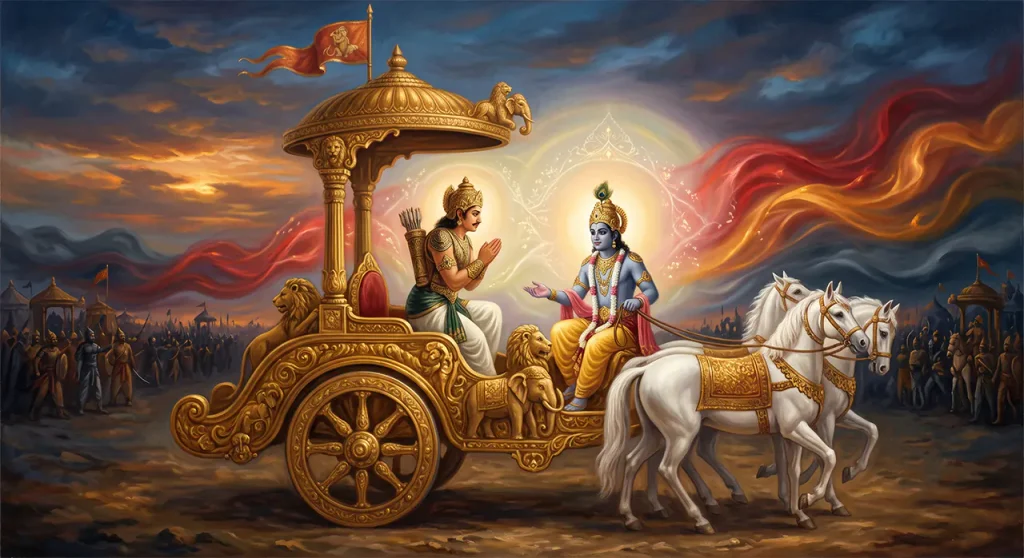
Chapter 14: How the Gunas Bind the Soul (Gunatraya Vibhaga Yoga)
In this foundational chapter, Sri Krishna explains that the three gunas are the primary cords tying pure consciousness to the physical body.
In Verse 5, He establishes:
sattvaṁ rajas tama iti guṇāḥ prakṛti-sambhavāḥ
nibadnanti mahā-bāho dehe dehinam avyayam
(Bhagavad Gita 14.5)
Meaning: “Sattva, Rajas, and Tamas—these three qualities born of Prakriti (nature)—bind fast in the body the immortal soul, O mighty-armed Arjuna.”
He then details what happens to an individual when they pass away while a particular guna is dominant:
- If a person dies when Sattva prevails, they attain the pure, higher realms of the wise and noble (Gita 14.14).
- If a person dies when Rajas is dominant, they are reborn among those driven by feverish action and worldly attachment (Gita 14.15).
- If a person dies submerged in Tamas, they sink into lower realms characterized by darkness and lack of awareness (Gita 14.15).
Philosophically, this teaches that your habitual state of consciousness throughout your lifetime creates deep mental grooves (samskaras) that determine your future path.
Chapter 17: Faith, Food, and Inner Attitude (Shraddhatraya Vibhaga Yoga)
In Chapter 17, Arjuna asks how an individual’s natural disposition influences their spiritual life. Krishna explains that every human being possesses an innate faith (shraddha), which reflects their dominant guna.
- Sattvic Faith: Worships the Divine, seeks truth, and serves selflessly.
- Rajasic Faith: Worships power, wealth, prestige, and seeks divine intervention solely for personal gain.
- Tamasic Faith: Turns toward dark, manipulative superstitions, harming oneself or others under the guise of religion.
Krishna also outlines the three gunas of charity (Dana):
- Sattvic Charity (17.20): Given out of a sense of duty, to a worthy recipient, at the right time and place, with no expectation of any return.
- Rajasic Charity (17.21): Given grudgingly, with the hope of receiving a favor in return, or purely for public recognition.
- Tamasic Charity (17.22): Given dismissively, at an inappropriate place or time, to unworthy causes, or accompanied by insults and disrespect.
Chapter 18: Knowledge, Willpower, and Happiness (Moksha Sanyasa Yoga)
In the concluding chapter of the Gita, Krishna shows that every faculty of human psychology is colored by the gunas.
He details the three kinds of intellect (Buddhi):
- Sattvic Buddhi (18.30): Clearly knows what to do and what to avoid, what is righteous (dharma) and unrighteous (adharma), what brings fear and what brings freedom.
- Rajasic Buddhi (18.31): Confused about duty and self-interest, misinterpreting righteousness based on personal desires.
- Tamasic Buddhi (18.32): Shrouded in darkness, considering unrighteousness to be righteousness, seeing everything in an inverted light.
The Three Gunas and Food: Eating for Body and Mind
In classical Hindu thought and Ayurveda, food is not viewed merely as fuel containing proteins, fats, and carbohydrates. Food carries subtle vitality (prana) that directly feeds your mental field (manomaya kosha).
As the ancient Chandogya Upanishad (6.5.4) declares:
anna-mayam hi saumya manaḥ
“O gentle one, the mind is indeed formed from the subtlest essence of the food we consume.”
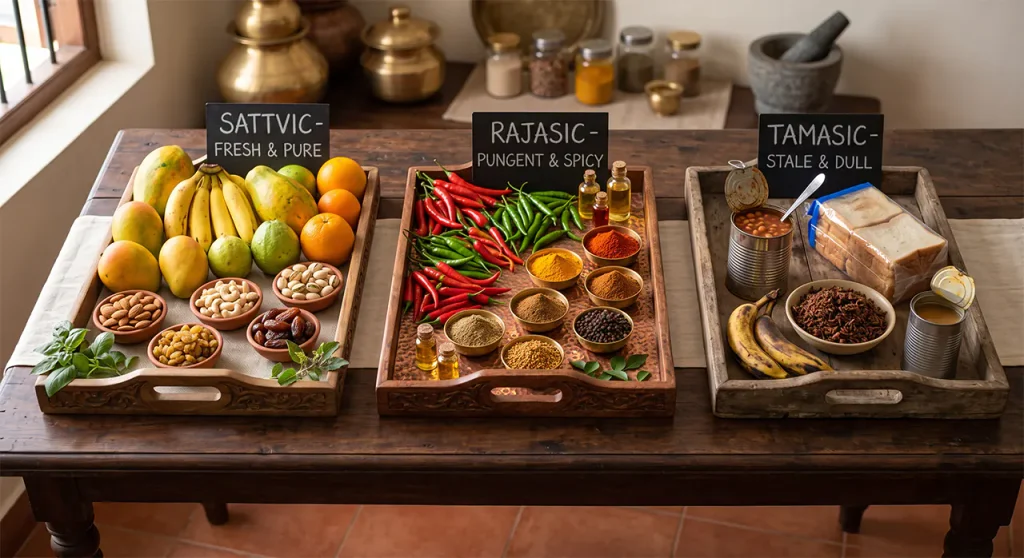
The Bhagavad Gita (17.8–10) provides one of the most famous classifications of food according to the three gunas.
1. Sattvic Food (Ayushya-Bala-Sukha-Priti-Vivardhana)
In Chapter 17, Verse 8, Krishna describes foods dear to the sattvic temperament:
āyuḥ-sattva-balārogya-sukha-prīti-vivardhanāḥ
rasyāḥ snigdhāḥ sthirā hṛdyā āhārāḥ sāttvika-priyāḥ
(Bhagavad Gita 17.8)
Meaning: “Foods that increase life span, purity of being, strength, health, happiness, and cheerfulness, and which are juicy, succulent, nourishing, and agreeable to the heart, are dear to the Sattvic.”
- Examples: Freshly harvested fruits, seasonal vegetables, whole grains (rice, wheat, oats), cow’s milk and ghee prepared with care, lentils, almonds, walnuts, seeds, honey, and fresh herbs.
- Effect on Mind: Leaves you feeling light, alert, emotionally steady, and ready to think clearly or meditate.
2. Rajasic Food (Duhkha-Shokamaya-Prada)
In Chapter 17, Verse 9, Krishna describes foods dear to the rajasic temperament:
kaṭv-amla-lavaṇāty-uṣṇa-tīkṣṇa-rūkṣa-vidāhinaḥ
āhārā rājasasyeṣṭā duḥkha-śokāmaya-pradāḥ
(Bhagavad Gita 17.9)
Meaning: “Foods that are intensely bitter, sour, excessively salty, burning hot, pungent, dry, and scorching are dear to the Rajasic. They cause pain, grief, and sickness.”
- Examples: Extremely spicy curries, deep-fried snacks, excessive caffeine (espresso, high-energy drinks), heavily salted foods, strong raw onions, garlic in excess, and pungent sauces.
- Effect on Mind: Triggers restlessness, raises body heat, quickens the pulse, creates a sharp tongue, and leads to digestive discomfort and sleep disturbances.
3. Tamasic Food (Yata-Yamam Gata-Rasam)
In Chapter 17, Verse 10, Krishna describes foods dear to the tamasic temperament:
yāta-yāmaṁ gata-rasaṁ pūti paryuṣitaṁ ca yat
ucchiṣṭam api cāmedhyaṁ bhojanaṁ tāmasa-priyam
(Bhagavad Gita 17.10)
Meaning: “Food that is cooked more than three hours prior (yāta-yāmam), which is tasteless, putrid, decomposing, leftover from others, and impure, is dear to the Tamasic.”
- Examples: Heavily processed canned foods, stale meals reheated repeatedly, meat from decaying carcasses, deep-frozen microwave dinners, alcohol, artificial intoxicants, and overripe or rotting produce.
- Effect on Mind: Drains vitality, promotes brain fog, makes the body feel heavy and sluggish, and dulls spiritual sensitivity.
Scriptural Wisdom vs. Modern Nutritional Science
It is important to maintain clarity and honesty: the Bhagavad Gita is an ancient spiritual text exploring the subtle effects of food on the mind and consciousness, not a modern medical textbook on clinical dietetics.
Modern nutritional science focuses on caloric density, macronutrients (proteins, carbohydrates, lipids), micronutrients, glycemic index, and cellular metabolism.
However, modern research increasingly points to the gut-brain axis—the bidirectional biochemical communication between the gastrointestinal tract and the central nervous system. Modern scientists now recognize that diets high in ultra-processed, sugary, and stale foods contribute to systemic inflammation and depressive, sluggish moods (mirroring Tamas), while diets overloaded with synthetic stimulants create anxiety and sleep disruption (mirroring Rajas).
The ancient sages arrived at a similar psychological conclusion through direct observation: what you put into your body inevitably colors your mental clarity.
It can be tempting to view the gunas as ancient history with little relevance to the 21st century. In reality, the modern digital landscape is an intense playground of Rajas and Tamas.
The Rajas-Tamas Trap of the Internet
Modern technology companies employ thousands of engineers whose primary objective is to keep your attention captive. They do this by triggering your Rajas:
- Breaking news banners
- Bright red notification badges
- Outrage-inducing headlines
- Constantly refreshing feeds
Your mind stays locked in high Rajas—alert, anxious, comparing, and reacting.
Eventually, human biology cannot maintain this fever pitch. The nervous system crashes. But instead of resting deeply in restorative sleep (Sattva), you collapse into Tamas:
- You slump on the sofa with a phone inches from your eyes.
- You watch video after video without genuine interest.
- You feel completely exhausted, yet unable to sleep soundly.
The next morning, you use high doses of caffeine (Rajas) to drag yourself out of Tamasic exhaustion, restarting the vicious cycle.
Applying the Gunas to Reclaim Balance
The guna framework gives you the self-awareness needed to step off this digital treadmill:
- Notice the Quality: When you feel jittery, pause and say: “This is Rajas in my nervous system, triggered by these notifications.”
- Interrupt the Loop with Sattva: Do not try to fight agitation with lethargy. Instead, put the phone in a drawer, step outside, take off your shoes, and breathe in the open air. Drink a glass of water. Read three pages of a peaceful book.
- Respect Natural Limits: Understand that your mind is part of nature. It cannot run on constant Rajas without breaking. Respecting your need for Sattvic quiet is an act of spiritual self-care.
Are the Gunas Similar to Modern Personality Types?
When people first learn about Sattva, Rajas, and Tamas, they often ask: “Is this like the Myers-Briggs (MBTI), the Enneagram, or the Big Five personality traits?”
While there are fascinating surface similarities, there are profound philosophical and operational differences.
The Differences That Matter
- Static Label vs. Dynamic State: Modern personality tests often assign you a permanent four-letter code or type (e.g., “I am an INTJ”). People begin to view this as their unchangeable identity. In contrast, Hindu philosophy insists that gunas are temporary, shifting states. You may wake up in Sattva, enter Rajas during a project presentation at 11:00 AM, and sink into Tamas after a heavy lunch at 2:00 PM.
- Behavioral Description vs. Cosmic Energy: Modern models describe social and cognitive preferences (introversion vs. extraversion, thinking vs. feeling). The guna framework describes the fundamental energies of the entire universe—influencing everything from a rock to a galaxy, a plant, a meal, an emotion, and an idea.
- Identity vs. Witness Consciousness: This is the most crucial distinction. Modern psychology typically treats your personality as you. Hindu philosophy teaches that you are not your gunas. You are the Purusha or Atman—the pure consciousness in which the gunas arise, play, and dissolve.
While modern psychometrics can be useful for career planning or team communication, the guna framework is designed for spiritual liberation (Moksha) and total inner freedom.
Is Sattva the Final Goal? Understanding the State of Gunatita
A common misconception among beginner students of Hindu philosophy is that the ultimate goal of spiritual life is simply to become 100% Sattvic forever.
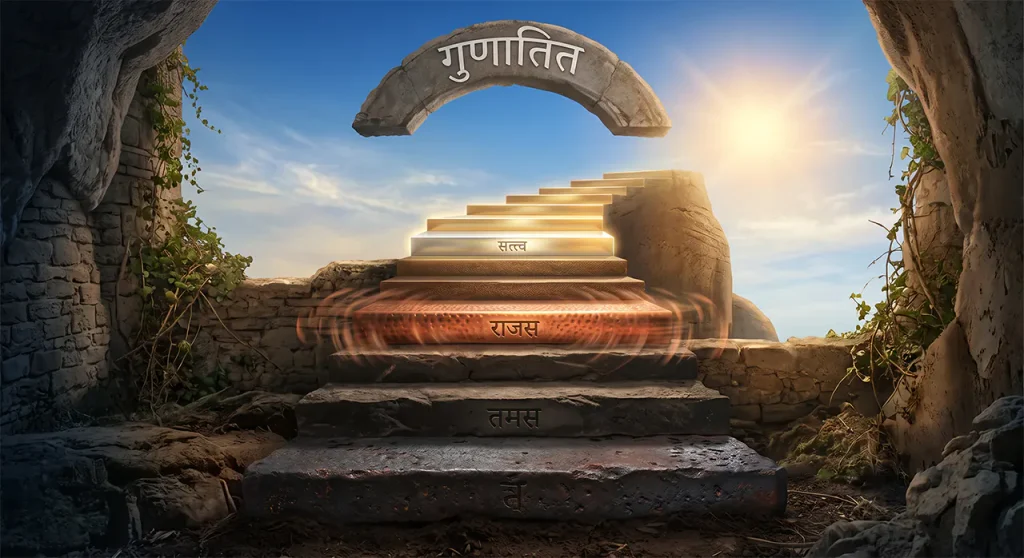
Sattva is certainly the most beautiful, luminous, and desirable quality in worldly life. Cultivating Sattva is like cleaning a glass mirror so that it can reflect the sun without distortion. Sattva brings health, wisdom, kindness, and inner peace.
Yet, in Chapter 14 of the Bhagavad Gita, Sri Krishna reveals a higher truth: even Sattva is a golden chain.
Why Sattva Still Binds
Remember verse 14.6: Sattva binds the soul through attachment to happiness and attachment to knowledge.
When a person becomes deeply Sattvic, they can develop subtle spiritual pride:
- “I am so peaceful compared to those loud, rajasic people.”
- “I eat such pure food, unlike those around me.”
- “I have so much scriptural knowledge.”
If the peaceful, quiet environment is disturbed by a loud lawnmower or an unannounced guest, the person who is attached to Sattva becomes secretly resentful. Their peace was conditional—it depended on nature behaving according to their sattvic preferences.
Becoming a Gunatita (One Who Has Transcended the Gunas)
Arjuna asks Krishna a practical question in Chapter 14, Verse 21:
kair liṅgais trīn guṇān etān atīto bhavati prabho
kim-ācāraḥ kathaṁ caitāṁs trīn guṇān ativartate
(Bhagavad Gita 14.21)
Meaning: “By what marks is one known who has transcended these three gunas, O Lord? What is their conduct, and how do they go beyond these three qualities?”
Krishna’s answer in Verses 22–25 is one of the grandest descriptions of spiritual freedom in world literature:
He who does not hate the presence of clarity (Sattva), activity (Rajas), or delusion (Tamas) when they arise, nor longs for them when they disappear… who sits as a neutral witness, undisturbed by the gunas, knowing that ‘the gunas alone are moving among the gunas’… who remains steady in pleasure and pain, looking upon a clump of earth, a stone, and a piece of gold with equal vision… that person is said to have transcended the gunas.
The enlightened sage (Gunatita) does not panic when Tamas arises as physical fatigue; they let the body sleep. They do not get swept away when Rajas arises for necessary action; they do their duty skillfully. They enjoy Sattva when it shines, but do not cling to it when life demands movement.
They know that the gunas belong to Prakriti (nature), while their true self (Atman) is eternally free, radiant, and untouched.
Common Misunderstandings About the Three Gunas
Because the gunas are often taught in brief soundbites, many myths have accumulated around them. Let us clear away the most common misconceptions.
Myth 1: “Sattva means good person, Rajas means active person, Tamas means bad person.”
- The Reality: The gunas are qualities of nature, not moral labels. A firefighter rushing into a burning building to save an infant is operating in high Rajas (courage, intense energy, rapid movement). Someone sleeping soundly to heal from an infection is using healthy Tamas. A proud, condescending scholar may be operating in flawed Sattva. Do not use these terms to sit in moral judgment of yourself or others.
Myth 2: “Tamas has no place in a spiritual life and should be 100% destroyed.”
- The Reality: You cannot eliminate Tamas while living in a physical body. Tamas is the biological principle that allows your brain to rest in dreamless sleep, your bones to remain dense, and your wounds to heal. The goal is never to destroy Tamas, but to eliminate unconscious, waking Tamas (procrastination, ignorance, apathy) and keep its healthy aspect (rest, stability).
Myth 3: “Rajasic ambition is sinful and should be avoided.”
- The Reality: Without Rajas, society would crumble. Roads would not be paved, hospitals would not be staffed, and families would not have food on the table. Hinduism celebrates the four noble pursuits of life (Purusharthas): righteousness (Dharma), honest prosperity (Artha), legitimate love and pleasure (Kama), and spiritual freedom (Moksha). Pursuing wealth and career through honest effort requires healthy Rajas directed by Sattvic wisdom.
Myth 4: “Eating Sattvic food will automatically make me enlightened.”
- The Reality: Food is an important foundation, but it is not the entire building. If someone eats only steamed vegetables and fresh fruit, but spends their afternoon gossiping, cheating business partners, or feeling superior to their neighbors, their mind remains steeped in Rajas and Tamas. Food refines the nervous system; your conscious thoughts and actions complete the work.
Myth 5: “Your dominant guna is fixed at birth and cannot be changed.”
- The Reality: While our past impressions (samskaras) give each of us certain natural tendencies, your dominant guna changes constantly based on your environment, habits, company, diet, and spiritual practice. You have the free will (Purushartha) to cultivate whatever quality you choose.
A Daily Guna Check: Real-Life Scenarios Table
Keep this practical comparison chart handy. It shows how the exact same everyday situation can be handled through Sattva, Rajas, or Tamas.
| Everyday Situation | Sattvic Response | Rajasic Response | Tamasic Response |
| 1. Receiving harsh criticism at work | Listens calmly to find any valid points; learns without losing inner peace. | Becomes furiously defensive; attacks the critic’s track record in retaliation. | Shuts down; feels hopeless, plays the victim, and secretly vows to quit. |
| 2. Stuck in a 45-minute traffic jam | Accepts reality; turns on an inspiring podcast or practices deep, slow breathing. | Honks repeatedly; tailgates cars, curses at drivers, feels blood pressure spike. | Slumps over steering wheel, ignores safety, and drifts into dangerous distraction. |
| 3. Choosing what to wear today | Wears clean, neat, comfortable clothes suited for duty and weather. | Spends 30 minutes choosing luxury brands to show off wealth and status. | Wears stained, rumpled, unwashed clothes that have been on the floor for days. |
| 4. Family member makes a mistake | Offers gentle guidance; helps clean up the mess with patience and love. | Lectures them loudly; brings up past mistakes to prove their incompetence. | Ignores the problem completely; leaves the mess for someone else to deal with. |
| 5. Preparing for an examination | Studies consistently with a schedule; takes short breaks to stay fresh. | Crams all night fueled by four energy drinks; panics about being top of the class. | Leaves studying until the last hour; gives up and relies on cheating or luck. |
| 6. Spending free time on Sunday | Goes for a nature walk, reads scripture, spends meaningful time with family. | Packs the day with five events; shops frantically, returns home exhausted. | Sleeps until 1:00 PM; spends the rest of the day lying on the sofa watching screens. |
| 7. Dealing with a physical injury | Follows doctor’s advice, eats nourishing food, rests mindfully to heal. | Frustrated by slowness; rushes back to exercise prematurely and reinjures self. | Ignores medical advice, neglects hygiene, and drowns discomfort in alcohol. |
| 8. Witnessing someone else’s success | Feels sincere joy; congratulates them warmly from the heart (Mudita). | Feels a sting of envy; immediately boasts about their own future projects. | Dismisses the achievement cynically: “They just got lucky or cheated.” |
| 9. Managing monthly finances | Budgets carefully, pays debts on time, sets aside funds for charity (Dana). | Spends heavily on status symbols; worries obsessively about investment yields. | Ignores bank statements; lets bills pile up until power or cards are cut off. |
| 10. Hearing shocking neighborhood gossip | Refuses to participate; gently changes the topic to something uplifting. | Leans in eagerly; adds dramatic rumors and spreads it to five other friends. | Believes every word uncritically without caring whether it ruins a life. |
| 11. Approaching daily prayer/meditation | Sits quietly with devotion, seeking inner clarity and connection with the Divine. | Prays loudly to be seen by others; asks God for a laundry list of material riches. | Dozes off while sitting; mechanically mumbles mantras with no thought or care. |
| 12. Experiencing a sudden financial loss | Stays composed; cuts expenses calmly and explores practical, honest solutions. | Panics; blames family, seeks reckless get-rich-quick schemes to recover money. | Paralyzed by despair; refuses to get out of bed and blames fate for everything. |
Conclusion: Living with Grace in the Dance of Nature
The ancient teaching of Sattva, Rajas, and Tamas is not a rigid philosophical cage; it is a mirror of self-discovery.
When you look into this mirror, you stop fighting yourself.
- When you wake up feeling heavy, you do not need to call yourself a failure. You simply recognize: “Tamas is present right now. Let me open the window, drink some fresh water, and move my body to invite in Rajas.”
- When your mind is pacing like a caged tiger, you do not need to panic. You recognize: “Rajas has caught fire in my thoughts. Let me step back, disconnect from this screen, take five deep breaths, and let Sattva cool the flames.”
- And when your heart feels light, kind, and peaceful, you simply smile and give thanks for the radiance of Sattva, using that precious energy to help and comfort those around you.
Remember that you are the eternal witness, the silent consciousness (Purusha) watching these three natural colors paint across the canvas of your days.
Treat yourself with gentleness. Work gradually to replace sluggish Tamas with noble Rajas, channel fiery Rajas into luminous Sattva, and let Sattva carry you toward the ultimate freedom of Gunatita—peaceful, unbroken, and forever free.
FREQUENTLY ASKED QUESTIONS (FAQs)
What are the three gunas in Hinduism?
The three gunas are the primary qualities or energetic forces that make up all of nature (Prakriti): Sattva (balance, light, clarity), Rajas (passion, energy, desire), and Tamas (inertia, darkness, heaviness). Introduced in Sankhya philosophy and elaborated in the Bhagavad Gita, they shape the physical universe, human personality, emotions, habits, and diet.
What is Sattva guna in simple words?
Sattva is the quality of light, truth, harmony, and peace. When Sattva is dominant, your mind feels calm, clear, and alert. You experience unforced cheerfulness, think of others with compassion, understand ideas easily, and make healthy, balanced choices without needing constant stimulation or praise.
What is Rajas guna in simple words?
Rajas is the quality of movement, passion, and ambition. It provides the energy required to work, build, and achieve goals. When Rajas becomes excessive, however, it manifests as restlessness, anxiety, greed, impatience, and an obsessive need for praise, competition, and sensory stimulation.
What is Tamas guna in simple words?
Tamas is the quality of inertia, heaviness, and rest. In its healthy form, it provides structural stability and allows the mind and body to rest in deep sleep. When excessive in waking life, it causes chronic laziness, brain fog, procrastination, emotional numbness, and neglect of duty.
Can all three gunas exist in one person?
Yes, every human being has all three gunas operating continuously. Tamas allows you to sleep at night and keeps your body grounded. Rajas gives you the drive to get out of bed, work, and solve problems. Sattva provides the calm wisdom to choose what is right and live peacefully.
How can I know which guna is dominant in me?
Observe your state of mind under pressure and your daily habits. If you respond to difficulties with calm patience, Sattva dominates. If you react with agitation, anger, and rapid planning, Rajas dominates. If you shut down, procrastinate, and avoid reality, Tamas is in control.
Can a person change their dominant guna?
Yes. The gunas are dynamic and shift according to your daily diet, physical environment, company (Satsanga), media consumption, sleep patterns, and spiritual practices. You can systematically elevate your state from Tamas to Rajas through physical activity, and from Rajas to Sattva through meditation and selfless action.
Is Rajas guna always negative in Hinduism?
No, Rajas is not inherently negative. Without Rajas, you could not work, protect your family, study for an exam, or practice spiritual disciplines. Rajas becomes destructive only when it is unguided by Sattva, turning into selfish greed, burning pride, and physical burnout.
Is Tamas guna always bad?
No. Tamas is a natural, necessary quality of physical matter. Without Tamas, your body could not sleep, tissue repair would not occur, and your nervous system would burn out from non-stop stimulation. Tamas becomes problematic only when it spills into daytime awareness as avoidance, sloth, and willful ignorance.
What foods are considered Sattvic?
According to Bhagavad Gita 17.8, Sattvic foods are fresh, juicy, nourishing, and agreeable to the heart. They include fresh seasonal fruits, vegetables, whole grains, cow’s milk and ghee prepared with care, nuts, seeds, legumes, and natural honey. They promote vitality, clarity, and peace of mind.
What does the Bhagavad Gita say about the three gunas?
The Bhagavad Gita dedicates major portions of Chapters 14, 17, and 18 to the gunas. Sri Krishna explains that all physical and mental phenomena arise from the gunas, shows how they bind the soul, classifies food, faith, and charity through them, and teaches how to transcend them.
What is the difference between Sattva and Rajas?
Sattva is still, contented, and focused on truth and service; it finds joy within. Rajas is moving, ambitious, and focused on achievement and sensory rewards; it seeks happiness through external objects, personal praise, and ongoing worldly conquests.
What is the difference between Rajas and Tamas?
Rajas is characterized by excessive kinetic energy, desire, and restlessness—it cannot stop moving. Tamas is characterized by lack of energy, heaviness, and resistance to change—it struggles to start moving. Rajas creates drama and agitation; Tamas creates stagnation and forgetfulness.
How can I increase Sattva in daily life?
You can increase Sattva by waking during the peaceful early morning hours, eating fresh, home-cooked food, keeping your home and workspace clean, speaking gently and truthfully, spending time in nature, and establishing a daily habit of silent meditation or prayer.
How do I reduce excessive Rajas?
To calm excessive Rajas, practice Karma Yoga (focusing on your work while surrendering attachment to the results), set strict boundaries around screens and notifications, pause for slow, deep breathing throughout the day, and take time for quiet nature walks without devices.
How can I overcome Tamas and laziness?
Do not try to move directly from Tamas to Sattva. Use Rajas as a bridge: get up and move your body, take a brisk walk in natural sunlight, splash cold water on your face, tidy your room, and break large tasks into micro-steps that take only two minutes to begin.
Can meditation increase Sattva?
Yes. Regular meditation, mantra japa, and conscious breath control (pranayama) quiet the restless fluctuations of the sensory mind, naturally dissolving both rajasic agitation and tamasic dullness. This leaves the mental field luminous, steady, and filled with Sattva.
What does it mean to go beyond the three gunas (Gunatita)?
To become Gunatita means to realize that your true self (Atman) is pure consciousness, entirely separate from the gunas of nature. An enlightened person witnesses the play of Sattva, Rajas, and Tamas without identifying with them, remaining equanimous in pleasure and pain, honor and dishonor.
Are the three gunas similar to modern personality types?
While both categorize human tendencies, the gunas are dynamic cosmic qualities that fluctuate from hour to hour, not fixed personality labels like the Myers-Briggs (MBTI). Furthermore, Hindu philosophy teaches that you are not your gunas; your true identity is the transcendent observer beyond them.
What is Sattvic speech?
According to Bhagavad Gita 17.15, Sattvic speech consists of words that are truthful, gentle, beneficial, non-agitating to others, and regularly cultivated through the study of sacred wisdom. It is spoken at the right time with pure intentions.
Does waking up early really increase Sattva?
Yes. Traditional Hindu texts call the period approximately 96 minutes before sunrise Brahma Muhurta. At this hour, environmental pollution, human noise, and mental chatter are at their lowest point, making the natural atmosphere predominantly Sattvic and ideal for meditation and study.
What happens when Sattva increases in the mind?
When Sattva increases, physical heaviness leaves the body, the senses become clear and perceptive, thoughts turn orderly, and a quiet sense of cheerfulness (prasada) fills the heart. Intuitive wisdom and moral courage arise effortlessly.