Atithi Devo Bhava: The Sacred Meaning & Significance
Few expressions capture the heart of Indian hospitality quite like Atithi Devo Bhava. Often heard during travels across India, painted on traditional doorways, or quoted in discussions about ancient ethics, this Sanskrit saying translates to a profound moral ideal: treat the guest with the reverence due to the divine.
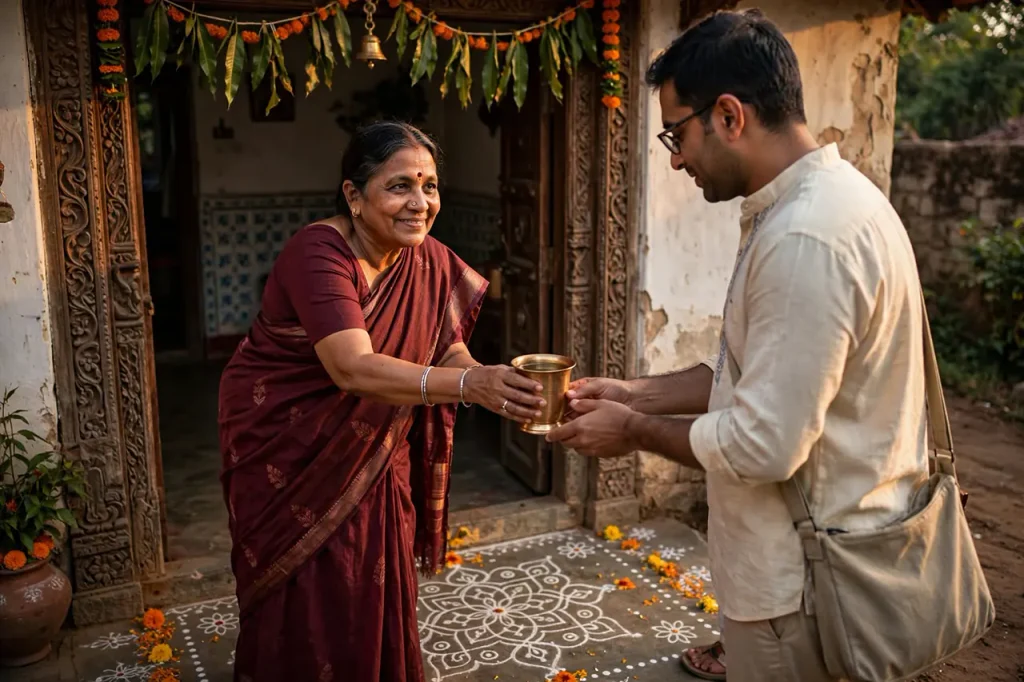
Yet behind this well-known cultural greeting lies a rich philosophical tradition. It is neither an empty marketing slogan nor an unreasonable demand to surrender your home to strangers. It represents a foundational pillar of Indian thought, born from ancient scripture, nurtured through centuries of social practice, and rooted in a deep understanding of human dignity, spiritual service, and mutual respect.
This guide explores the origins of Atithi Devo Bhava, analyzes its Sanskrit roots, traces its presence in classical texts like the Taittiriya Upanishad, and unpacks its practical application in contemporary life.
What Does Atithi Devo Bhava Mean?
Quick Answer:
Atithi Devo Bhava (अतिथिदेवो भव) is a Sanskrit injunction that means “May the guest be one to whom you accord the reverence due to God.” It commands the householder to receive an unexpected visitor not as an inconvenience or an outsider, but with honor, generosity, humility, and genuine care.
In everyday English, people often translate the phrase simply as “The guest is God.” While that translation is memorable, it oversimplifies the philosophical depth of the original Sanskrit.
The phrase is an ethical directive. It asks us to look past the surface identity of a visitor—their wealth, social standing, nationality, or physical state—and recognize the universal spark of consciousness within them. When you welcome a guest under this guiding principle, you do not just provide shelter or food. You transform an ordinary social interaction into an act of mindful service (seva).
Breaking Down the Sanskrit: Etymology and Vocabulary
To appreciate the philosophical precision of the phrase, we must examine its three constituent Sanskrit terms: Atithi, Deva (which inflects to Devo in sandhi), and Bhava.
| Sanskrit Term | Grammatical / Etymological Derivation | Primary Meaning | Functional Sense in Context |
| Atithi (अतिथि) | Prefix a- (negation) + tithi (lunar day / calculated date) | One who has no fixed date or scheduled calendar day | An unannounced wanderer, traveler, or visitor who arrives without prior notification |
| Devo / Deva (देवः) | Root div (to shine, radiate, illuminate) | A shining one; a deity; an embodiment of light | A being worthy of respect, reverence, and wholehearted hospitality |
| Bhava (भव) | Imperative mood (Lot Lakara), second-person singular of root bhu (to be/become) | Be thou; become; cultivate within yourself | An actionable internal injunction: “cultivate the attitude of seeing…” |
The Meaning of Atithi (अतिथि)
The word Atithi is built from the negative prefix a- (meaning “not” or “without”) and the noun tithi (meaning a lunar calendar day, calculated in traditional astronomy).
In classical India, an atithi was not a friend invited three weeks in advance for dinner. An atithi was a wanderer—a traveler, a spiritual seeker, a wandering mendicant, or an itinerant student—who walked between settlements. Because there were no phones, postal reservations, or modern booking systems, such a traveler arrived without warning, staying for a night or two before moving on.
An atithi is quite literally:
“One who arrives without an appointed day, whose coming is unscheduled, and who relies upon the spontaneous generosity of the home they approach.”
Traditional commentators distinguish between different types of visitors:
- Abhyagata (अभ्यागत): A known visitor, acquaintance, or expected relative who comes on an anticipated occasion.
- Atithi (अतिथि): The stranger or traveler who appears at the threshold unannounced, possessing no prior social claim on the householder.
The tradition places the highest ethical value on the atithi precisely because welcoming an unknown stranger requires greater generosity, selflessness, and moral maturity than hosting a dear friend.
The Meaning of Devo / Deva (देवः)
The word Deva originates from the Sanskrit verbal root div, which carries meanings related to shining, illuminating, playing, and radiating. A deva is a “shining one”—a celestial, an embodiment of cosmic order, or a being worthy of deep spiritual honor.
In compounds and idiomatic Sanskrit, calling someone a deva does not mean they created the universe. Instead, it indicates that the person should be treated with the same sanctity, care, and honor one would offer at a sacred altar. In sandhi rules, the word devaḥ followed by a voiced consonant or semi-vowel becomes devo.
The Meaning of Bhava (भव)
The word Bhava is the imperative form of the verbal root bhū, meaning “to be” or “to become.”
It is not a passive description of external reality. It does not state that the traveler is naturally divine in some supernatural way. Rather, it is a direct command to the householder’s consciousness:
“Make yourself someone who sees the guest in this light.”
It places the ethical responsibility entirely on the host. The guest’s spiritual nature is not the deciding factor; your capacity for reverence, patience, and generosity is.
Read More >>Why Do We Join Our Palms in Namaste? Meaning & Significance
Where Does Atithi Devo Bhava Come From? Scriptural Origins
Many people assume that Atithi Devo Bhava is simply a folk proverb or a modern tourism slogan. In reality, the phrase comes from one of the most venerable texts of the Vedic canon: the Taittiriya Upanishad, which belongs to the Krishna Yajurveda (Black Yajur Veda).
The Upanishads are the philosophical heart of Hinduism, focusing on the nature of reality (Brahman), the individual soul (Atman), and the ethical framework required to live in harmony with both. The Taittiriya Upanishad consists of three main chapters or sections known as Vallis (creepers):
- Shiksha Valli: The section dealing with phonetics, discipline, education, and moral duties.
- Ananda Valli: The section exploring the nature of ultimate bliss and the sheaths (koshas) covering the Self.
- Bhrigu Valli: The section detailing the sage Bhrigu’s progressive realization of ultimate reality.
The famous passage appears in the Shiksha Valli, within the Eleventh Anuvaka (Lesson 11).
Atithi Devo Bhava in the Taittiriya Upanishad
Understanding the exact context of the Taittiriya Upanishad transforms how we view this teaching. It does not appear as an isolated proverb; it forms part of an ancient graduation ceremony.
The Setting: An Ancient Convocation Address
In ancient India, young students lived with their teacher (Guru) in a forest academy or hermitage (Gurukula). There, they studied the Vedas, sciences, arts, and moral discipline.
When their education was complete, the students prepared to return to everyday society, marry, earn a living, and establish households. Before they departed, the preceptor offered them a final address known as the Samavartana Upadesha—the ancient equivalent of a university convocation speech.
The teacher recognized that abstract philosophy means nothing if it cannot guide everyday human relationships. Therefore, before the students stepped out into the world, the teacher laid out their daily duties:
वेदमनूच्याचार्योऽन्तेवासिनमनुशास्ति ।
सत्यं वद । धर्मं चर । स्वाध्यायान्मा प्रमदः ।
vedamanūcyācāryo’ntevāsinamanuśāsti |
satyaṁ vada | dharmaṁ cara | svādhyāyānmā pramadaḥ |
“Having taught the Vedas, the preceptor instructs the departing disciple: Speak the truth. Walk in righteousness. Do not neglect daily study.”
Following these core instructions on personal integrity, the text introduces the four pillars of interpersonal reverence:
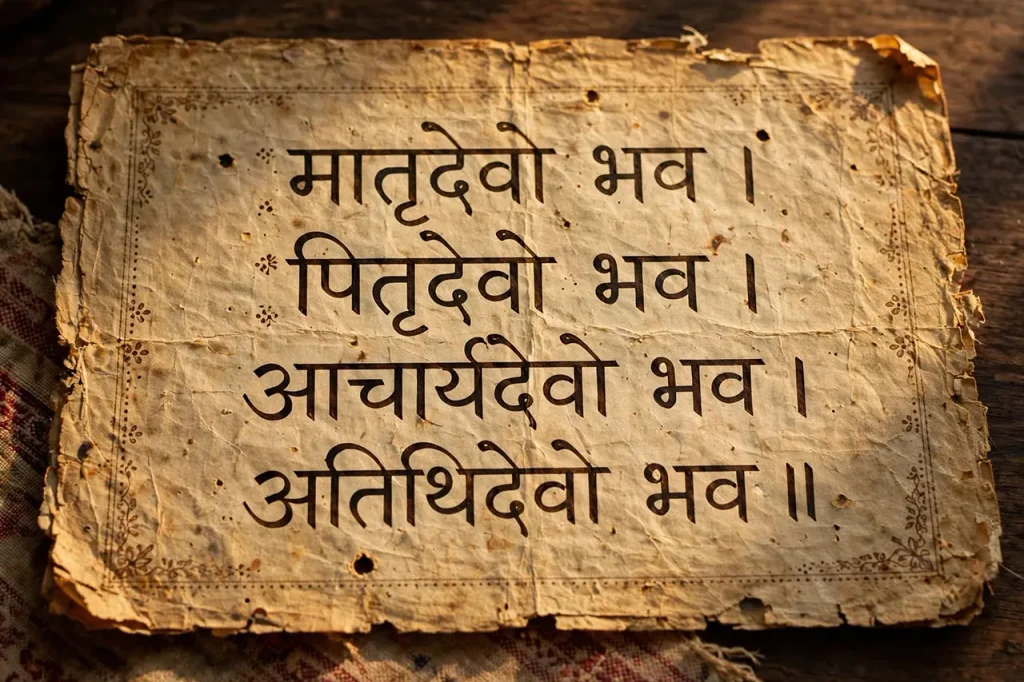
मातृदेवो भव । पितृदेवो भव ।
आचार्यदेवो भव । अतिथिदेवो भव ॥
mātṛdevo bhava | pitṛdevo bhava |
ācāryadevo bhava | atithidevo bhava ||
(Taittiriya Upanishad, 1.11.2)
The Complete Fourfold Exhortation
Notice that hospitality is not taught in a vacuum. It forms the final link in a conscious circle of sacred duties:
- Matri Devo Bhava: May your mother be to you like a deity. The mother gives physical life, carries the child through vulnerability, and serves as the child’s very first teacher.
- Pitri Devo Bhava: May your father be to you like a deity. The father provides protection, stability, material foundation, and early guidance into the responsibilities of the world.
- Acharya Devo Bhava: May your spiritual teacher be to you like a deity. The preceptor awakens the student’s intellect, imparts timeless wisdom, dispels ignorance, and prepares the youth for noble living.
- Atithi Devo Bhava: May the guest be to you like a deity. Having learned to honor family and teachers, the student must now expand their circle of reverence to include the wider world—the arriving stranger.
The progression is intentional. It begins with the most intimate bond (the mother), moves to the protective guide (the father), steps out to the intellectual mentor (the teacher), and culminates in the universal test of character: your treatment of the arriving stranger.
Adi Shankara’s Commentary
The great 8th-century philosopher and commentator Adi Shankaracharya provided an essential gloss on this passage in his Taittiriya Upanishad Bhashya.
Shankara makes it clear that the compound word should be understood as a Bahuvrihi compound:
Mātā devaḥ yasya saḥ = Mātṛdevaḥ
Atithiḥ devaḥ yasya saḥ = Atithidevaḥ
He explains the phrase as:
“One to whom the mother is a god is mātridevaḥ; be thou one such: mātṛdevo bhava. Similarly with the father, the teacher, and the guest.”
Shankara’s grammatical precision matters. The text does not declare that the guest has grown celestial wings or created the cosmos. Rather, it instructs the householder: hold the guest in your mind as an emblem of sacredness. Treat them with the care, thoughtfulness, and absence of resentment you would bring to divine worship.
What Is the Deeper Meaning of Atithi Devo Bhava?
To modern ears, calling an ordinary human being “divine” can sound either exaggerated or confusing. Does Hindu thought expect a family to bow down and worship a neighbor who dropped by to return a borrowed tool? Does it demand that we treat an impolite traveler like a celestial monarch?
To answer these questions, we must look past modern assumptions and examine how classical Indian philosophy views the relationship between humanity, the sacred, and the self.
Reverence vs. Literal Apotheosis
Hindu philosophy never asks us to lose our discernment. Reverence is an attitude of the heart, not an abdication of common sense.
When the tradition describes the guest as divine, it addresses the host’s inward disposition. In our default state of mind, unexpected visitors feel like interruptions. They disrupt our plans, eat our provisions, take up our space, and demand our energy. Our natural human ego reacts with irritation, guardedness, or resentment.
Atithi Devo Bhava directly challenges this self-centered reflex. It urges the host to frame the arrival not as an inconvenience, but as an opportunity for spiritual service. By receiving the guest with honor, the host works to dissolve their own selfishness and make room for generosity.
The Guest as an Agent of Spiritual Purification
In traditional Indian thought, the householder (Grihastha) faces a particular spiritual challenge: the creeping danger of domestic selfishness.
A householder spends their days acquiring wealth, securing comforts, and guarding their private property. Over time, it is easy to begin believing that one’s home exists solely to protect one’s personal pleasures.
The arriving guest serves as a healthy disruption to this domestic cocoon:
- The guest forces the host to share resources without expecting an immediate return.
- The guest compels the host to place another person’s comfort ahead of their own.
- The guest creates a living test of the family’s generosity, patience, and character.
In this sense, the guest acts as a cleansing presence. They allow the householder to practice non-attachment (Vairagya) right at the dining table, inside their own home.
Why Is a Guest Considered Divine in Hindu Thought?
Two central ideas explain why Hindu tradition places such immense spiritual value on hospitality: the metaphysical presence of the divine in all living beings, and the literary tradition of gods visiting humanity in disguise.
The Immanent Divine: Brahman in All Beings
At the heart of Vedanta philosophy lies a clear teaching: the divine is not locked away in a distant heaven. The supreme reality (Brahman) lives within all beings as the inner soul (Atman).
The Bhagavad Gita (13.28) expresses this clearly:
समं सर्वेषु भूतेषु तिष्ठन्तं परमेश्वरम् ।
samaṁ sarveṣu bhūteṣu tiṣṭhantaṁ parameśvaram |
“He sees truly who sees the Supreme Lord dwelling equally in all existing beings.”
If the divine lives equally in all hearts, then the stranger who approaches your doorway is not an alien presence. They are another expression of the same divine consciousness that animates your own body.
When you honor a guest, you are not engaging in empty flattery. You are acknowledging the living sacredness before you. The act of offering food, cool water, and a comfortable seat becomes a direct, practical worship of the divine manifested in human form.
The Story of Sudden Testing
Alongside this deep philosophy, Indian culture has long shared stories of deities testing human beings.
In the Puranas and epics, gods frequently disguise themselves as tired, hungry travelers, destitute beggars, or eccentric ascetics. They knock on palace gates or cottage doors in the dead of night, seeking nothing more than shelter and a humble meal:
- Shiva often wanders the earth as an ash-covered ascetic, testing whether kings and yogis see past appearances to honor the soul within.
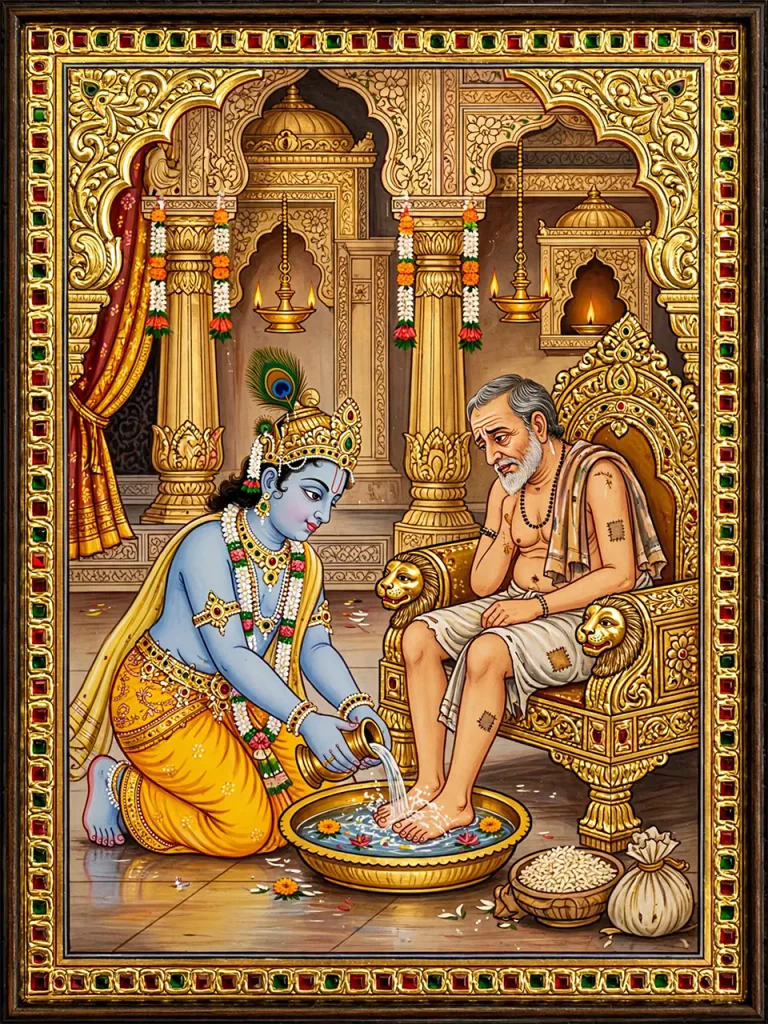
- Krishna received his impoverished childhood friend Sudama with tears of joy. Sudama arrived ragged, barefoot, and bearing only a handful of beaten rice. Yet Krishna washed his feet, seated him on his own royal couch, and treated him with divine reverence.
- Yama, the lord of justice, arrived at the home of young Naciketa in the Katha Upanishad. When Naciketa was away, Yama waited three days without food or water. Upon returning, Naciketa was so horrified that a guest had been left unserved that he offered three boons to make amends.
These stories teach a healthy cultural humility: never look down on anyone who stands at your door. You never know what moral beauty, quiet wisdom, or spiritual lesson walks beneath the dusty clothes of a weary traveler.
The Spiritual Significance: Seva, Humility, and Ego-Dissolution
Hospitality in the Vedic framework is not simply social etiquette; it is an active spiritual discipline (Sadhana). Welcoming a guest allows a householder to cultivate several core spiritual virtues:
1. Humility (Vinaya)
When an atithi arrives, the host steps out of the role of “master of the house.” The host stands, bows, washes the guest’s feet or offers water, and serves the meal before sitting down to eat.
This simple physical inversion—putting the visitor’s needs first—quietly cuts away arrogance. It reminds the host that their wealth, comfort, and position are temporary responsibilities, not reasons for self-importance.
2. Generosity (Dana)
True generosity happens when you give without looking for a return. Giving a lavish gift to someone who will give you an equally lavish gift next week is not charity; it is social trade.
Because a classical atithi was a wanderer who might depart at sunrise and never be seen again, serving them was an act of pure giving (shuddha dana). It expects no return, builds no political alliance, and earns no social debt. The gift exists purely for the benefit of the recipient.
3. Dedicated Service (Seva)
In Hindu thought, seva is selfless service performed without attachment to the results (Nishkama Karma). Many people dream of doing grand spiritual service on a mountaintop or in an ashram, but the scriptures bring that ideal straight into the home.
Cooking a warm meal, arranging a bed, and listening patiently to an exhausted traveler transforms everyday domestic chores into an act of living worship.
Read More>> What happens after death in Hinduism
Atithi Devo Bhava and Hindu Dharma
To fully understand Atithi Devo Bhava, we must examine its structural place within Dharma—the classical framework of cosmic order, righteousness, and social duty.
In classical Hinduism, life is organized around four broad life stages (Ashramas):
- Brahmacharya: The stage of the student, dedicated to learning and discipline.
- Grihastha: The stage of the householder, dedicated to family, earning wealth (Artha), and supporting society.
- Vanaprastha: The stage of retirement and gradual withdrawal from worldly attachments.
- Sannyasa: The stage of complete renunciation and contemplation of ultimate truth.
Among these four, the Grihastha (householder) carries the heaviest ethical burden. The student, the retiree, and the wandering monk all rely on the householder for sustenance. The householder’s primary moral obligation is to keep society fed, sheltered, and cared for.
The Householder’s Sacred Duty (Grihastha Dharma)
Ancient legal and philosophical texts, including the Manusmriti and the Yajnavalkya Smriti, describe hospitality not as an optional hobby for the generous, but as an essential daily duty. A householder who eats without first offering food to others is said to “eat their own sin.”
The Bhagavad Gita (3.13) echoes this sober reminder:
भुञ्जते ते त्वघं पापा ये पचन्त्यात्मकारणात् ।
bhuñjate te tvaghaṁ pāpā ye pacantyātmakāraṇāt |
“Those who prepare food solely for their own gratification eat only sin.”
The message is clear: resources enter a home to be shared, not hoarded behind locked doors.
Nri Yajna: The Offering to Human Beings
To help householders fulfill these responsibilities, Vedic tradition instituted the Pancha Maha Yajnas (the Five Great Daily Offerings). Every day, a family was expected to remember their interconnectedness with all of life:
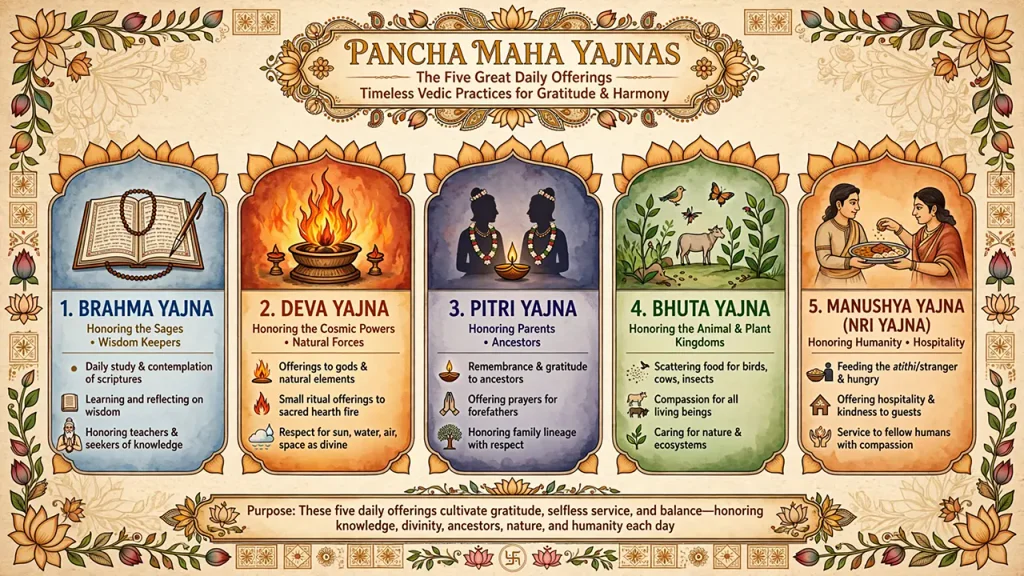
- Brahma Yajna (Rishi Yajna): Honoring the sages and wisdom keepers through daily study and contemplation.
- Deva Yajna: Honoring cosmic powers and natural forces through small ritual offerings into the sacred hearth fire.
- Pitri Yajna: Honoring parents and ancestors through remembrance, gratitude, and respectful conduct.
- Bhuta Yajna: Honoring the animal and plant kingdoms by scattering food for birds, cows, insects, and other creatures.
- Manushya Yajna (or Nri Yajna): Honoring humanity through hospitality—specifically by feeding the atithi, the stranger, and the hungry.
Notice that receiving guests is categorized directly as a Yajna—a sacred offering. Feeding an unexpected guest was seen as just as spiritually vital as keeping the sacred fire lit.
How Guests Were Traditionally Welcomed: The Mechanics of Hospitality
Hospitality in ancient and medieval India was not left to vague good intentions. It developed into a clear, dignified etiquette that balanced care for the traveler with deep mutual respect.
The Classical Welcoming Protocol (Upacharas)
When an atithi arrived at a traditional Indian homestead, the reception followed a graceful, step-by-step order:
1. Pratyudgamana (Going Forth to Greet)
The host did not sit back and wait for the visitor to knock repeatedly. Upon seeing someone approach the gate, the host stood up and walked forward to welcome them. Meeting the guest at the threshold showed that their arrival was seen as a joy, not a burden.
2. Pada Prakshalana and Padya (Cleansing the Feet)
Travelers in ancient India journeyed on foot, walking for miles across unpaved dirt roads and through hot sun. By the time they reached a home, their feet were covered in dust, bruised by stones, and exhausted by travel.
The host immediately offered clean, cool water to wash away the road grit. In noble households and deeply devout communities, the host poured the water themselves. This brought soothing physical relief while serving as an active practice of humility.
3. Asana Samarpana (Offering a Seat)
Before asking any questions about who the traveler was or why they were there, the host offered a clean, comfortable seat (Asana). The visitor was given time to catch their breath, rest their limbs, and let the heart settle.
4. Arghya and Achamaniya (Water for Thirst and Rinsing)
The host offered pure, fresh drinking water to cool the traveler down, along with water to rinse the hands, face, and mouth.
5. Madhuparka (Nourishing Refreshment)
For revered guests or wandering ascetics, the host often offered Madhuparka—a traditional, nourishing mixture of honey, yogurt, clarified butter (ghee), and milk. This sweet drink provided immediate energy and calmed the body after long hours in the sun.
6. Priyavachana (Gentle and Pleasant Speech)
Words matter just as much as food. Traditional texts warn against serving a guest with a cold voice, a furrowed brow, or sighs of exasperation.
The host was expected to speak kindly, asking polite questions about the traveler’s comfort without probing into personal business or making the guest feel self-conscious.
7. Anna Dana (The Offering of Sustenance)
The central act of hospitality was the shared meal. The guest was served the best food the home had to offer, with the host ensuring the visitor was completely satisfied before the family sat down to eat.
8. Anugamana (Accompanying the Guest on Departure)
When the guest was ready to resume their journey, the hospitality did not end abruptly at the front door. The host walked alongside the departing visitor to the edge of the property, the village boundary, or the nearest crossroad.
This gentle farewell ensured the traveler was safe, expressed gratitude for their visit, and offered well wishes for the road ahead.

The Hierarchy of Welcome: From Royal Banquets to Grass Mats
Did this mean an impoverished family had to bankrupt themselves to feed an unexpected traveler?
Not at all. Hindu scriptures show great practical wisdom on this point. What mattered was the spirit of the welcome, not the expense of the food.
A well-known verse from the Manusmriti (3.101) makes this balance beautifully clear:
तृणानि भूमिरुदकं वाक्सूनृता च चतुर्थिका ।
सतामेतानि गेहेषु नोच्छिद्यन्ते कदाचन ॥
tṛṇāni bhūmirudakaṁ vāksūnṛtā ca caturthikā |
satāmetāni geheṣu nocchidyante kadācana ||
“A mat of grass for a seat, space to rest upon the earth, water to quench thirst, and gentle, truthful speech—these four are never lacking in the house of a good person.”
Even the poorest hut in the poorest village could offer four things:
- A clean woven grass mat to sit on (Trinani).
- A sweep of dry, shaded floor to rest upon (Bhumi).
- A cup of clean, cool well water (Udakam).
- A kind, truthful, and welcoming word (Vak Sunrita).
Hospitality is an offering of the heart. A cup of water offered with warmth brings more peace than an elaborate banquet served with quiet resentment.
Are Guests Mentioned Elsewhere in Hindu Scripture?
The Taittiriya Upanishad is the best-known source for the exact phrase Atithi Devo Bhava, but the spirit of sacred hospitality runs throughout the entire Vedic and post-Vedic library.
Vedic References: Agni as the Divine Guest
In the Rig Veda, the oldest of the four Vedas, the sacred fire (Agni) is repeatedly addressed with the affectionate title of Atithi.
Agni is called Atithi Manushanam—”the divine guest of mortal human beings.” Just as a householder feeds the hearth fire every morning and evening with kindling and clarified butter, so too must they tend to the traveling stranger who arrives at their doorstep:
- Like fire, a guest arrives hungry and needs fuel (food).
- Like fire, a guest brings warmth, illumination, and life into the home.
- Like fire, a neglected guest can bring down spiritual misfortune through coldness and inattention.
By linking the everyday traveler with Agni, the Vedic rishis showed that caring for a guest is not merely a social courtesy—it is a living, domestic ritual.
The Itihasas: Stories from the Mahabharata and Ramayana
The two great Indian epics are filled with stories exploring the deep ethics of hospitality:
The Ramayana: Guha and Shabari
When Prince Rama was exiled to the Dandaka forest, he gave up his royal palaces to wander as an ascetic. Yet wherever he walked, hospitality welcomed him:
- Guha, the chieftain of the Nishada people, met Rama at the banks of the Ganga. Though from outside the city elite, Guha offered everything he had: his lands, boats, fruits, and personal service. Rama embraced him warmly, showing that true hospitality transcends social barriers.
- Shabari, an aged and humble forest ascetic, waited decades for Rama’s arrival. When he finally walked into her simple hermitage, she washed his feet, gave him cool water, and offered berries she had carefully tasted to ensure they were sweet. Rama accepted her humble forest offering with pure joy, moved by the devotion behind the gift.
The Mahabharata: The Story of the Golden Half-Mouse
Toward the end of the Mahabharata, King Yudhishthira conducted the grand Ashvamedha Yajna (Horse Sacrifice). He distributed mountains of gold, silver, cattle, and grain to thousands of citizens, and the court praised him for organizing the greatest sacrifice in history.
Suddenly, a strange mongoose with half its body turned to pure gold appeared in the sacrificial arena. The creature rolled in the dust, stood up, and laughed:
“Your great sacrifice is not worth a handful of barley flour given by the poor family of Kurukshetra.”
When the king’s advisors demanded an explanation, the mongoose shared a quiet story:
Once, during a severe famine, a poor family had not eaten for days. At last, they managed to gather a small measure of barley flour and divided it into four equal portions for the father, mother, son, and daughter-in-law.
Just as they were about to eat, an exhausted traveler knocked at their door, starving and asking for food. Without hesitation, the father gave the traveler his portion. The guest ate, but was still hungry. The mother then offered hers, followed by the son, and finally the daughter-in-law.
The stranger’s hunger was satisfied, and he blessed the family before walking on. Shortly after, the family died of starvation, their hearts light and free from regret.
The mongoose had rolled in the scattered crumbs left on their hut floor, and the moral power of their selflessness turned half its body into gold. Since then, the mongoose had traveled to every royal court across the land, hoping to find a sacrifice pure enough to turn the rest of its body to gold—and had never found one.
This striking story reminds us that true hospitality is not measured by the cost of the food or the grandeur of the setting. It is measured by the depth of love, sacrifice, and sincerity behind the giving.
Read More >> Is Sanatana Dharma and Hinduism Same
Does Atithi Devo Bhava Mean Every Guest Must Be Treated Like God?
This is one of the most important questions a thoughtful person can ask. Does Atithi Devo Bhava demand blind, naive obedience? Are we required to open our homes to someone who intends to harm us, simply because they stand at our doorstep?
The answer from Hindu philosophy is an unequivocal no.
Discernment and Wisdom (Viveka)
In the Hindu tradition, no single virtue (Dharma) stands alone. Every virtue must be guided by Viveka—the sharp, clear capacity for intellectual discernment, critical thinking, and practical wisdom.
Scripture repeatedly warns against foolish naivety:
- In the Ramayana, the demon king Ravana disguised himself as a gentle, ochre-robed wandering mendicant (Sannyasin) to trick Princess Sita. Sita, eager to practice hospitality and offer fruit and water to an ascetic, stepped beyond the protective boundary (Lakshmana Rekha), and was captured. The story serves as an enduring reminder: predators often wear the clothes of harmless guests.
- The ancient collection of wisdom tales, the Panchatantra, and the Hitopadesha are filled with stories of naive hosts who invited deceitful animals into their homes, only to pay with their lives.
Dharma never asks us to be foolish. Welcoming the guest must always be balanced by our foundational duty to protect the family, guard the home, and keep the community safe.
Personal Safety, Ethics, and Healthy Boundaries
In the modern world, this balance is essential. Following the spirit of Atithi Devo Bhava does not mean:
- Allowing an aggressive or dangerous person into your home.
- Enduring emotional, physical, or psychological abuse under your own roof.
- Ignoring common-sense precautions when dealing with people you do not know.
- Letting a guest take advantage of your generosity, overstay their welcome, or disrupt your family’s peace.
You can honor the divine spark in another human being without handing them the keys to your house.
If someone knocks at your door asking for help in a dangerous or suspicious situation, you can practice hospitality with wisdom: offer a packaged bottle of water through the gate, provide a sealed box of food, or call emergency services to assist them. You treat the person with dignity, but you maintain the boundary needed to keep everyone safe.
Atithi Devo Bhava in the Modern World
The world has changed dramatically since the days of forest hermitages and open village thresholds. Most of us no longer live in rural settlements where everyone knows their neighbors. We live in high-rise apartments with digital intercoms, secure gates, and long, demanding workdays.
How can an ancient Vedic ideal survive in a world of calendars, apps, and nuclear families?
Urban Realities: Apartments, Work Schedules, and Nuclear Families
In modern cities, people rarely have extra rooms or hours of free time. Both partners in a household often work long hours, and children have demanding school schedules. An unexpected visitor who arrives without a phone call can easily create quiet panic rather than spiritual joy.
Furthermore, commercial travel has transformed how we move. Travelers stay in hotels, use homestays, or take overnight flights. The wandering mendicant looking for a warm floor and a bowl of rice has become rare in urban neighborhoods.
Because of these shifts, some people wonder if Atithi Devo Bhava has simply become obsolete.
The Commercialization of Hospitality
In recent decades, the phrase has also been adopted by the tourism and travel industry. The Government of India’s Ministry of Tourism famously launched an “Atithi Devo Bhava” campaign to encourage courteous treatment of international travelers and improve service standards in hotels and transport.
While this campaign raised awareness, it can easily reduce a sacred ethical practice to commercial etiquette.
In a hotel or restaurant, polite service is delivered in exchange for payment. If the guest cannot pay, the hospitality stops. While professional courtesy is important, it is not the same as the original spiritual ideal:
| Dimension | Commercial Hospitality | Traditional Atithi Devo Bhava |
| Primary Motivation | Economic gain, business reputation, service contracts | Spiritual duty (Dharma), ego-dissolution, selfless service (Seva) |
| Foundational Dynamic | Service provider and paying customer | Householder and honored fellow human being |
| Underlying Expectation | Financial payment or mutual commercial benefit | No material return; practiced for spiritual purification |
| Atmosphere | Professional, standardized, contractual | Warm, personal, generous, sincere |
How to Practise Atithi Devo Bhava Today
We do not need to live in an ancient hermitage to live out the wisdom of this teaching. The essence of Atithi Devo Bhava has never been about grand gestures; it lives in the quality of attention, care, and warmth we bring to our everyday interactions.

Simple Domestic Practices
Here are a few meaningful ways to practice this ideal in everyday family life:
1. The Welcome Cup of Water
Make it a household rule: whenever anyone steps through your doorway—a guest, an old friend, a delivery worker, or a service technician—offer them a glass of clean, cool water before talking about business or tasks. This simple gesture takes ten seconds, costs almost nothing, and immediately honors the person’s physical humanity.
2. Undivided Attention (The Gift of Presence)
In our distracted world, the rarest gift you can offer someone is your undivided attention.
When a guest visits your home, put your smartphone aside, step away from your laptop, and mute the television. Look them in the eye, listen to their stories, and let them feel that their presence matters. In an age of digital distraction, mindful presence is one of the most generous forms of hospitality.
3. Thoughtful Comfort
Notice small needs before your guest has to ask. Ensure they have a comfortable place to sit, offer a warm cup of tea, show them where the washroom is, and make sure the room temperature is pleasant. Thoughtfulness is love expressed through small details.
4. Graciousness with Family and Relatives
It is easy to treat a distinguished outside visitor with lavish politeness, while treating our own relatives or in-laws with impatience and coldness. True Atithi Devo Bhava begins by showing consistent patience, respect, and warmth to the people closest to us.
Civic Hospitality and Everyday Kindness
We can also carry this spirit beyond the walls of our homes, into our neighborhoods and cities:
- Delivery Drivers and Home Workers: When a courier, repair worker, or maintenance technician arrives at your door on a scorching summer afternoon, offer them a cold bottle of water or a small snack. Treat them with the dignity you would show a respected colleague.
- Welcoming Strangers in Public Spaces: If you see someone looking lost at a transit station or struggling to find their way in an unfamiliar neighborhood, step forward and offer clear, polite directions.
- Neighborhood Generosity: When a new family moves in next door, drop by with a small plate of homemade food or a warm note welcoming them to the community.
- Everyday Courtesy: Bring patience and kindness to checkout counters, ticket booths, and public waiting rooms. Recognizing the dignity of the person on the other side of the counter keeps our public life human.
Read More >> Is Eating Non-Veg a sin in Hinduism?
Common Misunderstandings About Atithi Devo Bhava
Because the phrase is widely repeated, several misunderstandings have grown around it over time. Clearing away these misconceptions helps us see the teaching for what it truly is.
Misconception 1: “It means every visitor is literally God in human form.”
As discussed earlier, this is a misunderstanding of how Sanskrit philosophical language works. The teaching instructs the host to cultivate a spirit of reverence, care, and honor. It is an internal spiritual discipline, not a claim that the visitor possesses supernatural powers.
Misconception 2: “You must endure abuse, harassment, or boundary violations to be a good host.”
Nowhere do the Upanishads or epics ask us to abandon self-respect or personal safety. Hospitality that enables cruelty, arrogance, or dangerous behavior is not virtuous; it is unrighteous (Adharma). Clear boundaries and ethical discernment must always guide our kindness.
Misconception 3: “Hospitality is only genuine if you spend large sums of money on food and gifts.”
Vedic wisdom explicitly rejects this idea. As the Manusmriti reminds us, clean water, a simple seat, and a kind, truthful word are enough. Sincerity and warmth matter far more than an expensive spread.
Misconception 4: “The guest has no moral duties toward the host.”
Traditional texts clearly outline the responsibilities of the guest (Atithi Dharma). A good guest is expected to be considerate, undemanding, respectful of the home’s routines, and careful not to overstay their welcome. Hospitality is a shared balance of mutual respect, not a one-sided license for entitlement.


Core Life Lessons from This Ancient Philosophy
When we look beneath the historical customs and ancient languages, Atithi Devo Bhava offers three enduring insights for living a wise, grounded life:
1. The Antidote to Domestic Self-Absorption
It is easy to turn our homes into private fortresses where we retreat from the world and indulge our own comforts. Atithi Devo Bhava gently challenges this retreat. It asks us to open our doors, share our blessings, and stay connected to the wider human family.
2. The True Measure of Character
You can easily judge a person’s character by watching how they treat people who have no power to help them. Serving an influential guest who might advance your career is simple self-interest. Offering warmth, a meal, and quiet respect to an unknown traveler reveals the real depth of your heart.
3. Finding the Sacred in Ordinary Moments
You do not need to climb a mountain peak or withdraw to a forest monastery to live a spiritual life. Atithi Devo Bhava brings spiritual practice straight into our living rooms. It tells us that washing a cup, pouring water, slicing fruit, and listening patiently to a tired human being are sacred acts in their own right.
FAQ SECTION
What does Atithi Devo Bhava mean?
Atithi Devo Bhava is a Sanskrit phrase that means “May the guest be one to whom you accord the reverence due to God.” It directs the householder to receive visitors and unexpected travelers with honor, humility, generosity, and thoughtful care.
Where is Atithi Devo Bhava mentioned in Hindu scripture?
The exact phrase appears in the Taittiriya Upanishad (Shiksha Valli, Chapter 1, Lesson 11, Section 2). It forms part of the teacher’s final ethical address to students completing their studies before returning home to become householders.
What does the word “Atithi” mean in Sanskrit?
The word Atithi (अतिथि) comes from the prefix a- (without) and tithi (a calendar date or lunar day). It literally means someone who arrives without a scheduled date—an unannounced traveler or wanderer who relies on the spontaneous hospitality of others.
What are the four teachings mentioned alongside Atithi Devo Bhava?
In the Taittiriya Upanishad (1.11.2), the teacher delivers four interconnected instructions:
Matri Devo Bhava (Treat your mother with divine reverence)
Pitri Devo Bhava (Treat your father with divine reverence)
Acharya Devo Bhava (Treat your teacher with divine reverence)
Atithi Devo Bhava (Treat your guest with divine reverence)
Does Atithi Devo Bhava mean every guest is literally God?
No. In traditional Vedanta commentary (such as Adi Shankara’s Bhashya), it is an ethical and meditative directive (Bhavana). It commands the host to treat the visitor with the same sincerity, care, and reverence one brings to the worship of God, recognizing the divine consciousness within all living beings.
Why are guests considered divine in Hinduism?
Guests are respected because Hindu philosophy teaches that the supreme consciousness (Brahman) dwells within the hearts of all living beings (Atman). Serving a guest is viewed as a direct, practical worship of the divine in human form. Additionally, sacred stories frequently describe deities arriving disguised as humble wanderers to test human character.
What is the connection between Atithi Devo Bhava and Pancha Maha Yajna?
In classical Hindu duty (Grihastha Dharma), every householder is expected to perform five daily offerings (Pancha Maha Yajnas). Serving the guest constitutes Nri Yajna (or Manushya Yajna)—the sacred daily offering of food, shelter, and comfort to fellow human beings.
Does Atithi Devo Bhava require putting personal safety at risk?
No. Classical Hindu thought balances duty (Dharma) with practical discernment (Viveka). The scriptures warn against blind naivety (as shown in the story of Ravana disguised as a hermit). Hospitality should never compromise family safety, enable wrongdoing, or ignore common-sense precautions.
How can we practice Atithi Devo Bhava in modern life?
You can practice this ideal through simple daily habits: offering a glass of water to delivery workers, putting away your smartphone to give guests your full attention, speaking kindly to visitors, keeping guests comfortable, and treating service staff with dignity.
What is the difference between an Atithi and an Abhyagata?
In traditional terminology, an Abhyagata is an expected visitor, friend, or relative who arrives on a known occasion. An Atithi is a traveler or stranger who arrives without advance notice or prior appointment.
What if a family is too poor to provide a lavish meal for a guest?
Scripture states that wealth is never a requirement for hospitality. The Manusmriti (3.101) explains that even the poorest home can always offer four sacred gifts: a grass mat to sit on, a dry place to rest, pure drinking water, and kind, encouraging words.
Conclusion: The Enduring Power of Sacred Welcoming
Atithi Devo Bhava is far more than an ancient greeting or a tourism slogan. It is a timeless invitation to live with an open heart.
Born from the parting words of an ancient forest teacher to their graduating students in the Taittiriya Upanishad, this simple principle bridges the sacred and the everyday. It asks us to look at the unexpected visitor standing at our door—tired, dusty, and ordinary—and see something infinitely worthy of respect.
In a modern world that often feels hurried, divided, and guarded, this ancient wisdom remains as fresh and necessary as ever. We may not always be able to host travelers for days or prepare elaborate banquets. But we can always offer a cool glass of water, an unhurried smile, our full attention, and a kind word.
When we welcome another person with warmth and sincere respect, we do not simply honor them. We soften our own egos, bring light into our homes, and keep alive one of the most generous traditions the world has ever known.
SOURCES & REFERENCES
- Taittiriya Upanishad (Shiksha Valli, Anuvaka 11, Verse 2) – The Principal Upanishads, translated with commentary by S. Radhakrishnan (HarperCollins / George Allen & Unwin).
- Taittiriya Upanishad Bhashya by Adi Shankaracharya – Translated by Swami Gambhirananda, Advaita Ashrama, Kolkata.
- The Bhagavad Gita (Chapter 3, Verse 13; Chapter 13, Verse 28) – Commentary by Swami Swarupananda, Advaita Ashrama.
- Manusmriti (The Laws of Manu) (Chapter 3, Verses 99–106) – Critical edition translated by Wendy Doniger and Brian K. Smith (Penguin Classics).
- A Sanskrit-English Dictionary by Sir Monier Monier-Williams – Oxford University Press (Entry on Atithi, Tithi, and Deva).
- The Mahabharata (Ashvamedhika Parva & Shanti Parva) – Translated by Kisari Mohan Ganguli (Sacred Texts Archive).
- A History of Indian Philosophy (Vol. 1 & 2) by Surendranath Dasgupta – Motilal Banarsidass Publishers.