Ramappa Temple (Rudreshwara): History, Floating Bricks & Visitor Guide
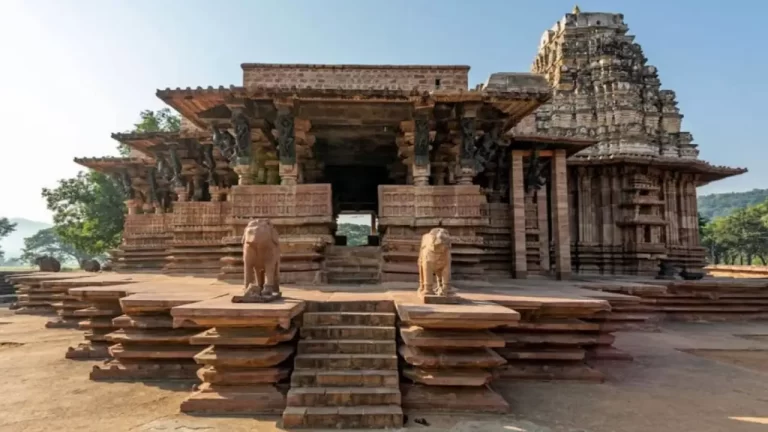
Ramappa Temple, also known as the Rudreshwara Temple, is a 13th-century Kakatiya-era architectural masterpiece located in Palampet village, Mulugu District, Telangana. Inscribed as a UNESCO World Heritage Site in July 2021, it is renowned as the only temple in India named after its chief sculptor, Ramappa, rather than the ruling monarch or the presiding deity, Lord Shiva.

Standing proudly on a 6-foot-high star-shaped platform, the temple is an extraordinary example of medieval Deccan civil engineering. It is globally famous for its earthquake-resistant sandbox foundation, feather-light floating roof bricks, and intricately carved, mirror-polished black dolerite bracket figures depicting graceful dancers (Madanikas).
Whether you are a devotee seeking the blessings of Ramalingeswara Swamy or a traveller eager to see India’s finest heritage engineering, this complete guide covers the temple’s history, architectural secrets, daily timings, pooja rituals, and practical travel logistics.
Quick Information: Ramappa Temple at a Glance
| Feature | Details |
| Temple Name | Rudreshwara (Ramappa) Temple |
| Presiding Deity | Lord Shiva (worshipped as Ramalingeswara Swamy) |
| Location | Palampet Village, Venkatapur Mandal, Mulugu District, Telangana, India |
| Architect / Sculptor | Master Craftsman Ramappa |
| Builder & Patron | General Recharla Rudra (during the reign of Kakatiya King Ganapati Deva) |
| Year of Consecration | 1213 CE (Shaka era 1135) |
| UNESCO World Heritage Status | Inscribed in July 2021 (Criterion i & iii) |
| Daily Darshan Timings | 6:00 AM to 6:00 PM (Open all 7 days) |
| Special Pooja Timings | Morning Abhishekam: 7:00 AM to 9:00 AM; Evening Aarti: 5:30 PM |
| Entry Fee | Free entry for regular darshan (nominal parking fee applies) |
| Dress Code | Traditional, modest Indian clothing recommended (dhoti/kurta or formal pants for men; sarees, salwar suits for women) |
| Best Time to Visit | October to March (pleasant weather; Maha Shivaratri festival) |
| Nearest Railway Hub | Kazipet Junction (approx. 72 km) / Warangal Railway Station (approx. 67 km) |
| Nearest Airport | Rajiv Gandhi International Airport, Hyderabad (approx. 215 km) |
| Key Highlights | Sandbox foundation, porous floating bricks, lathe-turned pillars, dancing Madanika brackets |

The Origin: Why Is the Temple Named After Its Sculptor?
In the vast tradition of Indian temple building, temples are almost universally named after the enshrined deity (such as Kashi Vishwanath) or the royal patron who funded the construction (such as the Brihadisvara Temple built by Raja Raja Chola).
Ramappa Temple breaks this rule completely.
An inscription found on a four-faced polished basalt pillar within the temple complex states that Recharla Rudra, the commander-in-chief (Senapati) of Kakatiya monarch King Ganapati Deva, commissioned the temple in the year 1213 CE.
According to regional historical accounts and oral tradition, the master sculptor Ramappa dedicated over 40 years of his life to designing, carving, and raising this sanctuary. When the royal court inspected the finished temple, King Ganapati Deva and Recharla Rudra were so spellbound by the sheer grace of the sculptures and the brilliance of the engineering that they declared the temple would forever bear the name of its creator: Ramappa.
To this day, the temple stands as a rare, immortal tribute to the skill of the Indian artisan.
Read More>> The Real Magic of Vadapalani Murugan Temple Revealed!
The Presiding Deity: Ramalingeswara Swamy
The sanctum sanctorum (Garbhagriha) houses a massive, polished black basalt Shiva Linga set upon a high Avudaiyar (pedestal). The deity is venerated as Ramalingeswara Swamy.
When you enter the inner sanctum through the pillared hall, you immediately notice a clever lighting technique used by Kakatiya builders. Even on overcast days, the directional orientation of the doorway and the reflective finish of the surrounding pillars focus natural daylight directly onto the Shiva Linga, keeping it illuminated from dawn to dusk without artificial lighting.
Devotees visit to perform Rudrabhishekam and Bilva archana, especially on Mondays, during the sacred month of Karthika Masam, and on Maha Shivaratri.
Read More>> India’s Amazing 1000 Pillar Temple!

The Architectural Marvels: The Science Behind Ramappa
The reason Ramappa Temple earned its UNESCO World Heritage inscription lies in its breathtaking harmony of art, geology, and advanced structural mechanics.
1. The Sandbox Technology: Earthquake Defense System
Telangana is not immune to tectonic activity. In the 17th and 19th centuries, severe earthquakes shook the region, causing nearby structures to crumble. The outer walls of Ramappa suffered partial shifts, yet the core sanctum and inner pillars remained fully upright.
The secret is the Kakatiyas’ sandbox foundation technique:
- The builders dug a deep foundation pit measuring roughly 3 meters deep.
- Instead of filling it entirely with rigid stone boulders, they packed the pit with a composite mixture of river sand, slaked lime, jaggery, and crushed karakkaya (black myrobalan fruit).
- The heavy stone plinth was then raised on top of this cushioned bed.
When seismic waves hit the ground, the sand mixture acted as a giant shock absorber, dissipating vibrational energy and allowing the superstructure to shift slightly without cracking or collapsing.
Read More>> Shivoham Shiva Temple: 65 Foot Tall Statue of Lord Shiva
2. The Floating Bricks of the Vimana
One of the most talked-about features of Ramappa Temple is the lightweight brickwork used to construct the central tower (Vimana/Shikhara).
Popular folklore often describes these as magical stones. However, metallurgical and archaeological research has revealed a brilliant ancient materials-engineering breakthrough:
- Kakatiya artisans manufactured these bricks using sponge-like clay mixed with sawdust, rice husk, and crushed organic matter.
- During kiln firing, the organic components burned away completely, leaving countless microscopic air pockets throughout the ceramic body.
- Because of this high internal porosity, the bricks have a very low specific gravity (ranging between 0.8 and 0.9 g/cm³), meaning they are lighter than water and can float.
Why did the builders do this? If the heavy pyramidal shikhara had been constructed out of solid red sandstone or granite, the immense downward deadweight would have crushed the central pillars during ground tremors. By building the roof with lightweight porous bricks, the architects significantly reduced the top-heavy load of the temple.
Note for Visitors: To protect the heritage monument from wear and tear, the Archaeological Survey of India (ASI) keeps original floating brick specimens preserved in safe display cases, and visitors are no longer permitted to break or drop artifacts into water tanks.
3. The Dancing Bracket Figures (Madanikas)
Flanking the outer eaves of the temple roof are 12 life-size bracket figures (Madanikas or Salabhanjikas). Carved out of dense, hard black dolerite stone, these statues represent the highest peak of Kakatiya sculptural art.
- The Ballerina (Natya Sundari): Depicts a classical dancer in a dynamic motion pose. Look closely at her long fingers, delicate bead necklaces, and elaborate hairstyle—every detail is carved with fluid realism.
- The Lady with the Bow: Portrays a poised huntress, showcasing that women in Kakatiya society were trained in martial arts and archery.
- Lustrous Mirror Finish: Unlike sandstone, dolerite is exceptionally tough to sculpt. The Kakatiya craftsmen used abrasive diamond dust and herbal polishes to give these statues a jet-black, metallic, mirror-like gleam that has not faded after 800 years of exposure to rain and sun.

The Nandi Mandapa: The Loyal Sentinel
Facing the sanctum sanctorum stands the monolithic stone sculpture of Nandi, the sacred bull and mount of Lord Shiva.
Unlike conventional Nandi statues that sit completely relaxed with legs tucked under, the Nandi at Ramappa is depicted in an alert, active posture. One ear is cocked forward as if listening intently for Lord Shiva’s command, and his muscular stance gives the impression that he could leap forward at a moment’s notice.
The detailing on Nandi’s ornaments—including layered chain bells, floral garlands, and embroidered saddle straps—is sculpted with razor-sharp precision. If you view Nandi from any angle in the open mandapa, his eyes appear to look straight at you.
Read More>> Kanipakam Varasiddhi Vinayaka Swamy
Exploring the Kakatiya Heritage Circuit
If you are planning a visit to Ramappa Temple, you are stepping into the heartland of the medieval Kakatiya Empire. To get the most out of your trip, visit Ramappa as part of the broader Warangal Heritage Circuit.
Editorial Note for Travelers: For complete guides to the sister monuments in this circuit, explore our detailed pilgrimage guides:
- Thousand Pillar Temple Hanamkonda to compare its famous triple-shrine (Trikuta) design with Ramappa’s single-shrine layout.
- Bhadrakali Temple Warangal to plan your morning temple rituals before heading toward Palampet.
- Yadadri Temple Guide if you are driving from Hyderabad along the popular Warangal temple highway route.

Ramappa Lake (Ramappa Cheruvu): Medieval Water Conservation
Just one kilometer from the temple complex lies Ramappa Lake, a massive man-made water reservoir constructed during the same Kakatiya era.
The Kakatiyas were legendary masters of irrigation. They connected natural hill ridges with massive earthen embankments to capture seasonal monsoon runoff. Covering an area of over 82 square kilometers, Ramappa Cheruvu provided perennial water to nearby farming villages, preventing both drought and soil erosion.
Today, Telangana Tourism operates a boating center here. After exploring the temple, taking a speed-boat or pedal-boat ride across the tranquil lake surrounded by forested hills is a relaxing way to spend the late afternoon.
Read More>> Char Dham Yatra – A Complete Guide to Spiritual Destination
How to Reach Ramappa Temple
Ramappa Temple is located in Palampet village in the Mulugu District of Telangana.
By Road (Most Convenient Option)
- From Hyderabad (approx. 215 km): Take the well-paved NH 163 (Hyderabad–Warangal–Bhopalpatnam Highway). Pass through Yadagirigutta, Jangaon, and Hanamkonda, then continue toward Mulugu and take the turnoff to Palampet. Driving time is approximately 4.5 to 5 hours.
- From Warangal / Hanamkonda (approx. 67 km): The road from Warangal passes through scenic countryside via Mulugu and Venkatapur. Regular TSRTC buses, private rental cars, and auto-rickshaws connect Warangal to Palampet.
By Train
- The nearest major railway stations are Kazipet Junction (72 km) and Warangal Railway Station (67 km).
- Both stations are well-connected to major Indian metros, including Hyderabad, Chennai, New Delhi, Bengaluru, and Mumbai. From the station, you can hire a private taxi or catch a state bus toward Mulugu/Palampet.
By Air
- The nearest international gateway is Rajiv Gandhi International Airport (HYD) in Hyderabad, located about 235 km away. From the airport, pre-paid taxis and self-drive car rentals provide a smooth drive via Outer Ring Road (ORR) onto NH 163.

Best Time to Visit and Weather Tips
- Winter (October to February): This is the best time to visit. Temperatures range between 18°C and 30°C, making it pleasant to walk barefoot across the stone courtyard and admire the outer wall carvings.
- Monsoon (July to September): The surrounding forests of Mulugu and Ramappa Lake turn lush green. However, carry umbrellas, as rain can make the open stone steps slick.
- Summer (March to May): Summers are hot in northern Telangana, with temperatures frequently exceeding 40°C. If visiting in summer, plan your darshan early in the morning between 6:30 AM and 9:30 AM to avoid the intense midday heat.
Read More>> Ananthagiri Temple Vikarabad: Where Myths and Legends Come to Life
Visitor Rules, Darshan Etiquette, and Practical Tips
- Footwear Storage: Footwear is not allowed on the main temple platform. Dedicated shoe storage stands are available near the entrance gate. During summer months, jute runners are laid out on the stone platform to protect your feet from heat.
- Photography Guidelines: Photography and mobile phone cameras are permitted in the outer courtyard and around the stone carvings. However, avoid using heavy flash photography inside the main sanctum sanctorum during active pooja rituals.
- Dress Code: Wear respectful clothing that covers your shoulders and knees. Traditional Indian attire (kurta-pyjama, dhoti, sarees, or salwar-kameez) is welcomed and appreciated.
- Hiring an ASI Guide: To truly appreciate the historical depth, hire an official guide accredited by the Archaeological Survey of India near the ticket counter. They will point out hidden sculptural details, such as musical pillars that ring when tapped and micro-carvings of Kakatiya jewellery.
- Food and Accommodation:
- Where to Stay: The Telangana Tourism Department operates the Haritha Lake View Resort near Ramappa Lake, which offers comfortable air-conditioned cottages and a restaurant. For more hotel choices, stay in Warangal or Hanamkonda, which have numerous 3-star and budget hotels.
- Food: Palampet village has small local food stalls serving South Indian breakfast (idli, dosa) and simple rice meals. For full-service restaurants, Warangal and Mulugu town offer the best dining options.

Frequently Asked Questions (FAQs)
1. Is Ramappa Temple an active place of Hindu worship?
Yes. Although Ramappa Temple is a protected UNESCO World Heritage Site managed by the Archaeological Survey of India (ASI), it remains an active living temple. Daily pooja rituals, morning Abhishekam, and evening aartis are conducted regularly for Lord Ramalingeswara Swamy by local temple priests.
2. Why was Ramappa Temple awarded UNESCO World Heritage status?
In July 2021, UNESCO inscribed the temple under Criteria (i) and (iii) of its World Heritage Convention. The international committee recognized it for its exceptional Kakatiya artistic mastery, unique floating brick superstructure, and earthquake-resistant sandbox foundation.
3. Can I test the floating bricks in water during my visit?
No. To prevent damage and preserve the historic fabric of the monument, visitors cannot handle or immerse the temple bricks in water tanks. The Archaeological Survey of India keeps sample bricks preserved in display vitrines for educational viewing.
4. What are the daily darshan timings at Ramappa Temple?
The temple complex is open to visitors every day from 6:00 AM to 6:00 PM without an afternoon closure. Morning prayers and Abhishekam typically take place between 7:00 AM and 9:00 AM.
5. How much time is needed to see the entire temple?
Most visitors spend between 1.5 to 2.5 hours exploring the temple carvings, inspecting the Nandi Mandapa, and walking through the gardens. If you also plan to visit nearby Ramappa Lake for boating, set aside half a day (3 to 4 hours).
6. Is Ramappa Temple wheelchair accessible?
The ground-level gardens and outer walkways around the monument are reasonably flat and accessible. However, reaching the main sanctum requires climbing several steep stone steps to reach the elevated 6-foot star platform, which may require assistance for senior citizens or travellers with mobility challenges.
Preserving Our Sacred Heritage
Ramappa Temple stands as living proof that ancient Indian builders were master civil engineers, materials scientists, and peerless artists all at once. From its shock-absorbing sand foundation to its lightweight roof and lifelike dancing figures, every square foot of this sanctuary tells a story of devotion and scientific brilliance.
When you visit Palampet, take your time walking around the star-shaped platform, listen to the gentle breeze coming off Ramappa Lake, and help preserve this 800-year-old marvel by respecting temple guidelines and keeping the premises clean.