Kanchi Kamakshi Temple: One of Powerful 18 Shakti Peethas
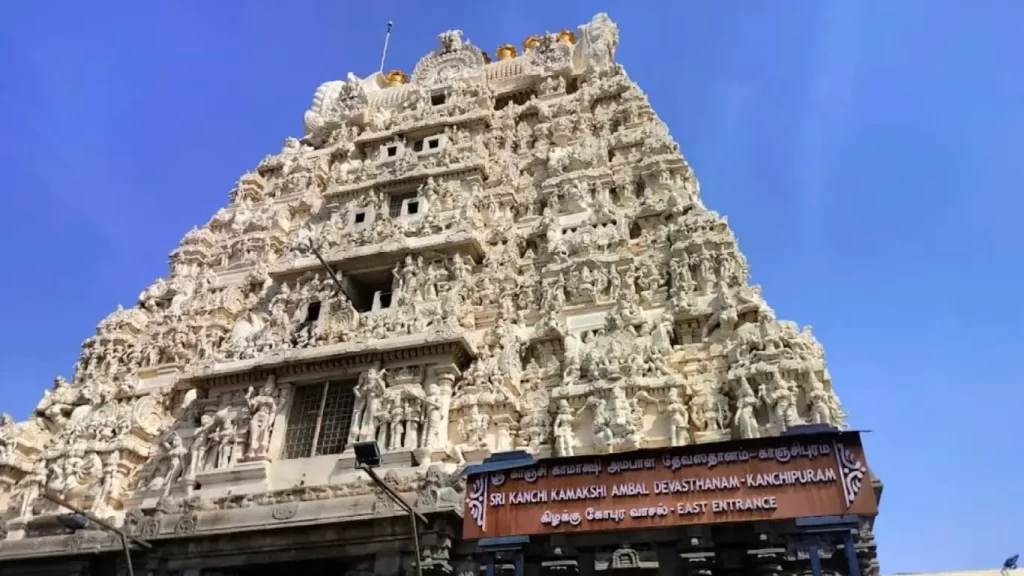
Kanchi Kamakshi Temple, situated in the ancient city of Kanchipuram, Tamil Nadu is amongst India’s most revered and stunning temples. Kanchipuram itself is a spiritual and historical center, and yet of all its marvels, the Kanchi Kamakshi Temple is an absolutely singular and special entity. It is not merely a temple; it is the heart and soul of this city. In contrast to other Shiva temples in Kanchipuram, which contain a different shrine for the Goddess, here, all forms of the Divine Mother are said to be housed within Goddess Kamakshi herself. This renders the Kanchi Kamakshi Temple the focal point of worship for all Shakti devotees.
Contents
- 1 The Richness of the Kanchi Kamakshi Temple History
- 2 The Endearing Legend of the Kanchi Kamakshi Temple
- 3 Cultural, Spiritual, and Mythological Significance
- 4 Uncommon Architectural Forms and Sculptures
- 5 Festivals and Special Days
- 6 Special Poojas and Rituals
- 7 Myths and Beliefs
- 8 Kanchi Kamakshi Temple Secrets
- 9 Kanchi Kamakshi Temple Timings
- 10 Hindu Places to Visit Near the Temple
- 10.0.1 Salai Kumaraswamy Temple Tirunelveli
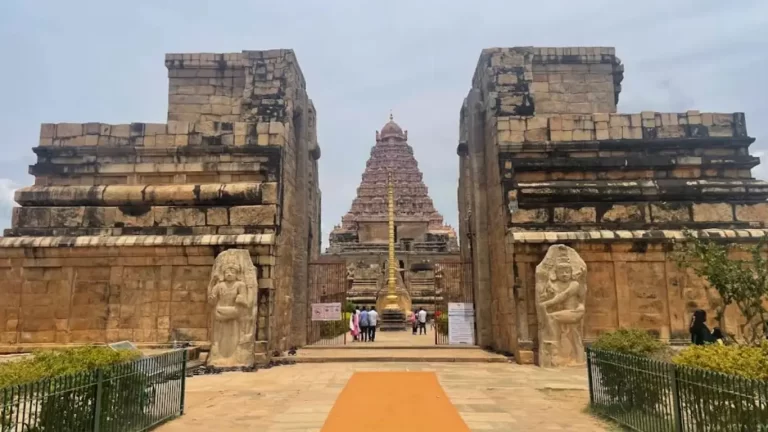
- 10.0.2 Gangaikonda Cholapuram Temple
- 10.0.3 Sivanmalai Temple: Murugan’s Sacred Box Predicts the Future
- 10.0.4 Thiruvidaikazhi Murugan Temple: Remove Sins of Even the Gods
- 10.0.5 Kanchi Kamakshi Temple: One of Powerful 18 Shakti Peethas
- 10.0.6 3BCE Pathala Sembhu Murugan Temple: Underground Copper Pot
- 11 Accommodation Options
- 12 How to Reach the Temple
The Richness of the Kanchi Kamakshi Temple History
The Kanchi Kamakshi Temple’s history is as profound and old as the city that it inhabits. Though the actual date of its construction is buried in time, the Pallava dynasty is believed to have originally constructed it as early as the 7th century. The temple has been there for more than a thousand years, witnessing the growth and decline of mighty empires such as the Cholas and the Vijayanagara rulers, who all added to its grandeur through numerous renovations and extensions.
Yet, the greatest turning point in the history of the temple is its connection with the renowned philosopher-saint Adi Shankaracharya. According to belief in the 8th century, he came to the Kanchi Kamakshi Temple and discovered the god, Goddess Kamakshi, in a terrible form. In order to calm her down and direct her vast energy for the welfare of the planet, he placed the Sri Chakra, a powerful and mysterious geometric image, before the central idol.
It is believed this action turned the goddess into the benevolent, forgiving form that we behold today. The Sri Chakra is so important to the worship that even poojas are initially offered to it before being done for the presiding deity. This tradition makes the temple not only a house of worship but a living example of the spiritual philosophy of Adi Shankaracharya.
Read More>> Vidyashankara Temple Sringeri 12 Pillars Reveal Your Destiny
The Endearing Legend of the Kanchi Kamakshi Temple
Each great temple has a tale behind it, a legend that tells us why it exists and what its connection with the divine is. The legend of the Kanchi Kamakshi Temple is one of love, penance, and devotion.
As per the Puranas, Goddess Parvati, wife of Lord Shiva, had once done something that was disrespectful in a playful mood when she covered the eyes of Lord Shiva. This harmless action caused darkness to descend over the world, and hence she was cursed to come in human form. As a penance for the same, she came to Earth and selected Kanchipuram as the site for her penance.
She adopted the name Kamakshi, which is a beautiful translation for “the one having loving eyes.” The name itself is a blend of two words: ‘Ka’ (Goddess Saraswati, goddess of knowledge) and ‘Ma’ (Goddess Lakshmi, goddess of prosperity). Kamakshi, therefore, is the one who possesses knowledge as well as prosperity in her eyes. Another understanding is that ‘Kama’ is desire and ‘Akshi’ are eyes, so she bestows all the wishes of her devotees with one merciful glance.
According to legend, Goddess Kamakshi undertook her rigorous penance at a mango tree in Kanchipuram, making a lingam of sand to pray to Lord Shiva. Her devotion was so deep that it awakened Lord Shiva who appeared before her and at last accepted her as his consort. It is this divine union that makes the Kanchi Kamakshi Temple so powerful and worshipped.
Kamakshi Amman Temple is also known as the “Kama Koti Peetham,” indicating its ability to grant wishes and liberate. It is regarded as one of the most prominent Shaktism centers, where Goddess Kamakshi is revered as the supreme form of Adi Parashakti. The temple’s connection with the Ashtadasa Shakti Peethas makes it one of the strongest pilgrimage centers and a reservoir of infinite spiritual energy for its devotees.
Read More>> Chinese Kali Temple Tangra Kolkata
Puranic References and Evidence
The religious significance of the Kanchi Kamakshi Temple is not just a local tradition; it is rooted deeply in ancient Hindu scriptures. The temple is a Shakti Peetha, the holy places where it is believed that fragments of Goddess Sati’s limbs fell upon the death of Lord Shiva’s Tandava. According to the Puranas, specifically the Lalitopakhyanam of the Brahmanda Purana and the Kanchi Purana, the Nabhi Bhaga (navel part) of Goddess Sati, along with her Odyana (waistband), fell here. This makes it the “Nabhi Shakti Peetha” and one of the 18 Astadasha Shakti Peethas mentioned in the Puranas.
Furthermore, the glory of Sri Kanchi Kamakshi is extolled in several texts. Her divine activities and significance are also described in the Devi Mahatmya Adyaya of the Markandeya Purana and the Sanathkumara Samhita of the Skanda Purana. The Kamakshi Rahasya, a special book, gives a detailed description of her mythology and why the Gayatri Mandapam where her idol is kept is so important. These sources give a scriptural basis to the sanctity of the temple, declaring it a superlative dwelling place of the Divine Mother.
Cultural, Spiritual, and Mythological Significance
Kanchi Kamakshi Temple is not merely a temple of worship; it is a hub of great cultural, spiritual, and mythological importance.
It is the hub of Kanchipuram culturally. The revelry of the vibrant festivals, the classic poojas, and the very way of life of the people around it depends on the temple. Even the city, by name, is called “Kamakoti” for the temple. The craft of silk weaving, for which Kanchipuram is internationally renowned, is also intimately connected with the temple. Weavers from the local area frequently take ideas from the temple’s exquisitely carved sculptures and stories, and the lovely Kanchipuram silk sarees are taken to be presentations to the Goddess herself.
Spiritually, the Kanchi Kamakshi Temple is an influential force for those who seek liberation. The seated position of Goddess Kamakshi, Padmasana, is one of the yogic sitting postures of meditation and peace, representing peace and prosperity. The Sri Chakra, which has been insalled by Adi Shankaracharya, is said to contain huge cosmic power. Faithfuls and spiritual seekers usually experience a sense of deep peace and inner tranquility within the temple complex. It is thought that a pilgrimage here not only satisfies worldly wishes but also helps in spiritual development and the elimination of hindrances. The temple is one of the seven holy sites (Mokshapuris) capable of providing salvation.
Mythologically, the temple is the only shrine for Goddess Parvati in Kanchipuram. Though Lord Shiva is venerated in numerous temples here, Goddess Kamakshi is venerated as the supreme energy, the Adi Parashakti. The myth of her penance and union with Lord Shiva makes the site a spiritual icon of divine love and devotion. The lack of a distinct shrine for the Goddess in other city temples underscores her supreme significance here; it is as if all the divine feminine power of the city is focussed in this one sacred space.
Read More>> Chamundeshwari Temple Mysore: Architectural Marvel & Spiritual Wonder
Uncommon Architectural Forms and Sculptures
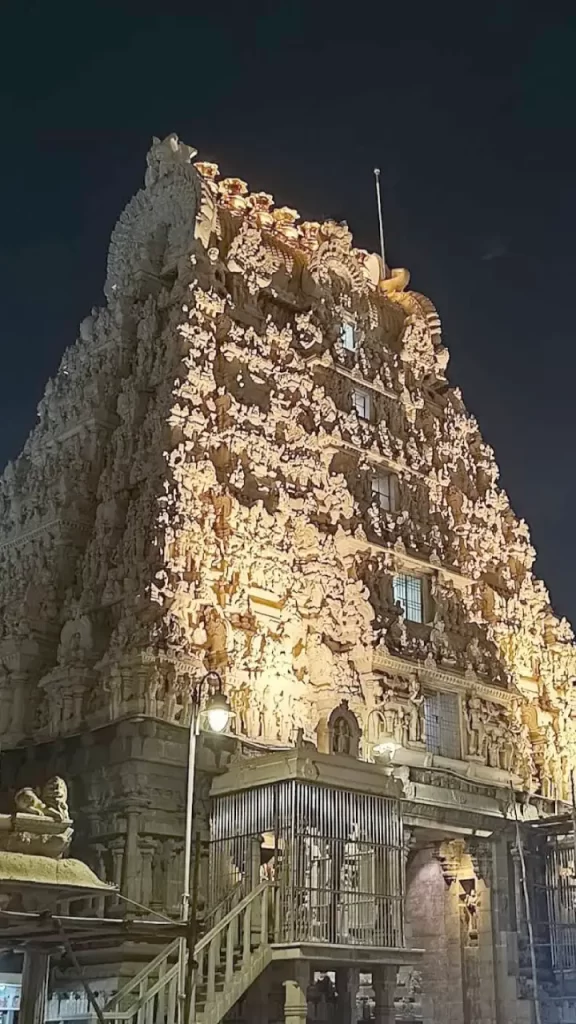
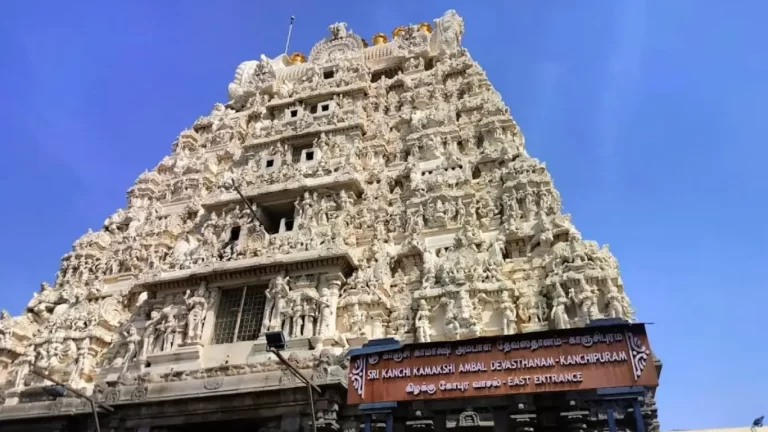
As we stroll through the temple, you’ll be amazed at its distinctive architectural fusion, predominantly Dravidian and Vijayanagara influences. The five-acre temple complex boasts four gopurams, or entrance towers, each a work of artful carvings. The monumental gateways are topped with sculptures exhibiting scenes from Hindu mythology, leading you into a realm of godly storytelling.
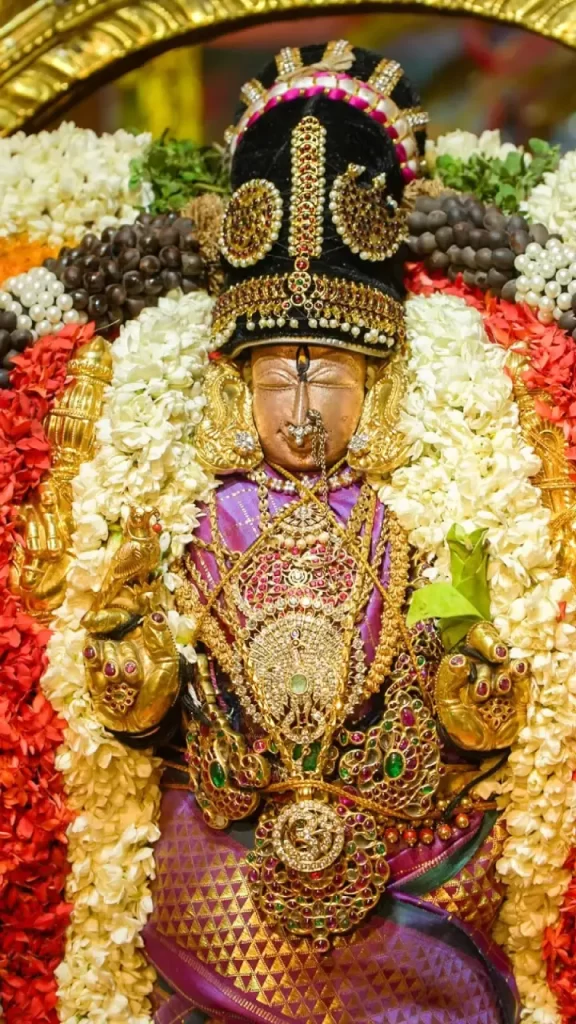
The main shrine, where the idol of Goddess Kamakshi is kept, is itself a wonder. It is enshrined inside the Gayatri Mandapam. Scriptures say this mandapam was constructed with four walls symbolizing the four Vedas and twenty-four pillars symbolizing the twenty-four syllables of the Gayatri Mantra. The Vimana (the tower over the central sanctum) is gold-plated, lending the temple a glistening appearance.
Within, the idol of Goddess Kamakshi is placed in the Padmasana position. Her peaceful countenance and the objects she possesses—a sugarcane bow, a cluster of five flowers, a noose (pasha), and a goad (ankusha)—all symbolize deep things. The mind is represented by the sugarcane bow, and flower arrows symbolize the five senses, which indicate her ability to surpass desires. It is a lovely sight to see the Bangaru Kamakshi Mandapam that contains the golden replica of the main deity, which is covered with jewels and is utilized for processions.
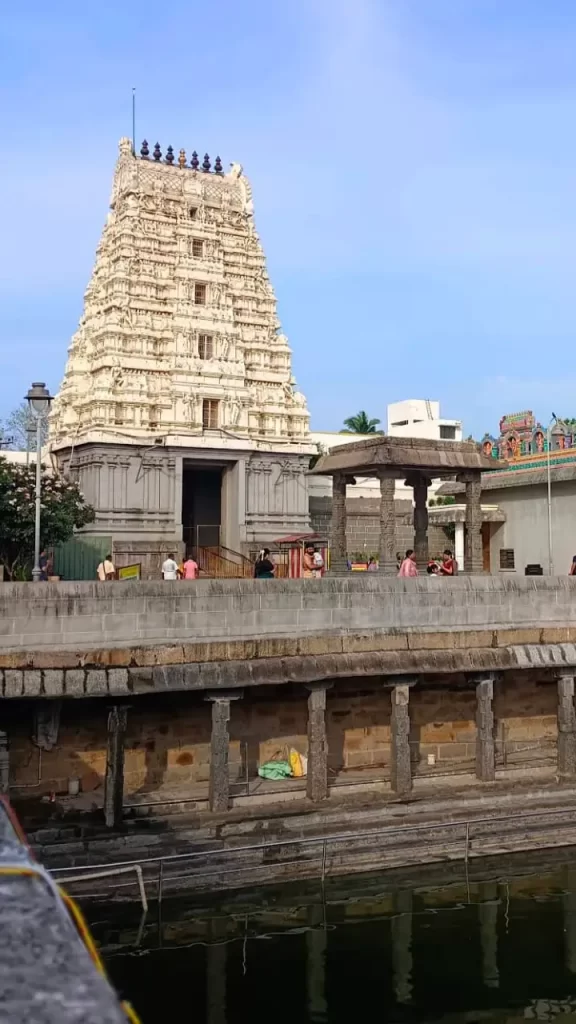
You will also spot the holy pond, the Panchaganga, and its imposing Neerazhi mandapam, a pavilion for devotees to cleanse themselves before they enter the temple. The temple is an artist’s paradise, with intricate carvings on all pillars and walls, making it a feast for the eyes for any visitor.
Festivals and Special Days
The Kanchi Kamakshi Temple is always a place of celebration, but some days stand out.
Brahmotsavam: The most significant festival is the annual 10-day celebration. It falls in the Tamil month of Masi (February-March) and is a grand affair. The god is taken out on a procession in various vahanams (divine vehicles), and the pièce de résistance is the Ther (chariot) festival, where the goddess is pulled on a resplendent temple car through the streets.
Navaratri: The nine-night celebration of the Goddess is observed with great zeal in September-October. The temple is decorated tastefully, and Goddess Kamakshi is bedecked in a new form every day, mesmerizing her devotees with her ethereal beauty.
Sankara Jayanthi: Adi Shankaracharya’s birthday is remembered in the month of Chithirai (April-May), marking his invaluable contribution to the temple.
Aadi and Aippasi Pooram: These too are important festivals, attracting huge crowds. The first day of the Tamil month, particularly Chithirai, is felt to be very sacred.
Fridays: Each Friday is a special and sacred day to go to the Kanchi Kamakshi Temple. The temple is usually more filled than normal, and an evening special procession of the goddess on a silver vahana is done.
Full Moon Days (Pournami): The temple conducts a special Navavarna Pooja on each full moon evening, said to be extremely powerful and drawing many devotees. This is again a very busy day, with a special aura of spirituality in the air.
Read More>> Nitya Kalyana Perumal Temple: Unlock Your Marriage Destiny!
Special Poojas and Rituals
The Kanchi Kamakshi Temple follows an organized daily ritual routine. The temple opens early with Gho Pooja (cow worship) at 5:30 AM, followed by Abhishekam (daily ritual bath) and Archana (offering of prayers with the names of the deity).
Abhishekam: Conducted three times a day, it is a lovely ritual in which the idol is bathed with holy substances.
Sahasranamam Archana: The recitation of a thousand names of the Goddess is done twice a day, with vibrations that fill the air with tremendous power.
Thanga Ratham (Golden Chariot) Procession: This is a special and regal ritual. The Golden Chariot procession is done on Fridays, during full moon days, and the first day of a Tamil month. Seeing this is said to bring one tremendous blessings.
Navavarna Pooja: One of the most important poojas that is conducted on full moon days, the ritual consists of worshiping the Sri Chakra itself as the goddess and is thought to be extremely powerful for spiritual growth and grant of wishes.
Myths and Beliefs
A lot of wonderful myths and beliefs are connected with the Kanchi Kamakshi Temple and have been given down from ages.
Touching the Golden Lizard: A belief while not within this temple is that touching the golden and silver lizards sculpted on the ceiling of the Varadaraja Perumal Temple can purify one of their sin. This is done commonly by pilgrims to the major temples at Kanchipuram.
The Sri Chakra Power: As stated, Sri Chakra is a source of great spiritual power. It is said to provide spiritual emancipation and satisfy all wishes if one meditates in front of it.
The Three Forms of Kamakshi: The Goddess is revered in three forms in the sanctum: Sri Kamakshi (the central idol), Sri Bilahasam (symbolizing the cosmic space), and the Sri Chakra. This symbolizes her all-pervading nature.
The Legend of the Golden Lotus Pond: The Pond of the temple is said to have been formed by Goddess Parvati, and it is believed that a golden lotus flower blooms in it, representing divine purity.
Read More>> Garbarakshambigai Temple: Secret of Fertility & Safe Birth
Kanchi Kamakshi Temple Secrets
The Kanchi Kamakshi Temple, the holy home of Goddess Kamakshi (one of the forms of Parvati, the divine mother), is rich in ancient mythology, deep spiritual meaning, and some fascinating “secrets” that attract millions of pilgrims. It is more than a temple, in fact a powerful spiritual hub.
One of the deepest “secrets” is the Sri Chakra that Adi Shankaracharya, one of the greatest philosopher-saints, installed. There is a legend that Goddess, in her pristine form, was extremely powerful (Ugra Swaroopini). To pacify Her and divert Her energy to the well-being of mankind, Adi Shankaracharya sanctified the extremely powerful Sri Chakra under the prime idol in the sanctum. This complex geometric sign, symbolizing the universe and combination of divine feminine and masculine energies, is said to emanate vast cosmic energy, converting her wrathful form into a gentle, beneficent form (Shanti Swaroopini), bestowing peace and prosperity upon worshippers. It is not displayed publicly but is the inner spiritual nucleus of the temple.
The other notable feature is that the Kanchi Kamakshi Temple alone is regarded as the sole Shakti temple in Kanchipuram where the Goddess has a separate sanctum. Whereas Kanchipuram itself is referred to as the “City of Thousand Temples” with innumerable Shiva temples, it is thought that Goddess Kamakshi, being supreme Universal Power (Parasakti) and Raja Rajeshwari, comprehensively represents the divine feminine power for the whole city, eliminating the necessity for independent Ambal or Shakti temples in other Shiva temples in its confines.
The temple is also closely associated with “Navel of the Earth” or the center of the eastern hemisphere and is one of the Shakti Peethas where Goddess Sati’s navel is said to have fallen. This imparts the site with tremendous spiritual energy and renders it a very efficacious site for seeking boons, especially for barren couples, who pray at a particular pillar having a hole symbolizing the navel to be blessed with offspring. King Dasaratha, father of Lord Rama, is also said to have offered the “Putra Kameshi Yagam” here for having children.
In addition to this, the symbolism of Goddess Kamakshi herself is also full of meaning. Her name, “Kamakshi,” translates to “one whose eyes awaken desire” or “one with desirable eyes,” representing her compassionate gaze that makes desires come true. She is seated in a yogic meditative pose (Padmasana) and is also traditionally depicted with attributes of Kama (the god of love), like a sugarcane bow and a parrot, indicating her ability to entice even Lord Shiva and involve him in worldly life. She is regarded as an embodiment of beauty, power, and compassion, able to annihilate sins and grant wisdom, prosperity, and good offspring.
It is also a major center for Srividya Sadhana, an intricate spiritual exercise aimed at self-realization centered around Kamakshi Devi. Practitioners (Sadhakas) follow rituals, hymns, and meditation, guided by the Sri Yantra to trigger the dormant divine power (Kundalini Shakti) within themselves. Adi Shankaracharya is also the author of “Saundarya Lahari,” a poetic piece extolling Goddess Tripura Sundari (the form of Kamakshi) and outlining ancient spiritual traditions in the practice of Tantra, Yantra, and Mantra rituals, further strengthening esoteric links of the temple.
Kanchi Kamakshi Temple Timings
To make sure that you experience a smooth and satisfying trip to the Kanchi Kamakshi Temple, it is crucial to get to know the timings. The temple is usually open between 5:30 AM and 12:30 PM and then again in the evening from 4:00 PM until 8:30 PM.
The temple gets extremely crowded on Fridays, full moon days, and during the important festivals such as Brahmotsavam and Navaratri. If you are not interested in the crowd and want a quiet darshan, I would suggest going early in the morning, immediately after the opening of the temple, or during a weekday.
Hindu Places to Visit Near the Temple
Your trip to Kanchipuram would be incomplete without visiting some of the other magnificent temples in the vicinity.
Ekambareswarar Temple: One of the Pancha Bhoota Sthalams (five Shiva temples representing the five elements), this temple represents the element of Earth. It is a stunning architectural marvel with a sacred mango tree that is over 3,500 years old.
Kailasanathar Temple: It is an old temple in Kanchipuram constructed by the Pallava dynasty. It’s an excellent piece of early Dravidian architecture with exquisite carvings.
Varadaraja Perumal Temple: One of the 108 Divya Desams (sacred abodes of Lord Vishnu), this temple is said to have the most amazing architecture as well as its celebrated Athi Varadar idol, which is displayed to the public only once in 40 years.
Chitragupta Swamy Temple: A rare temple for Chitragupta, the god accountant of Yama, god of death. One of the rare temples for him in India.
Kanchi Kudil: To experience traditional Tamil way of life, you can drop in at this heritage home that has been maintained like a living museum.

Accommodation Options
Kanchipuram is one of the prominent pilgrimage and tourist places and hence has good hotels to suit all budgets.
Luxury and Mid-Range Hotels: You can opt for a comfortable stay at places such as Regency Kanchipuram by GRT Hotels or SSK Grand. Both hotels are well-placed and equipped with contemporary amenities.
Budget Hotels and Lodges: There are several budget hotels and lodges around the temple and in the heart of the city. Hotel Tamilnadu, operated by the state tourism department, is a safe bet. Nitheesh Residency and Adhi Residency are also good bets.
Homestays: For a more homey and local experience, you can get a few homestays such as Selva Homestay that give you a peek into the local Tamil way of life.
Always reserve your accommodation well in advance, particularly if you’re visiting during the festival season, because the Kanchi Kamakshi Temple attracts pilgrims from across the globe.
Read More>> Kondagattu Anjaneya Swamy Temple
How to Reach the Temple
Reaching the Kanchi Kamakshi Temple is extremely easy since Kanchipuram is a well-connected town.
By Air: The closest airport is Chennai International Airport (MAA) at a distance of around 75 km. From the airport, you may take a taxi or bus to Kanchipuram.
By Train: Kanchipuram is served with its own railway station (CJ), which has good connections with big cities such as Chennai and other regions of Tamil Nadu.
By Road: The city is connected by a network of roads. You may travel by bus from Chennai, which takes around two hours, or take a private taxi. The temple is in the center of the city, and once you are there, you may travel around easily using an auto-rickshaw or a cycle rickshaw.
So, as you can see, a trip to the Kanchi Kamakshi Temple is not only a journey; it’s a spiritual pilgrimage into the very heart of Hindu mythology and culture. The peace you will find, the history you will learn, and the divine blessings you will experience will linger long after you depart. I hope this travel guide assists you in preparing for a memorable and spiritually uplifting experience. Welcome to the house of the Divine Mother!
8 Comments