Mayureshwar Ganpati Temple Morgaon
The Mayureshwar Ganpati Temple, alternatively known as the Moreshwar Temple of Morgaon, is a place that radiates supreme spiritual tranquility, rich history, and great architecture. Built at the serene location of the historic town of Morgaon, situated some 65 to 70 kilometers away from Pune city in Maharashtra state of India, this temple lies peacefully on the banks of the historic Karha River.
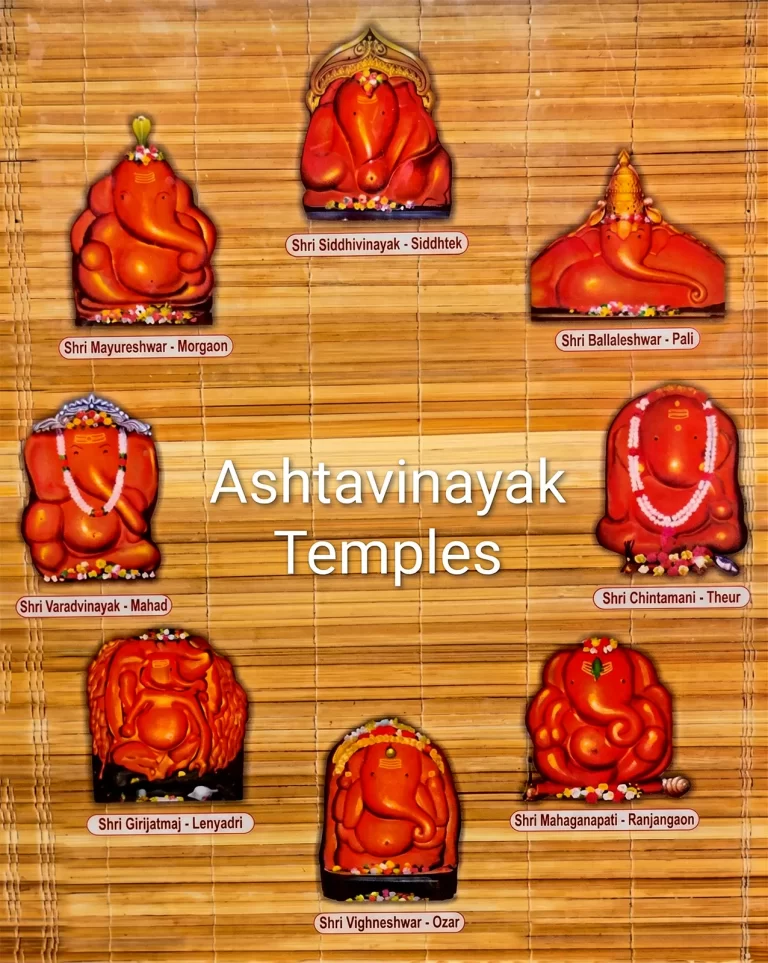
As a professional guide who has walked through these temple premises time and again, I can confidently say that the spiritual feeling at this temple goes deeper than one can ever imagine. What makes Mayureshwar Ganpati Temple so special is that it happens to be the only starting point and perhaps the most important point for the sacred Ashtavinayak pilgrimage that consists of eight self-manifested (Swayambhu) temples dedicated to Lord Ganesha spread around Maharashtra State. As per a very old and rigid tradition, one cannot consider his/her Ashtavinayak Yatra complete without making their way back to the Moreshwar Temple of Morgaon after visiting the other seven temples.
The exceptional quality of the Moreshwar Temple at Morgaon lies in its double importance. Firstly, it is considered a perfect temple of Bhaktiras (the devotion itself), since it is the historical headquarter of one of the most ancient Ganapatya sects that venerates the supreme, ultimate creator of the world (Nirguna Brahman). At the same time, it is an interesting structure for history and architecture lovers, as the Mayureshwar Ganpati Temple was built in such a way that its stone walls and corner minarets resemble Islamic fortress or mosques. This is a wonderful and smart architectural disguise designed to save this holy temple from destruction at the hand of iconoclasts in the stormy medieval centuries.
If you are a faithful devotee who wants to meditate while listening to the sounds of “Ganpati Bappa Morya” chants, an explorer trying to figure out something about ancient Maratha and Peshwa heritage or simply a tourist searching for quiet peace from urban bustle, the Moreshwar Temple at Morgaon is waiting for your visit with open doors. Join us in exploring its mystery-filled space full of secrets of ancient inscriptions and traditions.
Read More>> Mahaganapathi Temple Malleswaram
Morgaon Ganpati Temple History: The Legends and Legacies of Morgaon
In order to understand the beauty of the Moreshwar temple at Morgaon, we need to go back in time. I am happy to take my guests on an interesting historical journey in relation to Mayureshwar Ganpati Temple. It needs to be appreciated that the creation of the temple is based on two main stories: the stories from celestial scriptures related to Yugas and the historical records of worship by humans.
Mythological Story: The Victory Over Sindhurasur
According to the scriptures, the place known as the village of Morgaon was named after a plethora of peacocks (Mora in Marathi), making the literal meaning of Morgaon as Village of Peacocks. According to the legends of Treta Yuga, there was a very ferocious and almost immortal demon by the name of Sindhurasur (Sindhu). This demonic creature spread terror in heaven and on earth. The reason for his immortality lay in the fact that he had received a boon from the Sun God wherein his body would be equipped with a cosmic vessel having the Amrita elixir within him.
The tormented gods, evicted from their celestial abode, came to the banks of the Karha River in Morgaon, where they performed rigorous penances and supplicated God for their liberation. The Lord Ganesha appeared before them in His glorious, fair-skinned form having six hands and a peacock (Mayura) as His mount. There was a fierce battle between Ganesha and Sindhu in Morgaon. Lord Ganesha with His indomitable strength crushed the armies of Sindhu, killed his cruel commander Kamalasura, and then unleashed a divine missile that hit the belly of Sindhu and emptied the secret bowl of Amrita (nector of immortality) in him. This released the world from the grip of his evil influence.
As the Lord adopted the peacock as His mount, Mayureshwar (Lord of the Peacock), popularly called Moreshwar, became the permanent name for the Lord for His role in the cosmic battle. Once He had accomplished His divine mission, it is believed that Lord Ganesha bestowed His divine mount on His brother Kartikeya and established Himself in a self-created (Swayambhu) form to guard mankind.
Medieval Period & Great Saint Moraya Gosavi
The history of the Moreshwar Temple of Morgaon has a long and rich tradition associated with the revival of the Ganapatya sect between the 14th and 17th centuries CE. This tradition was led by the great holy man Moraya Gosavi.
He was a pious disciple of Lord Ganesha and practiced penances of utmost severity beneath the Kalpavruksha (thorny Tarti tree). It is believed that Moraya attained complete spiritual realization of his master in this temple due to his devotion. Later, he moved to Chinchwad, but his bond with the Mayureshwar Ganpati Temple made Morgaon the focal point of the Ganapatya sect.
Peshwa Patronage
In the 18th century, the temple of Moreshwar in Morgaon went through a period of great splendor thanks to direct royal patronage by the Peshwas, the Marathas’ Prime Ministers. The Peshwas considered Lord Ganesha to be their sacred family deity (Aradhya Devata). The rulers like Madhavrao Peshwa I had spared no expense to construct, expand, and embellish the Mayureshwar Ganpati temple. They provided huge tracts of tax-free land (Inam) to facilitate the proper conduct of day-to-day rites and grand annual festivals. The family members of Moraya Gosavi, who took care of the Chinchwad Devasthan Trust, were assigned the responsibility of overseeing the management of this great temple even till today.
Read More>> Famous Bhadrachalam Temple: Bhadradri Seetha Ramachandra Swamy
Religious and Cultural Significance: The Sovereign Core of Ganesha Worship
In order to fathom the divine significance of why the Moreshwar Temple of Morgaon is referred to as the sovereign crown jewel of Ganesha temples, it is necessary that we understand the underlying theological and scriptural background associated with such claims. Lord Ganesha is revered widely in traditional Hinduism as the god who removes obstacles (Vighnaharta). According to prevalent traditions of worshiping Ganesha in mainstream Hinduism, He is worshipped at the very outset of any important religious ritual.
However, in the sacred premises of the Mayureshwar Ganpati Temple, Lord Ganesha holds an exalted position that can in no way be equated with that of a secondary deity; He is revered as the Absolute Being—Nirguna Brahman, the creator, preserver, and the ultimate destructor of the cosmos, the very essence of all creation. Ganapatya Sect believes in such philosophy, and Morgaon is its holy capital.
Scriptural Proofs: The Voice of the Puranas
You do not have to believe in local beliefs alone; the high theological importance of Moreshwar temple of Morgaon has been clearly stated in ancient Hindu scriptures. The Ganesha Purana and Mudgala Purana, which are regarded as authentic scriptures that solely revolve around the glory of Lord Ganesha, speak of this sacred temple.
“Shri Kshetra Morgaon Bhuloke Sarvashrestha Ganesha Sthanam”
Translation: “Shri Kshetra Morgaon is the most supreme, excellent, and sacred place of Lord Ganesha worship on this entire earthly planet.”
Moreover, the Mudgala Purana has complete chapters dedicated to the description of Mayureshwar incarnation. As per the Mudgla Purana, millions of years ago, the creator God, Lord Brahma performed intense austerities at the same place. Fascinated with his devotion, Lord Ganesha appeared before him and then he consecrated the first temple. Moreover, according to Mudgla Purana, it was Lord Brahma who constructed the first-ever temple at Morgaon and also married off his twin sisters, Riddhi and Siddhi to Lord Ganesha on the bank of Karha river.
The Pulse of Living Traditions
From the cultural perspective, the Moreshwar Temple at Morgaon is alive and vibrant. The temple is like the pulsating heart connecting the ancient scriptural traditions with contemporary communal peace. Each and every household at the village of Morgaon has a direct relation with the God. For example, there is one tradition in which each house at Morgaon gives their share of food products in making Naivedya (food offering) to the Lord during major festivals.
This place is famous for its hospitality traditions. In good times, local people welcome tired pilgrims with their simple homes and provide them with special Thali food prepared by them with their hearts full of sincerity and faith, treating each one of them like their very own guests of Mayureshwar.
Read More>> Radiant Sri Puri Jagannath Temple: The Lord of the Universe
Architecture and Design: The Fortress of Faith
One of the highlights of being a tour guide is seeing the amazed look that comes across the travelers’ faces when they get their first view of the Mayureshwar Ganpati Temple. Without me letting you know, it would probably be difficult to differentiate between this structure and an Islamic medieval fort or even a medieval fortification.
Islamic Disguise: A Clever Medieval Approach
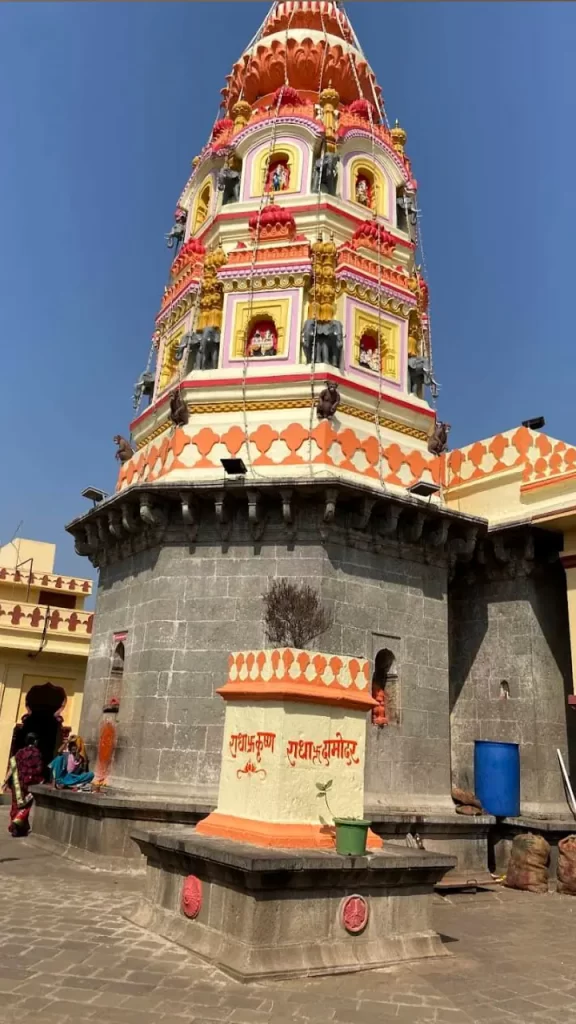
Predominantly built during the 14th to the 17th century, the Moreshwar Temple of Morgaon boasts a brilliant fusion of traditional architecture with Islamic design features, which was prevalent during the reign of the Bahmani Empire as well as the Mughals. In addition, the temple is fully encircled by a 50-foot high and a massive wall made out of black basalt stone.
In each of the four corners of this quadrilateral wall, a prominent stone pillar, which resembles a minaret (Minar), has been erected. In those tumultuous medieval times when Hindu temples used to be under attack and demolition by iconoclastic aggressors was common practice, such an architectural feature became a perfect camouflage. Those enemy troops who passed by would assume that this was actually a mosque and would thus pass it by, undisturbed. Such an ingenious plan helped save the temple of Mayureshwar Ganpati from demolition.
The Spiritual Quadrant: The Four Gates of Life
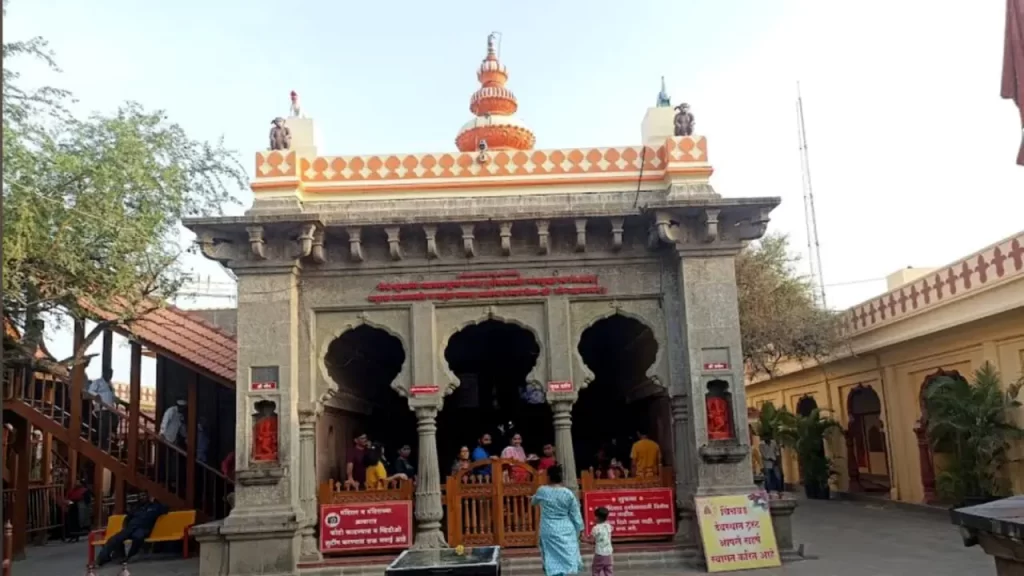
As you move closer to the fortified temple walls, you will notice that there are four grand entrance gates on the wall, one facing each of the four cardinal directions, namely North, South, East, and West. Not by coincidence, but with the purpose of adding a deeply spiritual significance to them, these four gates house four different carved images of Lord Ganesha representing His forms during the four cosmic ages of Hindu cosmology known as the four Yugas, corresponding to each of the four Purushartha, namely:
- The Eastern Gate (Dharma – Righteousness): Houses the image of Ballalvinayaka, accompanied by the divine figures of Lord Rama and Goddess Sita, symbolizing cosmic duty and righteousness.
- The Southern Gate (Artha – Wealth & Purpose): Carries the form of Vigneshwara, accompanied by the lords of wealth and cosmic balance, signifying righteous prosperity.
- The Western Gate (Kama – Desire & Love): Has the beautifully crafted image of Chintamani Ganesha, symbolizing worldly desires being cleansed and purified through love.
- The Northern Gate (Moksha – Absolute Liberation): The primary entrance of the temple which holds the grand and glorious image of Lord Mahaganapati, who signifies absolute and eternal liberation of the soul from the endless cycle of birth and death.
Read More>> Veerabhadra Swamy Temple Lepakshi: 26Ft Huge Nandi, Hanging Pillar
Inner Workmanship and Marvels of the Courtyard
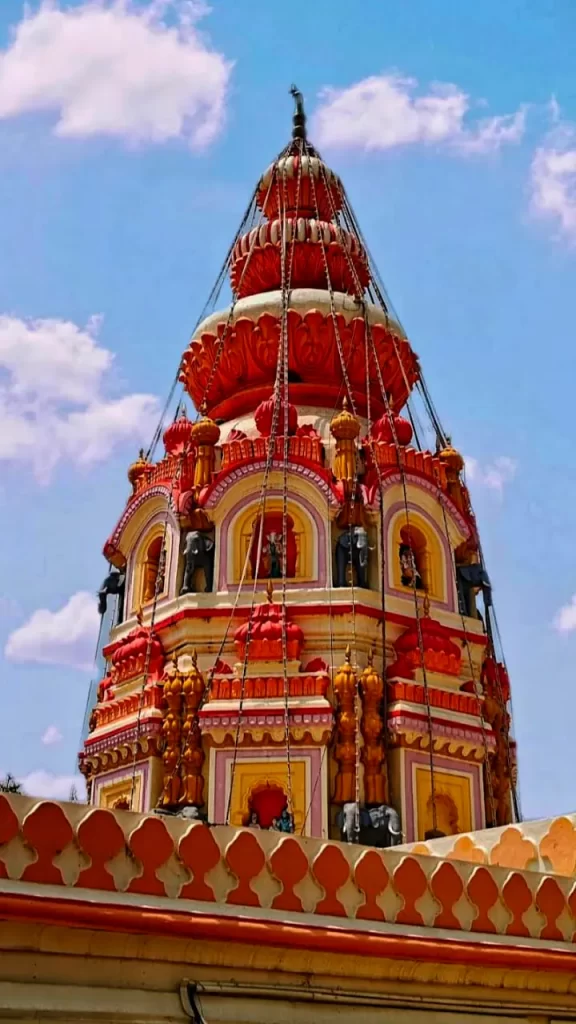
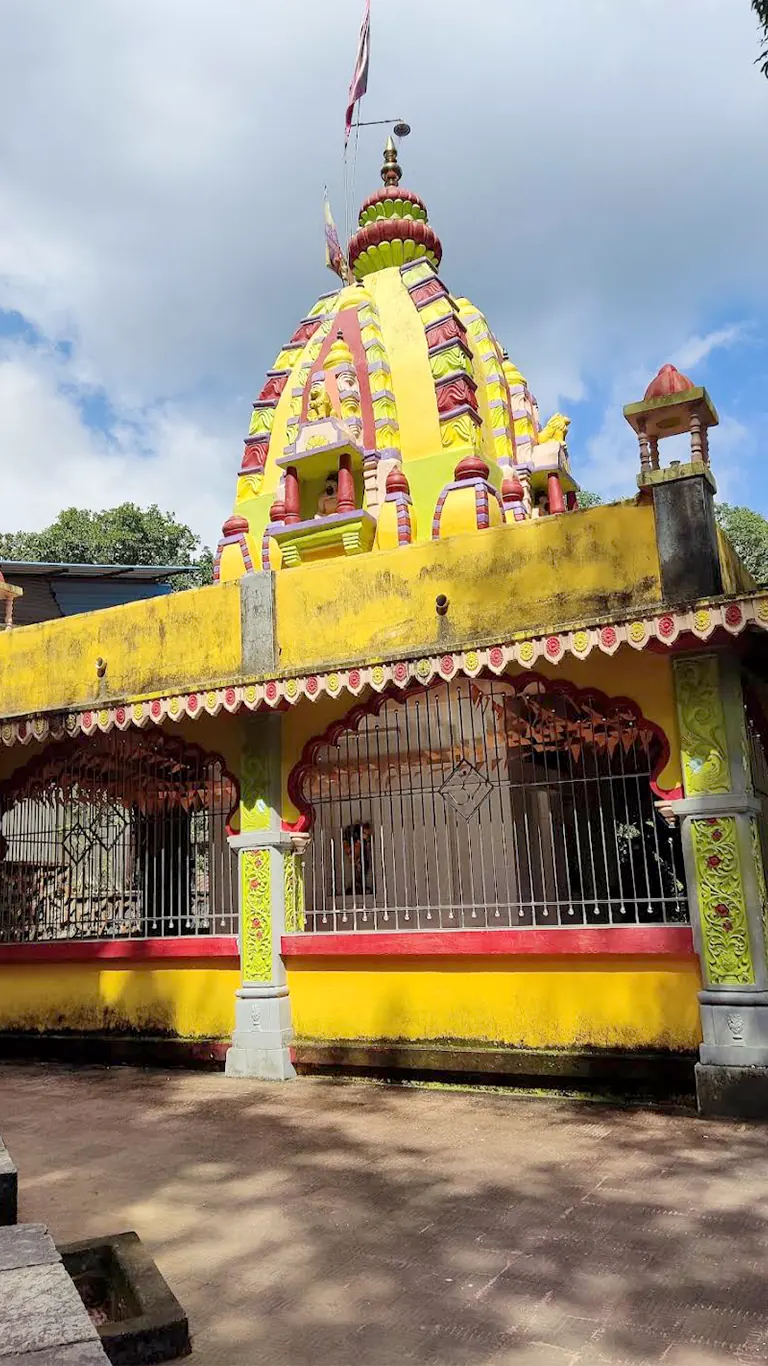
The moment one steps into the northern entrance gate of the temple, one leaves the fort-like structure outside and enters an iconic and spectacular Hindu temple structure. The vast interior courtyard consists of stone slabs laid out to form a beautiful and spacious courtyard, which is complete with two awe-inspiring deepmalas that consist of exquisitely carved stone lamp towers, complete with numerous niches meant to hold oil lamps.
The Sabha Mandap has been a work of wonder, comprising of intricately carved pillars made of wood and beams, all of which are adorned with historical murals depicting images from the Ganesha Purana. The construction technique makes extensive use of ashlar masonry, which involves the use of large-sized stones of black basalt fitted tightly in position by the use of natural lime mortar.
Main Attractions and Highlights: Hidden Jewels Within the Complex
Now that you are with a seasoned guide, allow me to take you through this fascinating inner courtyard of the Moreshwar Temple, Morgaon. There are a few things which will surely amaze you, but which you might easily miss unless pointed out for you.
First Comes First – The Case of the Enormous Nandi Bull Statue
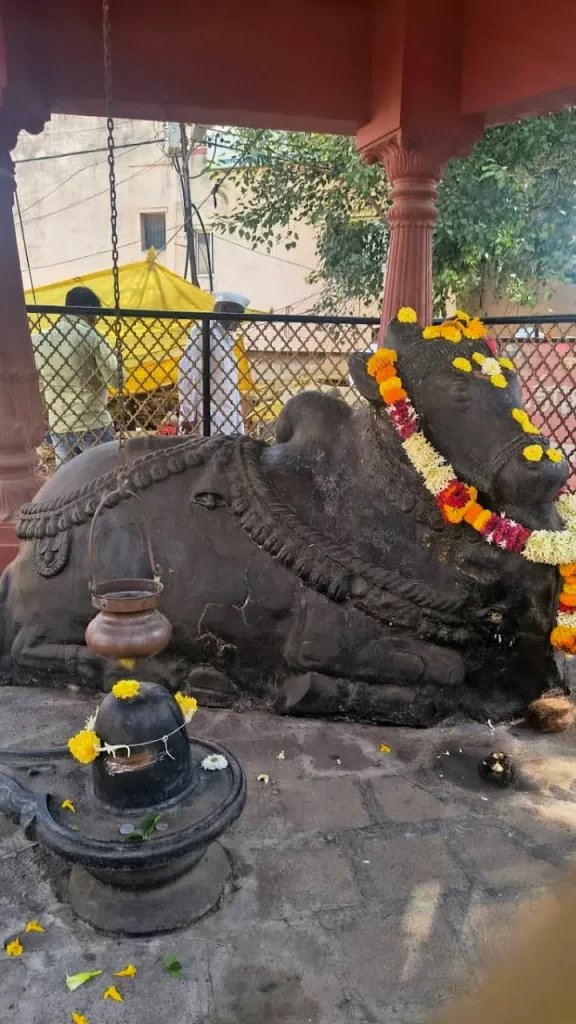
Outside the entrance pavilion of the temple, in front of the sanctum sanctorum of the Lord Ganesha himself, stands an enormous statue of the sacred bull Nandi. Now, if you have been travelling around India, you will know that the vahana (vehicle) of Lord Shiva alone is this huge statue, and it always faces towards a Shiva Lingam. Here lies a highly unique case of having this statue face a Ganesha temple and not a Shiva one!
There is a very old legend regarding the same, which goes as follows – Long ago, there was an enormous statue of Nandi which was brought from another place to some other place. On its way, when it reached close to the temple of the Mayureshwar Ganpati Temple at Morgaon, the axle of the wood wheel broke, and the statue crashed onto the ground!
No matter how many powerful cattle and humans were put to use, the statue of Nandi could not be moved even an inch from its place. The people knew that this was nothing less than divine play. On that very night, in a vision, the chief priest of the temple had a dream in which Nandi told him, “I want to live here forever and forever to serve my lord Mayureshwar”. And since then, it continues to do so, thus giving birth to this marvelous wonder of faith across different sects.
The Six Foot Mushak (Mouse)
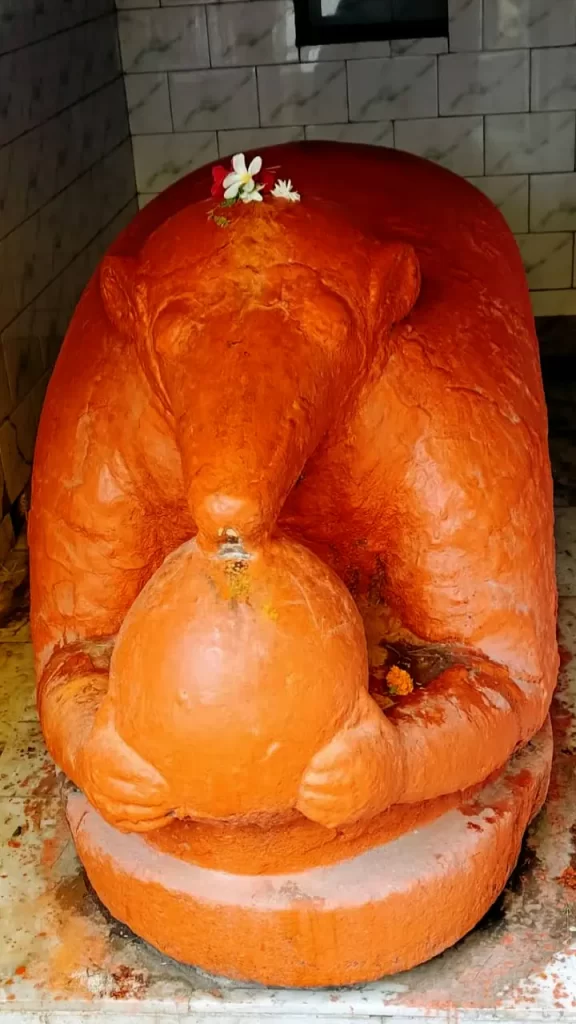
A little bit ahead of Nandi, under the Nagarkhana (traditional drum and music gallery), is the six-foot tall stone sculpture of the traditional mount of Lord Ganesha, Mushak. It is depicted as sitting majestically on its two hind legs with a huge and exquisitely crafted Ladoo (sweet dumpling) held tightly between its forelegs. Many devotees tend to bend forward and whisper their wishes which remain unanswered into its ears because they believe that this giant mouse will carry their message straight into the ears of the Lord.
Sanctum Sanctorum (Garbhagriha)
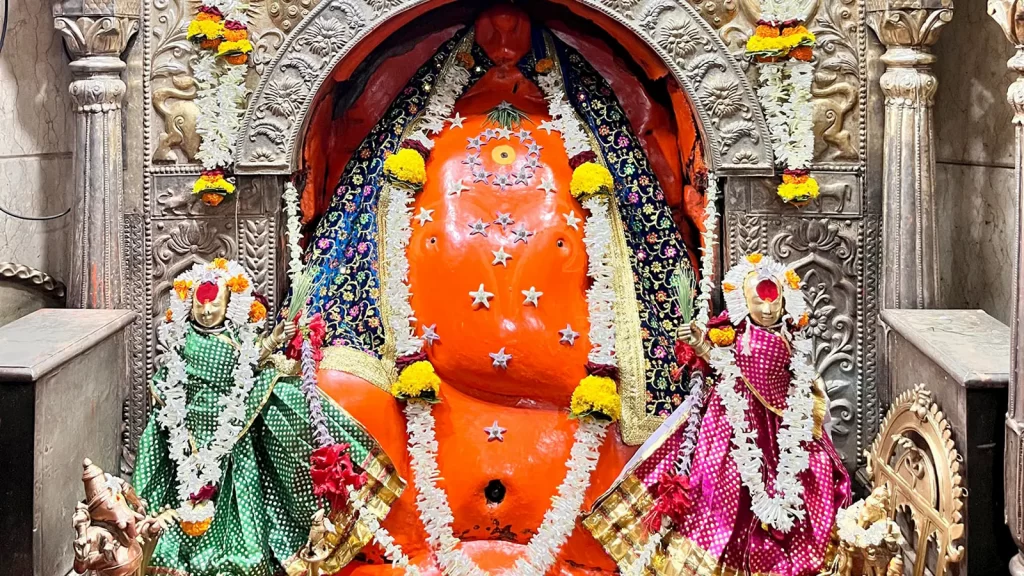
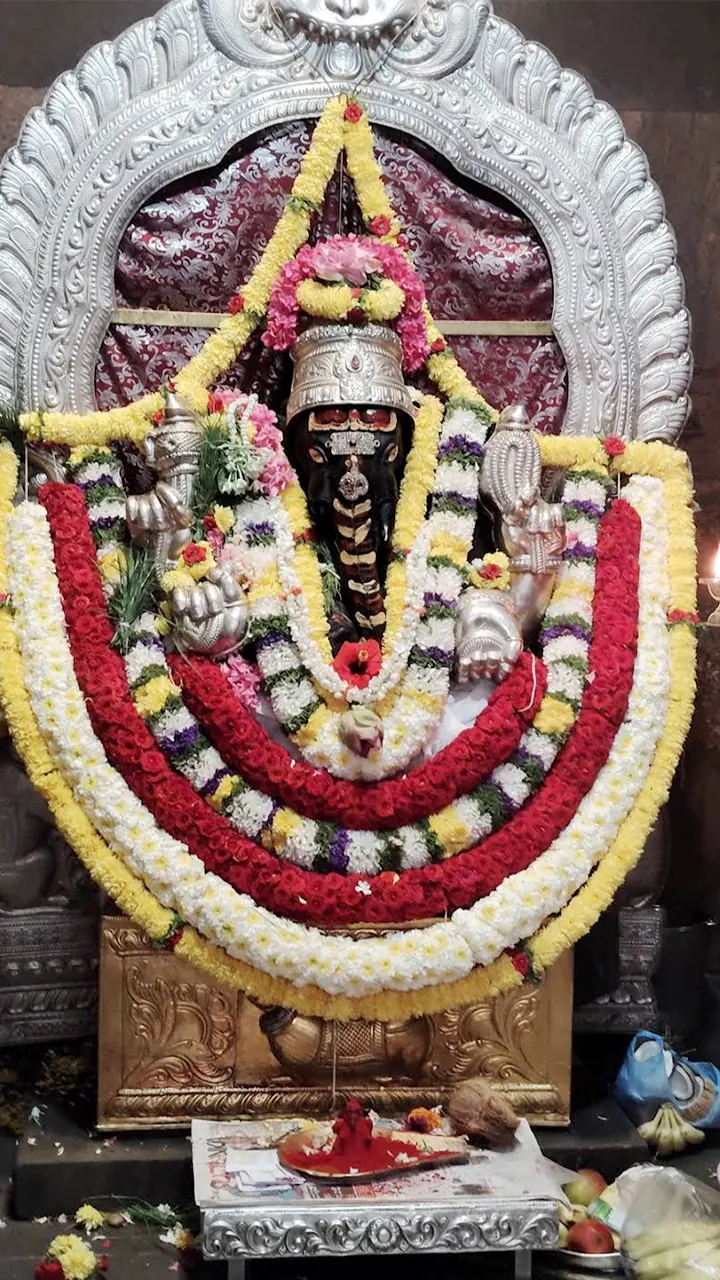
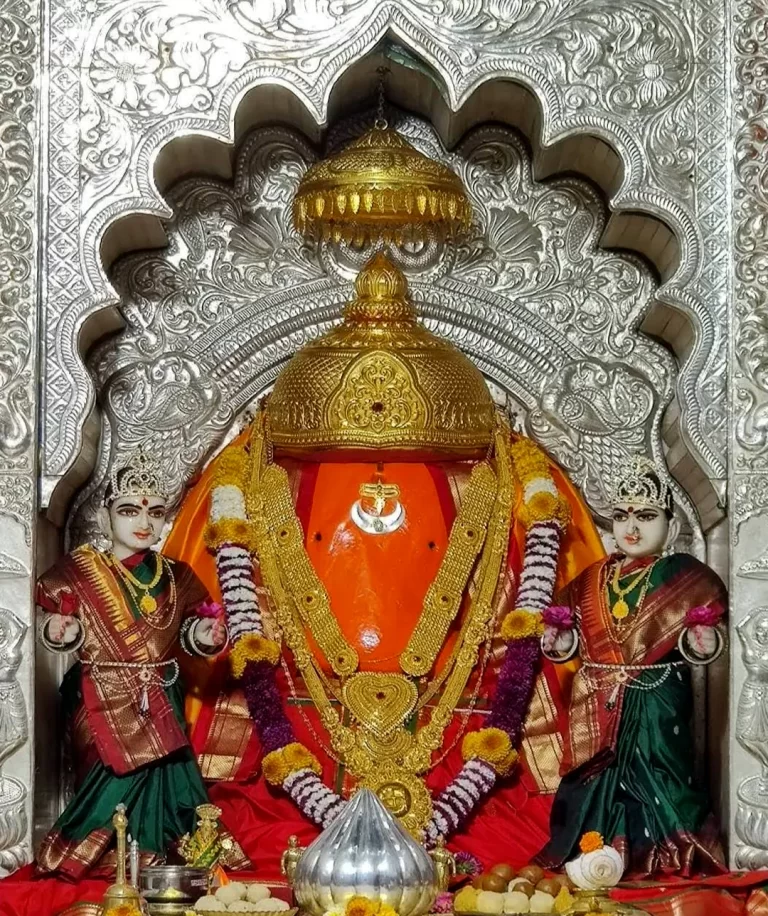
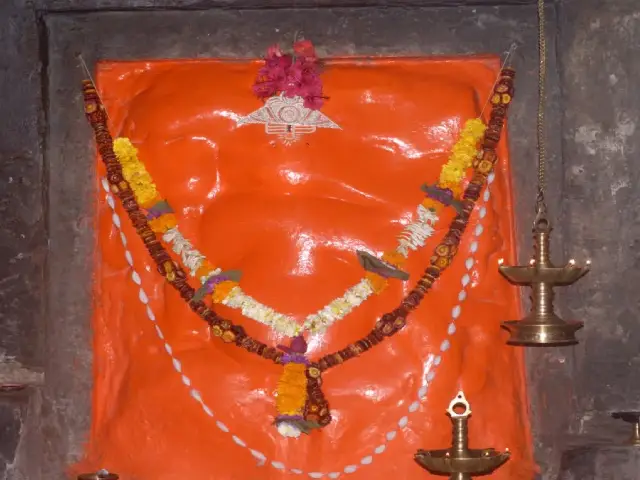
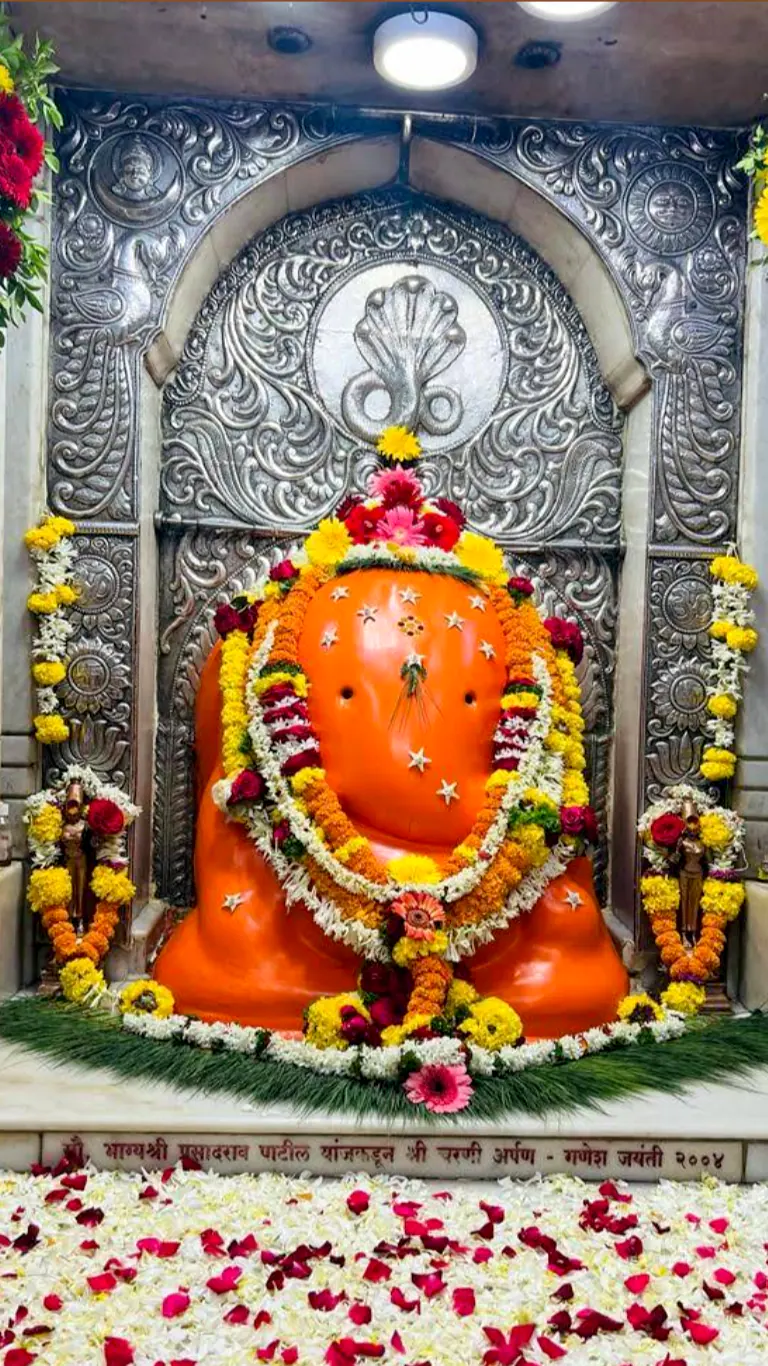
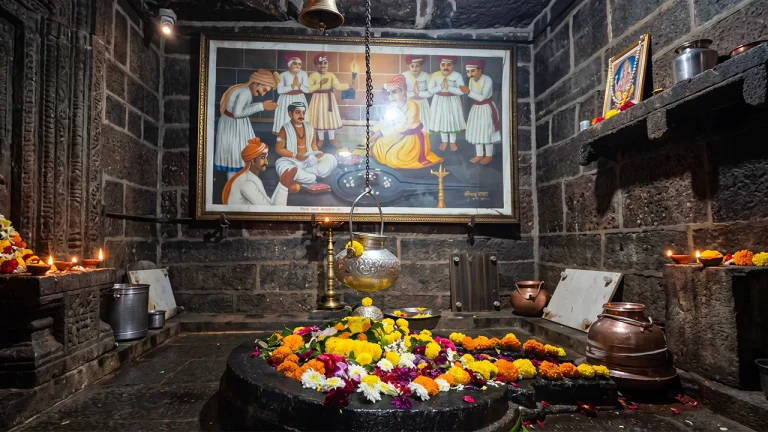
As we move towards the sacred sanctum, the air starts smelling of burning sandalwood, green durva grass, and camphor. The inner sanctum, which is made of dark silver plates, contains the image of Lord Mayureshwar, who appears by Himself (Swayambhu).
The idol is facing the northern direction and is shown in a relaxed, sitting posture having three eyes. His trunk is gracefully turned to his left side. A well-fashioned hood of snake made of pure silver has been erected above Ganesha’s head. Two images of his wives, viz. Riddhi and Siddhi, are present on either side of the main idol, made of five metals (Panchdhatu).
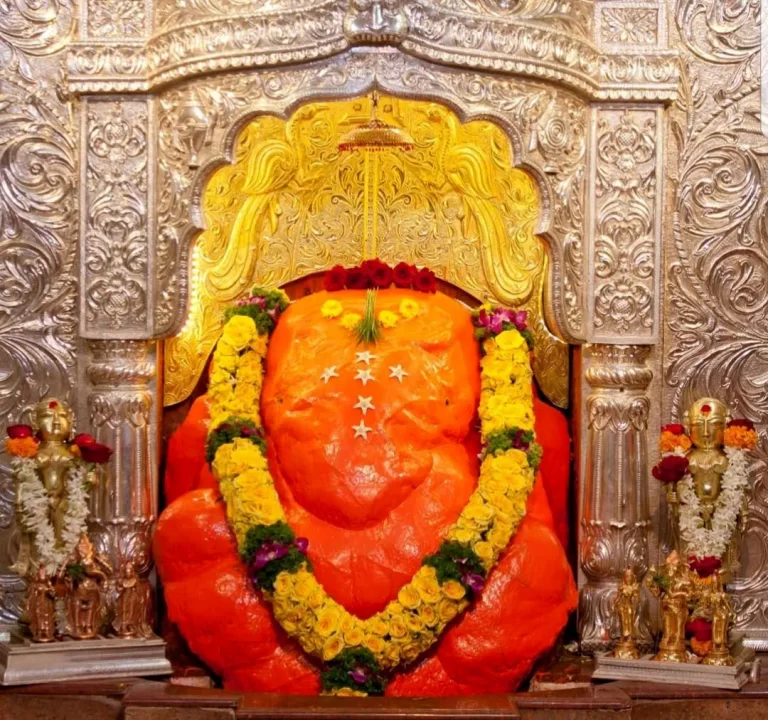
The eyes and the navel of the idol are set with precious and dark blue diamonds which shine beautifully under the mild light of the oil lamps. Interestingly, the idol that you are looking at is actually not as big as it appears to be! With time, the regular application of the sacred red, saffron-colored vermillion (Sindoor) has formed a protective outer covering of the idol made from the original stone.
Incredibly enough, the whole layer of this Sindoor comes off completely and naturally once in every 100-150 years in one single piece, which is considered a very sacred occurrence for the locals! This peeling took place in 1882, and people are waiting for the next such miraculous happening!
Read More>> Ram Mandir Ayodhya | Shri Ram Janmabhoomi
The Ashta-Vignaharta (Eight Manifestations of Lord Ganesha)
As you finish your Pradakshina (walking around the temple in the inner porticoes of the Moreshwar Temple), notice the idols of Ganesha carved in eight different forms in small niches around the temple walls. All the idols depicted below come from the eight volumes of the Mudgala Purana, as follows:
- Ekadanta (The Single-Tusked Lord)
- Mahodara (The Big-Bellied Sovereign)
- Gajanana (The Elephant-Faced Divine)
- Lambodara (The Great Pendulous Abdomen)
- Vikata (The Deformed or Unusual Form)
- Vighnaraja (The True King of Obstacles)
- Dhumravarna (The Smoke-Colored Savior)
- Vakratunda (The Lord of the Curved Trunk)
Viewing all the above-mentioned eight mini temples inside the Mayureshwar Ganpati Temple is very fortunate since it is considered equal to the Punya (merit) of having completed a pilgrimage to all the Ashtavinayaks in one single view!
The Holy Kalpavruksh Tree
Found on the west side of the inner courtyard is an old, spiky Tarti tree which is worshipped as the Kalpavruksh (the wish-giving divine tree). It is precisely this holy place where Saint Moraya Gosavi spent many years meditating. Now, people pray for good luck, wealth, and spiritual awakening by tying sacred threads on its branches.
Temple Timings and Rituals: A Day in the Presence of the Divine
In order to really connect with the strong spiritual vibe of the Moreshwar temple, Morgaon, I would suggest synchronizing your visit with their daily ritual activities. The daily routine of Mayureshwar Ganpati temple is very meticulously followed for several years with utmost perfection from early morning till late at night.
Schedule of Daily Poojas
The heavy timber doors of the temple open everyday exactly at 5:00 AM and stay open until 10:30 PM. Here is a day-by-day account of the spiritual activities of the temple:
| Time Slot | Name of the Ritual / Pooja | What Happens During the Ritual |
| 5:00 AM – 5:30 AM | Prakshalana Pooja | The doors to the temple are opened as the priests conduct the traditional process of cleaning the shrine and the feet of the god. |
| 5:30 AM – 6:00 AM | Kakad Aarti | The captivating morning awakening prayer. There is a sense of silence, freshness, and intense spirituality in the air. |
| 7:00 AM – 7:30 AM | Shodashopachar Puja (Morning) | An elaborate and traditional worship that consists of 16 steps which includes recitation of Vedic prayers and the offering of Dhup (incense). |
| 12:00 PM – 12:30 PM | Maha Pooja & Maha Naivedya | The main worshiping ceremony during the afternoon period. The god is offered a grand and luxurious meal, normally consisting of new Modaks and rice. |
| 3:00 PM – 3:30 PM | Prakshalana Pooja & Poshak | The second process of cleansing where the god is dressed in royal and attractive silk clothes (Poshak). |
| 7:30 PM – 8:00 PM | Samudaik Evening Aarti | The stunning communal evening prayer ceremony. The temple fills up with loud noises from heavy brass bells, cymbals, and drums. |
| 8:00 PM – 8:30 PM | Panchopachar Puja | The rapid and elegant 5-step evening prayer ceremony consisting of flowers, Dhup, lamps, fragrance, and sweets. |
| 10:00 PM – 10:30 PM | Shej Aarti | The beautiful bedtime lullaby ritual. The Lord’s silver bedchamber (Sejaghar) is prepared, and the doors are closed for the night. |
Direct Abhishekam – Unprecedented Privilege to Experience!
As I mentioned above, one more aspect which is very special about this shrine compared to other famous temples of India is that here you have a rare chance to organize an exclusive Abhishekam ritual of the temple God.
This means that under the direct guidance of priests, you will have the opportunity to touch the altar, observe the sacred ritual of water and milk pouring on God, and at the same time, listen to the chanting of the powerful Ganesh Atharvashirsha Mantra.
The Dress Code and Temple Rules
In order to preserve its uniqueness and purity, there is some special etiquette when visiting the Moreshwar Temple.
- Dress code for men: it is recommended to wear Dhoti-Kurta or at least pajamas. Shorts, sleeveless shirts, and sportswear are definitely not welcome in the temple.
- Dress code for women: wearing saree, salwar-kameez, and other decent national attire will be appropriate. However, avoid coming in western-style clothing such as short skirts or torn jeans.
- Common rules: it is necessary to take off footwear, leather belts, and wallets before entering the temple and leave them near a shoe stand situated right outside the main entrance of the shrine.
Read More>> Sree Padmanabhaswamy Temple: 8th CE Spiritual Wonder & Mystery
Festivals and Events: Times of Grand Celebrations and Crowds
If you wish to view the Moreshwar Temple of Morgaon in all its glory, then you will need to be present there during one of its many grand festivals that take place there every year. This entire region becomes one filled with color and light as well as spirituality. But, as your guide, it will be my duty to inform you that these festivals tend to draw massive crowds!
Two Festivals – Bhadrapada and Maghi Ganesh Utsav
While Ganpati is celebrated across the country, Mayureshwar Ganpati Temple celebrates two grand events every year:
Bhadrapada Ganesh Chaturthi (August-September)
The first is the world-renowned ten-day festival celebration where the entire temple is adorned with millions of marigolds. Elaborate lighting structures make the fort walls sparkle with light. People form a huge line which extends for miles and miles outside the town. Everything about this experience is infectious with folk dance and drumming performances taking place throughout the day and night.
Maghi Ganesh Jayanti (January-February)
Celebrated on the fourth day in the Hindu month of Magha, this festival symbolizes the official birthday of Lord Ganesha as described in the Ganesha Purana. For the Ganapatya sect at the Moreshwar Temple at Morgaon, it might even be considered a more significant event than the Bhadrapada festival! Some of the activities in the festival include spectacular Vedic fire sacrifices (Homas), intricate continuous chanting of scriptures, and exquisite lamp-lighting rituals (Deepdan) at the banks of the Karha river.
Silver Palanquin Procession
On the sixth day (Shashti) in the Bhadrapada and Maghi festivals as well as on the auspicious day of Vijayadashami (Dussehra), there is an exceptional practice that happens. This includes placing the portable idol of Mayureshwar in an extremely ornately decorated silver palanquin (Palkhi).
Carried on the strong shoulders of young men from the locality, the palanquin moves through the royal route in the neat village of Morgaon. The air is replete with fragrant gulal (pink colored powder), while women decorate huge Rangolis (colorful designs) outside their houses to receive the Lord.
Understanding Crowd Conditions
Let me enlighten you regarding crowd levels so that you can plan a trouble-free visit:
- Crowded Times (Peak Times): All Sankashti Chaturthis (every monthly holy fourth day following the full moon), all weekends (Saturdays and Sundays), as well as the festival time frames will have huge crowds. Queue waiting periods for the general public will typically be anywhere from 2 to 5 hours long.
- The Goldilocks Principle (Perfect Visiting Time): To experience Darshan in a serene and tranquil environment where you can meditate in the courtyard peacefully, select a Tuesday or Wednesday morning at 6:30 AM to 9:00 AM during the November or December months. There is basically no queue, and the climate is pleasantly cool.

Practical Travel Guide: Reaching the Sanctuary Safely
Arranging a tour to the Moreshwar Temple at Morgaon is pretty much convenient since it enjoys high connectivity to major transit points in Western Maharashtra. I will give you more detailed insights about how you could plan your trip to this holy place.
Via Road
Travelling by road is definitely the most flexible option of all means of conveyance. You could always choose to travel by your private taxi, car or even the MSRTC buses that run from the Swargate Bus Stand in Pune.
Pune (About 65 km): You should start your journey towards Hadapsar through the famous dive ghat which leads to Saswad. Then, take the route towards Jejuri and Morgaon and finally reach at the desired destination. The total distance would not take more than two hours.
Mumbai (About 210 km): Start from Mumbai and drive along the Pune Expressway till Hadapsar and then make the final stretch from Hadapsar towards Saswad-Morgaon Highway. It is going to be a really fulfilling experience for you.
Via Rail
- Jejuri is the nearest railway station where only some local and express trains running between Pune and Miraj halt.
- You will find no trouble finding dozens of auto-rickshaws, taxis, or buses available from the Jejuri railway station for a journey of merely 20 to 25 minutes straight to the gateways of the Moreshwar Temple in Morgaon.
By Air
- If one is traveling from all corners of India or overseas, then the closest airport to be considered would be the Pune International Airport (PNQ). This airport is approximately 72 kilometers away.
- A prepaid airport taxi could conveniently be hired from the airport complex itself to take one to Morgaon in less than two-and-a-half hours.
Read More>> Tungnath Temple: The Highest Shiva Shrine in the World 12k ft
Entrance Charges & Necessary Facilities at the Location
Entrance Fee: The Mayureshwar Ganpati Temple does not impose any entrance charges whatsoever for its visitors. It is absolutely free for all human beings irrespective of their caste, community, or nationality.
VIP Paid Passes: At certain times of the year, such as the time when festivals occur, the Chinchwad Devasthan Trust may provide paid Quick Darshan passes that will allow families with babies and other people doing business to bypass the large crowds in queues and get to visit the shrine.
Toilets and Drinking Water: There is a modern block containing toilets, drinking water taps, and shoe deposit facilities maintained by the trust just outside the main boundary wall of the shrine.
Food and Prasadalay: The temple offers Prasadalay which is exceptionally clean and provides holy lunches for the devotees for a very minimal amount between 12:00 PM and 2:00 PM.
Accommodation: Morgaon is a peaceful and small village. Therefore, it does not have luxurious hotels. But there are well-maintained and cheaply available guest houses named Bhakta Niwas for pilgrims.
Facilities for Elderly and Differently Abled People
While the outer courtyard of the Mayureshwar Ganpati Temple, which is made of pavers, has a level ground that makes it very easy for visitors to move around, the entry point to the inner Sabha Mandap and main sanctuary requires visitors to climb a few stone steps.
In case you are coming along with your parents or differently abled people, all you need to do is to inform the security people or the volunteers guarding the temple. They are extremely polite and will take you inside using the side door.
Dos and Don’ts: Honoring the Sanctity of Morgaon
For you to have your visit to Moreshwar Temple at Morgaon be memorable and full of dignity, without any hitch, consider observing the following cultural codes:
The Dos
- Join in the Artis: Take part in the communal prayers that take place during the evening Aarti at 7:30 PM. Although you may not be familiar with the hymns, standing and listening to the pounding rhythms of the cymbals will definitely cause the hair on your skin stand on end.
- Buy Village-made Prasad: Encourage the locals to earn some income by purchasing their products, especially fresh Durva grass (21-bladed clover grass much loved by Ganesha), red hibiscus flowers and locally made Pedas or Modaks that are sold at the colorful stalls at the marketplace.
- Be Silent: When you enter the temple’s black stone-walled compound, talk quietly because many people from distant places come to sit at the corners of the courtyard and meditate silently.
The Don’ts
- No Taking of Pictures within the Inner Sanctum: Photos are not allowed within the inner sanctum to avoid disturbance during ritualistic activities. You are free to click as many pictures as you like outside of the inner sanctum – from the outer fort walls, minaret towers, and courtyard deepmalas, but ensure that you have safely tucked away your mobile phone within your pockets while near the idol.
- Do Not Bring Any Items that Are Prohibited: Bringing in large leather bags, sharp tools, plastics bags, or anything associated with tobacco, alcohol, or non-vegetarian food is prohibited.
- Do Not Damage Ancient Carvings: The ancient scriptures, stone engravings, and wooden pillars are priceless artifacts of mankind’s cultural history. Do not damage them by handling with greasy fingers or by sitting back on the ancient murals.
Nearby Attractions: Expanding Your Spiritual Circuit
Once you’ve taken the trouble of driving to the Mayureshwar Ganpati Temple, don’t just turn around and rush back without exploring further! The area of Pune and Satara is absolutely stuffed with fascinating history sites and spiritually holy places. And you can easily take in your visit to the Moreshwar Temple at Morgaon along with the following fantastic sites nearby:
Jejuri Golden Hill (17 km)
Just 20 minutes by car from Morgaon, Jejuri is undoubtedly one of the liveliest and visually stunning temple villages in all of India. Nestled atop a charming hill is the age-old temple of Lord Khandoba, a fearsome form of Lord Shiva.
The entire hilltop is blanketed in a dazzling coat of yellow turmeric powder (called Bhandara). This beautiful golden powder is thrown by worshipers into the sky while they chant “Yelkot Yelkot Jai Malhar!” Travel photographers, this is one sight not to miss.
Chintamani Ganpati Temple at Theur (50 km away)
For seamless continuation of your holy pilgrimage of Ashtavinayak, proceed directly towards the charming temple located at the beautiful confluence of three rivers, viz., Mula, Mutha, and Bhima. According to legend, worshiping at this temple brings complete peace of mind by removing every worry or concern that arises out of materialism of this world. It enjoys immense support from Madhavrao Peshwa, who built his palace here long back.
Siddhivinayak Temple at Siddhatek (92 km away)
Another important landmark of Ashtavinayak Yatra, the Siddhatek temple is elegantly built on a hillock that overlooks the expansive Bhima River. This is the only temple among all other eight temples wherein the image of Ganesha has been placed with his trunk pointing towards his right side (Siddhivinayak). It is extremely important for rituals here, which makes it highly energetic.
FAQs: Trending Questions Answered
Here are some frequently asked questions that I have answered in order to make you well-prepared:
Q1: Why is Morgaon considered the first temple of Ashtavinayak?
Answer: As per the Ganesha Puran, Morgaon is the place where Lord Ganesha defeated the demon Sindhurasur to bring back peace into the world. Since Lord Ganesha appeared here in his Mayureshwar avatar to protect the universe from evil demons, Lord Brahma, the creator of the universe, decided to make this place as the start and end point of the complete pilgrimage journey of the Ashtavinayak temples.
Q2: How did the statue of Nandi come to be there outside the temple?
Answer: An extremely rare stone-made statue of the bull Nandi exists outside the Mayureshwar Ganpati Temple because Nandi always stays in Shiva temples. As per the local legend, this statue was going to a nearby Shiva temple but somehow its transportation vehicle stopped right in front of the Morgaon temple. The statue could not be moved even by priests and then the priest got a divine vision telling him that Nandi wanted to stay there forever to serve Lord Mayureshwar.
Q3: Is it possible for us to touch the main deity inside the sanctum?
Answer: Normal devotees who are waiting in line for general Darshan are not supposed to walk up to the main stage or touch the deity directly. However, if you pre-book for any special Abhishekam or Sankalpa Pooja services through the Chinchwad Devasthan Trust office, you can walk into the sanctum in your traditional clothes and experience holy water rituals done right at the feet of the deity.
Q4: How much time will it take to have a good Darshan?
Answer: Normally during weekdays (from Mondays to Thursdays), it is extremely quiet in the temple premises, and one can easily arrange a great Darshan in 15-30 minutes. But on the weekend days, holidays, and monthly Sankashti Chaturthi, you might need to spend from 2 to 5 hours in line to get a comfortable Darshan.
Q5: Is there any online booking system for Abhishek or room?
Answer: Yes! The official managing authority, the Chinchwad Devasthan Trust, provides a convenient web page where devotees can book Abhishekam slot, offer any donations for religious purposes, and reserve a nice room in the local Bhakta Niwas guest houses before their visit day.
Q6: Why is the temple built in such a manner that it looks like a fort or a mosque?
Answer: The temple was enlarged greatly at a time when there were many political changes taking place, and also because of the iconoclastic raids done by the medieval sultanates. The 50-feet high black walls and minarets at each corner were strategically designed to be an ingenious architectural deception.