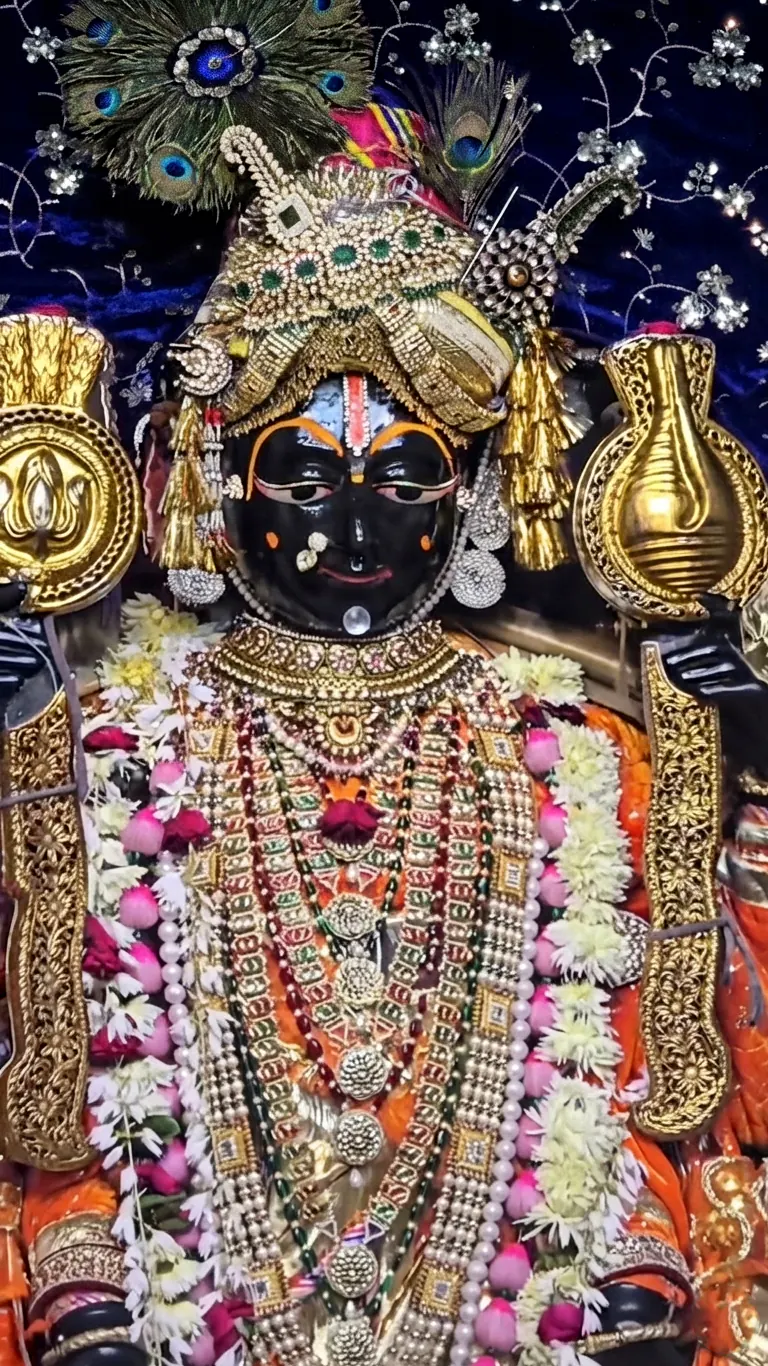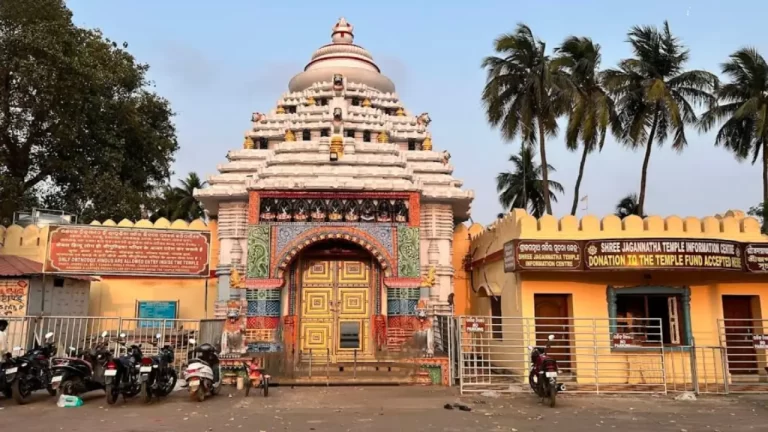
The Scriptural Mystery of Khatu Shyam Temple: Legend, History, and Darshan Guide
Khatu Shyam Temple, located in the town of Khatu in Rajasthan’s Sikar district, is one of India’s most visited Krishna pilgrimage shrines. The temple venerates Barbarika, the grandson of the Pandava prince Bhima, who sacrificed his head before the battle of Kurukshetra. Pleased by his unmatched devotion and righteousness, Lord Krishna granted him a supreme boon: in the age of Kali Yuga, Barbarika would be worshipped under Krishna’s own name, Shyam.
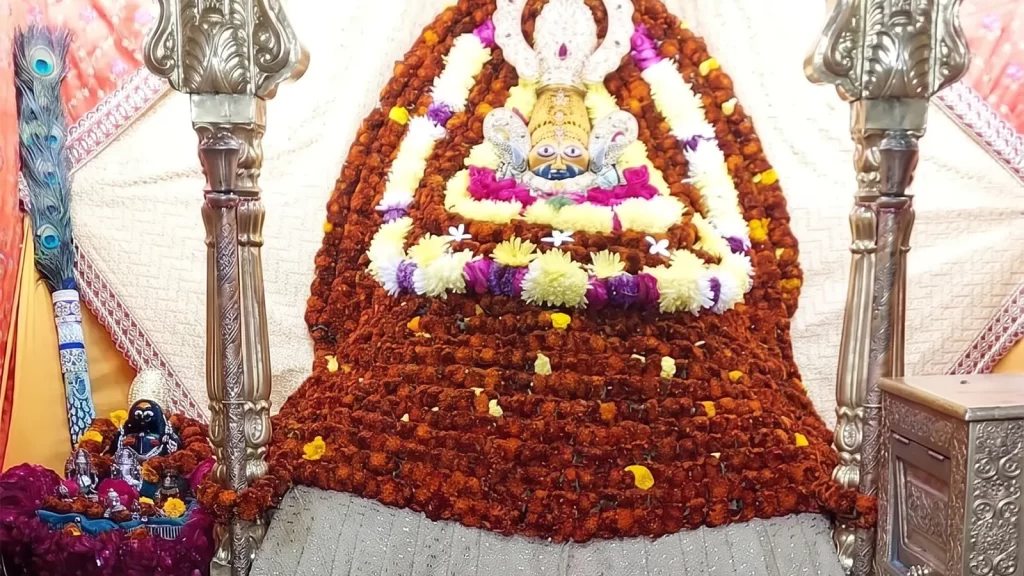
Today, millions revere him as Sheesh Ke Daani (the Giver of the Head) and Haare Ka Sahara (the Support of the Defeated). While popular folklore celebrates his miraculous power, the scriptural origin of this shrine connects deep classical Purana traditions, medieval Rajput history, and living pilgrimage practices.
Quick Information: Khatu Shyam Ji Temple
| Detail | Information |
| Temple Name | Shri Khatu Shyam Ji Mandir |
| Presiding Deity | Barbarika (Worshipped as Lord Shyam / Krishna) |
| Location | Khatu Village, Dantaramgarh Tehsil, Sikar District, Rajasthan |
| Coordinates / Region | Shekhawati Region, Northern Rajasthan |
| Temple Architecture | Rajput-Mughal marble style featuring an expansive prayer hall (Jagamohana) |
| General Temple Timings | Winter: 5:30 AM – 1:00 PM, 5:00 PM – 9:00 PM Summer: 4:30 AM – 12:30 PM, 4:00 PM – 10:00 PM (Subject to change on Ekadashi) |
| Major Festivals | Phalguna Lakhi Mela (Phalguna Shukla Shashti to Baras), Kartik Ekadashi, Krishna Janmashtami |
| Nearest Railway Station | Ringas Junction (RGS) – approximately 17 km away |
| Nearest Airport | Jaipur International Airport (JAI) – approximately 95 km away |
| Key Rituals | Nishan Yatra (walking with the holy flag from Ringas), Chappan Bhog, Rawat Aarti |
| Administrative Body | Shri Shyam Mandir Committee, Khatu |
Read More>> Banke Bihari Temple, Vrindavan
Who Was Barbarika? The Lineage of the Great Warrior
To understand the spiritual mystery of Khatu Shyam Ji, one must trace the epic genealogy found in the Skanda Purana (within the Kumarika Khanda).
Barbarika was the son of Ghatotkacha (the son of the Pandava warrior Bhima and the forest queen Hidimbi) and Kamkantkata (also revered as Maurvi, daughter of the Daitya king Mura). From his early youth, Barbarika demonstrated immense spiritual discipline. Rather than pursuing worldly power, he retired to the sacred forests to practice severe austerities (tapasya).
Moved by his devotion, Goddess Durga (in Her warrior manifestations) granted him a boon of celestial weapons: three infallible arrows (Teen Baan) and a divine bow. These weapons carried a sacred property: they could never fail, never miss their mark, and would always return to his quiver once their objective was accomplished. This earned him the title Teen Baan Dhaari (the Wielder of the Three Arrows).
His mother gave him one moral condition before he departed for the world: if he ever entered a battlefield, he must fight exclusively on the side of the party that was losing (Haare Ka Sahara).
The Mystery of the Three Arrows (Teen Baan)
In ancient warfare, armies measured their strength by infantry, elephants, chariots, and divine archery. Barbarika possessed only three arrows, yet these three were capable of ending the entire Kurukshetra war in minutes:
- The First Arrow: Its purpose was reconnaissance. When released, it flew across the battlefield, marked every target intended for destruction with a sacred mark (vermilion), and returned to the quiver.
- The Second Arrow: If Barbarika wished to save specific individuals, this arrow marked those who were to be spared.
- The Third Arrow: This arrow was the executioner. Once released, it traveled across the battlefield, pierced every single target marked by the first arrow, and returned safely to the quiver.
With just three arrows, Barbarika did not require vast armies or drawn-out campaigns. However, this unmatched power concealed a fatal paradox that threatened the cosmic order.
Read More>> Gowdagere Chamundeshwari Temple: Famous 61 ft Panchaloha statue
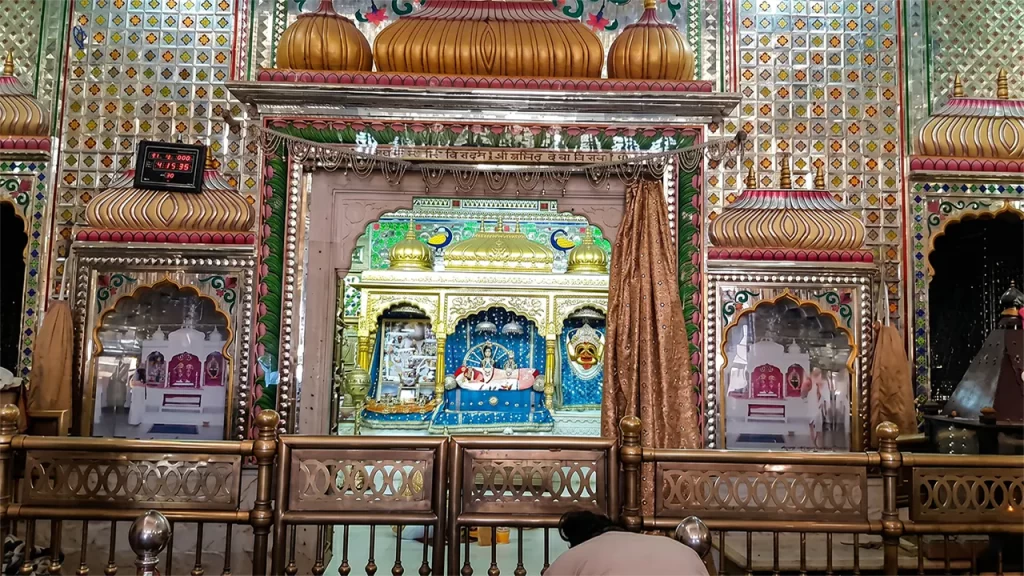
Krishna’s Test Under the Peepal Tree
As the armies of the Pandavas and Kauravas assembled at Kurukshetra, Barbarika rode toward the battlefield on his blue horse (Neela Ghora), intending to observe the conflict. Lord Krishna, aware of the young warrior’s immense power and his mother’s solemn vow, disguised Himself as a wandering Brahmin to test him.
Meeting Barbarika under the shade of a sacred peepal tree, the disguised Brahmin questioned the young warrior’s claim that he could conclude the war in moments with only three arrows.
Smiling, Krishna challenged him: “If your archery is as absolute as you claim, can you pierce every single leaf on this great peepal tree with just one arrow?”
Barbarika meditated on the Goddess, strung his bow, and released the first arrow. The arrow swiftly marked every leaf on the branches with a red dot. While the arrow was in flight, Krishna quietly placed His foot over one fallen leaf on the ground, hiding it from view.
The arrow marked every leaf on the tree, circled around Krishna’s foot, and hovered directly above His toes. Barbarika respectfully addressed the Brahmin:
“Revered sage, please lift your foot. My arrow does not seek to harm you, but it must complete its duty by marking the leaf hidden beneath your sole.”
Recognizing the perfection of Barbarika’s weaponry, Krishna understood that the young warrior’s vow held the potential to destroy both sides.
The Paradox of Haare Ka Sahara
Krishna then asked Barbarika which side he intended to support in the great war. Barbarika replied faithfully: “My mother commanded me to support whichever side is losing.”
Krishna revealed the mathematical inevitability of that vow:
- The Pandava army was significantly smaller (7 Akshauhinis) compared to the Kaurava army (11 Akshauhinis). Therefore, Barbarika would initially fight for the Pandavas.
- With his invincible arrows, Barbarika would instantly decimate a vast portion of the Kaurava army.
- As soon as the Kauravas began to lose, Barbarika’s vow would compel him to switch sides and fight for the Kauravas.
- In doing so, he would begin decimating the Pandava army.
- Consequently, he would oscillate between both sides until every warrior on Kurukshetra was dead—leaving only him standing.
His noble vow, meant to champion the vulnerable, would ironically lead to the annihilation of righteousness (Dharma).
Read More>> Vembinkulangara Sri Mahavishnu Temple
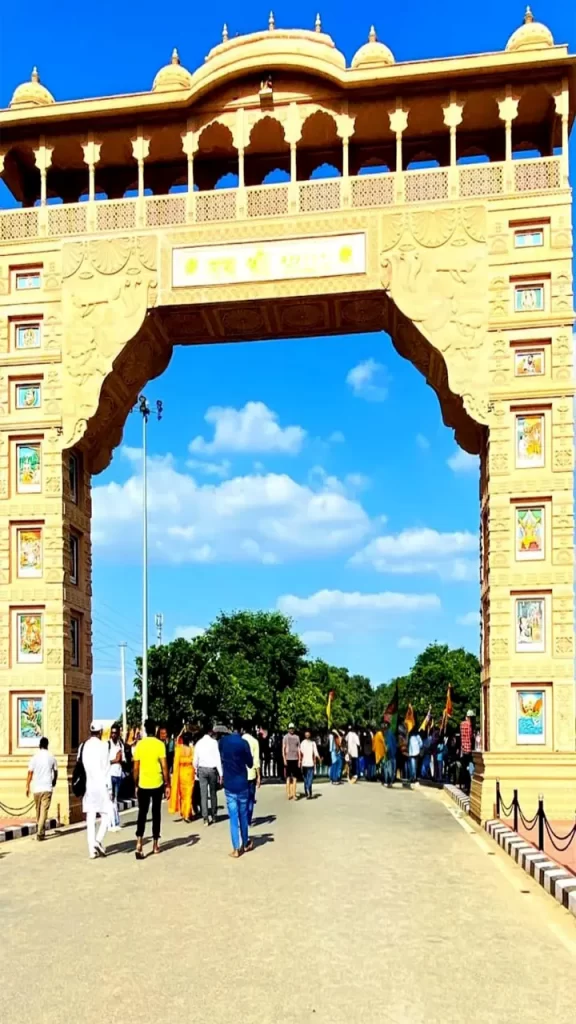
The Supreme Sacrifice: Sheesh Daan
To preserve the balance of the universe and ensure the victory of Dharma, the disguised Brahmin requested a sacred charity (Daan) from Barbarika. In the Kshatriya code, a warrior could never refuse a Brahmin’s request.
Barbarika agreed, asking what the Brahmin desired. Krishna asked for the young warrior’s head (Sheesh).
Barbarika instantly realized that no ordinary Brahmin would demand such a gift. He requested the traveler reveal His true identity. Lord Krishna then revealed His divine, cosmic form (Vishwaroopa).
Without hesitation, Barbarika agreed to make the ultimate sacrifice. He had only one final wish: he had journeyed to Kurukshetra to witness the historic battle between righteousness and unrighteousness, and he wished to see it to its conclusion.
Krishna granted his request. On the sacred dawn of Phalguna Shukla Dwadashi, Barbarika bathed, offered prayers, and severed his own head with a single stroke.
Krishna took the severed head, blessed it with celestial nectar, and placed it atop a high hill overlooking the battlefield of Kurukshetra. From this vantage point, the head of Barbarika witnessed the entire eighteen-day war.
Who Won the Mahabharata War? The Eyewitness Verdict
When the eighteen days of battle concluded and the Pandavas emerged victorious, pride swept through their ranks. Bhima claimed that his physical strength and mace had secured victory. Arjuna believed his celestial archery and Gandiva bow had decided the war.
Unable to agree, the brothers approached Lord Krishna to arbitrate. Krishna smiled and replied:
“There was one neutral witness who watched the entire battle from above without participating. Let us ask the head of Barbarika.”
The Pandavas ascended the hill to question Barbarika. The severed head smiled and spoke clearly:
“I saw no individual warrior defeating another. Across the entire field, I saw only one reality: Lord Krishna’s Sudarshana Chakra dancing across the battlefield, neutralizing the unrighteous, while the divine Mahakali drank the fallen energy of darkness. You were all merely instruments of His cosmic will.”
Humbled, the Pandavas bowed their heads, their ego shattered by the truth.
Read More>> Mahaganapathi Temple Malleswaram
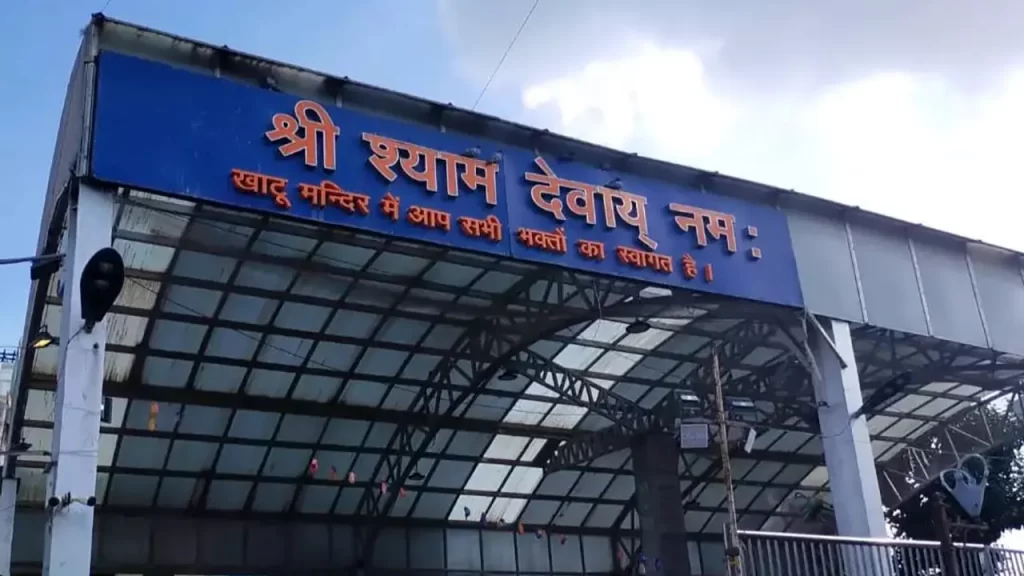
Krishna’s Eternal Boon: Becoming “Shyam” of the Kali Yuga
Deeply pleased by Barbarika’s egoless perception, ultimate sacrifice, and unwavering surrender, Lord Krishna bestowed a blessing unique in Hindu tradition:
“Because you gave your head without hesitation for the protection of Dharma, you shall be worshipped in the age of Kali Yuga under my personal name—Shyam. Your devotees shall attain peace, fulfillment of their righteous desires, and relief from despair simply by taking your name. You shall forever be the refuge of the defeated (Haare Ka Sahara).”
This divine boon forms the spiritual heart of the Khatu Shyam temple. Devotees visit the shrine not merely to see a deity, but to seek solace from a supreme friend who understands personal struggle and sacrifice.
The Historical Rediscovery of the Sacred Head in Khatu
Centuries after the Mahabharata era, during the medieval period, the sacred head lay buried near the village of Khatu in present-day Rajasthan.
According to local temple records (Sthala Purana):
- A cow belonging to a local herdsman would regularly stop at a specific mound of earth and spontaneously shower milk from her udders.
- Astonished by this recurring phenomenon, the local villagers excavated the mound carefully.
- Beneath the earth, they uncovered the sacred, radiant head (Sheesh) of Barbarika.
- The sacred relic was initially placed in the custody of a devout Brahmin, who worshipped it with reverence.
Later, the ruler of the region, King Roopsingh Chauhan, had a dream in which the deity instructed him to construct a grand temple on the site. On the eleventh day of the bright half of the month of Phalguna (Phalguna Shukla Ekadashi), the sacred head was enshrined within the sanctum sanctorum (Garbhagriha), where it continues to be worshipped today.
Read More>> Gangaikonda Cholapuram Temple
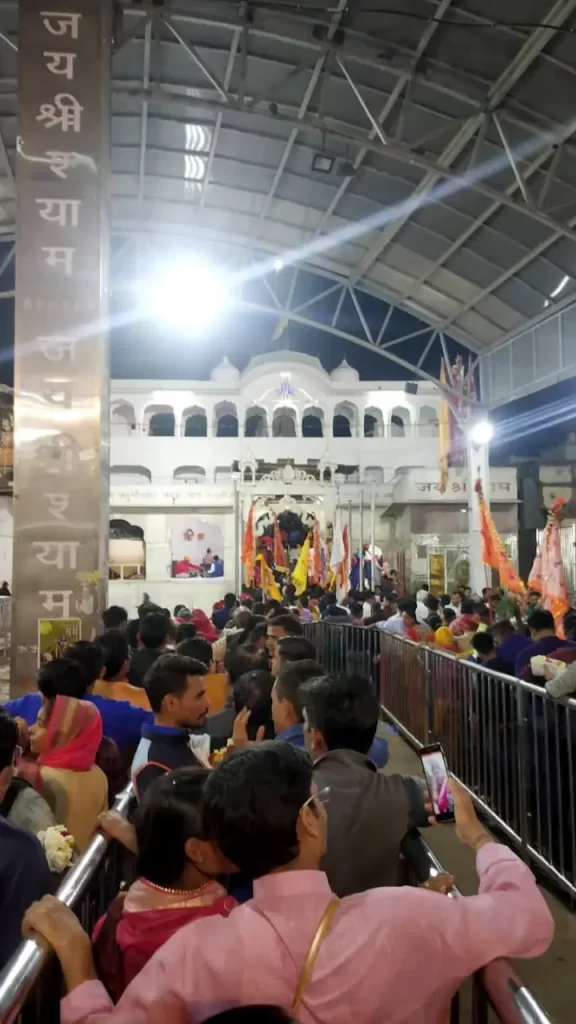
The Sacred Layout and Architecture of the Temple
The current temple structure is built from pure Makrana marble, reflecting classic Rajasthani craftsmanship:
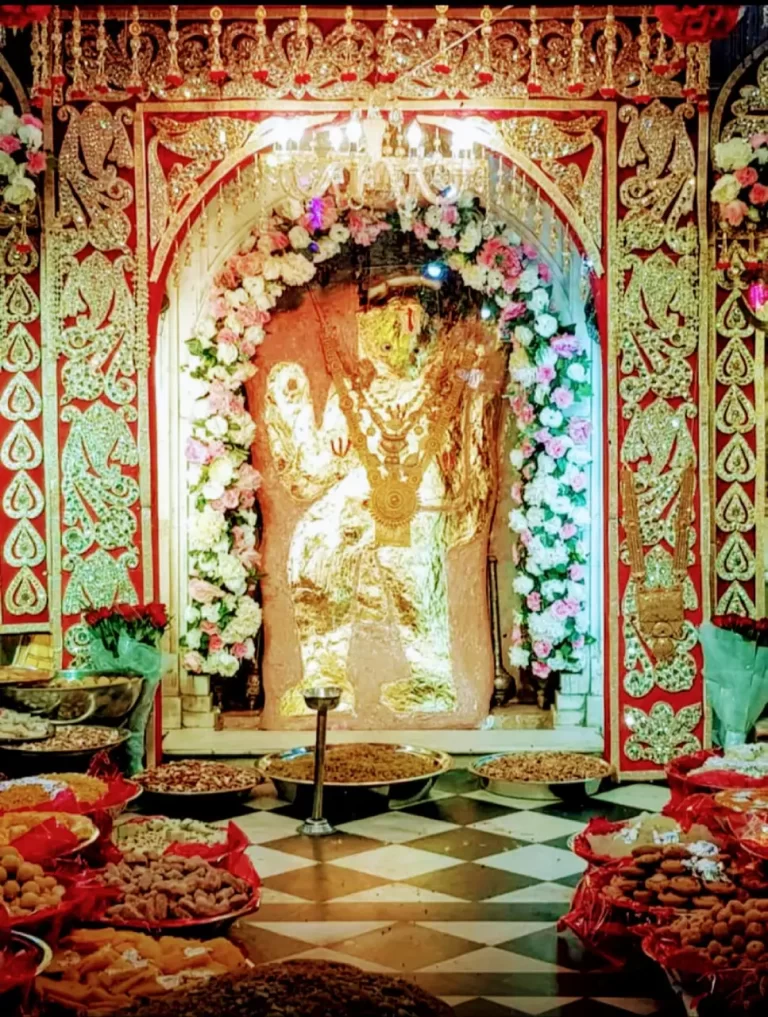
- The Inner Sanctum (Garbhagriha): Houses the elaborately adorned deity. The sacred head is decorated daily with fresh flowers (Shringaar), precious jewels, and traditional Rajasthani attire.
- The Prayer Hall (Jagamohana): A spacious, intricately carved marble pavilion where thousands of pilgrims gather for darshan. The walls depict scenes from the Mahabharata and Krishna Leela.
- Shyam Kund: A sacred water reservoir located near the main complex. Tradition holds that the holy head was first retrieved from this pond. Devotees take a ceremonial dip in Shyam Kund before proceeding to darshan, particularly during festival periods.
- Gopinath Ji Temple: An adjacent shrine dedicated to Lord Krishna in His pastoral form, maintaining the theological link between Krishna and Barbarika.
Ritual Traditions: The Nishan Yatra and Phalguna Lakhi Mela
The Sacred Nishan Yatra
One of the most physically demanding and spiritually uplifting rituals associated with Khatu Shyam Ji is the Nishan Yatra.
- Devotees gather at the town of Ringas, approximately 17 kilometers away from Khatu.
- Pilgrims carry a triangular silk flag (Nishan), usually in saffron, blue, or red, adorned with images of Lord Shyam, a coconut, and sacred peacock feathers (Morchhad).
- Devotees walk the entire distance barefoot along the highway, singing bhajans such as “Haare Ka Sahara, Baba Shyam Hamara”.
- Upon reaching the temple, the Nishan is offered at the sanctum as a symbol of surrender and gratitude.
The Annual Phalguna Lakhi Mela
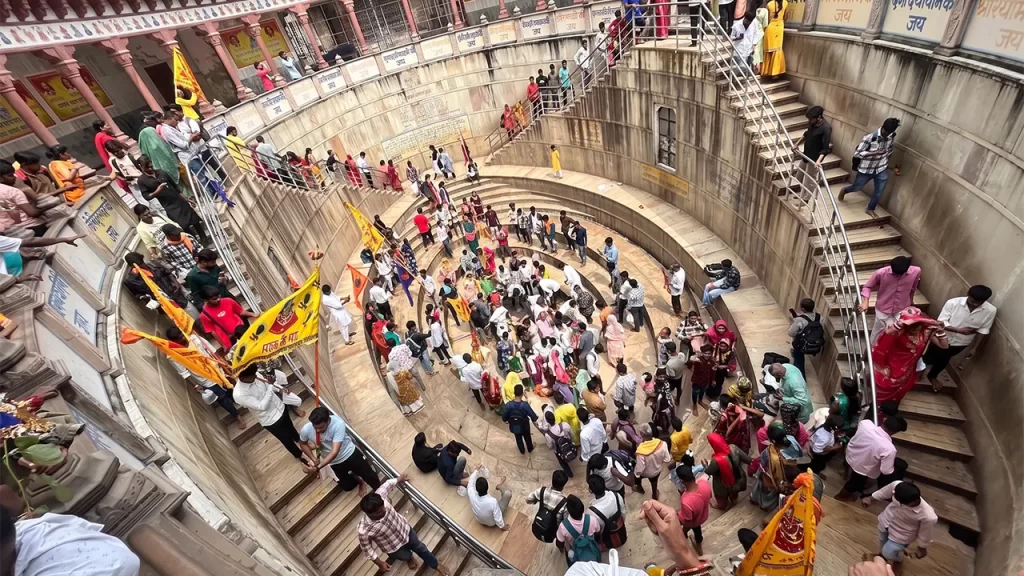
Every year, during the bright half of the Hindu month of Phalguna (typically February or March), Khatu transforms into a sea of devotion. The Lakhi Mela draws millions of pilgrims over five to six days:
- The peak days occur between Phalguna Shukla Navami and Dwadashi.
- The atmosphere features continuous kirtan, community kitchens (Bhandaras), and cultural processions.
- Pilgrims from Haryana, Punjab, Uttar Pradesh, Gujarat, and across India walk for days to reach the sanctum.
Read More>> Chelamattom Sreekrishna Swami Temple: Powerful Temple for Ancestors
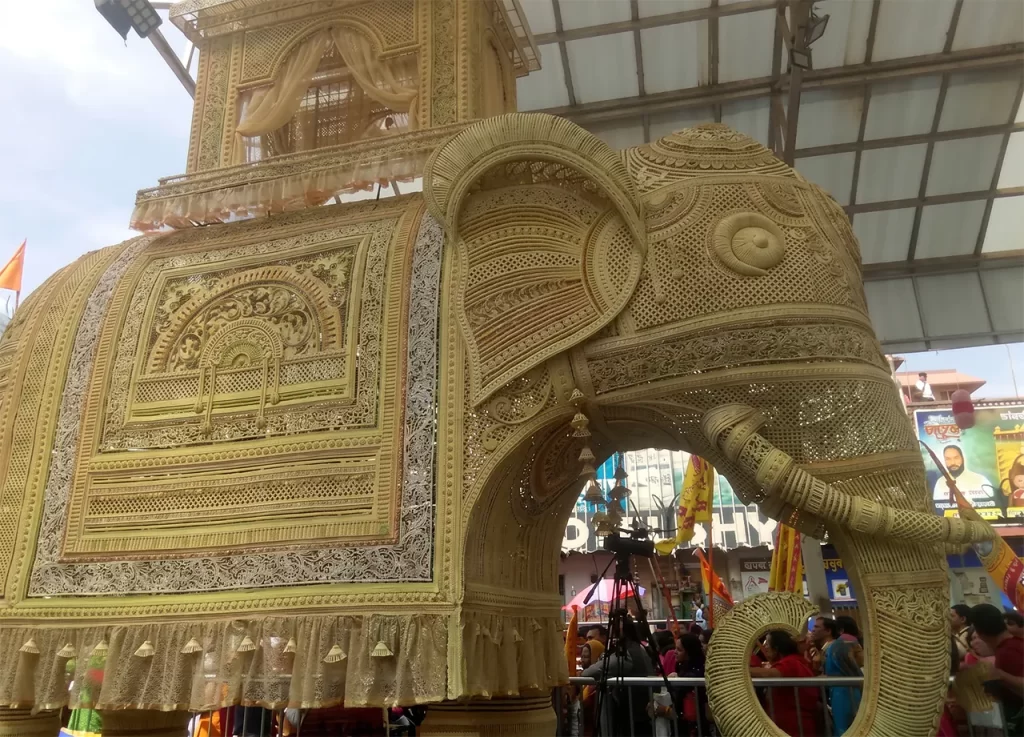
Daily Aarti Timings and Devotional Schedule
The temple follows an elaborate daily worship schedule. While timings shift slightly between the summer and winter seasons, the sequence of the five primary aartis remains constant:
- Mangala Aarti (Early Morning): Conducted at dawn when the temple doors open to awaken the deity.
- Shringaar Aarti (Morning): Performed after the deity has been bathed and decorated with fresh flowers, jewelry, and sandalwood paste.
- Bhog Aarti (Midday): The offering of sacred food offerings (Prasad), including traditional sweets like Peda, Kheer, and Churma. The temple closes briefly after this aarti.
- Sandhya Aarti (Evening): Performed at dusk as the temple lights are illuminated, accompanied by drums, conch shells, and devotional bells.
- Shayan Aarti (Night): The final evening service before the sanctum doors are closed for the deity’s rest.
(Note: During major festival days such as Phalguna Ekadashi, the temple administration often keeps the doors open continuously for up to 48 hours to manage large crowds).
How to Reach Khatu Shyam Ji Temple
Khatu is well connected to major transit hubs in northern India:
By Rail
- Nearest Major Junction: Ringas Junction (RGS), situated approximately 17 km from Khatu. Ringas connects directly to Jaipur, Delhi, Rewari, and Ajmer.
- From Ringas railway station, shared jeeps, state transport buses, and auto-rickshaws operate round-the-clock to Khatu town.
By Road
- Khatu is located just off National Highway 52 (NH 52).
- From Jaipur (approx. 80 km): Travel via NH 52 through Chomu and Ringas; the drive takes approximately 1.5 to 2 hours.
- From Delhi (approx. 270 km): Travel via the Delhi–Jaipur highway or the Western Peripheral Expressway through Kotputli and Neem Ka Thana. Regular private and Rajasthan State Road Transport Corporation (RSRTC) buses operate from Delhi’s ISBT Kashmiri Gate.
By Air
- Nearest Airport: Jaipur International Airport (JAI), located roughly 95 km away. Taxis can be hired directly from the airport terminal to Khatu.
Practical Pilgrimage Tips for First-Time Visitors
- Plan Around Ekadashi: The 11th lunar day of every Hindu month (Shukla Ekadashi) is especially sacred to Lord Shyam. Crowd sizes increase tenfold on these days; expect long queue times.
- Footwear and Valuables: Utilize the designated footwear counters managed by the temple trust. Keep mobile phones and wallets secure in dense queues.
- Senior Citizens and Children: During festival seasons, avoid peak morning hours. The temple trust provides dedicated queue lanes for elderly visitors when operational conditions permit.
- Dress Code & Decorum: While there is no rigid traditional dress requirement, modest and respectful clothing (traditional Indian attire such as Kurta-Pyjama or Saree/Salwar) is customary.
Read More>> 11th Century Adinath Temple Khajuraho
Frequently Asked Questions (FAQ)
Why is Khatu Shyam Ji called “Sheesh Ke Daani”?
He is called Sheesh Ke Daani (“the Giver of the Head”) because he severed his own head as an offering (Daan) to Lord Krishna before the Kurukshetra battle, ensuring that righteousness (Dharma) could prevail without the total destruction of both armies.
Why is Barbarika worshipped instead of Krishna in Khatu?
Barbarika is worshipped as Krishna. In recognition of his supreme sacrifice, Lord Krishna blessed Barbarika with His own divine name, “Shyam,” and declared that worshipping Barbarika in the Kali Yuga would yield the same spiritual grace as worshipping Krishna Himself.
What is the significance of the “Three Arrows” (Teen Baan)?
The three arrows granted by Goddess Durga were completely infallible. The first marked the targets to be eliminated, the second marked those to be protected, and the third destroyed the targets before returning to the quiver. They represent absolute divine mastery and justice.
What is the best time of year to visit Khatu Shyam Ji?
The ideal period is between October and March when the desert weather of Rajasthan is pleasantly cool. If you wish to experience the peak devotional fervor, visit during the Phalguna Mela (February–March), though pilgrims should prepare for large crowds.
How far is Khatu Shyam Ji from Salasar Balaji?
The road distance between Khatu Shyam Ji and Salasar Balaji is approximately 105 kilometers, taking around 2 to 2.5 hours by car. Many pilgrims complete both darshans within a single weekend pilgrimage circuit.