Fasting on Ekadashi: Meaning, Rules, Benefits & Food Guide
Fasting on Ekadashi: Many of us have watched a parent or grandparent wake up early in the morning, decline a warm plate of rice or roti, and spend the afternoon reading a holy book or chanting softly on a bead bag. When asked why they are not having lunch, the answer is often simple: “Today is Ekadashi.”
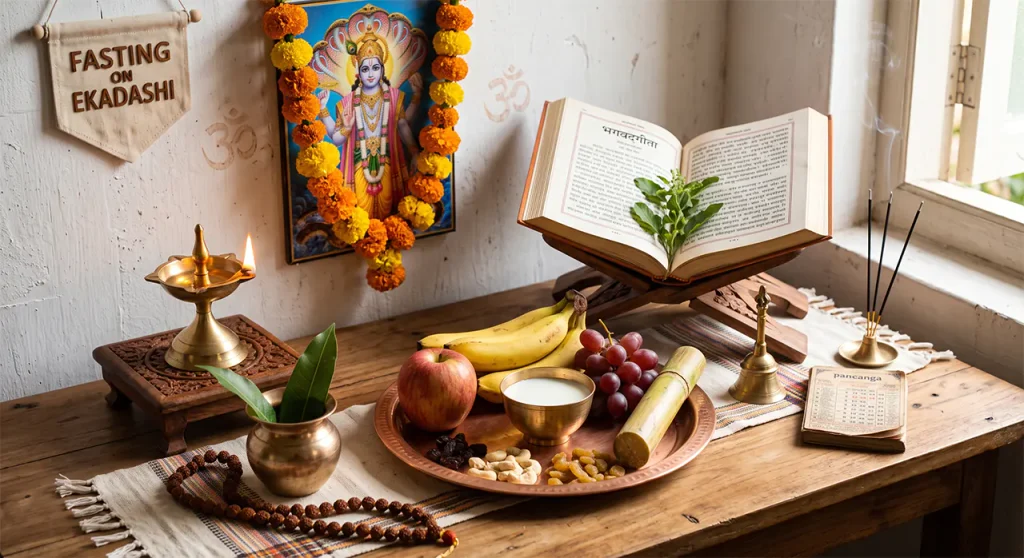
Fasting on Ekadashi is one of the most widely observed customs across Hindu homes, yet its roots and daily rules often raise questions. Why does this specific day arrive twice every month? Why do some families avoid grains entirely while others drink only water or eat dishes made of potatoes, fruits, and buckwheat? And how does fasting on this lunar day compare to the fasts kept during major festivals like Maha Shivaratri, Janmashtami, or Navaratri?
Fasting in the Hindu worldview is far more than skipping a meal to test one’s endurance. It is a deliberate pause—a rhythm designed to help a person step back from daily consumption, steady the senses, and create room for devotion, mindfulness, and inner balance.
What Is Fasting in Hindu Tradition?
Fasting in Hindu traditions is understood primarily as an internal discipline rather than an act of physical self-punishment.
The most common Sanskrit word for religious fasting is Upavasa (उपवास). The term is made up of two simple root words:
- Upa, meaning “near” or “close to”
- Vasa, meaning “to dwell,” “to stay,” or “to sit”
Taken together, Upavasa literally means “sitting close to the Divine” or “dwelling in a state of spiritual closeness.” The external act of setting aside food is meant to support this internal goal. When ordinary meal preparations, cooking routines, heavy digestion, and social dining are set aside, the mind has fewer distractions. The time and energy normally spent on eating are redirected toward prayer, study, quiet contemplation, and acts of charity.
Hindu philosophy views food (anna) not merely as fuel, but as something that directly influences mental states and temperament. Traditional texts classify foods into qualities that create calm clarity (sattva), restless energy (rajas), or dull heaviness (tamas). By intentionally consuming lighter, simpler items or pausing food intake altogether on designated days, a person practices conscious mastery over sensory impulses (indriyas).
Fasting is never intended to cause bodily harm. Across classical texts, taking care of the physical body is considered an essential duty, because the body is the instrument through which all ethical and spiritual duties (dharma) are carried out. Thus, fasting is approached with flexibility, humility, and balance, varying widely based on individual circumstances, family customs, and regional traditions.
What Is Ekadashi?
Ekadashi is a Sanskrit word that translates directly to “eleventh.” In the traditional Hindu lunar calendar (Panchang), it refers specifically to the eleventh lunar day (tithi) of each waxing and waning lunar fortnight.
To understand how the date works, think of the moon’s journey across the sky:
- Shukla Paksha (The Bright Fortnight): The period during which the moon grows larger each night, moving from the New Moon (Amavasya) to the Full Moon (Purnima). The eleventh day in this phase is called Shukla Paksha Ekadashi.
- Krishna Paksha (The Dark Fortnight): The period during which the moon shrinks each night, moving from the Full Moon back to the New Moon. The eleventh day in this phase is called Krishna Paksha Ekadashi.
Because every lunar month contains two fortnights, an Ekadashi occurs twice every month. Over a standard lunar year consisting of twelve months, there are typically 24 Ekadashis. During leap years in the Hindu calendar—when an extra intercalary month called Adhik Maas (or Purushottama Maas) is added roughly every three years—there are 26 Ekadashis.
Within Hindu sacred literature, particularly the Purāṇas, Ekadashi is closely associated with Lord Vishnu, the preserver and protector within the sacred trinity. Devotees who honor Vishnu, known broadly as Vaishnavas, consider Ekadashi the most important regular fasting day of the year, though people across many different Hindu traditions observe it with equal devotion.
Read More >> Pradakshina: Meaning, Significance, Rules & Why We Walk Clockwise
Why Do People Fast on Ekadashi?
People observe fasting on Ekadashi for a variety of deeply personal, cultural, and spiritual reasons. While some may follow the practice as an expression of pure devotion, others do so out of respect for family heritage or as a conscious exercise in regular self-discipline.
Devotional and Spiritual Focus
The foremost reason for fasting on Ekadashi is to dedicate an entire day to the remembrance of God without the clutter of everyday indulgence. By reducing time spent cooking, planning elaborate meals, and entertaining social engagements, practitioners free up their morning and evening hours for prayer, meditating on divine names (japa), reading scriptures, and visiting temples.
Cultivating Restraint and Willpower
In ordinary daily life, our appetite often dictates our schedule. We eat because the clock strikes a certain hour or because a tempting snack is nearby. Fasting on Ekadashi breaks this unconscious pattern. Saying “no” to immediate physical cravings builds mental stamina, emotional resilience, and intentional focus.
Honoring Lineage and Family Heritage
For millions of households, Ekadashi fasting is an unbroken tradition handed down through generations. Children grow up watching parents and grandparents keep the fast, learning the rhythm of the lunar calendar and absorbing the practice naturally as part of their domestic lifestyle.
A Mindful Dietary Reset
Many people find value in the predictable, twice-a-month pause from complex, heavy, and oily dishes. Even outside strict theological circles, observing a day centered on fresh fruit, pure water, milk, or simple root vegetables gives the digestive system a predictable break and encourages mindful consumption.
Spiritual Meaning of Ekadashi Fasting
Beyond the practical reduction of meals, classical texts describe Ekadashi as an internal recalibration involving our entire sensory system.
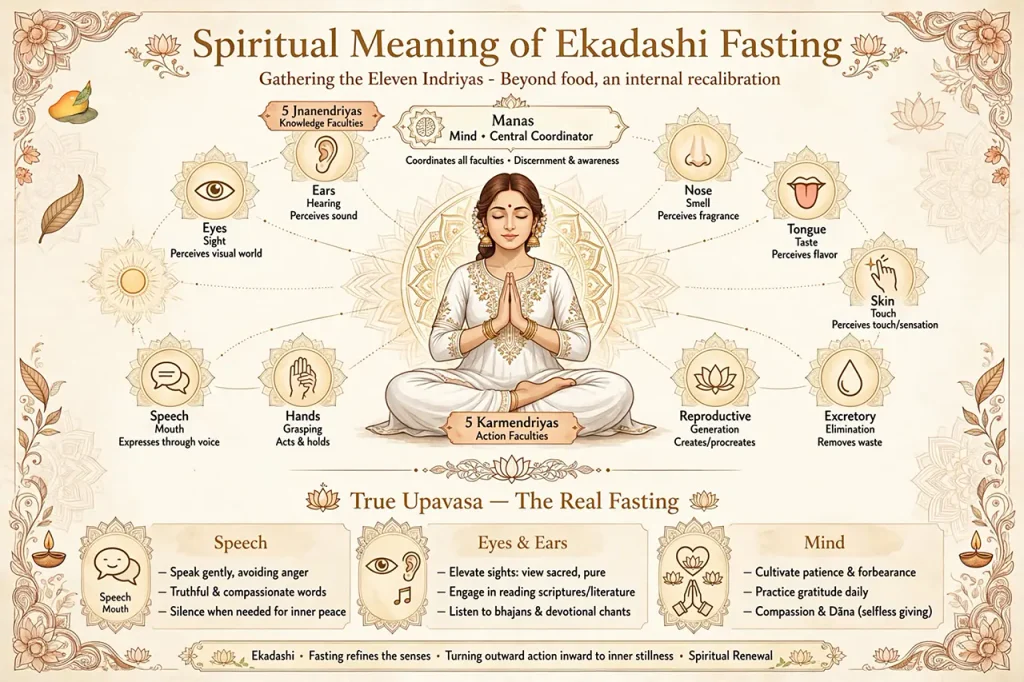
Traditional Indian thought enumerates eleven primary faculties of human perception and action—known as the Ekadasha Indriyas:
- Five organs of perception (Jnanendriyas): Eyes (sight), ears (hearing), nose (smell), tongue (taste), and skin (touch).
- Five organs of action (Karmendriyas): Speech/mouth (expression), hands (grasping), feet (movement), reproductive organs (generation), and excretory organs (elimination).
- The coordinating internal faculty (Manas / Mind): The central processing unit that directs and interprets sensory inputs.
In this allegorical and spiritual framework, the “eleventh day” serves as a reminder to gather all eleven faculties together and point them in a singular, uplifting direction. A complete fast is not achieved if the tongue refrains from grain while the eyes look for gossiping distractions, the ears listen to harsh criticism, and the mind wanders through grievances.
True Upavasa encompasses:
- Speech: Speaking gently, avoiding anger, arguments, or deceptive speech.
- Eyes and Ears: Seeking elevating sights, reading inspiring literature, and listening to devotional music (bhajans) or philosophical discourses.
- Mind: Cultivating feelings of patience, gratitude, compassion, and charity (dana) toward all living beings.
Why Are Grains Commonly Avoided on Ekadashi?
One of the first questions newcomers ask is why standard pantry staples—especially rice, wheat, lentils, and common pulses—are set aside during Ekadashi, while certain vegetables, dairy, and pseudocereals are accepted.
Traditional and Purāṇic Explanations
In Vaishnava traditions and various Purāṇas (such as the Padma Purāṇa and Brihan-naradiya Purāṇa), there are vivid traditional narratives detailing the appearance of the personified energy of Ekadashi, born from the body of Lord Vishnu to overcome disruptive forces.
According to these devotional stories, when negative tendencies (Papa-purusha, representing unwholesome actions and negative karma) had nowhere left to reside, they were granted shelter within cereal grains and beans specifically on the eleventh lunar day. Therefore, devotees refrain from eating grains on Ekadashi to symbolically keep themselves free from unwholesome influences.
Digestive Lightness and Meditation
From a practical and lifestyle perspective within traditional philosophy, cereal grains, lentils, and beans are dense, complex staples that require significant metabolic energy to break down. Heavy meals can induce lethargy and sleepiness (tamas). By abstaining from heavy staples and relying instead on light, easily digestible items, the body remains alert, making sitting upright for meditation, singing, and prayer considerably easier.
It is helpful to recognize that these religious explanations belong to sacred tradition and cultural belief systems rather than modern laboratory science. Traditions preserve these dietary codes to foster devotion, discipline, and communal uniformity across generations.
Different Types of Ekadashi Fasting
Hindu traditions celebrate diversity in worship. There is no single, rigid manual that every individual must follow regardless of circumstances. Depending on a person’s health, stage of life, family custom (kulachar), and spiritual lineage (sampradaya), Ekadashi fasting is observed in several distinct ways.
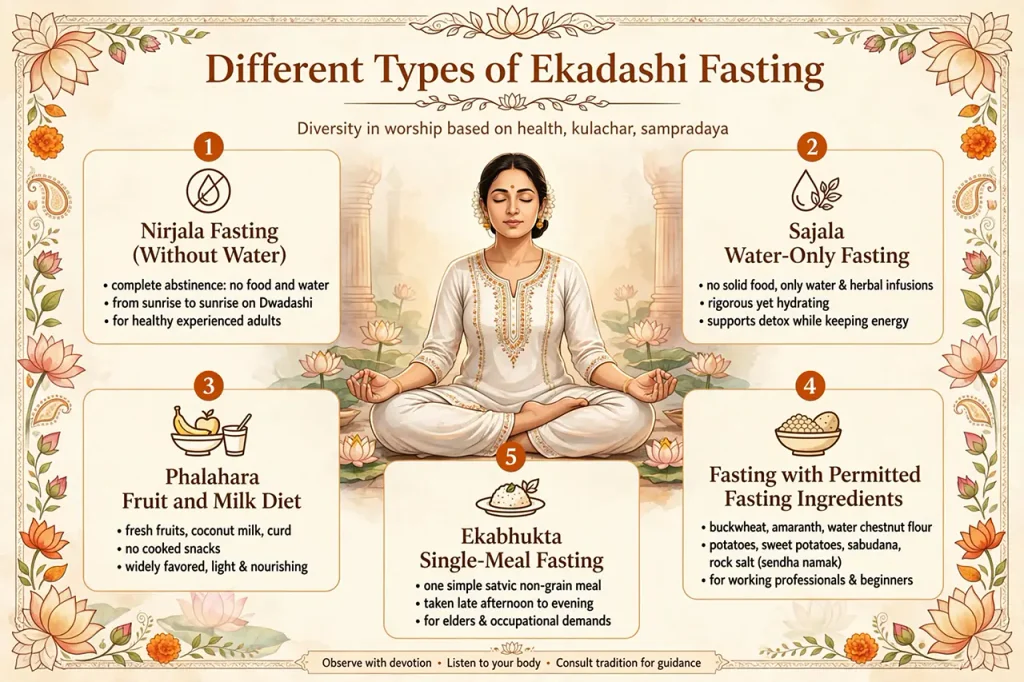
1. Nirjala Fasting (Without Water)
- What it involves: Complete abstinence from both food and water from sunrise on Ekadashi until sunrise on the following day (Dwadashi).
- Who observes it: Typically healthy adults with prior fasting experience, often undertaken specifically on Nirjala Ekadashi (in early summer) or on select sacred occasions. It requires sound physical health and determination.
2. Sajala / Water-Only Fasting
- What it involves: No solid or semi-solid food is eaten throughout the day, but plain water, warm water, or occasionally herbal infusions are taken regularly to maintain hydration.
- Who observes it: Devotees seeking a rigorous fast while safely supporting basic bodily functions.
3. Phalahara (Fruit and Milk Diet)
- What it involves: The diet consists entirely of fresh seasonal fruits, raw coconut, coconut water, milk, and plain curd (yogurt). No cooked grain substitutes or savory snacks are eaten.
- Who observes it: A widely favored traditional method that keeps the body light and nourished without entering a state of severe physical strain.
4. Fasting with Permitted Fasting Ingredients
- What it involves: Consuming prepared dishes made strictly from non-grain flours (such as buckwheat, amaranth, or water chestnut flour), potatoes, sweet potatoes, tapioca pearls (sabudana), rock salt (sendha namak), and designated herbs.
- Who observes it: Common among working professionals, families, students, and beginners who require sustained physical energy to carry out daily responsibilities.
5. Ekabhukta (Single-Meal Fasting)
- What it involves: Taking one simple, satvic, non-grain meal during the day—often in the late afternoon or evening—while fasting for the remainder of the hours.
- Who observes it: People who cannot manage an all-day fast due to occupational demands, elders, or those easing into regular fasting practices.

What Can You Eat During Ekadashi Fasting?
For those observing a modified or food-inclusive fast (Phalahara), traditional guidelines outline a clear selection of wholesome, satvic ingredients that provide sustained energy without violating the spirit of the day.
Fresh Fruits and Dried Fruits
All fresh seasonal fruits are traditionally welcome: apples, bananas, pomegranates, papayas, melons, guavas, oranges, and grapes. Dry fruits and nuts—including almonds, walnuts, cashews, raisins, pistachios, and dried figs—offer concentrated energy, healthy fats, and satiety.
Pure Dairy
Dairy holds a revered place in Indian pastoral traditions. Devotees may consume fresh cow’s milk, homemade curd (dahi), churned buttermilk (chaas), fresh cottage cheese (paneer), and pure clarified butter (ghee). Commercial dairy products with added artificial stabilizers, gelatins, or cereal starches should be avoided.
Root Vegetables and Non-Grain Starches
Tubers and roots that grow beneath the ground are standard fasting foods in many regional traditions:
- Potatoes and Sweet Potatoes: Boiled, mashed, or lightly sautéed in ghee with cumin seeds.
- Tapioca Pearls (Sabudana): Extracted from the cassava root, widely prepared as khichdi or kheer.
- Colocasia (Arbi) and Yam (Suran): Roasted or lightly spiced with rock salt and green chilies.
Ancient Pseudocereals and Seed Flours
While true cereals (grasses) are avoided, botanically distinct seeds and pseudocereal flours are standard across North, West, and Central India:
- Kuttu Atta (Buckwheat Flour): Used to make shallow-fried pancakes (chillas) or flatbreads (puris).
- Singhara Atta (Water Chestnut Flour): Milled from dried aquatic nuts.
- Rajgira / Chaulai (Amaranth): Popped whole or milled into nutrient-dense, protein-rich flour.
- Samak / Moraiyo / Barnyard Millet Seeds: Despite being called a “millet” in common parlance, these small wild seeds are traditionally treated as acceptable grain alternatives for making fasting porridge.
Fats, Salt, and Spices
- Fats: Pure cow’s ghee or cold-pressed groundnut (peanut) oil is preferred.
- Salt: Standard commercial table salt—which is often iodized and chemically processed with anti-caking agents—is set aside in favor of unprocessed Sendha Namak (Himalayan rock salt).
- Mild Spices: Whole cumin seeds (jeera), freshly ground black pepper (kali mirch), fresh ginger, green chilies, fresh coriander leaves, and lemon juice.
Read More >> Why Do We Ring the Bell Before Entering a Temple? Shocking Truth
What Should You Avoid During Ekadashi?
Understanding what to set aside is equally helpful for keeping the fast with clarity and peace of mind.
- All True Cereal Grains:Rice (including flattened rice/poha and puffed rice), wheat, semolina (sooji), all-purpose flour (maida), barley, oats, corn, rye, and standard breakfast cereals.
- All Pulses, Lentils, and Beans:Yellow lentils (toor dal, moong dal), red lentils (masoor), split chickpeas (chana dal), black gram (urad dal), kidney beans (rajma), and soybeans.
- Pungent and Tamasic Ingredients:Onions, garlic, leeks, shallots, asafoetida (hing—which frequently contains wheat flour as an anti-caking base), artificial food colors, chemical preservatives, alcohol, and tobacco.
- Commercial and Heavily Processed Foods:Store-bought snacks, restaurant curries, bottled sauces, and foods fried in reused commercial cooking oils.
- Non-Vegetarian Items:Meat, fish, poultry, and eggs are strictly excluded from all traditional Hindu fasting observances.
Note on regional customs: In certain South Indian Vaishnava traditions, items like mustard seeds (rai), sesame seeds (til), and certain leafy greens are excluded during particular months or fortnights. It is always wise to follow the specific guidance of your own elders and lineage.
Ekadashi Fasting Rules: A Practical Step-by-Step Approach
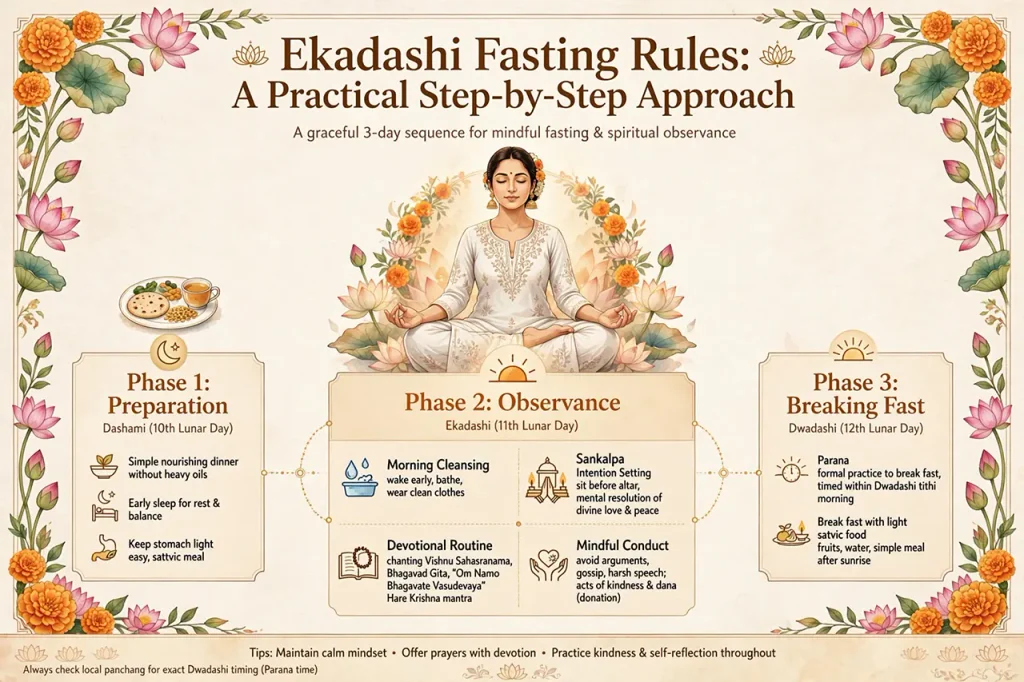
Observing Ekadashi smoothly requires thoughtful pacing. Rather than abruptly skipping meals, traditional manuals encourage a graceful three-day sequence: preparation on the 10th day (Dashami), fasting on the 11th day (Ekadashi), and breaking the fast on the 12th day (Dwadashi).
Phase 1: Preparation on Dashami (The 10th Lunar Day)
Preparation begins on the evening before the fast. Devotees eat a simple, nourishing dinner without heavy oils, rich sweets, or overeating. The objective is to go to sleep with a settled stomach so that waking up early on Ekadashi feels light and refreshing rather than sluggish.
Phase 2: Observance on Ekadashi (The 11th Lunar Day)
- Morning Cleansing: Wake up early, bathe, and wear clean, comfortable clothes.
- Sankalpa (Intention Setting): Sit quietly before your home altar or in a quiet space. Take a moment to form a sincere mental resolution (sankalpa). State clearly to yourself the spirit in which you are undertaking the day—whether for divine love, peace of mind, or inner strength—and choose the fasting level (water-only, fruits, or fasting foods) that suits your health.
- Devotional Routine: Spend time during the day chanting, reciting the Vishnu Sahasranama (Thousand Names of Vishnu), reading chapters of the Bhagavad Gita, or quietly repeating a simple mantra such as
Om Namo Bhagavate VasudevayaorHare Krishna. - Mindful Conduct: Avoid arguments, idle gossip, loud entertainment, and harsh speech. Engage in small acts of kindness or set aside a portion of funds or food to donate to those in need.
Phase 3: Breaking the Fast on Dwadashi (The 12th Lunar Day)
The fast is not broken casually at any random time. It is concluded on the following morning through a formal practice called Parana, timed carefully within the Dwadashi tithi.
What Is Ekadashi Parana?
Parana (पारण) refers to the formal, ritual conclusion of the Ekadashi fast on the morning of Dwadashi (the twelfth lunar day).
In traditional calendar systems, observing the correct Parana window is considered essential to completing the spiritual discipline. The basic rules include:
- After Sunrise: The fast must not be broken before local sunrise on Dwadashi.
- Within the Dwadashi Tithi: The fast should be broken before the Dwadashi lunar tithi comes to an end, unless specific astrological alignments (such as Hari Vasara) require waiting for an exact hour.
- Location-Specific Timing: Because lunar tithis and sunrises differ from city to city, exact Parana hours vary. Devotees consult an authentic local Panchang (traditional calendar) to check the precise morning window for their city.
How to Break the Fast
Begin by taking a clean bath and offering a brief morning prayer or lighting an oil lamp. It is customary to break the fast first with a sip of clean water, a sacred Tulsi (holy basil) leaf, or a piece of amla (Indian gooseberry), followed by a warm, light, and easily digestible meal. Traditional households often prepare a gentle dish made of rice, moong dal, or agathi keerai (hummingbird tree leaves) to soothe the stomach after a day of fasting.


Can Children, Elderly People, and Pregnant Women Fast?
One of the most compassionate and vital principles of Hindu tradition is that devotion must never become an instrument of physical harm. The scriptures clearly state that children, the elderly, pregnant or nursing mothers, and individuals recovering from illness are exempt from strict fasting rules.
- Children: Growing bodies need regular carbohydrates, fats, proteins, and minerals. Young children should never be asked to keep strict fasts. If they express curiosity, they can participate gently by eating regular meals while skipping packaged sweets or spending extra time reading inspiring stories.
- Pregnant and Lactating Women: Pregnancy and breastfeeding demand continuous nourishment and hydration. Strict fasting during these stages is strongly discouraged by both healthcare providers and traditional spiritual mentors. A mother’s primary spiritual duty (dharma) is safeguarding her health and that of her child.
- Elderly Individuals and Those with Medical Conditions: People living with conditions such as diabetes, gastrointestinal disorders, chronic kidney disease, or those taking scheduled prescription medicines should prioritize their health.
Health Reminder: Devotion lives in the heart, not in an empty stomach. If you have any underlying health conditions, take daily prescription medications, or are pregnant, consult a qualified healthcare professional before making substantial changes to your diet or meal timings.
Read More >> Why Do We Offer Water to Sun God? Meaning, Benefits and Surya Arghya
Can We Drink Water During Ekadashi?
Yes. Plain water is entirely permitted on standard Ekadashis.
There is widespread confusion among beginners who believe that all Ekadashi fasts require complete water deprivation. This is a misunderstanding. Complete waterless fasting is specific to Nirjala Ekadashi or chosen voluntarily by individuals who have built up the necessary experience and stamina.
During a typical Ekadashi, drinking clean water, warm water, lemon water, or tender coconut water is completely acceptable and encourages safe, healthy hydration throughout the day. Dehydration causes headaches, fatigue, dizziness, and irritability—states of body and mind that directly undermine the peaceful focus fasting is meant to create.
What Is Nirjala Ekadashi?
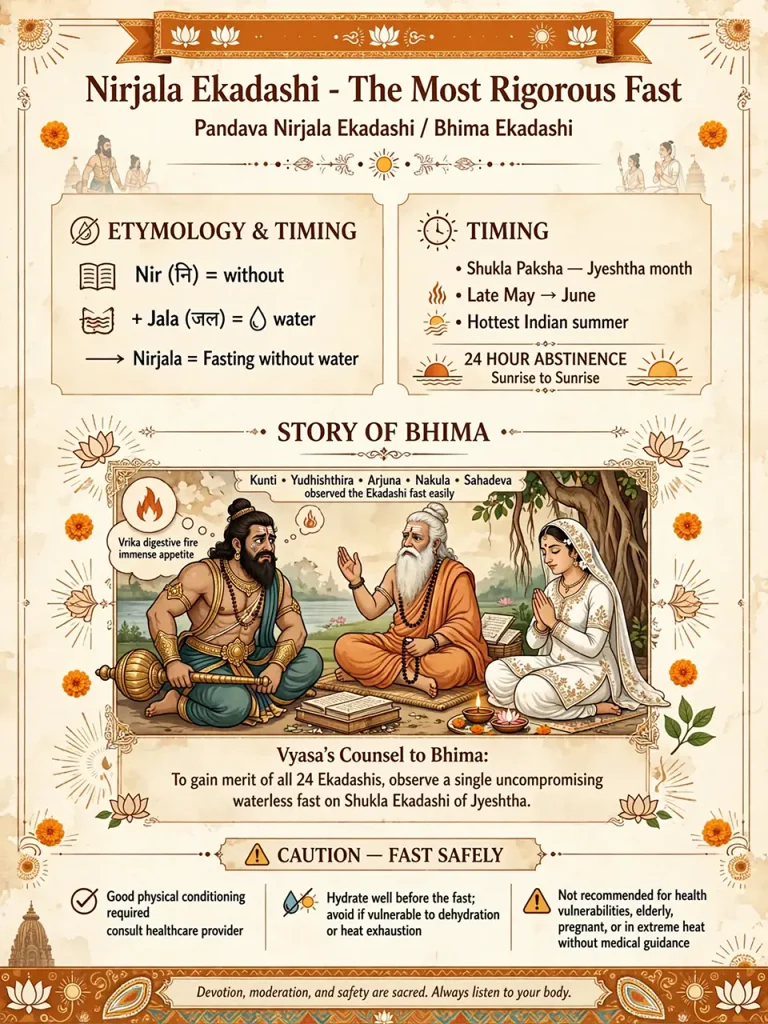
Nirjala Ekadashi is the most rigorous and famous of all 24 lunar fasts. The word Nirjala is made from two parts: Nir (without) and Jala (water).
Falling during the waxing fortnight (Shukla Paksha) of the traditional Hindu month of Jyeshtha (typically occurring in late May or June), this fast takes place during the hottest weeks of the Indian summer. Devotees who undertake it abstain from all food and every drop of water for a full 24-hour period, from sunrise on Ekadashi until sunrise on Dwadashi.
According to traditional accounts in the Mahabharata and Purāṇic literature, the mighty Pandava brother Bhima possessed an immense appetite driven by a powerful digestive fire known as Vrika. While his mother Kunti and brothers Yudhishthira, Arjuna, Nakula, and Sahadeva easily kept every regular Ekadashi fast, Bhima found going hungry twice a month nearly impossible.
Troubled by his inability to observe the family’s devotional vow, Bhima sought counsel from the great sage Vyasa. Sage Vyasa advised him that if he could not fast twice each month, he should observe a single, uncompromising, waterless fast on the Shukla Ekadashi of Jyeshtha. Because of this legendary association, Nirjala Ekadashi is also popularly celebrated as Pandava Nirjala Ekadashi or Bhima Ekadashi.
While many devotees look forward to this annual milestone, it requires good physical conditioning. One should never attempt complete water deprivation without proper hydration in the days leading up to it, nor should it be attempted in extreme heat by anyone with health vulnerabilities.
Why Do Hindus Fast on Festival Days?
While Ekadashi occurs predictably every fortnight, Hindus also observe special fasts during major annual festivals throughout the year.
Fasting on festival days serves several distinct purposes:
1. Spiritual Attunement
Festivals celebrate important cosmic events, divine incarnations (avataras), or seasonal transitions. Fasting serves as an internal preparation—clearing worldly preoccupations so the devotee can fully absorb the devotional joy, scriptural recitations, and rituals of the holy day.
2. Deep Connection to the Deity
Each festival aligns the practitioner with the qualities of a specific divine form:
- On Maha Shivaratri, devotees keep a fast and night-long vigil to honor Shiva’s deep stillness, simplicity, and victory over destructive tendencies.
- On Krishna Janmashtami, fasting continues through the day until midnight, the traditional hour when Lord Krishna appeared in Mathura, at which point sanctified feast offerings (prasada) are distributed with great joy.
- During Navaratri, nine days of light, pure meals honor the motherly protection, strength, and grace of Goddess Durga.
Ekadashi Fasting vs Festival Fasting
Although both share the core philosophy of Upavasa, regular Ekadashi fasting and annual festival fasting differ in their timing, focus, and practical guidelines.
| Feature | Ekadashi Fasting | Festival Fasting (Shivaratri, Janmashtami, Navaratri) |
| Frequency | Twice every month (24–26 times a year). | Once a year per festival (seasonal). |
| Primary Association | Lord Vishnu / Krishna. | Varies: Shiva, Devi (Durga), Rama, Krishna, Ganesha. |
| Core Dietary Rule | Strictly avoids all grains, lentils, and beans across all variations. | Varies: Some allow non-grain meals; others fast until midnight or midday. |
| Timing Basis | Tied directly to the 11th lunar tithi. | Tied to specific festival tithis, midnight hours, or multi-day periods. |
| Fast-Breaking (Parana) | Follows a strict morning window on the 12th tithi (Dwadashi). | Broken after specific festival rituals (e.g., midnight puja, moonrise, or sunset). |
| Underlying Tone | Calm, continuous monthly spiritual routine. | Celebratory, vibrant, communal, and often includes elaborate cultural rituals. |
Common Hindu Fasting Practices
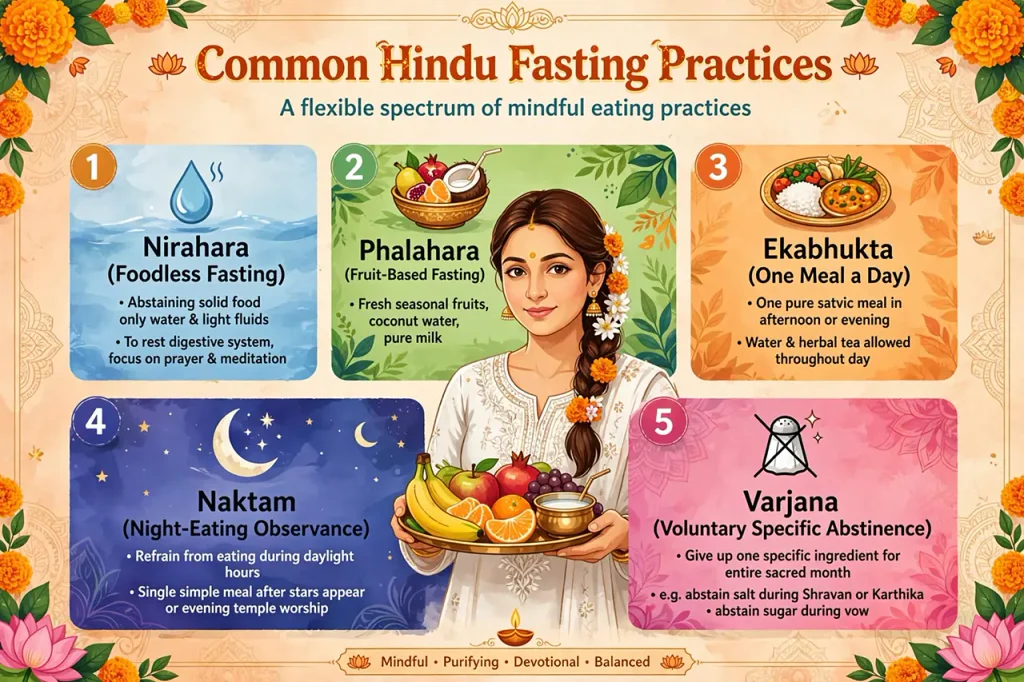
Fasting across Hindu communities spans an inspiring variety of expressions. The word “fast” does not describe a single, uniform action; rather, it represents a flexible spectrum of mindful eating practices.
- Nirahara (Foodless Fasting):Abstaining from all solid food while taking only water or light fluids to rest the digestive tract and focus entirely on prayer.
- Phalahara (Fruit-Based Fasting):Limiting intake strictly to fresh, seasonal fruits, coconut water, and pure milk.
- Ekabhukta (One Meal a Day):Eating one pure, satvic meal during the afternoon or evening and drinking water or herbal tea during the remaining hours.
- Naktam (Night-Eating Observance):Refraining from food throughout the daylight hours and taking a single simple meal after the stars appear or after evening temple worship.
- Varjana (Voluntary Specific Abstinence):Choosing to give up one specific ingredient for an entire sacred month (such as salt during Shravan or Karthika, or sugar during a special vow period).
Is Fasting the Same for Every Hindu?
No. There is no central, mandatory authority governing how every Hindu must fast. Practices vary naturally across lineages, philosophical schools, geographic regions, and families.
- Vaishnava Traditions: Place immense importance on Ekadashi, Janmashtami, and Radhashtami. They strictly avoid all cereal grains, legumes, onions, garlic, and non-vegetarian foods. Strict Vaishnava lineages often avoid processed restaurant fasting foods entirely, preferring pure fruits, milk, or home-cooked preparations.
- Shaiva Traditions: Focus deeply on Maha Shivaratri, Pradosha (the 13th lunar day of every fortnight), and Mondays during the sacred month of Shravana.
- Shakta Traditions: Emphasize the nine days and nights of Navaratri, during which devotees observe pure, satvic vegetarian diets dedicated to the Divine Mother.
- Regional Preferences: A fasting family in Gujarat or Maharashtra may prepare savory dishes using sabudana and peanuts; a family in Tamil Nadu or Karnataka may emphasize tender coconut water, milk, and bananas; while a household in Uttar Pradesh may make flatbreads from buckwheat (kuttu). All of these approaches are valid within their respective regional customs.
Fasting and Self-Control
In our daily routines, appetite is one of our strongest primal urges. When hunger surfaces, it commands our immediate attention, often dictating when we pause work, what we buy, and how we interact with those around us.
When you voluntarily observe a fast, you introduce a conscious space between experiencing an impulse and acting upon it. This intentional delay builds emotional resilience. When you demonstrate to yourself that you can comfortably step past lunch without agitation, smaller daily frustrations—such as traffic delays, delayed appointments, or minor disagreements—lose their power to upset your inner calm.
Fasting transforms food from an unconscious habit into a conscious blessing, cultivating gratitude for the simple meals we often take for granted.
Fasting and the Mind
Traditional Ayurvedic and yogic literature explains that physical digestion (Agni) and mental activity are closely intertwined.
When we consume rich, complex, or heavily spiced meals, our physiological resources are directed toward digestion for several hours. This often results in Alasya (lethargy) and mental sluggishness. Conversely, when the stomach is lightly nourished or empty, bodily resources remain free, heightening sensory alertness.
For thousands of years, meditators and yogis have used fasting as a practical tool to refine their concentration (dharana). A calm stomach supports an unhurried, steady mind during early morning meditation and prayer.
Are There Health Benefits to Fasting?
In recent years, modern nutritional science and clinical research have shown growing interest in intermittent fasting, time-restricted eating, and periodic caloric restriction. Many practitioners wonder how these contemporary scientific findings relate to ancient Hindu fasting practices.
Scientific studies on time-restricted eating have observed several metabolic adaptations, such as:
- Improved insulin sensitivity and glycemic control.
- Activation of natural cellular cleanup pathways, commonly referred to as autophagy.
- Periodic resting of gastrointestinal tissues.
- Temporary reductions in systemic markers of inflammation in healthy adults.
However, it is essential to distinguish between clinical research protocols and traditional religious fasts:
- Fasting is not a cure-all: Religious fasting is not a substitute for professional medical care, balanced daily nutrition, or prescribed medications.
- No guaranteed “detox”: The human body has dedicated organs—primarily the liver, kidneys, lungs, and skin—that continuously filter metabolic waste. Fasting does not magically “flush all toxins.”
- Individual variation: Fasting affects people differently depending on sleep quality, stress levels, hydration, age, and metabolic health.
Fasting on Ekadashi should be embraced first and foremost for its intended purpose: a devotional discipline that nurtures inner stillness, humility, and spiritual focus.
Common Mistakes People Make During Ekadashi
Even experienced practitioners occasionally fall into habits that detract from the peace of the fasting day. Recognizing these common missteps helps keep the observance meaningful and comfortable.
- Overeating on the Eve of the Fast: Stuffing oneself on Dashami evening to “prepare” for the fast leads to morning indigestion and lethargy. A light, simple dinner provides a much smoother transition.
- Treating Fasting Foods as an All-Day Buffet: Consuming platefuls of deep-fried potato chips, sugary sabudana vadas, and rich milk sweets every two hours defeats the purpose of dietary moderation. Simplicity is key.
- Forgetting to Hydrate: Devotees who observe standard fasts sometimes forget to drink adequate fluids, leading to unnecessary headaches and fatigue.
- Attempting Extreme Fasts Recklessly: Trying to complete a waterless (Nirjala) fast without prior experience or during extreme weather can be dangerous. Spiritual progress is built on consistency and sincerity, not physical distress.
- Focusing on Food Rules While Forgetting Kindness: Spending the entire day feeling irritable, snapping at family members, or arguing over tiny culinary details overlooks the true heart of Upavasa.
- Judging Others: Looking down on someone because they are eating a modified meal, taking medicine, or unable to fast is contrary to the spirit of compassion.
Does Eating Fasting Food Mean You Are Not Really Fasting?
A frequent question raised by younger devotees is: “If someone eats sabudana khichdi, fruit, and milk during the day, does that really count as fasting?”
In standard modern English, the word “fasting” often implies taking in zero calories. However, in the context of Hindu tradition, Upavasa and Vrata represent a conscious departure from normal eating habits to draw closer to the Divine.
Eating a modest meal made from non-grain, satvic ingredients is a time-honored, fully accepted form of fasting (Phalahari Vrata). It provides the body with clean, steady energy so that work, family duties, and worship can continue smoothly without weakness or distraction.
Fasting is measured by sincerity, humility, and prayerful awareness—not by how much discomfort one endures.
Can We Sleep During Ekadashi?
Yes, normal, healthy sleep is entirely permitted during Ekadashi.
In classical literature, dedicated practitioners occasionally observe an optional night vigil called Jagarana (staying awake through the night) on especially sacred dates like Vaikuntha Ekadashi or Maha Shivaratri. Devotees gather in temples or home altars to sing bhajans, chant divine names, and recite scriptures until dawn.
However, Jagarana is an optional, advanced devotional practice. For regular household observances, getting regular rest so that you wake up calm, refreshed, and clear-headed for the morning prayers of Dwadashi is completely appropriate.
Can We Go to Work or School During Ekadashi?
Yes. Ekadashi is designed to be integrated into daily life. Most working adults, college students, and parents carry out their usual daily responsibilities while fasting.
Here are a few practical tips for keeping the fast while meeting daily obligations:
- Choose a Supportive Fasting Level: If your day involves demanding meetings, school exams, or physical travel, opt for a nourishing fruit-and-dairy fast (Phalahara) or simple buckwheat flatbreads.
- Pack Your Own Meals: Bring a small lunchbox containing chopped fruits, roasted nuts, or a simple potato-and-peanut salad so you are not left searching for fasting-friendly options at commercial cafeterias.
- Cultivate Mental Calm: Use brief moments during your commute or lunch break to listen to quiet music, take a few deep breaths, or silently repeat a sacred mantra.
What Should You Do on Ekadashi Besides Fasting?
Setting aside food is simply the physical foundation of Ekadashi; the spiritual core of the day is built through what you choose to fill your time with.
- Japa and Meditation: Dedicate focused time to quiet mantra repetition using a tulsi mala, sitting comfortably in an undisturbed space.
- Reading Inspiring Sacred Texts: Spend twenty to thirty minutes reading verses from the Bhagavad Gita, the stories of the Bhagavata Purāṇa, or uplifting devotional poetry.
- Acts of Generosity (Dana): Traditional literature emphasizes that charity offered on sacred days carries profound spiritual merit. Share fresh food, support a local shelter, or assist a neighbor in need.
- Mindful Speech and Compassion: Practice active patience. Make a conscious choice to avoid gossiping, complaining, or engaging in heated arguments throughout the day.
Stories and Traditions Associated with Ekadashi
The rich tapestry of Hindu narrative tradition preserves several moving stories that highlight the meaning of Ekadashi.
The Divine Emergence of Ekadashi
According to Purāṇic accounts, there was once an era when a powerful, disruptive king named Mura troubled both earthly and celestial realms. While Lord Vishnu was resting in a cave after a long battle, a luminous goddess manifested from His divine consciousness and defeated the forces of Mura.
When Vishnu awakened, He was pleased by her devotion and named her Ekadashi, as she had appeared on the eleventh lunar day. The narrative describes how Vishnu granted her a boon: anyone who remembers this day through prayer, self-restraint, and fasting would receive divine protection, peace, and spiritual elevation.
King Ambarisha and Sage Durvasa
Another famous narrative from the Srimad Bhagavatam tells the story of the virtuous King Ambarisha, a devoted practitioner of the Ekadashi and Dwadashi vows. Having completed a strict one-year observance, the king prepared to break his fast on Dwadashi morning within the required Parana window.
Just before he broke the fast, the powerful sage Durvasa arrived as an honored guest. Ambarisha invited him to dine, and Durvasa accepted, heading to the nearby Yamuna River to perform his ablutions. However, the sage delayed his return, and the auspicious Parana window was about to close.
Faced with a dilemma—breaking the fast in the sage’s absence would be disrespectful, yet missing the Parana window would violate his sacred vow—Ambarisha took a single sip of water on the advice of his preceptors. Water was considered both an intake (fulfilling the Parana) and non-intrusive (leaving the meal intact for his guest).
When Durvasa returned and discovered this through mystical sight, he grew furious. In response, Lord Vishnu’s protective Sudarshana Chakra manifested to protect the humble king. The story emphasizes that humble devotion, sincerity, and pure intentions hold greater spiritual value than pride or outward displays of austerity.
Why Are There So Many Ekadashis?
Because the Hindu calendar is lunar-solar, each month is named after the constellation (Nakshatra) near which the moon is full. Each of the twelve months contains two Ekadashis, and every single one is associated with a distinct name, traditional theme, and seasonal significance.
These distinct names reflect the seasonal reflections, philosophical reminders, and Purāṇic stories tied to each time of the year.
Important Ekadashis Celebrated Across India
While every Ekadashi holds devotional merit, several major observances are celebrated with grand temple festivities and community gatherings across India.
1. Devshayani Ekadashi (Ashadha Shukla Ekadashi)
Marks the beginning of Chaturmas—the sacred four-month monsoon period in the Indian subcontinent. Traditional symbolism describes Lord Vishnu entering a period of cosmic rest (Yoga Nidra). Monastics, sages, and household devotees often take special spiritual vows during these four months. In Maharashtra, this day marks the culmination of the magnificent Pandharpur Wari pilgrimage honoring Lord Vithoba.
2. Devutthana / Prabodhini Ekadashi (Kartika Shukla Ekadashi)
Celebrates the conclusion of Chaturmas, when Lord Vishnu symbolically awakens from His cosmic rest. This day marks the start of the traditional Hindu wedding season and is widely celebrated with the sacred Tulsi Vivah ceremony (the ceremonial marriage of the sacred Tulsi plant to Lord Krishna).
3. Vaikuntha Ekadashi (Margashirsha / Pausha Shukla Ekadashi)
One of the grandest temple celebrations in South India, celebrated with immense splendor at the Sri Ranganathaswamy Temple in Srirangam and the Venkateswara Temple in Tirumala. Temples open the special Paramapada Vasal (the ceremonial Gateway to Vaikuntha), and thousands of pilgrims pass through its doors in prayer.
4. Mokshada Ekadashi (Margashirsha Shukla Ekadashi)
This sacred day coincides with Gita Jayanti, commemorating the dialogue between Lord Krishna and Arjuna on the battlefield of Kurukshetra, in which the teachings of the Bhagavad Gita were revealed.
5. Amalaki Ekadashi (Phalguna Shukla Ekadashi)
Celebrates the sacred Indian gooseberry tree (Amla / Phyllanthus emblica), acknowledging nature’s gifts of vitality, nutrition, and wellness.
Common Questions About Ekadashi Fasting
What is Ekadashi fasting?
Ekadashi fasting is a regular Hindu spiritual discipline observed twice every lunar month, on the eleventh lunar day (tithi) of both the waxing (Shukla) and waning (Krishna) fortnights. Devotees pause ordinary grain consumption to dedicate time to prayer, self-restraint, and devotion to Lord Vishnu.
Why do Hindus avoid rice on Ekadashi?
Grains—particularly rice and wheat—are traditionally avoided because they are considered dense staples that require significant metabolic energy to digest, encouraging bodily heaviness. In Vaishnava and Purāṇic literature, symbolic stories also describe negative karmic influences taking shelter within grains on the eleventh lunar day.
Can we drink water while fasting on Ekadashi?
Yes. Water is completely permitted on regular Ekadashis. Only the annual Nirjala Ekadashi involves complete water abstinence. Devotees keeping standard fasts should drink adequate water, herbal infusions, or coconut water to stay comfortably hydrated.
What foods are permitted on Ekadashi?
Permitted foods include all fresh fruits, nuts, dried fruits, pure milk, curd, ghee, potatoes, sweet potatoes, tapioca pearls (sabudana), rock salt (sendha namak), and non-grain flours such as buckwheat (kuttu), amaranth (rajgira), and water chestnut flour (singhara).
Can children and elderly people fast on Ekadashi?
Children, the elderly, pregnant or nursing mothers, and individuals with underlying medical conditions should not undertake strict food deprivation. Hindu traditions emphasize that devotion should never compromise health. They can participate simply through prayer and regular light meals.
What is Ekadashi Parana?
Parana is the formal breaking of the Ekadashi fast on the morning of the twelfth lunar day (Dwadashi). It is performed after local sunrise and within the designated morning Dwadashi time window, typically broken with water, Tulsi leaves, and a light satvic meal.
Can we sleep during the day or night on Ekadashi?
Yes, ordinary sleep is entirely fine. While some practitioners choose to stay awake singing bhajans during special night vigils (Jagarana), it is an optional practice. Adequate rest helps keep the mind calm and alert for morning prayers.
Can we go to work while fasting?
Yes. Most practitioners work, study, and care for their families while observing Ekadashi. Choosing a comfortable fasting style—such as a fruit and dairy diet or simple non-grain meals—ensures you maintain the energy needed for daily duties.
Can we drink tea or coffee during Ekadashi?
Customs vary by household. Some families permit plain tea, milk, or coffee, while more traditional practitioners avoid caffeinated beverages to keep their diet pure and non-stimulating (satvic).
Is Ekadashi fasting compulsory for all Hindus?
No. Ekadashi is an intentional, voluntary spiritual practice (vrata). While held in deep reverence across Vaishnava traditions and practiced in millions of homes, it is observed out of personal love, family heritage, and spiritual choice.