Consuming Temple Water (Charanamrit in Copper Bowls): Meaning, Tradition, Benefits & Safe Practice
Charanamrit in Copper Bowls: You step out of the quiet, dimly lit inner room of a Hindu temple. The air smells of burning camphor, crushed flowers, and fresh sandalwood. As you walk toward the side of the sanctum, a priest dips a small metal spoon into a shining copper bowl. He motions for you to step forward. You hold out your right hand, cupping your palm. The priest pours a few cool drops of water into your hand.
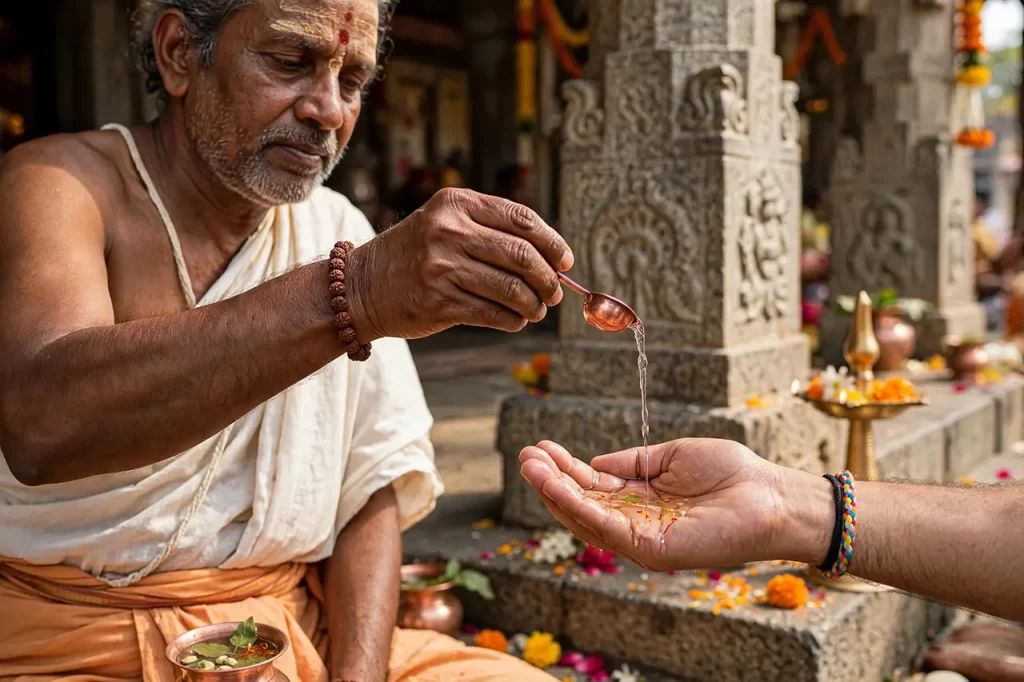
You sip the water quietly. It tastes cool, slightly metallic, and carries a faint scent of fresh Tulsi (holy basil) leaves or cardamom. Then, you gently wipe your damp palm over the crown of your head.
For millions of people visiting Hindu temples worldwide, this small act happens during almost every visit. Yet, many people leave the temple with natural questions:
- Why do temples give devotees this specific water?
- What does the word Charanamrit actually mean?
- Why is this water almost always kept in a copper pot or bowl rather than silver, brass, or clay?
- Is it true that copper makes the water healthy, or is that just a myth?
- Is it safe for everyone—including young children and pregnant women—to drink?
- What is the correct, respectful way to receive it?
This complete guide explains everything you need to know about consuming temple water. We explore the deep spiritual meaning found in Hindu tradition, look honestly at what modern science says about copper vessels, provide clear etiquette steps for your next temple visit, and address common questions about hygiene and safety.
What Is Charanamrit?
Quick Definition: Charanamrit (also written as Charanamrita) is sacred water offered to devotees in Hindu temples as a blessing (prasada). It is water that has been consecrated through ritual worship, often by bathing or touching the sacred feet (charana) of the deity, and is typically stored in a traditional copper vessel.
In daily temple life, Charanamrit is not viewed as regular drinking water meant to quench physical thirst. Devotees receive it in tiny quantities—usually half a teaspoon to a single tablespoon—as a sacred offering.
When you receive Charanamrit, you are accepting a physical reminder of the divine presence. Depending on the temple, the water may be pure spring water, water infused with fresh Tulsi (holy basil) leaves, or water scented with natural ingredients like edible camphor (pachha karpooram), saffron, or crushed cardamom pods.
Continue Reading >> Why Do We Touch the Feet of Elders? Charan Sparsh Meaning, Significance & Tradition
What Does the Word “Charanamrit” Mean?
To understand why this water is held in such high regard, it helps to break the Sanskrit word into its two root parts:
- Charana (चरण): This word means “feet,” specifically referring to the sacred feet of God, an avatar, or an enlightened spiritual teacher (guru).
- Amrita (अमृत): In Sanskrit, a- means “not” and mrita means “death.” Amrita translates literally to “that which does not die” or “nectar of immortality.” In Hindu thought, it refers to divine grace that frees the mind from spiritual ignorance and worldly suffering.
When these two words join, Charanamrit means “the sacred nectar coming from the feet of the Divine.”
You may see this word written in several ways depending on regional languages and transliteration styles:
- Charanamrita (closer to classical Sanskrit)
- Charanamrit (common in Hindi and across North India)
- Charan Amrit (written as two words)
- Padodaka or Pada Tirtha (the preferred terms in Kannada, Telugu, and parts of South India)
While the names vary across languages, the core meaning remains constant: it is water sanctified through connection with the deity.
Why Is Charanamrit Associated With the Deity’s Feet?
To someone unfamiliar with Indian culture, taking water connected with someone’s feet might sound unusual. In modern Western culture, feet are simply a physical body part associated with dirt and shoes.
In traditional Indian culture and Hindu philosophy, however, the feet carry an entirely different symbolic meaning.
1. The Ultimate Symbol of Humility
When you bow down before an elder, a teacher, or a deity, your head—the seat of human pride, ego, and intellectual arrogance—reaches down toward their feet. Bowing to the feet (Charan Sparsh or Pranama) represents laying down one’s personal ego. By drinking water sanctified at the deity’s feet, a devotee says: “I surrender my pride, my anger, and my worries at the feet of the Divine.”
2. The Universal Foundation
Just as a person stands firmly on their feet, the sacred feet of God (Vishnu Pada or Shiva Pada) are seen in Hindu philosophy as the steady resting place for the entire universe. In sacred literature, resting the mind at the deity’s lotus feet (Charan Kamala) means seeking refuge in eternal truth rather than temporary worldly troubles.
3. A Simple Comparison
Think of how a loving parent lifts a small child. The child does not look down on the parent’s feet; the child hugs the parent’s feet and legs knowing they are safe, supported, and protected. In the same way, receiving water associated with the deity’s feet is an expression of deep affection, safety, and spiritual protection.
Continue Reading >> The Meaning of Sattva, Rajas, and Tamas in Daily Hindu Living
Charanamrit, Tirtha, and Panchamrit: What Is the Difference?
Many temple visitors use the terms Charanamrit, Tirtha, and Panchamrit interchangeably. While they are all sacred offerings, they represent distinct preparations and serve different ritual roles.
Understanding the Terms
- Tirtha (or Teertha): The word Tirtha originally meant a sacred river ford, a crossing point, or a place of pilgrimage (like Varanasi or Haridwar). Over centuries, the word also came to describe any sanctified water used in temple worship. Strictly speaking, all Charanamrit is Tirtha, but not all Tirtha is Charanamrit. For example, water drawn directly from the sacred Ganga river is Tirtha, even before it is used in a specific temple ceremony.
- Charanamrit: This is specifically Tirtha water that has been used to wash the feet of the deity, poured over the sacred feet during worship, or sanctified directly before the deity’s altar.
- Panchamrit: The word Pancha means five, and Amrita means nectar. Panchamrit is not plain water. It is a traditional sweet mixture made from five natural ingredients: fresh cow’s milk, yogurt (curd), clarified butter (ghee), honey, and jaggery or sugar. It is used during the grand ritual bath (Abhisheka) of the deity and later distributed in small spoonfuls as a rich, sweet prasada.
- Abhisheka Jala: This refers to any liquid (water, rosewater, coconut water, or sugarcane juice) that has been poured over the consecrated murti (sacred form) of the deity during ritual bathing ceremonies.
Comparison Table: Understanding Sacred Temple Liquids
| Category | Charanamrit | Tirtha / Tirtha Jala | Panchamrit | Abhisheka Water |
| Primary Base | Pure water (often infused with Tulsi) | Clean water or holy river water | Dairy and natural sweeteners (No plain water) | Water, milk, or herbal decoctions |
| Typical Ingredients | Water, Tulsi, cardamom, edible camphor | Pure water, sometimes Ganga water or plain filtered water | Milk, curd, ghee, honey, and raw sugar | Water, raw milk, sandalwood paste, or coconut water |
| How It Is Prepared | Placed at or washed over the deity’s feet | Consecrated with Vedic mantras in a ritual pot | Mixed fresh for bathing ceremonies | Poured directly over the deity’s entire form |
| Vessel Commonly Used | Copper bowl or Panchapatra | Copper, brass, or silver Kalasha | Silver, brass, or stainless steel vessel | Brass, copper, or stone drainage channel (Gomukha) |
| Quantity Offered | A few drops (1/2 teaspoon) | A few drops | One small spoonful | A few drops |
| Taste Profile | Cool, herbal, slightly metallic | Neutral, fresh, or herbal | Sweet, rich, creamy | Varies (plain water or milk-like) |
Why Do Temples Serve Charanamrit in copper bowl?
If you observe temple rituals closely, you will notice that priests rarely serve daily Charanamrit from plastic jugs, glass cups, or iron containers. Instead, they use gleaming reddish-gold copper vessels.
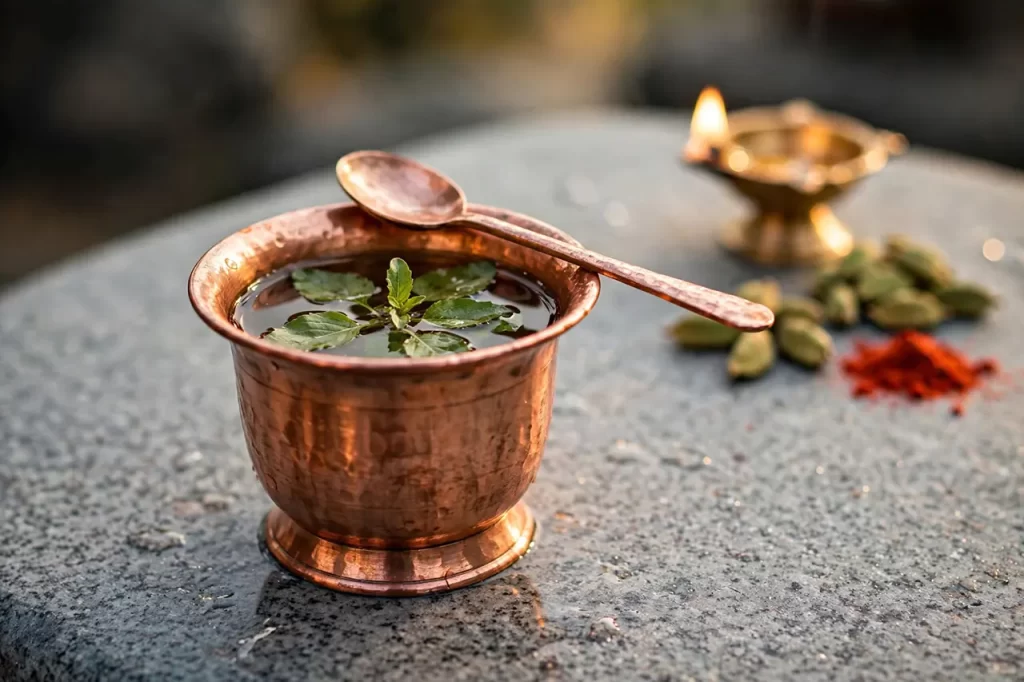
The two most common items used are:
- The Panchapatra: A small, gently tapered copper cup designed to hold ritual water.
- The Uddharini: A small, slender copper spoon with an open, shallow bowl used to ladle out drops of water.
Why did ancient Indian temple builders and ritual manuals specify copper? The answer spans two complementary perspectives: traditional ritual symbolism and the material science of copper.
Why Is Copper Used in Hindu Worship? (Traditional & Scriptural View)
In traditional Hindu metalwork and temple building manuals (Shilpa Shastras and Agama Shastras), metals are categorized by their ritual purity and spiritual resonance.
1. Ritual Purity (Shuddhi)
Traditional texts consider certain metals pure enough to hold offerings intended for the Divine. Gold and silver rank highest, but copper (Tamra) is regarded as the most practical, universally accessible, and ritually clean base metal for water offerings. Unlike iron or lead, which are considered ritually unsuitable for divine worship, copper is praised for holding and transmitting spiritual energy (sattvic vibrations).
2. Connection to the Sun (Surya)
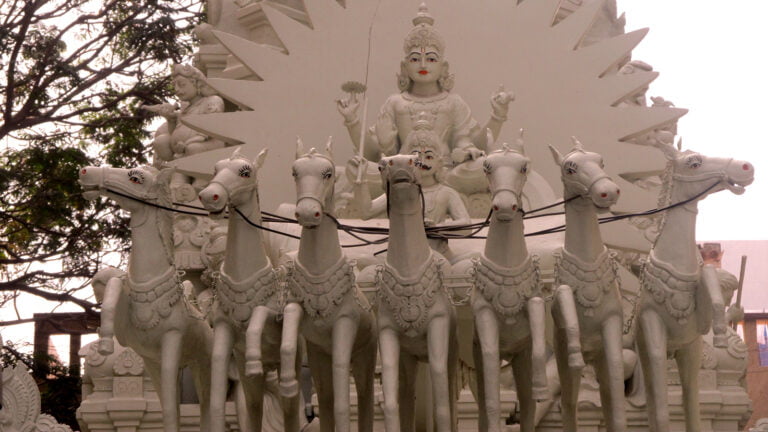
In Vedic astrology and sacred iconography, copper is the metal associated with Surya, the Sun god. The Sun represents light, vital life force (prana), clarity of vision, and the destruction of darkness. Storing sacred water in copper honors the life-giving warmth of the solar principle.
3. The Sacred Kalasha
Since ancient times, temple consecration ceremonies have used a copper pot called a Kalasha. Filled with fresh water, mango leaves, and a coconut, the copper Kalasha serves as a physical home for divine energy during prayer. The tradition of keeping temple water in copper flows directly from this ancient practice.


What Does Science Say About Copper Water?
While religious traditions value copper for spiritual purity, modern materials science and microbiology have investigated what actually happens when water sits inside a clean copper container.
To evaluate these findings responsibly, we must distinguish between real, laboratory-confirmed properties and exaggerated health claims found on internet blogs.
1. The Oligodynamic Effect (Antimicrobial Property)
Copper possesses a well-documented scientific property known as the oligodynamic effect.
When water is stored in a clean copper container, minute traces of copper dissolve into the liquid. These dissolved copper ions carry an electrical charge. When dangerous bacteria—such as Escherichia coli (E. coli), Salmonella, or Vibrio cholerae—come into contact with these ions, several things occur:
- The copper ions rupture the outer cell membrane of the bacterium.
- The ions disrupt the bacterium’s internal enzymes.
- The bacterium’s DNA is damaged, preventing it from multiplying.
- The bacterium dies.
World Health Organization (WHO) and public health studies in developing countries have shown that storing contaminated drinking water in clean copper vessels for 8 to 16 hours can significantly reduce viable bacterial counts.
2. Copper as an Essential Human Trace Mineral
Copper is not a poison when consumed in normal, tiny amounts; it is a micronutrient that your body requires every day. The human body uses trace amounts of copper to:
- Produce red blood cells (working alongside iron).
- Maintain healthy nerve cells.
- Synthesize collagen to support skin, bone, and connective tissue.
- Support the body’s natural antioxidant defense systems.
Since the human body cannot produce copper on its own, it must obtain small amounts from food (such as nuts, seeds, whole grains, and lentils) and drinking water.
3. Safe Limits and Copper Leaching
Water stored in a copper vessel absorbs very small amounts of copper over time. According to guidelines set by the World Health Organization (WHO) and the United States Environmental Protection Agency (EPA):
- The safe upper limit for copper in drinking water is 2.0 milligrams per liter (mg/L).
- When water is kept in a clean, non-acidic copper container for 8 to 12 hours, the copper content typically ranges between 0.05 mg/L and 0.20 mg/L—well below the safe global ceiling.
4. What Science Does NOT Say (Debunking the Hype)
It is equally important to be clear about what copper water cannot do:
- It does NOT cure cancer, diabetes, or arthritis. No credible peer-reviewed medical trial supports these claims.
- It does NOT instantly kill germs. The oligodynamic effect requires time—often 4 to 12 hours of contact with the copper surface. If a priest pours fresh tap water into a copper bowl ten seconds before giving it to you, the copper has had virtually no time to sanitize the water chemically.
- It does NOT replace standard medical care.
Continue Reading >> Navaratri Akhand Jyoti Rules & 9-Day Care: Complete Guide
Traditional Belief vs. Scientific Evidence
When exploring sacred traditions, it is helpful to look at religious beliefs and scientific observations side-by-side without confusing the two.
Comparison Table: Tradition vs. Science
| Aspect | What Hindu Tradition Teaches | What Scientific Research Demonstrates | Balanced, Practical Conclusion |
| Primary Purpose | Purification of inner sins, calming the mind, receiving divine grace. | Copper surfaces possess natural antibacterial properties; copper is an essential trace mineral. | Temple water is a spiritual offering. While copper surfaces naturally discourage bacterial growth, the main purpose of Charanamrit is devotional, not medical. |
| Water Purity | The sacred mantras and deity’s blessing make the water spiritually pure (pavitra). | Water safety depends on source cleanliness, contact time, water temperature, and hygiene. | Spiritual sanctity does not override the laws of biology. Temples must use clean, safe water sources. |
| Health Impact | Long-standing beliefs suggest it grants vitality, health, and peace of mind. | A tiny sip of water from a copper bowl provides a trace amount of minerals, but cannot cure diseases. | Consuming a few drops of clean copper water is harmless for most people and provides a mindful moment of reverence, but should never replace medical treatment. |
| Storage Time | Water kept overnight in temple sanctums is considered potent and sacred. | Water absorbs copper ions gradually over 8 to 16 hours. Storage beyond 24–48 hours can make water excessively bitter. | Overnight storage in clean copper is traditional and safe; storing water in uncleaned copper for many days is undesirable. |
How Is Charanamrit Prepared in Temples?
While recipes and rituals vary between regions and traditions, the daily preparation of Charanamrit in most major Hindu temples follows a clean and structured ritual process.

- Sourcing the Water: Traditionally, priests collected water at dawn from a dedicated temple well, a clean mountain stream, or a sacred river. In modern temples, clean municipal filtered water or reverse-osmosis (RO) purified water is standard.
- Cleaning the Utensils: Temple service rules require ritual utensils to be cleaned thoroughly each morning. Copper pots are scrubbed with natural cleaning agents like tamarind, lemon juice, or wood ash to remove dark copper oxide, leaving bright, fresh copper surfaces.
- Adding Natural Botanicals:
- In Vaishnava temples (dedicated to Lord Vishnu, Krishna, or Rama), fresh Tulsi leaves are essential. Tulsi adds a clean, refreshing aroma and contains natural polyphenols and essential oils like eugenol.
- In many South Indian temples, a tiny pinhead amount of edible camphor (pachha karpooram), saffron threads, or crushed cardamom pods is added, giving the water a cooling, distinctive taste.
- In Shaiva temples (dedicated to Lord Shiva), pure mountain water, Bilva (bael) leaves, and fragrant sandalwood water are commonly used during Abhishekam.
- Mantra Consecration: The water is consecrated during morning prayers by reciting ancient Vedic mantras—such as the Gayatri Mantra, the Purusha Sukta, or the Varuna Sukta. These prayers ask that the water carry life-affirming, peaceful energy for all who receive it.
How to Receive and Consume Charanamrit: A Step-by-Step Guide
If you are visiting a Hindu temple, knowing how to receive Charanamrit comfortably and respectfully helps you participate fully without hesitation.
Step 1: Approach the Priest Calmly
When the main prayer (Arati) concludes, form a quiet, orderly queue. Turn off your mobile phone, remove your shoes outside the hall, and approach the sanctum with a calm, focused mind.
Step 2: Form the Traditional Hand Posture
- Extend your right hand forward. In Hindu tradition, the right hand is used for giving, receiving, eating, and performing sacred rituals.
- Cup your right palm slightly to form a small bowl shape. In yoga and ritual texts, this gesture is known as the Gokarna Mudra (the hand shaped like a cow’s ear) or Brahmatirtha.
- Place your left hand beneath your right wrist or elbow. This supporting gesture demonstrates humility, care, and gratitude.
Step 3: Receive the Sacred Water
The priest will use the copper spoon (Uddharini) to gently pour a few drops of water into the center of your cupped right palm. Keep your fingers held tightly together so the water does not slip through your fingers onto the floor.
Step 4: Sip the Water Reverently
- Bring your cupped right hand toward your mouth.
- Sip the water quietly from the base of your palm or near the thumb.
- Do not make loud slurping sounds.
- Traditionally, devotees avoid touching their lips directly to their palm skin to maintain ritual purity (uchchishta / jhootha), but tipping your hand gently so the drops flow into your mouth is normal and practical.
Step 5: Touch the Remaining Moisture to Your Head
After sipping the water, a few drops of moisture will remain on your palm.
- Gently draw your right hand upward and touch your damp fingers to the top of your forehead or the crown of your head.
- What this means: In Hindu belief, the crown of the head (Brahmarandhra or Sahasrara) is the spiritual peak of the human body. Touching the remaining drops to your head symbolizes placing the deity’s blessings upon your thoughts and mind.
- What NOT to do: Do not wipe your wet hand on your trousers, shirt, or skirt. If you prefer not to touch your hair, simply let the moisture air-dry naturally.
Why Do Devotees Drink Only a Small Amount?
Many people wonder why the priest offers only half a teaspoon of water. Why not a full cup?

- It Is a Sacred Symbol, Not a Beverage: Charanamrit is a prasada—a symbolic token of divine favor. Just as you do not eat an entire meal at the altar, you do not drink temple water to quench physical thirst. A single drop carries the same spiritual significance as an entire vessel.
- Deep Respect for the Offering: In traditional ritual thought, sacred items must be handled with utmost care. Consuming a small quantity allows the devotee to focus on the moment mindfully, rather than treating the water like an ordinary drink.
- Hygiene and Shared Resources: A busy temple may welcome thousands of visitors every morning. Distributing small drops via an Uddharini ensures that everyone receives a portion without creating long queues or exhausting the day’s consecrated offering.
Safety, Hygiene, and Common Sense
While Charanamrit carries deep devotional value, practical cleanliness should never be ignored. Genuine spirituality and basic hygiene work hand in hand.
Is Temple Water Always Safe to Drink?
In most established, well-maintained temples, Charanamrit is entirely safe. Responsible priests prepare it fresh every morning using filtered, drinkable water and clean copper pots.
However, safety conditions can vary between locations. You should use common sense before drinking:
Understanding Green Copper Residue (Verdigris)
When copper is exposed to air, moisture, and acids over time, it naturally forms a greenish-blue layer called basic copper carbonate (often called verdigris).
- A light, dull copper color is normal.
- However, thick, crumbly green residue should never come into direct contact with drinking water. If acidic liquids (like curd or lemon) sit in an uncleaned copper pot with verdigris, they can dissolve toxic amounts of copper into the liquid, leading to stomach pain, nausea, and vomiting.
- Clean temples scrub their copper pots daily with lemon or tamarind to prevent verdigris from forming.
What Should You Do If You Are Unsure of the Water?
If you visit a remote temple or notice that the water looks cloudy or the surroundings appear unhygienic, you do not have to drink it.
Respectful Alternative: You can accept the drops in your right palm with complete devotion, bring your hand close to your heart in prayer, and touch the water gently to your hair or forehead without sipping it. In Hindu practice, touching a sacred offering with reverence is fully valid; you still receive the blessing without taking an unnecessary health risk.
Continue Reading >> Sacred Tulsi Plant at Home: Meaning, Worship, Placement & Care
Who Should Be Careful With Temple Water?
For healthy adults and older children, a few drops of temple water pose no health concern whatsoever. However, certain individuals should exercise sensible caution:
1. People With Wilson’s Disease
Wilson’s disease is a rare genetic disorder in which the human body cannot properly excrete copper. Over time, copper builds up in the liver, brain, and eyes, causing severe organ damage.
- Anyone diagnosed with Wilson’s disease or other copper-overload conditions must strictly avoid drinking water stored in copper vessels.
- Devotees with this condition should simply touch the drops to their head rather than sipping.
2. Infants and Very Young Children
Babies under one year of age have sensitive digestive systems and developing kidneys.
- Do not give unboiled temple water to newborn babies or infants under six months of age.
- For infants, a parent can touch a drop of the sacred water to the baby’s hair or forehead as a blessing.
3. Pregnant Women
A standard sip of fresh, clean temple water (half a teaspoon) is safe during pregnancy. However, pregnant women should avoid drinking unboiled water from unfamiliar or poorly maintained rural sources to protect against waterborne bacteria. When visiting smaller, remote shrines, touching the water to your hair is the safer, mindful choice.
4. Individuals With Compromised Immune Systems
People undergoing cancer chemotherapy, organ transplant recipients, or those with advanced immune disorders are vulnerable to common environmental waterborne bacteria. They should consume only thoroughly sterilized, boiled, or medically approved drinking water.
Can You Take Charanamrit Home?
Yes, many devotees carry a small vial of Charanamrit home from the temple to share with elderly family members, young children, or friends who were unable to visit the temple in person.
If you choose to bring temple water home, keep these practical guidelines in mind:
1. Use a Clean, Dedicated Container
Carry a small, clean stainless steel, glass, or food-safe brass vial. Wash and dry the container thoroughly before bringing it to the temple.
2. How Long Can It Be Stored?
- Water with fresh Tulsi or herbs: Best consumed within 24 hours. Fresh botanical leaves will break down, soften, and spoil if left in water at room temperature for several days.
- Plain consecrated water: Can be stored safely for 2 to 3 days in a clean, covered glass or stainless steel bottle in a cool place.
- Panchamrit (Dairy mixture): Because it contains fresh milk, yogurt, and honey, Panchamrit spoils quickly. It should be consumed within 4 to 6 hours, or refrigerated and finished within 24 hours.
3. Storing Charanamrit in Copper at Home
If you keep a copper lota or cup on your home altar (puja mandir):
- Do not store water in the same copper vessel for more than 24 hours without changing it.
- Scrub the inside of the copper vessel every few days with salt and tamarind or lemon juice to keep the surface bright and clean.
- Never store milk, yogurt, vinegar, fruit juices, or Panchamrit in copper utensils. Acidic substances react chemically with copper, creating harmful compounds.
4. Respectful Disposal
If stored temple water becomes stale, smells sour, or has been sitting for too long, do not pour it down the toilet or into a kitchen sink full of dirty dishes.
Instead, step outside and gently pour the water into the soil around a healthy, living plant—such as a Tulsi bush, a flowering garden plant, or the base of a tree. This ensures the sacred offering returns cleanly and respectfully to nature.
Charanamrit in Different Hindu Traditions
Hinduism encompasses a rich variety of regional customs, philosophical schools (sampradayas), and temple traditions. The way sacred water is prepared and named often reflects these regional traditions:

1. Vaishnava Traditions (Worship of Vishnu, Krishna, and Rama)
In Vaishnava temples—such as the famous Venkateswara Temple in Tirupati, the Jagannath Temple in Puri, or temples in Vrindavan—Charanamrit holds a central place.
- It is almost always called Charanamrita or Sripada Tirtha.
- It is directly associated with washing the lotus feet of Lord Vishnu or Lord Krishna.
- Fresh, fragrant Tulsi leaves are an absolute requirement. In Sri Vaishnava temples, the priest may also place a silver or copper crown stamped with the feet of the Lord (Satari or Sadari) gently on the devotee’s head after offering the water.
2. Shaiva Traditions (Worship of Lord Shiva)
In Shaiva temples, the central object of worship is usually the Shiva Lingam.
- The water is often called Shiva Tirtha, Rudra Tirtha, or simply Abhisheka Jala.
- It is collected after pouring gently over the Shiva Lingam while priests chant the Sri Rudram.
- Fragrant Bilva (bael) leaves and clean cooling water are commonly used, reflecting Shiva’s association with calm, meditative stillness and detachment.
3. South Indian Traditions (Padodaka / Tirtha)
Across Karnataka, Andhra Pradesh, Telangana, Tamil Nadu, and Kerala, the term Tirtha or Padodaka is frequently used.
- In the Dvaita tradition of Madhvacharya and the Lingayat tradition, Padodaka (water sanctified by the feet of the Divine or an enlightened Guru) holds deep spiritual significance.
- The water is served using a traditional Panchapatra and Uddharini, often accompanied by a fragrant touch of natural edible camphor.
Continue Reading >> What is Kamasutra in Hinduism
Is Charanamrit Mentioned in Hindu Scriptures?
Devotees often ask whether Charanamrit is a modern folk custom or an ancient, scripturally documented practice.
The practice of honoring sacred water, washing the feet of divine beings, and consuming water sanctified by prayer is documented throughout classical Hindu literature, spanning ancient Vedic hymns, classical Puranas, and regional devotion literature.
1. Vedic Reverence for Water (Apas)
The earliest layer of Hindu scripture, the Rigveda, contains beautiful hymns honoring water as a motherly, purifying force. The celebrated Apo-Sukta (Rigveda 10.9/ Taittiriya Samhita 7.4) prays:
“आपो हि ष्ठा मयोभुवः…”
“O Waters, you are the sources of happiness. Grant us vitality so that we may see great delight… Purify our minds and bodies.”
In the Vedic worldview, water was not treated merely as an inanimate chemical liquid (H2O), but as a living element capable of receiving and carrying sacred intent (sankalpa).
2. The Puranas and Pada Tirtha
In classical Puranas—such as the Bhagavata Purana, the Padma Purana, and the Vishnu Purana—there are repeated stories highlighting the sacredness of water connected to the feet of Lord Vishnu.
A famous example is the origin story of the sacred river Ganga. According to Puranic tradition, when Lord Vishnu in his Vamana avatar took his third cosmic step, his foot reached the edge of the universe. Lord Brahma bathed Vishnu’s lifted foot with celestial water, and that holy runoff became the river Ganga. For this reason, the Ganga is traditionally praised as Vishnu-Padi—“born from the foot of Vishnu.” Every time a devotee receives Charanamrit, they are symbolically participating in this timeless story.
3. The Agamas and Temple Manuals
The technical rules for temple worship—found in the Agama Shastras (such as the Pancharatra and Vaikhanasa Agamas for Vaishnava worship, and the Kamika Agama for Shaiva worship)—contain precise instructions on:
- Which metals can be used to hold water (prescribing copper, silver, and gold).
- How the Panchapatra and Uddharini must be washed each day.
- Which mantras must be recited when pouring water over the deity’s sacred form.
Common Myths vs. Facts About Charanamrit
To enjoy the full spiritual beauty of this practice without falling into superstition or health misunderstandings, let us separate common myths from verified facts.
1. Myth: Charanamrit can cure any chronic disease.
- The Fact: Charanamrit is a sacred spiritual offering, not a substitute for medical treatment. Drinking a teaspoon of temple water will not eliminate bacterial infections, heal fractured bones, or cure long-term illnesses like diabetes. Treat it with devotion, but visit a doctor for health concerns.
2. Myth: The water is literally collected from dirty walking feet.
- The Fact: In standard Hindu temple practice, the deity is a consecrated stone, metal (Panchaloha), or marble murti kept in an immaculate inner sanctum. The water is drawn fresh from clean sources, flavored with aromatic herbs like Tulsi and cardamom, poured over or placed at the altar of the sacred form, and distributed cleanly.
3. Myth: Copper kills all germs instantly.
- The Fact: Copper’s antibacterial properties (the oligodynamic effect) take several hours to work effectively. Water poured into a copper cup moments before distribution has not been chemically sterilized by the metal. Its safety depends on the temple using clean, drinkable water.
4. Myth: Charanamrit is the exact same thing as Panchamrit.
- The Fact: As explained earlier, Charanamrit is primarily water-based (often scented with Tulsi). Panchamrit is a thick, sweet preparation made of five dairy and sweet items: milk, curd, ghee, honey, and sugar.
5. Myth: More copper water is always better for your body.
- The Fact: Your body needs only tiny, micro-gram amounts of copper. Drinking excessive amounts of water that has been stored in uncleaned copper vessels for days can lead to copper toxicity, causing nausea, abdominal cramps, and digestive distress. Moderation and cleanliness are essential.
Continue Reading >> Why do we Ring Bells in Hindu Temples?
Practical Etiquette: Safe Practices at the Temple
To make your temple experience peaceful, respectful, and safe, keep this simple guide in mind:
Table: Safe Practice vs. What to Avoid
| What to Do (Respectful & Safe) | What to Avoid (Unsafe or Inconsiderate) |
| Hold out your right hand, cupped neatly, supported by your left hand. | Do not reach out with your left hand alone. |
| Keep your fingers close together so water does not drip onto the floor. | Do not let the sacred water splash onto the temple floor where people walk. |
| Sip the drops quietly and calmly. | Do not make loud slurping noises or demand a second large pour. |
| Touch the damp moisture gently to your hair or forehead. | Do not wipe your wet hands on your clothes, walls, or temple pillars. |
| Step aside quickly after receiving water to let the person behind you step forward. | Do not block the sanctum walkway or stand talking in front of the priest. |
| If the water appears visibly discolored or dirty, touch it to your hair with reverence instead of sipping it. | Do not create an argument at the altar; simply handle the situation with quiet discretion. |
Summary of Core Insights
When you visit a Hindu temple and receive Charanamrit from a copper bowl, you participate in an ancient, living tradition:
- A Sign of Humility: Charanamrit reminds us to lay down our ego, anger, and arrogance at the feet of the Divine.
- A Sacred Connection: The word connects Charana (sacred feet) with Amrita (nectar of spiritual liberation), offering a tangible moment of connection with God.
- The Wisdom of Copper: Traditional rituals chose copper because it is ritually pure and connected with solar energy. Modern science confirms that clean copper surfaces possess natural antibacterial properties, though this works slowly and cannot replace basic water sanitation.
- Mindful Balance: Clean, fresh temple water is a joy to receive. For healthy devotees, half a teaspoon is safe and meaningful. If you are ever unsure about water hygiene, touching the water reverently to your hair honors the tradition while keeping you safe.
Frequently Asked Questions (FAQs)
1. What is Charanamrit?
Charanamrit is sacred water offered to devotees in Hindu temples as a blessing (prasada). It is pure water that has been consecrated during ritual worship, often by being placed at or washed over the sacred feet of the deity, and is typically served in small amounts from a copper vessel.
2. What does the word “Charanamrit” mean in English?
The word comes from two Sanskrit roots: Charana (meaning “feet”) and Amrita (meaning “nectar of immortality”). Together, it translates to “the sacred nectar from the feet of the Divine.”
3. Why is Charanamrit served in a copper bowl?
In Hindu tradition, copper is considered one of the purest metals for divine worship and is associated with the life-giving energy of the Sun (Surya). From a scientific perspective, clean copper surfaces have natural antibacterial properties (the oligodynamic effect), which help discourage bacterial growth over time.
4. Is Charanamrit the same as Tirtha?
Not entirely. Tirtha is a broad term for any sanctified water used in Hindu worship, including water drawn from sacred rivers like the Ganga. Charanamrit is a specific type of Tirtha that has been placed at or washed over the sacred feet of the deity. All Charanamrit is Tirtha, but not all Tirtha is Charanamrit.
5. What is the difference between Charanamrit and Panchamrit?
Charanamrit is water-based, clear, and often infused with Tulsi leaves, cardamom, or edible camphor. Panchamrit is a rich, creamy mixture made without water from five specific ingredients: cow’s milk, curd (yogurt), ghee (clarified butter), honey, and sugar.
6. How should I hold my hands to receive Charanamrit?
Cup your right hand with fingers held tightly together to form a small bowl (Gokarna Mudra). Place your left hand beneath your right wrist or forearm as a traditional sign of humility, respect, and gratitude.
7. Why do devotees touch their wet hand to their head after drinking?
The crown of the head (Brahmarandhra) is considered the highest spiritual center in the human body. Devotees touch the remaining drops of sacred water to their head to symbolically place the blessings of the Divine upon their intellect, mind, and thoughts.
8. Why do priests give only a few drops of temple water?
Charanamrit is a sacred token of devotion (prasada), not an ordinary beverage meant to quench physical thirst. In Hindu philosophy, a single drop of consecrated water carries full spiritual significance. Offering a small amount also ensures that hundreds of visitors can receive it cleanly and efficiently.
9. Does drinking water from a copper bowl cure illnesses?
No. While copper is an essential mineral and has proven antibacterial surface properties, scientific research does not support claims that drinking small amounts of copper water cures chronic diseases like cancer, asthma, or diabetes. It should never replace medical treatment.
10. Can young children drink Charanamrit?
Older children can safely drink a few drops of clean, fresh temple water. However, infants under one year old—especially newborns under six months—should not drink unboiled temple water due to their sensitive digestive systems. Parents can simply touch a drop of the water to the baby’s forehead or hair.
11. Can pregnant women drink Charanamrit?
A small sip of fresh, clean temple water is safe during pregnancy. However, pregnant women should avoid unboiled water from remote, open, or unfamiliar sources. If there is any doubt about water sanitation, touching the water to your hair rather than drinking it is a safe and respectful alternative.
12. Can people with Wilson’s disease drink Charanamrit?
No. People diagnosed with Wilson’s disease have a genetic condition that prevents their bodies from clearing excess copper, leading to dangerous copper accumulation. They must strictly avoid drinking water from copper vessels and should simply touch the sacred water to their hair.
13. What should I do if the temple water looks cloudy or dirty?
Do not drink it. Receive the water in your cupped right palm with reverence, bring your hand close to your heart in prayer, and touch the moisture gently to the crown of your head. This fully respects the sacred offering without taking an unnecessary health risk.
14. What are the green patches that sometimes appear on copper bowls?
Greenish-blue residue on copper is called verdigris (basic copper carbonate). It forms when copper reacts with moisture and oxygen over time. While harmless on dry surfaces, it should never contact drinking water. Temples prevent this by scrubbing copper vessels daily with lemon or tamarind.
15. Can I take Charanamrit home from the temple?
Yes. Many devotees carry a small vial of temple water home for family members who could not attend. Use a clean stainless steel or glass bottle, keep it covered in a cool place, and consume it within 24 to 48 hours.
16. Can I store Charanamrit in a copper vessel at home?
You can store plain water in a clean copper pot at home for 8 to 16 hours. However, do not leave the same water in copper for days, as it will taste unpleasantly metallic. Never store Panchamrit, milk, yogurt, or acidic juices in copper, as they react chemically to produce toxic compounds.
17. How should I dispose of Charanamrit if it is no longer fresh?
Never pour sacred water down the drain, sink, or toilet. Pour it gently into the soil around a living plant or tree—such as a Tulsi bush or garden flower—returning the sacred offering respectfully to nature.
18. Why do Vaishnava temples put Tulsi leaves in Charanamrit?
Tulsi (holy basil) is deeply sacred to Lord Vishnu and his avatars (Rama and Krishna). Along with its spiritual symbolism of devotion and purity, Tulsi imparts a clean, pleasant aroma to the water and contains natural botanical compounds like eugenol.
19. What is Charanamrit called in South Indian temples?
In South Indian temples, it is often called Tirtha, Theertham, or Padodaka (in Kannada and Telugu). In Sri Vaishnava temples, it is known as Sripada Tirtha.
20. Is Charanamrit mentioned in ancient Hindu scriptures?
Yes. Reverence for sanctified water (Apas) is documented in the Rigveda. The specific practice of honoring water associated with Lord Vishnu’s feet is described across the Puranas (such as the Bhagavata and Padma Puranas), while temple manuals (Agamas) specify the exact use of copper vessels like the Panchapatra.