Shreenathji Nathdwara Temple
Shreenathji Nathdwara Temple – Tucked away amidst the beautiful and majestic landscape of the Aravalli range, lying within the historic city of Nathdwara (Rajsamand district, Rajasthan, approximately 48 kilometers northeast of Udaipur), this divine shrine goes beyond being merely a structure built out of stone. This temple is alive – breathing the air of devotion. It is the Haveli (palace) of the precious child-god of millions of people across the world.
If you are an ardent devotee looking for ultimate moksha, an archeologist interested in exploring the history behind the miraculous escape of gods in India, or simply a tourist hoping to immerse yourself in the pure and unadulterated energy of Indian Bhakti, this all-encompassing guide will make sure that you are well prepared for your visit to this unique destination.
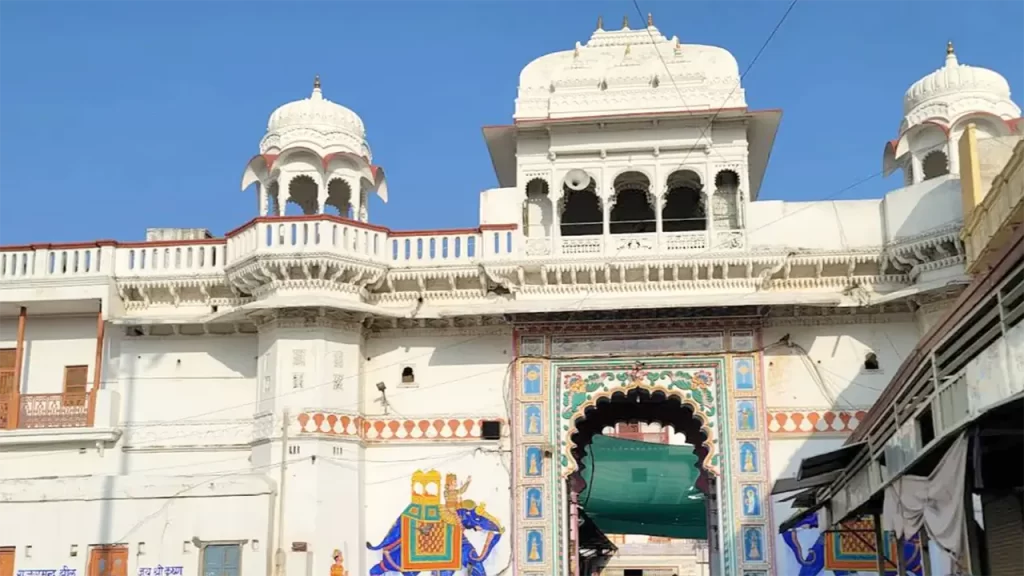
The Shreenathji Nathdwara Temple is among the most revered and wealthy places of worship of Lord Krishna in India. In contrast to other Hindu temples with high stone towers (shikharas) and impressive monumental gates (gopurams), the Shreenathji Nathdwara Temple was designed in the form of a fort-like Haveli.
The reason for such design lies in the following: the devotees of the Pushtimarg (the Way of Divine Grace) consider their Lord not an unapproachable and remote God, who dwells in the stone sculpture, but a seven-year-old little child called Shreenathji. As a result, He does not reside in a temple, but rather in a family home—the Shrinathji ki Haveli—with a dining room, drawing room, barns, and a treasury.
Significance and Uniqueness
What sets this temple apart from all other places of worship in the world is the entire routine followed there. Everything revolves around the timings, moods, and comfort level of a little boy aged about seven years old. The inner chamber door is opened and closed eight times a day in short bursts referred to as “Jhankis” (glimpses).
The architecture of the temple works in the manner of an independent ecological system. The roof of the Haveli has a tile clearing on which a majestic Sudarshan Chakra (divine discus of Vishnu) and seven different types of flags stand. On a spiritual basis, this place is considered to be the nucleus of the Vallabh Sampradaya, with pilgrims coming from all over the world to partake in a form of worship in which the God is worshiped not out of fear but love (Vatsalya & Sakhya Bhava).
Target Audience
Three categories of people will find this holy place resonating with them:
- The Pilgrims: Vaishnavites, more specifically those hailing from Gujarat, Rajasthan, and Maharashtra, who consider seeing the deity at the time of Rajbhog or Mangala the pinnacle of their spiritual life.
- The History Enthusiasts: People who have a keen interest in the survival of Indian heritage during tumultuous times politically, in particular, the migration of the deity from the Mughal domain to Mewar.
- The Cultural and Art lovers: Visitors who come to enjoy the world-renowned Pichhwai paintings, Maniaro music, and the exceptional food dishes created every day in the most precise temple kitchen in the world.
Nathdwara Temple History
Legends and Founding Stories
The origin of the sacred deity residing in the Shreenathji Nathdwara Temple goes way back to the mysterious region of Braj (Vrindavan & Mathura). As per ancient and divine legends, the God Himself was called Swayambhu, meaning self-manifested. It is believed that in the late 14th century, one arm miraculously appeared out of the rocks of the revered Govardhan Hill in Mathura.
Years later, on the very day when the celebrated mystic Shri Vallabhacharya was born in 1479 CE, the face of the deity came out of the rock. At first, the people of the region worshipped the deity as Devdaman (literally, tamer of Gods – referring to Krishna’s conquest of Lord Indra). However, Shri Vallabhacharya set up the worship of the deity on the hilltop Govardhan, and He was henceforth called Gopalji. His illustrious son, Shri Vitthalnathji, fondly addressed Him as Shreenathji.
The Great Migration to Mewar
Perhaps the most exciting period in this story took place during the 17th century. When the reign of Mughal emperor Aurangzeb led to iconoclastic movements against the ancient temples of the Braj area, it was the Goswamis who decided to move their deity from Govardhan Hill in 1669 CE, for the sake of protecting their Lord.
For almost three years, the journey of the deity had taken place using a secret wooden chariot moving through the river Yamuna, hiding for months at a time at such places as Agra. The priests searched in vain for protection in different states, but many kings did not want to anger the mighty Mughal emperor.
At last, one great king stood firm against all odds – the pious and valorous Maharana Raj Singh of Mewar. He promised to behead one hundred thousand Rajput soldiers rather than letting anyone lay even one finger on the Lord.
During the year 1672 CE, the sacred chariot was passing through Sinhad in Mewar. The heavy wooden wheels suddenly sank in the thick mud and would not budge any further; the bullocks would not pull the chariot anymore. It was then realized by the priest in charge that this particular location was destined to be the permanent abode of Shreenathji, the God himself. The village of Sinhad was henceforth renamed to Nathdwara which means ‘Gateway to the Lord.’
Read More>> Banke Bihari Temple, Vrindavan
Association with Dynasties and Saints
Shreenathji Nathdwara Temple’s history is deeply linked with the ruling royal family of Mewar, Udaipur. The maharanas considered themselves to be the guardians of the land politically, whereas Shreenathji was considered to be the real king of Mewar. Over generations, they presented their kingship to the temple and bestowed upon the Haveli enormous amounts of land, diamonds and gold coins.
There were several threats posed by invading armies to the temple throughout the ages, ranging from Maratha Holkar and Pindari raids. However, the zeal of the local Rajputs never allowed anything bad to happen to the sanctum sanctorum. The line of purohits who are the descendants of Shri Vallabhacharya have been doing the ritualistic rites for five hundred years now without any break.
Religious and Cultural Significance
Deity Worshipped
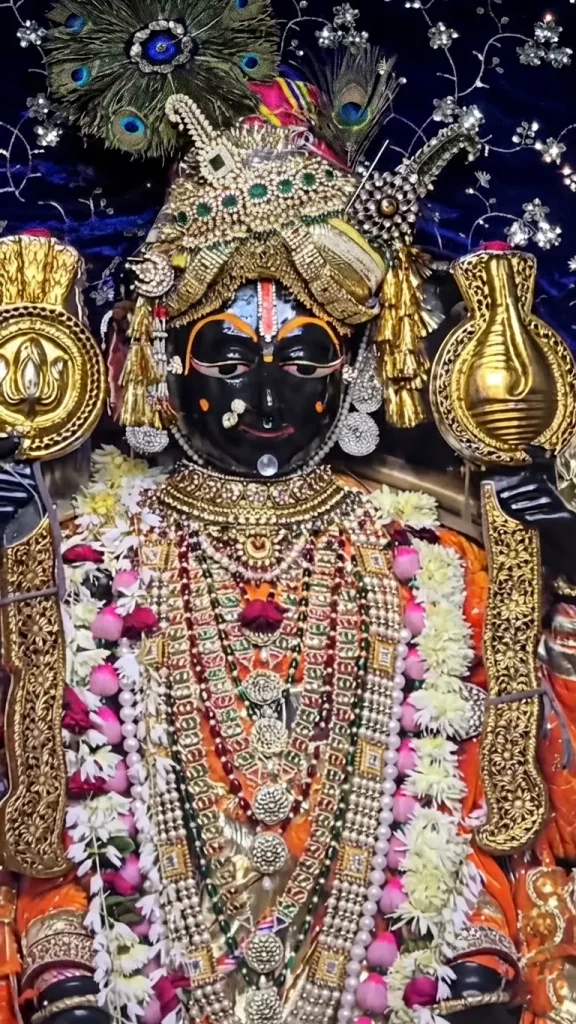
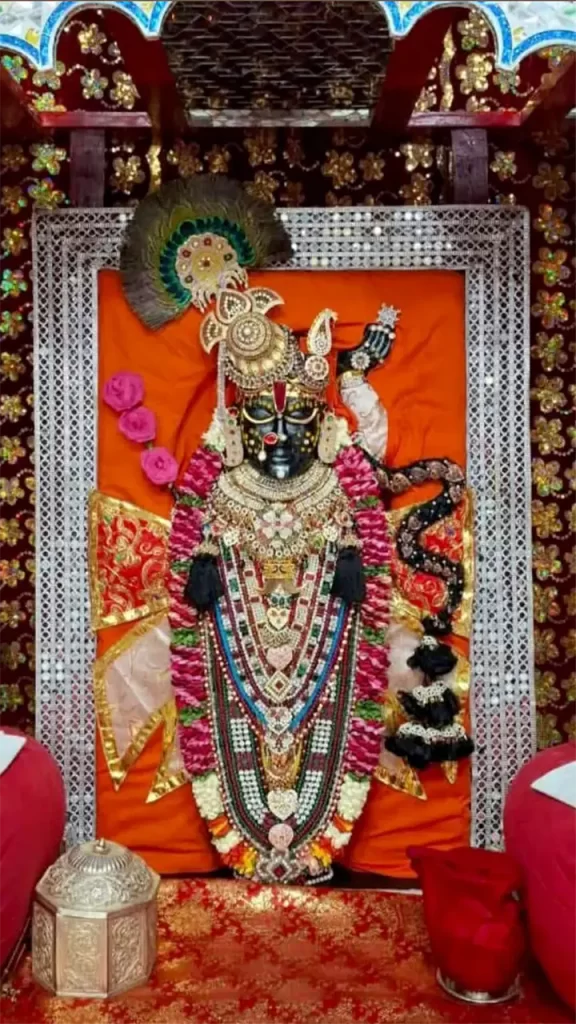
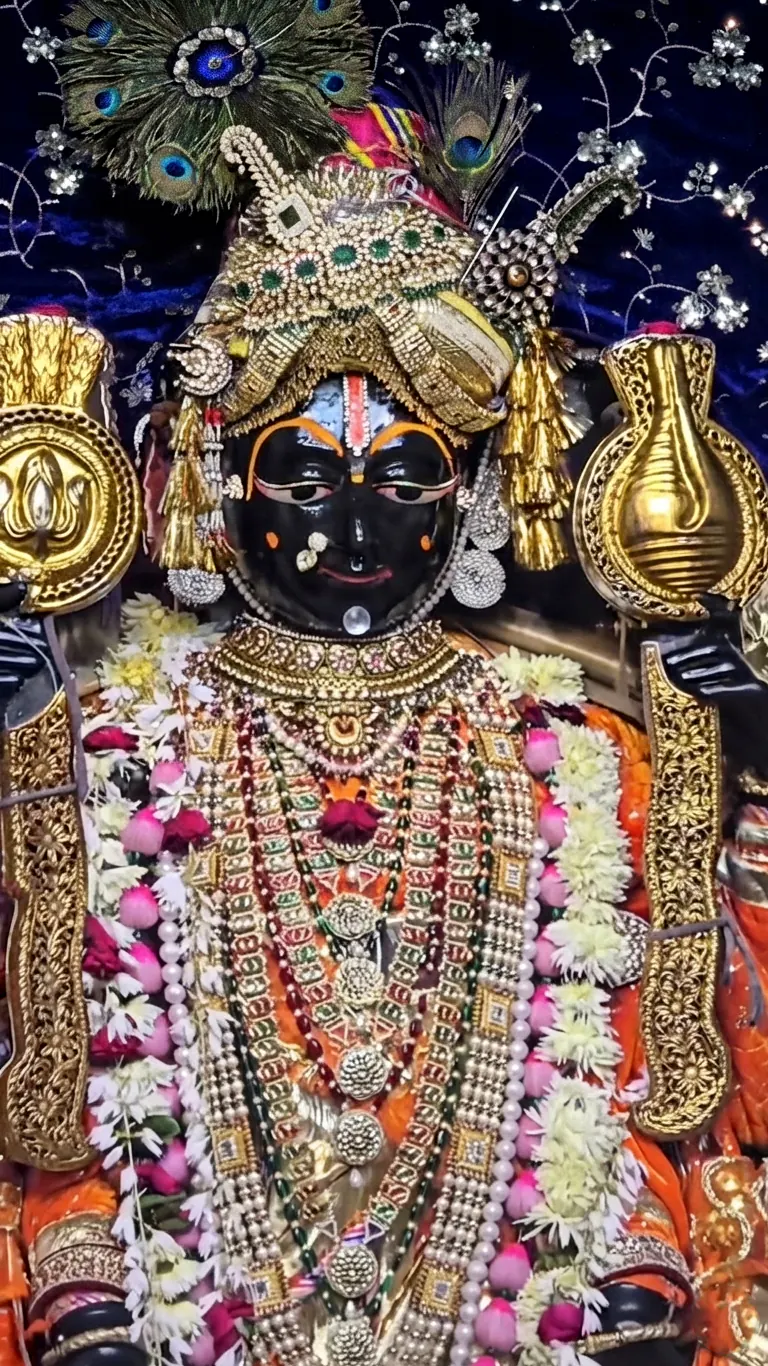
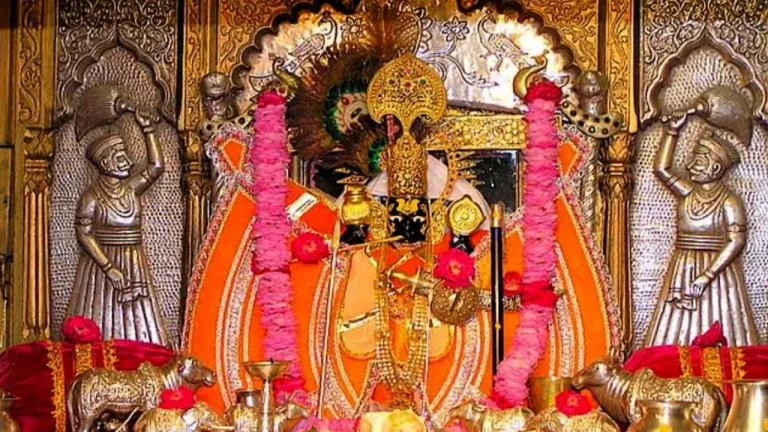
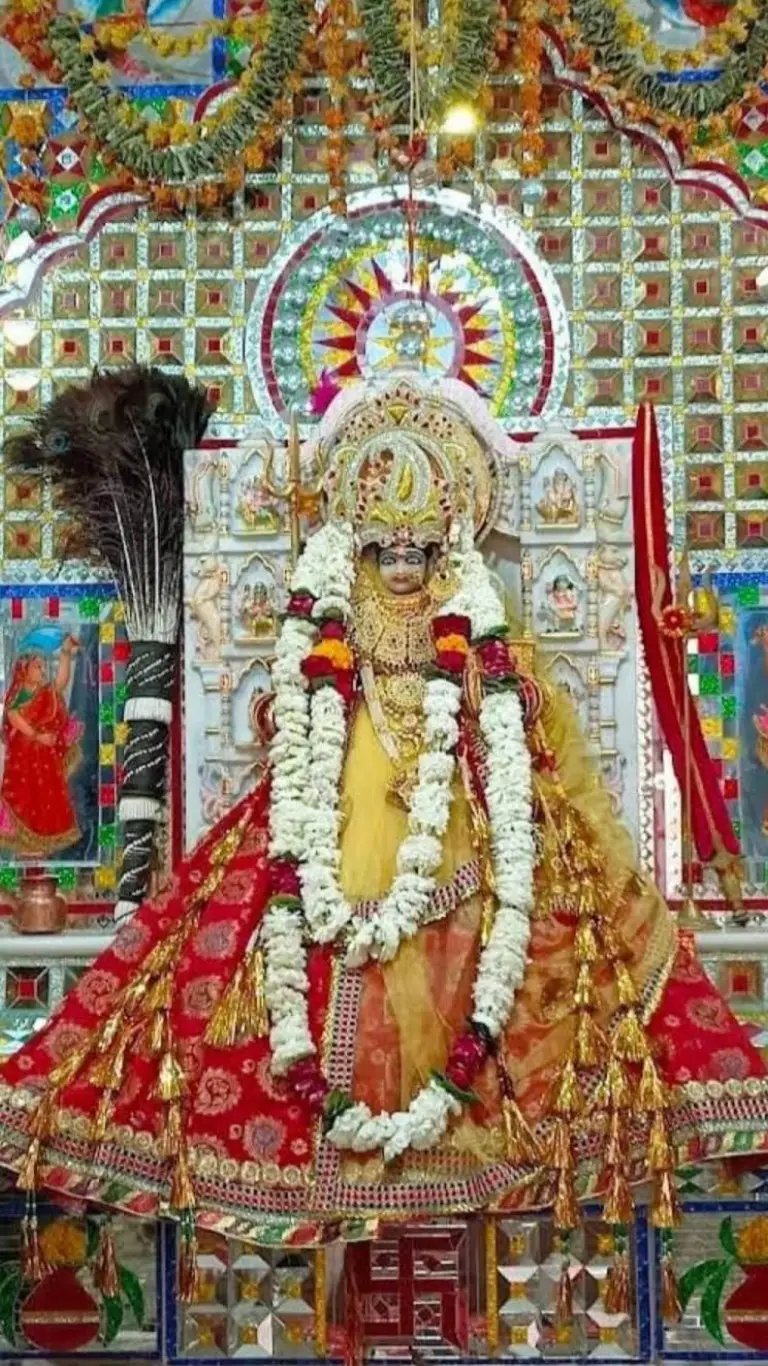
Lord Krishna is worshiped in the temple of Shreenathji Nathdwara. The god is sculptured in the form of a massive block of single black marble, depicting an eternal moment from his childhood. At seven years old, he lifts up the huge mountain of Govardhan to protect his innocent followers, both human beings and cattle, from the terrible rains created by the furious Indra.
His right hand is made into a loosely curled fist that lies gently on his waist. Both eyes are downcast, reflecting profound tranquility and motherhood along with childish mischief. Underneath his lower lip, there shines a huge diamond which, according to legends, is gifted by one of his true devotees.
Religious Importance in Scriptures and Mythology
For proof of the ancient spiritual power of this god, we need to examine the traditional texts of Hinduism. The incarnation of Krishna lifting the mountain is the emotional crux of the Bhagavata Purana, specifically the 10th canto. In addition, the Garga Samhita extols this particular incarnation within its Giriraja-Khanda section:
Giri-rajo guhā-gehe devatā-darśanaṁ param,
tatraiva tiṣṭhati śrīmān devadamana-rūpa-dhṛk.
Translation: “Residing in the holy caves of the King of Mountains (Govardhan) is the divine Supreme Being called Devadaman (Shreenathji), who upon being beheld awards the devotee his final fruit.”
From the Shuddhadvaita theology propounded by Vallabhacharya, Shreenathji is not simply an incarnation but rather Purna Purushottam—absolute reality made tangible for humans to worship, caress, and feed.
Festivals and Cultural Impact
The influence of the cultural legacy of Shreenathji Nathdwara Temple is reflected in the art history of Western India. The renowned Pichhwai painting, which comprises complex hand-painted paintings on cloths that include scenes such as lotuses, cow herds, and moonlit nights, was created solely for the purpose of being used as a backdrop for the deity.
The classical music of the temple, Haveli Sangeet, has kept alive centuries-old compositions made by the Ashta-Chhap (eight founder saint-poets), including the well-known poet who was blind, Surdas. The life and culture of Nathdwara revolve around the temple every single day.
Architecture and Design
Architectural Style: The Haveli Framework
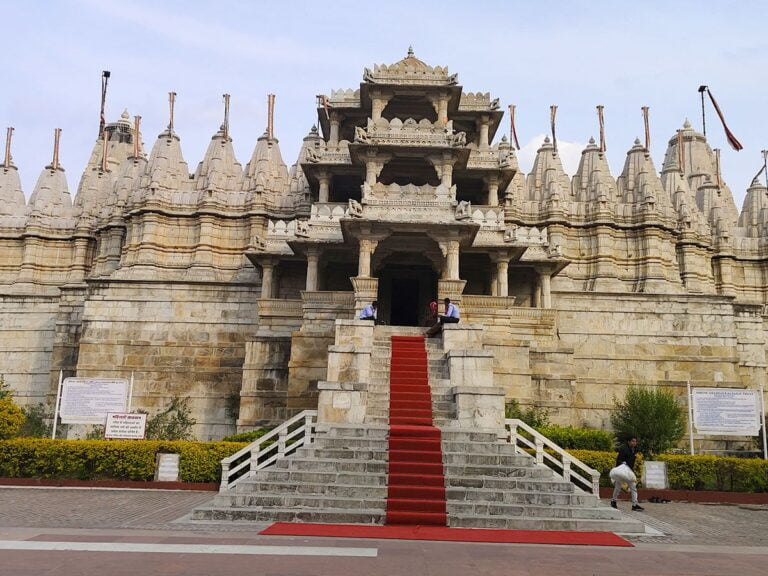
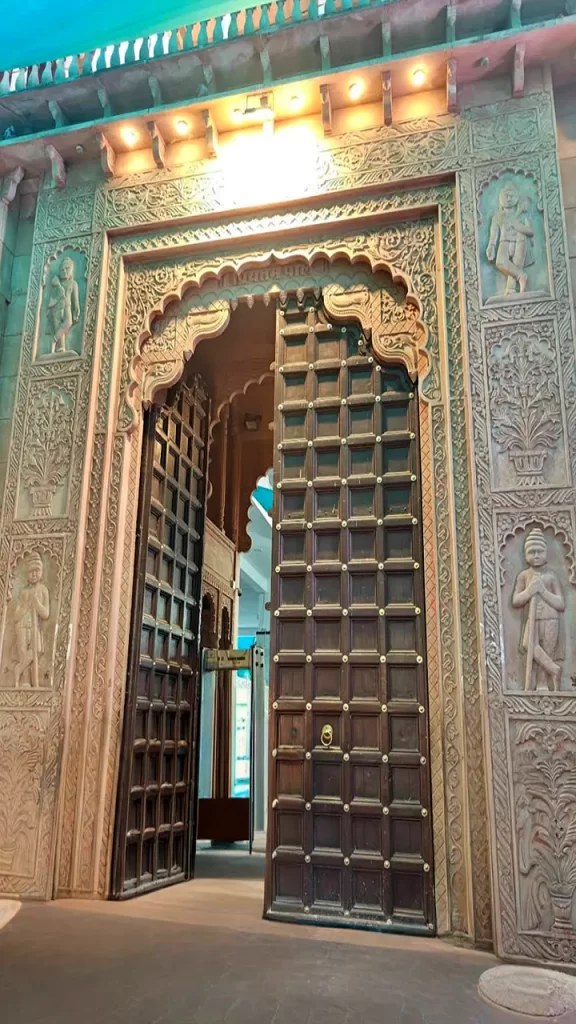
The Shreenathji Nathdwara Temple will be a shock to you if you expect a North Indian Nagara style temple with its high stone spire or the South Indian Dravidian temple with its enormous Gopuram. This temple was intentionally built in the architectural style of the Mewari Haveli and Palace style.
This approach had a very practical reason: in the turbulent century of the 17th, the building had to have a simple exterior, as if it were an ordinary palace of some nobleman, in order not to be noticed by iconoclastic troops. Later this became spiritual doctrine. The design resembles the house of Nanda Baba (father-in-law of Krishna) from Mahavan.
Notable Features and Layout
Temple complex comprises a vast maze of courtyards, halls, and other dedicated rooms. Let us understand its anatomy step-by-step:
- The Roof with Seven Flags: Instead of the typical shikhara style, the temple roof is covered with a simple sloping palace-style roof. Perched on top of the roof is the huge, golden plinth Sudarshan Chakra surrounded by seven sacred flags. This seven-flag system symbolizes the seven families or houses of Vallabhacharya that preached the path of love throughout the land of India.
- The Courtyards (Chauks): These include vast open-to-air courtyards like the Ratan Chauk (Jewel Courtyard) and Kamal Chauk (Lotus Courtyard). Both these courtyards have pure white marble floors which remain cool despite scorching Rajasthan heat, enabling hundreds of devotees to wait in comfort until the entrance doors spring open in celebration.
- The Specialized Rooms: Keeping true to the spirit of a royal residence, the temple has dedicated rooms such as Phool Ghar (Flowery Room for making floral garlands), Rasoighar (gigantic kitchen), Tambol Ghar (Room of Betel leaves), and Shish Mahal (Palace of Mirrors).
Materials and Construction Techniques
The structure is made from a resilient mixture of local granite, white marble extracted from the Makrana mines, and plaster using chuna – an old-fashioned material that allows the thick walls of the palace to breathe while keeping them cool in the intense summer heat. These walls feature magnificent fresco paintings made using lime, depicting stories of the Ras Leela (the divine dance of love) and herds of ornately painted cows.
Main Attractions or Highlights
The Sanctum Sanctorum (Garbhagriha)
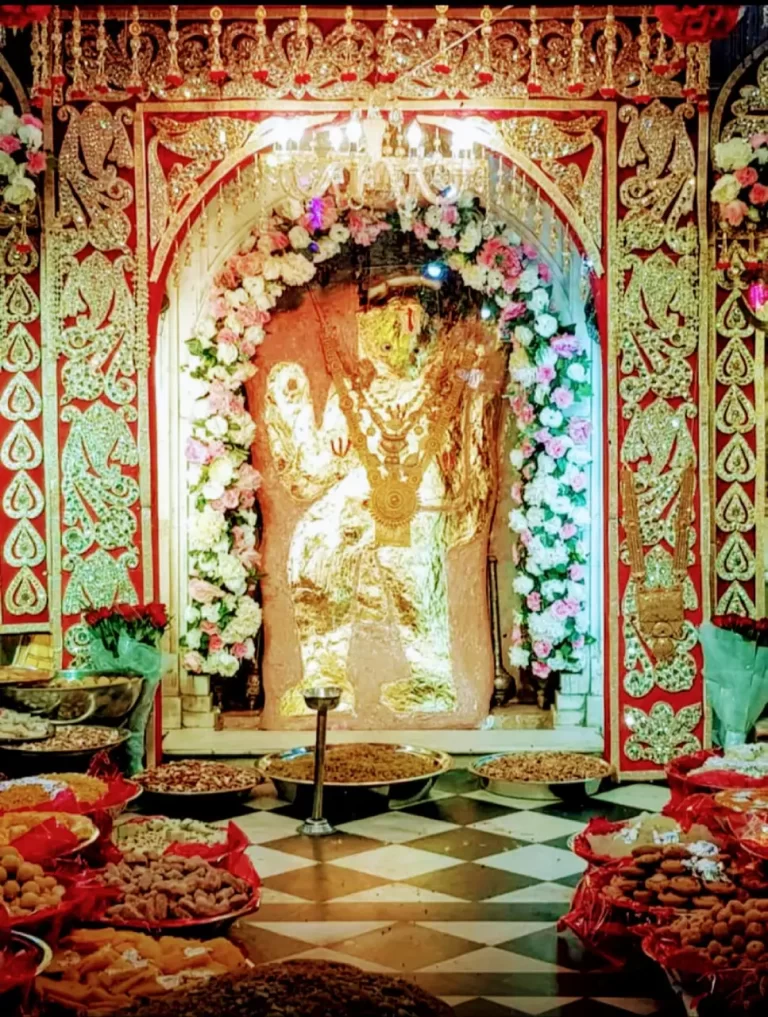
The spiritual soul of the temple complex, however, lies in the Garbhagriha. In this section, the monolith idol stands before a massive stone slab. The slab itself is a fine example of relief sculpture, which includes figures like two cows, a roaring lion, a snake coiled, two graceful peacocks, and a parrot.
The lighting of this chamber remains soft and delicate, being provided only by the light of pure ghee lamps that are golden. The result is that there is an aura of mysticism in the place because the black marble idol takes on different expressions based on the viewing angle.
The Sacred Kitchen (Rasoighar)
This temple cannot be properly comprehended without knowing about the legendary kitchen which serves as the ultimate source of spirituality. Here, cooking is not perceived as something mundane but rather the utmost form of selfless service known as Seva.
The water which is used for cooking is specially transported from the sacred river of Yamuna using the special channels. Silver and gold utensils are used to cook hundreds of kilograms of delicacies like milk sweets, Puri (Indian bread), and complicated vegetables. The hygiene here matches that of the contemporary surgical operation rooms.
The Temple Tank And Other Nearby Shrines
Right next to the mansion there can be found the sacred Lal Baug and stepwells. Around the main shrine, there are other shrines of smaller size dedicated to other gods who belong to the family of Vallabh including Navnit Priyaji (the beautiful metal image of baby Krishna carrying a ball of butter).
Nathdwara Temple Timings and Rituals
Ashta Darshan SystemNext, we come to know about the real heart of this temple experience. The Shreenathji Nathdwara Temple is run in an absolute beautiful sequence of Eight Daily Jhankis (Darshans). As a tourist, you have to keep in mind that the doors will not remain open the whole day. It opens for 20 to 45 minutes at eight particular intervals.
These are particular times which are associated with different periods in the daily life of young Krishna. See the interesting chart below:
1. Mangala Darshan: The Divine Morning Awakening
- Estimated Timing: 5:15 AM – 6:00 AM
- Spiritual Significance and Ceremony: As the first darshan of the day, Mangala stands for The Awakening. This ceremony is an opportunity for devotees to witness how the child-lord wakes up from His slumber. Ceremonies are easily modified depending on the seasons; in case of cold winters, the idol of Shreenathji is warmly covered in blankets and only his face is left uncovered. Warm and soothing foods like hot milk, jaggery preparations, and popped rice are offered in order to appease His morning hunger.
2. Shringar Darshan: The Divine Dressing
- Estimated Timing: 7:15 AM – 7:45 AM
- Spiritual Significance and Ceremony: Also called The Adornment, this ceremony depicts the way that the god is taken care of by the High Priest. Shreenathji is properly bathed and adorned in elaborate outfits. One particular highlight of this process is when a mirror is placed in front of Him so that he could admire himself. The significance of time is reflected here as well since His attire along with His heavy jewelry changes completely everyday, determined strictly by calendars and astronomy.
3. Gwal Darshan: The Mid-Morning Herding
- Time of Occurrence: Approximately 9:15 AM – 9:45 AM
- Spiritual Significance and Ceremony Involved: The Gwal darshan represents The Mid-Morning Herding ceremony, which reminds us of those wonderful moments of childhood when little Krishna used to take His father’s cows for grazing in the green pastures. The atmosphere is happy and cheerful with priests distributing exquisite offerings like luscious milk products and kheer. Priests add an intensely personal dimension to the ritual by singing out the names of Lord’s favorite cows during the Gwal darshan.
Read More>> Vidyashankara Temple Sringeri 12 Pillars Reveal Your Destiny
4. Rajbhog Darshan: The Grand Royal Feast
- Time of Occurrence: Approximately 11:15 AM – 12:05 PM
- Spiritual Significance and Ceremony Involved: Rajbhog is considered as the most grand and majestic darshan of the entire day. This darshan marks The Royal Feast where Lord Shreenathji is dressed up in his regal splendor invoking awe in the hearts of pilgrims. A magnificent multi-cuisine royal lunch feast is offered to the deity. The most remarkable feature about the Rajbhog darshan for pilgrims is to witness the humongous mound of Prasad with the burning of incense sticks nearby.
5. Utthapan Darshan: The Afternoon Awakening
- Time Duration: 3:30 PM – 4:00 PM
- Spiritual Significance and Rites: Post an extensive and quiet sleep that was given to protect the child-lord from the harsh rays of the afternoon sun, The Afternoon Awakening ceremony occurs. The gentle mood is set as Shreenathji is woken up. Cool milk products along with fresh fruits are offered as snacks to awaken the sleeping deity from His slumber.
6. Bhog Darshan: The Peaceful Evening Snack
- Time Duration: 4:45 PM – 5:15 PM
- Spiritual Significance and Rites: The Bhog darshan marks The Evening Snack session of the day. In this ritual, the environment inside the sanctum becomes calm and serene. The deity receives exquisite delicacies accompanied by bright floral arrangements. To make the setting more peaceful, soul-rousing devotional music called Kirtans is played using the traditional stringed musical instruments.
7. Sandhya Aarti: The Protective Twilight Ceremony
- Time Required: 5:15 PM – 6:00 PM
- Spiritual Significance and Rituals: Paying tribute to The Twilight Ceremony, the Darshan highlights the touching scene when Krishna comes back home from the dry fields with His cows. Symbolically portraying the maternal care of Mother Yashoda, this ritual depicts her concernedly cleaning up all evil by waving a beautifully crafted golden oil lamp called an aarti. Vibrations that emanate in the temple premises during this particular ceremony are especially spiritually powerful.
8. Shayan Darshan: The Gentle Bedtime Retreat
- Time Required: 6:45 PM – 7:30 PM
- Spiritual Significance and Rituals: This Darshan marks the last public ceremony in the daily routine, representing The Bedtime Retreat. The temple air becomes incredibly silent. Soft lullabies are sung for the child-god who falls asleep. In addition, a traditional checkerboard called Chopat is placed inside the sanctum sanctorum in case of playing at night. When His soft bed is ready, the temple gates are closed till dawn comes the following day.
Dress Code and Protocol
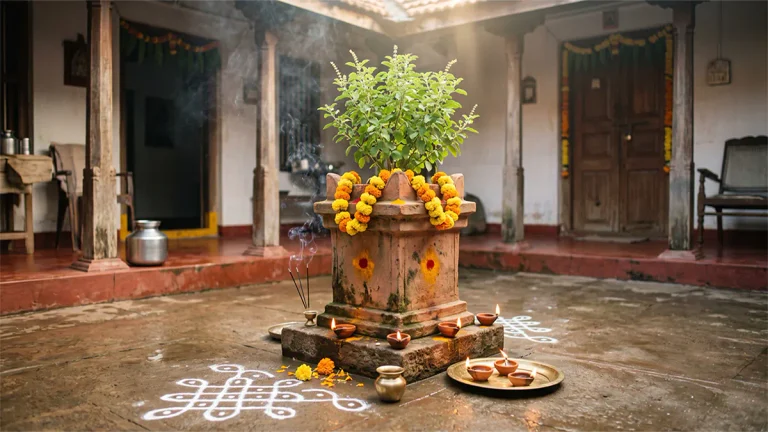
In order to keep up the sanctity of the spiritual energy at the Haveli, it is important that one adheres to traditional rules regarding dressing. Ideally, for men, one should wear traditional clothes, such as the Dhoti-Kurta or Kurta-Pyjama; however, it is acceptable for them to wear simple, formal pants and shirts as well. Ladies would ideally wear a saree or Salwar Kameez. Sleeveless tops, mini skirts, or torn jeans would not be allowed.

Festivals and Events
Important Festivals of Each Year
Even though each day at the Shreenathji Nathdwara Temple has the air of a royal wedding, there are some particular festivals that witness an influx of lakhs of people from all across India.
Krishna Janmashtami (August/September)
This is the most electrifying celebration that takes place during the birth of the Lord. The whole Nathdwara township glows under the light of countless tiny lights called fairy lights. Just at the dead of night, 21 cannons are fired as a mark of celebration, followed by a ritual holy bath for the deity while lakhs of devotees sing out “Hathi Ghoda Palki, Jai Kanhaiya Lal Ki!”
Annakut and Govardhan Puja (October/November)
This festival comes up the very next day after Diwali and is considered one of the most famous events in Nathdwara. Thousands of kilograms of fresh rice are piled up in the shape of a hill in the main courtyard of the temple, surrounded by hundreds of delicacies known as Chappan Bhog.
The most amazing feature about this festival is the tribal looting of rice done safely through centuries-long rights accorded to the local Bhil tribe community of Nathdwara.
Holi and Phool Phag (March)
This festival offers one of the most unique and beautiful celebrations at Nathdwara. While the temple does not use the conventional chemical dyes, it opts for the fragrant organic powders that are made from saffron, crushed marigold petals, and real rose water. On the Phool Phag day, a profusion of flower petals is showered onto the idol, providing an amazing visual feast.
The Ideal Days to Avoid Large Crowds
Those looking for an opportunity to spend their time contemplating and praying in solitude should opt for the period between October and March, when the temperature drops considerably in Rajasthan (from 12°C to 25°C). As a result, long queues become very easy to cope with.
Try to visit the shrine on Tuesdays and Wednesdays since the weekends are crowded with pilgrims who come from Gujarat and Ahmedabad.
A Warning for High-Traffic Days
In the periods of Janmashtami, Diwali, and Adhik Maas (a holy month), the number of visitors per day will reach 100,000. When visiting during such peak seasons, be prepared to wait long lines in the yards of the temple, as well as crush the crowds inside its inner courtyards.
Read More >> 15 Best Places to Visit in Odisha
Practical Traveler Information
How to Reach Nathdwara
Getting to the Shreenathji Nathdwara Temple is fairly easy considering how close it is to all the transport points in Rajasthan.
By Air: The closest airport is the Maharana Pratap Airport at Udaipur, which lies at a distance of 60 kilometers. It receives multiple daily flights from New Delhi, Mumbai, Hyderabad, and Jaipur. You can hire a good private prepaid taxi from the airport and get to Nathdwara in one and a half hours.
By Rail: The main railway station is the Udaipur City Railway Station that lies at a distance of 48 kilometers and connects to almost all the long-distance trains from anywhere in India. The other nearby railway station is the Mavli Junction, which lies at a distance of 28 kilometers but not many express trains stop here.
By Road: Nathdwara is strategically located just beside the major National Highway NH-48, a multi-lane highway with great paving. Luxury Volvo AC sleeper buses run daily between all the main nearby locations including Ahmedabad (300 kilometers), Surat, Jaipur, and Indore.
Entry Fee & Darshan
The temple administration imposes absolutely no entry fees on all individuals coming for darshan purposes. Everyone has to join the same queue in groups. Nevertheless, for those who come accompanied by children, family members, or have limited time availability, the temple administration board maintains a well-planned Mukhya Darshan / Special Seva Ticket System during the grand hours like Rajbhog. Such tickets may be procured through the official website of the temple or the counters arranged on grounds, allowing individuals to enter through a parallel, less crowded queue.
On Ground Services and Ease of Access
Temple administrators maintain very modern pilgrim holding centers and hotels (Dharmashala) such as Shri Goverdhan Parandhama around the city. They provide highly subsidized tariffs on all hotel rooms. There are also well-maintained public toilet facilities, filtered water drinking sources, and shoe-keeping counters provided at all key points en route to the Kamal Chauk.
The temple’s narrow pedestrian pathways become very difficult to navigate, especially for elderly pilgrims, women with babies, and physically challenged visitors. Thus, there is an eco-friendlier battery-powered e-rickshaw service maintained by the local municipal administration to transport such pilgrims till the outer security barriers of the temple gates.
Read More >> Garbarakshambigai Temple: Secret of Fertility & Safe Birth
Dos and Don’ts: Cultural Etiquette
To make sure that your experience here is as respectful as possible, please follow these unbreakable rules of the temple:
Strict Prohibitions
- Mobile Phones: Mobiles, smart watches, cameras, and power banks are absolutely forbidden after passing the first line of security checkpoints. In case you carry any of those into the inner area of the temple, it would be confiscated and a substantial fine imposed on you. You can use free token-based lockers just beyond the entrance gates of the temple.
- Leather Products: Do not wear any leather products such as belts or leather wallets. Such products are spiritually polluted and should be kept at home or in your car.
- Shoes: Any kind of footwear is forbidden within the precincts of the temple. Shoes should be deposited at the free Juta Chappal Ghar points.
Cultural Manners to Observe
- The Crowd Surge: Whenever the massive doors of a Jhanki eventually swing open, there will be an outpouring of strong emotion within the throng that might shout slogans of adoration with great zeal. There is no need to feel afraid or try to push through the crowd, but instead, just let yourself be carried along by the flow of the line.
- Menstrual Traditions: As part of the customary traditions followed in all the great historical temples according to Orthodox Hindu belief systems, women who are currently menstruating are encouraged to stay outside the Haveli rooms because of ritual purity rules.
Read More >> Famous Kollur Mookambika Temple: Discover the Unseen Powers
Nearby Attractions
If you are looking to create your own complete plan to enjoy the whole weekend based on the trip to the Shreenathji Nathdwara Temple, check out these amazing historic and spiritual locations near you:
Statue of Belief (Vishwas Swaroopam)
This fascinating site can actually be found in Nathdwara itself! Rising to the incredible height of 369 feet, it is said to be the tallest statue of Lord Shiva anywhere in the world. Inside the gigantic structure are elevators that will take you inside the body of the statue and allow you to witness a stunning panorama of the Aravalli mountains from there. The light and sound show held there every night is also not to be missed.
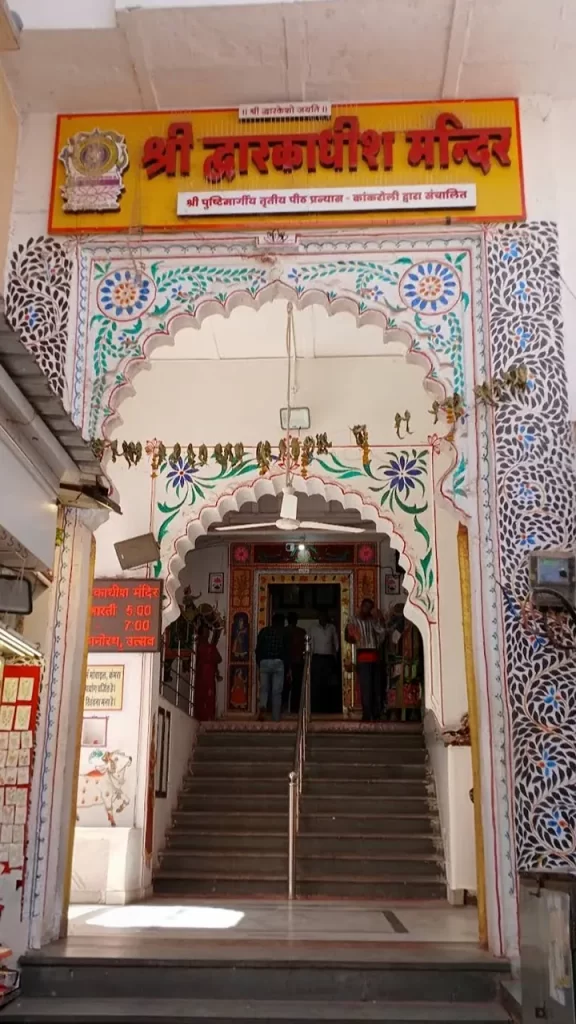
Dwarkadhish Temple, Kankeroli
This amazing temple complex is located at a distance of about 18 kilometers from Nathdwara. It can be found on the banks of the huge Rajsamand Lake and is part of a major Pushtimarg sect. The ambiance of the place is amazingly peaceful.
The Haldighati Mountain Pass
For history buffs, the legendary mountain pass lies a mere 17 kilometers from the city. It was the very place where the famous and bloody Battle of Haldighati (1576 CE) took place between the brave Rajput hero, Maharana Pratap and Mughal army led by Emperor Akbar. The soil here still carries its distinctive yellowish-golden color, which resembles the turmeric plant known as Haldi in Hindi. There is a good interactive museum that makes you relive the historical saga of the faithful steed Chetak through light and sound models.
Eklingji-Shrinathji Tour Package
You can even club your visit with a side trip to the Eklingji temple (26 km), which is a multi-shrine temple complex hewn out of white marble in honor of the chief deity of the Mewar royal family, with a magnificent four-headed black stone icon of Lord Shiva carved in 734 CE.
Frequently Asked Questions (FAQs)
Q1: Is there any possibility for non-Hindus and foreign nationals to visit the innermost chamber?
Answer: Shreenathji Nathdwara temple practices orthodox scriptures protocols in a very rigid manner. While the entire temple including markets is free to enter by everyone, the inner Garbhagriha where the deity stays is open only for practicing Hindus. It is always recommended for foreigners of non-Hindu communities to inquire about clearance permission through the temple Kachari office.
Q2: What is the reason behind closing of the temple during mid-day for hours?
Answer: Keep in mind that it is not any organization or building but the abode of a little boy. In such extreme heat conditions in Rajasthan, the little Shreenathji feels tired after having his lavish lunch meal named Rajbhog. Hence, from 12:30 PM till 4:00 PM, the entire abode remains completely silent allowing the little god-child to take rest for some time.
Q3: Why are the famous Nathdwara Pichwai paintings important?
Answer: Pichwai means “painting that hangs behind”. The amazing and intricate artwork is hand-painted using natural stone pigments as well as real gold threads and is made of large pieces of starched cotton cloth. The purpose of these paintings is that of interchangeable backgrounds for the deity and change according to the season; for instance, a depiction of a cooling pond in summertime and that of celebrations in wintertime.
Q4: What local food and souvenirs can you buy in the temple streets?
Answer: There is one dish that you absolutely must try—Nathdwara Pedas, which are very dense and roasted milk sweets with a mixture of pure cardamom and saffron. Some other must-try items include crispy Khamand Dhokla and spicy Poha for breakfast, both served on leaf plates. Some souvenirs worth looking for include handmade Pichwai paintings, silver jewelry, and terracotta pottery.