Sanwariya Seth Temple: Tycoons Secretly Offer 50% Profits
The Sanwariya Seth Temple is an awe-inspiring architectural structure located in the serene, spiritually rich village of Mandphiya in Chittorgarh District of Rajasthan, India. Revered worldwide by millions of believers as the “Shri Dham of Mewar,” this temple is much more than a mere place of worship. Instead, it is a living testament of unflinching devotion and divine blessing. There truly is no other place on earth like it where the lines between our worldly life and God’s intervention appear to fade away completely.
As you step into the expansive premises of the Sanwariya Seth Temple, you will feel an overwhelming energy in the atmosphere. Based on my experience as a professional tour guide, this temple exerts a strong psychological and spiritual pull on anyone who visits the holy precincts. This temple is not just another local deity, but a celebrated pilgrimage center dedicated to the dark-complexioned, divine king of love, Lord Krishna. This lord has been worshipped at this temple in his revered form as Sanwariya Seth, the Almighty Corporate Head, the Supreme Divinity of Business, and the Divine Financier, better known as the “Seth of all Seths.”
The reason why the Sanwariya Seth Temple is an architectural and spiritual wonder of absolute proportions is that of its unique identity concerning both material prosperity and spirituality. While other temples in the country can be visited by people seeking spiritual bliss or salvation, the Sanwariya Seth Temple functions on a highly unconventional yet intimate notion of Divine Business Partnership, wherein local traders, millionaires, farmers, and even international diamond traders consider Lord Krishna as an equal partner in their business enterprises.
They offer a certain percentage of the profit earned in exchange for their services to Lord Krishna in his donation box (Gupt Daan), which ranges anywhere between 2 percent to 50 percent. Therefore, it comes as no surprise that the Sanwariya Seth Temple has become the wealthiest religious establishment in Northern India, earning millions of rupees every month.
The strong transactional bond between these two aspects makes for an intriguing audience for the temple. This includes:
- Religious Pilgrims (Bhaktas): People who wish to be completely sheltered beneath the divine eyes of Krishna as they seek solace from past sins, illnesses, or emotional burdens.
- Cultures and History Buffs: Those who yearn to unravel the mysteries associated with Mewari mythology and how a discovery made in the 19th century turned a sleepy village into a globally recognized pilgrim spot.
- Tourists and Sociologists: Visitors amazed by the magnitude of religion and the grandeur of architectural structures, all coupled with the exciting and much-famed ritual of counting money that appears in the national news!
Read More>> Banke Bihari Temple, Vrindavan
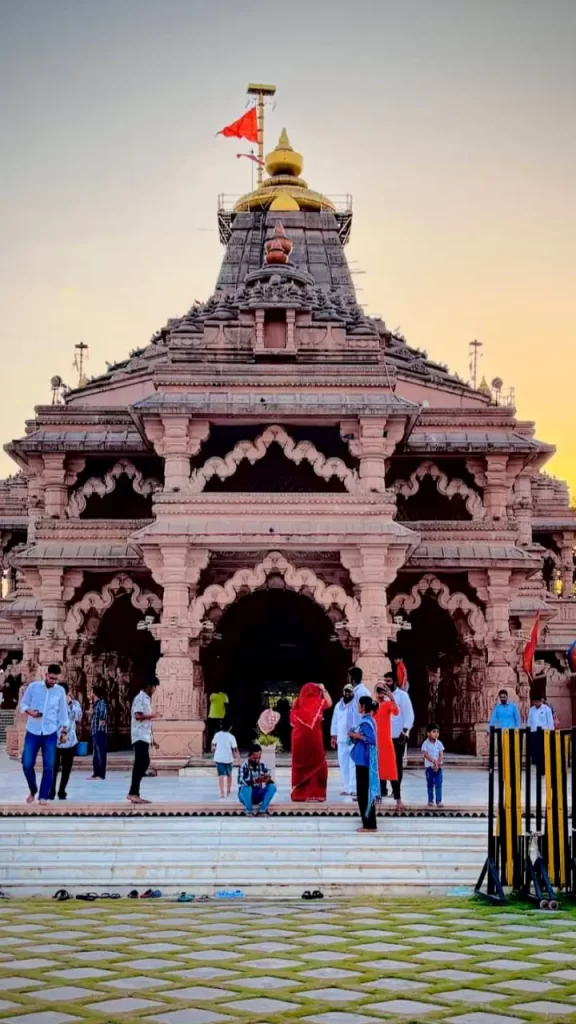
Sanwariya Seth History: Dreams, Digging, and the Miraculous Awakening of 1840
In order to understand the full mystery of the Sanwariya Seth Temple, it is imperative that we take a step back in time, to the year 1840 AD. It was the period of Mewar that came under the influence of its royal traditions, where all day-to-day activities were centered on agricultural practices and rearing of cattle. Chapar village situated in Bhadsoda-Bagund area was home to an innocent, humble milkman, Bholaram Gurjar.
One evening, Bholaram woke up from his sleep, after a highly surreal heavenly experience that occurred in his dream. In this dream, Bholaram heard the divine voice, which had all the grandeur of power coupled with sweetness, informing him about the existence of three majestic old statues of Lord Krishna who had been hidden deep inside the earth at a particular spot on the nearby highway.
Though initially skeptical, Bholaram rejects the idea, considering it merely a product of his imagination. But when Bholaram started dreaming about the same incident for several consecutive nights, it became clear that he had been bestowed with this divine vision. He asked his villagers to join him at the indicated place with shovels, only to dig deeper into the mystery. The air grew thick with anticipation. Suddenly, the metal hit something solid.
When the villagers meticulously cleaned the compact soil from the surface, they gasped in awe as the three beautiful, identical idols of Lord Krishna appeared before them. Sculpted exquisitely out of dark-colored stone, the idols of Lord Krishna were perfect representations of Him in His famous position of Tribhanga (the Three Bent Position), with a charming smile playing across His divine face.
The placement of the three divine statues has been in accordance with a perfectly agreed upon plan by the local residents:
- The biggest idol is located in Bhadsoda, where a historic temple exists to accommodate it.
- The third idol is housed in its place of discovery, Chapar, which still retains its monastic structure of a shrine.
- The second idol, the one with its almost magnetic radiance on the face, is found in the village of Mandphiya.
It was this second statue that grew in fame to become the world-famous Sanwariya Seth Temple.
Read More>> Kartik Swami Temple Uttarakhand
Historical Connections and Development
Whereas the origin myths are firmly entrenched in mysticism and mythological legends, the rise of the Sanwariya Seth Temple as a socio-political force has been significantly influenced by the historic ruling clans of Mewar. The rulers of Udaipur (Sisodia Rajputs) were very spiritual and kept a keen eye on socio-spiritual activities within their realms. Although the temple began life as a simple, straw-thatched temple built by the combined contributions of local cowherds and farmers, it was soon adopted by the rich Mewari merchant guilds (Mahajans).
The years of the early 20th century witnessed the construction of many new buildings in the temple complex. Local ascetics, sages, and bhajan singer monks carried stories about the miracles of Sanwariya Ji to other states, like Gujarat, Madhya Pradesh, and Maharashtra. By the time a government-recognized temple trust had been constituted in 1992, the Sanwariya Seth Temple had emerged from a small local temple into a massive architectural complex built completely out of the spectacularly anonymous donations of its multi-billionaire corporate “business partners.”
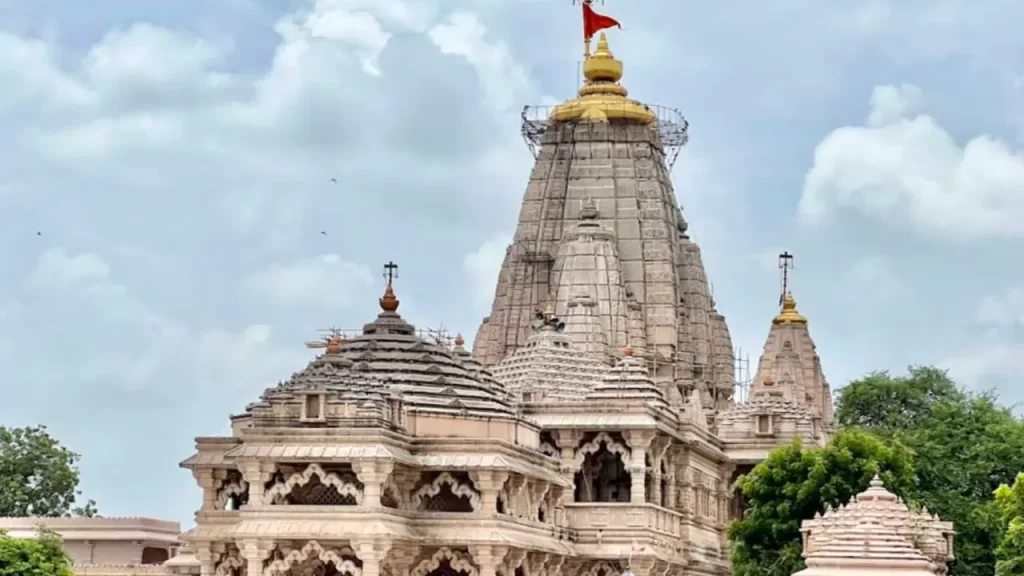
Religious and Cultural Significance: The Sovereign of Souls and the Scriptural Truth
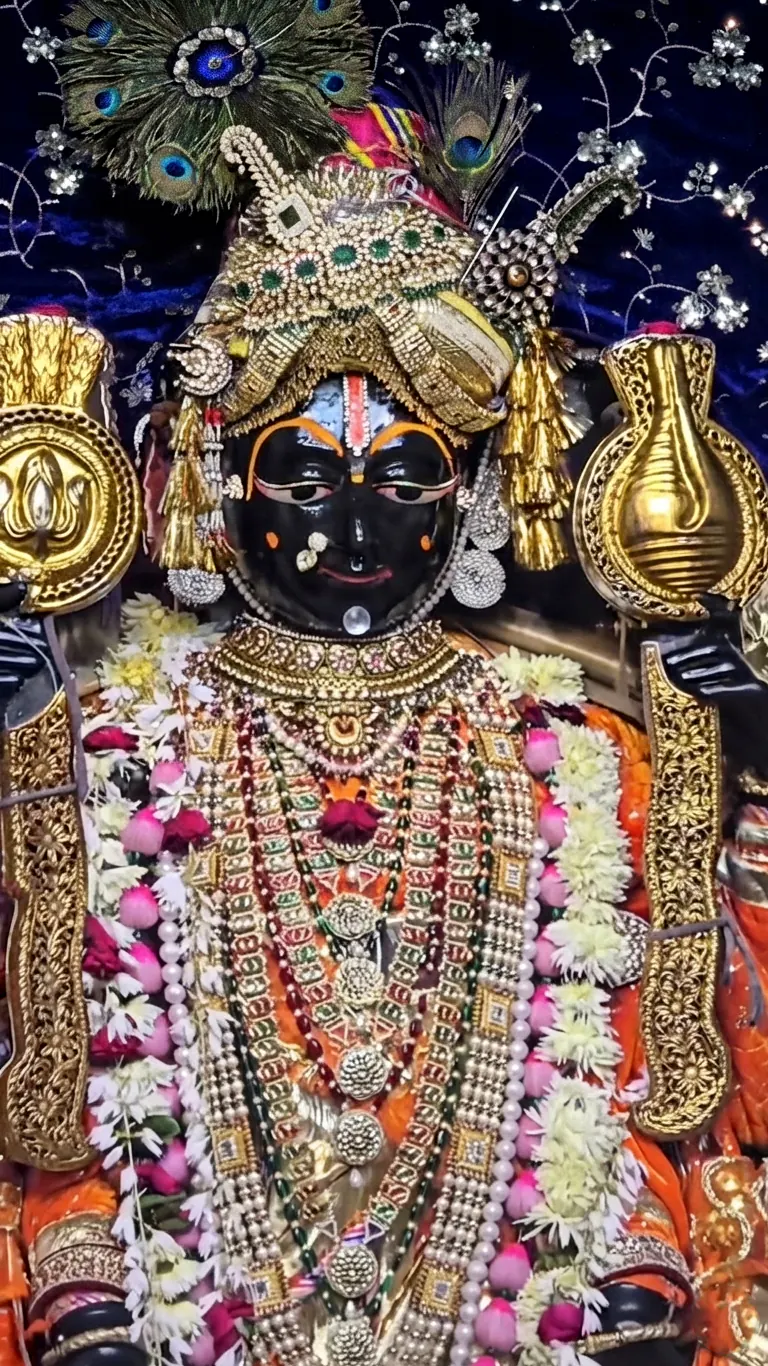
In the center of the Sanwariya Seth Temple stands the grand and black as night statue of Lord Krishna. In fact, the term “Sanwariya” itself means “the Dark-Complexioned One,” and this is a nickname lovingly applied to Lord Krishna by North Indian saints because of his skin color, which resembles that of the clouds. On the other hand, the term “Seth” bestows yet another level of uniqueness to the temple’s name. In Indian society, the Seth is defined as a rich merchant, banker, or businessman. Through the term Sanwariya Seth, the local culture in Rajasthan has bestowed Lord Krishna with the status of a businessman patron who takes care of mundane issues such as money management.
References From Scriptures & Myths
In order to grasp why the Sanwariya Seth Temple bears such enormous theological significance, it becomes essential to delve into the old scriptures of Hinduism. While it was after 1840 that the geography associated with Mandphiya became well-known, the worship of Swaroopa of Krishna (his dark form) has its deep roots in the Puranas Bhagavata and Brahma Vaivarta Puranas.
The Puran Bhagavat provides extensive references of the Aishwarya and Madhurya of Krishna’s dark form in its Dasham Skandhana (10th Canto). This Puran states that during the time of transition between Dwapara and Kali Yugas, the physical forms of the Lord would transform into Swayambhu (self-manifested) black stones in order to maintain the cosmic balance.
It is worth mentioning here the traditional verse often cited by the temple priests in order to substantiate their spiritual legacy:
“कस्तूरीतिलकं ललाटपटले वक्षःस्थले कौस्तुभं
नासाग्रे वरमौक्तिकं करतले वेणुं करे कङ्कणम्।
सर्वाङ्गं हरिचन्दनं सुललितं कण्ठे च मुक्तावलिं
गोपस्त्रीपरिवेष्टितो विजयते गोपालचूडामणिः॥”
Translation: “Marked with the fragrant tilak of musk on the forehead, adorned with the precious Kaustubha gem on the chest, having a pearl on the nose, flute in hand, and the entire body covered with the sacred sandal paste – Victory to the Jewel of the Cowherd, the Dark One who liberates us all!”
Moreover, the regional religious texts called Sthala Puranas connect these particular idols intimately with the worship of Sant Meerabai, an ancient and celebrated poet-saint Princess of Mewar of the 16th century. According to the beliefs of many older priests, these three black stones were part of the secret royal treasure of the objects worshipped by Meerabai along with her fellow saints when they escaped royal wrath by fleeing into the forest of Mewar. For centuries, these precious divine objects were buried in the ground to protect them from the iconoclastic forces, only to be discovered in 1840.”
Read More>> Mahaganapathi Temple Malleswaram
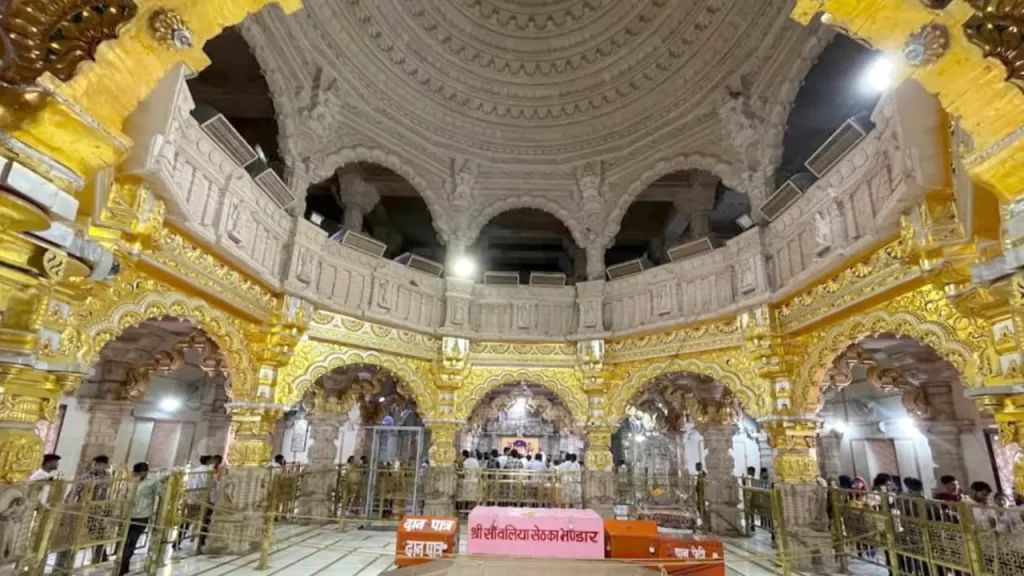
Architecture and Design: A Marvel of Modern Nagara Splendor
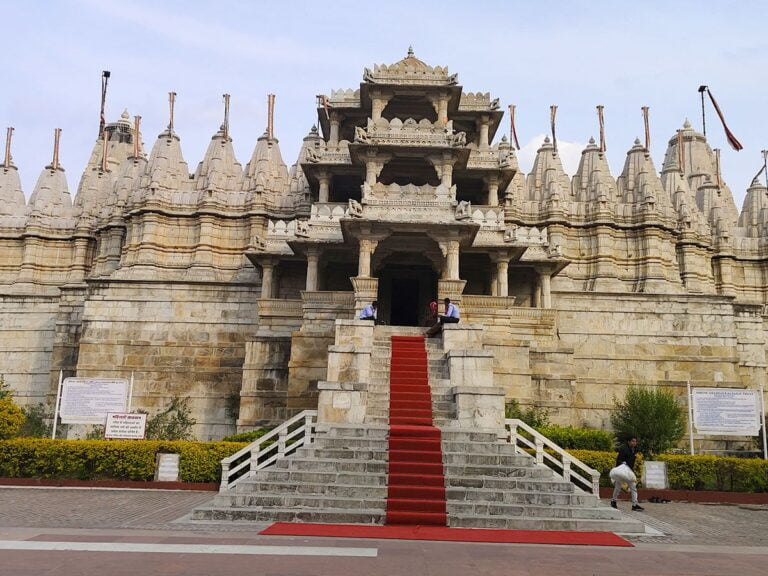
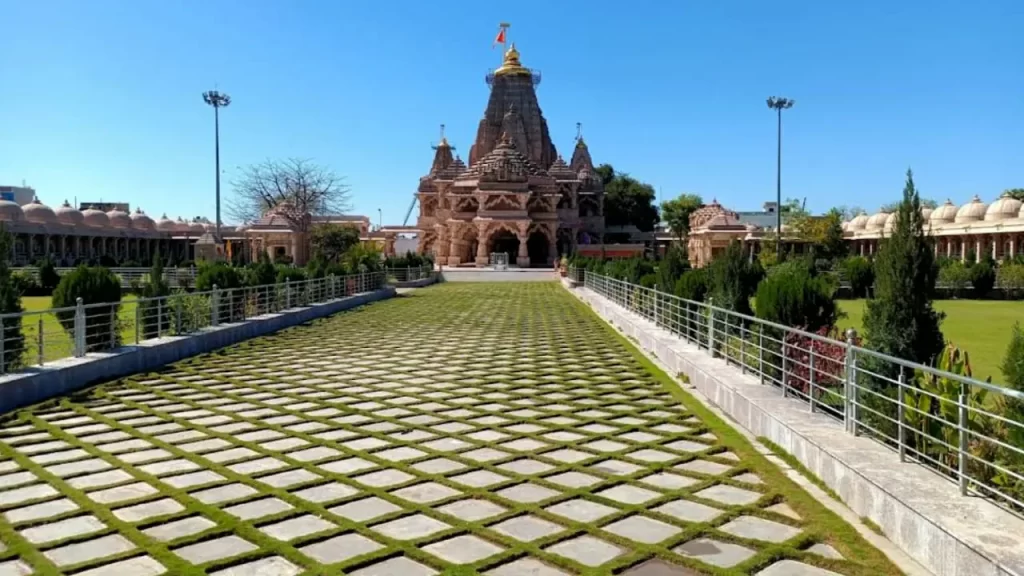
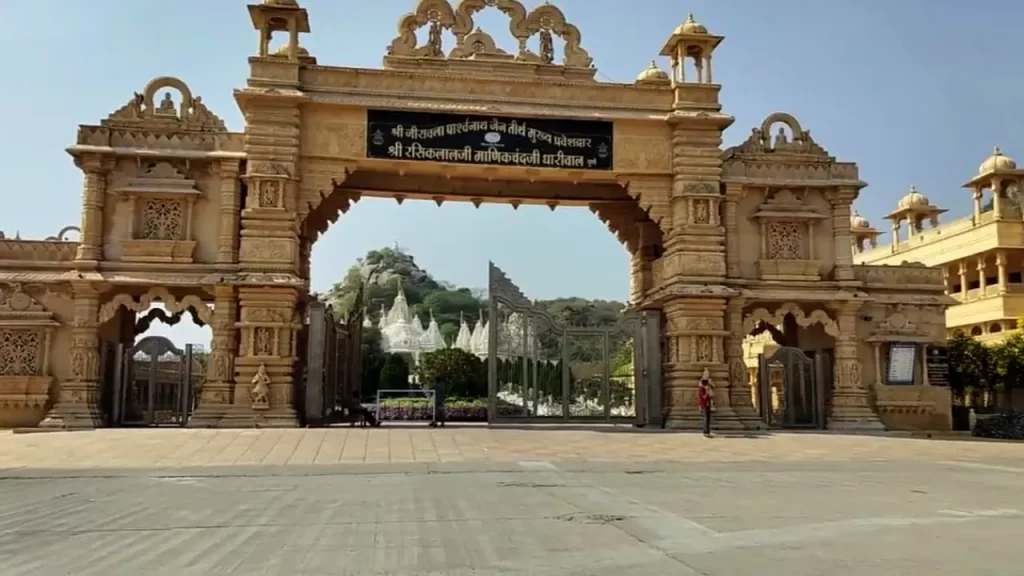
In my capacity as your tour guide, one of the most exciting aspects for me as far as taking you around our city is the analysis of the breathtaking architecture present in the outer courtyard of the Sanwariya Seth Temple. The architecture of the Sanwariya Seth Temple is an amazing progression from the traditional Nagara Architectural Style with influences from traditional Mewari Havelis and Palace Architecture.
Although initially built in 1840, the current building complex is a complete spectacle in terms of architecture, and is constructed almost entirely using high-quality Makrana White Marble and premium Pink Sandstone from Bansi Paharpur.
Structural Elements
The Shikhara (Spire): This magnificent spire which rises above the temple’s most sacred part of the main shrine consists of many stories and is encircled by several smaller shikaras known as Urushringas before reaching the large Amalaka segmented stone disk surmounted by a gold Kalasha.
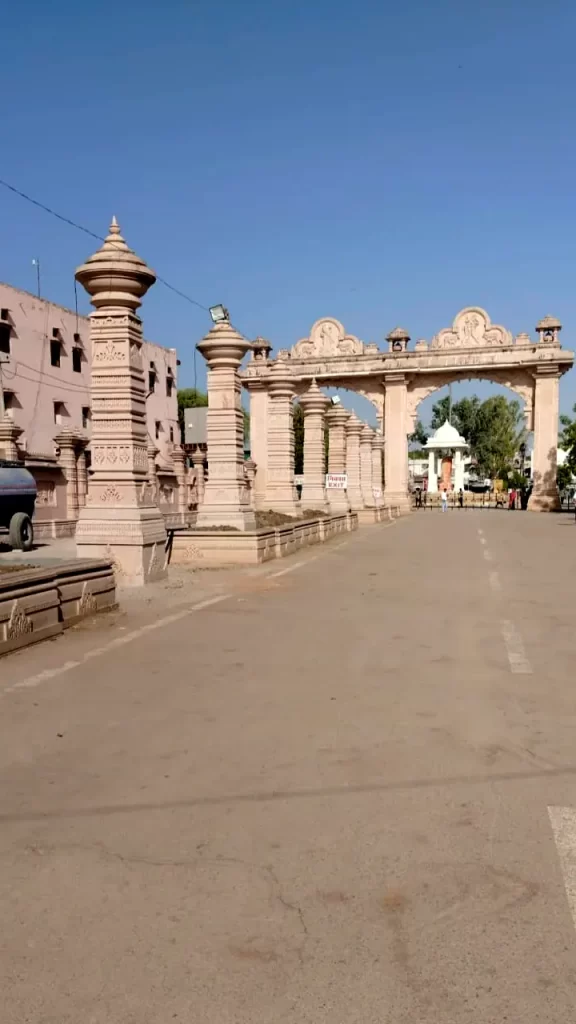
Gopuram Style Doors: Although the real Gopurams are the defining elements of Dravidian temples, the doors to the entrance halls of this complex mimic them with multi-level doorways and carvings that imitate the archways, jharokhas or overhanging balconies, and sculpted friezes of elephants from the royal forts of Chittorgarh.
Pillars & Ceiling Paintings: Once inside the Maha-Mandapam hall, one’s first instinct is to gaze at its ceiling because it is decorated with paintings of the Raas Leela, lifting of Govardhan Hill and other life events of Lord Krishna in addition to murals in vibrant colors adorned with gold-leaf. There is not a single marble pillar holding this ceiling without being embellished with apsaras and musicians carvings and images of vines growing all around them.
Symbols Used in the Building
There are no random designs found in the Sanwariya Seth temple; each design is deeply laden with spiritual symbolism:
- The passage from brightly lit outside courts to gradually dark interior corridors culminating in the highly concentrated Garbhagriha reflects the path followed by a soul as he or she moves from the distraction-ridden physical world of Samsara to the peaceful core of divine consciousness.
- While the use of elephants on the lower levels reflects stability in the earthly domain, the layers of Gods and angels and spires denote the ascending state of human consciousness.


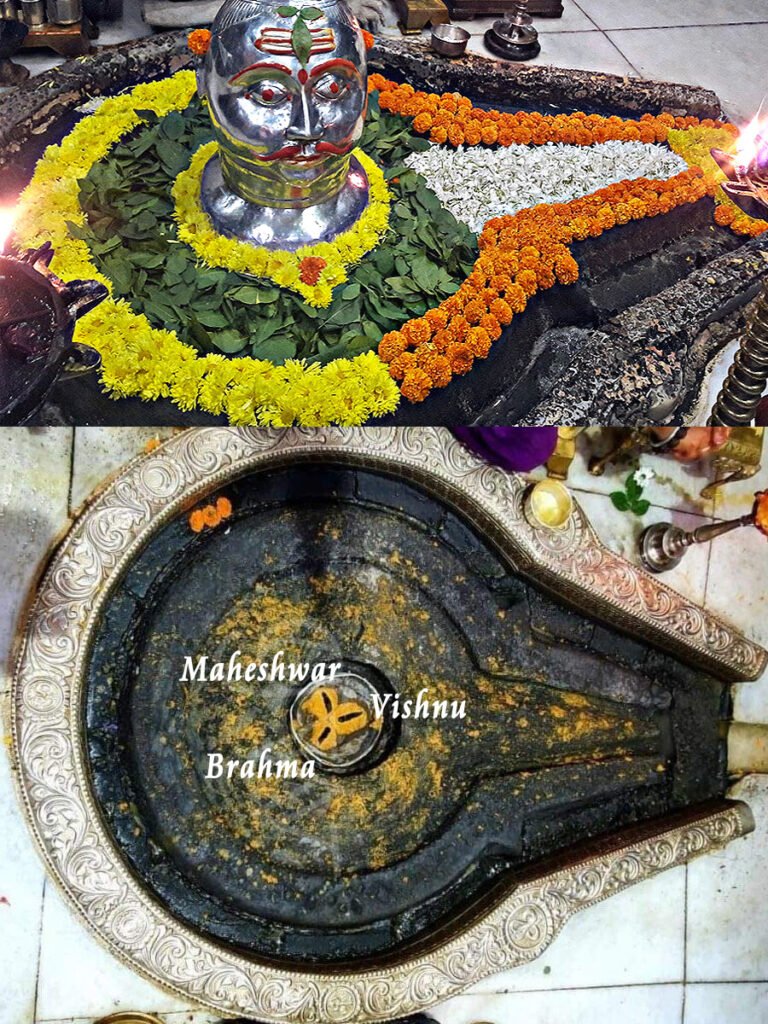

Main Attractions or Highlights: Exploring the Sacred Zones
In the course of visiting the majestic structure of the Sanwariya Seth Temple, it would be useful for you to organize your visit well so as not to miss out on the spectacular elements of this temple complex. Now let us look at some of those features which cannot be missed.
The Sanctum Sanctorum (Garbhagriha)
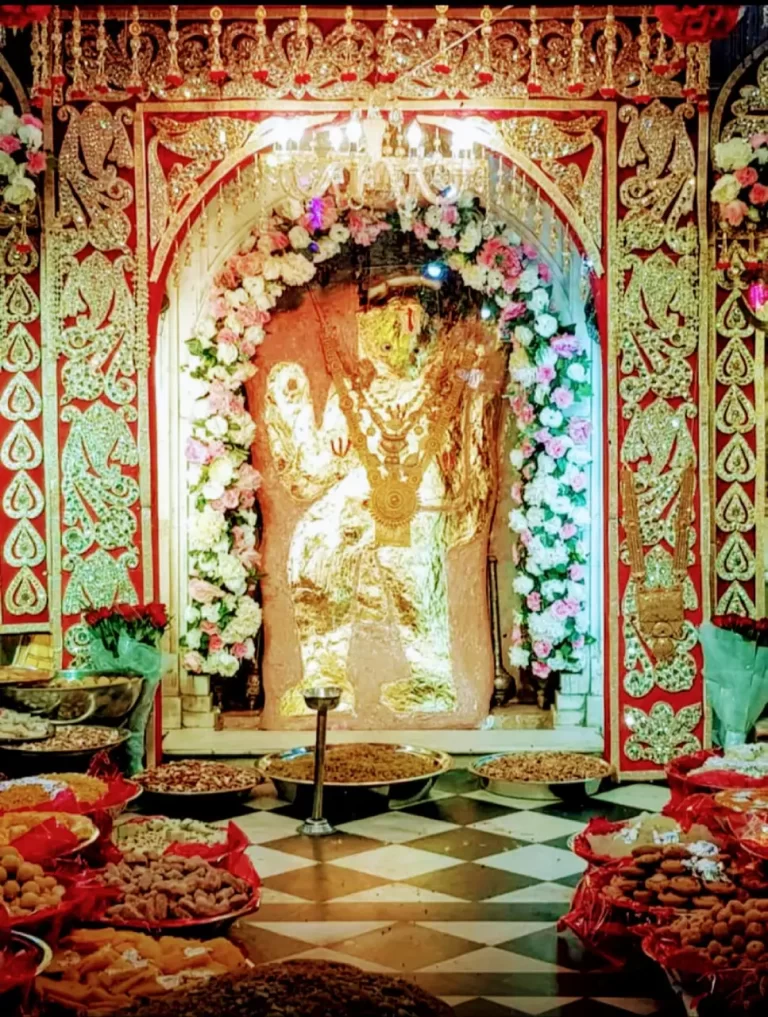
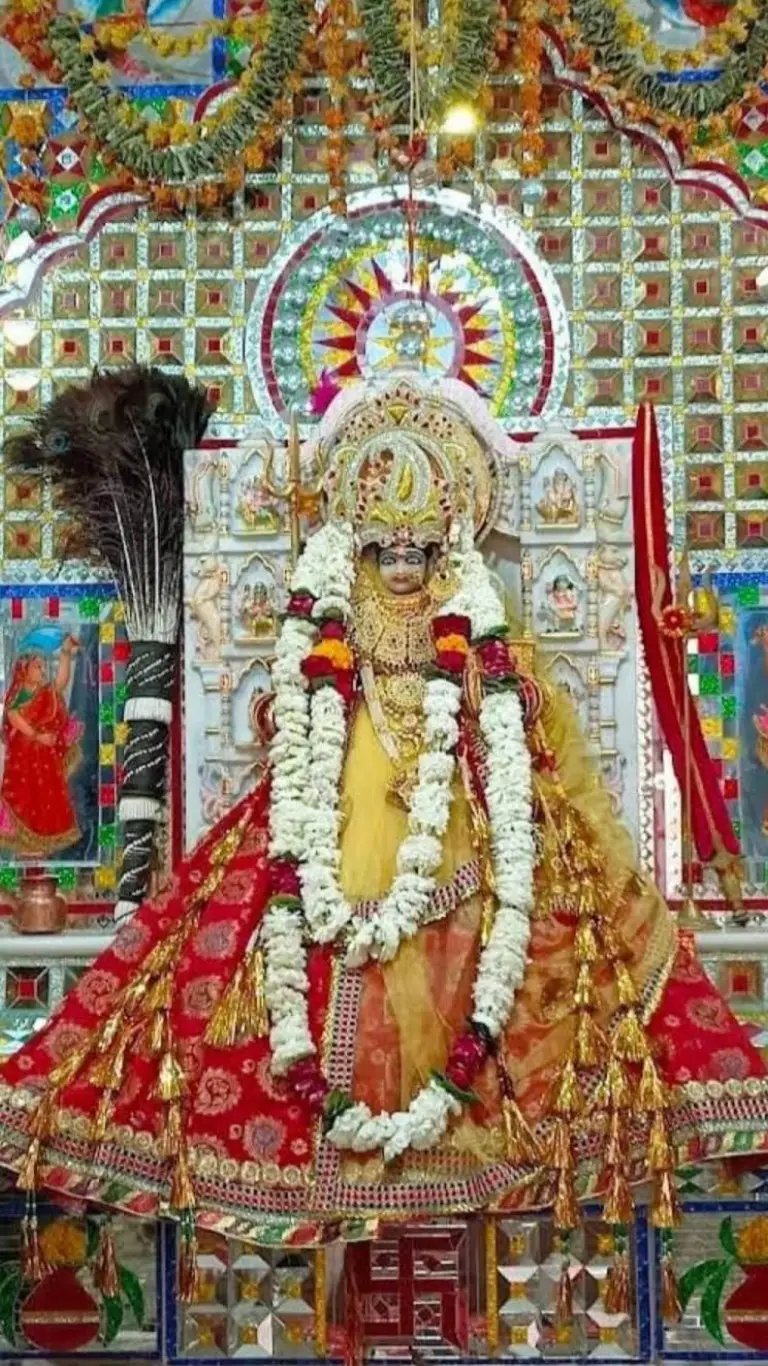
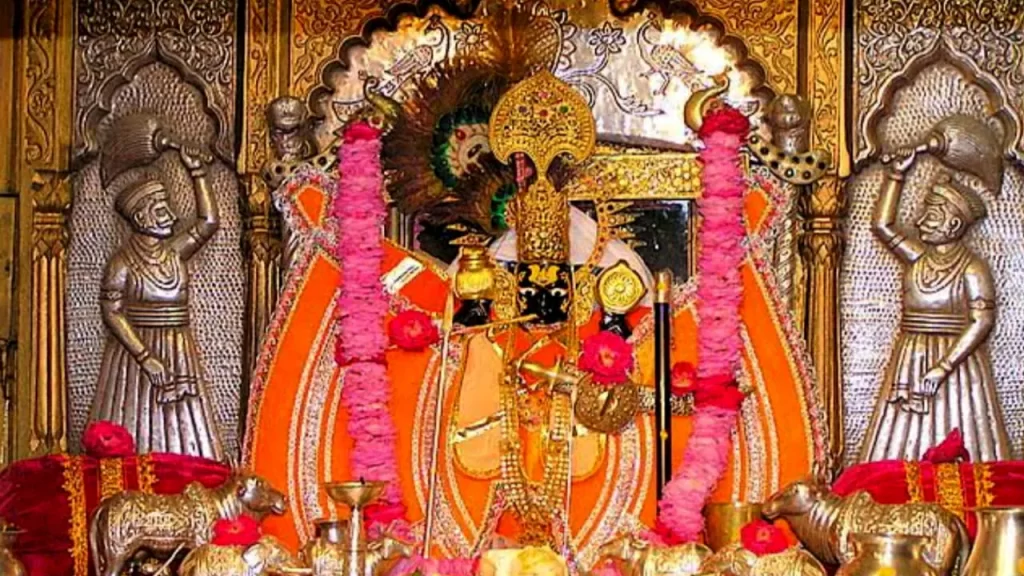
It is the spiritual hub of the temple. This is the most sacred part of the temple with doors covered in beautiful silver-paneled doors. It houses the celebrated black marble statue of Sanwariya Seth. The statue wears clothes that are richly embellished with gold and silver embroidery and adorned with precious gems like diamonds and other stones along with a grand golden crown. The idol is holding a gold flute in his hand. There is something very special about the look in his eyes; you will feel that he is looking at you from wherever you are standing in the temple hall.
Sub-Shrines and Adjacent Temples
Although there is no denying that the monarch of this place is Sanwariya Ji, the site also comprises a few other equally important sub-shrines, which are as follows:
- Radha Krishna Shrine: An elegant shrine celebrating the eternal relationship between Radha and Krishna.
- Hanuman Temple: Strategically located near the entrance of the temple, guarding the sanctity of the entire complex.
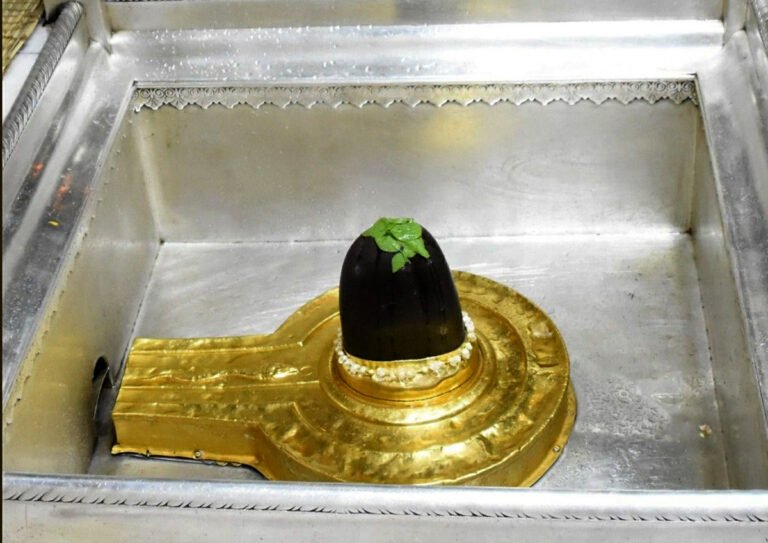
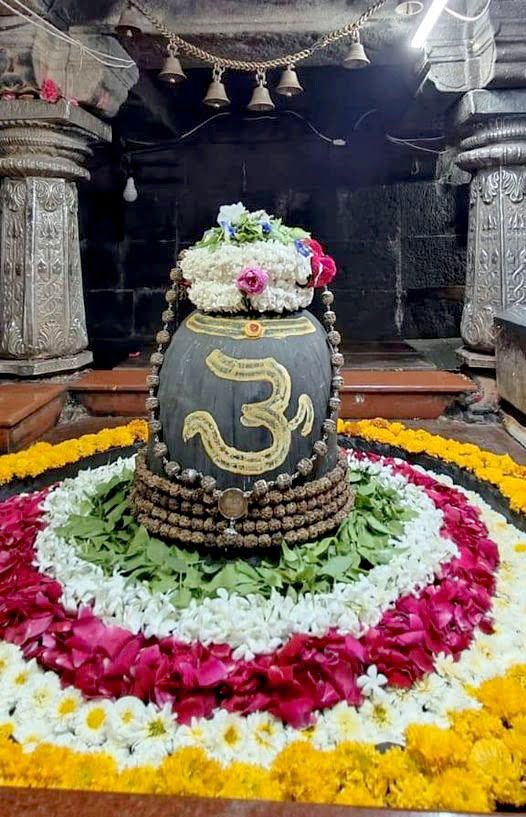
- Shiva Panchayat: An exquisite sub-shrine comprising a pure Shiva Lingam surrounded by Parvati, Ganesha, and Kartikeya, representing the perfect blend of Vaishnava and Shaiva sects.
The Mandapams (Assembly Halls)
The grandiose Kalyan Mandapam acts as the nucleus. Its seating capacity can house thousands of people who gather together every day for kirtans and bhajans. This floor comprises cooling white marble decorated with semi-precious stones in Pietra Dura style.
The Temple Tank and Gardens
The gardens surrounding the stone structure are lush and vibrant with their perfectly maintained vegetation. The gardens contain a musical fountain, which performs with the melodies from songs dedicated to Lord Krishna in the evenings. Located at the eastern side of the garden complex is the sacred Temple Tank (Kunda). As bathing in the water in the Kunda is strictly prohibited, devotees use the water for sprinkling onto their heads due to its healing powers.
Read More>> Karmanghat Hanuman Temple made Aurangzeb Shiver to Destroy
Temple Timings and Rituals: A Day in the Court of the Divine King
In order to have the maximum experience at the Sanwariya Seth Temple, it is important to time your visit accordingly. Here, the entire day goes according to a strict timetable that resembles that of an imperial palace.
Breakdown of Important Practices
Mangala Aarti (05:30 AM): Without question, this is probably one of the most spiritually fulfilling times to visit. The doors to the temple are thrown open amidst the clashing noise from shankh, tabla, and brass bell. The deity is gradually roused from his sleep. The air is fresh, and the crowd is devoted.
Rajbhog Aarti (10:00 AM – 11:15 AM): This ceremony is quite lavish as the Seth gets treated to an elaborate mid-day meal consisting of a variety of Indian cuisines such as Chappan Bhog (56 different types of food products), sweets prepared in ghee, and seasonal fruits. This is a time when many businesspersons come to pay their respects as the prayers here are said to be connected with material success.
Sandhya Aarti (07:30 PM): Experience divine energy in the evening Aarti. The temple is aglow with thousands of lights. The priests move huge multi-tier brass lamps full of camphor and ghee. There is clapping and singing of Sanwariya Seth in chorus in the whole assembly hall.
Dress Code and Etiquettes
Although the temple trust is extremely welcoming, maintaining culture etiquettes is very necessary.
Dress Code: Visitors have to dress formally and respectfully in traditional Indian clothes. For men, dhotis, kurtas or formal trousers are encouraged (shorts, torn trousers, and tank tops discouraged). Traditional Indian dresses such as sarees, salwar kameez for women are highly recommended.
Etiquettes: Take off your footwear at the designated area before stepping onto the marble steps. It is preferable to keep leather objects such as belts or large wallets at least in your car or locker. Mobile phones need to be switched off or in silent mode in Maha-Mandapam.
Read More>> Kundeshwar Temple Pune Trekking
Festivals and Events: The Zenith of Devotional Ecstasy
While the Sanwariya Seth Temple is vibrant on any given day of the week, during major Hindu festivals, it transforms into a grand spectacle of colors, crowds, and absolute devotional bliss.
Krishna Janmashtami (August/ September):
Marking the occasion of Lord Krishna’s birth, this is a massive event in the temple. There is complete illumination of the village Mandphiya in fair lights. The idol is dressed in a special costume made with diamonds and pearls. The Darshan will go throughout the night, and peak around midnight when the birth is celebrated. Be prepared for extremely high crowd levels, easily reaching 3 to 5 lakh people per day.
Jaljhulani Ekadashi Fair (Bhadrapada Shukla Ekadashi)
This is perhaps the oldest and most culturally rich festival in the Sanwariya Seth Temple. A grand and awaited three-day annual fair takes place on this occasion. On this important day, the Utsav Murti of Sanwariya ji is brought out from the main shrine and placed in an exquisitely designed golden chariot (Viman).
An incredibly massive procession of caparisoned elephants, traditional folk artists, camel contingents, and band musicians will move around the streets of Mandphiya. The procession moves towards the nearby lake, and here the idol is given an elaborate ceremonial bath (Jal Jhula). This three-day event is simply unsurpassed in its vibrance, attracting folk pilgrims from the deepest heartlands of Rajasthan and Madhya Pradesh.
Annakoot Day (Diwali Festival Celebration)
Annakoot celebration comes after the festival of lights and marks the victory of Lord Krishna from Lord Indra. The event is commemorated with the worshiping of the God through the making of artistic mounds of various vegetarian dishes, sweets, and rice preparations to express immense gratitude to the God for granting an abundant harvest season and fruitful financial year.
Crowd Control & the Perfect Visit Timing
In case one wants to offer darshan in a calm manner and have the ability to stand before God for some time without the disturbance of moving crowds, visit on non-weekend days and special days like Ekadashi Days.
Read More>> Sri Kshetra Dharmasthala Temple: Miracles of Lord Manjunatha
Logistics and Visitor Guide: Planning Your Journey Seamlessly
Allow me to assist you with all the necessary logistical information regarding your tour to the Sanwariya Seth Temple such that your pilgrimage will go perfectly well without any hassles whatsoever.
How to reach Mandphiya?
Since Mandphiya enjoys an ideal geographical position, it’s well-connected by airways, railways, and roadways to Chittorgarh and Udaipur cities.
Airway: The nearest airport is Udaipur Maharana Pratap Airport, which lies around 110 kilometers away from Mandphiya. One can easily take a pre-paid taxi (AC) from the airport straightaway to the temple site, which takes only 2 hours via the national highway.
Railway: Chittorgarh Railway Station is the nearest to Mandphiya (75 kilometers away); moreover, it’s exceptionally well-connected by trains to Delhi, Mumbai, Jaipur, and Ahmedabad cities. As an alternative one, Udaipur Railway Station can also be considered.
Roadway: There are continuous runs of RSRTC buses, Volvos, as well as taxis available from Chittorgarh, Udaipur, and Bhilwara to Mandphiya.
Entrance Fees and Ticketing Process
There are absolutely zero entrance fees applicable for the Sanwariya Seth Temple. The temple trust maintains the policy of spiritual equality wherein all darshans are on first-come-first-served basis only. There are currently no online booking facilities available for the VIP Darshans. People of all categories stand in the equally well-managed and multiple-laned queue systems. Beware of any local touts or unauthorized guide service providers who offer the privilege of quick darshans for money—It is a completely walk-in system.
Read More>> Famous Tirumala Tirupati Venkateswara Swamy Temple Guide
Facilities Available On-site for Visitor Convenience
The temple trust is exceptionally well-organized and utilizes the massive monetary power of theirs to facilitate the best of public amenities for people visiting the temple:
Restrooms & Drinking Water: Very clean restroom blocks and chilled, reverse osmosis (RO) purified drinking water stations can be found after each certain distance along the queue lanes.
Food (Prasad & Bhojnalaya): There is an extremely hygienic, well-maintained and huge Bhojnalaya (Dining Hall) maintained by the temple from where excellent, healthy traditional Rajasthani food is served at extremely discounted prices (sometimes even free of cost or very nominal charges like ₹20-50).
Accommodations: The temple has a number of huge Dharamshalas (guest houses), which have both clean air-conditioned rooms as well as budget dormitory-style rooms. People who seek luxurious accommodations can opt for heritage resort hotels situated on the Udaipur to Chittorgarh road, which is a 20-minute drive from the temple.
Facilities for Elderly and Disabled Pilgrims
In terms of architecture, the temple is very futuristic. All the important areas of the complex have ramps next to all the staircases. There are temple volunteers at the gate who provide free wheelchairs and assistance for the disabled pilgrims to get to the front of the temple queue.
Read More>> Sacred 12 Jyotirlingas in India: A Symbol of Eternal Spirit
Dos and Don’ts: Essential Code of Conduct
In order to make sure that you leave behind no untoward incidents behind, here is a quick list of rules that need to be followed at the temple:
Dos
- Please store all your valuable belongings and electronic items in your cars or at the dedicated token-based counter for safe locker storage facilities offered by the temple trust.
- Accept the Charanamrit and Prasad offerings with the right hand as an expression of reverence.
- Please remain quiet during the entire visit and recite the holy name “Hathi Ghoda Palki, Jai Kanhaiya Lal Ki” or “Radhe Radhe”.
- Make the donation through the official locks steel Hundi collection box or by taking the formal stamped receipt issued from the accounting counter of the temple trust.
Don’ts
- No pictures should be taken in the most sacred places. Pictures can be taken outside in the garden areas and the magnificent marble structures. The use of cameras and mobile phones for videos is banned from inside the inner prayer chambers.
- No luggage or baggage should be brought in the interiors of the barricade structure.
- Avoid smoking, chewing tobacco, and drinking alcohol in the one kilometer radius around this sacred place.
- It is prohibited to touch the silver railings inside as well as to climb on the platform where the idol is kept.
Read More>> Sri Bhramaramba Mallikarjuna Swamy Temple Srisailam
Nearby Attractions: Expanding Your Mewar Itinerary
When visiting all the way to Mandphiya, there is absolutely no point in missing the opportunity to visit both, the Sanwariya Seth Temple along with the amazing historic and cultural landmarks that lie just at its doorstep.
- Chittorgarh Fort (40 KM away)
This huge UNESCO World Heritage monument serves as the true epitome of Rajput bravery, sacrifices, and chivalry. Here one can witness the magnificent Vijay Stambh (Victory Tower), Kirti Stambh, remains of the palace of Rana Kumbha, and the famous artificial water tanks where the beautiful queen Padmini lived. - Shrinathji Temple, Nathdwara (100 KM away)
The sibling pilgrimage site for any Krishna lover. Nathdwara represents the 17th-century incarnation of Lord Krishna when he lifted the Govardhan hill as a little kid of seven years. This temple is known worldwide as the global headquarter of Pushtimarg sect and famous for its unique Pichwai Paintings. - Udaipur City (110 KM away)
Famously referred to as the ‘City of Lakes’ and ‘Venice of the East’. One can rejuvenate after visiting Mandphiya by spending a relaxing time on the boats in the waters of Lake Pichola, exploring the vast City Palace Museum, or shopping for traditional silver jewelry and Bandhani fabrics in the old market of Udaipur.
FAQs: Clearing All Your Doubts
Q1. What is the reason behind the name of “God of Businessmen” given to the idol of Sanwariya Seth?
Ans: The reason behind this name lies in the age-old practice of business people, traders, and entrepreneurs partnering financially with the god. They attribute their prosperity to him and pay a certain percentage of their business profits back to the temple.
Q2. Is there any provision for booking VIP/fast track tickets online?
Ans: No. There is no online booking facility at all for any VIP ticket or even paying entry or fast track tickets at the Sanwariya Seth Temple. The entire system operates on the principles of democracy with no online facilities available.
Q3. Are there any restrictions on taking photographs inside the temple premises?
Ans: You can take pictures of anything external like the building architecture and outer garden areas. No photos are allowed once you are inside the Maha-Mandapam and Sanctum Sanctorum.
Q4. When should we ideally visit the temple?
Ans: The ideal time to visit the temple would be between October and March. At this time of the year, the temperature in Rajasthan is really good and extremely suitable for exploring the open walkways in the temple.
Q5. What is the story associated with three separate idols which were excavated in 1840?
Ans: As per folklore, all the three idols have been unearthed from the ground on the basis of divine dreams which were witnessed by Bholaram Gurjar. These idols were then distributed in three adjoining villages – Mandphiya, Bhadsoda and Chapar which ensured blessings of the Lord at all these places.
Conclusion: The Everlasting Grace of the Dark Lord
As our journey reaches its conclusion, it is evident that the Sanwariya Seth Temple is no ordinary destination listed in a travel guide. It is a deeply spiritual journey of pure faith, unmatched human generosity, and divine intervention. You could be traveling from far off places to seek blessings for repairing your failed business ventures, studying the fascinating history of Mewar, or just being there to be captivated by the melodious sound of Sandhya Aarti at the end of each day, but Sanwariya Ji never leaves anybody disappointed.
The local residents of Mandphiya have an adoring saying about this divine place:
“साँवरिया सेठ के दरबार में, सब मिलता है झोली पसार के।” (In the court of Sanwariya Seth, everything is granted to those who open their hearts and spread their arms in faith.)