Badami Cave Temples: 6CE India’s Ultimate Ancient Adventure
Badami cave temples are spectacular rock-cut temples located near the small town of Badami in Bagalkot, north-central Karnataka, India, about 142 kilometers east of Belagavi and around 140 kilometers northwest of the legendary ruins of Hampi. As soon as you get here, you are bound to notice the breathtaking view of the tall red sandstone cliffs which encircle the historic town of Badami. And it is here, on the vertical faces of these sandy-colored mountains, where the majestic rock-cut Badami cave temples exist.
For many years, I have taken various kinds of people through the mysterious tunnels of these splendid monuments. Whether you are a religious pilgrim hoping to find spiritual connection with the divine, a history enthusiast trying to solve puzzles about ancient dynasties, or simply an adventurous traveler interested in appreciating beauty, the Badami cave temples always manage to cast some kind of spell upon everybody who visits them. Come walk with me as we delve into history and discover secrets of the past hidden behind these rocks.
1. Introduction
From your position at the foot of the hill, where you gaze upwards to admire the Badami cave temples, you will be witnessing not only historical monuments but also a live workshop of art. Dating back to the late 6th century, the complex includes four major caves, which are connected to each other via a flight of steps going up the hill. Every cave in the complex is a unique piece of art, carved from living rock in an accuracy level that becomes difficult to believe after realizing the fact that the only tools those artists had were the hammer and chisel.
There can be no better example of architectural wonder than the fact that Badami cave temples are called the “cradle of temple architecture” in South India. Together with the neighboring architectural sites of Aihole and Pattadakal, the Badami cave temples made the Malaprabha River valley into the place where two distinct architectural styles united.
From a spiritual point of view, they symbolize a great period of religious peace where you have shrines of Lord Shiva, Lord Vishnu, and the Jain Tirthankaras existing next to one another. To pilgrims, visiting the Badami cave temples feels like turning the pages of Hindu and Jain holy books. From an historical perspective, it is a library that provides information about kings and their politics in the form of inscriptions. In my role as a guide, I always say to my visitors: “Do not just see the carved figures with your eyes; see them with your imagination to hear the sound of the sculptor’s hammer 1,500 years ago.”
Read More>> Ashtavinayak Temples Tour: 8 Shrines, 1 Perfect Road Plan
2. Historical Background
However, in order to understand the beauty of the Badami caves, we must go back in time, back to the 6th century CE. At that time, the town did not have the name Badami. Its ancient name was Vatapi (also Vatapipura or Vatapinagari), and it was the capital city of the Early Chalukya empire – a flourishing kingdom which existed from the 6th to the 8th century CE and extended its rule over large territories in modern-day Karnataka, Andhra Pradesh, and Maharashtra.
Genesis and the Founding Dynasty
While King Pulakeshin I founded the capital in the year 535 CE and fortified the area to protect it from enemies, he could never imagine that his sons would turn their defensive fortress into a haven for the arts. Indeed, King Kirtivarman I (567-598 CE), eldest son of Pulakeshin, started carving magnificent temples from red sandstone cliffs. After the death of Kirtivarman, the reign was taken up by his brother Mangalesha (598-610 CE), as Kirtivarman’s only son Pulakeshin II was still a young child.
Being a generous patron and a very religious king, Mangalesha himself was able to complete the construction of these amazing rock-cut caves. It is proven by an extremely valuable historic record carved right into the rock of Cave 3. This historic record was written using the old Kannada language along with the Sanskrit alphabet and says that Mangalesha dedicated this beautiful temple of Vishnu in Saka 500 years, which translates to 578/579 CE. Therefore, Cave 3 is actually the earliest reliably dated rock-cut Hindu cave temple in the whole world! Moreover, in order to commemorate the installation of Vishnu image, Mangalesha presented a whole village to the temple to pay for daily maintenance.
The Mythological Legends of Vatapi
So, what is the origin of the name of this place? In order to provide a tour for guests, this is one of my favorite legends to recite, as it perfectly combines history with mythology. According to legends and the Hindu texts of the Puranas, the kings of the area of Badami were the demon brothers Vatapi and Ilvala. Their cruel method of murder was…
Ilvala had a special ability; he could summon anyone from the dead with just a call. He planned something lethal with the help of his brother. Ilvala would turn his brother, Vatapi, into a goat, cook it and have a delicious meal for his unsuspecting visitor. After the visitor enjoyed the feast, Ilvala shouted out loud “Vatapi! Come out!” Vatapi tore apart the guts of the visitor and killed them instantly. Both the demons fed on the body of the dead one.
One day, sage Agastya came across this ravine during his wandering. They tried the same trick on him. Agastya, who was highly spiritually empowered, quietly had the meal. Before Ilvala could shout for Vatapi, Agastya patted his belly and whispered:
“Vatapi Jeerno Bhava” (May Vatapi be digested forever!)
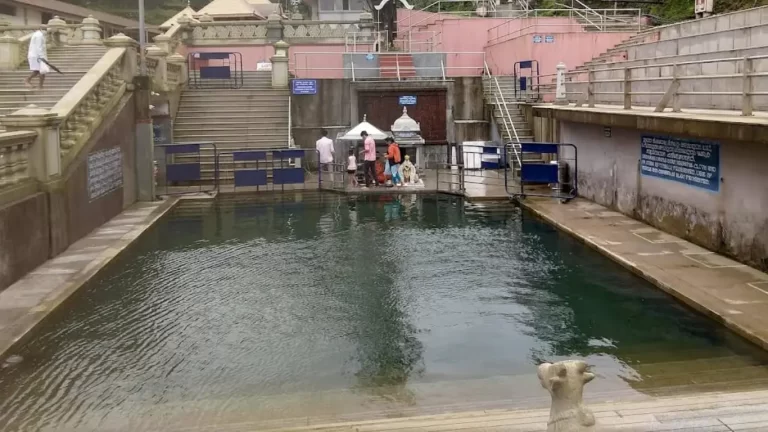
As Ilvala bellowed out for his brother, no reaction occurred because Vatapi was already fully digested and destroyed! It is interesting to note that the beautiful lake found near the caves is known as Agastya Teertha Lake in respect of the sage Agastya who once purified the area by practicing his meditations there!
Read More>> Scriptural Mystery of Khatu Shyam Temple: Legend of 3 Arrows
Centuries of Turmoil and Development
The peace of Vatapi was not meant to endure for long. There existed an endless rivalry between the rulers of the Chalukya dynasty and the kings of the Pallavas of Kanchipuram (present-day Tamil Nadu state). The Pallava army, led by Siruthondar under King Narasimhavarman I, attacked Vatapi in 642 AD to take revenge on the previous war he lost.
Throughout the ages, the power of Vatapi changed hands as frequently as the sand dunes shift. The Rashtrakuta Empire ruled, followed by the Western Chalukyas, the Vijayanagara Empire, Adil Shahis of Bijapur, Marathas, Hyder Ali, Tipu Sultan, and finally the English. Each empire managed to leave its imprint on the landscape in one way or another, but the greatness of Badami cave temples stood firm against all odds.
3. Religious and Cultural Significance
The pilgrimage experience of visiting Cave 1 and Cave 4 shows how this site has been an example of religious tolerance since ancient times. Although the Chalukya kings were themselves devoted followers of Vaishnavism, they were open-minded about other religions that existed during their reign. For instance, the Badami cave temples were created to reflect different major religions of those times, and so we have one temple for each: Cave 1 honors Lord Shiva, Caves 2 and 3 honor Lord Vishnu, and finally Cave 4 pays tribute to the Jain Tirthankaras.
Religious texts and holy water
The spiritual significance of this place is explained in several Hindu texts. The Skanda Purana and Mahabharata both make mention of this holy site, which is associated with the Malaprabha River Valley and hermitage of Sage Agastya. The Agastya Teertha lake situated under the cave openings is considered to be extremely sacred. According to mythology, this lake was brought to Earth from heaven by Garuda, the vahana of Lord Vishnu.
The celestial source of water has endowed it with miraculous healing powers, which have been attracting pilgrims for centuries. It is believed that anyone who takes a holy dip in Agastya Teertha believing it can wash away physical illnesses and cleanse the soul of karmic sins.
Fostering Religious Tolerance
Theological conflicts between religious groups such as the Shaivites and the Vaishnavites have been common in medieval times due to their differences in beliefs. Through their art in the Badami cave temples, the kings of the Chalukyan kingdom were able to convey their message of religious tolerance.
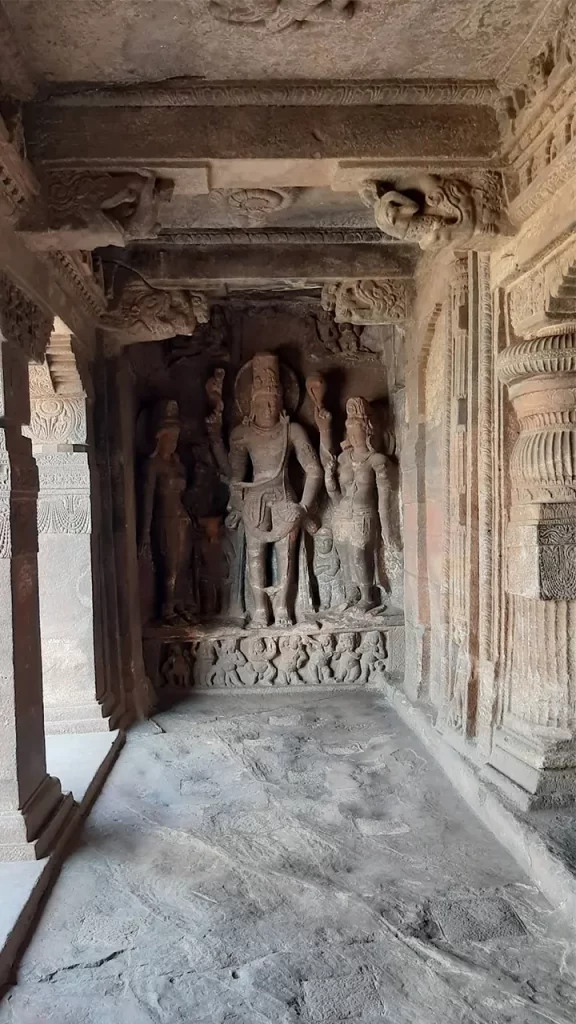
While viewing Cave 1, I will point out the gigantic statue of Harihara, which symbolizes the union between the two most powerful gods—Shiva on the left side and Vishnu on the right side. The kings of old merged the two gods into one body, conveying their message, “The Supreme Truth is one; the wise call it by various names.”
4. Architecture and Design
Now, let us have a detailed discussion on the construction of these wonders. The architectural design of the Badami cave temples can be regarded as one of the earliest and most magnificent phases in the development of Badami Chalukya Architecture. This is an interesting combination of the northern-style Nagara architecture with the southern-style Dravida architecture to form what is known as the Vesara style of architecture.
Layout of the Rock Cut Temple
Every one of the Badami cave temples has a well-organized and carefully designed structural layout that has been sculpted from the outer surface of the mountain wall to its inner surface. The four architectural units of the layout include:
- The Entrance Verandah (Mukha Mantapa): This is a broad-columned entrance porch serving as a transitional space from the bright light of the gorge to the sanctity of the mountain.
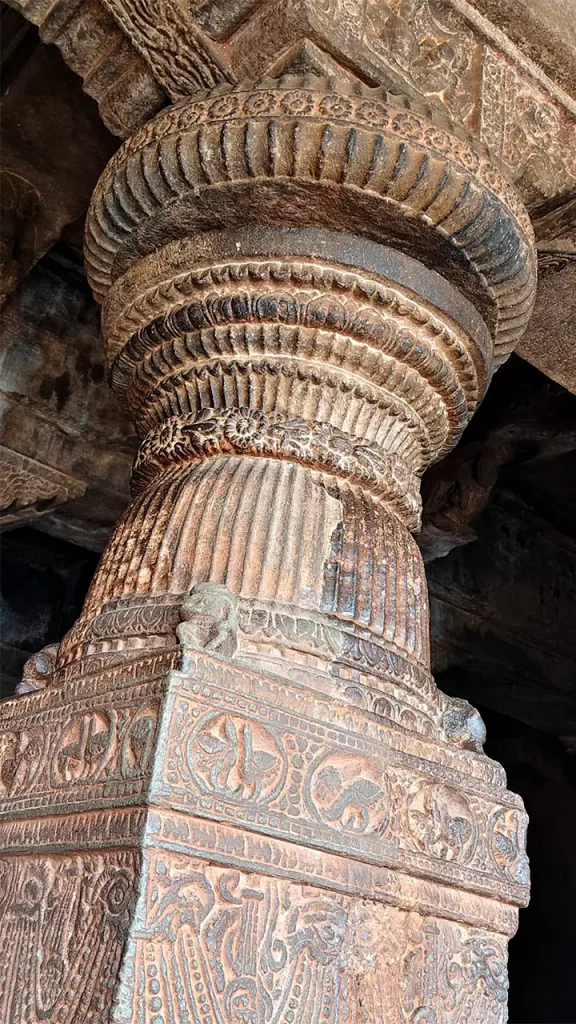
- The Pillars and Brackets: The verandah has huge stone columns with beautifully carved brackets (Madanikas or Surasundaris).
- The Columned Main Hall (Maha Mantapa): This is an extensive, shaded hall built on square pillars with aisles that lead you toward the back of the cave.
- The Sanctum Sanctorum (Garbhagriha): A little, dark, square room that is excavated deeply into the mountain. It houses the principal deity and is located away from the hustle-bustle of the outside world.
Read More>> Sanwariya Seth Temple: Tycoons Secretly Offer 50% Profits
Construction Materials and Engineering Brilliance
For construction, the chosen stone is the renowned Badami Sandstone. The stone is well-known for its characteristic reddish-orange coloration that gradually transitions into gold in the setting sun. This type of sandstone is soft when extracted from beneath the ground, giving artisans scope to create fine details; however, it becomes very hard after being exposed to the open air.
Let’s reflect on the kind of engineering brain required for such a construction task. In constructing a conventional temple structure, if the artisan makes an error while shaping the blocks of stones, the mistakes can be scrapped off and a new stone procured. But when it comes to constructing a rock-cut temple like the Badami cave temples, there is no jointing. In the case of rock-cut architecture, every pillar, wall, ceiling pattern, and gigantic statue is chiseled out of a single block of mountain stone.
A mistake by just one blow of his hammer would result in the complete destruction of ten years’ worth of labor. The stonemasons worked backwards, starting from the top and working their way down until they left just enough stone to create pillars that would hold up the tremendous weight above. Truly amazing!
Symbolic Details and Traces of Ancient Paint
By examining the ceiling decorations in the Badami caves, one will notice many rings carved out of stone, geometric designs, and flying couples of celestial beings called Gandharvas. Initially, however, the interiors of these caves were not just rock structures, but were entirely painted.
The early painters in these caves made use of various vegetable and mineral pigments to color the rock carvings. In Cave 3, by looking at the nooks of the cave ceiling and walls, some notches can be seen that served as paint mixers for the artists, along with small portions of the 1,500-year-old paintings.
5. Main Attractions or Highlights
Make sure you wear comfortable shoes since we will be scaling the rock steps, and together, discover the exclusive features of each of the four Badami caves.
Cave 1: The Realm of Lord Shiva
As soon as you reach the top of the stairs leading to the first cave, you are already standing in front of Cave 1, constructed during the last years of the 6th century. In this cave, there is one feature that you cannot miss – an impressive 18-armed statue of Lord Nataraja engaged in his Tandava dance.
On close examination of the 18 arms of Nataraja, one finds that they are placed in a remarkable geometric shape. On tracking the movement of the hands one by one, it is discovered that they actually perform 81 mudras of Bharatanatyam dance. To the left of his legs is seen a slender representation of Lord Ganesha in his ancient avatar and a tiny figure of the faithful drummer Tandu.
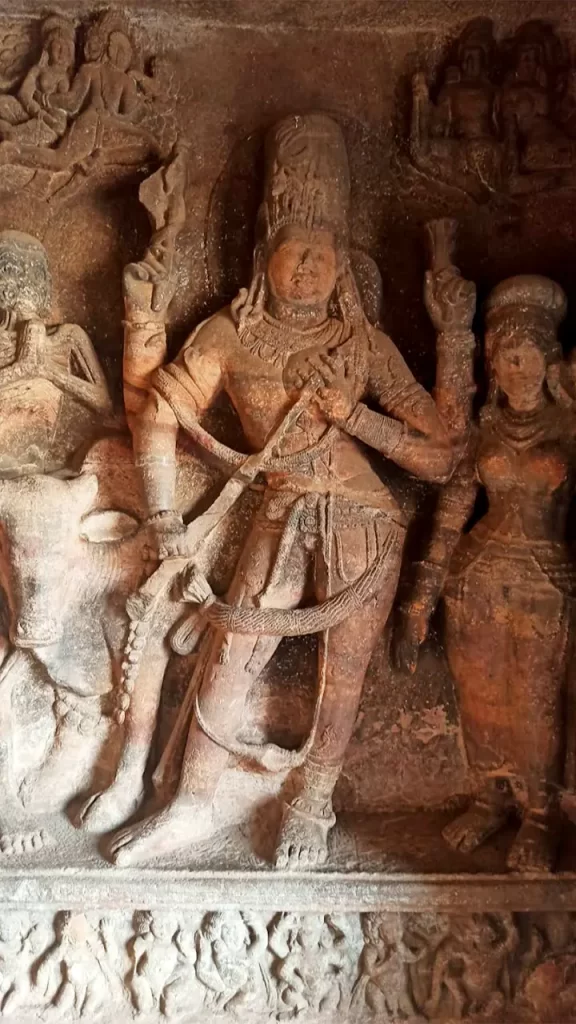
In Cave 1, besides other sculptures, there can be seen the beautiful, 7-foot tall panel of Ardhanarishvara—the perfect combination of Shiva and Parvati vertically. The male half of Shiva wears an axe, a snake, and a little crescent on his head while the female part of Parvati displays a delicate figure, an ornamented ear-ring, a high breast, and a foot wearing anklets.
Beside it, observe the figure of a sage named Bhringi, who was a sage with a skeleton body. It is said that he would not worship anybody but Shiva because Shiva had blessed him with immortality. This infuriated Parvati, who cursed him to become fleshless as his mother had given flesh to him alone. Out of sympathy, Shiva gave him a third leg to stand erect!
Cave 2: The Cosmic Strides of Vishnu
Going up a few steps, we reach Cave 2, where Lord Vishnu is enshrined. At Cave 2, the guard pillars have celestial beings known as Dvarapalas wielding their arms.
The major attractions at Cave 2 include the following two enormous and dynamic wall panels:
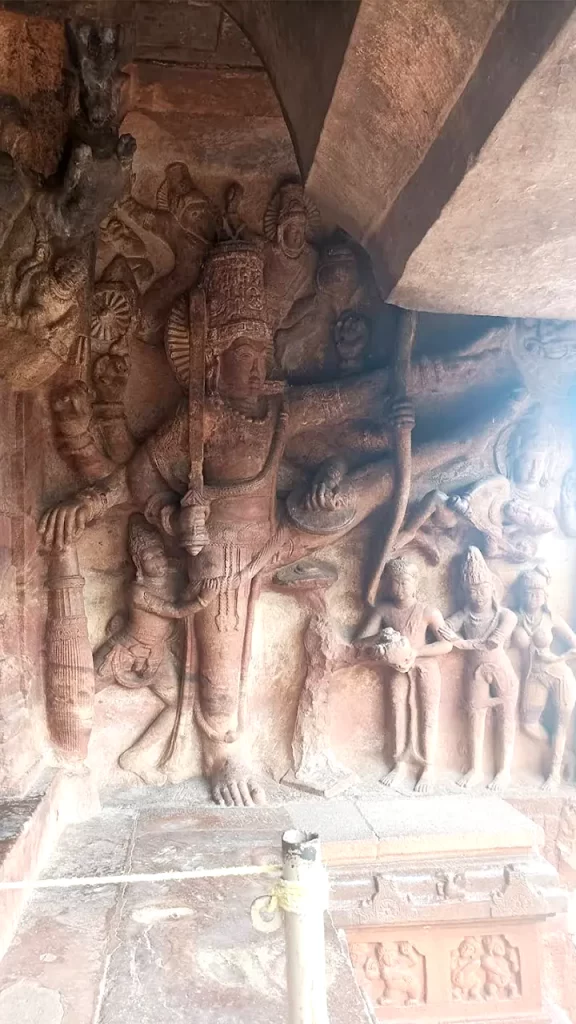
- Trivikrama (The Giant Strides): The panel illustrates Lord Vishnu taking his giant strides. He takes the form of a huge cosmic being, placing one leg on Earth and the other leg in the skies, seizing the entire cosmos from King Bali.
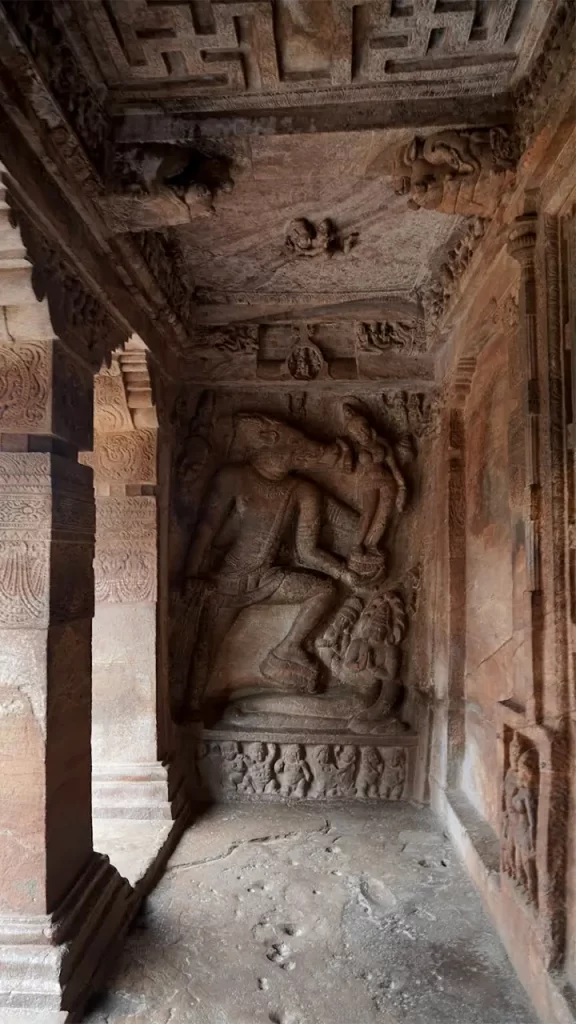
- Varaha (The Cosmic Boar): This poignant panel illustrates Vishnu in the form of a cosmic boar, rescuing Bhoodevi, the Goddess Earth, from the tumultuous primordial oceans and placing her on his shoulders.

Cave 3: The Crown Jewel of Vatapi
Now take a deep breath as we ascend towards Cave 3. This cave temple is the largest, deepest, and most intricately carved cave out of all those present within the Badami cave temples group. As I discussed above, this particular cave is proud to house the famous inscription dated 578 CE from King Mangalesha.
Unsurpassed in its artistic perfection, the interiors of Cave 3 contain very dense relief carvings on its columns that showcase figures of couples, dwarfs (ganas), and floral designs. Some of the best works present at Cave 3 are as follows:
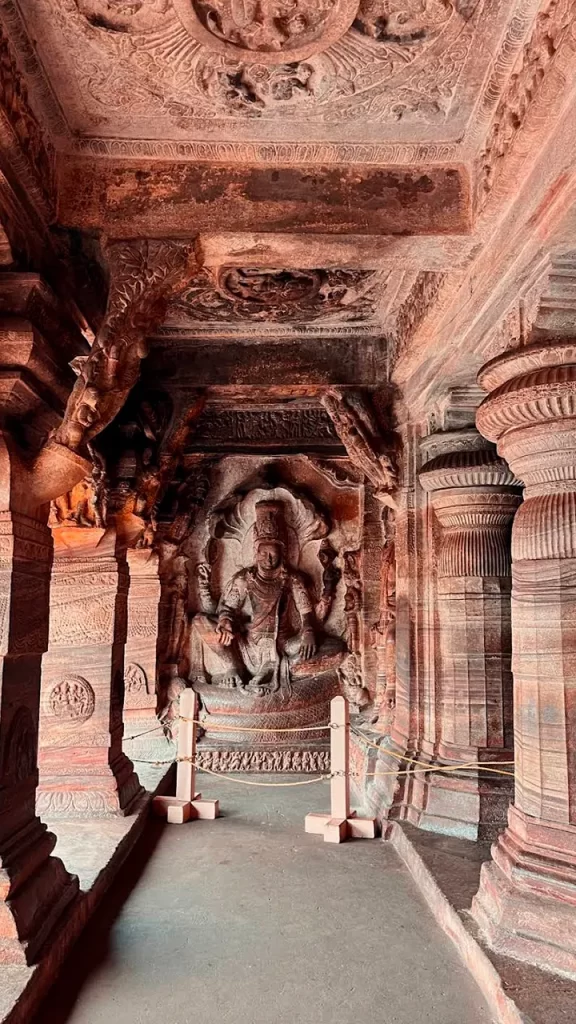
- Seated Vishnu (Anantasayana): A massive sculpture of Lord Vishnu in a state of immense tranquility seated on the coils of the body of the five-headed serpent king named Adishesha.
- Maha Narasimha: An absolutely amazing four-armed sculpture of the lion-human form of Maha Narasimha leaning against his weapon in sheer majesty.
- Harihara and Trivikrama: Larger sculptures of the two previously seen figures, yet much more detailed in design.
Cave 4: The Serene Abode of Jain Tirthankaras
Next comes Cave number 4, the topmost cave, which was hewn somewhat later, probably during the late 7th to early 8th century. Here is a great change of mood from violent conflicts in the universe to total peace and silence for meditation.
In Cave number 4, the cave walls are decorated with some elegant, sharp sculptural depictions of Jain Tirthankaras. There are two main attractions here, namely:
- Lord Bahubali (Gommateshwara): An impressive figure of Bahubali, who is in profound meditation and so motionless that forest creepers start wrapping themselves around his limbs.
- Lord Parshvanatha: An impressive depiction of Parshvanatha, who stands in deep meditation under the protection of an elegant multi-headed hood of a snake.
- The Sanctum: In the inner sanctum there is an elegantly sculpted idol of Lord Mahavira, the 24th Tirthankara, seated calmly on a lion’s throne.
6. Temple Timings and Rituals
Now that you know how to visit these monuments successfully, let us look at the operational logistics of the Badami Cave Temples.
Opening Timings
The temple complex is administered directly by the Archaeological Survey of India (ASI) and operates on all days of the week. From Monday to Sunday it opens at 06.00 AM and closes at 06.00 PM.
Pro-Tip from your Guide: For an enchanting view of how the red sandstone rocks transform into fiery orange rocks, ensure that you either catch the sunrise just before 06:00 AM or climb the stairs around 04:30 PM. The noon time sun heats up the rock formations, making them feel extremely hot.
Daily Routines and Poojas
Since the Badami Cave temples are officially recognized by ASI as historical monuments, they lack the status of functioning as an active community parish temple with daily routines such as frequent prasadam offerings and archana sessions at set hours.
Nevertheless, the inner fire is never allowed to die out. The local priest performs an extremely ritualistic ‘Morning Pooja’ and an equally tranquil ‘Sunset Aarti’ in the temples to revere the ancient deities.
On special dates, when Hindu festivals fall in line, special prayers are held in the caves filled with the melodious recitation of Vedic hymns.
Dress Code and Manners
Although there isn’t a stringent dress code that is checked at the gate level, since these are ancient shrines of immense cultural value, it is very important to dress appropriately in order to pay respect to their sanctity. One should avoid dressing in sleeveless tops, mini skirts, and beachwear.
- Rule on Footwear: It is necessary to take off one’s shoes before entering the elevated verandahs and sanctums of each cave temple.
- Monkey Alert: The staircase leading to the Badami caves houses an enormous number of local macaque monkeys that can get extremely naughty! It is best not to carry any food items or bottled drinks on the excursion; they should be kept safely inside the backpacks.
7. Festivals and Events
However, in order for this ancient landscape of sandstone to come alive before your eyes, it would be advisable to try and plan a visit during one of the colorful festivals that take place in the region.
Chalukya Utsava
This is a fabulous cultural festival held annually by the Government of Karnataka, normally in February, over the course of three wonderful days. The festival takes place in Badami, Aihole, and Pattadakal. At Chalukya Utsava, the cave temples of Badami light up during the night in thousands of lights.
The artists, classic dancers, musicians, actors, and performers arrive from all over the country. You will be able to watch vibrant folk dances such as Dollu Kunitha, enjoy performances of classical music, and watch exciting historical dramas performed on the backdrop of the lit-up red rocks.
Banashankari Devi Jatra
Banashankari Devi Jatra temple car festival takes place at the famous Banashankari Amma Temple, which is only a few kilometers away from the cave system. This festival takes place annually during the month of January or February on an auspicious day called Pushya Maasa.
The Banashankari Devi Jatra temple car festival is one of the biggest rural fairs in northern Karnataka. It attracts thousands of devotees to the area. There are big wooden carts that roll down the streets of the fair ground along with various shops selling sweets.
Important Religious Days
On the occasion of Mahashivratri (February/March), Cave 1 becomes one of the most important places that receive a large number of devotees for offering prayers to the dancing Nataraja and Harihara. Likewise, on Navratri/Dussehra (September/October), there are religious decorations with evening lamps lit all around the Agastya Teertha lake.
Crowd Patterns
- Days When Crowds Peak: Weekends (Saturday and Sunday), public holidays, and even the whole period of January/February when there is a full-scale festival witness an extremely heavy influx of visitors and school tours.
- The Most Solitary Periods to Visit: For those who like to be alone, meditating and having their moments with a drawing book or a camera in hand, a visit during July-October Tuesday/Wednesday mornings would suit them well, as the monsoon showers have made the canyons green and red rocks squeaky clean.



8. Practical Travel Information
Here’s everything you need to know about how you can reach here and how things will be once you’re on the ground.
Getting to Badami
Badami is highly accessible via several means of transportation, thus forming an important part of your itinerary:
Via Air: The closest domestic airport is located in Hubballi (Hubli), just about 105 km from Badami, which offers regular services connecting to all major Indian metropolises like Bengaluru, Mumbai, and Delhi. The closest international airport is Belagavi, just about 142 km away.
Via Rail: There is a railway station named BDM in Badami, connecting directly to other major cities like Hubli, Bagalkot, Bangalore, Bijapur, and Gadag.
Via Road: State highways connect Badami. Frequent bus services are available from Bengaluru (450 km), Hubli, and Hosapete (Hampi).
Entrance Fee Structure
The entrance fee system in the Badami cave temples is extremely economical:
(It is very easy for you to get your tickets on site at the ASI through their online portal via a QR code scan without standing in queue at the ticket window.)
Facilities On-Site
- Bathrooms and Drinkable Water: The ASI provides clean and well-maintained restrooms as well as drinkable water stations located near the entrance gate at the bottom of the hill.
- Local Guides: Local guides registered in the ASI are always available close to the ticket booth. Hiring such guides would cost about Rs. 200 to 300. I would suggest that you hire them, because they know everything carved here and are passionate about sharing local legends!
- Hotel Facilities: There are many hotels available in the town of Badami, starting from cheap local guesthouses to quality three-star hotels run by the Karnataka State Tourism Development Corporation (KSTDC).
Accessibility for Elderly & Physically Challenged Visitors
Since the Badami caves have been carved out in a natural mountain rock formation, one will have to climb many steps, about 150 to 200 steps, to move from Cave 1 to Cave 4, because of the elevation difference between the two.
Unfortunately, owing to the inflexibility of the ancient monument that is constructed out of rock, there is no possibility of installing wheelchair lifts or ramp access to the caves. Those who suffer from any physical difficulties should definitely bring their walking stick and rest after every few minutes at the stone platforms between caves.
Read More>> Banke Bihari Temple, Vrindavan
9. Dos and Don’ts
For you to have a safe, enjoyable, and educational visit to the Badami cave temples, you need to follow the following rules:
The Dos:
- Do drink enough water: With the stone walls reflecting sunlight and heating up the area, the steps leading up to the temple may cause you to become thirsty very quickly.
- Do employ a local guide: History and mythology bring lots of meaning to what you would see in there.
- Do use a tripod after receiving prior authorization: Using normal cameras without tripods is absolutely fine, but if you want to shoot professionally with expensive equipment or heavy tripods, you should get a permit first.
- Do keep silent: The caves have very good acoustics. You will not believe how echoes bounce around the place, so do remain silent out of reverence.
The Don’ts:
- Do not touch or scratch the carvings: The oil produced by the human body will eventually erode the sandstone reliefs which have been around for nearly 1,500 years now.
- Don’t bring in open foods: It’s important to know that the monkeys here are excellent pickpockets. This is why it is necessary to keep your food well-sealed.
- Don’t throw any trash anywhere: Help us preserve this ancient heritage site. Use only the waste disposal areas set up on the terraces.
- Don’t take photos with a flash on: The powerful lights coming from the camera’s flash may harm the remains of the vegetable dye paintings on the ceiling of the caves.
Read More>> Chinnamasta Devi Temple Jharkhand
10. Nearby Attractions
When you are done with admiring the amazing Badami cave temples, hold your horses for there are even more stunning sights that await you at close quarters.
The Bhutanatha Temple Complex
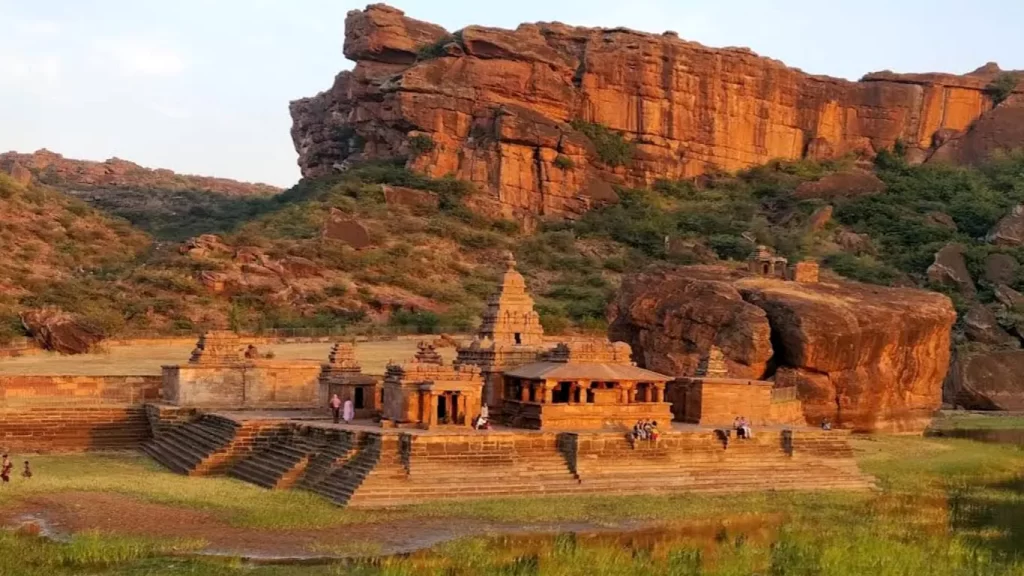
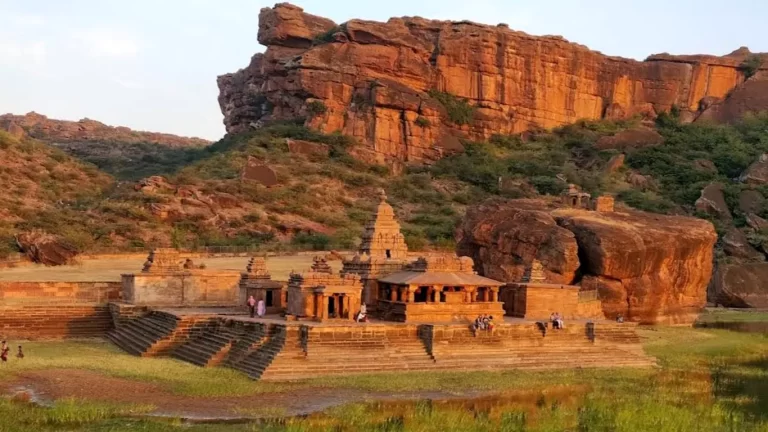
From Cave 2 or 3 terraces, overlooking the water body, you would be able to admire the picturesque view of a group of shrines built of sandstone resting on the eastern shore of the Agastya Lake. The Bhutanatha Temple Complex is devoted to Lord Shiva in the Bhutanatha incarnation. It dates back to the 7th to 11th century and comprises architectural wonders of both Early Chalukyas and later Kalyani Chalukyas. An absolute must visit is the Bhutanatha Temple Complex by the sunset when it mirrors in the water.
Badami Fort and Upper Shivalaya
This impressive Badami Fort, located on the northern cliffs and situated right opposite the cave temples, can be easily accessed if you have enough energy to climb even higher. You will have to go through the sandstone gorges, ancient gates, and other fortifications built to protect the site from intruders. On reaching the very top, you will encounter the Upper Shivalaya and Lower Shivalaya temples constructed by the King Pulakeshin II, providing you with an amazing 360-degree panoramic view of the entire valley.
The Archaeological Museum
Another great sightseeing opportunity provided by the site is this incredible ASI-run museum located just off the northern shore of the lake. Here, tourists are able to see amazing archaeological artifacts, inscriptions, and sculptures found after numerous excavations carried out throughout the area. What makes this museum unique is its collection of Lajja-Gauri figurines related to the prehistoric fertility cult.
A Great Architectural Trilogy: Aihole & Pattadakal
No visit to Badami can be considered complete without the visits to its twin sites that are only a few kilometers away from each other:
Pattadakal (14 km): A UNESCO World Heritage site situated on the banks of the Malaprabha River and having a fantastic collection of nine structural temples of Hindus and one temple of Jainism – the epitome of the evolution of the art of Chalukya Architecture.
Aihole (35 km): Referred to the world over as “the laboratory of Indian architecture,” Aihole has over 120 stone temples to boast of, among which the horse-shoe shaped temple of Durga & the Meguti Temple.
Read More>> Mopidevi Subramanya Swamy Temple
11. FAQs (Frequently Asked Questions)
Some answers to the most frequently asked trending questions by tourists who come to the Badami caves are listed below:
Question 1: What is the number of caves at the Badami caves temple complex?
Answer: There are a total of four big numbered caves within the temple complex at the Badami cave temples site. Cave No.1 is Shaivite, while Caves No.2 and No.3 are Vaishnavite in nature. Cave No.4 is Jain. Besides, if you venture a bit more around the area beyond the caves complex around the fort and lake areas, you can discover several other small natural caves which have rudimentary carvings on their walls, including a small Buddhist cave.
Question 2: Which is the best season for visiting the Badami caves?
Answer: Ideally, the best season for visiting the Badami caves is the winter and early spring months (October to March). During these months, the climate is absolutely gorgeous, with temperatures between 16°C and 28°C and ideal climatic conditions for outdoor trekking along the cliffs. The monsoons period between July and September are equally wonderful when the whole of the dry landscape becomes lush and green.
Q3: Is it safe to visit Badami alone, and how many monkeys can be seen there?
Answer: Indeed, Badami is a very safe, serene, and hospitable city for solo and foreign travelers. And regarding the monkeys—yes, there are huge numbers of rhesus macaque monkeys near the steps leading to the cave temples of Badami. They are generally harmless, provided you keep off them, but they will viciously attack anyone with plastic bags, food products, or even water bottles. Just keep all your stuff properly zipped and you’ll be just fine!
Q4: How do Badami cave temples differ from other similar cave structures like Ajanta and Ellora?
Answer: Even though Ajanta and Ellora caves are amazing sites, Badami cave temples differ from them in historical importance since they mark the first securely dated rock-cut shrines of Hindus in India, according to the inscription dating back to 578 AD in Cave 3. Moreover, they are historically crucial due to their role as an evolutionary connection between northern and southern architectural style of temples in India.
Q5: Is it possible to photograph in the caves, and is there an additional fee for cameras?
Answer: Personal photography on smartphones and other cameras for personal purposes is completely free and can be done inside all the caves. On the other hand, taking videos professionally, using drones, and setting up large tripods would need special permission from ASI. Don’t forget to keep the flash turned off while seeing the ancient wall murals!
12. Conclusion
As our trek draws to a close and the setting sun sends a warm and golden-purple hue into the calm waters of the Agastya Teertha lake, it becomes clear why the Chalukya kings considered this secret valley sacred and made it their dwelling place. The Badami cave temples aren’t just a group of ancient stone structures; they’re a timeless declaration of love from the past, expressed in the enduring medium of red sandstone.
From the powerful dance of the eighteen armed Nataraja to the meditative repose of Lord Mahavira sitting on his lion throne, each of the carvings we viewed today speaks of an India where artistic perfection was cherished alongside engineering brilliance and an acceptance of many spiritual paths.
Looking around at these cliff faces, you know that empires come and go, kings become dust, and rich cities disappear, but what the human spirit achieves through devotion can endure any test of time for over 1,500 years.
I really appreciate giving me the honor to be your guide for such an amazing journey through history today. I do wish that as you pack up and head home, you have a little part of the golden charm of the Badami caves with you in your heart always. Until we meet another day down some other trail-Happy Traveling!