Sacred Tulsi Plant at Home: Meaning, Worship, Placement & Care
In millions of Indian homes, the day begins not with a blaring alarm or the clatter of kitchen utensils, but with a quiet walk to a modest green plant. Someone carries a small brass pitcher of fresh water, their feet bare against the cool morning floor. They pause, fold their palms together, whisper a simple prayer, and pour the water into the moist soil beneath delicate, aromatic leaves. As the evening sets in, a warm mustard oil or ghee lamp flickers gently beside the same planter, casting soft shadows across the courtyard or balcony.
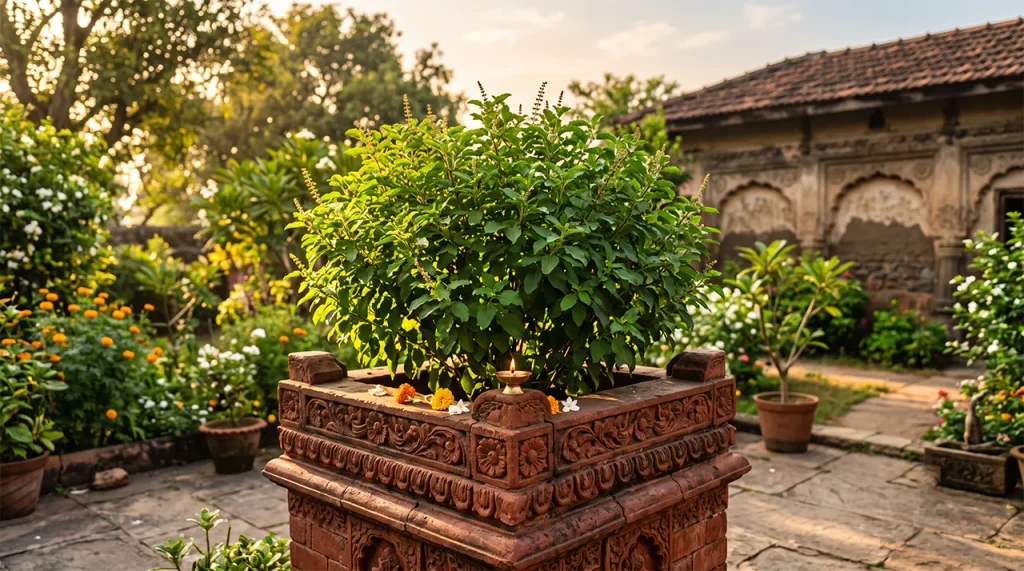
This is the Tulsi plant at home—a fixture of daily life across the Indian subcontinent for thousands of years. It sits on sprawling open courtyards of heritage village homes, on crowded urban window sills, and on apartment balconies twelve floors above bustling city traffic.
To an outsider, Tulsi looks like an ordinary botanical specimen—a woody shrub with small, fragrant green or purple leaves belonging to the mint family. Yet, to the people who tend it, Tulsi is never just a houseplant. She is addressed as Tulsi Devi or Tulsi Maharani, revered as a sacred manifestation of devotion, a spiritual protector of the household, and an inseparable part of family life.
Why does a modest herb hold such an enduring place in Hindu culture? What does the plant represent spiritually, why is it tied so deeply to Lord Vishnu, and what are the timeless traditions—and practical gardening requirements—needed to help it thrive?
What Is Tulsi? Botanical Identity and Cultural Roots
Botanically classified as Ocimum tenuiflorum (and historically referred to as Ocimum sanctum), Tulsi belongs to the Lamiaceae family, commonly known as the mint family. In English, it is widely known as Holy Basil. It is closely related to culinary sweet basil (Ocimum basilicum), but carries a distinctly more pungent, peppery, clove-like scent caused by high concentrations of essential oils like eugenol.
In Sanskrit, the word Tulsi (तुलसी) literally translates to “the incomparable one” or “she who has no equal.” In traditional texts, it is also called by names that describe its nature and qualities:
- Surasa (one who has delightful juice or fragrance)
- Devadundubhi (signaling the presence of the divine)
- Vaishnavi (belonging or dear to Lord Vishnu)
- Pavani (the purifier)
While modern science views the plant as an aromatic, adaptogenic shrub rich in antioxidants, classical Indian tradition views it as a living bridge between the human household and the divine realms.
The Sacred Varieties: Rama, Krishna, and Vana Tulsi
When people speak of growing a Tulsi plant at home, they are usually referring to one of three primary varieties found across India. Each has slight botanical distinctions, unique aromatic profiles, and traditional preferences.
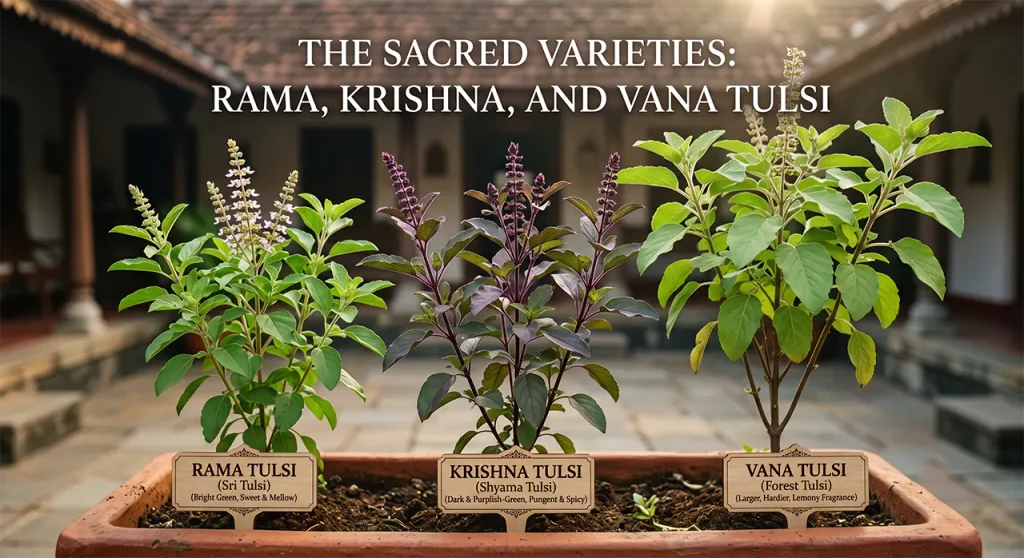
1. Rama Tulsi (Sri Tulsi)
Rama Tulsi has bright, vibrant green leaves and light purplish-white flowers. It smells sweet, mellow, and slightly like cloves. It is the most common variety found in residential home courtyards and terraces because it adapts well to daily domestic worship and domestic care.
2. Krishna Tulsi (Shyama Tulsi)
Krishna Tulsi—often called Shyama Tulsi due to its dark, purplish-green leaves and stems—is named after Lord Krishna, whose complexion is traditionally described as dark like a monsoon cloud. This plant has a more pungent, spicy scent and a higher concentration of aromatic oils. Many families prefer Krishna Tulsi specifically for devotional rituals dedicated to Vishnu and Krishna.
3. Vana Tulsi (Forest Tulsi)
Vana Tulsi (Ocimum gratissimum) is a hardier, wilder relative that grows naturally in the fields and lower hills of India. It features larger, broad green leaves and a strong, lemony, spicy fragrance. While it can be grown in pots, it grows into a significantly taller, woodier bush and is less commonly used as the central household ceremonial plant than Rama or Krishna Tulsi.
Read More >> Fasting on Ekadashi: Meaning, Rules, Benefits & Food Guide
Why Is Tulsi Considered Sacred? Spiritual Meaning and Devotional Symbolism
Tulsi is considered sacred in Hinduism because she is not seen merely as flora, but as a pure, conscious devotee of the Supreme who took the form of a plant to bestow grace upon the world.
In traditional Hindu theology, plants, rivers, mountains, and animals can manifest spiritual energy. Tulsi sits at the pinnacle of this plant reverence. She embodies Bhakti—pure, unmotivated, and unshakeable devotional love.
Purity (Shuddhi) and Auspiciousness (Mangalam)
Traditional families believe that the spot where a Tulsi plant grows becomes inherently sanctified. Its presence designates a clean, uplifting perimeter within the home. The scent of the leaves, the cleanliness required around the planter, and the daily habit of pausing before it create an atmosphere of mindfulness that dispels daily domestic agitation.
Protection (Kavacha)
Ancient texts frequently speak of Tulsi acting as a spiritual shield around the home. Her presence is said to ward off inauspicious energies, spiritual stagnation, and ill intent. This is why traditional homes place her directly in the central open courtyard (angan) or right near the primary threshold, creating an energetic doorway through which everyone enters and leaves.
The Embodiment of Goddess Lakshmi
In many Puranic traditions, Tulsi is treated as an earthly expansion or form of Goddess Lakshmi, the consort of Lord Vishnu and the deity of spiritual and material abundance. To welcome Tulsi into the home is, symbolically and spiritually, to invite Lakshmi herself to reside within the family space.
Tulsi in Hindu Scriptures: Puranic Lore, Lord Vishnu, and Vrinda
The reverence for Tulsi is anchored across major Hindu texts, notably the Padma Purana, Skanda Purana, Brahma Vaivarta Purana, and Srimad Bhagavatam. While regional traditions tell variations of these stories, they all tie Tulsi directly to devotion, unyielding chastity, and the mercy of Lord Vishnu.
The Legend of Vrinda
The most prominent story is that of Vrinda, a deeply devoted woman married to the demon king Jalandhara. Born of the ocean, Jalandhara possessed immense power, which was rendered invincible by the spiritual purity and absolute fidelity of his wife, Vrinda. Because of Vrinda’s unwavering pativrata dharma (unmatched piety and protective marital fidelity), Jalandhara could not be defeated in battle, even by the Devas (gods).
As Jalandhara’s tyranny threatened cosmic balance, the gods approached Lord Vishnu for an intervention. Understanding that only breaking Vrinda’s vow would weaken Jalandhara, Vishnu took the form of Jalandhara and appeared before her. Deceived by the disguise, Vrinda greeted him, unintentionally compromising the spiritual power of her vow. At that precise moment on the battlefield, Jalandhara fell.
When Vrinda realized the truth, she was shattered by the deception. In her grief and anger, she cursed Vishnu to turn into a black, unyielding stone (which manifested as the sacred Shaligram stone found in the Gandaki River of Nepal). Recognizing her supreme devotion and suffering, Lord Vishnu accepted the curse and blessed her. He declared that she would transcend physical death, transforming into the sacred plant Tulsi. He promised that his worship would forever remain incomplete unless her leaves were offered at his feet, and that he would marry her in an eternal union.
Scriptural Verses Honoring Tulsi
The Padma Purana states that even a glimpse of Tulsi destroys accumulated misdeeds, touching her purifies the body, praying to her removes anxieties, watering her removes the fear of death, and planting her leads to closeness with the Divine:
दृष्ट्वा स्पृष्ट्वा तथा ध्यात्वा कीर्तिता नमसा कृता ।
रोपिता सेविता नित्यं पूजिता तुलसी शुभे ॥
(Padma Purana, Uttarakhanda)
Meaning: “By seeing her, touching her, meditating upon her, singing her glories, bowing before her, planting her, serving her, and worshipping her daily—Tulsi always brings auspiciousness.”
The Festival of Tulsi Vivah: The Divine Wedding
One of the highlights of the Hindu calendar is Tulsi Vivah, the ceremonial wedding of the sacred Tulsi plant to Lord Vishnu, usually in his form as the Shaligram stone or as Lord Krishna.
When and Why It Is Celebrated
Tulsi Vivah is observed during the bright half of the lunar month of Kartika (usually October or November), starting on Prabodhini Ekadashi (the 11th lunar day) and continuing through Kartik Purnima (the full moon).
According to tradition, this festival marks the end of Chaturmas—the four-month period during which Lord Vishnu is said to rest in cosmic sleep (Yoga Nidra). When he awakens on Prabodhini Ekadashi, the very first act performed is his marriage to Tulsi. This ceremonial union inaugurates the annual Hindu wedding season; no traditional marriages are typically held during Chaturmas until Tulsi Vivah has taken place.
The Rituals of the Wedding
Families transform their courtyards into festive wedding venues:
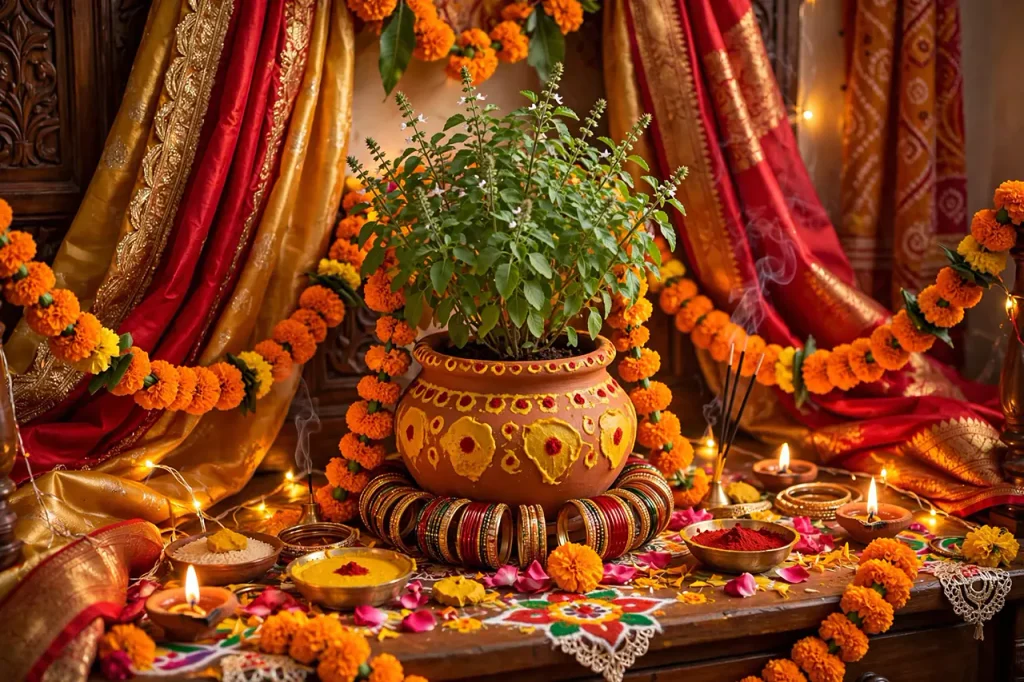
- The stone or ceramic Tulsi planter (Tulsi Chaura or Vrindavan) is whitewashed, painted with bright colors, and decorated with intricate rice-flour patterns (rangoli or kolam).
- A canopy of fresh sugarcane stalks, mango leaves, and marigold garlands is erected over the plant.
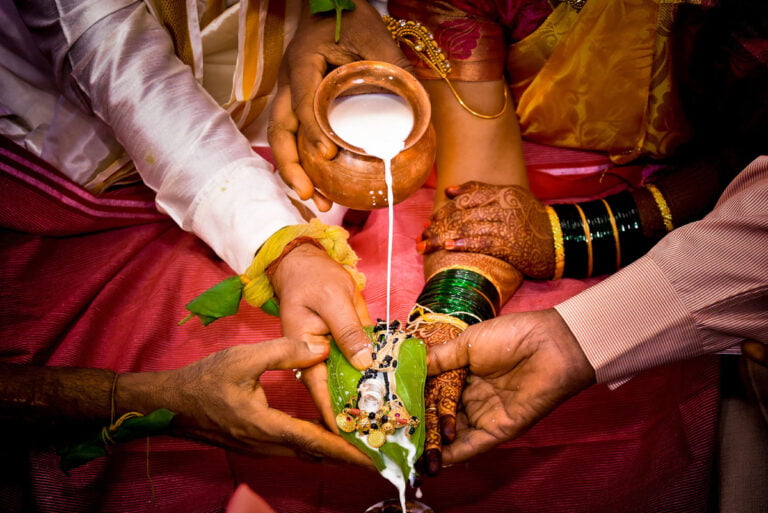
- The Tulsi plant is dressed like a bride in a red silk cloth (dupatta or sari), adorned with vermilion (sindoor), turmeric, bangles, and small ornaments.
- A Shaligram stone, an idol of Krishna, or an image of Vishnu is placed beside the plant, draped as the groom.
- A family priest or senior elder ties a sacred thread (kautuka) connecting the plant and the deity, chanting Vedic wedding mantras while offerings of sweets, puffed rice, fruits, and tamarind are shared among neighbors.
Why Hindus Keep Tulsi at Home: Spiritual, Cultural, and Domestic Roles
To understand why Tulsi sits in practically every traditional Hindu home, one must look at how domestic spaces are viewed in Indian philosophy. The home is not merely a box of concrete and wood; it is regarded as a griha-ashram—a sacred sanctuary where daily family life is lived as an offering to God.
1. A Living Daily Altar
Unlike metal statues inside a closed prayer closet (puja ghar), Tulsi is a living, breathing being that requires care, light, and water. Tending to her turns routine morning chores into conscious spiritual discipline (Sadhana). You cannot merely wipe dust off Tulsi once a month; she demands daily mindfulness.
2. Passing Traditions to the Next Generation
In traditional joint families, the care of the Tulsi plant is often entrusted to children or young adults. Tending the plant teaches fundamental virtues:
- Waking early: Approaching the plant after bathing instills clean morning habits.
- Reverence for nature: Teaching children that a green plant possesses sacred dignity builds ecological sensitivity early in life.
- Gentle handling: Plucking leaves with care teaches gentleness and gratitude.
3. A Natural, Uplifting Domestic Atmosphere
Beyond ritual, the presence of an aromatic Tulsi plant imparts a clean, clarifying atmosphere. Her foliage releases delicate essential oils when warmed by the sun, naturally freshening courtyards and open living spaces.
Where Should the Tulsi Plant Be Kept at Home? Direction and Placement
One of the most frequent questions people ask is: “Where exactly should I place my Tulsi plant?” Traditional domestic architecture (Vastu Shastra) and modern botanical requirements provide clear, complementary answers.

Ideal Vastu Directions
In Vastu traditions, the flow of subtle energy within a living structure moves primarily from the Northeast to the Southwest. Therefore, directions that welcome morning light and fresh atmospheric currents are prioritized:
- North-East (Ishan Kon): This is considered the absolute premier location for a Tulsi plant. The Northeast is associated with clarity, spiritual growth, and high water energy. It receives gentle morning sunlight without the harsh afternoon heat that wilts soft leaves.
- East: Placing Tulsi in the East ensures the plant absorbs rich, unfiltered morning rays, fostering both healthy botanical growth and positive solar energy.
- North: The direction associated with Kubera (prosperity) and open air circulation is also considered suitable.
Locations to Avoid
- South and South-West: Traditional Vastu discourages placing the sacred plant in the South or Southwest zones of the house, which are associated with heaviness, storage, and dense earth/fire energies. Botanically, southern balconies in tropical regions often heat up excessively, burning potted root systems.
- Directly Next to Clutter, Brooms, or Dustbins: The perimeter around Tulsi should always be clean, well-swept, and free of household detritus.
- Directly Under a Clothesline: Avoid drying wet clothes directly over the plant, as dirty wash water or detergents dripping onto the soil can harm the plant.
Read More >> Why Do We Offer Water to Sun God? Meaning, Benefits and Surya Arghya
Can Tulsi Be Kept Inside the House? Balancing Tradition with Botany
Many urban apartment dwellers wonder whether they can keep their Tulsi plant inside a living room or bedroom.
The short, honest answer is: Tulsi is fundamentally an outdoor plant. While it can be brought indoors temporarily, keeping it indoors permanently often harms it.
1. The Botanical Reality
Tulsi requires at least 4 to 6 hours of direct, unfiltered sunlight every day. Window glass filters out critical ultraviolet rays that the plant relies on to produce its aromatic oils and support photosynthesis.
Furthermore, indoor living spaces suffer from stagnant air, air-conditioners that strip moisture from the air, and central heating that dries out delicate leaves. In dark or stagnant conditions, Tulsi quickly drops its lower leaves, stretches into a weak, leggy stem, and falls prey to spider mites, mealybugs, and fungal root rot.
2. The Traditional Perspective
Historically, Indian homes were constructed with an open-air central courtyard known as the angan. The Tulsi planter (Tulsi Chaura) was built directly under the open sky in the very center of this courtyard. She was never enclosed beneath a roof because she was meant to receive direct sunlight, open rain, morning dew, and free air.
The Modern Solution for Apartments
If you live in an apartment without a central courtyard:
- Place your Tulsi on an open balcony facing East or North.
- If you only have a window, place the pot on the outer window sill where it catches open sun and wind.
- If you must bring the plant indoors for special prayer ceremonies, return it outdoors to direct sunlight immediately afterward.
Read More >> Why Do We Join Our Palms in Namaste? Meaning & Significance
How to Worship Tulsi at Home: A Simple Step-by-Step Daily Routine
Traditional daily worship (Tulsi Puja) does not require complex rituals or expensive offerings. It is a gentle, mindful interaction rooted in clean habits and quiet reverence.
The Morning Ritual (Pratah Puja)
- Personal Cleanliness: Worship is traditionally done in the morning after bathing and changing into clean clothes.
- Sweeping the Area: Quickly wipe or sweep the area around the planter so it is free of fallen debris or dust.
- Offering Water (Jala Arpan): Using a clean copper or brass vessel, gently pour fresh, clean water at the base of the plant. Offer water mindfully—do not flood the pot or churn the soil violently.
- Applying Sacred Pastes: A tiny mark (tilak) of sandalwood paste (chandan) or turmeric paste (haldi) may be placed on the edge of the pot or gently at the base of the central stem.
- Chanting a Simple Prayer: You may recite the classical Tulsi Pranam Mantra:
वृन्दायै तुलसीदेव्यै प्रियायै केशवस्य च ।
कृष्णभक्तिप्रदे देवि सत्यवत्यै नमो नमः ॥
Transliteration:
Vṛndāyai Tulasī-devyai priyāyai keśavasya ca |
Kṛṣṇa-bhakti-prade devi satyavatyai namo namaḥ ||
Simple Meaning:
“I bow down again and again to Vrinda, Tulsi Devi, who is infinitely dear to Lord Keshava (Vishnu), and who readily bestows pure devotion to Lord Krishna.”
- Circumambulation (Pradakshina): If your space allows, walk around the plant clockwise three times. If you have a small balcony where walking around is impossible, stand in front of the plant and slowly turn around in a clockwise circle once or three times on your own spot (Atma-Pradakshina).
The Evening Ritual (Sandhya Puja)
As dusk falls, daily worship resumes with the lighting of a small lamp:
- A clay or brass lamp (diya) fueled with sesame oil, mustard oil, or pure cow’s ghee is placed beside the pot.
- A stick of mild incense may be lit.
- Note: Avoid placing a burning lamp too close to low-hanging foliage, as the heat can singe the leaves.

When Should Tulsi Leaves Be Plucked? Traditional Rules and Etiquette
Because Tulsi is honored as an expansion of Vrinda Devi, her leaves are never torn off mindlessly. Traditional Hindu households follow respectful guidelines for how and when her foliage is harvested for worship or health needs.
Days to Avoid Plucking
In most Indian traditions—especially within Vaishnava lineages—there are specific days when Tulsi leaves should not be plucked:
- Sundays (Ravivar): Sunday is governed by solar energies and treated traditionally as a rest day for the plant.
- Ekadashi: The 11th lunar day of both the waxing and waning moon is dedicated to deep fasting and devotion. In devotional lore, Tulsi Devi is believed to be observing her own fast on this day; therefore, disturbing her foliage is avoided.
- Solar and Lunar Eclipses (Grahan): Cosmic shifts during eclipses make it traditional practice to harvest leaves before the eclipse begins.
- Nighttime / After Sunset: Plants rest after dark; traditional rules strictly forbid disturbing the plant during the night.
How to Harvest Respectfully
- Seek Permission: Approach the plant calmly and mentally ask permission to take a few leaves for service or medicine.
- Use the Pad of the Fingers: Pinch the base of the leaf stem gently between the pads of the thumb and index finger. Avoid snapping branches with your fingernails.
- Pinch the Tips: Whenever possible, pinch the central flower heads (manjari) along with two sets of small top leaves. As discussed below, this benefits the plant botanically by encouraging bushier, healthier branches!
Read More >> Pradakshina: Meaning, Significance, Rules & Why We Walk Clockwise
Why Tulsi Is Essential for Lord Vishnu and Krishna
If you visit a major temple dedicated to Lord Vishnu, Lord Jagannath, Lord Venkateswara, or Lord Krishna, you will find Tulsi leaves everywhere. They rest across the deities’ feet, crown their garlands, and float in sacred water (Charanamrita).
Why are Tulsi leaves non-negotiable in Vishnu worship, yet traditionally omitted from worship of certain other deities like Ganesha?
The Sacred Parable of Satyabhama’s Weighing
A famous traditional story illustrates this spiritual principle. Queen Satyabhama, one of Krishna’s wives, once wished to demonstrate her immense wealth and love by offering gifts to Sage Narada. She pledged to give whatever was required to balance Krishna on a giant set of balance scales (Tula-bhara).
Lord Krishna sat serenely on one side of the scale. Satyabhama heaped her side with mountains of gold coins, sparkling rubies, emeralds, and heavy royal jewelry. Yet, the divine scale did not move; Krishna remained heavier than all the material wealth of the kingdom.
Humbled and frantic, she called upon Queen Rukmini. Rukmini entered the prayer chamber, knelt, and prayed to Krishna with deep humility. She placed just one single, fresh Tulsi leaf atop the vast pile of gold.
Instantly, the balance tipped. The modest green leaf, offered with genuine devotion, weighed more than all the gold in the world. The story shows that God cannot be bought with external wealth; the Divine yields only to pure, unpretentious love.
Deities Who Do Not Receive Tulsi
While Tulsi is dear to Vishnu, Lakshmi, Krishna, and Rama, certain traditional rules (Puranic vidhi) suggest omitting it during specific rituals:
- Lord Ganesha: According to a story in the Ganesha Purana, a young Tulsi wished to marry Ganesha, but Ganesha remained committed to his ascetic path. Following a gentle disagreement, it became traditional custom not to offer Tulsi leaves to Ganesha, except during Ganesh Chaturthi in specific regional traditions.
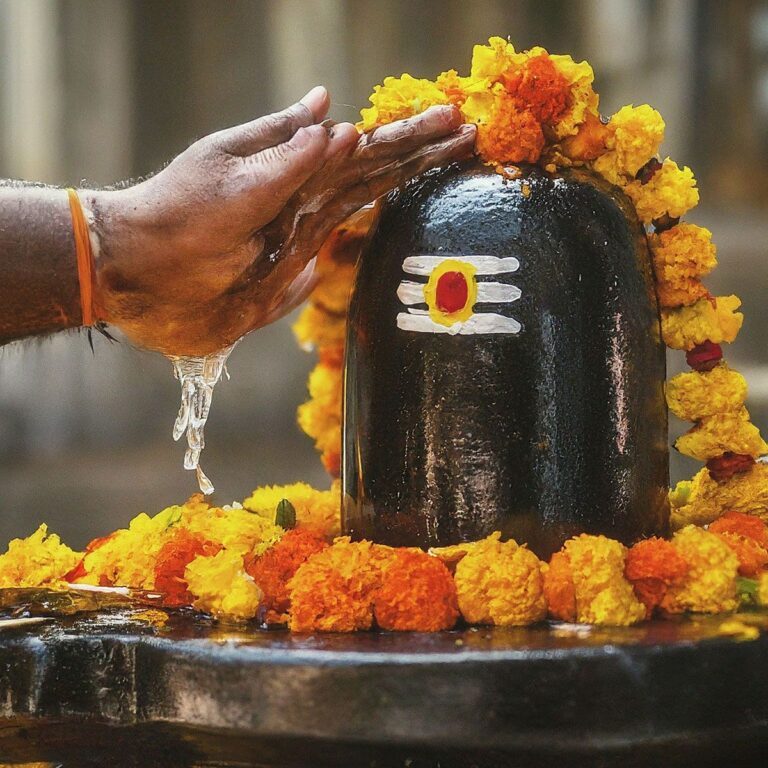
- Shiva Linga: Typically, Bilva (Bael) leaves are offered to Lord Shiva, while Tulsi is reserved for Vishnu. However, certain traditions permit offering Tulsi to Shiva under specific circumstances.
Complete Beginner’s Guide: How to Grow and Care for Tulsi
You do not need an agricultural degree to grow a thriving Tulsi plant at home. You only need to understand the fundamental growing requirements of this subtropical shrub.
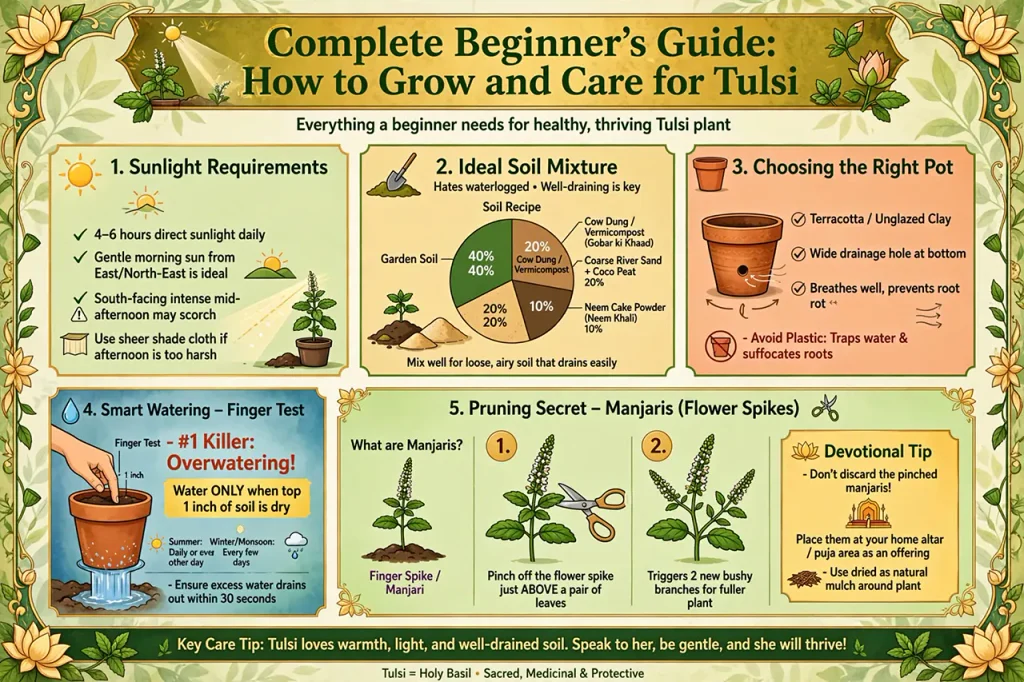
1. Sunlight Requirements
Tulsi loves warm, bright conditions:
- Provide 4 to 6 hours of direct outdoor sunlight every day.
- Gentle morning sunlight from an Eastern or North-Eastern exposure is ideal.
- If your plant is on a South-facing balcony during hot summer months, the intense mid-afternoon sun may scorch its leaves. If you see the tips wilting, place a sheer shade cloth over it during peak heat.
2. The Ideal Soil Mixture
Tulsi hates heavy, compacted, waterlogged mud. Its delicate, fine roots rot quickly in standing water.
Recommended Potting Recipe:
- 40% Regular garden soil
- 30% Well-rotted cow dung compost (gobar ki khaad) or vermicompost
- 20% Coarse river sand or coco peat (to ensure swift drainage)
- 10% Neem cake powder (neem khali—a natural root shield against soil bugs and fungi)
3. Choosing the Right Pot
Always select a container made of terracotta or unglazed clay with a wide drainage hole at the bottom. Clay breathes; it allows moisture to evaporate through the pot walls, preventing soggy conditions. Avoid unvented plastic pots that trap water and suffocate the roots.
4. Smart Watering: The “Finger Test”
The number one killer of household Tulsi plants is well-intentioned overwatering. Because family members often pour a glass of water into the pot as a devotional gesture every morning, the soil stays constantly waterlogged.
- The Golden Rule: Water only when the top 1 inch of soil feels dry to the touch.
- In hot summer months, water daily or every other day.
- During cool winters or wet monsoon seasons, reduce watering to once every few days.
- Ensure that excess water drains freely out of the bottom hole within 30 seconds of pouring.
5. Pruning and the Secret of “Manjaris”
Have you noticed your Tulsi plant growing tall, skinny, and bare at the bottom? This happens when the plant produces flower spikes (manjaris).
When Tulsi forms flowers and seeds, it assumes its life cycle is ending. It stops growing lush foliage and diverts its resources into seed production, causing the stem to turn hard and woody.
- What to do: Routinely pinch off the flowering spikes as soon as they appear!
- Use your fingers to snap the flower spike off right above a pair of leaves.
- This triggers dormant growth nodes below the cut, prompting the plant to sprout two bushy new branches in place of one. Your plant will stay green, bushy, and vibrant for years.
- Devotional Note: Do not discard the pinched manjaris; place them at the feet of your home altar or scatter them in the pot as mulch.
Read More >> Varalakshmi Vratham: Pooja Vidhanam, Vrat Katha & Pooja Items
What Should You Avoid Doing With a Tulsi Plant?
To help family members care for their plant, here is a practical checklist separating spiritual traditions from horticultural care mistakes.
What If the Tulsi Plant Dries Up? Emotional, Spiritual, and Practical Guidance
Few things cause more anxiety in a traditional home than waking up to find the family Tulsi plant completely dry, brittle, and brown. People often ask: “Is this a bad omen? Did our family do something wrong?”
Let us dispel fear and look at the situation with calm wisdom.
1. Removing Guilt and Fear
First, understand that Tulsi is a living botanical organism. Plants dry up for ordinary, natural reasons:
- A sudden winter cold snap or frost.
- Root rot caused by unintentional overwatering.
- An unnoticed infestation of tiny root nematodes or mealybugs.
- Natural aging: In a home pot, an individual Tulsi bush often completes its vigorous life cycle in 2 to 3 years.
In traditional folklore, elders often offer a comforting, positive perspective: if a Tulsi plant suddenly withers despite good care, it is believed that the plant willingly absorbed negative energies or illnesses that might otherwise have affected the household. There is never any need to panic or feel superstitious guilt.
2. Checking for Life: The “Scratch Test”
Before giving up on a seemingly dead plant, perform the scratch test:
- Take your thumbnail or a small coin and gently scratch the outer brown bark of the main stem, roughly 2 inches above the soil.
- If you see vibrant green underneath: The plant is still alive! It has merely dropped its leaves from shock or cold. Prune back dead branch tips, place it in warm sunlight, stop overwatering, and wait for fresh shoots to sprout.
- If the wood is brittle, dry, and pale brown all the way through: The plant has completed its earthly life.
3. How to Retire a Dried Tulsi Plant (Visarjan)
Just as holy images or worn scriptures are treated with dignity, a dried Tulsi plant is not tossed carelessly into a plastic garbage bag.
Traditional Retirement Steps:
- Gently loosen the soil around the pot and lift the dried plant out by its root ball.
- Immerse the plant in a clean, natural body of running water—such as a river, lake, or stream (Visarjan).
- If you live in a dense city without clean bodies of water nearby, simply bury the dried plant in clean garden soil or beneath a tree in a quiet park, allowing it to return naturally to the earth.
- Thoroughly wash the pot, let it dry in direct sunlight for two days to kill any lingering root fungus, replenish it with fresh potting soil, and welcome a new, healthy green sapling.





Religious Beliefs vs. Practical Facts About Tulsi: A Clear Comparison
To build deep, authentic trust, it helps to understand how cultural traditions, religious reverence, and botanical realities fit together.
Common Gardening Mistakes People Make With Tulsi
Even the most dedicated home gardeners can run into challenges with their Tulsi plants. Here are five practical issues and how to fix them quickly:
Key Takeaways
- A Living Altar: The Tulsi plant at home (Ocimum tenuiflorum) is revered as a sacred manifestation of Vrinda Devi, embodying pure devotion (Bhakti) and bringing auspiciousness to the household.
- Three Main Varieties: Rama Tulsi (bright green, sweet scent), Krishna Tulsi (purple-tinted, spicy aroma), and Vana Tulsi (large leaf, wild and hardy). Rama and Krishna are the most popular for home worship.
- Best Location: Place Tulsi outdoors in the North-East, East, or North areas of your balcony, terrace, or courtyard, where it can receive 4 to 6 hours of direct morning sunlight.
- Avoid Overwatering: Water only when the top inch of soil feels dry. Overwatering in poorly draining pots is the leading cause of Tulsi plants dying at home.
- Encourage Bushy Growth: Regularly pinch off the flowering seed spikes (manjaris) to keep the plant bushy, green, and vibrant for years.
- Respectful Care: Traditionally, leaves are not harvested after sunset, on Sundays, or on Ekadashi days. Harvest leaves with the pads of your fingers rather than snapping them with fingernails.
- No Reason to Panic: If a Tulsi plant dries up, check for green beneath the bark using the scratch test. If it has truly died, respectfully retire it into running water or bury it in clean soil, then plant a healthy new sapling with a calm heart.
Frequently Asked Questions About Tulsi at Home
1. Why is the Tulsi plant kept at home?
Tulsi is kept at home because she is revered as a sacred manifestation of devotion, purity, and spiritual protection. Traditionally regarded as an earthly expansion of Goddess Lakshmi and deeply beloved by Lord Vishnu, having Tulsi in the home sanctifies the living space, grounds the family in daily morning prayer, and brings a clean, uplifting fragrance to the domestic environment.
2. Which direction is best for keeping a Tulsi plant?
According to Vastu Shastra, the best direction for a Tulsi plant is the North-East (Ishan Kon), followed closely by the East and the North. These zones welcome the soft, nourishing morning sun and gentle cross-breezes, providing both positive energetic flow and ideal growing conditions for the plant.
3. Can Tulsi be grown indoors inside an apartment?
Tulsi should not be kept indoors permanently. It requires 4 to 6 hours of direct, open sunlight and fresh air circulation to survive. Without sunlight, indoor plants stretch, drop their leaves, and succumb to fungal root rot or spider mites. If you live in an apartment, grow Tulsi on an open balcony or sunny outer window ledge instead.
4. How often should I water my Tulsi plant?
Water your Tulsi plant only when the top inch of soil feels dry to the touch. Pouring water into the pot every single day out of routine often leads to waterlogged soil and root rot. During warm summers, daily watering may be necessary; in winters or monsoon seasons, watering once every few days is usually sufficient.
5. Why are Tulsi leaves not plucked on Sundays and Ekadashi?
In Hindu tradition, especially Vaishnava traditions, Sunday is considered a rest day for the plant, while Ekadashi is regarded as a sacred day on which Tulsi Devi observes her own fast in devotion to Lord Vishnu. To honor her rest and spiritual discipline, devotees avoid picking her leaves on these days, as well as during solar or lunar eclipses.
6. Can women worship Tulsi during their menstrual cycle?
Traditional household customs in many Indian families recommend taking a few days of rest from ritual offerings and direct plant worship during menstruation. However, practical care like checking soil moisture from a distance or admiring the plant with quiet devotion is never restricted. Practices vary widely across families, lineages, and modern households.
7. What should I do if my Tulsi plant dries up completely?
First, perform the scratch test: scrape the outer bark with your thumbnail. If there is green underneath, the plant is still alive; cut back the dead tips and give it warm sun. If the stem is completely dry and brittle, gently remove the plant and retire it into a flowing river or bury it respectfully in clean soil. Clean the pot thoroughly and plant a new sapling with a calm, devoted mind.
8. Is a drying Tulsi plant a bad omen?
No. A drying Tulsi plant is a botanical reality caused by ordinary factors like overwatering, sudden winter frost, aging, or root pests. In traditional belief, if a plant withers despite attentive care, it is thought to have absorbed negative influences on behalf of the family. There is no reason to feel fear or guilt.
9. Why do we pinch off the flower spikes (manjaris)?
Pinching off the flower spikes prevents the plant from spending all its energy on seed development. If left untouched, flowering causes the plant to become tall, woody, and drop its lower leaves. Trimming the spikes encourages the plant to branch out, staying lush, green, and bushy.
10. Which variety of Tulsi is best for home worship?
Both Rama Tulsi (bright green with a sweet, mild scent) and Krishna Tulsi (dark purple-green with a spicy aroma) are excellent for home courtyards and balconies. Rama Tulsi is slightly easier for beginners to maintain, while Krishna Tulsi is traditionally sought after for dedicated Vishnu and Krishna worship.
11. Can Tulsi leaves be swallowed or chewed?
Ayurvedic and cultural traditions recommend folding Tulsi leaves and swallowing them with fresh water, or brewing them into herbal teas, rather than chewing them aggressively. This traditional advice aligns with dental care: Tulsi leaves contain natural iron and compounds that can soften or stain tooth enamel if chewed repeatedly every day.
12. Why is Tulsi offered to Lord Vishnu but not to Lord Ganesha?
Scriptural legends from the Ganesha Purana describe an ancient past encounter where Lord Ganesha chose to maintain his ascetic vows rather than marry Tulsi. This led to a mutual pact where Tulsi leaves are generally omitted from Ganesha’s ritual offerings (except during Ganesh Chaturthi in specific regional customs), while remaining the supreme offering for Lord Vishnu.
13. What is Tulsi Vivah?
Tulsi Vivah is the ceremonial wedding of the sacred Tulsi plant to Lord Vishnu (often represented as the Shaligram stone or Lord Krishna). Celebrated in the lunar month of Kartika on or shortly after Prabodhini Ekadashi, it marks the end of the four-month monsoon rest period (Chaturmas) and inaugurates the annual Hindu wedding season.
14. What kind of pot is best for growing Tulsi?
A traditional terracotta or unglazed clay pot with at least one generous drainage hole at the bottom is best. Clay pots are porous, allowing air to reach the roots and excess moisture to evaporate safely through the pot walls. Avoid plastic pots whenever possible.
15. How do you protect a Tulsi plant during cold winters?
Tulsi is a subtropical plant that suffers when temperatures drop below 10°C (50°F). Protect your plant by moving the pot into a bright, sheltered corner of the balcony, reducing watering significantly, and loosely draping a light, breathable cotton cloth over the plant during cold winter nights.