
Why Do We Ring the Bell Before Entering a Temple? Shocking Truth
Why Do We Ring the Bell Before Entering a Temple? Picture yourself approaching a serene Hindu temple in India. As you remove your shoes, feel the cool floor stones, and move towards the towering door of the temple, you see a bright brass bell hanging from a thick wooden beam just above your head. As you enter the temple, you hold the bell in your hand and pull it vigorously with a strong ringing noise that reverberates in the air – TNNNNGGGG.

What purpose does it serve to ring a bell when approaching the temple? According to many Hindu practices related to the temples, ringing the bell, which is also known as ghanta, is regarded as a practice intended to prepare people for worship and entrance into a sacred space.
⚡ Quick Answer: Why Do We Ring the Bell Before Entering a Temple?
When you ring a temple bell, you are engaging in an ancient ritual designed to prepare your body, mind, and spirit for prayer.
- Marking the Transition: It signals that you are moving from the everyday outer world into a sacred space.
- Focusing the Mind: The sudden, resonant chime breaks your train of thought and clears away mental clutter.
- Auspicious Sound: Traditional interpretations regard the acoustic resonance as a holy, positive vibration.
- Divine Invocation: In Hindu ritual literature, sounding the bell formally invites divine presence while dispelling negative or distracting energy.
- Sacred Atmosphere: It forms a key part of worship (puja) and helps maintain a quiet, reverent environment.
This comprehensive article will explore the religious, symbolic, ritual, historical, and practical meanings behind the temple bell, answering every question you might have about this beautiful tradition.
Uncover the secret: Discover… Marleshwar Temple: Mystery, Cobras, Waterfall & Cave Shrine
What Is a Temple Bell Called in Hinduism?
In Hinduism, the ritual bell is known by its Sanskrit name, Ghanta (घण्टा). Etymologically and traditionally, the term refers to an object that produces a resonant sound meant to invoke divine forces.
While both words refer to bells, there is a clear distinction between a ghanta and a ghanti:
- Ghanta (घण्टा): Refers to the large, heavy bells hanging from temple ceilings, archways, and doorway beams. They are meant to be struck by devotees as they enter or during grand temple ceremonies.
- Ghanti (घण्टी): Refers to the smaller, handheld bell used by priests during rituals or by families at home during daily puja.
The ringing of bells in Hinduism is not considered just an act but also a sacred object (puja dravya). As part of the traditional temple ritual, before the actual worship starts, the priest conducts a brief blessing (Ghanta Puja) of the bell in recognition of its importance in creating a holy environment.

Why Do Hindus Ring the Bell Before Entering a Temple?
Asking yourself the question ‘why do we ring the bell before entering the temple?’, you will get the following answers.
1. To Prepare the Mind for Worship
Before entering the temple, the mind could have been preoccupied with all sorts of thoughts from the external world, such as work pressures, traffic, family conversations, or daily stressors.
- External: High mental noise, worries, constant chatter.
- Internal: Devotion, deep contemplation, vision (darshan) of the deity.
A single and resonant chime of the temple bells is an instrument for resetting your mind senses. The traditional interpretations of the bell include its use as a ritual reminder that allows you to release yourself of any thoughts from the outside and concentrate on the present.
2. To Announce or Mark the Devotee’s Arrival
There is one general belief prevalent throughout India that ringing the bell “announces” the devotee before the god. Even though the deities are omnipresent according to Hindu beliefs, the above mentioned view has a personal significance attached to it.
Ringing the bell helps the worshipper to have a proper protocol before entering the sanctum, just like knocking at the door before going into the house of an honored senior.
3. To Invite Divine Presence
According to Agamas and Tantras, sound is very important for evoking consciousness. According to traditional ritual manuals, the ringing of the bell can be termed as an invocation (Ahavana). The sound made by the bell starts the spiritual interaction.
4. To Dispel Negative or Inauspicious Influences
The Hindu scriptures describe the act of ringing a bell as one that wards off all negative thoughts and energies, such as lethargic energy (tamasic) and rakshasic or disturbing energy.
5. To Create an Auspicious Sound
There is an auspicious value attached to some sounds in Indian traditions (mangal dhwani). The vibrations produced by drums, shankhas, and bells uplift the human consciousness level. The act of ringing a bell provides a feeling of upliftment at the entrance of the temple.
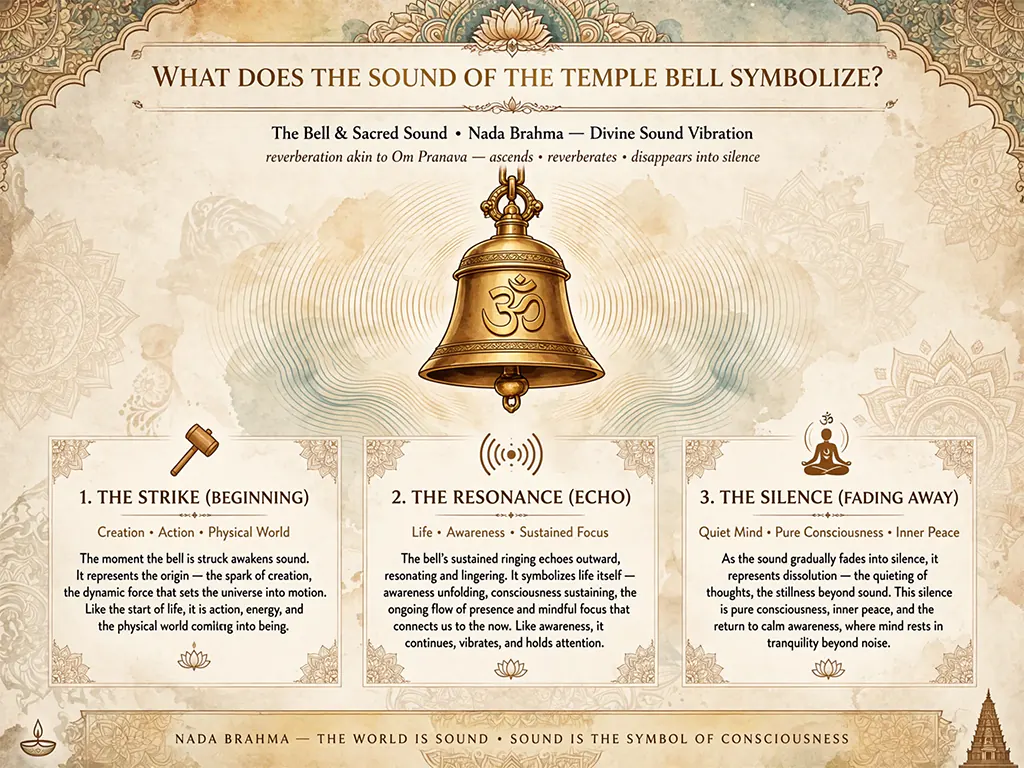
What Does the Sound of the Temple Bell Symbolize?
The Bell and Sacred Sound
Creation in Vedic philosophy starts with sound, that is, Nada Brahma, which translates to Divine Sound Vibration. The sounding bell has everything to do with this concept.
The traditional sources of information on the matter such as Hindupedia indicate that the reverberation created by the ringing of a bell is akin to that created by the sound Om, or Pranava. Like Om, it ascends, reverberates and then disappears into silence.
Sound as a Symbol of Consciousness
The bell’s sound can be understood in three distinct stages:
- The Strike (The Beginning): Represents creation, action, and the physical world.
- The Resonance (The Echo): Represents life, awareness, and sustained focus.
- The Silence (The Fading Away): Represents quiet mind, pure consciousness, and inner peace.
Why Resonance Matters Symbolically
A good bell made of either bronze or brass will make a sound that will continue to hum for some few seconds. In terms of meaning, this sound is meant to make you realize that after the sound there is silence.




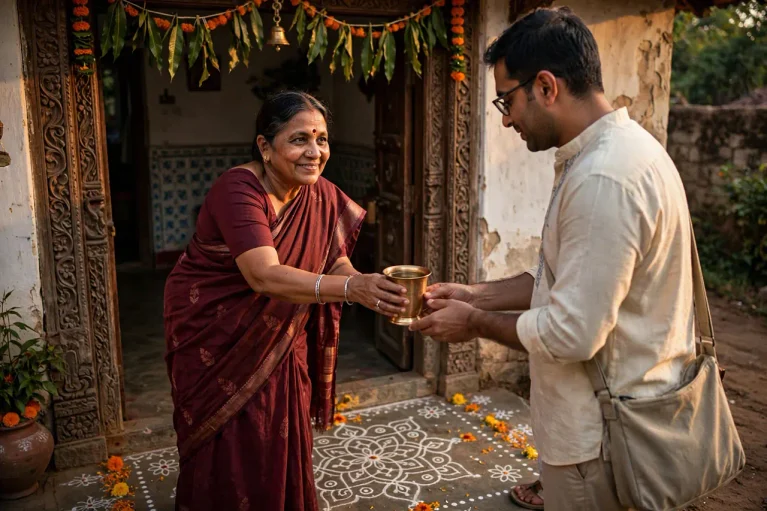

The Spiritual Meaning of the Temple Bell
Beyond simple rules, ringing the bell holds deep spiritual meaning for a devotee:
- A Reminder to Become Present: The bell brings you directly into the “here and now.” You cannot change the past or control the future, but you can be fully present for worship.
- Leaving Worldly Distractions Outside: Reaching up to strike the bell acts as a personal commitment: “I am leaving my ego, my status, and my daily worries outside this door.”
- Entering a Sacred Space With Awareness: It reminds you that a temple is not just a building, but a sanctuary dedicated to high values and quiet reflection.
- Focusing the Mind Before Darshan: Before you look at the deity’s image (darshan), the bell aligns your hearing, helping bring all your senses into balance.
- Sound as an Offering: Just as light (arati), flowers, and incense are offered, pure sound (dhwani) is presented as a devout gift.
Uncover the secret: Discover… Scriptural Mystery of Khatu Shyam Temple: Legend of 3 Arrows
Symbolism of Different Parts of the Ghanta
A ritual bell in the traditional sense is more than just a metallic object; it possesses symbolism through its physical structure. Even though interpretations may differ from one region to another, traditional references such as Hindupedia suggest certain associations:
| Bell Component | Traditional Symbolic Interpretation |
| Bell Body (Dome) | Symbolizes cosmic form, expanse, and the vessel of divine sound. |
| Clapper (Tongue) | Associated in some traditions with Saraswati (goddess of wisdom and speech). |
| Handle | Associated with Prana Shakti (vital energy) and divine figures like Garuda or Hanuman. |
| Sound (Dhwani) | Symbolizes Pranava (Om) and sacred sound energy. |
| Metal Alloy | Represents unity, balance, and the harmonizing of elements. |
Note: Symbolic interpretations vary across different regional traditions, Agamas, and texts.

Why Are Temple Bells Usually Placed at the Entrance?
The entrance of a temple is the boundary separating two worlds: the outer world of everyday life and the interior of silence.
In Indian architecture (Vastu Shastra and Agamic design), the door opening (Dwara) is an important boundary:
- Boundary Symbolism: Entering through the door is physically moving from outer action to inner peace.
- Mental Boundary: Banging the bell right at the entrance door prepares you mentally before stepping into the interior.
- Space Purification: Bang the bell at the boundary to create a welcoming ambience for all those entering.
Behind the tradition: Read about… Bande Mahakali Temple Bangalore
Is Ringing the Bell a Religious Requirement?
However, ringing of the temple bell is not a compulsory rule in all cases for every Hindu.
It is an existing ritual, but practices of worshipping differ significantly depending on different schools:
- Individual Worshipping: There are those who ring the bell always, and there are those who just bow their heads as they enter the temple.
- Temple-specific Traditions: In some quiet temples, in some meditative ashrams or certain ceremonies ringing of the bell is forbidden for silence preservation.
- Hours: When the deity is in his/her state of rest according to the symbolic practice (Nidra or Sayana Arati), it is inappropriate to ring big bells.
- Sampradaya differences: There are diverse traditions emphasizing either the habit of silent meditation (Manasa Puja) or sound-filled rituals.
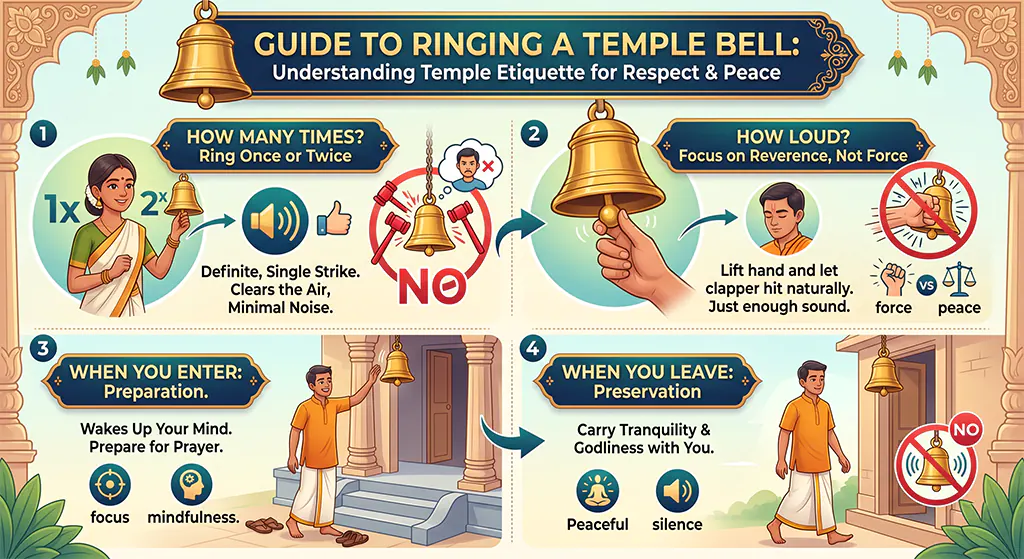
How Should You Ring a Temple Bell?
Understanding Temple Etiquette ensures that an atmosphere of respect prevails for all.
Ring Once or Twice?
It is common practice to ring the bell once or twice with a definite strike. This results in only one resounding ring that clears the air without making any extra noise. Repeated hammering or ringing of the bell can be disturbing for people meditating.
Should it be Loud?
The key lies in reverence, not in forcefulness. It’s sufficient to just raise the hand and allow the clapper to hit the metal bell with full force.
Should You Ring the Bell While Leaving?
It is a frequently asked question. According to convention, the entrance bell is not rung while leaving the temple.
- Entry: Ringing the bell will wake up your mind in preparation for the prayers.
- Exit: When you exit the temple, you carry the tranquility, silence, and aura of Godliness with you. Ringing the bell loudly at the time of exiting will spoil that calmness.







What Is the Scientific Reason Behind Ringing Temple Bells?
It is common to look for the scientific explanation for why temple bells ring. It becomes easier to distinguish between the science and religion behind it.
What We Can Say About Sound and Acoustics
- Auditory Attention: Highly defined acoustic tone immediately grabs your attention. The acoustic event disrupts any repetition of thoughts, allowing you to be here now.
- Sustained Resonance: Heavy metal bells made of brass or bronze create harmonics. Listening to an extended, fading tone makes you naturally concentrate in a moment of silence.
Popular Scientific Claims vs. Reality
There are many internet articles making general statements regarding the use of temple bells. It is important to understand what is traditionally believed to be true and what has been scientifically proven:
- Myth: “Temple bell sound kills airborne bacteria instantly.”
- Reality: Sound waves with high frequency can have some impact on microscopic organisms in laboratory settings, but temple bells do not sanitize the air.
- Myth: “The bell vibrates at a frequency which helps to balance left and right brain activity.”
- Reality: Even though listening to rhythmic sound can lower mental tension, there is no scientific evidence supporting that ringing the temple bell will achieve that effect.
- Myth: “The bell automatically opens all seven chakras.”
- Reality: Chakras belong to subtle body theories and are not physical organs.
Conclusion: Ringing the bell is more of a spiritual act than a scientifically-backed medical practice. Describing it as a spiritual act gives it the respect it deserves.
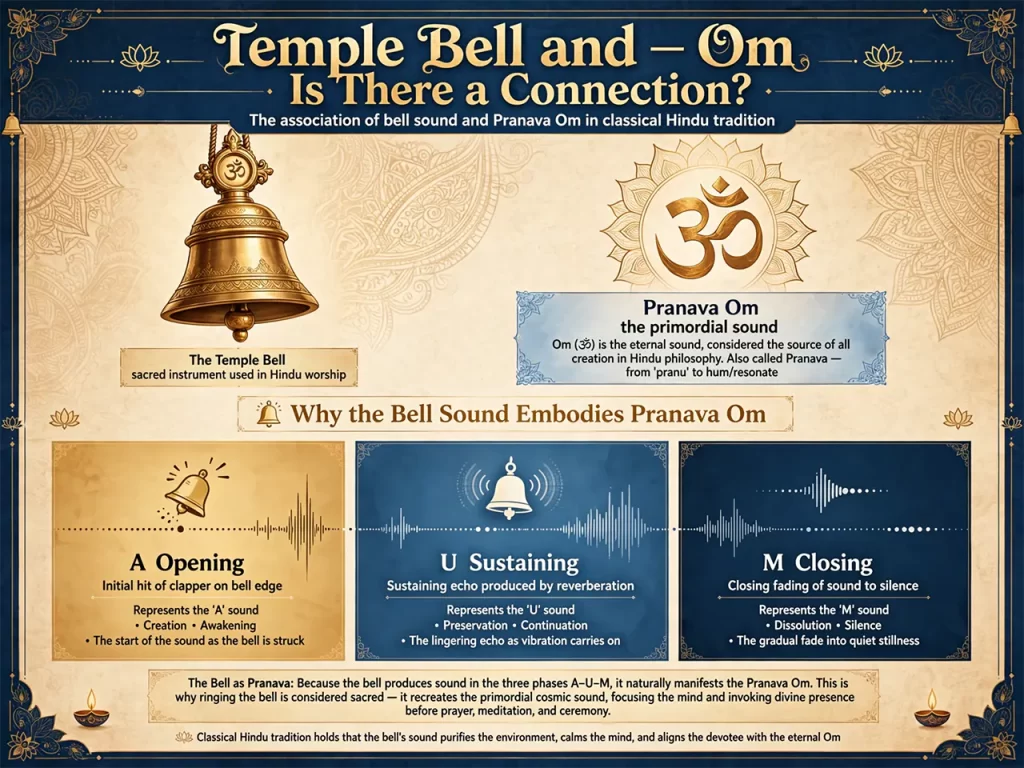
Temple Bell and Om — Is There a Connection?
Indeed, the association of the sound of a bell and Pranava (Om) is strongly established in classical Hindu tradition.
The bell sound is also created through a process involving three phases:
- A (Opening): The initial hit of the clapper on the bell’s edge.
- U (Sustaining): The echo produced by the reverberation.
- M (Closing): Fading of the sound to silence.
This correspondence explains why, in classical interpretation, the bell is regarded as an object used to create the sound of Pranava.
Behind the tradition: Read about… Mahaganapathi Temple Malleswaram
What Do Hindu Scriptures Say About the Temple Bell?
References to the ritual bell appear across Agamic literature, Puranic texts, and temple ritual manuals (Paddhatis).
The most famous Sanskrit verse recited while worshiping or ringing the bell comes from traditional Ghanta Puja liturgies:
आगमार्थं तु देवानां गमनार्थं तु रक्षसाम् ।
घण्टारवं करोम्यादौ देवताह्वान लाञ्छनम् ॥
Āgamārthaṁ tu devānāṁ gamanārthaṁ tu rakṣasām |
Ghaṇṭāravaṁ karomyādau devatāhvāna lāñchanam ||
Translation:
“I sound the bell at the start of worship as a mark of inviting divine forces (Devas) and dispelling disruptive or negative influences (Rakshasas).”
This ancient verse highlights the two main functions of the bell: invoking the sacred and clearing away negative influences.


History of Bells in Indian Temples
The history of bells in India dates back several centuries and is associated with metallurgy, architecture, and religion.
- Early Ritual Practices: Small bells and chimes are seen in early metal artifacts from South Asia.
- Architectural Advancements During the Medieval Period: With the rise of stone temples constructed during the Chola, Pallava, Chalukya, and Gupta dynasties, advanced methods of heavy casting from bronze and brass led to bells being permanently installed on temple gateways.
- Cultural Diversity in Practices Involving Bells: Bells are used not only by Hindus but also by Buddhists and Jains in their rituals using bells, gongs, and singing bowls.
Why are Temple Bells Made Out of Metals?
Temple bells are usually made out of traditional metals such as brass, bronze, or metal alloys (Panchaloha-a combination of five metals that include copper, zinc, tin, iron, silver/gold).
- Audible Sound: Iron and lead give out a dull sound, while brass and bronze have clear and resonant sounds.
- Durability: These temple bells have to endure thousands of hits per day without getting cracked for many years.
- Symbolism: According to Hindu religion, casting of metals into bells is symbolizing combining different natural forces into one piece.
Temple Bell Traditions Across India
Although the custom itself remains the same, the regional traditions in India depict the custom of bell as follows:
Temples in South India
Temple architecture in Tamil Nadu, Kerala, Karnataka and Andhra Pradesh include rows of bells installed at the entrance of the temples. During grand religious activities of the temples like Pujas and Abhishekam, priests use multi-layered bell chimes along with Nadaswaram or Chenda drums.
Temples in North India
Temple architecture in temples of Uttar Pradesh, Madhya Pradesh and Rajasthan includes bell structures that hang beneath the entrance archways (Torana). Devotees ring them along with chants of “Jai Mata Di” or “Hara Hara Mahadev”.
Maharashtra and Western India
During evening Aarti performed in temples of Maharashtra, devotees ring bells rhythmically along with drums and singing Abhangs.
Temples in Eastern India
Ghanti or small bells are used along with Shankha or conch shell and Dhak or traditional drums in Durga Puja and Kali Puja of Bengal, Odisha and Assam.





Temple Bell vs Puja Bell at Home
While temple bells and home bells serve similar purposes, their size and use differ:
| Feature | Temple Bell (Ghanta) | Home Puja Bell (Ghanti) |
| Size | Large, heavy, permanently hung overhead. | Small, lightweight, handheld. |
| Primary User | Devotees entering the temple; priests. | Family members during daily prayers. |
| Usage | Struck once or twice at the threshold. | Held in the left hand and rung continuously. |
| Symbolism | Marks the entry into a large sacred space. | Sets a prayerful mood in the home shrine. |
Why do priests ring bells during Aarti?
Have you ever participated in the evening Aarti ceremony at a temple? Then you must be aware that the experience is full of visual and audio effects – lighting of lamps, burning of incense sticks, mantras, and bells ringing throughout the ceremony.
The priest rings the hand bell (Ghanti) continuously with the left hand, while holding the lamp (Aarti) in his right hand. Why?
- Multisensory Experience: Sight, smell, and sound are engaged through which you keep your complete attention devoted to the worship ceremony.
- Energy for Worship: Continuous sound of the bell keeps the rhythm going and enables the chanting of mantras.
- Sound Offering to the God: The sound itself is offered as worship.
Is Ringing a Temple Bell the Same in Every Hindu Tradition?
No. The Hindu religion has different Sampradaya traditions, practices, and rituals.
- Agamic Temples: Rituals have to strictly be according to the traditional manuals (Agamas), where bell ringing is done in a set pattern.
- Bhakti & Bhajan Sampradayas: Singing devotionals songs is the prime focus, and here bells are used along with finger cymbals for rhythm.
- Meditative & Vedanta Ashrams: Prioritize silence and inner meditation (Dhyana), using bells minimally or not at all.
Common Myths About Temple Bells
Myth 1: “You must ring the bell exactly three times.”
- Reality: There is no universal scriptural rule specifying three strikes. Striking it once or twice with care is completely standard.
Myth 2: “The bell removes all negative energy scientifically.”
- Reality: Dispelling negative energy is a spiritual belief and ritual metaphor, not an established laboratory fact.
Myth 3: “Every temple bell must contain seven metals.”
- Reality: While multi-metal alloys (Panchaloha) are traditionally respected, many temple bells are made simply of high-quality brass or bronze.
Myth 4: “Ringing the bell is only done to wake up the deity.”
- Reality: Deities are not thought to be sleeping in a physical sense. Ringing the bell is meant to wake up the devotee’s own awareness.
Myth 5: “You should ring the bell as loudly as possible.”
- Reality: Mindfulness and reverence are far more important than volume.
What Should You Do Before Entering a Hindu Temple?
This action alone constitutes part of the ritual of temple tradition etiquette:
- Removing Footwear: Place your footwear at the door as a gesture of purity and humbleness.
- Washing Hands and Feet: Many traditional temples have taps installed by the entrance for washing purposes.
- Dressing Properly: Dress in clean and decent attire that befits the place of worship.
- Belling Gently and Vigorously: Go ahead, ring the bell once or twice and listen to it slowly fading away.
- Crossing the Entrance Gracefully: Cross the entrance with awareness, leaving all your problems behind.
- Approaching for Darshan: Approach the inner shrine with a peaceful mindset.
Frequently Asked Questions
1. Why do we ring the bell before entering a temple?
We ring the bell in order to center our minds, shift into a sacred place, create a good sound, and observe the ancient traditions of Hinduism.
2. What is a Hindu temple bell called?
The temple bell in Sanskrit is called Ghanta. The small hand bells which are used during prayers are referred to as Ghanti.
3. What is the spiritual meaning of a temple bell?
It serves as a symbol for shifting your concentration inwards, putting aside all of the materialistic preoccupations and immersing yourself into the present.
4. Why are bells placed at temple entrances?
They are located right at the entry threshold to show the shift from the outer world to the inner sacred place.
5. Is ringing the temple bell compulsory?
No, it is an old tradition, not something obligatory. The personal practice can vary depending on traditions.
6. Should we ring the bell once or multiple times?
Ringing the bell once or twice is common courtesy.
7. Is there a scientific reason for ringing temple bells?
From an acoustical standpoint, a clear sound helps to focus the attention of humans. The scientific theories about killing bacteria or affecting the brain waves are questionable.
8. Does the temple bell represent Om?
Yes, the tradition says that the bell strike, resonance, and silence have resemblance to the holy sound Om (Pranava).
9. Why do priests ring bells during puja?
Priests sound the hand-bell (Ghanti) during the puja and aarti as part of the sacred sound offering and also for maintaining momentum and building an inspiring atmosphere.
10. Why are temple bells made of metal?
Metals such as brass and bronze have good acoustic resonant qualities and can withstand years of regular use.
11. Can we ring the temple bell while leaving?
In accordance with the traditions, it is inappropriate to ring the doorbell when leaving because one wants to take the peaceful ambience of the temple along.
12. What does Ghanta mean in Sanskrit?
The term Ghanta means “a bell or an acoustic instrument that creates auspicious sound in rituals.”
13. Is ringing a temple bell mentioned in Hindu scriptures?
Yes, ritual manuals (Agamas) have stanzas on the bell, for example, Ghanta Puja Sloka (“Agamartham tu devanam…”).
Conclusion
The next time you go to a Hindu temple and try to pull the bell made of brass, take a moment to pause. Listen to the ringing of the bell, as it reverberates within the hall and then dies away.
Pulling the bell is an exercise not only of routine but a means of stepping into the realm of peace of mind and freeing yourself of worries.